
South Korea Makeup Market Size by Product Type, Category, Ingredient Type, Consumer Group and Application.
Overview
The South Korea Makeup Market is valued at USD 3.1 billion in 2025 and is projected to reach USD 5.4 billion by 2032, growing at a CAGR of 8.2%. Growth is driven by K-beauty trends, rising demand for premium and innovative cosmetics, social media influence, e-commerce expansion, and increasing adoption of makeup among younger consumers.
South Korea Makeup Market Definition
The South Korea Makeup Market comprises cosmetic products used to enhance, define, and improve facial and nail appearance. It includes face makeup, eye makeup, lip makeup, and nail makeup, such as foundation, concealer, powder, blush, eyeliner, eyeshadow, mascara, lipstick, lip gloss, and nail polish.

The market covers the manufacturing, distribution, retail, and online sale of makeup products across South Korea. Demand is supported by beauty-conscious consumers, product innovation, K-beauty trends, social media influence, and growing interest in premium, multifunctional, natural, and skincare-infused makeup products.
| Parameter | Value |
| Market Size (Base Year) | USD 3.1 Billion |
| Forecast Market Size (2032) | USD 5.4 Billion |
| CAGR (2026–2032) | 8.2% |
| Base Year | 2025 |
| Forecast Period | 2026–2032 |
| Historical Period | 2020–2025 |
| Key Growth Opportunity | AI-powered beauty & premium cosmetics |
South Korea Makeup Market Overview
The South Korea Makeup Market represents a highly innovative segment of the beauty and personal care industry, driven by strong beauty consciousness, K-beauty influence, product innovation, premiumization, and rapid digital adoption. South Korea Makeup Market Analysis indicates increasing demand for premium, multifunctional, skincare-infused, and trend-driven makeup products as consumers actively engage with social media, beauty influencers, livestream commerce, and online beauty communities. The South Korea Makeup Market Size is supported by sophisticated retail infrastructure, strong e-commerce penetration, specialty beauty stores, and direct-to-consumer channels. Continuous innovation in formulations, textures, packaging, personalized beauty solutions, and clean beauty products is strengthening South Korea Makeup Market Growth and shaping the long-term South Korea Makeup Market Outlook.
The South Korea Makeup Market Report provides insights into market size, forecasts, segmentation, consumer preferences, distribution channels, competitive dynamics, market trends, and growth opportunities. The analysis covers product categories, price segments, consumer groups, and distribution channels, while examining purchasing behavior, K-beauty trends, premiumization, social commerce, clean beauty, and skincare-makeup convergence. The report also evaluates key players such as Amorepacific, LG H&H, L'Oréal, and Estée Lauder, alongside competitive positioning, strategic initiatives, regulatory factors, market challenges, and emerging opportunities. These insights help manufacturers, investors, retailers, distributors, and new entrants identify high-growth segments, assess competitive risks, and develop informed market expansion and investment strategies.
South Korea Makeup Market Share and Growth Analysis
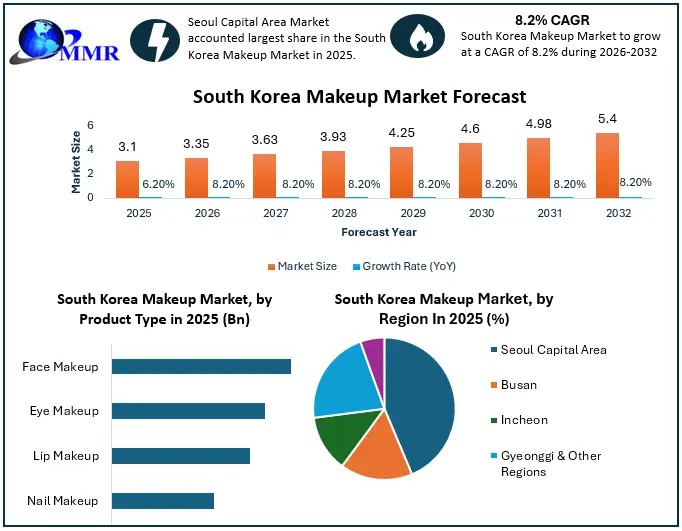
To know about the Research Methodology :- Request Free Sample Report
South Korea Makeup Historical Market Size (2020–2025)
| Year | Market Size | Growth Rate (YoY) |
| 2020 | USD 2.29 Bn | 3.8% |
| 2021 | USD 2.47 Bn | 8.0% |
| 2022 | USD 2.64 Bn | 6.9% |
| 2023 | USD 2.81 Bn | 6.5% |
| 2024 | USD 2.92 Bn | 3.7% |
| 2025 | USD 3.10 Bn | 6.2% |
South Korea Makeup Market Size Forecast (2026–2032)
| Year | Market Size | Growth Rate (YoY) |
| 2026 | USD 3.35 Bn | 8.2% |
| 2027 | USD 3.63 Bn | 8.2% |
| 2028 | USD 3.93 Bn | 8.2% |
| 2029 | USD 4.25 Bn | 8.2% |
| 2030 | USD 4.60 Bn | 8.2% |
| 2031 | USD 4.98 Bn | 8.2% |
| 2032 | USD 5.4 Bn | 8.2% |
South Korea Makeup Market Key Highlights
• Market Size (2025): The South Korea Makeup Market reaches USD 3.1 billion, indicating strong demand.
• Market Size (2032): The market is projected to reach USD 5.4 billion, reflecting continued expansion.
• CAGR (2026–2032): The market grows at an 8.2% CAGR, supported by rising beauty consumption.
• Dominant Product: Face Makeup leads with a 38.6% share, driven by everyday makeup demand.
• Fastest-Growing Product: Eye Makeup records strong growth, particularly among younger consumers.
• Dominant Distribution: Offline Retail accounts for 58.4%, supported by in-store product trials.
• Key Innovation Trend: AI Beauty and AR Try-On gain rapid adoption through personalized and virtual beauty experiences.
South Korea Makeup Market Consumer Insights & Demand Analysis
| Consumer Dimension | Key Insights | Market Implication |
| Beauty Awareness | Extremely high beauty consciousness among Korean consumers | Supports frequent purchase behavior and premium positioning |
| Price Sensitivity | Bifurcation between premium K-beauty seekers and value buyers | Dual-tier product strategy required |
| Demand Patterns | Rising consumption of innovative formulations among urban demographics | Rapid product launch cycles essential |
| Sustainability | Growing preference for vegan, cruelty-free, and eco-certified products | Clean beauty premium gaining market share |
| Digital Behavior | Social media, K-pop, and beauty influencers dominate purchase decisions | Digital-first and DTC strategy essential |
South Korea Makeup Market Dynamics
South Korea Makeup Market Drivers
• Global popularity of K-beauty and Korean entertainment driving international demand for South Korean cosmetic products
• Strong cosmetics export growth and international brand expansion into North America, Southeast Asia, and Europe
• Increasing consumer demand for multifunctional beauty products combining makeup and skincare benefits
South Korea Makeup Market Restraints
• Intense domestic competition among established conglomerates and emerging indie brands
• Rapid changes in consumer trends requiring extremely short product development and launch cycles
• High dependency on export markets increasing vulnerability to geopolitical and trade disruptions
South Korea Makeup Market Opportunities
• Beauty-tech integration through AI-powered skin analysis and personalized product recommendation platforms
• Men's grooming and gender-neutral makeup products representing a fast-growing underserved segment
• Sustainable, vegan, and cruelty-free cosmetics responding to rising global clean beauty demand
• Expansion into emerging international markets including the Middle East, Latin America, and Africa
South Korea Makeup Market Challenges
• Regulatory complexities and varying compliance requirements across diverse export destination markets
• Short product life cycles creating pressure on R&D investment and inventory management
• High innovation pressure among manufacturers to sustain consumer interest and competitive relevance
South Korea Makeup Market Segment Analysis
South Korea Makeup Market, by Product
The South Korea makeup market is segmented into Face Makeup, Lip Makeup, Eye Makeup, Nail Makeup, and Other Makeup Products. Face makeup holds a strong position, supported by demand for cushion foundations, BB creams, concealers, and complexion products. Lip and nail makeup are among the faster-growing categories, driven by changing beauty trends, product innovation, and demand for convenient, long-lasting formats.
South Korea Makeup Market, by Distribution Channel
The market includes Health & Beauty Stores, Specialty Beauty Stores, Department Stores, Supermarkets & Hypermarkets, Pharmacies & Drugstores, and Online/E-Commerce. Health and beauty stores remain a major channel, supported by extensive specialty retail networks, while online retail is expanding rapidly through mobile shopping, live commerce, influencer marketing, and personalized digital beauty experiences.

South Korea Makeup Market Regional Analysis
| Region | Market Share | Key Demand Drivers & Trends |
| Seoul Capital Area | 46.2% | Largest market, high concentration of beauty brands and flagship stores, premium consumer base, K-beauty trends, strong e-commerce and social-commerce adoption |
| Busan | 17.4% | Tourism-driven demand, premium beauty retail, strong consumer spending, expanding shopping districts, growing demand for Korean beauty products |
| Incheon | 13.6% | Airport and duty-free beauty retail, international tourism, expanding retail infrastructure, premium cosmetics demand |
| Gyeonggi & Other Regions | 22.8% | Emerging consumption, expanding beauty retail infrastructure, rising e-commerce penetration, younger consumer base, increasing beauty spending |
South Korea Makeup Market Competitive Landscape
The South Korea Makeup Market is highly competitive, with leading domestic beauty companies, specialized cosmetics brands, international players, and emerging niche brands competing through product innovation, quality, brand reputation, pricing, and extensive distribution networks. Domestic companies benefit from strong consumer loyalty, advanced formulation capabilities, established beauty expertise, and deep understanding of local beauty trends, while international brands compete through premium offerings, global brand recognition, and trend-driven product launches. Key players include Amorepacific Corporation, LG Household & Health Care, Clio Cosmetics, Able C&C, Aekyung Industrial, Espoir, L'Oréal Korea, and Estée Lauder Companies.
Competition is increasingly shaped by K-beauty trends, premiumization, skincare-infused makeup, clean formulations, digital commerce, and influencer marketing. Manufacturers are introducing lightweight textures, long-lasting formulations, multifunctional products, and innovative shades to meet evolving consumer preferences. Social media and e-commerce are accelerating product discovery, while emerging brands compete through affordable pricing, distinctive packaging, viral products, and rapid trend adoption. Overall, product innovation, brand strength, affordability, digital engagement, localized beauty trends, and omnichannel distribution remain key factors shaping competitive dynamics in South Korea's makeup
South Korea Makeup Market Key Players & Benchmarking
| Company | Headquarters | Product Type | Market Position | Revenue (Est.) |
| Amorepacific Corporation | Seoul, South Korea | Face, Lip, Eye | Market Leader | ~KRW 4.7 Tn |
| LG Household & Health Care | Seoul, South Korea | Face, Lip, Eye, Base | Major Player | ~KRW 6.3 Tn* |
| Clio Cosmetics | Seoul, South Korea | Eye, Lip, Face | Fast-Growing Player | ~KRW 360 Bn |
| Able C&C | Seoul, South Korea | Face, Lip, Eye, Base | Established Player | ~KRW 130 Bn |
| Aekyung Industrial | Seoul, South Korea | Face, Lip, Eye, Base | Major Player | ~KRW 680 Bn* |
| Espoir | Seoul, South Korea | Face, Lip, Eye, Base | Premium/Trend-Focused Player | Part of Amorepacific |
| L'Oréal Korea | Seoul, South Korea | Face, Lip, Eye, Base | International Major Player | Private |
| Estée Lauder Companies | New York, USA | Face, Lip, Eye, Base | Premium International Player | ~USD 14.3 Bn* |
South Korea Makeup Market Technology & Innovation Trends
| Innovation Area | Current Trend | Market Impact |
| AI Beauty | Personalized skin analysis and makeup recommendations | Increased customer retention and brand loyalty |
| AR Try-On | Virtual makeup testing via smartphone and web | Improved online conversion rates |
| Smart Cosmetics | Integrated makeup and skincare formulations | Premium product growth and margin expansion |
| Sustainable Packaging | Refillable containers and eco-friendly materials | ESG alignment and consumer preference satisfaction |
| Beauty Devices | Home-use LED and treatment devices | New revenue streams and category expansion |
South Korea Makeup Market Regulatory Framework
The South Korean cosmetics market is regulated by the Ministry of Food and Drug Safety (MFDS). Regulations cover product safety, ingredient approval, labelling requirements, import and export procedures, and consumer protection standards. The Cosmetics Act governs the classification of cosmetics, functional cosmetics, and quasi-drugs, with functional cosmetics (including sun protection, whitening, and anti-wrinkle products) subject to separate registration requirements. Compliance with international standards including ISO and ASEAN Cosmetics Directive requirements remains essential due to growing exports.
South Korea Makeup Market Strategic Insights
Why does this market deserve investor attention?
South Korea occupies a global leadership position in beauty innovation. Strong export capabilities, premium beauty demand, continuous technological advancement, and the global appeal of K-beauty create compelling long-term growth potential for domestic and international investors.
What are the key growth drivers and momentum?
Growth is supported by increasing per-capita beauty expenditure, rising demand for personalized cosmetics, expansion of e-commerce and social commerce channels, and the continued international popularity of K-beauty products and Korean entertainment culture.
What regional factors shape demand?
Within South Korea, demand is highest in Seoul and its metropolitan area due to concentration of flagship beauty retail, high consumer spending, and strong beauty culture. Busan, Incheon, and Gyeonggi Province represent secondary markets with significant growth potential, while emerging regions offer longer-term upside.
How strong is innovation and competition?
Innovation intensity is extremely high, with leading companies investing in AI beauty platforms, sustainable formulations, biotechnology-derived ingredients, and next-generation packaging. Competition is fierce among both domestic giants and fast-growing indie brands, creating opportunities for differentiated players with superior technology or trend-responsive capabilities.
Where are the biggest future opportunities?
The largest future opportunities lie in premium and luxury makeup segments, AI-powered beauty personalization, men's cosmetics, sustainable and vegan product lines, and international market expansion, particularly in Southeast Asia, North America, and the Middle East.
South Korea Makeup Market Investor Takeaway
South Korea's makeup market offers a strong investment proposition combining a dynamic domestic market growing at 8.2% CAGR through 2032 with world-leading export capabilities and global K-beauty brand equity. South Korea's first-mover advantage in beauty technology, deep talent pool in cosmetic science, and established manufacturing infrastructure create a uniquely advantaged competitive position. Investment in Korean beauty brands, beauty technology platforms, and sustainable cosmetics manufacturing represents both domestic market capture and access to rapidly growing global K-beauty demand.
South Korea Makeup Market Scope: Inquire before buying
| Global Market | |||
|---|---|---|---|
| Report Coverage | Details | ||
| Base Year: | 2025 | Forecast Period: | 2026-2032 |
| Historical Data: | 2020 to 2025 | Market Size in 2025: | USD 3.1 Bn. |
| Forecast Period 2026 to 2032 CAGR: | 8.2% | Market Size in 2032: | USD 5.4 Bn. |
| Segments Covered: | by Product Type | Face Makeup Lip Makeup Eye Makeup Nail Makeup and Other |
|
| by Category | Mass Market Products Premium Products Luxury Products Professional Makeup Products |
||
| by Ingredient Type | Conventional Products Natural Products Organic Products Vegan Products Cruelty-Free Products |
||
| by Distribution Channel | Supermarkets / Hypermarkets Specialty Beauty Stores Pharmacies & Drugstores Brand-Owned Stores Online Retail / E-Commerce Direct Selling |
||
| by Consumer Group | Women Men Gender-Neutral Consumers |
||
| by Application | Daily Wear Professional Use Social Events Festivals & Celebrations Bridal Makeup, and Special Occasions |
||
Frequently Asked Questions (FAQs)
1. What is the size of South Korea’s makeup market?
The South Korea makeup market was valued at approximately USD 3.1 Billion in 2025 and is projected to reach USD 5.4 Billion by 2032, growing at a CAGR of 8.2% during the forecast period.
2. What is driving growth in South Korea’s makeup market?
Growth is driven by K-beauty trends, rising demand for premium and innovative cosmetics, social media influence, e-commerce expansion, and increasing adoption of makeup among younger consumers.
3. How is the South Korea makeup market regulated?
The South Korean cosmetics market is regulated by the Ministry of Food and Drug Safety (MFDS) under the Cosmetics Act. Functional cosmetics including sun protection, whitening, and anti-wrinkle products require separate registration and clinical substantiation.
4. Which product type dominates the South Korea makeup market?
Face Makeup dominates the South Korea Makeup Market, accounting for approximately 40.8% market share. Demand is driven by strong adoption of cushion foundations, BB/CC creams, foundations, and concealers. Consumers increasingly prefer lightweight, natural-looking, and multifunctional complexion products, supporting continued growth in the segment.
5. Who are the key companies in South Korea’s makeup market?
Major players include Amorepacific Corporation, LG Household & Health Care, Clio Cosmetics, Able C&C, Aekyung Industrial, Espoir, L'Oréal Korea, and Estée Lauder Companies.