India Eyewear Market by Product Type, Spectacle Lens Type, Frame Material, Frame Type, Spectacle Lens Material, Price Range, Consumer Group and Distribution Channel – Forecast to 2034

8.5%
CAGR (2026-2034)
11.09 USD Bn.
Forecast Market Size
193
Report Pages
45
Market Tables

Overview

The India Eyewear Market was valued at USD 11.09 Billion in 2025 and is projected to reach USD 23.11Billion by 2034, growing at a CAGR of 8.5% during the forecast period 2026–2034.

India Eyewear Market Overview

Eyewear are used for protection, fashion and to improve visuals. As Indian market is concerned their are many factors, that are driving the Indian market. As per Ministry of Health and Family welfare data 11.90% Bn population are affected with myopia, raised geriatric  population in India  due to reduced birth and fertility rates, increased use of electronics gadget in youths, dust and pollution, raise in the use of sunglasses as trend of fashion, economy conditions, awareness regarding healthcare, improved living standards, are the main reason India seals 1.2 Billion eyeware.  Increased advancements of the technologies, raised trend of the smart wearable eyewear, and rising the investments into R&D.

  India Eyewear Market Growth and Analysis
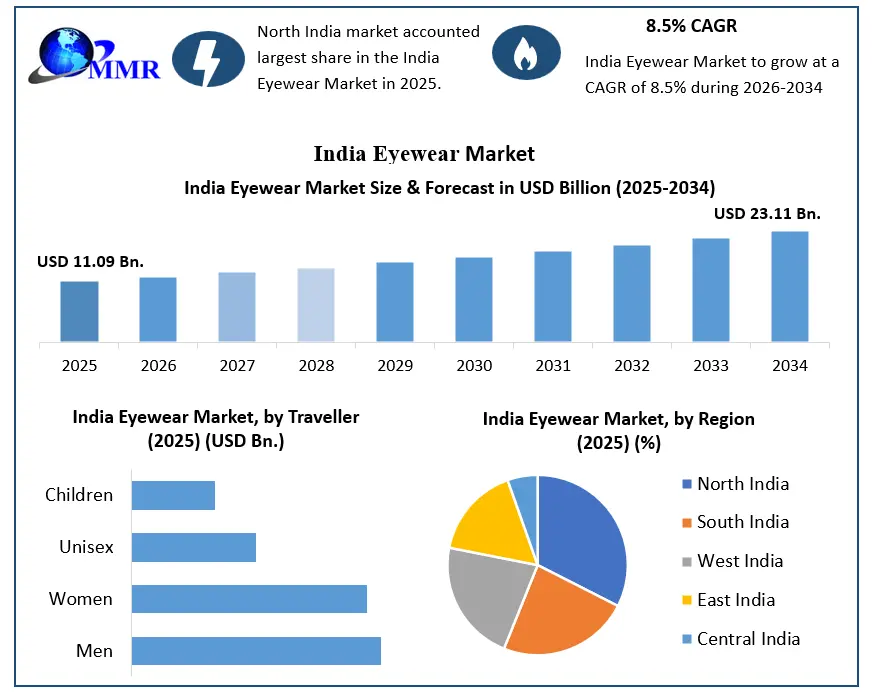
India Eyewear Growth OutlookTo know about the Research Methodology:-Request Free Sample Report

India Eyewear Market Segment Analysis

India Eyewear Market, by Frame Type

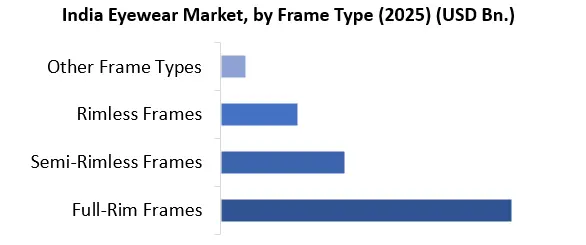
In the India Eyewear Market, the Full-Rim Frames segment holds a dominant position due to increasing demand for durable prescription eyeglasses, fashionable optical frames, affordable spectacles, and everyday vision correction products. The Semi-Rimless Frames segment attracts consumers seeking lightweight eyewear, professional styling, and comfortable spectacle designs. The Rimless Frames segment benefits from growing demand for minimalist eyewear, premium optical frames, and lightweight prescription glasses among urban consumers. Meanwhile, the Other Frame Types segment includes specialty, flexible, and customized eyewear designs that address evolving consumer preferences. Rising digital screen exposure, increasing awareness of eye health, expanding optical retail networks, and growing demand for branded eyewear support growth across the Indian eyewear industry.
India Eyewear by Frame TypeIndia Eyewear Market, by Price Range

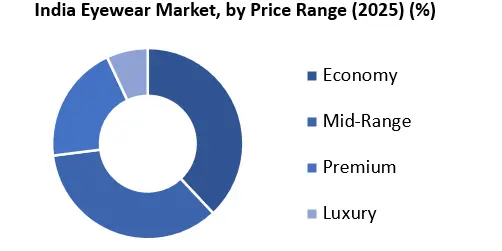
In the India Eyewear Market, the Economy segment holds a significant position due to strong demand for affordable spectacles, budget-friendly optical frames, and cost-effective prescription eyewear among price-sensitive consumers. The Mid-Range segment benefits from increasing disposable income, growing demand for branded eyeglasses, stylish optical frames, and durable eyewear products. The Premium segment attracts urban consumers seeking designer eyewear, lightweight frames, advanced lens technologies, and high-quality vision correction solutions. Meanwhile, the Luxury segment caters to consumers seeking exclusive designer spectacles, luxury eyewear brands, premium materials, and customized optical products. Expanding organized optical retail, increasing fashion consciousness, and growing online eyewear sales support growth across the India eyewear industry.
India Eyewear by Price Range

India Eyewear Market Regional Insights

North India  hold the largest share of sunglasses market and also estimated to hold market during the forecast period. Delhi is expected to hold the largest share of the market in forecast period as a fashion trend is huge in Delhi city. Rising demand for eye protection, increase in demand for vision correction spectacles, and rising demands for international brands in India. Increasing usage of digital gadgets among the youth population will increase the need for vision correction spectacles and contact lenses. Key player’s studies, analyzed, profiled and benchmarked in eyewear market are Essilor, GKB High Tech, Carl Zeiss, Hoya, Ray-Ban, Maui Jim, Silk lens, Oakley, Sparkle, Biomedic 55, Alcon, Vintage, Vogue, and Vision Rx.

The objective of the report is to present comprehensive analysis of India Eyewear Market including all the stakeholders of the industry. The past and current status of the industry with forecasted market size and trends are presented in the report with the analysis of complicated data in simple language. The report covers all the aspects of industry with dedicated study of key players that includes market leaders, followers and new entrants by region. PORTER, SVOR, PESTEL analysis with the potential impact of micro-economic factors by region on the market have been presented in the report. External as well as internal factors that are supposed to affect the business positively or negatively have been analyzed, which will give clear futuristic view of the industry to the decision makers.

The report also helps in understanding India Eyewear Market dynamics, structure by analyzing the market segments, and project the India Eyewear Market size. Clear representation of competitive analysis of key players by India Eyewear Type, price, financial position, product portfolio, growth strategies, and regional presence in the India Eyewear Market make the report investor’s guide.

Eyewear Market Scope: Inquire before buying

India Eyewear Market
Report Coverage Details
Base Year: 2025 Forecast Period: 2026-2034
Historical Data: 2020 to 2025 Market Size in 2025: USD 11.09 Bn.
Forecast Period 2026 to 2034 CAGR: 8.5 % Market Size in 2034: USD 23.11 Bn.
Segments Covered: by Product Type Spectacles / Eyeglasses
Prescription Spectacles
Non-Prescription / Fashion Spectacles
Sunglasses
Non-Prescription Sunglasses
Prescription Sunglasses
Contact Lenses
Smart Eyewear
by Spectacle Lens Type Single-Vision Lenses
Bifocal Lenses
Progressive Lenses
Other Multifocal Lenses
Plano / Non-Prescription Lenses
by Frame Material Plastic & Acetate Frames
Metal Frames
Stainless Steel Frames
Titanium Frames
Other Metal Frames
Mixed-Material / Combination Frames
Others
by Frame Type Full-Rim Frames
Semi-Rimless Frames
Rimless Frames
Other Frame Types
by Spectacle Lens Material Standard Plastic / CR-39 Lenses
Polycarbonate Lenses
High-Index Plastic Lenses
Trivex & Other Specialty Polymer Lenses
Glass Lenses
by Price Range Economy
Mid-Range
Premium
Luxury
by Consumer Group Men
Women
Children
Unisex
by Distribution Channel Offline Retail
Independent Optical Stores
Optical Retail Chains
Brand-Owned Exclusive Stores
Department Stores & General Retail
Other Offline Channels
Online Retail
Brand-Owned Websites & Apps
Online Optical Retailers
E-Commerce Marketplaces
Other Online Channels

Key Players, India Eyewear Market

  1. Lenskart Solutions Limited
  2. Titan Company Limited (Titan Eye+)
  3. Specsmakers Opticians
  4. ClearDekho
  5. GKB Opticals
  6. Himalaya Optical
  7. Lawrence & Mayo
  8. Vision Express India
  9. Gangar Eyenation
  10. Ben Franklin Opticians
  11. Optorium
  12. GEM Opticians
  13. GKB Hitech Lenses
  14. EssilorLuxottica
  15. Carl Zeiss AG (ZEISS)
  16. HOYA Corporation
  17. Alcon Inc.
  18. Johnson & Johnson Vision Care
  19. Bausch + Lomb Corporation
  20. CooperVision, Inc.
  21. Nikon Corporation
  22. Shamir Optical Industry Ltd.
  23. Ray-Ban
  24. Oakley
  25. Gucci
  26. Prada
  27. Vogue Eyewear
  28. Burberry
  29. Tom Ford
  30. Maui Jim
  31. Calvin Klein
  32. Carrera
  33. Polaroid Eyewear
  34. Tommy Hilfiger
  35. Giorgio Armani
  36. Emporio Armani
  37. Dolce & Gabbana
  38. Versace
  39. Bvlgari
  40. Christian Dior
  41. Fendi
  42. Cartier
  43. Maybach
  44. LINDBERG
  45. Montblanc
  46. Silhouette

Frequently Asked Questions:

1. Which region has the largest share in India Eyewear Market?
Ans:North India region holds the highest share in 2025.

2. What is the growth rate of India Eyewear Market?
Ans: The India Eyewear Market is growing at a CAGR of 8.5 % during forecasting period 2026-2034.

3. What is scope of the India Eyewear market report?
Ans: India Eyewear Market report helps with the PESTEL, PORTER, COVID-19 Impact analysis, Recommendations for Investors & Leaders, and market estimation of the forecast period.

4. Who are the key players in India Eyewear market?
Ans: The important key players in the India EyewearMarket are – Essilor, GKB High Tech, Carl Zeiss, Hoya, Ray-Ban, Maui Jim, Oakley, Vintage, Vogue, Vision Rx, Silk lens, Sparkle, Biomedic 55, Alcon, Police, Lenskart, Ray-Ban, Fastrack, Polaroid, Velocity, Hidesign, Idee Eyewear, and Vogue Eyewear.

5. What is the study period of this market?
Ans: The India Eyewear Market is studied from 2020 to 2034.

Table of Contents

1. India Eyewear Market – Industry Landscape 1.1. India Eyewear Market Size (USD Billion) and Volume (Units), 2025–2034 1.2. Evolution of Organized Optical Retail Across Indian Cities 1.3. Consumer Adoption of Prescription and Non-Prescription Eyewear 1.4. Eyewear Manufacturing Clusters and Domestic Production Capabilities 1.5. Import Dependence Across Frames, Lenses, and Components 1.6. Market Growth Outlook Across Urban and Emerging Markets 1.7. CAGR Analysis and Long-Term Market Growth Outlook, 2025–2034 2. India Eyewear Market Dynamics and Framework Analysis 2.1. India Eyewear Market Trends 2.2. India Eyewear Market Dynamics 2.2.1. Market Drivers 2.2.2. Market Restraints 2.2.3. Opportunities 2.2.4. Challenges 2.3. PORTER's Five Forces Analysis 2.4. PESTLE Analysis 3. Eyewear Product Pricing, Cost Structure and Margins 3.1. Frame Manufacturing Costs Across Materials and Construction Methods 3.2. Lens Pricing by Material, Coating, and Prescription Complexity 3.3. Retail Markups Across Independent and Organized Optical Outlets 3.4. Premium Pricing Strategies Among Domestic and International Brands 3.5. Discounting Practices Across Online and Offline Sales Channels 3.6. Profitability Differences Across Private-Label and Branded Eyewear 4. Eyewear Manufacturing, Sourcing and Supply Chain 4.1. Domestic Frame Manufacturing Capacity Across Major Industrial Clusters 4.2. Lens Production Capabilities and Specialized Coating Infrastructure 4.3. Imports of Optical Frames, Lenses, and Components 4.4. Supplier Networks for Acetate, Metals, and Polymers 4.5. Procurement Strategies Among Organized Eyewear Retail Chains 4.6. Supply Disruptions Affecting Inventory Availability and Product Launches 5. Consumer Demand, Purchasing Behaviour and Usage Patterns 5.1. Prescription Eyewear Demand Across Age and Occupation Groups 5.2. Sunglasses Purchasing Influenced by Fashion and UV Protection 5.3. Children's Eyewear Requirements Across Schools and Households 5.4. Replacement Frequency Driven by Prescription Changes and Damage 5.5. Brand Preferences Across Affordability and Premium Customer Segments 5.6. Purchase Decisions Influenced by Fit, Comfort, and Design 6. Eyewear Product Innovation, Materials and Lens Technologies 6.1. Acetate, Metal, and Lightweight Polymer Frame Adoption 6.2. Single-Vision and Progressive Lens Technology Demand Patterns 6.3. Anti-Reflective, Scratch-Resistant, and UV-Protective Coating Adoption 6.4. Blue-Light Filtering Lenses and Screen-Related Eyewear Preferences 6.5. Photochromic and Polarized Lens Product Development Trends 6.6. Smart Eyewear Integration with Connected Consumer Technologies 7. Optical Retail Infrastructure and Store Economics 7.1. Organized Optical Chains Expanding Across Metropolitan Retail Locations 7.2. Independent Opticians Serving Neighborhood Prescription Eyewear Requirements 7.3. Store Productivity Differences Across Malls and High Streets 7.4. In-Store Eye Testing and Prescription Consultation Service Models 7.5. Franchise Expansion Strategies Among Established Optical Retail Brands 7.6. Retail Location Selection Based on Footfall and Demographics 8. E-Commerce, Omnichannel Retail and Digital Sales 8.1. Online Eyewear Purchases Across Brand-Owned Digital Storefronts 8.2. Marketplace Participation in Frames and Sunglasses Distribution 8.3. Virtual Try-On Technologies Improving Online Product Selection 8.4. Prescription Verification Requirements for Digitally Ordered Eyewear 8.5. Click-and-Collect Models Connecting Online and Physical Stores 8.6. Digital Customer Acquisition Costs Across Eyewear Retail Platforms 9. Prescription Services, Eye Testing and Vision Care Integration 9.1. Refraction Testing Availability Across Organized Optical Retail Outlets 9.2. Optometrist Staffing Patterns Across Retail and Clinical Settings 9.3. Prescription Verification Processes for Digitally Ordered Eyewear 9.4. Optical Retail Partnerships with Ophthalmology Clinics and Hospitals 9.5. Contact Lens Fitting Services and Recurring Purchase Management 9.6. Vision Screening Initiatives Influencing Corrective Eyewear Adoption 10. Brand Positioning, Branding Strategies and Product Differentiation 10.1. Brand Identity Development Across Domestic Eyewear Retail Companies 10.2. Premium Brand Positioning Through Design and Material Differentiation 10.3. Private-Label Branding Strategies Improving Retailer Assortment Control 10.4. Celebrity Endorsements Influencing Eyewear Awareness and Consumer Preferences 10.5. Brand Storytelling Connecting Fashion Identity with Functional Eyewear 10.6. Consumer Loyalty Programs Strengthening Repeat Purchases and Brand Retention 11. Business Eyewear Market and Commercial Opportunities 11.1. Corporate Eyewear Demand Across Professional and Workplace Environments 11.2. Bulk Procurement Opportunities for Employee Prescription Eyewear Programs 11.3. Corporate Partnerships with Optical Retailers and Manufacturers 11.4. Workplace Safety Eyewear Requirements Across Industrial Establishments 11.5. Institutional Contracts Covering Schools, Hospitals, and Government Organizations 11.6. B2B Distribution Models Serving Employers and Institutional Buyers 12. Investment Landscape, Capital Allocation and Funding Analysis 12.1. Private Equity Investments in India's Organized Eyewear Retail 12.2. Venture Capital Funding for Digital Eyewear Business Models 12.3. Capital Expenditure Toward Optical Stores and Manufacturing Facilities 12.4. Investment Allocation Across Technology, Inventory, and Retail Expansion 12.5. Foreign Direct Investment Opportunities Across Eyewear Manufacturing and Retail 12.6. Investor Assessment of Scalability, Profitability, and Market Penetration 13. Import–Export Trade Flows and International Market Linkages (2025) 13.1. India's Eyewear Import Value and Volume Trends 13.2. Export Performance Across Frames, Lenses, and Sunglasses 13.3. Major Source Countries Supplying Indian Eyewear Manufacturers and Retailers 13.4. Export Destinations for Domestically Manufactured Optical Products 13.5. Trade Balance Differences Across Eyewear Product Categories 13.6. Customs Duties and Trade Policies Affecting Eyewear Imports 14. Domestic Trade, Distribution Networks and Regional Connectivity 14.1. Manufacturer-to-Distributor Trade Flows Across Indian Eyewear Markets 14.2. Wholesale Trading Hubs Supplying Independent Optical Retail Outlets 14.3. Regional Warehousing Supporting Multi-Store Inventory Availability 14.4. Interstate Movement of Eyewear Products and Components 14.5. Distributor Margins Across Organized and Independent Retail Networks 14.6. Logistics Bottlenecks Affecting Regional Product Availability and Delivery 15. Regulatory Framework, Product Standards and Consumer Protection 15.1. Applicable Indian Standards Governing Eyewear Product Quality 15.2. Import Compliance Requirements for Frames and Optical Lenses 15.3. Consumer Protection Obligations for Online Eyewear Transactions 15.4. Product Labeling Requirements Affecting Optical Product Commercialization 15.5. Medical Device Regulations Applicable to Relevant Vision Products 15.6. Advertising Claims and Warranty Practices Across Eyewear Brands 16. Sustainability, Circularity and Responsible Eyewear Manufacturing 16.1. Recycled Plastics and Metals in Frame Manufacturing 16.2. Bio-Based Acetate Adoption Across Sustainable Eyewear Collections 16.3. Packaging Reduction Initiatives Across Eyewear Distribution Networks 16.4. Repair and Refurbishment Services Extending Product Lifecycles 16.5. Supplier Traceability Across Materials and Manufacturing Operations 16.6. Consumer Willingness to Purchase Sustainably Positioned Eyewear 17. Strategic Risk Assessment and Market Resilience 17.1. Imported Component Dependency and Foreign Exchange Exposure 17.2. Counterfeit Eyewear Circulation Affecting Established Brand Revenues 17.3. Inventory Obsolescence Risks Across Seasonal Eyewear Collections 17.4. Price Competition from Unorganized Optical Retail Operators 17.5. Supply Disruptions Affecting Imported Materials and Product Availability 17.6. Business Continuity Strategies Across Retail and Manufacturing Operations 18. India Eyewear Market Regional and State-Level Analysis 18.1. Eyewear Demand Concentration Across Major Metropolitan Markets 18.2. Regional Income Differences Influencing Eyewear Spending Patterns 18.3. Optical Retail Penetration Across Tier 1 and Tier 2 Cities 18.4. Distribution Gaps Across Smaller Towns and Rural Districts 18.5. State-Level Manufacturing Clusters and Commercial Distribution Networks 18.6. Regional Brand Competition and Consumer Preference Differences 19. Strategic Outlook, Growth Opportunities and Industry Forecast 19.1. Market Expansion Opportunities Across Underserved Consumer Populations 19.2. Premiumization Potential Across Fashion and Prescription Eyewear 19.3. Digital Transformation Opportunities Across Optical Retail Operations 19.4. Domestic Manufacturing Investments Supporting Import Substitution Opportunities 19.5. Brand Expansion Strategies Across Emerging Indian Consumer Markets 19.6. Long-Term Growth Prospects for India's Eyewear Industry 20. India Eyewear Market Size and Forecast by Segmentation (By Value in USD Billion and Volume in Units) (2025–2034) 20.1. India Eyewear Market Size and Forecast, By Product Type 20.1.1. Spectacles / Eyeglasses 20.1.1.1. Prescription Spectacles 20.1.1.2. Non-Prescription / Fashion Spectacles 20.1.2. Sunglasses 20.1.2.1. Non-Prescription Sunglasses 20.1.2.2. Prescription Sunglasses 20.1.3. Contact Lenses 20.1.4. Smart Eyewear 20.2. India Eyewear Market Size and Forecast, By Spectacle Lens Type 20.2.1. Single-Vision Lenses 20.2.2. Bifocal Lenses 20.2.3. Progressive Lenses 20.2.4. Plano / Non-Prescription Lenses 20.3. India Eyewear Market Size and Forecast, By Frame Material 20.3.1. Plastic & Acetate Frames 20.3.2. Metal Frames 20.3.2.1. Stainless Steel Frames 20.3.2.2. Titanium Frames 20.3.3. Mixed-Material / Combination Frames 20.4. India Eyewear Market Size and Forecast, By Frame Type 20.4.1. Full-Rim Frames 20.4.2. Semi-Rimless Frames 20.4.3. Rimless Frames 20.5. India Eyewear Market Size and Forecast, By Spectacle Lens Material 20.5.1. Standard Plastic / CR-39 Lenses 20.5.2. Polycarbonate Lenses 20.5.3. High-Index Plastic Lenses 20.5.4. Trivex Lenses 20.5.5. Glass Lenses 20.6. India Eyewear Market Size and Forecast, By Price Range 20.6.1. Economy 20.6.2. Mid-Range 20.6.3. Premium 20.6.4. Luxury 20.7. India Eyewear Market Size and Forecast, By Consumer Group 20.7.1. Men 20.7.2. Women 20.7.3. Children 20.7.4. Unisex 20.8. India Eyewear Market Size and Forecast, By Distribution Channel 20.8.1. Offline Retail 20.8.1.1. Independent Optical Stores 20.8.1.2. Optical Retail Chains 20.8.1.3. Brand-Owned Exclusive Stores 20.8.1.4. Department Stores & General Retail 20.8.2. Online Retail 20.8.2.1. Brand-Owned Websites & Apps 20.8.2.2. Online Optical Retailers 20.8.2.3. E-Commerce Marketplaces 21. India Eyewear Market Competitive Landscape 21.1. Competitive Matrix 21.2. Key Player Benchmarking 21.2.1. Company Name 21.2.2. Eyewear Portfolio 21.2.3. Lens Technologies 21.2.4. Quality Compliance 21.2.5. Production Capacity 21.2.6. Distribution Network 21.2.7. Brand Portfolio 21.2.8. Customer Reach 21.2.9. Revenue 21.2.10. Market Share 21.2.11. R&D Investment 21.2.12. Operating Margin 21.2.13. Year-on-Year Growth 21.2.14. Geographic Presence 21.3. Market Structure 21.3.1. Market Leaders 21.3.2. Market Followers 21.3.3. Emerging Players 21.4. Mergers and Acquisitions Details 21.5. Recent Key Developments 22. India Eyewear Market – Company Profiles: Key Players 22.1. Overview 22.2. Business Portfolio 22.3. Financial Overview 22.4. SWOT Analysis 22.5. Strategic Analysis 22.6. Recent Developments 22.7. Lenskart Solutions Limited 22.8. Titan Company Limited (Titan Eye+) 22.9. Specsmakers Opticians 22.10. ClearDekho 22.11. GKB Opticals 22.12. Himalaya Optical 22.13. Lawrence & Mayo 22.14. Vision Express India 22.15. Gangar Eyenation 22.16. Ben Franklin Opticians 22.17. Optorium 22.18. GEM Opticians 22.19. GKB Hitech Lenses 22.20. EssilorLuxottica 22.21. Carl Zeiss AG (ZEISS) 22.22. HOYA Corporation 22.23. Alcon Inc. 22.24. Johnson & Johnson Vision Care 22.25. Bausch + Lomb Corporation 22.26. CooperVision, Inc. 22.27. Nikon Corporation 22.28. Shamir Optical Industry Ltd. 22.29. Ray-Ban 22.30. Oakley 22.31. Gucci 22.32. Prada 22.33. Vogue Eyewear 22.34. Burberry 22.35. Tom Ford 22.36. Maui Jim 22.37. Calvin Klein 22.38. Carrera 22.39. Polaroid Eyewear 22.40. Tommy Hilfiger 22.41. Giorgio Armani 22.42. Emporio Armani 22.43. Dolce & Gabbana 22.44. Versace 22.45. Bvlgari 22.46. Christian Dior 22.47. Fendi 22.48. Cartier 22.49. Maybach 22.50. LINDBERG 22.51. Montblanc 22.52. Silhouette 23. Retail Network, Manufacturing and Capacity Benchmarking 23.1. Store Counts Across Company-Owned and Franchised Outlets 23.2. Manufacturing Locations and Frame Production Capabilities 23.3. Lens Processing Facilities and Prescription Fulfillment Infrastructure 23.4. Geographic Coverage Across Metropolitan and Emerging Markets 23.5. Retail Expansion Pipelines and New-Store Opening Strategies 23.6. Private-Label Production Capabilities and Portfolio Breadth Comparisons 24. Product Portfolio and Technology Benchmarking 24.1. Frame Assortment Comparisons by Material and Design 24.2. Lens Offerings Across Prescriptions, Coatings, and Specialty Applications 24.3. Smart Eyewear Features and Connected Technology Integration 24.4. Premium Product Positioning Across Domestic and International Brands 24.5. Customization Options and Prescription Fulfillment Capabilities 24.6. Product Innovation Pipelines and Technology Partnerships 25. Branding, Marketing and Customer Acquisition Benchmarking 25.1. Brand Awareness Strategies Across Major Eyewear Market Participants 25.2. Advertising Expenditure and Promotional Campaign Positioning Comparisons 25.3. Celebrity Endorsements and Influencer Marketing Partnership Strategies 25.4. Brand Portfolio Architecture Across Value and Premium Segments 25.5. Customer Loyalty Initiatives and Repeat Purchase Performance 25.6. Brand Differentiation Through Design, Quality, and Customer Experience 26. Trade, Export Competitiveness and Sourcing Benchmarking 26.1. Import Sourcing Strategies Across Major Eyewear Companies 26.2. Domestic Supplier Relationships and Component Procurement Structures 26.3. Export Market Presence Across Indian Eyewear Manufacturers 26.4. Trade Exposure to International Suppliers and Manufacturing Hubs 26.5. Supply Chain Localization Strategies and Import Substitution Initiatives 26.6. Trade-Related Cost Advantages Across Competing Eyewear Businesses 27. Mergers, Acquisitions, Joint Ventures and Strategic Partnerships 27.1. Acquisition Activity Consolidating India's Fragmented Eyewear Retail Landscape 27.2. Strategic Investments Supporting Domestic Eyewear Brand Expansion 27.3. Joint Ventures Connecting International Brands with Indian Manufacturers 27.4. Partnerships Between Optical Retailers and Technology Solution Providers 27.5. Acquisitions Expanding Product Portfolios and Geographic Retail Coverage 27.6. Investment Exits and Ownership Changes Across Eyewear Businesses 28. Omnichannel Strategy and Digital Retail Benchmarking 28.1. E-Commerce Platform Capabilities Across Leading Eyewear Retailers 28.2. Virtual Try-On Tools and Digital Fitting Technologies 28.3. Online-to-Offline Customer Conversion Strategies and Store Integration 28.4. Customer Acquisition Approaches Across Paid Digital Channels 28.5. Delivery, Returns, and Prescription Remake Service Performance 28.6. Loyalty Programs and Customer Retention Mechanisms 29. Commercial Strategy and Business Customer Benchmarking 29.1. Corporate Eyewear Procurement Programs and Contract Structures 29.2. Institutional Supply Relationships Across Schools and Healthcare Organizations 29.3. Industrial Safety Eyewear Distribution and Compliance Requirements 29.4. Bulk Order Customization and Enterprise Fulfillment Capabilities 29.5. Distributor Partnerships Supporting Regional B2B Market Access 29.6. Business Customer Retention and Account Expansion Strategies 30. Financial Performance, Investment and Growth Benchmarking 30.1. Revenue Comparisons Across Major Eyewear Retail Businesses 30.2. Store-Level Economics and Operating Margin Differences 30.3. Capital Allocation Toward Stores, Technology, and Manufacturing 30.4. Investment Activity Across India's Organized Eyewear Sector 30.5. Acquisition Strategies and Portfolio Expansion Opportunities 30.6. Growth Strategies Across Premiumization and Emerging Markets 31. Key Findings 32. Strategic Moves and Industry Outlook 33. Research Methodology

Custom Market Research Services

We Will Customise The Research For You, In Case The Report Listed Above Does Not Meet With Your Requirements