
Makeup Market Size : Segment-Level Market Assessment, Growth Opportunity Analysis, Competitive Mapping & Forecast to 2032
Overview
Makeup Market Executive Summary
The Global Makeup Market continues to expand as beauty products become increasingly integrated into consumers' daily personal care routines. Rising beauty awareness, evolving fashion trends, increasing influence of social media platforms, and growing demand for premium cosmetic products are driving market growth worldwide.
Manufacturers continue to invest in product innovation, long-wear formulations, inclusive product offerings, and sustainable product development to strengthen brand positioning and capture emerging consumer preferences.
In 2025, the Global Makeup Market was valued at USD 48.48 billion and is projected to reach USD 71.65 billion by 2032, registering a CAGR of 6.72% during the forecast period. Market expansion is supported by increasing disposable incomes, growing participation of younger consumer demographics, rising urbanization, and continuous product innovation across face, eye, lip, and nail cosmetic categories.
Makeup Market Overview
The makeup industry represents one of the most dynamic segments within the broader beauty and personal care sector. Consumer demand continues to evolve toward premium-quality products offering enhanced performance, extended wear, skin-friendly ingredients, and greater shade inclusivity. Growth in digital retail channels, beauty influencer marketing, and omnichannel distribution strategies has significantly improved product accessibility across both developed and emerging economies.
The market is characterized by strong competition among multinational beauty corporations, prestige cosmetic brands, clean beauty manufacturers, and direct-to-consumer companies. Continuous innovation in formulations, packaging, and product positioning remains a critical factor influencing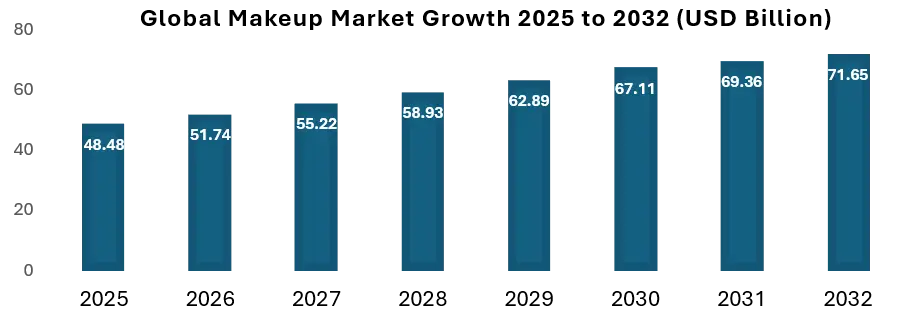
To know about the Research Methodology :- Request Free Sample Report
Makeup Market Dynamics
Increasing Beauty Consciousness and Personal Grooming Awareness
Consumers are becoming increasingly aware of personal appearance and self-care, leading to higher spending on makeup and cosmetic products. Growing urbanization, rising disposable incomes, and changing lifestyles are further encouraging the adoption of beauty products across different age groups and genders.
Growing Demand for Premium and Prestige Cosmetics
Consumers are shifting toward high-quality and luxury cosmetic products that offer superior performance, innovative ingredients, and enhanced user experiences. The rising preference for premium brands, especially among millennials and Gen Z consumers, is significantly contributing to market growth.
Rising Influence of social media and Beauty Influencers
Social media platforms such as Instagram, TikTok, and YouTube have transformed consumer purchasing behavior. Beauty influencers, celebrities, and online tutorials play a vital role in promoting makeup products, increasing brand awareness, and driving demand for new and trending cosmetics.
Continuous Innovation in Cosmetic Formulations
Manufacturers are investing heavily in research and development to introduce advanced formulations with long-lasting effects, skin-friendly ingredients, and multifunctional benefits. Innovations such as vegan makeup, hybrid skincare-cosmetic products, and personalized beauty solutions are supporting market expansion.
Market Restraints
Availability of Counterfeit Cosmetic Products
The presence of counterfeit and low-quality cosmetic products poses a major challenge to established brands. These products not only affect brand reputation but also raise concerns regarding consumer safety, thereby limiting market growth.
Stringent Cosmetic Regulations and Compliance Requirements
The cosmetics industry is subject to strict regulations concerning ingredient safety, labeling standards, and product testing. Compliance with varying regulatory frameworks across different regions increases production costs and delays product launches.
Fluctuating Raw Material Costs
Volatility in the prices of raw materials, packaging components, and transportation expenses can impact profit margins and disrupt manufacturing operations. These fluctuations create uncertainties for cosmetic manufacturers and suppliers.
Makeup Market Opportunities
Expansion of Men's Grooming Cosmetics
Growing awareness regarding skincare and personal grooming among men is creating significant opportunities for cosmetic manufacturers. Increasing demand for products such as foundations, concealers, beard care, and skincare-enhanced cosmetics is driving market growth.
Growth in Clean Beauty and Organic Makeup Products
Consumers are increasingly seeking products made from natural, organic, and sustainable ingredients. The clean beauty trend, driven by concerns about chemical exposure and environmental sustainability, presents substantial growth opportunities for manufacturers.
Increasing Demand for Cruelty-Free Formulations
Ethical consumerism and increasing awareness about animal welfare are boosting demand for cruelty-free and vegan cosmetics. Companies that offer certified cruelty-free products are gaining competitive advantages and expanding their customer base.
Untapped Opportunities in Emerging Economies
Rapid urbanization, rising disposable incomes, and expanding retail networks in emerging countries across Asia-Pacific, Latin America, and Africa are creating lucrative growth prospects for cosmetic companies seeking market expansion.
Makeup Market Challenges
Intense Brand Competition
The global makeup industry is highly competitive, with numerous international, regional, and local brands competing for market share. Continuous product innovation, marketing strategies, and pricing pressures make it challenging for companies to maintain customer loyalty and profitability.
Rapidly Changing Consumer Preferences
Consumer preferences and beauty trends evolve rapidly, requiring companies to continuously adapt their product portfolios and marketing approaches. Failure to respond to changing trends can result in declining demand and reduced market competitiveness.
Supply Chain and Ingredient Sourcing Challenges
Disruptions in global supply chains, geopolitical uncertainties, and shortages of key ingredients can affect production schedules and product availability. Ensuring sustainable and reliable sourcing while maintaining product quality remains a major challenge for industry participants.
Makeup Market Trends
Premiumization of Beauty Products
One of the most prominent trends in the global makeup market is the growing preference for premium and prestige beauty products. Consumers are increasingly willing to spend on high-quality cosmetics that offer superior performance, advanced ingredients, and enhanced user experiences. Luxury brands and premium product lines are gaining popularity, particularly among millennials and Gen Z consumers, contributing significantly to market value growth.
Growth of Clean-Label and Cruelty-Free Cosmetics
Consumers are becoming more conscious about product ingredients, safety, and ethical manufacturing practices. This has accelerated the demand for clean-label cosmetics that are free from harmful chemicals and synthetic additives. Additionally, increasing awareness regarding animal welfare has boosted the popularity of cruelty-free and vegan makeup products, encouraging companies to adopt ethical and transparent product development practices.
Expansion of Men's Cosmetic Products
The men's grooming segment is emerging as a significant growth area within the cosmetics industry. Rising awareness of skincare, changing perceptions regarding male grooming, and increasing acceptance of cosmetic products among men are driving demand for products such as foundations, concealers, tinted moisturizers, and eyebrow grooming solutions. Brands are increasingly introducing specialized product lines to cater to this expanding consumer base.
Skincare-Infused Makeup Formulations
The convergence of skincare and cosmetics is becoming a major trend in the market. Consumers are seeking multifunctional products that combine beauty enhancement with skincare benefits. Makeup products enriched with ingredients such as hyaluronic acid, vitamins, antioxidants, and SPF protection are gaining traction, providing hydration, nourishment, and long-lasting skin benefits alongside cosmetic appeal.
Sustainable Packaging Initiatives
Environmental sustainability has become a key focus area for cosmetic manufacturers. Companies are increasingly adopting eco-friendly packaging solutions, including recyclable materials, refillable containers, biodegradable packaging, and reduced plastic usage. These initiatives are aimed at minimizing environmental impact while meeting growing consumer expectations for sustainable and responsible products.
Inclusive Beauty and Shade Diversity Expansion
The beauty industry is witnessing a strong shift toward inclusivity and diversity. Cosmetic brands are expanding their product portfolios to offer a wider range of shades and formulations suitable for different skin tones, ethnicities, and skin types. This trend has been fueled by increasing consumer demand for representation and personalization, enabling brands to reach broader and more diverse customer segments.
Makeup Market Segmentation Analysis: Inquire before buying
| Segment Category | Main Segment | Sub-Segments |
| By Product Type | Face Makeup | Foundation, Concealer, Primer, Blush, Bronzer, Highlighter, Compact Powder |
| Eye Makeup | Mascara, Eyeliner, Eyeshadow, Eyebrow Products | |
| Lip Makeup | Lipstick, Lip Gloss, Lip Liner, Lip Tint | |
| Nail Makeup | Nail Polish, Nail Art Products | |
| Natural & Organic Makeup | Mineral Makeup, Botanical-Based Cosmetics | |
| By Consumer Group | Women | Mass Market Users, Premium Users |
| Men | Grooming Cosmetics, BB Creams, Concealers | |
| Gender-Neutral Consumers | Inclusive Beauty Products | |
| By Distribution Channel | Online Retail | E-Commerce Platforms, Brand Websites, Social Commerce |
| Specialty Stores | Beauty Retailers, Cosmetic Stores | |
| Supermarkets & Hypermarkets | Organized Retail Chains | |
| Department Stores | Premium Beauty Counters | |
| Pharmacies & Drug Stores | OTC Cosmetic Retail | |
| By Pricing Tier | Luxury Prestige Cosmetics | Ultra-Premium Beauty Products |
| Premium Cosmetics | Professional & High-End Brands | |
| Mid-Market Cosmetics | Value-Premium Products | |
| Mass-Market Cosmetics | Affordable Beauty Products | |
| By Formulation | Conventional Makeup | Synthetic-Based Formulations |
| Clean Beauty Makeup | Natural, Vegan, Cruelty-Free Products | |
| By Finish Type | Matte Finish | Long-Wear Cosmetics |
| Dewy Finish | Hydrating Makeup Products | |
| Satin Finish | Hybrid Finish Products | |
| By Region | North America | United States, Canada |
| Europe | Germany, United Kingdom, France, Italy, Spain, Rest of Europe | |
| Asia Pacific | China, Japan, India, South Korea, Australia, Rest of Asia Pacific | |
| Middle East & Africa | GCC Countries, South Africa, Rest of Middle East & Africa | |
| South America | Brazil, Argentina, Chile, Rest of South America |
Makeup Market Regional Analysis
Asia Pacific dominates the global makeup market and is expected to maintain its leading position throughout the forecast period. The region's growth is primarily driven by strong beauty product consumption in countries such as China, Japan, South Korea, and India, supported by rising disposable incomes, rapid urbanization, and increasing beauty consciousness among consumers. The popularity of K-beauty trends, expanding e-commerce channels, and the presence of a large young population further contribute to market growth. In addition, growing demand for premium and skincare-infused cosmetics is accelerating product adoption across the region.
North America represents a major revenue-generating region in the global makeup industry. The market is characterized by high consumer spending on premium and prestige cosmetics, strong brand loyalty, and widespread adoption of innovative beauty products. The presence of leading cosmetic companies, extensive retail networks, and the increasing popularity of clean-label, vegan, and cruelty-free formulations continue to support market expansion. Social media influence and celebrity endorsements also play a significant role in driving product demand in the United States and Canada.
Europe continues to hold a substantial share of the global makeup market due to strong demand for luxury and high-end beauty products. Countries such as France, Germany, the United Kingdom, and Italy have well-established cosmetic manufacturing industries and are home to several globally recognized beauty brands. Increasing consumer preference for sustainable, organic, and ethically sourced cosmetics, coupled with ongoing product innovation, is contributing to steady market growth across the region.
South America is emerging as a promising market for makeup products, supported by rising urbanization, improving living standards, and growing awareness of personal grooming. Countries such as Brazil and Mexico are witnessing increasing demand for affordable and premium cosmetic products. The expansion of online retail channels and growing influence of beauty trends through social media are further enhancing market penetration in the region
The Middle East and Africa region is expected to experience moderate growth during the forecast period. Increasing disposable incomes, expanding retail infrastructure, and rising demand for international cosmetic brands are supporting market development. Growing awareness regarding beauty and personal care products, particularly among younger consumers, is creating new growth opportunities. Furthermore, untapped markets in several African countries present significant potential for future expansion.
Makeup Market by Geography
North America (United States, Canada, and Mexico)
Europe (UK, France, Germany, Italy, Spain, Sweden, Austria, and the Rest of Europe)
Asia Pacific (China, South Korea, Japan, India, Australia, ASEAN, Indonesia, Philippines, Malaysia, Vietnam, Thailand, ASEAN, Rest of Asia Pacific)
Middle East & Africa (South Africa, GCC, Nigeria, Rest of ME&A)
South America (Brazil, Argentina, Rest of South America)
Makeup Market Scope
| Report Attribute | Details |
| Base Year | 2025 |
| Forecast Period | 2025–2032 |
| Market Size (2025) | USD 48.48 Billion |
| Forecast Value (2032) | USD 71.65 Billion |
| CAGR | 6.72% |
| Segments Covered | Product Type, End User, Distribution Channel, Region |
| Regions Covered | North America, Europe, Asia Pacific, Middle East & Africa, South America |
Makeup Market Competitive Landscape
The global makeup market is highly competitive and characterized by the presence of multinational cosmetic companies, luxury beauty brands, mass-market manufacturers, and emerging direct-to-consumer players. Product innovation, brand positioning, distribution expansion, and digital marketing strategies remain key competitive differentiators.
Makeup Market Key Players
The Global Cosmetics Market represents the worldwide industry involved in developing, manufacturing, and marketing beauty and personal care products aimed at enhancing appearance, self-expression, and personal grooming across diverse consumer groups.
Companies with dominant global market share, extensive product portfolios, and strong worldwide distribution networks.
| Company | Headquarters | Classification | Product Specialization & Core Competencies |
| L'Oréal S.A. | France | Market Leader | Mass-to-Premium Cosmetics, Global Distribution |
| The Estée Lauder Companies | USA | Prestige Beauty Leader | Luxury & Premium Makeup |
| Shiseido Co., Ltd. | Japan | Premium Beauty Leader | Skincare-Makeup Integration |
| Coty Inc. | USA | Global Challenger | Celebrity & Prestige Brands |
| Revlon Inc. | USA | Mass Market Leader | Color Cosmetics |
| Procter & Gamble | USA | Consumer Beauty Leader | Mass Cosmetics |
| Unilever PLC | UK | Emerging Market Leader | Regional Beauty Brands |
| Kao Corporation | Japan | Innovation-Focused Player | Ingredient Technology |
| LVMH Beauty | France | Luxury Beauty Leader | Dior & Givenchy Beauty |
| Amorepacific | South Korea | K-Beauty Leader | Asian Beauty Expansion |
| Charlotte Tilbury | UK | Prestige Cosmetics Specialist | Premium Makeup Portfolio |
| e.l.f. Beauty | USA | Clean Beauty Leader | Affordable Cosmetics |
| Rare Beauty | USA | D2C Beauty Challenger | Social Commerce Strength |
| Glossier | USA | Digital-First Beauty Brand | Community-Led Growth |
| Fenty Beauty | USA | Inclusive Beauty Specialist | Shade Diversity Leadership |