
Global Sour Cream Market Size by Product, Application, and Region – Segment-Level Market Assessment, Growth Opportunity Analysis, Competitive Mapping & Forecast to 2032
Overview
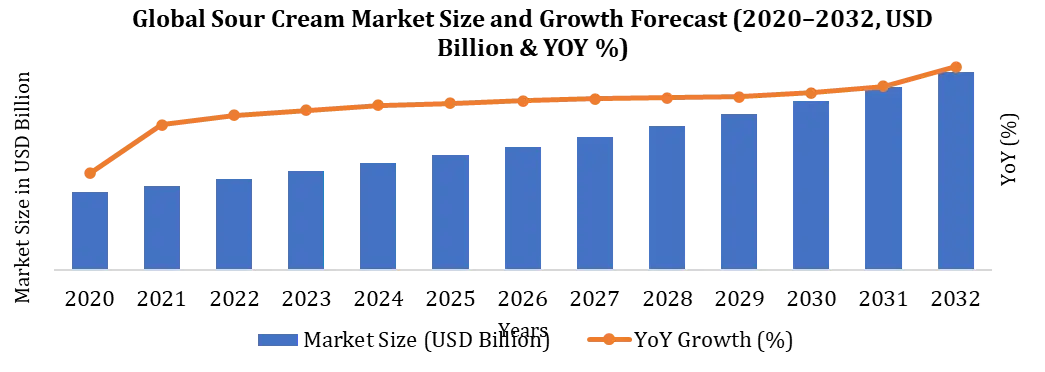
The Sour Cream Market Size was valued at USD 2.85 Billion in 2025 and estimated at USD 3.05 Billion in 2026 and is projected to reach around USD 4.92 Billion by 2032, registering a CAGR of nearly 8.10% during the forecast period (2026–2032).
The Global Sour Cream Market demonstrated consistent growth momentum, driven by evolving consumer demand for premium dairy products and the rapid expansion of convenience food consumption worldwide. The Sour Cream Market continues to expand alongside the broader fermented dairy industry, driven by rising demand for probiotic and functional dairy products.
Sour Cream Market Key Highlights:
| Market Parameter | Value / Insight | Trend |
| Global Sour Cream Market Size (2025) | USD 2.85 Billion | ↑ Steady Growth |
| Projected Market Size (2032) | USD 4.92 Billion | ↑ Strong Expansion |
| Forecast CAGR (2026–2032) | 8.10% | ↑ Growing Industry |
| Dominant Type (2025) | Regular Sour Cream | ↑ Market Leader |
| Second Largest Segment | Low-Fat Sour Cream | ↑ Health Demand |
| Third Largest Segment | Organic Sour Cream | ↑ Premium Growth |
| Primary Application | Food Processing | ↑ Core Demand |
| Retail Consumption | Increasing Household Usage | ↑ Stable Growth |
| Clean Label Demand | Rising Preference for Natural Products | ↑ Strong Trend |
| Plant-Based Alternatives | Emerging Segment | ↑ Innovation |
To know about the Research Methodology :- Request Free Sample Report
Global Sour Cream Market Overview
The Sour Cream Market transitioned into a value-added dairy segment, characterized by continuous product innovation, premiumization, and an increasing emphasis on health-oriented offerings. Manufacturers increasingly focused on improving texture, flavor profile, shelf stability, and nutritional composition to strengthen product differentiation. Leading to the development of low-fat, organic, lactose-free, and plant-based sour cream variants. This shift aligned with changing consumer demand for clean-label and functional food products, strengthening the company's overall market position.
The growing utilization of sour cream across diverse applications including dips, sauces, bakery products, and ready-to-eat snacks significantly supported the expansion of market size. In addition, advancements in packaging technologies, such as extended shelf-life solutions and sustainable materials, improved product safety and convenience. Furthermore, the adoption of environmentally responsible dairy farming practices enhanced brand credibility and consumer trust, contributing to the sustained growth of the Sour Cream Market globally.
Sour Cream Market Core Driving Factors
The Sour Cream Market Growth was primarily driven by increasing consumer demand for dairy-based convenience foods and ready-to-eat products. The rising demand for dips, dressings, and sauces in fast-food and quick-service restaurants significantly boosted product consumption.
Growing demand from the dairy ingredient market and processed food manufacturers significantly accelerated sour cream consumption globally. Additionally, the growing awareness of probiotics and gut health encouraged consumers to adopt fermented dairy products, including sour cream. The expansion of organized retail and e-commerce platforms further enhanced product accessibility, supporting market growth globally.
Sour Cream Market Key Opportunities
The Sour Cream Market demonstrated strong growth opportunities driven by the increasing adoption of plant-based alternatives derived from soy, almond, and coconut, effectively addressing the needs of vegan and lactose-intolerant consumers. The rising demand for organic, clean-label, and minimally processed products further supported the expansion of premium market segments.
Advancements in packaging solutions, including sustainable and resealable formats, along with the rapid expansion of retail and e-commerce distribution channels, enhanced product accessibility and consumer convenience. Additionally, product innovation through flavor diversification and the introduction of low-fat variants contributed to broader consumer acceptance across multiple applications. The rapid expansion of the organic dairy products market created strong opportunities for premium sour cream manufacturers.
Sour Cream Market: Key Emerging Trends
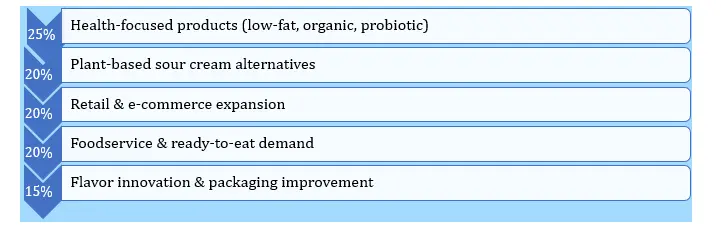
• The Sour Cream Market witnessed increasing demand for healthier products, with rising demand for low-fat, organic, and probiotic-rich options. Consumers increasingly preferred clean-label products with natural ingredients.
• Plant-based sour cream alternatives also gained popularity due to vegan trends and lactose intolerance. Additionally, companies focused on introducing new flavors like garlic, herbs, and spicy variants to attract a wider consumer base.
• The expansion of retail and e-commerce channels improved product availability and visibility. Rising demand from foodservice and ready-to-eat segments further accelerated market expansion. Continuous innovation in packaging and product formats enhanced consumer convenience and brand differentiation.
Sour Cream Market Emerging Trends & Market Share (2025) %
Sour Cream Market Segment Analysis
The Regular Sour Cream segment dominated the Global Sour Cream Market in 2025 and accounted for 42% market share, driven by its widespread utilization across household consumption, foodservice applications, dips, sauces, and bakery products. The segment maintained strong penetration due to its cost-effectiveness, creamy texture, and broad compatibility with fast-food and ready-to-eat meal applications. Increasing demand from restaurants, quick-service chains, and processed food manufacturers further supported segment expansion globally.
The Low-Fat Sour Cream segment emerged as the second-largest category, supported by rising health-conscious consumer preferences and increasing awareness regarding calorie reduction and balanced nutrition. In addition, the Organic Sour Cream segment witnessed accelerating adoption due to the growing organic dairy products market and rising clean-label product demand among premium consumers. Furthermore, the Plant-Based Sour Cream segment demonstrated significant growth potential due to the rapid expansion of the dairy alternatives market and increasing vegan and lactose-intolerant consumer populations worldwide.
Sour Cream Market Investment & Expansion Analysis
The Sour Cream Market experienced steady investment growth, driven by rising global demand and expanding foodservice applications. Capital allocation was primarily focused on capacity expansion, advanced processing technologies, and cold chain infrastructure to improve efficiency and reduce operational costs.
Regionally, investments were concentrated in high-growth markets such as Asia-Pacific and Latin America, where dairy consumption increased at a faster pace than the global average. Strategic initiatives, including mergers, acquisitions, and partnerships, supported market consolidation and enhanced distribution capabilities.
Sour Cream Market Regulatory & Compliance Analysis
• The Sour Cream Market operated under strict regulatory frameworks governing food safety, quality standards, and labeling requirements. Regulatory authorities across regions enforced guidelines related to dairy processing, hygiene standards, and permissible ingredients.
• Compliance with these regulations ensured product safety and consumer trust while also influencing production costs and operational processes. Additionally, increasing emphasis on sustainability and environmental regulations encouraged manufacturers to adopt eco-friendly packaging and reduce carbon footprints. Regulatory alignment remained essential for market entry and expansion, particularly in international markets.
• Additionally, premium segments such as organic, low-fat, and probiotic sour cream accounted for higher-margin opportunities, with pricing typically 20–35% above standard products. Overall, the market demonstrated strong ROI potential, supported by scalable operations, consistent demand growth, and increasing premiumization.
Sour Cream Market Consumer Behavior Analysis
Consumer behavior in the Sour Cream Market reflected a shift toward health-conscious and premium product choices. Demand for low-fat, organic, and probiotic-enriched sour cream products increased significantly, particularly among urban consumers. Convenience remained a key purchasing factor, with consumers preferring ready-to-use and easily accessible packaging formats. In addition, flavor innovation and product diversification attracted younger demographics and expanded the product’s application scope. Brand trust, product quality, and nutritional value played a crucial role in influencing purchasing decisions. Rising probiotic dairy consumption among health-conscious consumers significantly influenced demand for functional sour cream products.
Sour Cream Market Manufacturing Cost & Pricing Analysis
• Raw Material Cost Analysis
Milk and cream represented the largest share of production cost, influenced by dairy farming conditions and seasonal availability.
• Processing & Packaging Cost
Fermentation, pasteurization, and packaging contributed significantly to overall costs.
• Pricing Strategy
Pricing was typically 15–30% higher than production cost, depending on brand positioning and product type (organic, flavored, or low-fat).
• Total Product Cost
Final product pricing included raw materials, processing, packaging, distribution, and retail margins, making premium sour cream products more expensive.
Sour Cream Market Regional Insights
North America dominated the Sour Cream Market in 2025 due to high dairy consumption and strong demand from fast-food and quick-service restaurants. Advanced processing infrastructure, continuous product innovation, and the availability of low-fat and flavored variants further accelerated market growth. Consumer preference for convenient food products also sustained demand.
Europe Sour Cream Market: Mature Market and Established Dairy Industry Hub
Europe represented a mature market driven by established dairy consumption habits and demand for high-quality products. Growth was accelerated by increasing preference for organic and clean-label products, along with innovations in packaging and product offerings. Strong regulatory standards and rising health awareness contributed to steady expansion.
Asia Pacific emerged as the fastest-growing region, driven by urbanization, rising incomes, and the influence of Western diets. Expanding retail networks, e-commerce, and international food chains improved product accessibility. Increasing awareness of nutritional benefits further enhanced market growth.
South America showed moderate growth due to rising dairy consumption and expansion of the foodservice sector. Urbanization and changing lifestyles supported demand, while improvements in retail distribution enhanced product availability.
The Middle East & Africa experienced gradual growth driven by expanding retail infrastructure and improving cold chain logistics. Rising urbanization and demand for convenience foods enhanced the market, although growth remained moderate due to varying dairy consumption patterns.
Sour Cream Market Competitive Landscape
The Sour Cream Market demonstrated a moderately competitive and fragmented landscape, characterized by the presence of both multinational corporations and regional dairy producers. No single player dominated the market, resulting in a balanced competitive environment. Market participants strategically focused on product innovation, particularly through the introduction of organic, low-fat, and value-added variants to align with evolving consumer preferences. In addition, companies emphasized brand positioning, expanded distribution networks, and strengthened partnerships with foodservice providers to enhance market penetration. Competitive dynamics were primarily influenced by pricing strategies, product quality, and the ability to respond effectively to shifting consumer demand, especially toward healthier and premium dairy products.
Leading sour cream manufacturers are focusing on product innovation, premiumization, and distribution expansion to strengthen global market presence. Key industry players such as Nestlé, Danone, Kraft Heinz Company, Dairy Farmers of America, etc., focused on portfolio expansion, quality enhancement, and supply chain optimization to sustain and strengthen their market positions. Global sour cream suppliers are increasingly investing in cold chain logistics and sustainable dairy sourcing to improve operational efficiency.

Sour Cream Market Recent Key Developments:
| Market Parameter | Value / Insight | Trend |
| Global Sour Cream Market Size (2025) | USD 2.85 Billion | ↑ Steady Growth |
| Projected Market Size (2032) | USD 4.92 Billion | ↑ Strong Expansion |
| Forecast CAGR (2026–2032) | 8.10% | ↑ Growing Industry |
| Dominant Type (2025) | Regular Sour Cream | ↑ Market Leader |
| Second Largest Segment | Low-Fat Sour Cream | ↑ Health Demand |
| Third Largest Segment | Organic Sour Cream | ↑ Premium Growth |
| Primary Application | Food Processing | ↑ Core Demand |
| Retail Consumption | Increasing Household Usage | ↑ Stable Growth |
| Clean Label Demand | Rising Preference for Natural Products | ↑ Strong Trend |
| Plant-Based Alternatives | Emerging Segment | ↑ Innovation |
Global Sour Cream Market Scope: Inquire before buying
| Sour Cream Market | |||
|---|---|---|---|
| Report Coverage | Details | ||
| Base Year: | 2025 | Forecast Period: | 2026-2032 |
| Historical Data: | 2020 to 2025 | Market Size in 2025: | USD 2.85 Bn. |
| Forecast Period 2026 to 2032 CAGR: | 8.1% | Market Size in 2032: | USD 4.92 Bn. |
| Segments Covered: | by Type | Regular Sour Cream Low-Fat Sour Cream Fat-Free Sour Cream Organic Sour Cream Flavored Sour Cream Plant-Based Sour Cream |
|
| by Packaging Type | Tubs Squeeze Bottles Pouches Glass Jars Single-Serve Cups Bulk Packaging |
||
| by Source | Animal-Based (Dairy) Plant-Based Soy-Based Almond-Based Coconut-Based Oat-Based |
||
| by Processing Method | Traditional Fermentation Industrial Fermentation Pasteurized Ultra-Pasteurized Probiotic-Enriched |
||
| by Application | Food Processing Bakery and Confectionery Dips and Sauces Snacks and Ready-to-Eat Food Household Consumption Foodservice |
||
Sour Cream Market, by Region
North America (United States, Canada, and Mexico)
Europe (United Kingdom, France, Germany, Italy, Spain, Sweden, Russia, Ukraine, Austria, Poland, Portugal, Ireland, Switzerland, Romania, and Rest of Europe)
Asia Pacific (China, India, Japan, South Korea, Australia, Indonesia, Malaysia, Philippines, Thailand, Vietnam, and Rest of Asia Pacific)
Middle East and Africa (UAE, South Africa, Saudi Arabia, Bahrain, Kuwait, Oman, Qatar, Egypt, Nigeria, Israel, Turkey, Rest of ME&A)
South America (Brazil, Argentina, Chile, Colombia, and Rest of South America)
Key Players/Competitors Profiles Covered in the Sour Cream Market Report in Strategic Perspective
The sour cream market is highly competitive with the presence of more than 50 global and regional players, including major dairy cooperatives, multinational food companies, and niche organic producers.
Global Core Dairy Leaders
1. Daisy Brand LLC
2. The Kraft Heinz Company
3. Danone S.A.
4. Lactalis Group
5. Fonterra Co-operative Group Ltd
6. Saputo Inc.
7. Dairy Farmers of America, Inc.
8. Arla Foods amba
9. Friesland Campina
10. Nestlé S.A.
Major Dairy & Cooperative Producers
11. Cabot Creamery Cooperative
12. Organic Valley
13. Agropur Dairy Cooperative
14. Prairie Farms Dairy Inc.
15. Land O’Lakes, Inc.
16. Valio Ltd.
17. Meiji Holdings Co., Ltd.
18. Schreiber Foods
19. Smith Foods Inc.
20. HP Hood LLC
Regional & Strong Market Players
21. Borden Dairy Company
22. Hiland Dairy
23. Green Valley Creamery
24. Redwood Hill Farm & Creamery
25. Laiterie Chalifoux
26. Gay Lea Foods Co-operative Ltd.
27. Bulla Dairy Foods
28. Zott SE & Co. KG
29. Meggle Group
30. Emmi Group
Europe & Emerging Dairy Players
31. Müller Group
32. DMK Group
33. Sodiaal Group
34. Savencia Fromage & Dairy
35. Royal A-ware
36. Uelzena Ingredients
Asia-Pacific & Middle East Players
37. Amul (Gujarat Cooperative Milk Marketing Federation)
38. Mother Dairy
39. Parag Milk Foods Ltd.
40. Hatsun Agro Product Ltd.
41. Almarai Company
Niche / Specialty / Organic Players
42. Cacique Foods LLC
43. FAGE International S.A.
44. Chobani, LLC
45. Tillamook County Creamery Association
46. Horizon Organic Dairy
47. Nancy’s Yogurt
Ingredient & Industrial Dairy Players
48. NZMP (Fonterra Ingredients)
49. Bluegrass Dairy & Food Inc.
50. Molda AG
51. Arion Dairy Products