
Smart Warehousing Market Size, Share, Growth, Trends, Industry Analysis, Demand, Technology, Automation, Artificial Intelligence 2034
Overview
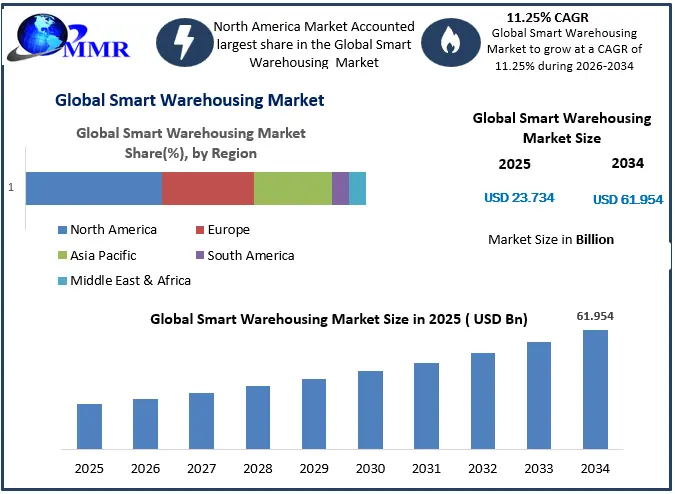
The Global Smart Warehousing Market is valued at US$ 23.73 billion in 2025 and is estimated to reach US$ 26.40 billion in 2026, growing at a CAGR of 11.25% during 2026–2034 to reach around US$ 61.95 billion by 2034.
Smart Warehousing Market Key Highlights
• Market Size: The market reaches US$23.734 billion in 2025 and is projected to reach US$61.954 billion by 2034.
• Market Growth: The market expands at a 11.25% CAGR during 2026–2034.
• Technology Leader: IoT dominates the technology segment with a 35% share in 2025.
• Application Leader: Order Fulfillment dominates the application segment with a 40% share in 2025.
• Regional Leader: North America dominates with a 40% share in 2025, supported by advanced automation and e-commerce infrastructure.
• Growth Opportunity: Asia Pacific grows fastest, driven by e-commerce expansion, manufacturing activity, robotics adoption, and warehouse modernization.
Smart Warehousing Market Overview:
Smart warehousing refers to the integration of connected digital technologies, warehouse automation systems, intelligent software, robotics, and data-driven solutions to optimize warehouse operations, inventory management, material handling, and order fulfillment. The smart warehousing market encompasses hardware, software, and associated services that enable automated, connected, and intelligent warehouse operations. Key solutions include warehouse management systems (WMS), warehouse execution and control systems (WES/WCS), automated storage and retrieval systems (AS/RS), autonomous mobile robots (AMRs), automated guided vehicles (AGVs), conveyors and sortation systems, RFID and sensor-based systems, artificial intelligence (AI), Internet of Things (IoT), machine vision, cloud platforms, analytics, and digital twin technologies. These solutions enable real-time inventory visibility, automated material movement, optimized storage utilization, predictive decision-making, faster order fulfillment, and improved operational efficiency.
These technologies enable businesses to improve inventory visibility, optimize storage utilization, automate material handling, accelerate order fulfillment, and reduce manual errors across increasingly complex supply chains. The integration of these technologies creates connected, intelligent, and highly efficient warehouse operations.
The shift of businesses toward e-commerce, omnichannel retail, same-day delivery, and real-time inventory management strengthens demand for smart warehouse solutions. In the U.S., e-commerce sales reached US$308.9 billion in the fourth quarter of 2024, representing 16.4% of total retail sales. E-commerce sales increased 9.4% year over year, highlighting the continuous pressure on warehouses to process higher order volumes efficiently.
Warehouse operators are also increasing their adoption of automated technologies. A 2024 warehouse and distribution center operations survey found that the use of warehouse execution or warehouse control systems increased to 13% from 8% in 2023. The sorter adoption rose to 23% from 13%, and palletizer adoption increased to 24% from 16%. Paper-based picking also declined to 44% from 56%, indicating a broader transition toward digitally enabled and automated warehouse processes. The market is supported by advances in AI-powered inventory forecasting, machine vision, IoT sensors, robotics, predictive analytics, digital twins, and cloud-based WMS platforms, which allow warehouses to coordinate human workers, automated equipment, and inventory data in real time. Industry also identifies automated storage and retrieval systems, AMRs, IoT, and AI as important technologies shaping the evolution of smart warehouses.
Global Smart Warehousing Market Size, Growth & Share Analysis
To know about the Research Methodology :- Request Free Sample Report
Global Smart Warehousing Market Dynamics
Rapid Growth of E-Commerce and Omnichannel Fulfillment Drives Market Growth
The expansion of e-commerce and omnichannel retail increases the volume of small, frequent, and time-sensitive orders, creating sustained demand for automated picking, sorting, inventory tracking, and order fulfillment solutions. In the U.S., total e-commerce sales reached US$1.1926 trillion in 2024, increasing 8.1% from 2023. The continued expansion of digital commerce increases warehouse throughput requirements and strengthens demand for robotics, automated material handling, intelligent warehouse management systems, and automated fulfillment solutions.
Labor Shortages and Rising Operating Costs Accelerate Automation
Persistent labor availability challenges and rising warehouse operating costs are encouraging operators to automate repetitive material handling, picking, sorting, transportation, and inventory activities. AMRs, AS/RS, automated picking systems, and AI-enabled warehouse management solutions allow operators to improve productivity while reducing dependence on manual processes. The economic case for automation is particularly strong in high-throughput facilities where labor represents a significant component of operating costs.
High Initial Investment Restrains Adoption Among SMEs
Smart warehouse implementation requires investment in robotics, sensors, automated storage systems, WMS/WES platforms, connectivity infrastructure, system integration, employee training, and maintenance. These requirements can make advanced automation difficult for small and medium-sized enterprises to justify, particularly when warehouse throughput is insufficient to generate attractive returns. As a result, capital intensity remains a significant barrier to broader adoption.
Legacy-System Integration Challenges Restrain Market Growth
Many warehouses continue to operate with legacy WMS, ERP, material-handling, and inventory systems. Integrating these platforms with AI, IoT, robotics, cloud technologies, and modern warehouse execution systems can require significant customization, technical expertise, and implementation time. Integration complexity, data-security requirements, and uncertainty regarding return on investment remain important barriers to smart warehouse modernization.
AI-Enabled Warehouse Optimization Creates Growth Opportunities
AI and advanced analytics are increasingly being applied to demand forecasting, inventory optimization, warehouse slotting, route planning, predictive maintenance, robotic picking, and workforce allocation. The integration of AI with IoT and robotics enables warehouses to move from task-level automation toward increasingly autonomous and data-driven operations. This convergence creates opportunities for vendors offering intelligent warehouse orchestration, predictive analytics, and AI-enabled decision-support solutions.
Brownfield Warehouse Modernization Creates a Significant Opportunity
A large installed base of conventional warehouses creates opportunities for modular automation and brownfield modernization. Operators can retrofit existing facilities with AMRs, intelligent WMS/WES platforms, machine vision, automated sortation, and modular AS/RS solutions without completely replacing existing infrastructure. This enables progressive automation while reducing the disruption and capital requirements associated with greenfield warehouse development.
Autonomous Warehouse Orchestration Creates a High-Value Opportunity
The convergence of AI, robotics, IoT, WES, and real-time analytics is shifting the market from standalone automation toward integrated warehouse orchestration. Intelligent systems increasingly coordinate inventory, labor, robotic equipment, material flow, and order priorities dynamically, creating opportunities for vendors that can provide end-to-end autonomous warehouse management capabilities.
Robot-as-a-Service Expands Access to Automation
Robot-as-a-Service (RaaS) models enable warehouse operators to access robotic systems through subscription or usage-based commercial models rather than large upfront capital investments. This approach can reduce financial barriers, particularly for SMEs, while allowing customers to scale robotic capacity according to order volumes and operational requirements.
Cybersecurity and Data Protection Challenges Create Deployment Risks
The increasing connectivity of IoT devices, cloud platforms, robotics, WMS, and warehouse control systems expands the number of digital access points within warehouse environments. Consequently, operators require stronger cybersecurity controls, access management, data governance, network protection, and system monitoring alongside investments in automation.
Shortage of Skilled Personnel Challenges Technology Deployment
Smart warehouses require personnel capable of operating and maintaining robotics, AI systems, WMS/WES platforms, IoT infrastructure, and analytics solutions. The transition from conventional warehouse operations to technology-intensive environments therefore creates a continuing requirement for technical training, workforce reskilling, and specialized system-management capabilities.
Global Smart Warehousing Market Trends
• AI-Powered Warehouse Intelligence Expands – Warehouses increasingly deploy AI and advanced analytics for demand forecasting, inventory optimization, predictive maintenance, resource allocation, warehouse slotting, and real-time operational decision-making.
• Autonomous Mobile Robot Adoption Increases – AMRs are gaining traction because they provide flexible and scalable material movement and can adapt to changing warehouse layouts without extensive fixed infrastructure. Their integration with AI, machine vision, and IoT improves picking, sorting, transportation, and fulfillment efficiency.
• Cloud-Based and Connected WMS Adoption Grows – Businesses are increasingly deploying cloud-based WMS platforms integrated with IoT sensors, robotics, analytics, and warehouse execution systems to achieve real-time inventory visibility and coordinate warehouse activities across facilities.
• Brownfield Automation Gains Momentum – Warehouse operators are increasingly retrofitting existing facilities with modular automation, AMRs, AS/RS, intelligent software, and automated sortation rather than relying exclusively on new warehouse construction.
• Digital Twins Enable Warehouse Simulation – Digital twin technologies enable warehouse operators to simulate layouts, material flows, storage utilization, throughput, and automation scenarios before implementing physical changes, supporting better investment and operational decisions.
• Warehouse Automation Moves Toward Autonomous Orchestration – The market is shifting from standalone automation equipment toward integrated environments where AI, WMS/WES, robotics, IoT, and material-handling systems coordinate warehouse activities dynamically.
Smart Warehousing Market Segment Analysis:
Smart Warehousing Market Technology Segment Analysis
Internet of Things (IoT) dominates the smart warehousing technology segment in 2025, accounting for 35% of the technology market. IoT provides the connectivity layer for smart warehouses by linking sensors, RFID systems, equipment, inventory, and warehouse management platforms to enable real-time monitoring and visibility. The increasing adoption of connected warehouse infrastructure supports IoT demand across inventory tracking, asset monitoring, equipment management, and warehouse operations.
Artificial Intelligence (AI) and Machine Learning represent the fastest-growing technology segment, supported by increasing adoption of predictive analytics, demand forecasting, intelligent inventory optimization, predictive maintenance, robotic decision-making, and autonomous warehouse operations. The integration of AI with IoT and robotics enables warehouses to convert real-time operational data into automated and predictive decisions.
Robotics and Automation remains a major technology segment as warehouse operators increasingly deploy AMRs, AGVs, robotic picking systems, automated sortation, and automated storage and retrieval systems to improve throughput, reduce manual handling, and address labor constraints.
Big Data and Analytics supports warehouse optimization by enabling operators to analyze inventory, order, equipment, labor, and operational data to improve forecasting, resource allocation, and warehouse performance.
Cloud Computing enables scalable deployment of WMS, WES, analytics, and connected warehouse applications while supporting centralized visibility across multiple warehouse facilities.
Digital Twin Technology, RFID, and Machine Vision increasingly support warehouse simulation, real-time identification, automated inspection, inventory tracking, and intelligent material handling.

Smart Warehousing Market Application Segment Analysis
Order Fulfillment dominates the smart warehousing application segment in 2025, accounting for around 40% of the application market. Its leadership is primarily attributed to the expansion of e-commerce and omnichannel retail, where warehouses are required to process high volumes of individual orders quickly and accurately. Automated picking, sorting, robotics, WMS, and intelligent order-management solutions increasingly support fulfillment operations.
Inventory Management represents a major and rapidly expanding application area, driven by the growing requirement for real-time inventory visibility, accurate stock levels, automated replenishment, and predictive demand planning. AI, IoT, RFID, barcode systems, and analytics increasingly support inventory optimization and enable warehouse operators to reduce stock discrepancies and improve utilization.
Picking and Packing is increasingly adopting robotics, machine vision, automated picking systems, and intelligent workflow management to improve order accuracy and reduce processing time. The application is particularly important in high-volume e-commerce and omnichannel fulfillment environments.
Sorting and Consolidation is gaining importance as warehouses process increasingly fragmented order volumes and require faster movement of products through fulfillment facilities. Automated sortation systems improve throughput and reduce manual handling requirements.
Asset and Equipment Tracking is supported by IoT, RFID, sensors, and connected warehouse platforms, enabling operators to monitor inventory, equipment location, utilization, and operational status in real time.
Warehouse Maintenance and Predictive Maintenance is increasingly supported by AI, IoT sensors, and analytics that identify equipment performance issues and potential failures before they disrupt warehouse operations.

Smart Warehousing Market Regional Insights and Regional Warehouse Automation Growth
North America dominates the global smart warehousing market in 2025, accounting for approximately 40% of the market. The region benefits from mature logistics infrastructure, high e-commerce penetration, large-scale fulfillment centers, advanced warehouse automation capabilities, and strong adoption of robotics, AI-enabled WMS, IoT, and automated material-handling systems. The U.S. represents the largest market within the region, supported by extensive fulfillment networks and continued investment in warehouse productivity and automation. Persistent labor availability and productivity pressures further strengthen the business case for AMRs, AS/RS, automated sortation, machine vision, and AI-based warehouse management solutions.
Europe maintains a strong smart warehousing position. It is driven by advanced manufacturing, established logistics networks, e-commerce fulfillment, sustainability requirements, and demand for highly efficient warehouse operations. Germany, the U.K., France, Italy, and the Netherlands represent important markets, supported by companies such as Körber, KION, SSI Schäfer, Vanderlande, and KNAPP. European warehouse operators increasingly modernize existing facilities with robotics, WMS, energy-efficient automation, and intelligent inventory systems rather than relying solely on new warehouse construction. Regulatory requirements concerning data protection, cybersecurity, worker safety, energy efficiency, and sustainability influence technology selection and encourage more controlled and efficient warehouse modernization.
Asia Pacific represents the fastest-growing regional market for smart warehousing, supported by expanding e-commerce, large manufacturing ecosystems, rapid urbanization, increasing logistics investment, and growing adoption of warehouse automation. China, Japan, South Korea, and India represent major markets, supported by strong manufacturing and logistics activity and increasing investment in robotics, automated material handling, WMS, and connected warehouse technologies. The region also benefits from ongoing warehouse modernization as operators seek higher throughput, improved inventory visibility, and greater operational efficiency.
South America shows an emerging smart warehousing market, supported primarily by e-commerce expansion, logistics modernization, labor constraints, and growing investment in automated distribution facilities. Brazil represents the major regional opportunity because of its large consumer market, expanding online retail ecosystem, and increasingly sophisticated logistics infrastructure. Companies are gradually adopting WMS, RFID, automated storage, robotics, and data-driven inventory management to improve fulfillment efficiency. However, comparatively lower automation penetration, higher upfront investment requirements, infrastructure differences, and limited availability of specialized technical expertise constrain adoption compared with North America, Europe, and Asia Pacific.
Middle East & Africa represents an emerging opportunity for smart warehouse automation, particularly in the GCC countries, where large logistics hubs, free-trade zones, e-commerce growth, retail modernization, and investments in ports and distribution infrastructure support demand. The UAE and Saudi Arabia are particularly important because their logistics strategies emphasize digitalization, automation, and supply-chain efficiency. Smart warehouses increasingly support food distribution, retail, e-commerce, pharmaceuticals, and cross-border logistics. However, the region remains smaller than the major markets because adoption is concentrated around advanced logistics hubs and large enterprises, while high technology costs and uneven infrastructure limit broader penetration.
Smart Warehousing Market Recent Developments:
| Date | Company | Recent Development | Strategic Impact |
| July 2026 | American Industrial Partners / Honeywell | Warehouse automation business transaction | Expands the combined warehouse automation platform across robotics, AS/RS, sortation, conveyors, software, and lifecycle services |
| January 2026 | Daifuku | Warehouse automation strategy emphasizing AS/RS, shuttle systems, and automated sortation | Reinforces focus on high-capacity and large-scale fulfillment automation |
| 2026 | Dematic | Expansion of warehouse automation demonstration and innovation capabilities | Supports customer engagement, technology demonstration, and workforce development |
| 2025–2026 | Industry | Increasing convergence of AI, robotics, IoT, and warehouse software | Shifts competition toward integrated and intelligent warehouse automation ecosystems |
Smart Warehousing Market Competitive Landscape and Smart Warehouse Automation Strategies
The global smart warehousing market remains highly fragmented, with The global smart warehousing market is highly competitive and fragmented across warehouse automation, robotics, warehouse management software, warehouse execution systems, material-handling equipment, IoT, machine vision, and systems integration. Competition is increasingly shifting from standalone equipment toward integrated solutions that combine intelligent software, robotics, automation hardware, real-time data, and lifecycle services.
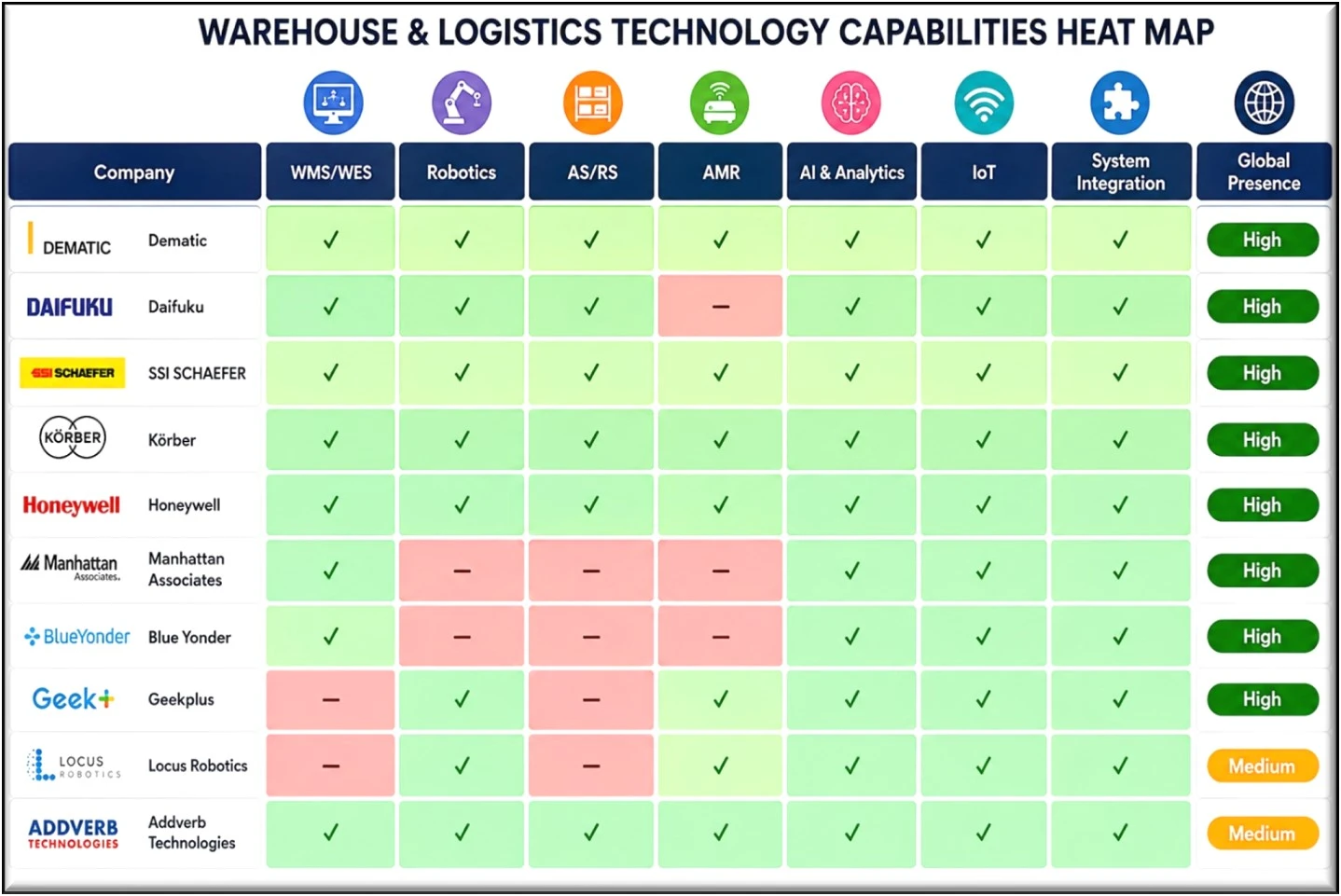
Major participants include Dematic (KION Group), Daifuku, SSI SCHAEFER, Vanderlande, Körber, Honeywell, Manhattan Associates, Blue Yonder, Zebra Technologies, Cognex, ABB, Siemens, Geekplus, Locus Robotics, and Addverb Technologies. Companies differentiate through AI-enabled software, cloud-native WMS/WES platforms, AMRs, AS/RS, machine vision, predictive analytics, modular automation, system integration capabilities, and lifecycle support.
MMR Competitive Matrix for Key Players:
Smart Warehouse Automation Product Innovation and Service Strategies
Manhattan Associates strengthens its software-led positioning through AI and cloud-native warehouse execution. Its Manhattan Active Warehouse Management platform integrates inventory, labor, automation, and transportation in a cloud-native environment. The company introduced Agentic AI capabilities in 2025, allowing AI agents to autonomously perform tasks and orchestrate workflows. Its platform is already deployed across major customers, including DHL, Staples, and Foot Locker; Manhattan reports that DHL uses its technology across more than 14 million square meters of warehouse operations.
Honeywell competes through integrated hardware, software, robotics, and services rather than standalone warehouse equipment. The company has expanded its warehouse automation portfolio through cloud-based warehouse execution, intelligent automation, robotics, sortation, and software capabilities. Following the transition of its warehouse automation business to American Industrial Partners, Intelligrated and Transnorm are positioned within a broader warehouse automation platform alongside Trew, strengthening the combined portfolio across robotics, AS/RS, sortation, conveyors, software, and lifecycle services.
Dematic, SSI SCHAEFER, and Daifuku compete through large-scale turnkey automation projects. Dematic emphasizes integrated WMS, robotics, AS/RS, IoT, and analytics, while SSI SCHAEFER combines high-bay automation, AMRs/AGVs, and WAMAS software. Daifuku focuses strongly on material handling and AS/RS. Its 2025 strategy emphasizes complete automation solutions, automated picking, and conveyorless transport. Daifuku also expanded its Indian manufacturing footprint in 2025 with a new Hyderabad plant producing AS/RS, pallet sorters, and conveyors, strengthening its ability to serve Asian customers locally.
Geekplus differentiates through flexible robotics and lower-capital deployment models. Its AMR portfolio supports goods-to-person, shelf-to-person, picking and sorting applications, while its RaaS model allows customers to scale robotic capacity without making the same level of upfront capital investment as conventional fixed automation. Geekplus reports more than 1,000 global customers, including UPS, Siemens, and Carrefour. In one UPS facility, more than 700 Geekplus robots support e-commerce fulfillment, while the company also deployed 165 robots at Yusen Logistics' 1.2-million-square-foot U.K. distribution center.
Competitive Positioning by Solution Category
| Category | Representative Players |
| Warehouse Automation | Dematic, Daifuku, SSI SCHAEFER, Vanderlande |
| Warehouse Software | Manhattan Associates, Blue Yonder, SAP, Oracle |
| Warehouse Robotics | Geekplus, Locus Robotics, Addverb Technologies |
| Industrial Automation | ABB, Siemens |
| Machine Vision & Identification | Cognex, Zebra Technologies |
| Integrated Warehouse Solutions | Körber, Honeywell |
Smart Warehousing Market Pricing and Customer-Buyer Strategy
Pricing in the smart warehousing market is predominantly quotation-based rather than standardized because solution costs vary according to warehouse size, storage capacity, SKU complexity, throughput requirements, automation intensity, integration requirements, software functionality, installation, maintenance, and lifecycle services.
WMS, WES, analytics, and other software solutions are generally priced through subscription, license, or enterprise contract models. Robotics providers increasingly offer both direct purchase and Robot-as-a-Service (RaaS) models. AS/RS, conveyor, sortation, and turnkey automation projects are typically customized and priced according to system configuration, capacity, throughput, installation requirements, and integration complexity. Maintenance and support are generally structured through annual or multi-year service contracts.
| Solution | Typical Pricing Model |
| WMS / WES | Subscription / License / Enterprise Contract |
| AMRs | Per Robot / RaaS |
| AS/RS | Project-Based |
| Conveyors | Project-Based |
| Sortation Systems | Project-Based |
| System Integration | Project-Based |
| Analytics | Subscription / License |
| Maintenance | Annual / Multi-Year Contract |
Smart Warehousing Market Customer and Buyer Strategy
Smart warehousing purchasing decisions are increasingly influenced by expected return on investment, throughput improvement, labor savings, scalability, integration compatibility, implementation timeline, system uptime, cybersecurity, and total cost of ownership. Large retailers, e-commerce companies, 3PL providers, manufacturers, grocery and food companies, pharmaceutical companies, automotive companies, and electronics manufacturers represent key customer groups.
Large enterprises remain major adopters because they can justify significant automation investments and typically operate high-throughput facilities. SMEs represent an emerging opportunity as cloud-based WMS, modular automation, AMRs, and RaaS models reduce upfront capital requirements and enable phased automation.
Key Buyer Decision Criteria
• ROI and payback period
• Throughput improvement
• Labor productivity
• Scalability
• Integration compatibility
• Implementation timeline
• System uptime
• Cybersecurity
• Vendor support
• Total Cost of Ownership
Global Smart Warehousing Market Scope:Inquire before buying
| Smart Warehousing Market | |||
|---|---|---|---|
| Report Coverage | Details | ||
| Base Year: | 2025 | Forecast Period: | 2026-2034 |
| Historical Data: | 2020 to 2025 | Market Size in 2025: | 23.73 USD Billion |
| Forecast Period 2026-2034 CAGR: | 11.25% | Market Size in 2034: | 61.95 USD Billion |
| Segments Covered: | by Component | Hardware Robots Automated Storage and Retrieval Systems (AS/RS) Automated Guided Vehicles (AGVs) Autonomous Mobile Robots (AMRs) Conveyors and Sortation Systems RFID and Barcode Systems Sensors and Connected Devices Software Warehouse Management Systems (WMS) Warehouse Execution Systems (WES) Warehouse Control Systems (WCS) Inventory Management Software Analytics and Optimization Software Services Consulting and Integration Services Implementation Services Maintenance and Support Services |
|
| by Technology | Internet of Things (IoT) Artificial Intelligence (AI) and Machine Learning Robotics and Automation Big Data and Analytics Cloud Computing Digital Twin Technology RFID and Machine Vision Other Technologies |
||
| by Warehouse Type | Distribution Centers Fulfillment Centers Manufacturing Warehouses Cold Storage Warehouses General Warehouses Cross-Docking Facilities Other Warehouses |
||
| by Software Deployment | On-Premises Cloud-Based Hybrid |
||
| by Application | Inventory Management Order Fulfillment Picking and Packing Sorting and Consolidation Receiving and Put-Away Shipping and Dispatch Asset and Equipment Tracking Warehouse Maintenance and Predictive Maintenance |
||
| by End-Use Industry | Retail and E-commerce Manufacturing Transportation and Logistics Food and Beverages Healthcare and Pharmaceuticals Automotive Consumer Goods Electronics and Semiconductors Chemicals Other Industries |
||
Smart Warehousing Market, by Region
North America (United States, Canada, and Mexico)
Europe (UK, France, Germany, Italy, Spain, Sweden, Austria, and the Rest of Europe)
Asia Pacific (China, South Korea, Japan, India, Australia, Indonesia, Malaysia, Vietnam, Taiwan, Bangladesh, Pakistan, and the Rest of APAC)
Middle East and Africa (South Africa, GCC, Egypt, Nigeria, and the Rest of ME&A)
South America (Brazil, Argentina Rest of South America)
Smart Warehousing Market Key Players by Region
North America
1. Dematic (KION Group) — U.S.
2. Honeywell International Inc. — U.S.
3. Manhattan Associates, Inc. — U.S.
4. Blue Yonder Group, Inc. — U.S.
5. Zebra Technologies Corporation — U.S.
6. Cognex Corporation — U.S.
7. Locus Robotics — U.S.
8. Amazon Robotics — U.S.
9. Bastian Solutions — U.S.
10. Made4net — U.S.
11. 6 River Systems — U.S.
12. RightHand Robotics — U.S.
13. Covariant — U.S.
14. Tecsys Inc. — Canada
15. Attabotics — Canada
Europe
16. Körber AG — Germany
17. SSI SCHAEFER Group — Germany
18. Siemens AG — Germany
19. PSI Software SE — Germany
20. Mecalux, S.A. — Spain
21. KNAPP AG — Austria
22. Vanderlande Industries B.V. — Netherlands
23. Swisslog Holding AG — Switzerland
24. ABB Ltd. — Switzerland
25. Jungheinrich AG — Germany
26. Magazino GmbH — Germany
27. SAP SE — Germany
28. Reply S.p.A. — Italy
29. Generix Group — France
30. AutoStore Holdings Ltd. — Norway
Asia Pacific
31. Daifuku Co., Ltd. — Japan
32. Geekplus Technology Co., Ltd. — China
33. Murata Machinery, Ltd. — Japan
34. HAI Robotics — China
35. Toyota Material Handling — Japan
36. Yaskawa Electric Corporation — Japan
37. Samsung SDS Co., Ltd. — South Korea
38. ST Engineering — Singapore
39. Addverb Technologies — India
40. Godrej Consoveyo Logistics Automation — India
41. Falcon Autotech — India
42. Vinculum Solutions — India
43. Increff — India
44. Unicommerce — India
45. WareIQ — India
South America
46. SSI SCHAEFER South America — Brazil
47. Mecalux Brasil — Brazil
48. Consoveyo — Brazil
49. Senior Sistemas — Brazil
50. TOTVS — Brazil
Middle East & Africa
51. Swisslog Middle East — UAE
52. Vanderlande Middle East — UAE
53. Geekplus Middle East — UAE
54. Gulf Warehousing Company (GWC) — Qatar
55. Aramex — UAE
56. Agility Logistics — Kuwait
57. Fetchr — UAE
58. DP World — UAE
Smart Warehousing Market Frequently Asked Questions
1. What is smart warehousing?
Smart warehousing integrates automation, robotics, AI, IoT, warehouse management systems, analytics, and connected technologies to improve warehouse efficiency, inventory visibility, material handling, and order fulfillment.
2. What is included in the smart warehousing market?
The market includes smart warehouse hardware, software, automation systems, robotics, connected technologies, system integration, implementation, and related maintenance and support services.
3. What drives the smart warehousing market?
Key growth drivers include e-commerce expansion, labor shortages, rising operating costs, faster delivery requirements, increasing automation adoption, and demand for real-time inventory visibility.
4. Which technology dominates the smart warehousing market?
IoT dominates the technology segment in 2025, supported by its role in connecting sensors, equipment, inventory, and warehouse management platforms.
5. Which application dominates the smart warehousing market?
Order fulfillment dominates the application segment in 2025, supported by the expansion of e-commerce and omnichannel fulfillment.
6. Which region dominates the smart warehousing market?
North America dominates the market in 2025, supported by mature logistics infrastructure, high e-commerce penetration, and strong adoption of warehouse automation.
7. Which region is expected to grow fastest?
Asia Pacific is expected to be the fastest-growing regional market, supported by e-commerce expansion, manufacturing activity, logistics investment, and warehouse modernization.
8. How is AI changing smart warehousing?
AI supports demand forecasting, inventory optimization, predictive maintenance, warehouse slotting, robotic decision-making, and increasingly autonomous warehouse operations.
9. How is RaaS influencing warehouse automation?
RaaS reduces upfront capital requirements and allows warehouse operators to scale robotic capacity according to operational requirements, supporting broader adoption among SMEs and other cost-sensitive customers.
10. What are the major barriers to smart warehouse adoption?
High initial investment, legacy-system integration, cybersecurity requirements, technical complexity, skilled-labor shortages, and uncertain ROI can limit adoption.