IoT Sensors Market Size by Product Type, Type, Application, Region, Industry-Wide Analysis, Competitive Landscape Assessment & Long-Term Forecast to 2032

28.9%
CAGR (2026-2036)
23.13 USD Bn.
Market Size
307
Report Pages
148
Market Tables

Overview

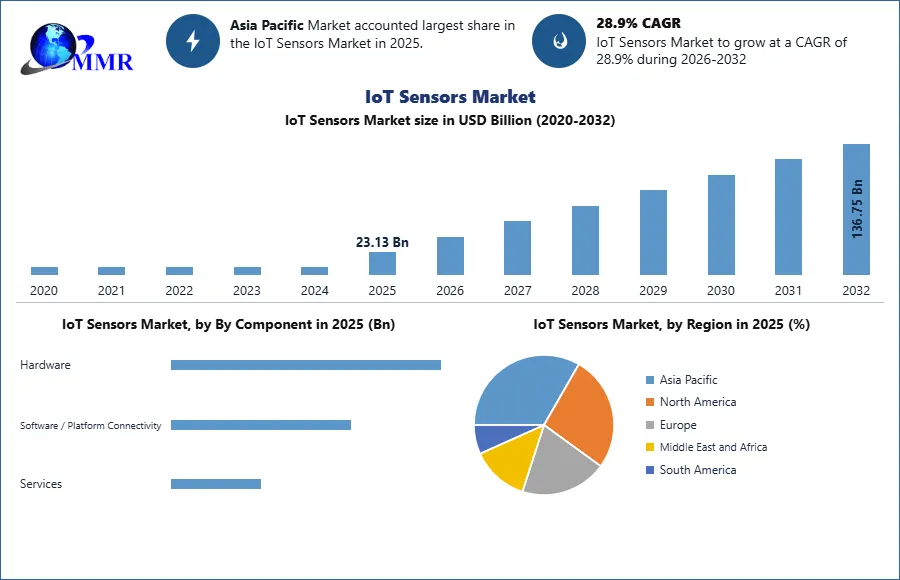
The IoT Sensors Market size was valued at USD 23.13  Billion in 2025 and the total IoT Sensors Market revenue is expected to grow at a CAGR of 28.9 % from 2026 to 2032, reaching nearly USD 136.75 Billion.

IoT Sensors Market Overview-

The IoT Sensors are technology innovation that makes it possible to connect devices and communicate with each other. IoT sensors are parts or pieces of hardware that help to detect changes in the environment and collect the data through sensors. For example, television is controlled through smartphone devices. Sensors are devices that gather real-time information about their surroundings. This information includes such as anything like temperature, pressure, and light. Wearable sensors in smartwatches help to monitor heart rate, blood pressure, etc. Factors such as rising demand for connected wearable devices, and the rise in the use of IoT sensors in the automotive and industrial sectors drives the growth of the IoT sensor market. IoT sensors play an important role in the development of smart cities. Data Privacy and data security hinder the demand for IoT sensors due to increased cyber-attacks. For example, in the use of IoT sensors in cars, a pressure sensor measures the amount of IoT that applies to steering when using the car on autopilot mode.
IoT Sensors Market (1)To know about the Research Methodology :- Request Free Sample Report

IoT Sensors Market Dynamics-

Increased application of IoT sensors in various sectors drives the IoT sensors market growth

Real-world data is collected through IoT Sensors data consists of various types such as environmental elements which include temperature, humidity, and air quality, it also gathers complicated data like motion and light. As IoT sensors are connected through various devices, IoT sensors can gather or collect information in a central processing unit or other interconnected devices. This stored information can later be used for analysis and decision-making, due to increased demand for IoT sensors in various businesses driving the IoT sensors market growth. IoT sensors are used in various sectors such as agriculture in which large farm owners can use sensors to monitor animal health. In the manufacturing industry, IoT Sensors are used for predictive maintenance. IoT is used to look after the manufacturing of products throughout their lifecycle. They help organizations to collect data about product design and customer service.

IoT sensors are used in the healthcare business for different purposes, including detecting changes in patient conditions and collecting data like body temperature, pulse rate, etc. Data collected by IoT sensors is saved in electronic health records. IoT solutions help doctors to check their patients' health without physical presence. In the food industry, IoT sensors are being used for tracking food during the production process, which helps food manufacturing companies check food safety more easily and accurately. For example, EcoPlant is an Israeli food manufacturer company that uses IoT sensors for predictive maintenance to monitor air compression packing The demand for IoT sensors is expanding due to increased applications in industries, including healthcare, real estate, automotive, food, and agriculture.

Privacy concerns and the generation of huge data create challenges for the IoT sensor market

The gathering of data by IoT sensors has brought uncertainties about the privacy of user's data. Information such as individuals' details, routines, and choices are continuously transmitted and saved, giving rise to ethical issues. Implementation of IoT solutions is a complex process as it requires a combination of various devices and platforms, complexity becomes a challenge and hinders the IoT sensors market growth. As data collected through IoT sensors is huge, processing and storing such massive amounts of data poses an IoT Sensor market challenge. When sensors which are installed on premises fails it creates problems in day-to-day business functions. Some sensors work inconsistently in different environmental conditions for example safety sensors of cars get blocked in winter due to snow. Attacks on IoT devices provide cybercriminals with all the sensitive data, In October 2023 data breach of the ICMR database exposed the personal information of millions of Indians. The estimated cost of the ICMR data breach is around USD 800 million. Government regulations are mandatory for IoT devices, In India testing and certifications comply with MTCTE guidelines, which are issued by the Department of Telecommunications.

IoT Sensors Market Segment Analysis

By sensor type- The pressure sensors segment dominated the IoT sensor market in 2025, These sensors are important for industries such as automotive, aerospace, healthcare, and manufacturing. They are generally used to measure pressures and to look after the safety and efficacy of various products. Pressure sensors are an electronic device that detects, collect, and monitor pressure in physical form and convert it into electronic signals by installing pressure sensors alerts are generated if there is a change in pressure, which avoids damage to machines or equipment. For example, car pressure sensors have various applications, such as monitoring tire pressure. In Tesla cars when auto steering is used the pressure sensor, measures the amount of IoT applied. In healthcare, they are essential components in medical devices like ventilators and infusion pumps, ensuring optimal pressure levels for patient care.

By End Use Industry: The industrial sector holds a dominant position in the IoT Sensors market. The industrial sector holds around forty percent share of the total market share. Including IoT sensors in industries helps in predictive maintenance, and supply chain management. Many companies are using IoT sensors to obtain real-time data which will help to track conditions of finished products. Understanding faults in finished products helps to detect faults in the process, which further helps in the decision-making process. The IoT Sensors market is expected to grow to increase industries and businesses.

IoT Sensors Market EcosystemIoT Sensor Market

IoT Sensors Market Regional Insights-

The Asia-Pacific region was dominant in the IoT sensor market in 2025, The Asia-Pacific region held a substantial market share and is serving as the hub for such technologies. This region is growing due to factors including an increase in industries, urbanization, and increasing demand for smart devices. In countries like China, Japan, and South Korea, IoT is important. In China's goals within the Fourth Industrial Revolution. It supplies the data essential for China's advancements in artificial intelligence and supports the infrastructure of China's progressively smart cities. IoT serves as a foundation of China's ambitions for intelligent automation in these areas. The Asia-Pacific region leads IoT sensor usage, due to b increase in the industrial sector. Many Asian countries are now focusing on smart city initiatives, which also increases the demand for IoT sensors in the region. The IoT Sensors market is expected to grow exponentially due to technological advancements in the region.

North America is the fastest-growing region in the IoT sensors market, North America is fastest growing because of established IoT sensor manufacturers in the region and faster adoption of IoT technology across different industries. Companies in the North America region are increasing the use of IoT to observe the functioning of their products, which helps to avoid excess costs related to breakdown. The broad use of IoT in North America is clear, as a Stanford University and Avast study found that households in this region have the highest density of IoT devices worldwide.



IoT Sensors Market Scope: Inquire before buying

IoT Sensors Market
Report Coverage Details
Base Year: 2025 Forecast Period: 2026-2032
Historical Data: 2020 to 2025 Market Size in 2025: 23.13 USD Billion
Forecast Period 2026-2032 CAGR: 28.9% Market Size in 2032: 136.75 USD Billion
Segments Covered: By Component Hardware
Software / Platform Connectivity
Services
by Sensor Type Pressure Sensors
Temperature Sensors
Humidity Sensors
Flow Sensors
Accelerometers
Magnetometers
Others
By Networking Technology Wired
    KNX
    LonWorks
    Ethernet
    MODBUS
    Digitak Addressable Lighting Interface (DALI)
Wireless
    Wi-Fi
    ZIGBEE
    Z-Wave
    Bluetooth
    NFC
    Process Field Bus
    Others
By Technology Type MEMS
Piezoelectric
Capacitive
Resistive
Optical
Magnetic
Other Technologies
By Verticals Consumer IoT
Commercial IoT
Industrial IoT
by Power Source Battery-Powered
Energy-Harvesting
Powered-over-Ethernet and Wired
by Organization Size Large Enterprises
Small and Medium-Sized Enterprises
by End User Consumer Electronics
Automotive
Industrial
Healthcare
Food & Beverages
Aerospace & Defense
Agriculture
Others

IoT Sensors Market, by Region:

North America (United States, Canada and Mexico)
Europe (UK, France, Germany, Italy, Spain, Sweden, Austria and Rest of Europe)
Asia Pacific (China, South Korea, Japan, India, Australia, Indonesia, Malaysia, Vietnam, Taiwan, Bangladesh, Pakistan and Rest of APAC)
Middle East and Africa (South Africa, GCC, Egypt, Nigeria and Rest of ME&A)
South America (Brazil, Argentina Rest of South America)

IoT Sensors Market,Key Players

  1. Texas Instruments
  2. Bosch Sensortec / Robert Bosch GmbH
  3. STMicroelectronics
  4. NXP Semiconductors
  5. Infineon Technologies
  6. Analog Devices, Inc.
  7. Honeywell International
  8. TE Connectivity
  9. Qualcomm (IoT segment)
  10. Sensirion
  11. Siemens AG
  12. ABB Ltd
  13. Sensata Technologies
  14. Emerson Electric Co.
  15. OMRON Corporation
  16. Monnit Corporation
  17. Murata Manufacturing Co., Ltd.
  18. Innovative Sensor Technology IST AG .
  19. Kita Sensor Tech. Co., Ltd.
  20. Hunan HKT Technology Co., Ltd
  21. Sony Semiconductor Solutions Corporation
  22. Rockwell Automation
  23. BeanAir
  24. Panasonic
  25. Schneider Electric
  26. Microchip Technology
  27. Renesas Electronics Corporation.
  28. Broadcom Limited
  29. Amphenol Corporation
  30. Cisco Systems, Inc

Table of Contents

1. IoT Sensors Market : Executive Summary 1.1. Study Assumption and Market Definition 1.2. Scope of the Study 1.3. Executive Summary 1.3.1 Market Size (2025) & Forecast (2026-2032), 1.3.2 Market Size (Value USD Mn.) and Market Share (%) - By Segments, Regions and Country 2. IoT Sensors Market : Competitive Landscapes 2.1. MMR Competition Matrix 2.2. Key Players Benchmarking 2.2.1 Company Name 2.2.2 Headquarter 2.2.3 Sensor Type Portfolio 2.2.4 Power Source Provided 2.2.5 Provided Technology Type Coverage 2.2.6 Connectivity & protocols supported 2.2.7 Innovation and R&D Investment 2.2.8 After-sales & deployment support 2.2.9 Market Share (%) 2025 2.2.10 Revenue 2025 (USD Million 2.2.11 YoY Growth (%) 2.2.12 Global Reach 2.3 Competitive Positioning Of Top Key Players 2.4. Market Structure 2.4.1 Market Leaders 2.4.2 Market Followers 2.4.3 Emerging Players 2.5. Strategic Developments, M&A, and Alliances 2.5.1 Recent Mergers and Acquisitions 2.5.2 Joint Ventures and Strategic Alliances 2.5.3 Licensing and IP Ownership Trends 2.5.4 Research and Development Pipeline Data By Top Key Players 3. IoT Sensors Market: Dynamics 3.1. IoT Sensors Market Trends 3.2. IoT Sensors Market Dynamics 3.2.1 Drivers 3.2.2 Restraints 3.2.3 Opportunities 3.2.4 Challenges 3.3. PORTER’s Five Forces Analysis 3.4. PESTLE Analysis 3.5. Key Opinion Leader Analysis For the Global Industry 4. Global IoT Ecosystem Overview 4.1 Global Connected Device Base (Million Units) – Volume & Forecast (2025–2032) 4.2 IoT Sensor Penetration Rate (%) Across Connected Devices 4.3 Global Installed Base of IoT Sensors (2025) 4.4 Total IoT Sensor Shipments – Volume & Forecast (2025–2032) 4.5 Industrial vs Consumer IoT Sensor Deployment Share (%) 4.6 Regional IoT Sensor Installed Base Distribution (2025) 5. Technological Innovations in the IoT Sensor Industry 5.1 Introduction to IoT Sensor Technology Innovation Landscape 5.2 Evolution of Core Sensor Technologies 5.3 MEMS and Microfabrication Advancements 5.4 Nano-Sensor and Advanced Material Integration 5.5 Multi-Sensor Fusion Technologies 5.6 Innovation in Industrial IoT Sensors 5.7 Predictive Maintenance and Condition Monitoring 5.8 Environmental and Process Monitoring Sensors 5.9 Smart Factory and Automation Integration 5.10 Innovation in Smart Building and Consumer IoT Sensors 5.11 Occupancy and Presence Detection 5.12 Indoor Air Quality (IAQ) Sensors 5.13 Wearable and Health Monitoring Sensors 5.14 Emerging Disruptive Technologies 5.15 Printed and Flexible Sensors 5.16 Quantum and Bio-Inspired Sensors 5.17 AI-Driven Autonomous Sensor Networks 6. Production Statistics (2020-2032) 6.1 Overview of key production-related data in the IOT Sensor market 6.2 Total production volume of IOT Sensor (2020-2025) 6.3 Total production volume of IOT Sensors globally (2020-2032) 6.4 Year-over-year production growth statistics 6.5 Sustainable Toys Production Share in % by Type (2025) 6.6 Regional Manufacturing Capacity Share of IOT Sensor (2025) (%) 7. Adoption Statistics (2020-2032) 7.1 Overview of market adoption trends for IOT Sensor 7.2 Global Adoption Rate of IOT Sensor type By Region In 2025 7.3 Adoption rates by Organization (2025)(%) 7.4 Adoption rates by End User (2025)(%) 7.5 Overview of Key Adoption Barriers 8. IoT Sensors Market : Integration Analysis 8.1 Global and Local Impact of IoT Sensor Integration by 2025 8.2 Smart Cities: A Global Shift Towards Urban Efficiency 8.3 Global and Local Impact of IoT Sensor Integration On Smart Cities 8.4 Healthcare: Empowering Local and Global Patient Care 8.5 Global and Local Impact of IoT Sensor Integration On Healthcare 8.6 The Evolution of IoT Sensors in 2025 8.7 Emerging Trends in IoT Sensor Integration by 2025 8.8 AI and Machine Learning-Powered IoT Sensors 8.9 Global and Local Impact of IoT Sensor Integration 5G Connectivity for Real-Time Data Transmission 5.1 Global and Local Impact of IoT Sensor Integration 5.2 Challenges to IoT Sensor Integration in 2025 5.3 Overview IoT Sensors Integration analysis A Local-to-Global Perspective 9. IoT Sensors Market : Supply Chain Analysis 9.1 IoT Sensor Ecosystem & Value Chain Mapping 9.2 Raw Material Suppliers (Semiconductor Wafers, Rare Earths) 9.3 Fabrication & Packaging Companies 9.4 Sensor Chip Designers 9.5 Module Integrators 9.6 IoT Platform Providers 9.7 Cloud & Data Analytics Providers 9.8 OEMs & End-Users 9.9 Distribution & Channel Partners 9.10 Aftermarket & Replacement Market 10. IoT Sensors Market : Price Analysis 10.1 IoT Sensors Market Price Overview 10.2 Global Price Landscape Overview 10.3 Historical ASP Trends (2020–2025) 10.4 Forecast Price Trends (2026–2032) 10.5 Key Factors Influencing Price Movements 10.6 Average Selling Price (ASP) Analysis 10.7 Global ASP by Sensor Type 10.8 Regional Price Analysis 10.9 Cost Structure Breakdown (2025) 10.10 Raw Material Cost Contribution (%) 10.11 Semiconductor Fabrication Cost 10.12 MEMS Manufacturing Cost 10.13 Packaging & Assembly Cost 10.14 Testing & Calibration Cost 10.15 Logistics & Distribution Cost 10.16 Certification & Compliance Cost 10.17 Analyis of Price Dynamics & Market Drivers 11. IoT Sensors Market : Trade Analysis 11.1 Overview of trade dynamics in the IOT Sensor market 11.2 Overview of IOT Sensor Trade Landscape 11.3 HS Codes Used for IOT Sensor 11.4 Country-Level Trade Flow Analysis 11.5 Top IOT Sensor Exporting Countries (2025) 11.6 Top IOT Sensor Importing Countries (2025) 11.7 Tariffs, Duties & Trade Policy Impact 12. Buyer Behavior & Procurement Intelligence (2025) 12.1 Global Buyer Segmentation Overview 12.2 Enterprise vs SME Procurement Patterns 12.3 OEM vs Aftermarket Purchasing Behavior 12.4 Industrial vs Consumer Buyer Dynamics 12.5 Regional Procurement Maturity Levels 12.6 Technical Evaluation Criteria (2025) 12.7 Accuracy & Precision Benchmarks 12.8 Environmental Durability (IP Rating, Temp Range) 12.9 Power Consumption Requirements 12.10 Connectivity Compatibility (LPWAN, BLE, 5G) 12.11 Edge AI Capability & Processing Power 12.12 Calibration & Drift Tolerance 12.13 Security & Encryption Standards 12.14 Overview of Vendor Selection Intelligence 12.15 Analysis of Regional Procurement Intelligence (2025) 13. End User Demand Analysis (2025) 13.1 Consumer Electronics Analysis 13.2 Mapping By Demand Drivers, Sensor Type Preferences, Revenue Contribution 13.3 Automotive Sector Analysis 13.4 Mapping By Demand Drivers, Sensor Type Preferences, Revenue Contribution 13.5 Industrial Sector Analysis 13.6 Mapping By Demand Drivers, Sensor Type Preferences, Revenue Contribution 13.7 Healthcare Sector Analysis 13.8 Mapping By Demand Drivers, Sensor Type Preferences, Revenue Contribution 13.9 Aerospace & Defense Sector Analysis 13.10 Mapping By Demand Drivers, Sensor Type Preferences, Revenue 13.11 Others 13.12 Global IOT sensor Volume (Units) Share By End User (2025) (%) 13.13 IOT sensor Demand Contribution Share by Vertical (%) (2025) 13.14 IOT sensor Demand Contribution Share by OEM vs Aftermarket Split (2025)(%) 13.15 IOT sensor Demand Contribution Share by Enterprise vs SME Adoption (2025) (%) 14. Sustainability & Environmental Impact & Life Cycle, And System Longevity Analysis 14.1 Sustainable sourcing of raw materials and components 14.2 Key Environmental Benefits of IoT Sensors Types 14.3 Life Cycle Environmental Impact of IoT Sensors Types 14.4 Sustainability Drivers in IoT Sensors 14.5 Environmental Regulations and Compliance 14.6 Environmental Impact Assessment (EIA) Methodology for IoT Sensors 14.7 Sustainability in Technology Type Manufacturing and Component Sourcing 14.8 IoT Sensors Type Lifecycle- Design and Planning Stage, Verticals Phase, Operational Phase and End-of-Life Phase. 14.9 Impact of Regular Maintenance on sensor Type Performance and Longevity 14.10 Industry Standards for Maintenance and Sensor Type Lifespan 15. Investment Landscape & Growth Opportunities 15.1 Overview of venture capital, private equity, and public funding in the sector. 15.2 Investment potential in Asia-Pacific, Africa, and Latin America. 15.3 Opportunities for Roadmap for Industry Development. 15.4 Funding Analysis of Government Grants and Incentives for IoT Sensors Innovation and Research 16. Policy, Regulatory, and Compliance Environment 16.1 Global Regulatory Overview for IoT Sensors 16.2 ISO Standards for Industrial Sensors 16.3 Automotive-Grade Certifications (AEC-Q100, ISO 26262) 16.4 ATEX & Hazardous Area Compliance 16.5 Data & Cybersecurity Regulations 16.6 GDPR Impact on Sensor Data 16.7 U.S. IoT Cybersecurity Regulations 16.8 China Cybersecurity Law Implications 16.9 Wireless & RF Certification 16.10 FCC, CE, ETSI Requirements 16.11 Spectrum Allocation for LPWAN & 5G IoT 16.12 Certification Timelines & Cost Implications 16.13 Environmental & Sustainability Regulations 16.14 RoHS (Restriction of Hazardous Substances) 16.15 REACH Compliance 16.16 WEEE (Waste Electrical & Electronic Equipment) 16.17 Carbon Emission Reporting Requirements 16.18 ESG & Sustainable Electronics Standards 16.19 Circular Economy & E-Waste Management Policies 16.20 Government Initiatives & Incentives 16.21 Semiconductor Subsidy Programs 16.22 Smart City & Digital Infrastructure Policies 16.23 Industry 4.0 Support Programs 16.24 R&D Grants for IoT Sensor Innovation 16.25 Domestic Manufacturing Incentives 16. Cybersecurity Risk Analysis 16.1 Global IoT Threat Landscape (2025) 16.2 Evolution of IoT Sensor Cyber Risks (2020–2025) 16.3 Attack Surface Expansion in Connected Sensor Networks 16.4 Risk Exposure by Deployment Scale 16.5 Cybersecurity Maturity Levels by Industry 16.6 Cybersecurity Investment & Budget Trends 16.7 Overview of Vulnerability Drivers & Root Causes 16.8 Industry 4.0 Cybersecurity Controls Benchmark 16.9 Standards, Policy & Compliance Requirements 18. IoT Sensors Market: Global Market Size and Forecast by Segmentation (by Value in USD Billion) (2025-2032) 18.1. Global IoT Sensors Market Size and Forecast, By Component 18.1.1 Hardware 18.1.2 Software / Platform Connectivity 18.1.3 Services 18.2. Global IoT Sensors Market Size and Forecast, by Sensor Type 18.2.1 Temperature Sensors 18.2.2 Pressure Sensors 18.2.3 Humidity Sensors 18.2.4 Flow Sensors 18.2.5 Accelerometers 18.2.6 Magnetometers 18.2.7 Gyroscopes 18.2.8 Inertial Sensors 18.2.16 Others 18.3. Global IoT Sensors Market Size and Forecast, By Networking Technology 18.3.1 Wired 18.3.2 KNX 18.3.3 LonWorks 18.3.4 Ethernet 18.3.5 MODBUS 18.3.6 Digitak Addressable Lighting Interface (DALI) 18.3.7 Wireless 18.3.8 Wi-Fi 18.3.9 ZIGBEE 18.3.10 Z-Wave 18.3.11 Bluetooth 18.3.12 NFC 18.3.13 Process Field Bus 18.3.14 Others 18.4. Global IoT Sensors Market Size and Forecast, By Technology Type 18.4.1 MEMS 18.4.2 Piezoelectric 18.4.3 Capacitive 18.4.4 Resistive 18.4.5 Optical 18.4.6 Magnetic 18.4.7 Other Technologies 18.5. Global IoT Sensors Market Size and Forecast, By Verticals 18.5.1 Consumer IoT 18.5.2 Commercial IoT 18.5.3 Industrial IoT 18.6. Global IoT Sensors Market Size and Forecast, by Power Source 18.6.1 Battery-Powered 18.6.2 Energy-Harvesting 18.6.3 Powered-over-Ethernet and Wired 18.7. Global IoT Sensors Market Size and Forecast, by Organization Size 18.7.1 Large Enterprises 18.7.2 Small and Medium-Sized Enterprises 18.8. Global IoT Sensors Market Size and Forecast, by End User 18.8.1 Consumer Electronics 18.8.2 Automotive 18.8.3 Industrial 18.8.4 Healthcare 18.8.5 Food & Beverages 18.8.6 Aerospace & Defense 18.8.7 Agriculture 18.8.8 Others 18.9. Global IoT Sensors Market Size and Forecast, by Region 18.9.1 North America 18.9.2 Europe 18.9.3 Asia Pacific Middle East and Africa 18.9.4 South America 19.North America IoT Sensors Market Size and Forecast by Segmentation (by Value in USD Billion) (2025-2032) 19.1. North America Market Size and Forecast, By Component 19.2. North America Market Size and Forecast, by Sensor Type 19.3. North America Market Size and Forecast, By Networking Technology 19.4. North America Market Size and Forecast, By Technology Type 19.5. North America Market Size and Forecast, By Verticals 19.6. North America Market Size and Forecast, by Power Source 19.7. North America Market Size and Forecast, by Organization Size 19.8. North America Market Size and Forecast, by End-User 19.9. North America Market Size and Forecast, by Country 19.9.1 United States 19.9.2 United States Market Size and Forecast, By Component 19.9.3 United States Market Size and Forecast, by Sensor Type 19.9.4 United States Market Size and Forecast, By Networking Technology 19.9.5 United States Market Size and Forecast, By Technology Type 19.9.6 United States Market Size and Forecast, By Verticals 19.9.7 United States Market Size and Forecast, By Power Source 20. Europe IoT Sensors Market Size and Forecast by Segmentation (by Value in USD Billion) (2025-2032) 20.1. Europe Market Size and Forecast, By Component 20.2. Europe Market Size and Forecast, by Sensor Type 20.3. Europe Market Size and Forecast, By Networking Technology 20.4. Europe Market Size and Forecast, By Technology Type 20.5. Europe Market Size and Forecast, By Verticals 20.6. Europe Market Size and Forecast, by Power Source 20.7. Europe Market Size and Forecast, by Organization Size 20.8. Europe Market Size and Forecast, by End-User 20.9. Europe Market Size and Forecast, by Country 20.9.1 United Kingdom 20.9.2 France 20.9.3 Germany 20.9.4 Italy 20.9.5 Spain 20.9.6 Netherlands 20.9.7 Belgium 20.9.8 Russia 20.9.9 Turkey 20.9.10 Sweden 20.9.11 Poland 20.9.12 Rest of Europe 21. Asia Pacific IoT Sensors Market Size and Forecast by Segmentation (by Value in USD Billion) (2025-2032) 21.1. Asia Pacific Market Size and Forecast, By Component 21.2. Asia Pacific Market Size and Forecast, by Sensor Type 21.3. Asia Pacific Market Size and Forecast, By Networking Technology 21.4. Asia Pacific Market Size and Forecast, By Technology Type 21.5. Asia Pacific Market Size and Forecast, By Verticals 21.6. Asia Pacific Market Size and Forecast, by Power Source 21.7. Asia Pacific Market Size and Forecast, by Organization Size 21.8. Asia Pacific Market Size and Forecast, by End-User 21.9. Asia Pacific Market Size and Forecast, by Country 21.9.1 China 21.9.2 South Korea 21.9.3 Japan 21.9.4 India 21.9.5 Taiwan 21.9.6 Australia 21.9.7 Indonesia 21.9.8 Philippines 21.9.9 Malaysia 21.9.10 Vietnam 21.9.11 Thailand 21.9.12 Rest of Asia Pacific 22.. Middle East and Africa IoT Sensors Market Size and Forecast by Segmentation (by Value in USD Billion) (2025-2032) 22..1. Middle East and Africa Market Size and Forecast, By Component 22..2. Middle East and Africa Market Size and Forecast, by Sensor Type 22..3. Middle East and Africa Market Size and Forecast, By Networking Technology 22..4. Middle East and Africa Market Size and Forecast, By Technology Type 22..5. Middle East and Africa Market Size and Forecast, By Verticals 22..6. Middle East and Africa Market Size and Forecast, by Power Source 22..7. Middle East and Africa Market Size and Forecast, by Organization Size 22..8. Middle East and Africa Market Size and Forecast, by End-User 22..9. Middle East and Africa Market Size and Forecast, by Country 22.1 South Africa 22.2 GCC 22.3 Egypt 22.4 Nigeria 22.5 Rest of ME&A 23. South America IoT Sensors Market Size and Forecast by Segmentation (by Value 23.1 in USD Billion) (2025-2032) 23.1. South America Market Size and Forecast, By Component 23.2. South America Market Size and Forecast, by Sensor Type 23.3. South America Market Size and Forecast, By Networking Technology 23.4. South America Market Size and Forecast, By Technology Type 23.5. South America Market Size and Forecast, By Verticals 23.6. South America Market Size and Forecast, by Power Source 23.7. South America Market Size and Forecast, by Organization Size 23.8. South America Market Size and Forecast, by End-User 23.9. South America Market Size and Forecast, by Country 23.9.1 Brazil 23.9.2 Argentina 23.9.3 Colombia 23.9.4 Chile 23.9.5 Rest Of South America 24. Company Profile: Key Players 24.01. Texas Instruments 24.01.1 Company Overview 24.01.2 Business Portfolio 24.01.3 Financial Overview 24.01.4 SWOT Analysis 24.01.5 Strategic Analysis 24.02. Bosch Sensortec / Robert Bosch GmbH 24.03. STMicroelectronics 24.04. NXP Semiconductors 24.05. Infineon Technologies 24.06. Analog Devices, Inc. 24.07. Honeywell International 24.08. TE Connectivity 24.09. Qualcomm (IoT segment) 24.10. Sensirion 24.11. Siemens AG 24.12. ABB Ltd 24.13. Sensata Technologies 24.14. Emerson Electric Co. 24.15. OMRON Corporation 24.16. Monnit Corporation 24.17. Murata Manufacturing Co., Ltd. 24.18. Innovative Sensor Technology IST AG . 24.19. Kita Sensor Tech. Co., Ltd. 24.20. Hunan HKT Technology Co., Ltd 24.21. Sony Semiconductor Solutions Corporation 24.22 Rockwell Automation 24.23. BeanAir 24.24. Panasonic 24.25. Schneider Electric 24.26. Microchip Technology 24.27. Renesas Electronics Corporation. 24.28. Broadcom Limited 24.29. Amphenol Corporation 24.30. Cisco Systems, Inc. 24.30.1 Others 25. Key Findings 26. Strategic Recommendations 27. IoT Sensors Market: Research Methodology

Custom Market Research Services

We Will Customise The Research For You, In Case The Report Listed Above Does Not Meet With Your Requirements