E-commerce Logistics Market - Industry Structure Evaluation, Demand Drivers Analysis, Regional Growth Analysis and Identification, Competitive Positioning / Landscape Review & Global Market Size Forecast to 2034

21.4%
CAGR (2026-2034)
459.71 USD Bn.
Forecast Market Size
317
Report Pages
123
Market Tables

Overview

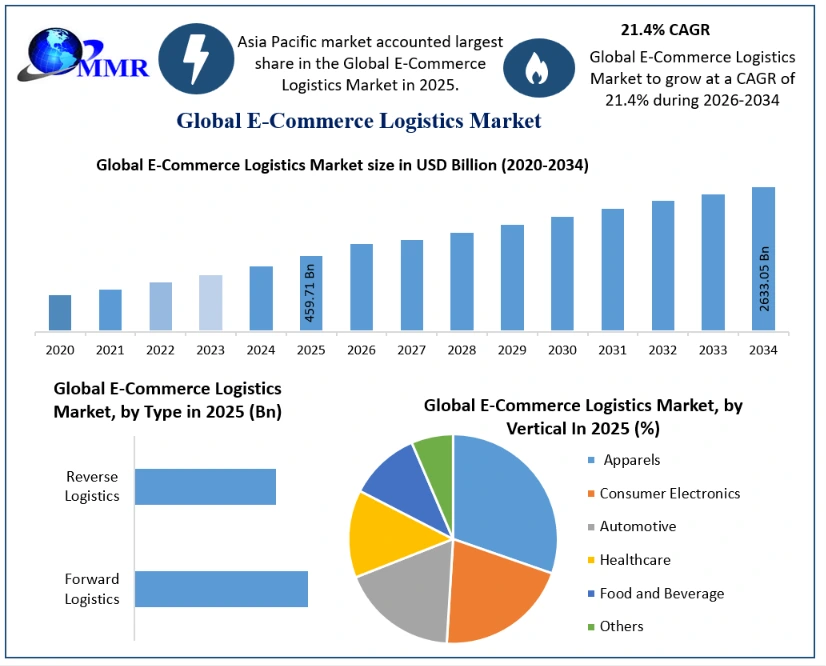
Global E-commerce Logistics Market size was valued at USD 459.71 Bn. in 2026, and the total Global E-commerce Logistics Market revenue is expected to grow by 21.4% from 2026 to 2034, reaching nearly USD 2633.05 Bn.

In the past years, the E-commerce Logistics Market has grown at a remarkable rate and is projected to showcase a lucrative growth over the upcoming years.

E-commerce Logistics Market Definition:

E-Commerce logistics is a set of cooperative technologies & communication computing that helps to transform logistical processes to be consumer centric by sharing data, knowledge and information with supply chain partners. The ultimate goal of e-commerce logistic is to deliver right product in right quantities at right place and to the right customer.

E-commerce Logistics Market Size, Share and Growth  AnalysisE-Commerce Logistics Market Growth
To know about the Research Methodology :- Request Free Sample Report

E-commerce Logistics Market Dynamics:

The scope of the report includes a detailed study of global and regional markets for Global E-commerce Logistics Market with the reasons given for variations in the growth of the industry in certain regions. Logistics has become an essential component of an E-commerce business as it is accountable for planning, control and flow of products from the point of origin to end-user. The proliferation of the e-commerce segment and consequent increase in cross-border e-commerce trading activities has been one of the major factors fueling e-commerce logistics market globally.

The upsurge in cross-border e-commerce trading activities is majorly on account of trade liberalization. Therefore, rises in both intra-regional and cross-border trades are collectively contributing to the growth of the global market for e-commerce logistics. Developing digital habits of users and increased Internet penetration, especially in emerging countries is assumed to influence the overall market growth as it will augment demand for foreign goods in these countries.

E-commerce Logistics Market Trends:

Technological advancement in E-commerce logistics is one of the major trends that will contribute to e-commerce logistics market growth. Technological advancements like blockchain technology play an important role in revolutionizing e-commerce logistics because it helps in providing reliable tracking information to the clients. This technology offers efficient and cost-saving business operations for e-commerce logistics companies. Also, advances in printed electronics technology are the creation of e-commerce logistics more economical.

E-commerce Logistics Market Segment Analysis:

Based on Service Type, the Transportation segment is expected to account for the largest xx% market share by 2034. Investments made by the government are for the development of road structure and to ensure proper connectivity between rural and urban areas is instrumental in driving transportation by roadways. Moreover, benefits offered in terms of accessibility, reliability, the flexibility of operations, and service make highway a preferred mode of transport.

Based on Operation, the Domestic segment dominated the E-commerce Logistics Market in 2025 and is expected to maintain its lead during the forecast period. This dominance is driven by the rapid expansion of online shopping within national borders, shorter delivery timelines, and the growing demand for same-day or next-day delivery services.

E-commerce Logistics Market Regional Analysis:

Asia Pacific play important roles in, with a market size of US$ xx Mn in 2025 and will be US$ xx Mn in 2034, with a CAGR of xx%. This is because of the increasing population in APAC. The growth of the e-commerce industry in economies such as India, China, and Japan is one of the primary factors that will drive the growth of the market in the Asia-Pacific region.

E-commerce Logistics Market Competitive Landscape:

Players in the Global E-commerce Logistics Market are more focused on enhancing their product and service offerings through various strategic approaches. FedEx is headquartered in the U.S and operates under many business segments, namely FedEx Express, FedEx Ground, FedEx Freight, and FedEx Services. The company offers integrated solutions designed to streamline and support online businesses.

The objective of the report is to present a comprehensive analysis of the Global E-commerce Logistics Market including all the stakeholders of the industry. The past and current status of the industry with forecasted market size and trends are presented in the report with the analysis of complicated data in simple language. The report covers all the aspects of the industry with a dedicated study of key players that includes market leaders, followers and new entrants by region.

PORTER, SVOR, PESTEL analysis with the potential impact of micro-economic factors by region on the market has been presented in the report. External as well as internal factors that are supposed to affect the business positively or negatively have been analyzed, which will give a clear futuristic view of the industry to the decision-makers.

The report also helps in understanding Global Market dynamics, structure by analyzing the market segments and projects the Global Market size. Clear representation of competitive analysis of key players by Application, price, financial position, Product portfolio, growth strategies, and regional presence in the Global Market make the report investor’s guide.

E-commerce Logistics Market Recent Developments:

Date Company Development Impact
28 May 2025 JD Logistics JD Logistics accelerated its international fulfillment expansion by doubling its overseas warehouse space and air cargo footprint across Asia, Europe, and North America. The expansion reinforces two-to-three-day cross-border delivery service levels for international e-commerce sellers.
27 May 2026 Amazon Amazon committed a $20 billion investment in the UK to establish new robotic fulfillment sites and expand nationwide delivery networks. The capital injection significantly scales automated order processing capacity and last-mile infrastructure to handle surging e-commerce package volumes.
28 May 2026 DHL eCommerce DHL eCommerce signed an exclusive, multi-year $10 billion last-mile delivery contract with the United States Postal Service (USPS). The partnership leverages USPS's national postal distribution network to optimize final-mile delivery costs without requiring redundant infrastructure investments.
18 June 2026 Delhivery Delhivery partnered with Bajaj Auto to deploy 1,500 Bajaj RIKI eCarts across Tier-2 and Tier-3 urban markets. The initiative accelerates fleet electrification and reduces per-parcel operational costs for micro-fulfillment and last-mile e-commerce deliveries.
15 July 2026 DTDC Express Ltd. DTDC Express Ltd. inaugurated the DTDC Bharat One Hub facility in Haryana to scale up hub-and-spoke processing capability. The strategic hub strengthens regional sorting throughput and expands national last-mile delivery coverage for online merchants.

E-commerce Logistics Market Scope: Inquire before buying

Global E-commerce Logistics Market
Report Coverage Details
Base Year: 2025 Forecast Period: 2026-2034
Historical Data: 2020 to 2025 Market Size in 2025: USD 459.71  Bn.
Forecast Period 2026 to 2034 CAGR: 21.4% Market Size in 2034: USD 2633.05  Bn.
Segments Covered: by Type Forward Logistics
Reverse Logistics
by Service Type Transportation
Airways
  Railways
  Roadways
  Waterways
Warehousing
Mega Centers
  Hubs/Delivery Centers
  Returns Processing Centers
Others
by Model 3PL
4PL
Others
by Operation Domestic
International
by Vertical Apparels
Consumer Electronics
Automotive
Healthcare
Food and Beverage
Others

E-commerce Logistics Market, by Region

North America (United States, Canada and Mexico)
Europe (UK, France, Germany, Italy, Spain, Sweden, Austria and Rest of Europe)
Asia Pacific (China, South Korea, Japan, India, Australia, Indonesia, Malaysia, Vietnam, Taiwan, Bangladesh, Pakistan and Rest of APAC)
Middle East and Africa (South Africa, GCC, Egypt, Nigeria and Rest of ME&A)
South America (Brazil, Argentina Rest of South America)

E-commerce Logistics Market, Key Players are:

North America
1. FedEx Corporation
2. United Parcel Service, Inc. (UPS)
3. Amazon Logistics (Amazon.com, Inc.)
4. XPO, Inc.
5. GXO Logistics, Inc.
6. C.H. Robinson Worldwide, Inc.
7. J.B. Hunt Transport Services, Inc.
8. Kenco Group, Inc.
9. CEVA Logistics (CMA CGM Group)
10. Ryder System, Inc.
11. Flexport, Inc.
12. ShipBob, Inc.
13. Radial, Inc. (bpost SA/NV)
14. United States Postal Service (USPS)
15. Purolator Inc. (Canada Post Corporation)
16. Canada Post Corporation
Others

Europe
17. DHL Group (Deutsche Post DHL Group)
18. DSV A/S
19. DB Schenker (DSV A/S — acquired 2024/2025)
20. Kuehne+Nagel International AG
21. Rhenus Group (Rhenus SE & Co. KG)
22. Geodis S.A. (SNCF Group)
23. PostNL N.V.
24. International Distributions Services plc (Royal Mail — taken private by EP Group, 2025)
25. Groupe La Poste
26. GeoPost S.A. (DPD Group) (Groupe La Poste)
27. Poste Italiane S.p.A.
28. Correos (Sociedad Estatal Correos y Telégrafos, S.A.)
29. PostNord AB
30. Bpost SA/NV
31. Swiss Post (Die Schweizerische Post)
Others

Asia Pacific
32. JD Logistics, Inc. (JD.com, Inc.)
33. Cainiao Smart Logistics Network Ltd. (Alibaba Group Holding Limited)
34. SF Express Co., Ltd. (S.F. Holding Co., Ltd.)
35. Delhivery Limited
36. Blue Dart Express Limited (DHL Group)
37. Nippon Express Holdings, Inc.
38. Yamato Holdings Co., Ltd.
39. Sagawa Express Co., Ltd. (SG Holdings Co., Ltd.)
40. Singapore Post Limited
41. Ninja Logistics Pte. Ltd. (Ninja Van)
42. Shadowfax Technologies Private Limited
43. Ecom Express Private Limited
44. XpressBees (BusyBees Logistics Solutions Private Limited)
45. DTDC Express Limited
46. Australia Post (Australian Postal Corporation)
47. StarTrack (Australia Post)
Others

Middle East & Africa
48. Aramex International (Aramex PJSC)
49. Agility Public Warehousing Company K.S.C.P.
50. iMile Delivery Services
51. Saudi Post (SPL)
52. Emirates Post Group

South America
53. Total Express
54. Mercado Envíos (Mercado Libre, Inc.)
55. Correios (Empresa Brasileira de Correios e Telégrafos)
56. Loggi

Frequently Asked Questions:

1. Which region has the largest share in Global Market?
Ans: Asia Pacific region held the highest share in 2025.

2. What is the growth rate of Global E-commerce Logistics Market?
Ans: The Global Market is growing at a CAGR of 21.4% during forecasting period 2026-2034.

3. What is scope of the Global market report?
Ans: Global Market report helps with the PESTEL, PORTER,  Recommendations for Investors & Leaders, and market estimation of the forecast period.

4. Who are the key players in Global Market?
Ans: The important key players in the Global Market are – Deutsche Post AG, DHL International GmbH, FedEx Corporation, SF Express Co., Ltd., Amazon.com, Inc., United Parcel Service, Inc., Clipper Logistics Plc., CEVA Logistics, C.H. Robinson Worldwide, Inc.

5. What is the study period of this Market?
Ans: The Global Market is studied from 2020 to 2034.

Table of Contents

1. Global E-Commerce Logistics Market Introduction 1.1. Executive Market Landscape and Industry Overview 1.1.1. Global E-Commerce Logistics Market Size (Value USD Mn), 2025–2034 1.1.2. Historical Market Size Trends and Growth Momentum Analysis 1.1.3. Forecast Revenue Projections With Underlying Market Growth Drivers 1.1.4. Demand-Supply Balance Influencing Global Market Expansion 1.1.5. Impact of Macroeconomic Indicators on E-Commerce Logistics Market Growth Trajectory 1.1.6. Impact of Online Retail Penetration on Logistics Volume and Service Requirements 1.1.7. Long-Term Market Outlook Highlighting Growth Opportunities 1.1.8. CAGR Analysis of Global E-Commerce Logistics Market (2025–2034) 1.2. E-Commerce Logistics Market Dynamics 1.2.1. E-Commerce Logistics Market Trends 1.2.2. E-Commerce Logistics Market Dynamics 1.2.2.1. Drivers 1.2.2.2. Restraints 1.2.2.3. Opportunities 1.2.2.4. Challenges 1.2.3. PORTER’s Five Forces Analysis 1.2.4. PESTLE Analysis 1.3. E-Commerce Logistics Pricing Structure and Value Chain Profitability Assessment 1.3.1. Comprehensive Breakdown of E-Commerce Logistics Cost Structure Across Value Chain 1.3.2. Cost Distribution Across Warehousing, Fulfillment, Transportation, Last-Mile Delivery, and Reverse Logistics 1.3.3. Margin Distribution Analysis Among Logistics Providers, Fulfillment Operators, Carriers, and Delivery Partners 1.3.4. Impact of Fuel Price Fluctuation on E-Commerce Logistics Pricing 1.3.5. Strategies 1.3.6. Influence of Labor Costs on Fulfillment and Last-Mile Delivery Economics 1.3.7. Impact of Delivery Distance, Parcel Density, and Delivery Speed on Logistics Costs 1.4. E-Commerce Evolution and Its Impact on Logistics Infrastructure 1.4.1. Evolution From Traditional Retail to Digital-First and E-Commerce Business Models 1.4.2. Rising Online Shopping Penetration and Its Influence on Logistics Demand 1.4.3. Growth of Mobile Commerce and Its Impact on Order Frequency and Delivery Volumes 1.4.4. Expansion of Marketplace-Based E-Commerce and Third-Party Logistics Requirements 1.4.5. Social Commerce and Live Commerce Driving New Fulfillment and Delivery Models 1.4.6. Emergence of Quick Commerce and Ultra-Fast Delivery Expectations 1.5. Consumer Behavior Evolution and E-Commerce Delivery Expectations 1.5.1. Rising Consumer Preference Toward Convenient and Flexible E-Commerce Delivery Services 1.5.2. Influence of Lifestyle Changes on Online Shopping and Delivery Frequency 1.5.3. Demographic and Psychographic Factors Influencing E-Commerce Logistics Demand 1.5.4. Growing Preference for Same-Day and Next-Day Delivery Services 1.5.5. Consumer Expectations for Real-Time Order Tracking and Delivery Visibility 1.5.6. Increasing Adoption of Delivery Time-Slot Selection and Flexible Delivery Options 1.5.7. Influence of Free Shipping Policies on Consumer Purchase and Logistics Economics 1.5.8. Consumer Preference for Easy Returns and Hassle-Free Reverse Logistics 1.6. E-Commerce Fulfillment Models and Operational Innovation 1.6.1. Evolution of Centralized and Decentralized E-Commerce Fulfillment Models 1.6.2. Growth of Distributed Fulfillment Networks to Reduce Delivery Time 1.6.3. Micro-Fulfillment Centers Supporting Rapid Order Processing 1.6.4. Dark Stores and Local Fulfillment Hubs Supporting Quick Commerce 1.6.5. Ship-from-Store and Store-as-a-Fulfillment-Center Models 1.6.6. Cross-Docking Strategies Enhancing Order Processing Efficiency 1.6.7. Drop-Shipping Models and Their Influence on Inventory and Logistics Structures 1.7. Warehouse Automation and Fulfillment Technology Innovation 1.7.1. Adoption of Warehouse Automation Across E-Commerce Fulfillment Centers 1.7.2. Automated Storage and Retrieval Systems Enhancing Warehouse Productivity 1.7.3. Robotics and Autonomous Mobile Robots Supporting Order Picking and Movement 1.7.4. Artificial Intelligence in Inventory Planning and Fulfillment Optimization 1.7.5. Computer Vision Technologies Supporting Sorting, Picking, and Quality Control 1.7.6. IoT-Enabled Warehouse Monitoring and Asset Tracking 1.7.7. Industry 4.0 Implementation Across E-Commerce Logistics Facilities 1.8. Last-Mile Delivery Evolution and Distribution Network Dynamics 1.8.1. Last-Mile Delivery as a Critical Driver of E-Commerce Logistics Market Development 1.8.2. Rising Demand for Same-Day and Next-Day Last-Mile Delivery 1.8.3. Urban Delivery Challenges and Solutions Across High-Density Markets 1.8.4. Parcel Locker and Pick-Up Point Expansion Supporting Delivery Flexibility 1.8.5. Autonomous Delivery Vehicles and Drones in Last-Mile Logistics 1.8.6. Electric Vehicle Adoption for Sustainable Last-Mile Delivery 1.8.7. Route Optimization and Dynamic Delivery Planning Technologies 1.9. Digital Transformation and Technology-Enabled Logistics 1.9.1. Artificial Intelligence and Machine Learning in E-Commerce Logistics Optimization 1.9.2. Big Data Analytics Supporting Demand Forecasting and Capacity Planning 1.9.3. Cloud-Based Logistics Management Platforms 1.9.4. Real-Time Shipment Tracking and End-to-End Supply Chain Visibility 1.9.5. Digital Freight Platforms Connecting Shippers and Logistics Providers 1.9.6. Predictive Analytics for Delivery Delay and Exception Management 1.10. Omnichannel Logistics and Inventory Distribution Transformation 1.10.1. Integration of Online and Offline Inventory Across Omnichannel Retail Networks 1.10.2. Buy Online, Pick Up In-Store (BOPIS) and Click-and-Collect Logistics Models 1.10.3. Buy Online, Return In-Store (BORIS) and Integrated Reverse Logistics 1.10.4. Ship-from-Store Models Supporting Faster Customer Fulfillment 1.10.5. Distributed Inventory Strategies Reducing Delivery Distance 1.10.6. Real-Time Inventory Visibility Across Multiple Sales Channels 1.11. Sustainability and Green E-Commerce Logistics Trends 1.11.1. Rising Demand for Sustainable E-Commerce Logistics Solutions 1.11.2. Electric Vehicle Adoption in Last-Mile Delivery Fleets 1.11.3. Alternative Fuel and Low-Emission Transportation Solutions 1.11.4. Sustainable Packaging and Reduction of Packaging Waste 1.11.5. Carbon Footprint Reduction Across E-Commerce Supply Chains 1.11.6. Route Optimization Supporting Fuel and Emission Reduction 1.11.7. Green Warehousing and Energy-Efficient Fulfillment Centers 1.12. Import-Export Trade Analysis (2025) 1.12.1. Global Cross-Border E-Commerce Trade Flow Trends 1.12.2. Import-Export Patterns Influencing International E-Commerce Logistics Demand 1.12.3. Cross-Border Parcel Movement and International Delivery Trends 1.12.4. Customs Clearance and Border Processing Challenges 1.12.5. Tariff and Regulatory Barriers Affecting Cross-Border E-Commerce Logistics 1.12.6. Geopolitical Factors Impacting International E-Commerce Supply Chains 1.13. Transportation Technologies and Process Optimization Trends 1.13.1. Adoption of Transportation Management Systems Across E-Commerce Logistics 1.13.2. Artificial Intelligence-Based Route and Fleet Optimization 1.13.3. Automated Parcel Sorting and Transportation Planning 1.13.4. Real-Time Fleet Tracking and Telematics Technologies 1.13.5. Autonomous Vehicles in E-Commerce Transportation 1.13.6. Drone Delivery Technologies and Commercial Deployment Trends 1.13.7. Electric and Alternative-Fuel Commercial Delivery Vehicles 1.14. Reverse Logistics and Returns Management Evolution 1.14.1. Rapid Growth of E-Commerce Returns and Its Impact on Logistics Networks 1.14.2. Rising Consumer Expectations for Free and Convenient Returns 1.14.3. Reverse Logistics Cost and Profitability Challenges 1.14.4. Automated Returns Processing and Sorting Technologies 1.14.5. Return-to-Warehouse and Return-to-Store Logistics Models 1.14.6. Refurbishment, Resale, Recycling, and Disposal of Returned Products 1.15. Peak Season Demand and E-Commerce Logistics Performance Analysis 1.15.1. Peak Season Parcel Volume Contribution to Overall Annual Logistics Revenue 1.15.2. Demand Variations During Major Online Shopping Events 1.15.3. Impact of Black Friday, Cyber Monday, Singles' Day, and Regional Shopping Festivals 1.15.4. Capacity Planning and Fleet Allocation During Peak Demand Cycles 1.15.5. Temporary Warehousing and Workforce Expansion Strategies 1.15.6. Delivery Performance and Service-Level Management During Peak Seasons 1.16. Regulatory Framework and Compliance Analysis 1.16.1. Global Regulations Governing E-Commerce Logistics Operations 1.16.2. Transportation and Freight Regulations Across Major Markets 1.16.3. Cross-Border Customs and Import-Export Compliance Requirements 1.16.4. Data Protection and Privacy Regulations Affecting Digital Logistics Platforms 1.16.5. Packaging Waste and Extended Producer Responsibility Regulations 1.16.6. Environmental Regulations Governing Commercial Delivery Fleets 1.17. Delivery Experience and Customer Service Strategy Analysis 1.17.1. Delivery Speed as a Key Differentiation Factor in E-Commerce 1.17.2. Real-Time Tracking and Shipment Visibility Enhancing Customer Experience 1.17.3. Flexible Delivery Options and Customer Convenience 1.17.4. Delivery Accuracy and On-Time Performance Benchmarking 1.17.5. Parcel Locker and Pick-Up Point Strategies 1.17.6. Customer Communication and Automated Delivery Notifications 1.18. Emerging E-Commerce Business Models and Logistics Demand Patterns 1.18.1. Gen Z and Millennial Shopping Preferences Driving E-Commerce Logistics Demand 1.18.2. Social Commerce and Influencer-Led Commerce Logistics Requirements 1.18.3. Quick Commerce and Ultra-Fast Delivery Models 1.18.4. Subscription-Based E-Commerce and Recurring Delivery Volumes 1.18.5. Direct-to-Consumer Brands and Their Logistics Requirements 1.18.6. Marketplace Seller Growth and Third-Party Logistics Adoption 1.19. Third-Party Logistics and Platform-Based Logistics Expansion 1.19.1. Growth of Third-Party Logistics Providers Supporting E-Commerce Businesses 1.19.2. Increasing Outsourcing of Warehousing and Fulfillment Operations 1.19.3. Fourth-Party Logistics and Integrated Supply Chain Management Models 1.19.4. Logistics-as-a-Service Models Supporting E-Commerce Businesses 1.19.5. Technology-Enabled 3PL Platforms and Digital Logistics Marketplaces 1.19.6. Partnerships Between E-Commerce Platforms and Logistics Providers 1.20. E-Commerce Logistics Market: Market Size and Forecast by Segmentation (By Value USD Billion) (2025–2034) 1.20.1. E-Commerce Logistics Market Size and Forecast, By Type 1.20.1.1. Forward Logistics 1.20.1.2. Reverse Logistics 1.20.2. E-Commerce Logistics Market Size and Forecast, By Service Type 1.20.2.1. Transportation 1.20.2.1.1. Airways 1.20.2.1.2. Railways 1.20.2.1.3. Roadways 1.20.2.1.4. Waterways 1.20.2.2. Warehousing 1.20.2.2.1. Mega Centers 1.20.2.2.2. Hubs/Delivery Centers 1.20.2.2.3. Returns Processing Centers 1.20.2.2.4. Others 1.20.3. E-Commerce Logistics Market Size and Forecast, By Model 1.20.3.1. 3PL 1.20.3.2. 4PL 1.20.3.3. Others 1.20.4. E-Commerce Logistics Market Size and Forecast, By Operation 1.20.4.1. Domestic 1.20.4.2. International 1.20.5. E-Commerce Logistics Market Size and Forecast, By Vertical 1.20.5.1. Apparels 1.20.5.2. Consumer Electronics 1.20.5.3. Automotive 1.20.5.4. Healthcare 1.20.5.5. Food and Beverage 1.20.5.6. Others 1.20.6. E-Commerce Logistics Market Size and Forecast, By Region 1.20.6.1. North America 1.20.6.1.1. United States 1.20.6.1.2. Canada 1.20.6.1.3. Mexico 1.20.6.2. Europe 1.20.6.2.1. United Kingdom 1.20.6.2.2. France 1.20.6.2.3. Germany 1.20.6.2.4. Italy 1.20.6.2.5. Switzerland 1.20.6.2.6. Spain 1.20.6.2.7. Sweden 1.20.6.2.8. Russia 1.20.6.2.9. Rest of Europe 1.20.6.3. Asia Pacific 1.20.6.3.1. China 1.20.6.3.2. Japan 1.20.6.3.3. India 1.20.6.3.4. Australia 1.20.6.3.5. Indonesia 1.20.6.3.6. Philippines 1.20.6.3.7. Malaysia 1.20.6.3.8. Vietnam 1.20.6.3.9. Thailand 1.20.6.3.10. Rest of Asia Pacific 1.20.6.4. Middle East and Africa 1.20.6.4.1. South Africa 1.20.6.4.2. Turkey 1.20.6.4.3. Saudi Arabia 1.20.6.4.4. UAE 1.20.6.4.5. Qatar 1.20.6.4.6. Egypt 1.20.6.4.7. Nigeria 1.20.6.4.8. Rest of ME&A 1.20.6.5. South America 1.20.6.5.1. Brazil 1.20.6.5.2. Argentina 1.20.6.5.3. Chile 1.20.6.5.4. Colombia 1.20.6.5.5. Rest of South America 2. Competitive Intelligence & Industrial Ecosystem 2.1. Competitive Landscape 2.1.1. MMR Competition Matrix 2.1.2. Competitive Positioning of Leading Key Players [Revenue and Market Share (%)] 2.1.3. Key Players Benchmarking 2.1.3.1. Company Name 2.1.3.2. Headquarter 2.1.3.3. E-Commerce Logistics Service Portfolio 2.1.3.4. Inverter & Power Electronics Product Portfolio 2.1.3.5. Express & Same/Next-Day Delivery Capability 2.1.3.6. Reverse Logistics & Returns Management Capability 2.1.3.7. Technology & Digital Logistics Platform 2.1.3.8. AI & Automation Adoption 2.1.3.9. Transportation Fleet / Delivery Capacity 2.1.3.10. Last-Mile Delivery Network 2.1.3.11. Supply Chain Strength 2.1.3.12. Customer Base 2.1.3.13. Revenue (2025) 2.1.3.14. R&D Investment 2.1.3.15. Profit Margin (%) 2.1.3.16. Growth Rate (Y-o-Y %) 2.1.3.17. Geographic Presence 2.1.4. Market Structure 2.1.4.1. Market Leaders 2.1.4.2. Market Followers 2.1.4.3. Emerging Players 2.1.5. Growth Rate/Y-o-Y (%) of Companies 2.1.6. Profit Margin (%) of Companies 2.1.7. R&D Investments (%) of Companies 2.1.8. Mergers and Acquisitions Details 2.1.9. Recent Key Developments 2.2. Competitive Landscape and Industry Structure Analysis 2.2.1. Market Concentration Levels and Competitive Intensity Across E-Commerce Logistics Industry 2.2.2. Competitive Positioning Strategies Among Leading Global Logistics Providers 2.2.3. Entry Barriers and Challenges for New Participants 2.2.4. Technology Capability as a Competitive Differentiation Factor 2.2.5. Network Density and Geographic Coverage Influence on Competitive Positioning 2.2.6. Market Share Distribution Patterns Among Established and Emerging Players 2.2.7. Competitive Benchmarking Based on Pricing, Delivery Speed, Technology, and Service Quality 2.3. Company Market Share and Positioning Analysis (2024–2025) 2.3.1. Revenue-Based Market Share Comparison Across Leading E-Commerce Logistics Companies 2.3.2. Competitive Positioning Across Integrated Logistics, 3PL, Last-Mile, and Fulfillment Services 2.3.3. Growth Performance Analysis of Emerging Logistics Players 2.3.4. Competitive Pricing Benchmarking Across Major Industry Participants 2.3.5. Impact of Logistics Network Scale on Market Share Expansion 2.3.6. Technology and Delivery Capability as Key Factors in Competitive Positioning 2.4. Strategic Initiatives and Expansion Strategy Analysis 2.4.1. Mergers and Acquisitions Shaping E-Commerce Logistics Competitive Landscape 2.4.2. Warehouse and Fulfillment Capacity Expansion Strategies 2.4.3. Global Market Entry and Geographic Expansion Strategies 2.4.4. Strategic Partnerships Between E-Commerce Platforms and Logistics Providers 2.4.5. Investment in Automation and Digital Logistics Technologies 2.4.6. Fleet Electrification and Sustainable Logistics Expansion 2.4.7. Diversification Across Fulfillment, Transportation, and Last-Mile Services 2.5. Financial Performance and Profitability Benchmarking 2.5.1. Revenue Growth Trends Across Leading Market Participants 2.5.2. Profit Margin Analysis and Cost Structure Comparison Across Companies 2.5.3. Investment Trends in Research and Development Activities 2.5.4. Financial Resilience During E-Commerce Demand and Economic Cycles 2.5.5. Impact of Last-Mile Costs on Revenue and Profitability 2.5.6. Operational Efficiency Strategies Supporting Cost Optimization and Profitability 2.6. Logistics Network and Supply Chain Strategy Benchmarking 2.6.1. Warehousing and Fulfillment Network Strategies Across Leading Companies 2.6.2. Last-Mile Distribution Network Efficiency 2.6.3. Transportation Network Optimization Strategies 2.6.4. Regional and International Logistics Footprint Comparison 2.6.5. Supplier and Carrier Relationship Management Strategies 2.6.6. Cross-Border Logistics Capabilities 2.6.7. Supply Chain Visibility and Shipment Traceability Systems 2.7. Innovation Leadership and R&D Investment Analysis 2.7.1. Research and Development Investment Trends Across Leading Companies 2.7.2. Innovation Leadership in E-Commerce Fulfillment and Logistics Technology 2.7.3. Artificial Intelligence and Machine Learning Adoption 2.7.4. Robotics and Warehouse Automation Innovation 2.7.5. Autonomous Delivery and Drone Technology Development 2.7.6. Digital Twin and Predictive Analytics Applications 2.7.7. Collaboration With Technology Providers and Research Institutions 2.8. Company Profile: 30+ Key Players 2.8.1. Overview 2.8.2. Business Portfolio 2.8.3. Financial Overview 2.8.4. SWOT Analysis 2.8.5. Strategic Analysis 2.8.6. Recent Developments 2.8.7. North America 2.8.7.1. FedEx Corporation 2.8.7.2. United Parcel Service, Inc. (UPS) 2.8.7.3. Amazon Logistics (Amazon.com, Inc.) 2.8.7.4. XPO, Inc. 2.8.7.5. GXO Logistics, Inc. 2.8.7.6. C.H. Robinson Worldwide, Inc. 2.8.7.7. J.B. Hunt Transport Services, Inc. 2.8.7.8. Kenco Group, Inc. 2.8.7.9. CEVA Logistics (CMA CGM Group) 2.8.7.10. Ryder System, Inc. 2.8.7.11. Flexport, Inc. 2.8.7.12. ShipBob, Inc. 2.8.7.13. Radial, Inc. (bpost SA/NV) 2.8.7.14. United States Postal Service (USPS) 2.8.7.15. Purolator Inc. (Canada Post Corporation) 2.8.7.16. Canada Post Corporation 2.8.7.17. Others 2.8.8. Europe 2.8.8.1. DHL Group (Deutsche Post DHL Group) 2.8.8.2. DSV A/S 2.8.8.3. DB Schenker (DSV A/S — acquired 2024/2025) 2.8.8.4. Kuehne+Nagel International AG 2.8.8.5. Rhenus Group (Rhenus SE & Co. KG) 2.8.8.6. Geodis S.A. (SNCF Group) 2.8.8.7. PostNL N.V. 2.8.8.8. International Distributions Services plc (Royal Mail — taken private by EP Group, 2025) 2.8.8.9. Groupe La Poste 2.8.8.10. GeoPost S.A. (DPD Group) (Groupe La Poste) 2.8.8.11. Poste Italiane S.p.A. 2.8.8.12. Correos (Sociedad Estatal Correos y Telégrafos, S.A.) 2.8.8.13. PostNord AB 2.8.8.14. Bpost SA/NV 2.8.8.15. Swiss Post (Die Schweizerische Post) 2.8.8.16. Others 2.8.9. Asia Pacific 2.8.9.1. JD Logistics, Inc. (JD.com, Inc.) 2.8.9.2. Cainiao Smart Logistics Network Ltd. (Alibaba Group Holding Limited) 2.8.9.3. SF Express Co., Ltd. (S.F. Holding Co., Ltd.) 2.8.9.4. Delhivery Limited 2.8.9.5. Blue Dart Express Limited (DHL Group) 2.8.9.6. Nippon Express Holdings, Inc. 2.8.9.7. Yamato Holdings Co., Ltd. 2.8.9.8. Sagawa Express Co., Ltd. (SG Holdings Co., Ltd.) 2.8.9.9. Singapore Post Limited 2.8.9.10. Ninja Logistics Pte. Ltd. (Ninja Van) 2.8.9.11. Shadowfax Technologies Private Limited 2.8.9.12. Ecom Express Private Limited 2.8.9.13. XpressBees (BusyBees Logistics Solutions Private Limited) 2.8.9.14. DTDC Express Limited 2.8.9.15. Australia Post (Australian Postal Corporation) 2.8.9.16. StarTrack (Australia Post) 2.8.9.17. Others 2.8.10. Middle East & Africa 2.8.10.1. Aramex International (Aramex PJSC) 2.8.10.2. Agility Public Warehousing Company K.S.C.P. 2.8.10.3. iMile Delivery Services 2.8.10.4. Saudi Post (SPL) 2.8.10.5. Emirates Post Group 2.8.11. South America 2.8.11.1. Total Express 2.8.11.2. Mercado Envíos (Mercado Libre, Inc.) 2.8.11.3. Correios (Empresa Brasileira de Correios e Telégrafos) 2.8.11.4. Loggi 3. Key Insights, Strategic Outlook & Methodological Framework 3.1. Key Findings 3.2. Strategic Moves & Industry Outlook 3.3. Research Methodology

Custom Market Research Services

We Will Customise The Research For You, In Case The Report Listed Above Does Not Meet With Your Requirements