
Smart Robot Market – Global Market Size, Strategic Growth Drivers, Risk Assessment Framework, Regulatory Landscape Review, Competitive Intensity Mapping & Long-Term Industry Outlook to 2032
Overview
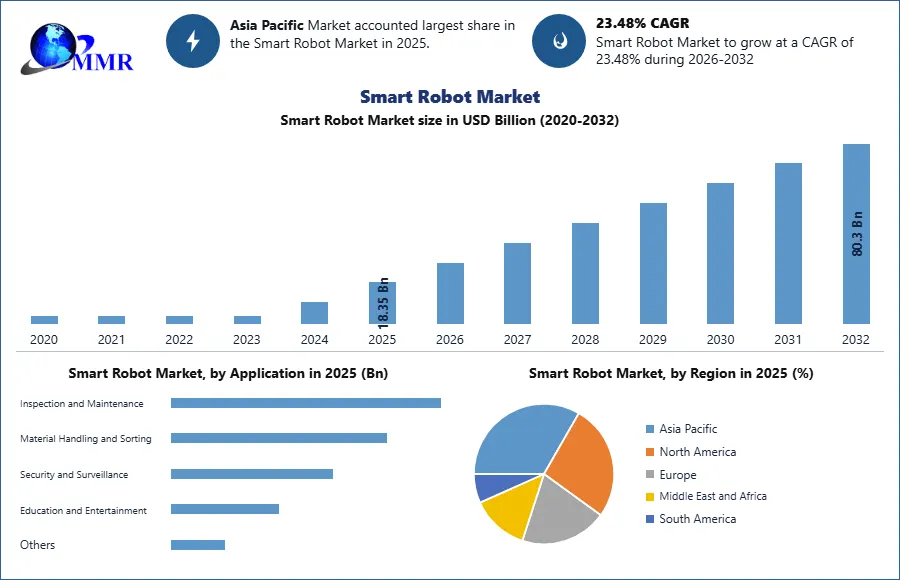
The Smart Robot Market size was valued at USD 18.35 Billion in 2025 and the total Smart Robot revenue is expected to grow at a CAGR of 23.48% from 2025 to 2032, reaching nearly USD 80.31 Billion.
Overview:
The smart robotics industry has gained a lot of significance due to development in mechanical, sensor and vision technology. The prevalence of lower-cost components, open-source code, accessible options for contract manufacturing, an influx of interest in investment capital, and a growing social acceptance of robots are some of the prominent factors that are encouraging many engineers to design innovative robotics for a variety of collaborative tasks. Smart robot is the application of technology for the design, construction, operation and use of robots. It has a wide range of applications from manufacturing sector to health care to defense. The robotics industry is growing rapidly as more and more businesses adopt robotics technology. It presents opportunities for investors’ and key players operating sector.
To know about the Research Methodology:-Request Free Sample Report
In response to current trends such as IoT, Industrie 4.0, and artificial intelligence (AI), prominent key players operating in the market is promoting Mechatronics as a solution concept for realizing a new industrial automation revolution. Many industrial robots are now used in a wide range of industries, including electric and electronic equipment, semiconductor manufacturing, biomedical, food, medical products, logistics. Key companies are offering robotics solution by collecting, accumulating, and analyzing the state of the servomotors that make up the body and the results of operations. It helps to contribute to improving productivity and quality through the stable operation of facilities and lines at customers’ production sites across manufacturing industries.
Market Dynamics
Smart robot has potential to reshape the supply chain industry. The main differences between traditional robots and smart robots are the activity related to the utility and human interaction. The smart robots are also known as household robots, which are increasingly being encountered in daily lives across developed countries. Many consumers are familiar with the Roomba, a household robot. It helps to keeps the floor clean without users having to lift a finger. The demand for smart robots that can assist with household chores is on the rise in the recent years and same has been captured in the Smart Robot Market report by end use and region.
The trending theme close to household robots revolves around utility. In a smart home environment, developers and consumers are consistently looking for way that technology can streamline daily life tasks. Robotics and the increasing use of automation denote some of the most exciting invest opportunities for key players operating in the market during the forecast period. (2023-2029).
Investors are funding to the latest robotics innovations in various industries like the medical, manufacturing, logistics, hospitality, and automotive sectors. In the current Smart Robot Market scenario, venture capital (VC), private equity (PE), and strategic investors are aiming to capitalize on and steer development of disruptive robotics technologies. Adoption of robotic technologies by businesses and consumers, advances in artificial intelligence (AI), machine learning (ML), the Internet of Things (IoT) and big data are driving the demand for robot into most aspects of end user industries.
The number of robotics and automation companies has increased intensely in recent decades as corporations seek to produce goods and services more efficiently. In recent years, the insistence to automate to cut labor costs has accelerated because of the global competition and other forces. The robotics industry is one of the largest markets in the technology space, which has high demand in applications across diverse sectors.
Venture capitalists investment to drive Smart Robot Market
The robot technology development needs a lot of initial investment. Different investment companies are now investing in the field at different stages. Many Tech companies are generating different types of robots and other robotics applications in recent times. The main source is sufficient robotics funding from the best venture capitalists across the world through different Series rounds. The investors are gaining popularity among aspiring tech companies to help them become successful high-tech companies in the nearby future. The Octopus Ventures, Playground Global, Foxconn Industrial Internet, Shunwei Capital, Asimov Ventures, Shasta Ventures, Micron Ventures and Felicis Ventures are some of the venture capitalists in robotics.
Venture capital firms are funding more robotics companies as industries seek more automation in the manufacturing sector. Venture capital firms are eager to allocate money into robotics firms as more automation became a focus during the global pandemic. Factory automation is a large aspect as new capabilities arise for robot demand in industrial and consumer sectors. The growth of AI being used in tech and products is leading the market. Investors are attracting to the robotics industry because the growth potential. Robotics, automation, and AI is a growing field which is gaining a lot of interest because of the digitization, labor shortages, and the pandemic.
Smart Robot Market Segment Analysis
By Component, the Sensors segment dominated the Smart Robot Market in 2025 due to the increasing demand for intelligent perception systems, real-time monitoring, and autonomous decision-making capabilities across industrial and service robotics applications. Sensors play a critical role in enabling robots to identify objects, measure distance, monitor environmental conditions, and perform precision-based operations with minimal human intervention. The growing integration of AI-powered vision systems, LiDAR, infrared sensors, ultrasonic sensors, and motion detection technologies has significantly enhanced robotic navigation, safety, and operational efficiency. Industrial automation, warehouse robotics, healthcare robotics, and autonomous mobile robots (AMRs) are major contributors to sensor demand globally. The expansion of smart factories and Industry 4.0 initiatives is accelerating the adoption of advanced sensing technologies within robotic systems.
By Type, the Personal/Domestic Robots segment is witnessing strong growth in the Smart Robot Market due to increasing consumer demand for automation, convenience, and smart home technologies. Personal robots are widely used for household cleaning, lawn mowing, elderly assistance, education, entertainment, and home security applications. The growing adoption of AI-enabled robotic vacuum cleaners, companion robots, and smart surveillance robots is significantly driving market expansion. Rising urbanization, increasing disposable income, and growing awareness regarding smart living solutions are further supporting demand for domestic robotic systems globally. Advancements in voice recognition, machine learning, cloud connectivity, and IoT integration are improving robotic functionality and user experience. In addition, the aging population and increasing demand for healthcare assistance robots are accelerating adoption across developed economies such as Japan, the U.S., and Germany.
Smart Robot Market Regional Insights
The Asia-Pacific Smart Robot Market dominated in 2025 due to adoption of the robots in developing economies during the forecast period. Growing awareness about innovative manufacturing techniques, economic growth, and increasing interest of foreign investors are factors driving the Smart Robot market in the Asia Pacific. The developing economies have must adopt additive manufacturing technologies in all manufacturing segments including defence and public sectors to position itself as a pioneer in restructuring its supply chain. The companies need a high level of know-how to develop suitable applications and implement additive manufacturing in their businesses. The current cost-competitive parts need to exploit the AM compensations. Technology suppliers and researchers are encouraged to push more in the direction of end users, who are placing focus on costs and the specific requirements. Funding and investments by collaborating partners along the process chain must be strengthened to increase the production of the robotics solution.
As automation increases across manufacturing industries, the number of robot machine installations are also increasing at a rapid rate in India. Indian industries are rapidly moving towards automation for growing production volume, accuracy, and safety. The demand for robotics is gaining momentum in areas where automation is required like disinfection and sanitization, patient screening, discharge of nuclear medicines, and rehabilitation.
Recent Developments
On April 2026,ABB introduced advanced AI-enabled robotics and digital automation solutions for smart manufacturing applications. The company expanded its RobotStudio platform with virtual simulation, predictive maintenance, and intelligent robotic programming capabilities. ABB also launched collaborative robotic systems and autonomous mobile robots (AMRs) for industrial automation and logistics operations. These developments are helping manufacturers improve productivity, operational flexibility, and manufacturing precision. ABB continues investing in cloud robotics, machine vision systems, and energy-efficient automation technologies to strengthen its position in the Smart Robot Market. The company’s robotic solutions are widely used across automotive, electronics, healthcare, and warehouse automation industries globally.
On April 2026, KUKA launched its AI-based “Automation 2.0” platform integrating robotics, industrial software, and autonomous mobile robots for smart manufacturing applications. The company introduced intelligent robotic systems designed to improve production efficiency, operational flexibility, and automated material handling. KUKA also expanded investments in cloud-connected robotic platforms and AI-driven automation technologies for automotive and industrial manufacturing facilities. The company showcased advanced robotic systems with machine learning capabilities for predictive maintenance and digital factory operations. KUKA continues focusing on smart logistics, autonomous robotics, and industrial digitalization to strengthen its global market position in intelligent automation solutions.
Smart Robot Market Scope: Inquire before buying
| Smart Robot Market | |||
|---|---|---|---|
| Report Coverage | Details | ||
| Base Year: | 2025 | Forecast Period: | 2026-2032 |
| Historical Data: | 2020 to 2025 | Market Size in 2025: | 18.35 USD Billion |
| Forecast Period 2026-2032 CAGR: | 23.48% | Market Size in 2032: | 80.3 USD Billion |
| Segments Covered: | by Component | Sensors Actuators Power Sources Control Systems Software Others |
|
| by Type | Personal/Domestic Robots Professional Robots |
||
| by Mobility | Mobile Fixed/Stationary |
||
| by Application | Inspection and Maintenance Material Handling and Sorting Security and Surveillance Education and Entertainment Others |
||
| by End User | Manufacturing Healthcare Agriculture Military and Defense Others |
||
Smart Robot Market, by Region
North America (United States, Canada and Mexico)
Europe (UK, France, Germany, Italy, Spain, Sweden, Austria and Rest of Europe)
Asia Pacific (China, South Korea, Japan, India, Australia, Indonesia, Malaysia, Vietnam, Taiwan, and Rest of APAC)
Middle East and Africa (South Africa, GCC, Egypt, Nigeria and Rest of ME&A)
South America (Brazil, Argentina Rest of South America)
Key players/Competitors profiles covered in the Smart Robot Market report in strategic perspective
1. iRobot Corporation (US)
2. Omron Adept Technology, Inc. (US)
3. Intuitive Surgical, Inc. (US)
4. ST Engineering Aethon, Inc. (US)
5. Gecko Systems International Corporation (US)
6. Delaval, Inc (US)
7. Brain Corporation (US)
8. Neato Robotics (US)
9. Greyorange (US)
10. SoftBank Group (Japan)
11. Honda Motor Co., Ltd. (Japan)
12. Yaskawa Electric Corporation (Japan)
13. FANUC (Japan)
14. Cyberdyne (Japan)
15. Hanson Robotics Limited (Hong Kong)
16. Samsung Electronics Co., Ltd. (South Korea)
17. KUKA AG (Germany)
18. Rethink Robotics (Germany)
19. Eca Robotics (France)
20. Blue Frog Robotics (France)
21. Ganymed Robotics (France)
22. Smart Robots S.r.l. (Italy)
23. ABB Ltd. (Switzerland)
24. Lely Industries N.V. (Netherlands)
25. Kongsberg Maritime (Norway)
26. Universal Robots (Denmark)