
Agricultural Drone Market Size by Type, Component, Payload Capacity, Application, Region, Industry-Wide Analysis, Competitive Landscape Assessment & Long-Term Forecast to 2034
Overview
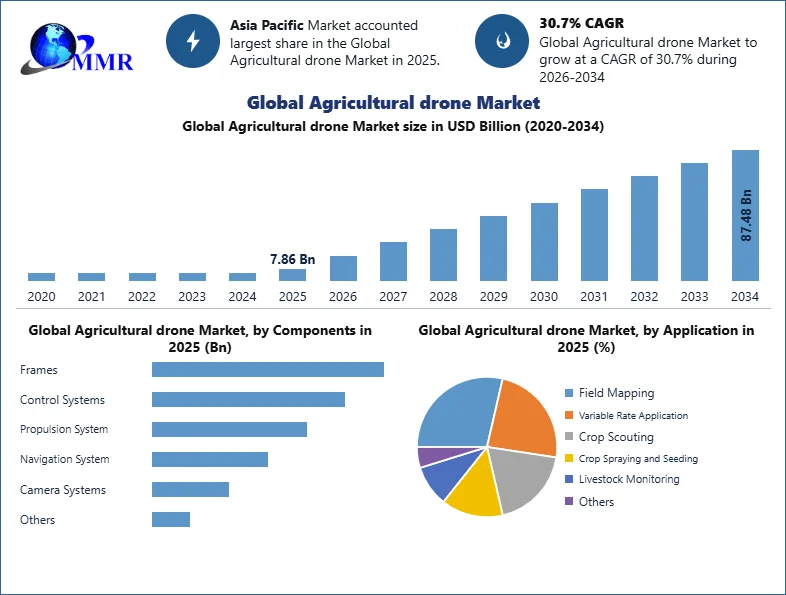
Agricultural Drone Market size was valued at USD 7.86 Bn in 2025, and the total Agricultural Drone Market revenue is expected to grow at a CAGR of 30.70% from 2026 to 2032, reaching nearly USD 87.48 Bn by 2034.
Agricultural Drone Market Overview
An agricultural drone is an unmanned aerial vehicle (UAV) equipped with advanced sensors, cameras, and spraying systems designed to optimize farming operations. It enables precision agriculture by monitoring crop health, spraying fertilizers/pesticides, mapping fields, and analyzing soil conditions, improving efficiency, yield, and sustainability. The demand for agricultural drones is rising due to their ability to enhance farm productivity, reduce labor costs, and support precision farming. Meanwhile, supply is increasing as manufacturers develop more advanced, affordable, and regulatory-compliant drones to meet growing farmer needs.
The Asia-Pacific dominated the agricultural drone market in 2025, driven by large-scale farming in China, Japan, and India. Key players include DJI (China), XAG (China), Parrot (France), AgEagle (U.S.), and Yamaha Motor (Japan), leading in innovation and market share. The report covered the Agricultural Drone Market's segments (Type, Component, Payload Capacity, Application, and Region). Data has been provided by market participants, and regions (North America, Asia Pacific, Europe, Middle East & Africa, and South America). It provides a thorough analysis of the rapid advances that are currently taking place across all industry sectors.
To know about the Research Methodology:-Request Free Sample Report
Agricultural Drone Market Dynamics
Agricultural Drone Market Trends
1. Rising Adoption of Precision Farming
• Drones equipped with multispectral, thermal, and hyperspectral sensors help farmers monitor crop health, soil conditions, and irrigation needs.
• AI-powered analytics enable data-driven decision-making, optimizing pesticide, fertilizer, and water usage.
2. Government Support & Subsidies
• Countries like India, China, and the U.S. are promoting drone use in agriculture through subsidies and training programs.
• Example: India’s “Kisan Drone” scheme provides financial aid to farmers for drone purchases.
3. Shift Toward Autonomous & AI-Integrated Drones
• AI and machine learning are being used for real-time crop disease detection, yield prediction, and automated spraying.
• Companies like DJI, AgEagle, and Parrot are launching fully autonomous drones for field mapping and spraying.
4. Increased Use of Spraying Drones
• LiDAR and GPS-enabled drones are improving spraying accuracy, reducing chemical wastage by up to 30%.
• China leads in spraying drone adoption, with companies like XAG and DJI dominating the market.
Precision Farming Demand and AI Integration to Boost Agricultural Drone Market Growth
The agricultural drone market is driven by the increasing need for precision farming, enabling efficient crop monitoring, soil analysis, and targeted spraying. AI-managed drones provide real time data analytics, improve yield adaptation and reduce input costs. Government subsidy (e.g., India’s Kisan Drone Scheme) and labor shortages further accelerate adoption. Advanced sensors (multispectral, LiDAR) enhance field mapping accuracy, while autonomous drone streamlines operations. Along with prominent players such as DJI and XAG leading innovation, permanent farming and smart agricultural fuel demand. Demand and climate challenges of global food push farmers towards drone-based solutions, making them essential for modern agriculture.
High Costs and Regulatory Hurdles to Hamper Widespread Drone to Restrain Agricultural Drone Market
Despite the development, the agricultural drone market faces restrictions including high early investment (drone, sensor, software) and operating costs. Limited battery life (20–40 minutes) restrictions massive use, while complex rules (BVLOS restriction, pilot licensing) delayed deployment. Data security concerns and obstructing adopting lack of technical expertise among farmers. In developing areas, poor connectivity and infrastructure limit. Additionally, resistance to new technologies in traditional agricultural communities slows down the market. These challenges should be addressed to unlock the full capacity of agricultural drones.
Drone-as-a-Service (DaaS) and Emerging Markets to Create Agricultural Drone Market Opportunity
The Drone-as-a-Service (DaaS) model presents a major opportunity, allowing small farmers to access drone technology affordably. Emerging markets (Africa, Latin America) offer untapped potential due to increasing agritech investments. Advances in swarm drone technology and solar-powered drones could enhance efficiency. AI and 5G integration will enable real-time data processing, while government initiatives (e.g., FAA/EASA approvals) will expand commercial use. Partnerships between agritech firms and drone manufacturers (e.g., John Deere & Blue River) will drive innovation. Sustainable farming trends and carbon credit incentives may further boost adoption, positioning drones as a key tool in future agriculture.
Agricultural Drone Market Segment Analysis
By offering, the agriculture drone market is segmented into hardware and software. Hardware held the larger share in 2025, driven by strong demand for drone platforms, sensors, cameras, controllers, batteries, propulsion systems, and navigation modules used in field mapping, spraying, and crop monitoring. Rotary-wing drones remained widely adopted due to their maneuverability, hovering capability, and suitability for spraying and close-field inspection, while fixed-wing and hybrid-wing drones supported large-area mapping and longer flight endurance. Software gained strong traction as farmers increasingly used data management, imaging, and analytics platforms to convert drone-captured field data into actionable insights for crop health, irrigation, nutrient application, and yield optimization.
Based on Payload Capacity, the Agricultural Drone Market is segmented into Lightweight drones (up to 2kg), Medium-weight drones (2 to 10kg), and Heavy-weight drones (Above 10kg –up to 25kg). Medium-weight drones (2 to 10kg) segment dominated the Agricultural Drone Market in 2024 and is expected to hold the largest market share over the forecast period. Dominance is due to an optimal balance between payload capacity, strength, and operational efficiency. These drones are versatile enough to handle key farming tasks like crop spraying, multispectral imaging, and field mapping, while remaining cost-effective for small to mid-sized farms.
Unlike lightweight drones (limited to basic scouting) or heavy-weight drones (expensive and complex), medium-weight models offer longer flight times, higher spray capacity (5–10L), and compatibility with advanced sensors, making them ideal for precision agriculture. Prominent players like DJI (Agras T30/T40) and XAG (P Series) dominate this segment, with automatic spraying and adoption through AI-operated analytics. Their widespread use in Asia (China, India) and North America strengthens their market dominance.
By application, the agriculture drone market is segmented into field mapping, variable rate application, crop scouting, crop spraying and seeding, livestock monitoring, and others. Crop scouting held the largest share in 2025 because drones are increasingly used to monitor crop health, detect pest and disease pressure, assess plant stress, and support real-time farm decision-making. Field mapping also captured a major share as growers used drone imagery for boundary mapping, elevation analysis, soil variation assessment, and precision farming plans. Crop spraying and seeding continued to expand as farmers adopted drones to reduce labor dependency, improve input efficiency, and support targeted chemical, fertilizer, and seed application. Variable rate application, livestock monitoring, and other uses contributed to market growth through precision input management, animal tracking, pasture monitoring, and farm-level automation.

Unlike standalone applications like field mapping or livestock monitoring, precision farming integrates real-time crop health analysis, targeted pesticide/fertilizer application, and irrigation management into a unified system – delivering measurable ROI for farmers. Key players like DJI, XAG, and AgEagle focus on this segment through smart spraying drones and farm management software, with adoption strongest in row-crop farms (corn, soybeans) and orchards. Government subsidies for precision agriculture further accelerate growth, making it the core application driving drone demand globally.
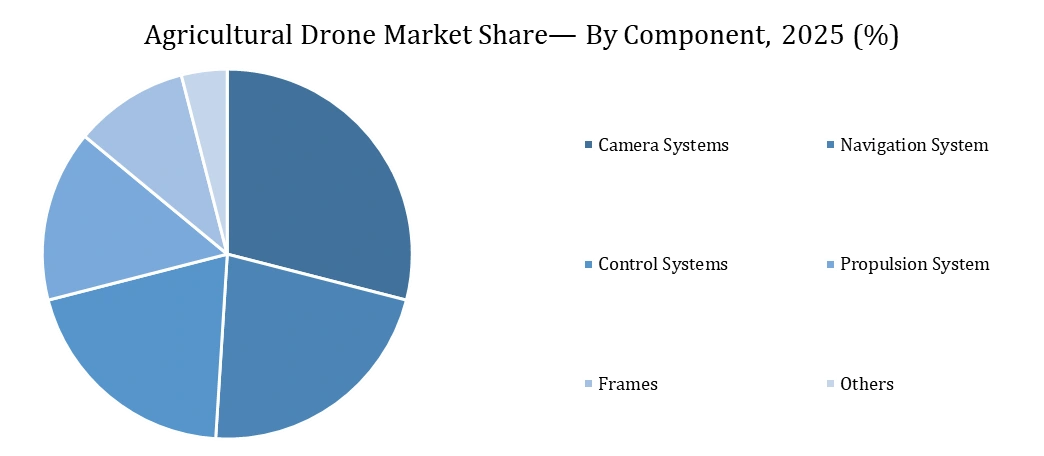
By components, the agriculture drone market is segmented into frames, control systems, propulsion systems, navigation systems, camera systems, and others. Camera systems accounted for the largest share in 2025 because imaging sensors, multispectral cameras, thermal cameras, and high-resolution visual cameras are central to crop health monitoring, field mapping, disease detection, and variable-rate input planning. Navigation systems also held a strong share due to the rising use of GPS, RTK, and autonomous flight systems, while control systems and propulsion systems remained essential for operational stability, payload handling, and flight precision. Frames and other components supported the structural and operational performance of drones across fixed-wing, rotary-wing, and hybrid-wing platforms
By service model, the agriculture drone market is segmented into product sales and Drone-as-a-Service. Product sales held the larger share in 2025 as large farms, agribusinesses, cooperatives, and agri-tech service providers continued purchasing drone hardware, sensors, batteries, and software licenses for in-house use. However, Drone-as-a-Service gained strong momentum because it lowers upfront investment for farmers and provides access to drone-based mapping, spraying, crop scouting, and analytics through service contracts or seasonal usage models. This model is particularly attractive for small and medium farms that need drone services but do not want to invest in equipment ownership, pilot training, maintenance, and regulatory compliance
Agricultural Drone Market Regional Analysis
Asia-Pacific (APAC) Region Dominate the Agricultural Drone Market
Dominance by China, India, and Japan led the global agricultural drone market in 2025, which is the largest stake for accurate agricultural technologies, government subsidies, and acute labor deficiency in agriculture. China stands as the world's largest market, with companies such as DJI and Zag Pioneering have a cost -effective spray drones used in millions of hectares. India accelerates adoption among small farmers for crop monitoring and chemical spraying with its peasant drone subsidy scheme. Japan's aging population is a demand for further fuel. APAC is required by favorable rules, expansion of agritech startups, and durable farming practices, as the fastest-growing area. North America and Europe remain important markets, but high drone costs and more mechanized APAC in volume due to the current form of infrastructure. The region's dominance is expected to be strong with AI-managed drone and herd technology.
Recent Development
May 2025 – John Deere acquired Sentera to strengthen aerial field scouting and drone-based farm intelligence. Sentera provides remote imagery solutions for agriculture, including drone-compatible cameras and field analytics used for crop scouting, weed detection, pest pressure identification, disease monitoring, and agronomic decision-making. The acquisition allows John Deere to integrate aerial imagery into its digital agriculture ecosystem and expand precision farming tools for growers and ag service providers.
February 2025 – Yamaha Motor agreed to acquire Robotics Plus and establish Yamaha Agriculture as a new U.S.-based precision agriculture company. Yamaha also purchased assets from The Yield Technology Solutions and combined Robotics Plus’ agricultural automation capability with AI-powered digital agriculture tools. The move strengthens Yamaha’s position in autonomous farming systems for orchards, vineyards, and specialty crops, where robotic spraying, sensing, and data-based crop management are gaining demand.
February 2025 – Hylio raised USD 2 million through equity crowdfunding to expand U.S. agriculture drone production. The company planned to use the capital to scale manufacturing at a new site capable of producing more than 5,000 drones per year at full capacity. This is highly relevant for the agriculture drone market because Hylio is one of the key U.S.-based spray-drone manufacturers benefiting from demand for domestic, NDAA-compliant, precision spraying platforms.
February 2026 – Hylio and KULR entered a strategic collaboration to produce Texas-manufactured battery systems for U.S.-built unmanned agricultural drones. The partnership targets one of the most important cost and reliability bottlenecks in agriculture drones: battery performance, replacement cycles, and domestic supply security. This strengthens the U.S. agriculture drone supply chain and supports wider adoption of drone spraying systems in commercial farming.
May 2025 – AgEagle Aerial Systems formed a strategic alliance with Vyom Drones in India to manufacture and sell AgEagle’s eBee X drones locally. The alliance includes licensing, manufacturing, sales, service, and maintenance training, positioning AgEagle to participate in India’s fast-growing agricultural mapping, surveying, and precision farming market. This is a strong route-to-market development because India is actively promoting drone use in agriculture through subsidy, training, and localization programs.
March 2025 – Garuda Aerospace invested in Zuppa to strengthen indigenous drone technology capability. Garuda invested INR 1 crore in Zuppa and also placed drone orders worth INR 1 crore, while Zuppa’s post-money valuation was reported at INR 160 crore. Although Zuppa is more defense and secure-autopilot focused, this investment is relevant for agriculture drones because secure flight-control systems, localization, and domestic drone component capability directly support India’s agri-drone manufacturing ecosystem.
January 2025 – General Aeronautics completed a Series A+ funding round led by Fowler Westrup India to support precision agriculture drone technology. The company focuses on agricultural spraying drones and integrated crop protection platforms. The funding supports commercialization of cost-effective drone-based spraying solutions, helping Indian growers adopt precision input application and reduce dependence on manual spraying.
November 2024–2025 – XMobots’ SPAD 75 spraying drone became eligible for Brazil’s Finame financing line, allowing rural producers to access lower-interest financing for drone-based spraying systems under Brazil’s 2024/2025 Crop Plan. Brazil’s plan allocated BRL 400.59 billion, including BRL 107.30 billion for investment, and XMobots positioned SPAD 75 financing as a tool to accelerate adoption of locally developed spraying drones in Brazilian agribusiness.
July–November 2025 – DJI Agriculture expanded its Agras portfolio globally with the Agras T100, T70P, and T25P agricultural drones. The T100 has a maximum payload of 100 kg and supports spraying, spreading, and lifting applications, while DJI later announced availability across Europe, Central Asia, Africa, and other markets through authorized dealers. This is a major product investment signal because DJI continues to push payload capacity, operational efficiency, and global dealer-based commercialization in agriculture drones.
November 2025 – XAG launched the P150 Max agricultural drone and R Series Agricultural Rover at Agritechnica 2025. The launch expanded XAG’s portfolio beyond aerial spraying into smart field automation, combining high-capacity agricultural drones with electric ground robotics for orchards, vineyards, greenhouses, and complex farm terrains. This development is relevant because agriculture drone companies are increasingly moving toward integrated aerial-ground automation platforms rather than selling only standalone drones.
Agricultural Drone Market Scope: Inquire before buying
| Agricultural Drone Market | |||
|---|---|---|---|
| Report Coverage | Details | ||
| Base Year: | 2025 | Forecast Period: | 2026-2032 |
| Historical Data: | 2020 to 2025 | Market Size in 2025: | 7.86 USD Bn |
| Forecast Period 2026-2034 CAGR: | 30.7% | Market Size in 2034: | 87.48USD Bn |
| Segments Covered: | by Service Model | Product Sales Drone-as-a-Service (DaaS) |
|
| by Component | Frames Control Systems Propulsion System Navigation System Camera Systems Others |
||
| by Payload Capacity | Lightweight drones (up to 2kg) Medium-weight drones (2 to 10kg) Heavy-weight drones (Above 10kg –up to 25kg) |
||
| by Application | Field Mapping Variable Rate Application Crop Scouting Crop Spraying and Seeding Livestock Monitoring Others |
||
| by Offering | Hardware Software |
||
Agricultural Drone Market Key Region
North America (United States, Canada and Mexico)
Europe (United Kingdom, France, Germany, Italy, Spain, Sweden, Russia, Rest of Europe)
Asia Pacific (China, Japan, South Korea, India, Australia, Malaysia, Thailand, Vietnam, Indonesia, Philippines, Rest of APAC)
Middle East and Africa (South Africa, GCC, Nigeria, Egypt, Turkey, Rest of MEA)
South America (Brazil, Argentina, Colombia, Chile, Peru, Rest of South America)
Key players/Competitors profiles covered in the Agricultural Drone Market report in strategic perspective
- DJI
- XAG
- Yamaha Motor
- AeroVironment
- Parrot
- AgEagle Aerial Systems
- Eavision Robotics
- JTI (Jingwei)
- Nileworks
- Hylio
- Quantum Systems
- Delair
- MMC UAV
- Kray Technologies
- John Deere
- TTA Drone
- Harris Aerial
- XMobots
- AGX Drones
- General Aeronautics
- Garuda Aerospace
- IoTechWorld Avigation
- Thanos Technologies
- HexaAero / HexaFlight
- Aerones
- FlySight
- DroneScan
- Hemav
- SkyDrive
- senseFly
Others
Frequently Asked Questions:
1. What are agricultural drones?
Ans: Agricultural drones are unmanned aerial vehicles designed for farming tasks such as crop monitoring, soil analysis, and precise application of fertilizers and pesticides.
2. What are the main types of agricultural drones?
Ans: The market is segmented into fixed-wing drones, rotary drone blades, and hybrid drones, with fixed-wing drones dominating due to their ability to cover large areas efficiently.
3. What are the top manufacturers of agricultural drones?
Ans: Major manufacturers include DJI, XAG, Garuda Aerospace, Yamaha, IO TechWorld, and others, with a focus on advancing technology for precision agriculture.
4. What recent developments are there in the agricultural drone market?
Ans: Recent advancements include the introduction of new drones, government initiatives promoting drone usage, and the establishment of standard operating procedures for pesticide application via drones.