
Peppermint Oil Market Size by Product Type, Extraction Method, Application, Distribution Channel, Region, Industry-Wide Analysis, Competitive Landscape Assessment & Long-Term Forecast to 2034
Overview
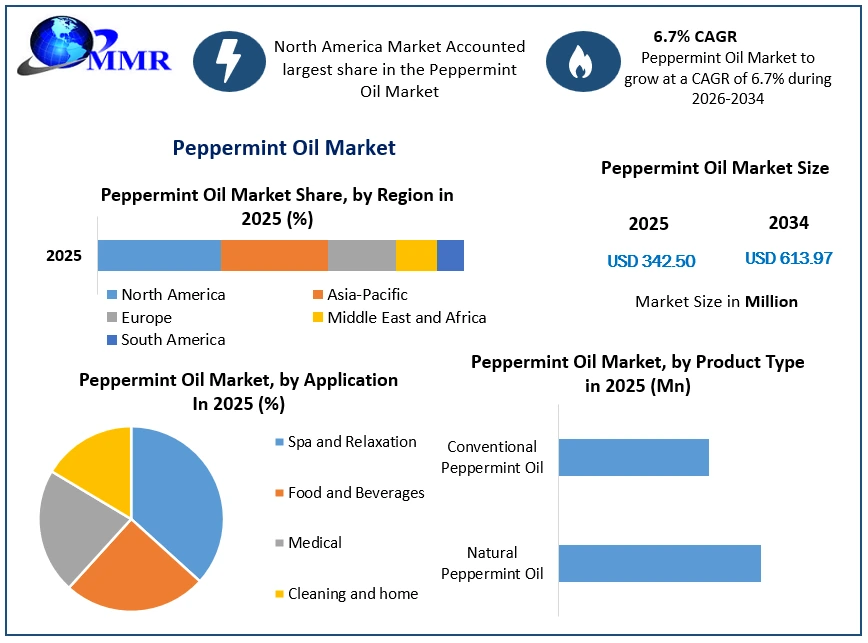
Peppermint Oil Market size was valued at USD 342.50 Million in 2025 and the total Global Peppermint Oil revenue is expected to grow at a CAGR of 6.7% from 2026 to 2034, reaching nearly USD 613.97 Million.
Peppermint Oil Market Overview
Peppermint oil is the essential oil made from the flowers and leaves of the peppermint plant. It is often used to flavour foods and drinks, and it is also used as a fragrance in soaps and cosmetics. The global peppermint oil market is experiencing significant growth driven by the increasing consumer demand for natural products. As health and wellness trends gain momentum, industries such as food and beverages, cosmetics, and pharmaceuticals are incorporating peppermint oil into their offerings. In the food sector, peppermint oil is widely used as a natural flavouring agent, and featured in products such as herbal teas and candies. This growing consumer preference for clean and sustainable options expands the market across multiple sectors. In personal care and cosmetics, brands like Lush and Burt's Bees leverage peppermint oil for its refreshing scent and skin benefits
Based on product type the market is segmented into Natural Peppermint Oil and Synthetic Peppermint Oil, with natural peppermint oil holding the largest market share due to its recognised therapeutic benefits and versatile applications. Regionally, North America held a dominant position in the peppermint oil market, due to the high demand for natural and organic products and the region's robust peppermint production, particularly in the United States. The U.S. accounts for more than 70% of global peppermint oil production, with key producing states including Oregon, Washington, and Indiana. The competitive landscape of the peppermint oil market is shaped by key players such as Young Living, doTERRA, and Lionel Hitchen, focusing on natural and high-quality peppermint oil production. Recent innovations, such as doTERRA’s introduction of Birch oil and expansion into sleep and gut health product lines, illustrate the ongoing product diversification in the essential oils market.
• The largest producers of peppermint oil are the United States, China, and India. India produces approximately 600 to 700 metric tons of peppermint oil each year.
To know about the Research Methodology :- Request Free Sample Report
Peppermint Oil Market Dynamics
Increasing Demand for Natural Products to Drive Peppermint Oil Market Growth
The growing demand for natural products significantly drives the growth of the peppermint oil market, as consumers increasingly prioritize health and wellness in their purchasing decisions. This trend is evident in many sectors including food and beverages, cosmetics, and pharmaceuticals. For instance, in the food industry, peppermint oil is used as a natural flavouring agent in products such as herbal teas, candies, and chewing gum. Brands such as York Peppermint Pattie and Trident Gum emphasize the use of natural peppermint oil to appeal to consumers looking for fresher, cleaner options. Additionally, in the cosmetics and personal care industries, brands such as Lush and Burt's Bees are incorporating peppermint oil into their formulations for its invigorating scent and skin-soothing benefits, attracting consumers looking for natural beauty products. This increasing preference for natural and organic products aligns with the broader consumer movement towards sustainability and health, creating a substantial demand for peppermint oil.
• In 2025, the global Natural Cosmetics market made about USD 13.87 billion in revenue. It is expected to grow at an annual rate of 6.75% from 2025 to 2034. China is the top revenue generator in this market, earning USD 3.1 billion in 2025.
Additionally, the shift towards natural medicines and holistic health solutions has fueled the growth of peppermint oil in the pharmaceutical sector. Consumers are becoming more open to using essential oils as part of their wellness regimens, choosing natural treatments over traditional medications. Peppermint oil, known for its ability to relieve digestive problems, reduce headaches, and calm the respiratory tract, has gained popularity in this context. For instance, products such as peppermint oil capsules from brands like NOW Foods and Nature's Way have gained popularity among consumers looking for natural alternatives to support their health. As the market for natural health products grows, the demand for peppermint oil continues to grow. This growing trend shows how consumer preferences for natural solutions not only influence purchasing behaviour but also shape product development in various industries.
Peppermint Oil Market: Import Export Analysis
In 2025, the United States emerged as the leading importer of peppermint oil, with a total of 5,471 shipments. This substantial volume highlights the high demand for peppermint oil in the country. The United Kingdom followed as the second-largest importer, receiving 1,380 shipments, reflecting the growing use of peppermint oil in various industries. India secured the third spot with 1,127 shipments, indicating a rising demand for peppermint oil to support its expanding pharmaceutical, food, and personal care sectors.
India dominated the export market for peppermint oil in 2025, with a remarkable total of 18,838 shipments. This leading position highlights India's strong production capabilities and its crucial role in the global supply chain for peppermint oils. The United States also made a significant impact as an exporter, with 2,442 shipments, reflecting its established presence in the peppermint oil market. China ranked third among exporters, with 830 shipments, showcasing its growing involvement and contributions to the global peppermint oil market.
Peppermint Oil Market Segment Analysis
By Product Type, the market is segmented into Natural Peppermint Oil and conventional Peppermint Oil. The Natural Peppermint Oil segment dominated the market in 2024 & is expected to hold the largest market share during the forecast period. The growth is fueled by the rising consumer preference for clean-label, plant-based, and chemical-free products across food & beverages, pharmaceuticals, and personal care industries. Natural peppermint oil is widely used as a flavoring agent, digestive aid, and therapeutic essential oil, making it more versatile compared to conventional variants. Increasing adoption of aromatherapy, herbal medicines, and organic cosmetics strengthens its demand. Regulatory bodies and health-conscious consumers are also pushing for natural formulations, giving natural peppermint oil a competitive edge over conventional peppermint oil.
By Extraction Method the market is segmented into Steam Distillation, Hydro Distillation, Cold Pressing, Others. The steam distillation segment dominated the market in 2025 & is expected to hold the largest market share during the forecast period. This method is the most widely used and preferred extraction process because it ensures high purity, efficiency, and cost-effectiveness in extracting essential oils from peppermint leaves. Steam distillation preserves the natural aroma and therapeutic properties of the oil, making it suitable for large-scale applications in food & beverages, pharmaceuticals, and personal care products. Its scalability, relatively lower operational costs, and ability to produce consistent quality oil give it a significant edge over hydro distillation and cold pressing, which are used more in niche or small-scale applications.
Peppermint Oil Market Regional Insights
In 2025, North America dominated the peppermint oil market holding a significant market share of more than xx%. North American peppermint oil industry has experienced significant growth due to increasing demand for natural and organic products, growing acceptance of mint-flavored products, and easier access to peppermint products with the emergence of e-commerce and online sales across the region. Additionally, the presence of leading peppermint manufacturing companies and major exporter countries is also likely to foster the region’s market growth. The United States produces more than 70% of the world's peppermint production. Oregon, Washington, Idaho, Indiana, California, and Wisconsin are the largest peppermint-producing states.
In the United States, peppermint oil is widely recognized for its therapeutic properties and is widely used in various applications, including aromatherapy, personal care products, and dietary supplements. In addition, regulatory frameworks in North America support the use of natural ingredients, and provide a favorable environment for the peppermint oil market. The Food and Drug Administration (FDA) allows the use of peppermint oil as a flavoring agent in food products, making it a staple in the food industry.
• The annual production of peppermint oil in the United States has fluctuated over the past few years. In 2018, peppermint oil production reached 5.3 million pounds, followed by a slight increase to 5.4 million pounds in 2019. However, peppermint oil production began to decline in 2020, reaching 4.9 million pounds. By 2025, production had dropped to 2.8 million pounds.
Peppermint Oil Market Recent Industry Development
| Date | Company | Development | Impact |
|---|---|---|---|
| 08 August 2025 | UNIFI, Inc. | The company launched A.M.Y.® Peppermint, an innovative, naturally deodorizing yarn infused with peppermint oil extracts. | This development leverages the natural odor-neutralizing properties of peppermint oil to expand its application boundaries into recycled and synthetic high-performance textiles. |
| 13 February 2026 | Natures Natural India | The brand commercialized a premium, highly purified Peppermint Oil 95% formulation targeting high-end industrial buyers. | The launch enhances global B2B access to 100% organic, nutrient-enriched steam-distilled essential oils optimized for complex pharmaceutical flavorings and cosmetics. |
| 20 March 2026 | Fact.MR | The firm published data identifying that natural sources hold a 63.8% market share within the peppermint oil sector. | The shift confirms a dominant global procurement preference toward plant-based, non-synthetic flavorings in confectionery and therapeutic applications. |
| 08 May 2026 | Aromatic and Allied Chemicals | The company established a strategic farming expansion framework under the Peppermint-2025 program utilizing advanced strains engineered by CSIR-CIMAP. | This initiative increases global supply chain stability by introducing fully traceable, blockchain-verified crop cultivation across non-traditional growing regions. |
Peppermint Oil Market Competitive Landscape
The competitive landscape of the peppermint oil market is shaped by a mix of global and regional players that contribute to the market's growth through a variety of offerings, from natural pe4ppermint oils to innovative formulations for different industries. Key players such as Young Living Essential Oils LLC and doTERRA dominate with their strong focus on high-quality, therapeutic-grade peppermint oils, largely serving the wellness and aromatherapy sectors. Companies such as Lionel Hitchen (UK) and Biolandes (France) cater to the European market with premium natural oils, emphasizing sustainability and organic production. Indian manufacturers such as Aromaaz International and Natures Natural India play a crucial role in large-scale peppermint oil production for export, contributing to the global supply chain. These companies are focused on innovations in extraction processes, expanding product applications, and maintaining high-quality standards, making the peppermint oil market highly competitive and diverse.
In September 2023, doTERRA announced the launch of several new essential oils and blends at their global convention, alongside expansions to their sleep and gut health product lines. One of the key highlights was the introduction of Birch oil, marking a significant milestone for the company. After years of extensive effort, doTERRA successfully developed the world’s first commercial-scale birch distillery, ensuring the oil is 100% pure and unadulterated.
Peppermint Oil Industry Ecosystem

Peppermint Oil Market Scope: Inquire Before Buying
| Global Peppermint Oil Market | |||
|---|---|---|---|
| Report Coverage | Details | ||
| Base Year: | 2025 | Forecast Period: | 2025-2032 |
| Historical Data: | 2020 to 2025 | Market Size in 2025: | USD 342.50 Mn. |
| Forecast Period 2026 to 2034 CAGR: | 6.7% | Market Size in 2034: | USD 613.97 Mn. |
| Segments Covered: | by Product Type | Natural Peppermint Oil Conventional Peppermint Oil |
|
| by Extraction Method | Steam Distillation Hydro Distillation Cold Pressing Others |
||
| by Application | Spa and Relaxation Food and Beverages Medical Cleaning and home |
||
| by Distribution Channel | Direct Distribution MLM Distribution Retail Distribution Others |
||
Peppermint Oil Market, by Region:
North America (United States, Canada, Mexico)
Europe (UK, France, Germany, Italy, Spain, Sweden, Austria, Turkey, Russia and Rest of Europe)
Asia Pacific (India, China, Japan, South Korea, Australia, ASEAN, and Rest of APAC)
Middle East and Africa (South Africa, GCC, Egypt, Nigeria, and Rest of ME & A)
South America (Brazil, Argentina, Columbia, and Rest of South America)
Peppermint Oil Market, Key Players
North America
1. Young Living - United States
2. Lebermuth Company- United States
3. doTerra- United States
4. Saje Natural Wellness- Canada
5. Bluemercury- United States
Europe
1. Lipoid Kosmetic AG- Germany
2. Lionel Hitchen - United Kingdom
3. Firmenich- Switzerland
4. Biolandes - France
5. Perrigo Company Public Limited Company- Ireland
Asia-Pacific
1. Aromaaz International- India
2. Natures Natural India – India
3. Shaanxi Guanjie Technology Co - China
4. Greenleaf Extractions Pvt. Ltd - India
5. AmbePhytoextractsPvt. Ltd.- Austria
6. Synthite Industries Ltd- India
7. Bio Extracts (Pvt.) Ltd- Sri Lanka
8. Triefta Aroma Nusantara- Indonesia
Middle East and Africa
1. Green Fields Oil Factory – Egypt
2. Royal Herbs- Egypt
Frequently Asked Questions (FAQs)
1. What is the projected size of the peppermint oil market by 2034?
Ans: The peppermint oil market is expected to reach a value of USD 613.97 million by 2034, growing at a CAGR of 6.7% from USD 342.50 million in 2025.
2. What are the main drivers of growth in the peppermint oil market?
Ans: The primary drivers of growth include increasing consumer demand for natural products, health and wellness trends, and the incorporation of peppermint oil into various industries such as food and beverages, cosmetics, and pharmaceuticals.
3. How is the peppermint oil market segmented?
Ans: The peppermint oil market is segmented by product type (Natural Peppermint Oil and Synthetic Peppermint Oil), extraction methods (Steam Distillation, Hydrodistillation, Cold Pressing, and Others), and applications (Aromatherapy, Food and Beverage, Cosmetics & Personal Care, Pharmaceuticals, and Others).
4. Which region dominates the peppermint oil market?
Ans: North America holds the largest share of the peppermint oil market, primarily due to the high demand for natural and organic products and robust peppermint production, especially in the United States.
5. What is the scope of the Peppermint Oil market report?
Ans: The market report helps with the PESTLE, PORTER, Recommendations for Investors & Leaders, and market estimation of the forecast period.