
Beauty and Personal Care Products Market Revenue Analysis, Sales Trend, Pricing Trend, Competitive Analysis, Distribution Channel, Market Gap Analysis and Forecast 2034
Overview
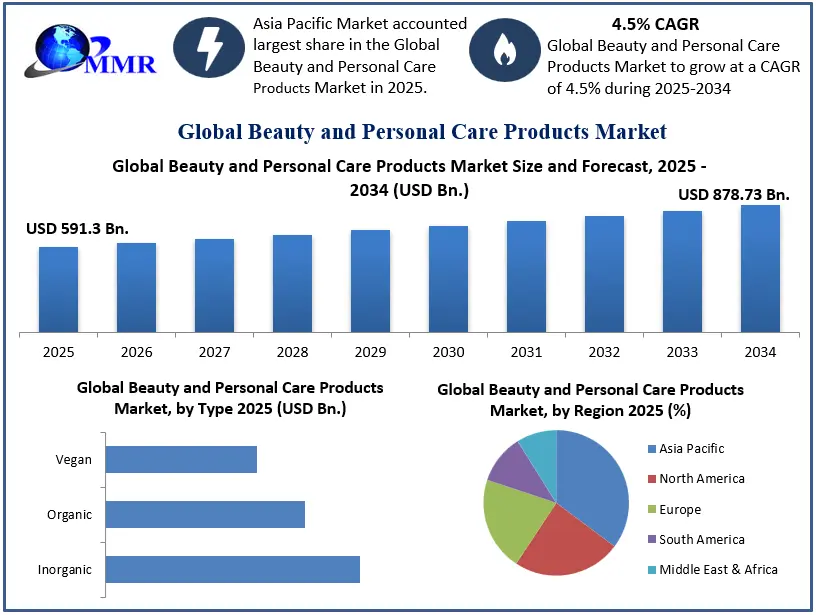
Global Beauty and Personal Care Products Market size was valued at USD 591.3 Billion in 2025 and the total Beauty and Personal Care Products revenue is expected to grow at a CAGR of 4.5% from 2026 to 2034, reaching USD 878.73 Billion by 2034.
Beauty and Personal Care Products Market Overview:
The Beauty and Personal Care Products Market covers a wide range of products used for personal hygiene, grooming, skincare, haircare, cosmetics, fragrances, oral care, sun care, and body care. It is an important consumer market because these products are used regularly across different age groups and lifestyles. Demand is supported by rising awareness of personal appearance, self-care, wellness, hygiene, and beauty routines.
The market is growing as consumers increasingly choose premium beauty, affordable beauty, clean beauty, natural and organic products, vegan and cruelty-free formulations, personalised skincare, multifunctional products, men's grooming, and sustainable beauty products. E-commerce, social media, influencer marketing, and direct-to-consumer brands are also increasing product reach and changing purchasing behaviour. L'Oréal is a major player in the market, with its broad portfolio across skincare, haircare, makeup, and fragrances, while Asia Pacific remains an important region due to its large consumer base, growing disposable income, changing beauty preferences, and increasing online beauty sales.
MMR's research provides clients with a detailed analysis of market trends, product segments, distribution channels, consumer preferences, regional demand, competitive landscape, growth drivers, restraints, challenges, and opportunities. The report identifies growth opportunities in skincare, haircare, cosmetics, fragrances, men's grooming, clean beauty, natural products, personalised beauty, sustainable packaging, and e-commerce, helping manufacturers, brands, retailers, and investors identify attractive segments and make informed business decisions.
Beauty and Personal Care Products Market Growth and Share Analysis
To know about the Research Methodology :- Request Free Sample Report
Beauty and Personal Care Products Market, Key Highlights:
Global Beauty and Personal Care Products Market analysis and forecast, in terms of value.
Comprehensive study and analysis of market drivers, restraints and opportunities influencing the growth of the Global market
The market segmentation on the basis of type, source, end-user, and region (country-wise) has been provided.
Global market strategic analysis with respect to individual growth trends, future prospects along with the contribution of various sub-market stakeholders have been considered under the scope of study.
Global Beauty and Personal Care Products Market analysis and forecast for five major regions namely North America, Europe, Asia Pacific, the Middle East & Africa (MEA) and Latin America along with country-wise segmentation.
Profiles of key industry players, their strategic perspective, market positioning and analysis of core competencies are further profiled.
Competitive developments, investments, strategic expansion and competitive landscape of the key players operating in the Global market are also profiled.
Beauty and Personal Care Products Market Dynamics:
Beauty and Personal Care Products Drivers
Rising Digital Beauty Shopping and Demand for High-Performance Products Support Market Growth
The Beauty and Personal Care Products Market has stronger consumer interest in skincare, haircare, grooming, wellness-focused beauty, and products that provide clear functional benefits. Digital purchasing is becoming particularly important, with online beauty sales growing 9 times faster than in-store sales, while Asia Pacific recorded 20% online beauty sales growth in the latest industry assessment. Product performance is also becoming a major purchase factor, with 41% of Japanese consumers identifying proven efficacy as an important skincare purchase consideration. Social commerce, mobile shopping, ingredient-focused marketing, and personalized recommendations are therefore helping brands reach consumers more directly, while demand for natural, organic, plant-based, and clinically supported formulations is creating additional opportunities across skincare, haircare, cosmetics, and personal hygiene products.
Beauty and Personal Care Products Restraints
Price Sensitivity and Regulatory Compliance Put Pressure on Beauty Product Profitability
Price sensitivity, changing consumer spending patterns, and different product regulations across countries are creating pressure for manufacturers and brands. Consumers are increasingly checking whether products deliver sufficient value before purchasing, making it harder for brands to rely only on premium positioning or promotional marketing. At the same time, manufacturers must manage different requirements for ingredient approval, safety testing, labeling, product claims, and advertising across major markets. This becomes more important as brands introduce natural, organic, vegan, and specialized formulations that may require additional testing and documentation. In Asia Pacific, conventional ingredients still represented 68.93% of market value in 2025, showing that cost, formulation stability, established supply chains, and dependable product performance continue to influence purchasing and manufacturing decisions.
Beauty and Personal Care Products Opportunities
Natural Formulations, Personalized Beauty and Online Retail Create New Revenue Opportunities
The market has strong opportunities in natural formulations, personalized skincare, dermocosmetics, premium products, and digital-first beauty brands as consumers increasingly seek products matched to specific skin, hair, age, lifestyle, and wellness needs. In Asia Pacific, natural and organic ingredient products are projected to record an 8.14% compound annual growth rate, while premium beauty products are projected to grow at an 8.03% compound annual growth rate, creating room for differentiated formulations with stronger ingredient transparency and functional claims. Online retail is another important opportunity, with the channel projected to grow at an 8.51% compound annual growth rate in Asia Pacific, supported by mobile shopping, digital payments, social commerce, and influencer-led product discovery.
Beauty and Personal Care Products Challenges
Intense Competition, Product Authenticity and Changing Consumer Preferences Require Strong Brand Differentiation
Intense competition and rapidly changing consumer preferences remain major challenges for companies operating in the Beauty and Personal Care Products Market. Consumers have greater access to product reviews, ingredient information, price comparisons, and competing brands, making brand loyalty harder to maintain. Counterfeit and unbranded products can also weaken consumer trust, particularly through online marketplaces, while frequent product launches increase pressure on companies to maintain innovation without reducing product quality. Beauty brands must also balance sustainability expectations with packaging costs, product safety, performance, and affordability. The shift toward evidence-based beauty further raises the standard for brands, as consumers increasingly expect products to demonstrate meaningful results rather than relying only on marketing claims.
Beauty and Personal Care Products Market Trends:
| Market Trend | Description |
| Artificial Intelligence-Led Beauty Discovery | Consumers are increasingly using conversational tools and recommendation systems to compare ingredients, understand product benefits, and select suitable beauty products. |
| Preventive Beauty and Longevity-Focused Products | Beauty routines are moving beyond traditional anti-aging products toward preventive skin, scalp, hair, and wellness care. Consumers are showing greater interest in products connected with long-term skin health, scalp health, cellular resilience, and healthy aging, creating demand for science-backed formulations and ingestible beauty products. |
| Social Commerce and Creator-Led Purchasing | Beauty discovery is increasingly happening through short-form videos, creators, live shopping, and shoppable social content rather than through traditional advertising alone. |
| Proof-Based Clean Beauty | Consumers are becoming more careful about broad claims such as natural, clean, or chemical-free and are showing greater interest in ingredient transparency, testing, certification, and evidence of product performance. |
| Asian Beauty Ingredients and Affordable Clinical Results | K-beauty, J-beauty, and C-beauty are influencing product development through ingredients, textures, formulation techniques, and accessible pricing. Ingredients such as PDRN and fermented botanicals are gaining attention, while Asian brands are increasingly competing with established premium brands through visible results and value for money. |
| Affordable Beauty as Everyday Self-Care | Consumers are increasingly choosing smaller beauty purchases that provide an immediate sense of enjoyment while still offering practical value. Lip products, fragrances, skincare treatments, and other accessible items are benefiting from this shift, particularly when products combine attractive presentation, noticeable results, and an affordable price point. |
Beauty and Personal Care Product Market Segment Analysis:
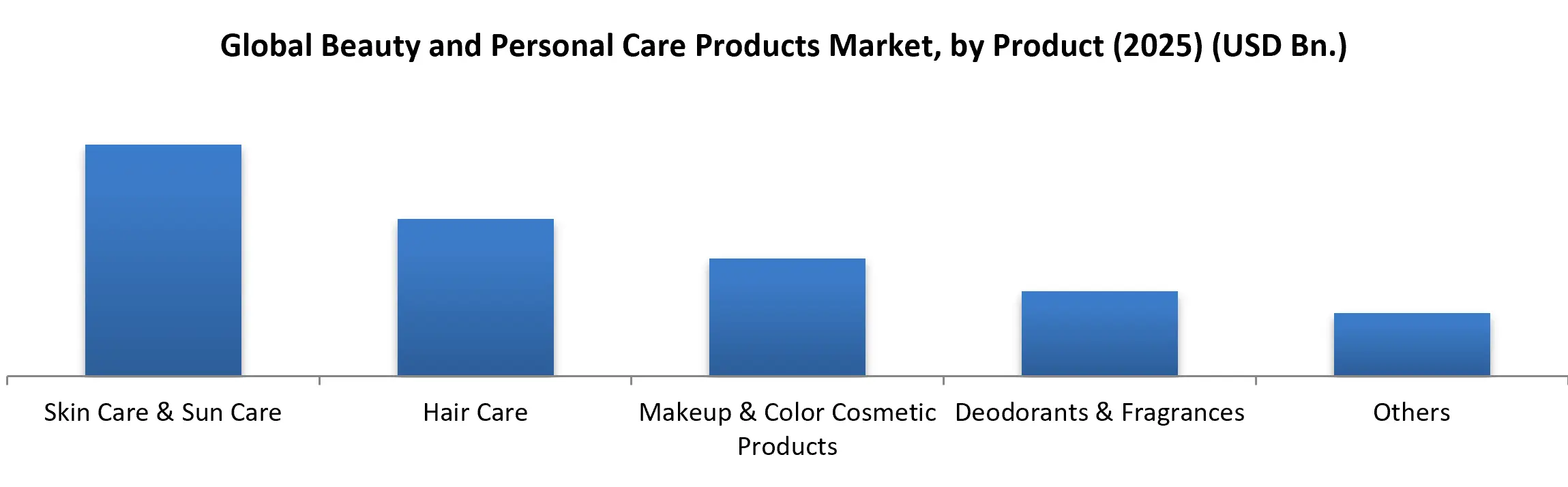
By Product, Skin Care & Sun Care remains the leading product segment in 2025, supported by daily skincare routines, stronger awareness of ultraviolet protection, pollution-related skin concerns, and growing interest in preventive skin health. It accounts for about 35.4% of the market in the latest 2025 assessment, keeping it clearly ahead of the other product categories. Hair Care remains a strong second category as consumers increasingly purchase specialized shampoos, conditioners, scalp treatments, hair repair products, and styling solutions. Makeup & Color Cosmetic Products is gaining momentum through social media-driven product discovery, inclusive shade ranges, multifunctional cosmetics, and premium formulations, while Deodorants & Fragrances benefit from everyday grooming and premium fragrance purchases. Others, including personal hygiene and related beauty products, continue to provide a stable base of routine consumption. Current industry analysis also identifies color cosmetics as the fastest-growing product segment, making it an important opportunity despite its smaller current share.
 By Distribution Channel, E-commerce is currently the most dynamic distribution channel in the Beauty and Personal Care Products Market, as consumers increasingly prefer convenient product discovery, wider brand selection, customer reviews, doorstep delivery, and easy price comparison. Hypermarkets & Retail Chains continue to hold an important position because they provide broad product availability, promotional pricing, and convenient one-stop shopping for everyday personal care products. Specialty Stores remain relevant for premium skincare, haircare, fragrances, and products where consumers value product demonstrations and expert guidance. Direct Selling continues to serve customers through personal recommendations and relationship-based selling, particularly for beauty and personal care products; in India, cosmetics and personal care represented about 24% of direct-selling sales in 2024. Other channels include salons, pharmacies, convenience stores, and professional beauty outlets, which remain important for specialized and routine purchases.
Beauty and Personal Care Products Market Regional Analysis:
Asia Pacific is leading region in the Beauty and Personal Care Products Market, supported by a large consumer base, strong skincare and haircare routines, rising interest in beauty technology, and rapid digital shopping adoption. China, India, Japan, and South Korea remain important demand centers, while local beauty brands are gaining attention alongside established international brands. Consumers are also showing stronger interest in ingredient-focused products, sun care, scalp care, vegan formulations, and affordable premium beauty. Social media and mobile commerce are particularly influential in product discovery, helping new beauty products reach consumers quickly.
North America remains a major region in the Beauty and Personal Care Products Market, supported by high consumer spending, strong brand awareness, advanced retail infrastructure, and demand for premium and specialized products. Skincare, haircare, fragrances, and multifunctional beauty products continue to attract consumers, while sustainable packaging, refillable formats, clean formulations, and responsible sourcing are becoming more important purchasing considerations. The region also has a highly developed online beauty ecosystem, where consumers increasingly combine physical store visits with digital research, reviews, subscriptions, and online purchasing.
Europe holds a strong position in the Beauty and Personal Care Products Market because of its mature beauty industry, established premium brands, product quality standards, and consumer focus on sustainability. Demand is increasingly influenced by environmentally responsible packaging, natural ingredients, product traceability, and responsible manufacturing. France continues to have strong influence in luxury beauty, while Germany, the United Kingdom, Italy, and Spain provide substantial demand across skincare, haircare, fragrances, and cosmetics. Regulatory attention toward product ingredients and environmental impact is also encouraging manufacturers to improve formulation and packaging practices.
South America is becoming an important regional market for the Beauty and Personal Care Products Market, supported by strong beauty culture, rising digital product discovery, and increasing consumer attention toward skincare, haircare, fragrances, and color cosmetics. Brazil plays a central role in regional demand, with local preferences influencing product textures, fragrances, hair treatments, and personal grooming products. Social media creators, online reviews, and digital marketplaces are helping consumers discover new brands, while local and regional manufacturers are competing by offering products suited to climate, hair types, skin needs, and different purchasing budgets.
Middle East and Africa is an emerging region in the Beauty and Personal Care Products Market, with demand supported by urbanization, changing grooming habits, premium beauty preferences, and greater access to organized and digital retail. Fragrances, skincare, haircare, grooming products, and premium cosmetics have particular relevance across the region, while consumer preferences are encouraging brands to adapt products to local climates, cultural expectations, and hair and skin characteristics. Beauty technology, social media, online shopping, and collaboration with local creators are also becoming more important for brand discovery and customer engagement.
Beauty and Personal Care Product Competitive Landscape
The Beauty and Personal Care Products Market is highly competitive and remains fragmented across product categories, price levels, regions, and distribution channels, with leading companies competing through product innovation, strong brand portfolios, premium formulations, digital marketing, and wider retail access. Major participants such as L’Oréal, Unilever, Procter & Gamble, The Estée Lauder Companies, Shiseido, Beiersdorf, Coty, Kao Corporation, Amorepacific, and LVMH maintain strong positions across skincare, haircare, makeup, fragrances, and personal care, while regional brands and digitally native companies are gaining consumer attention through focused product ranges and faster product launches. Competition is increasingly centered on science-backed formulations, personalized beauty, natural and organic ingredients, sustainable packaging, social commerce, and artificial intelligence-supported product recommendations rather than brand scale alone. Companies are also strengthening their positions through acquisitions, partnerships, new product development, influencer marketing, and direct-to-consumer channels, while Asian beauty brands are gaining visibility through innovative ingredients, accessible pricing, and strong digital engagement. This competitive structure gives consumers a wide range of choices and encourages established companies and emerging brands to continuously improve product performance, value, sustainability, and customer experience.
Beauty and Personal Care Product Market Recent Development:
| Month/ Year | Company | Recent Development in 2026 |
| January 2026 | Estée Lauder Companies | Estée Lauder appointed British actress Daisy Edgar Jones as a new global brand ambassador, with her first campaign scheduled to debut in February across digital, print, and retail channels. |
| February 2026 | Shiseido | Shiseido introduced artificial intelligence based systems to assess ingredient biodegradability and identify safety information, strengthening its use of technology in cosmetic research and formulation development. |
| June 2026 | L’Oréal | L’Oréal announced a collaboration with OpenAI focused on artificial intelligence powered beauty discovery and consumer journeys. Maybelline New York is also bringing virtual makeup try on into ChatGPT through L’Oréal’s ModiFace technology. |
| August 2026 | Estée Lauder Companies | Estée Lauder launched Glimmer, a new prestige fragrance, while the company also reported a return to sales growth in fiscal 2026 and continued product innovation across skincare, makeup, fragrance, and haircare. |
Beauty and Personal Care Products Market Scope: Inquire before buying
| Beauty and Personal Care Products Market | |||
|---|---|---|---|
| Report Coverage | Details | ||
| Base Year: | 2025 | Forecast Period: | 2026-2034 |
| Historical Data: | 2020 to 2025 | Market Size in 2025: | USD 591.3 Bn. |
| Forecast Period 2026 to 2034 CAGR: | 4.5% | Market Size in 2034: | USD 878.73 Bn. |
| Segments Covered: | by Product | Skin Care & Sun Care Hair Care Makeup & Color Cosmetic Products Deodorants & Fragrances Others |
|
| by Distribution Channel | Direct Selling Hypermarkets & Retail Chains E - Commerce Specialty Stores Other |
||
| by Type | Vegan Organic Inorganic |
||
Beauty and Personal Care Products Market, by Region
North America (United States, Canada and Mexico)
Europe (UK, France, Germany, Italy, Spain, Sweden, Austria and Rest of Europe)
Asia Pacific (China, South Korea, Japan, India, Australia, Indonesia, Malaysia, Vietnam, Taiwan, Bangladesh, Pakistan and Rest of APAC)
Middle East and Africa (South Africa, GCC, Egypt, Nigeria and Rest of ME&A)
South America (Brazil, Argentina Rest of South America)
Beauty and Personal Care Products Market Key Players are:
1. L’Oréal Groupe
2. Unilever
3. Procter & Gamble
4. The Estée Lauder Companies
5. LVMH Moët Hennessy Louis Vuitton
6. Beiersdorf AG
7. Shiseido Company Limited
8. Coty Inc.
9. Kao Corporation
10. Henkel AG and Co. KGaA
11. Colgate Palmolive Company
12. Church and Dwight Co. Inc.
13. Mary Kay Inc.
14. Avon Products
15. Revlon Inc.
16. L’OCCITANE Group
17. Sally Beauty Holdings Inc.
18. Johnson and Johnson
19. Natura andCo
20. Amorepacific Corporation
21. Puig Brands SA
22. KOSÉ Corporation
23. Kenvue Inc.
24. Bath and Body Works Inc.
25. Chanel Limited
26. Clarins Group
27. Shiseido Group
28. Galderma Group AG
29. Interparfums Inc.
30. Intercos Group
31. Reckitt
32. Oriflame Holding AG
33. Cavinkare Private Limited
34. Forest Essentials
35. VLCC Health Care Limited
36. Himalaya Wellness Company
37. Emami Limited
38. Dabur India Limited
39. Wipro Consumer Care and Lighting
40. Godrej Consumer Products Limited
41. Lotus Herbals
42. Colorbar Cosmetics
43. Sugar Cosmetics
44. Nykaa
45. The Body Shop
Frequently Asked Questions:
1. Which region has the largest share in Beauty and Personal Care Products Market?
Answer: Asia Pacific region held the highest share in 2025.
2. What is the growth rate of Beauty and Personal Care Products Market?
Answer: The Beauty and Personal Care Products Market is growing at a CAGR of 4.5% during the forecast period 2026 to 2034.
3. What is the scope of the Beauty and Personal Care Products Market report?
Answer: Beauty and Personal Care Products Market report covers PESTEL, PORTER, COVID 19 Impact analysis, recommendations for investors and leaders, and market estimation during the forecast period.
4. Who are the key players in Beauty and Personal Care Products Market?
Answer: The important key players in the Beauty and Personal Care Products Market are L’Oréal Groupe, Unilever, Procter & Gamble, The Estée Lauder Companies, LVMH, Beiersdorf, Shiseido, Coty, Kao Corporation, Henkel, and Colgate Palmolive.
5. What is the study period of this Market?
Answer: The Beauty and Personal Care Products Market is studied from 2020 to 2034.