
Neuroscience Market Size by Technology, Component, End-User, Region – Revenue Pool Analysis, Margin Structure Assessment, Capital Flow Trends, Competitive Benchmarking & Forecast to 2034
Overview
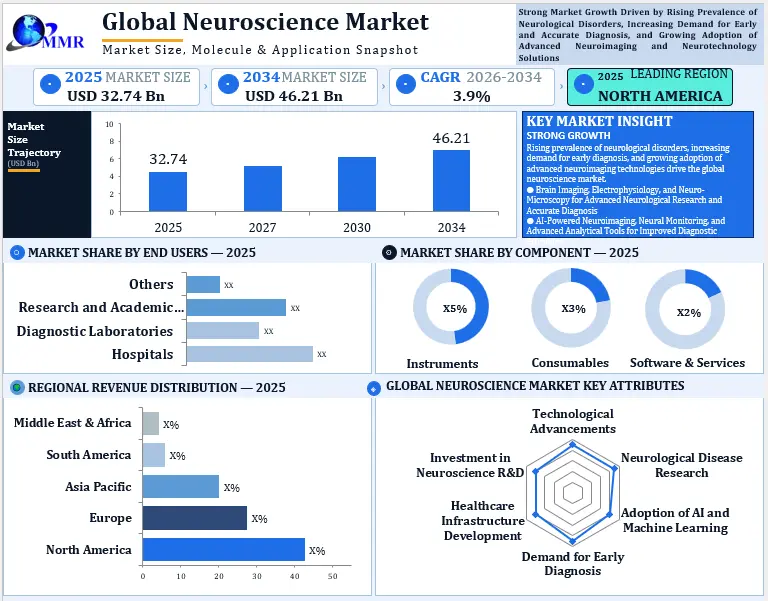
The Neuroscience Market size was valued at USD 32.74 Billion in 2025 and the total Neuroscience revenue is expected to grow at a CAGR of 3.9% from 2026 to 2034, approaching to USD 46.21 Billion.
Neuroscience Market Overview:
Neuroscience is a multidisciplinary field of research that focuses on understanding the structure, functions, and operations of the nervous system, including the brain, spinal cord, and peripheral nerves. The field encompasses several specialized areas, including behavioural, computational, and cognitive neuroscience, as well as the development, physiology, cellular and molecular biology, anatomy, and pharmacology of the nervous system. Neuroscience plays an important role in understanding brain functions, neural communication, cognitive processes, and the mechanisms underlying neurological disorders. Diagnostic technologies, such as magnetic resonance imaging (MRI), computed tomography (CT), electroencephalography (EEG), and computer-generated three-dimensional models, support the examination of brain structures and neurological activity.
These technologies assist in the detection, diagnosis, and monitoring of various conditions, including Down syndrome, Parkinson's disease, brain tumours, and stroke-related complications, including language impairments. Furthermore, advances in neuroimaging, computational modelling, and neurological research support the development of improved diagnostic methods and treatment approaches. Growing interest in understanding neurological diseases, brain development, and nervous system disorders strengthens the importance of neuroscience across healthcare, pharmaceutical research, and biomedical innovation.
Neuroscience Market Size, Growth & Share Analysis
To know about the Research Methodology :- Request Free Sample Report
The ageing population is expected to rise, government spending on healthcare infrastructure in developed nations is expected to increase, and technological improvements are expected to accelerate the growth of the neuroscience market.
In this report, the Neuroscience market's growth reasons, as well as the market's many segments (Technology, Component, End-User, and Region.), are discussed. Data has been given by market players, regions, and specific requirements. This market report includes a comprehensive overview of all the significant improvements that are presently prevailing in all market segments. Key data analysis is presented in the form of statistics, infographics, and presentations.
The study discusses the Neuroscience market's Drivers, Restraints, Opportunities, and Challenges. The report helps to assess the market growth drivers and determines how to use these drivers as a tool. The report also helps to rectify and resolve issues related to the Global Neuroscience market situation.
Global Neuroscience Market Key Highlights
• Market Size and Growth: The global neuroscience market is valued at USD 32.74 billion in 2025 and is projected to reach USD 46.21 billion by 2034, growing at a CAGR of 3.9% from 2026 to 2034.
• Rising Prevalence of Neurological Disorders: The increasing burden of Alzheimer's disease, Parkinson's disease, epilepsy, stroke, and multiple sclerosis drives demand for advanced neurological diagnostics, disease monitoring, and neuroscience research. More than 3 billion people worldwide live with a neurological condition, according to the WHO.
• Technological Advancements: Innovations in MRI, functional MRI, PET, EEG, advanced microscopy, optogenetics, and brain-computer interfaces strengthen neuroscience research, neurological diagnosis, and neural activity monitoring.
• North America Leads the Market: North America holds the leading regional position, supported by advanced healthcare infrastructure, substantial neuroscience research investment, established pharmaceutical and biotechnology industries, and widespread adoption of neuroimaging technologies.
• AI and Precision Neuroscience Create Opportunities: Increasing adoption of artificial intelligence, computational modelling, multimodal neuroimaging, and neural monitoring technologies supports improved brain data analysis, neurological disease research, and the development of personalized diagnostic and treatment approaches.
Neuroscience Market Dynamics:
Global Neuroscience Market Drivers
Rising Prevalence of Neurological Disorders: The increasing prevalence of neurological disorders, including Alzheimer's disease, Parkinson's disease, epilepsy, stroke, and multiple sclerosis, drives demand for neuroscience research, diagnostic technologies, and therapeutic solutions. According to the World Health Organization (WHO), more than 3 billion people worldwide live with a neurological condition, making neurological disorders a major contributor to illness and disability. This growing disease burden increases the need for early diagnosis, advanced neuroimaging, neurological monitoring, and research into disease mechanisms. Technologies such as magnetic resonance imaging (MRI), electroencephalography (EEG), and electrophysiology systems support the identification and monitoring of neurological abnormalities, strengthening demand across the global neuroscience market.
Advancements in Neuroimaging and Neurotechnology: Continuous advancements in neuroimaging and neurotechnology support the development of more precise neurological diagnostic and research methods. MRI, functional MRI (fMRI), positron emission tomography (PET), EEG, and advanced microscopy enable researchers and healthcare professionals to examine brain structures, monitor neural activity, and investigate neurological functions. Emerging technologies, including optogenetics, brain mapping, functional near-infrared spectroscopy (fNIRS), and brain-computer interfaces (BCIs), expand the scope of neuroscience research. These technologies support the investigation of neural communication, cognitive processes, and neurological disorders, encouraging healthcare institutions, universities, and research organizations to adopt advanced neuroscience tools.
Increasing Research and Development Expenditure: Growing investment in neuroscience research and development (R&D) supports innovation in neurological diagnostics, drug discovery, neurotechnology, and brain research. Governments, pharmaceutical companies, biotechnology firms, and academic institutions allocate resources to investigate neurological diseases and develop improved diagnostic and therapeutic approaches. According to the WHO, neurological conditions affect more than 3 billion people globally, highlighting the substantial need for research into prevention, diagnosis, treatment, and rehabilitation. Public research funding and collaborations between universities, medical institutions, and technology companies support the development of advanced neuroimaging systems, neural monitoring devices, and computational tools for studying brain function.
Global Neuroscience Market Restraints
High Costs of Neuroscience Equipment and Procedures: The high cost of advanced neuroscience equipment represents a major restraint on market expansion. MRI scanners, PET systems, advanced microscopy instruments, electrophysiology equipment, and specialized neural monitoring systems require substantial capital investment, installation expenditure, maintenance, and trained personnel. These costs create challenges for smaller hospitals, research laboratories, universities, and healthcare facilities in developing economies. In addition, the expense associated with neurological imaging, specialized testing, and long-term patient monitoring can limit access to advanced diagnostic services. Budget constraints and differences in healthcare infrastructure affect the adoption of sophisticated neuroscience technologies across regions.
Shortage of Specialized Professionals and Technical Expertise: The limited availability of trained neurologists, neuroscientists, neuroimaging specialists, and neurotechnology professionals constrains the adoption of advanced neuroscience solutions. Specialized technologies such as fMRI, optogenetics, electrophysiology, and computational neuroscience require expertise in equipment operation, experimental design, data interpretation, and clinical assessment. Healthcare facilities and research institutions may experience difficulties recruiting and retaining qualified professionals, particularly in regions with limited specialist training programs. Furthermore, the complexity of neurological conditions and the need for multidisciplinary expertise increase the time and resources required for accurate diagnosis, research, and treatment development.
Global Neuroscience Market Opportunities
Growing Demand for Brain-Computer Interfaces and Neural Monitoring: The growing development of brain-computer interfaces (BCIs), wearable neurological monitoring devices, and neural signal acquisition systems creates opportunities for neuroscience companies. These technologies support the measurement and interpretation of brain activity and neural signals for research, rehabilitation, and selected clinical applications. According to the International Data Corporation (IDC), worldwide spending on augmented and virtual reality is projected to reach US$ 7.1 billion in 2026, reflecting investment in immersive technologies that also support applications in neurological rehabilitation, cognitive research, and brain training. Advances in wearable sensors, electromyography, and neural interfaces encourage the development of compact and accessible neuroscience devices.
Expansion of Precision Medicine and Neurological Drug Discovery: Advances in genomics, molecular neuroscience, computational biology, and artificial intelligence create opportunities for personalized approaches to neurological disease diagnosis and treatment. Researchers use these technologies to investigate disease-associated genetic variations, identify biomarkers, understand disease progression, and evaluate potential therapeutic targets. The increasing use of high-throughput screening, advanced imaging, and computational modelling supports the identification of drug candidates for neurological conditions, including Alzheimer's disease, Parkinson's disease, epilepsy, and multiple sclerosis. Collaboration among pharmaceutical companies, biotechnology firms, academic institutions, and neuroscience technology providers strengthens innovation and supports the development of targeted therapies and improved diagnostic approaches.
Global Neuroscience Market Challenges
Complexity of Neurological Diseases and Clinical Diagnosis: The complexity of neurological disorders creates challenges for diagnosis, disease classification, and treatment development. Many conditions, including Alzheimer's disease, Parkinson's disease, multiple sclerosis, and other neurodegenerative disorders, exhibit overlapping symptoms or progress gradually. Accurate assessment often requires a combination of clinical examination, neuroimaging, laboratory testing, cognitive assessment, and neurological monitoring. Furthermore, differences in disease progression, genetic background, and individual patient responses complicate the development of standardized diagnostic and treatment approaches. These factors increase the need for reliable biomarkers, improved diagnostic protocols, and integrated neuroscience technologies.
Data Management, Integration, and Research Reproducibility: The growing use of MRI, fMRI, EEG, genomics, electrophysiology, and other advanced research tools generates large and complex datasets. Integrating these datasets requires compatible technologies, standardized data formats, robust computational infrastructure, and specialized analytical expertise. Differences in experimental methods, patient populations, equipment configurations, and data-processing techniques can also affect the reproducibility of neuroscience research. In addition, protecting sensitive neurological and genetic information creates data privacy and security requirements for healthcare providers and research institutions. Addressing these challenges requires improved data-sharing frameworks, standardized research protocols, and secure analytical platforms.
Global Neuroscience Market Trends
Increasing Adoption of Artificial Intelligence in Neuroscience: Artificial intelligence (AI) increasingly supports neuroscience research through automated image analysis, neural signal processing, disease classification, and computational modelling. AI-based tools help researchers identify patterns in MRI scans, analyze EEG signals, and investigate relationships between neurological biomarkers and disease progression. Machine learning also supports the development of predictive models for neurological conditions and helps researchers evaluate potential therapeutic targets. The integration of AI with neuroimaging, genomics, and clinical datasets strengthens analytical capabilities and supports more efficient neuroscience research and diagnostic workflows.
Growing Integration of Multimodal Neuroimaging Technologies: The integration of MRI, PET, EEG, fMRI, and other neuroimaging technologies represents an important trend in neuroscience. Multimodal approaches allow researchers to examine brain anatomy, functional activity, metabolic processes, and electrical signals using complementary methods. This integration supports a more comprehensive understanding of neurological conditions and helps researchers investigate relationships between brain structure and function. Advances in imaging software, computational analysis, and data integration further support the adoption of multimodal technologies across hospitals, academic institutions, and specialized neuroscience research centers.
Neuroscience Market Segment Analysis:
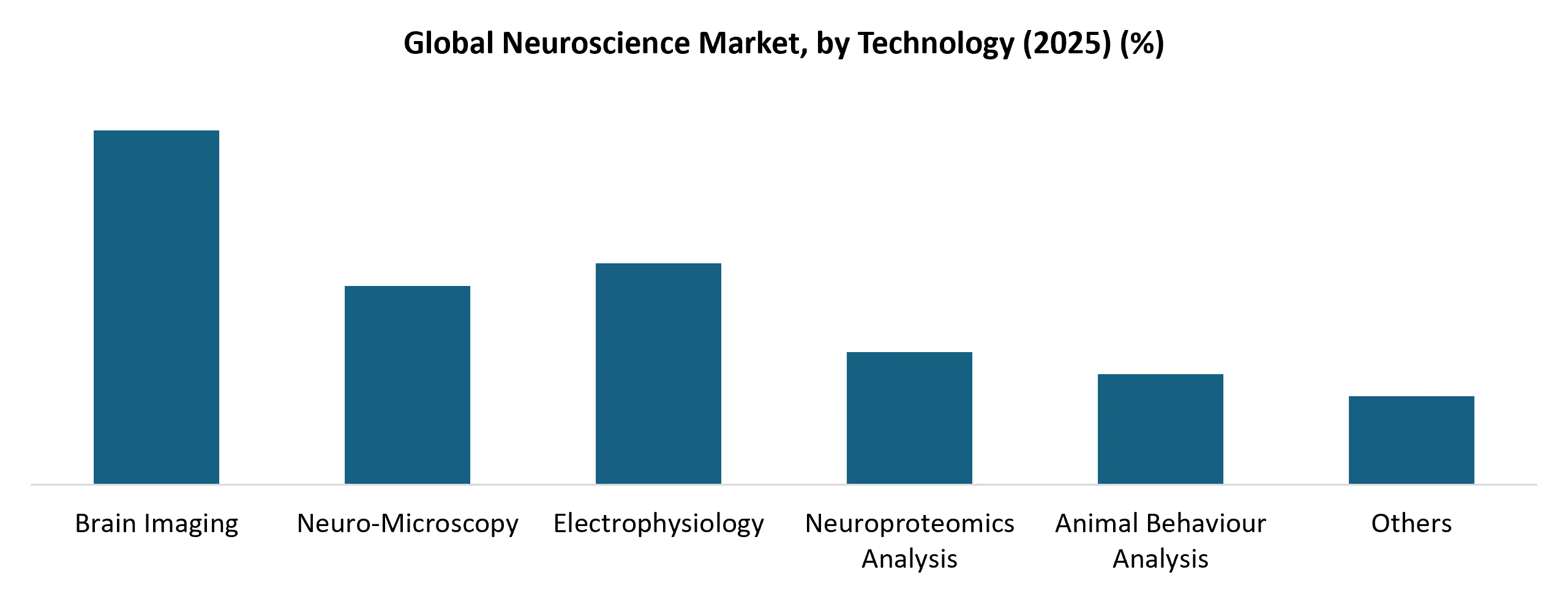
By Technology, The market is segmented into Brain Imaging, Neuro-Microscopy, Electrophysiology, Neuroproteomic Analysis, Animal Behaviour Analysis and Others. These applications include the identification of neural networks involved in cognitive processes, understanding disease pathways, and early disease diagnosis. It enables the study of disease progression at a molecular level, thereby leading to greater usage by researchers in order to develop novel medicines and treatment strategies for nervous disorders.
 By End-User, Based on Application, The market is bifurcated into Hospitals, Diagnostic Laboratories, Research Institutes, and Others. Hospitals are anticipated to become the fastest-growing market in the forecast period. The increasing preference of patients towards hospitals for better diagnosis of their neurological disorders is one of the major factors driving the hospital segment. The quality treatment facilities offered by the hospitals and the availability of advanced equipment have positively increased the growth of the segment.
Neuroscience Market Regional Insights:
North America is the leading region in the global neuroscience market, supported by advanced healthcare infrastructure, substantial investment in neuroscience research, established pharmaceutical and biotechnology industries, and widespread adoption of advanced neuroimaging technologies. The United States accounts for a significant share of regional demand, driven by the increasing prevalence of neurological disorders, including stroke, Alzheimer's disease, Parkinson's disease, and brain tumours. According to the US Centers for Disease Control and Prevention (CDC), approximately 795,000 people in the United States experience a stroke each year, highlighting the need for advanced neurological diagnosis, monitoring, and rehabilitation. The region benefits from strong research capabilities, government funding, and collaborations between universities, hospitals, and biotechnology companies. The growing adoption of magnetic resonance imaging (MRI), functional MRI (fMRI), electroencephalography (EEG), and brain-computer interfaces (BCIs) supports neuroscience research and clinical applications. Furthermore, continuous advancements in artificial intelligence (AI), neuroimaging, and neural monitoring strengthen North America's position in the global neuroscience market.
Europe represents a significant region in the global neuroscience market, supported by established healthcare systems, advanced medical research facilities, and increasing investment in neurological disease research. Countries such as Germany, the United Kingdom, France, Italy, and Switzerland contribute to regional demand through their pharmaceutical industries, academic research institutions, and specialized neurological treatment centres. The increasing burden of neurological conditions, including dementia, epilepsy, multiple sclerosis, and Parkinson's disease, supports the adoption of advanced diagnostic and research technologies. European research institutions and healthcare providers utilize MRI, PET imaging, electrophysiology, advanced microscopy, and computational neuroscience tools to investigate brain function and neurological disorders. Additionally, collaborations between universities, medical device manufacturers, and pharmaceutical companies support drug discovery, biomarker identification, and the development of innovative neurological therapies. The growing application of AI in neuroimaging, precision medicine, and neurological data analysis further supports the development of the European neuroscience market.
Asia Pacific is an important growth region in the global neuroscience market, driven by expanding healthcare infrastructure, increasing healthcare expenditure, a growing ageing population, and rising awareness of neurological disorders. China, Japan, India, South Korea, and Australia contribute to regional demand through investments in hospitals, diagnostic laboratories, pharmaceutical research, and neuroscience facilities. The increasing prevalence of age-related neurological conditions, including Alzheimer's disease, Parkinson's disease, stroke, and dementia, strengthens demand for neuroimaging systems, neurological monitoring devices, and advanced research technologies. Healthcare providers and research institutions increasingly adopt MRI, EEG, electrophysiology, and computational neuroscience tools to support neurological diagnosis and scientific investigation. Furthermore, government initiatives, expanding clinical research capabilities, and collaborations between academic institutions and biotechnology companies support innovation in neurotechnology and neurological drug development. Improvements in access to specialized healthcare services and the increasing adoption of AI-enabled diagnostic technologies create further opportunities for the Asia Pacific neuroscience market.
South America demonstrates gradual development in the global neuroscience market, supported by improvements in healthcare infrastructure, increasing awareness of neurological disorders, and the expansion of specialized diagnostic and research facilities. Brazil and Argentina contribute to regional demand through hospitals, universities, medical research institutions, and pharmaceutical companies. The need to diagnose and manage neurological conditions, including stroke, epilepsy, dementia, and Parkinson's disease, supports the adoption of neuroimaging equipment, EEG systems, and neurological monitoring technologies. Investments in medical equipment and improvements in specialist healthcare services contribute to the development of regional neuroscience capabilities. Additionally, academic research and collaborations with international research institutions support neuroscience education, clinical investigations, and neurological disease research. However, disparities in healthcare expenditure, limited access to advanced diagnostic equipment, and shortages of specialized professionals constrain the adoption of sophisticated neuroscience technologies in some countries.
The Middle East and Africa region experiences increasing opportunities in the global neuroscience market, supported by healthcare infrastructure development, investments in specialized medical services, and growing awareness of neurological disorders. Saudi Arabia, the United Arab Emirates, and South Africa contribute to regional demand through hospital modernization, diagnostic service expansion, and investments in medical research. The increasing need to diagnose and manage neurological conditions supports demand for MRI systems, EEG equipment, electrophysiology instruments, and other neurological diagnostic technologies. Healthcare providers are increasingly incorporating advanced imaging and monitoring systems into specialized neurology departments to improve diagnostic capabilities and patient management. Furthermore, investments in healthcare technology, professional training, and research infrastructure support the adoption of modern neuroscience solutions. However, limited access to specialized neurological services, high equipment costs, and differences in healthcare infrastructure continue to influence market development across parts of the region.
Global Neuroscience Market Competitive Landscape
The global neuroscience market is highly competitive, with established medical technology manufacturers, pharmaceutical companies, biotechnology firms, and specialized neurotechnology developers competing through product innovation, research and development (R&D), strategic collaborations, and portfolio expansion. Key market participants focus on developing advanced neuroimaging systems, neurological diagnostic instruments, electrophysiology equipment, neuromodulation devices, and brain-computer interface technologies. Companies such as GE HealthCare, Siemens Healthineers, Koninklijke Philips, Medtronic, Abbott Laboratories, and Boston Scientific strengthen their market positions through technological advancements, extensive product portfolios, and established healthcare distribution networks.
Companies increasingly invest in artificial intelligence (AI), precision neuroscience, brain mapping, and advanced neuroimaging technologies to improve diagnostic accuracy and research efficiency. Leading imaging manufacturers develop advanced MRI and functional MRI systems, while specialized technology providers focus on neural signal acquisition, electrophysiology, microscopy, and neurological monitoring. Companies such as Bruker Corporation, Carl Zeiss, Thermo Fisher Scientific, Nihon Kohden, and Compumedics contribute to neuroscience research and diagnostic applications through specialized instruments and laboratory technologies.
Furthermore, market participants emphasize strategic partnerships, clinical research collaborations, product development, and geographic expansion to strengthen their competitive positions. The growing demand for neurological disease diagnosis, neurodegenerative disease research, neurorehabilitation, and brain-computer interfaces encourages companies to develop innovative solutions for hospitals, research institutions, pharmaceutical companies, and specialized neurological centres. Continuous advancements in neurotechnology, AI-enabled diagnostics, neural interfaces, and personalized neurological treatments shape competition and support the long-term development of the global neuroscience market.
Neuroscience Market Recent Development
| Date | Company | Development | Impact |
| August 20, 2026 | Hyperfine, Inc. | Receives FDA clearance for an updated Optive AI software package for its Swoop portable MRI system, enhancing image quality and introducing improved three-dimensional brain visualization. | Improves portable brain imaging capabilities and supports wider use of AI-powered neuroimaging in hospitals and clinical settings. |
| June 16, 2026 | Neurophet | Showcases AI-based brain imaging solutions, including Neurophet AQUA AD Plus, designed to support treatment decision-making for Alzheimer's disease. | Strengthens the role of AI-driven brain image analysis in neurological diagnosis, treatment planning, and precision neuroscience. |
| June 12, 2026 | Medtronic | Completes its acquisition of Scientia Vascular to integrate vascular access technologies with its neurovascular treatment portfolio. | Expands neurovascular capabilities and supports physicians across procedures used to treat cerebrovascular conditions. |
| April 29, 2026 | Hyperfine, Inc. | Announces the clinical deployment of its Swoop portable MRI system at AIIMS New Delhi, marking its introduction for routine bedside brain imaging in India. | Expands access to portable brain imaging and supports neurological assessment in clinical settings where conventional MRI access may be limited. |
| April 9, 2026 | Hyperfine, Inc. | Receives CE marking and UKCA approval for its next-generation Swoop portable MRI system and updated Optive AI software. | Enables commercialization in Europe and the United Kingdom, expanding the reach of portable neuroimaging technologies. |
| April 22, 2026 | AbbVie | Announces a US$1.4 billion manufacturing campus investment that supports the production of medicines across neuroscience, immunology, and oncology. | Strengthens pharmaceutical manufacturing capacity and supports the development and supply of treatments for neurological and other diseases. |
Neuroscience Market Scope: Inquire before buying
| Neuroscience Market | |||
|---|---|---|---|
| Report Coverage | Details | ||
| Base Year: | 2025 | Forecast Period: | 2026-2034 |
| Historical Data: | 2020 to 2025 | Market Size in 2025: | USD 32.74 Bn. |
| Forecast Period 2026 to 2034 CAGR: | 3.9 % | Market Size in 2034: | USD 46.21 Bn. |
| Segments Covered: | by Technology | Brain Imaging Neuro-Microscopy Electrophysiology Neuroproteomic Analysis Animal Behaviour Analysis Others |
|
| by Component | Instruments and Consumables Software and Services |
||
| by End-User | Hospitals Diagnostic Laboratories Research and Academic Institutes Others |
||
Neuroscience Market, by Region
Asia Pacific (China, South Korea, Japan, India, Australia, Indonesia, Malaysia, Vietnam, Taiwan, Bangladesh, Pakistan and Rest of APAC)
Europe (UK, France, Germany, Italy, Spain, Sweden, Austria and Rest of Europe)
North America (United States, Canada and Mexico)
Middle East and Africa (South Africa, GCC, Egypt, Nigeria and Rest of ME&A)
South America (Brazil, Argentina Rest of South America)
Neuroscience Market Key Players
1. Biobserve GmbH
2. Doric Lenses Inc.
3. GE HealthCare
4. Kendall Research Systems LLC
5. Laserglow Technologies
6. Mightex Systems
7. NeuroNexus Technologies
8. Noldus Information Technology
9. Prizmatix Ltd.
10. Siemens Healthineers
11. Koninklijke Philips N.V.
12. Medtronic plc
13. Bruker Corporation
14. Thermo Fisher Scientific Inc.
15. Carl Zeiss AG
16. Evident Corporation
17. Leica Microsystems
18. Nikon Corporation
19. Molecular Devices LLC
20. Axion BioSystems
21. Plexon Inc.
22. Tucker-Davis Technologies
23. Brain Products GmbH
24. Compumedics Limited
25. Neuroelectrics
26. Blackrock Neurotech
27. Intan Technologies
28. Cambridge NeuroTech
29. Scientifica Ltd.
30. Sutter Instrument Company
31. World Precision Instruments
32. Harvard Apparatus
33. Lafayette Instrument Company
34. Coulbourn Instruments
35. Sanworks LLC
36. NeuroBehavioral Systems, Inc.
37. ADInstruments
38. BIOPAC Systems, Inc.
39. ANT Neuro
40. g.tec medical engineering GmbH
Frequently Asked Questions:
1. What was the Global Neuroscience Market size in 2025?
Ans: The Global Neuroscience Market size was USD 32.74 Billion in 2025.
2. What is the Forecast Period of the Neuroscience Market?
Ans. Forecast Period for Neuroscience Market in 2026-2034.
3. What is the projected market size & growth rate of the Neuroscience Market?
Ans. Neuroscience Market is expected to grow at 3.9 % through 2026 to 2034, approaching to USD 46.21 Bn.
4. What segments are covered in the Neuroscience Market report?
Ans. The segments covered are Technology, Component, End-User, and Region.
5. Which Region is the leading region of the Global Neuroscience Market?
Ans. North America is the leading region of the Global Neuroscience Market