
Global Honey Spread Market Size by Processing, Application, and Region – Segment‑Level Market Assessment, Growth Opportunity Analysis, Competitive Mapping & Forecast to 2034
Overview
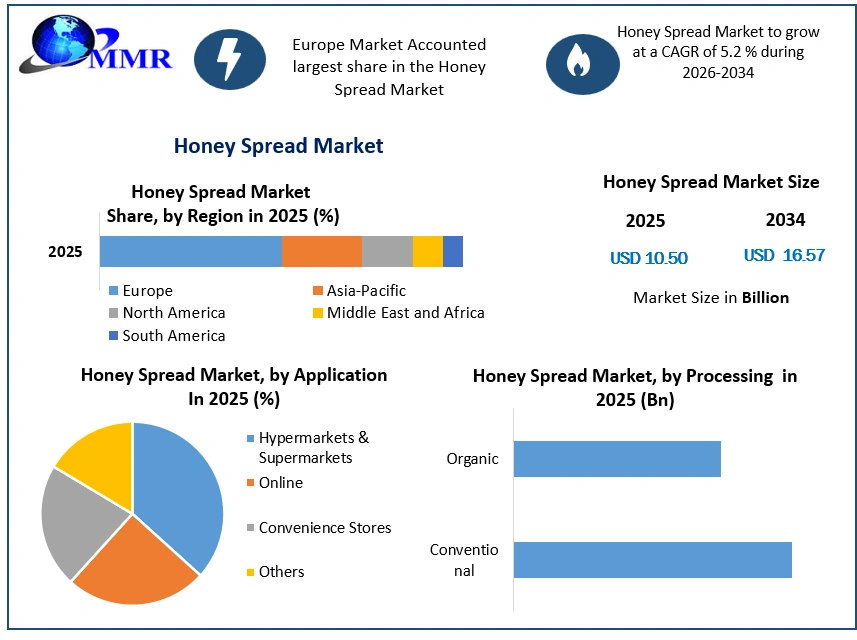
Honey Spread Market size was valued at USD 10.50 Bn. in 2025 and the total revenue is expected to grow at 5.2% through 2026 to 2034, reaching nearly USD 16.57 Bn.
Honey Spread Market Overview:
Honey is a sweet, viscous food substance produced by bees and some related insects. A spread is a food that is actually spread across food products like bread and crackers, usually with a knife. Honey's main applications as a food have been in cooking, baking, desserts, and as an additive to various beverages, such as tea, as well as a sweetener in some commercial beverages.
Honey is high in vitamins, minerals, calcium, and antioxidants, among other nutrients. The market is being driven by a high demand for nutritious food products, as people are becoming more aware of the benefits of leading a healthy lifestyle.
Honey Spread Market Growth Outlook
To know about the Research Methodology:-Request Free Sample Report
Honey can be found in a variety of beverages, processed meals, jams, and jellies, as well as in health and beauty treatments. The market demand is being aided by the general availability of these items, as well as their ability to impart a pleasing taste in food and beverage products. Honey also has a number of medicinal properties, such as the potential to increase metabolic activity, control blood pressure, reduce the risk of diabetes, and even cure burn wounds. As a result, it is widely utilised in a variety of applications other than food and beverages, including as cosmetics and medicines, which is expected to boost market growth.
Honey Spread Market Dynamics:
To engage a growing number of consumers, product manufacturers are coming up with new launches. Dabur, for example, introduced honey-infused syrups, a new line of syrups and spreads, in July 2021. The product contains no added sugar and is a healthier alternative to traditional strawberry syrups and sugary chocolates. Consumers' growing health consciousness has prompted them to incorporate natural sweeteners into their diets and minimise their consumption of white sugar. Natural sweeteners are popular among consumers because of their antioxidant and antibacterial effects. Furthermore, the product's prolonged shelf life and high affordability are important elements that contribute to market expansion.
Driving Factors: The increased usage of honey as a healthy alternative to artificial sweeteners, an energy source, an immune system booster, and a weight loss source is likely to drive the honey spread market forward over the forecast period. Honey contains a variety of nutrients, including minerals, vitamins, calcium, and antioxidants. It offers a variety of therapeutic characteristics that can aid in metabolic activity, diabetes prevention, blood pressure control, and even burn wound healing. As a result, it is utilised in a variety of applications other than food and beverages, such as pharmaceuticals and cosmetics, which is expected to sustain the honey market.
The rise in demand for natural sweeteners is likely to have a substantial impact on product growth, propelling the honey market forward throughout the forecast period. People's growing health consciousness has prompted them to incorporate natural sweeteners into their meals and minimise their consumption of white sugar. Honey's antioxidant and antibacterial characteristics, as well as the inclusion of various important minerals and vitamins, have made it a great sweetener choice.
Honey is proliferating untapped verticals of food and beverage production, in addition to being the world's most popular food additive. Commercial beverages, honey mustard, and honey barbecue sauce are just a few of the modern honey applications in the F&B industry.
Honey fermentation for sweet alcoholic beverages such as meads, honey wines, and honey beers is also gaining popularity. Honey's therapeutic properties are projected to be a major driver of the global honey spread market. Honey's therapeutic application pushes the market into industrial verticals such as drug manufacturing, healthcare facilities, and medical disposables. Honey has a long shelf life, allowing users to preserve it in the absence of a refrigerator.
Restraining Factors: The honey spread market is projected to be hampered by a rise in product adulteration. Honey adulteration and fraud occurrences have been one of the market's significant issues in recent years, negatively affecting worldwide honey spread market growth.
Honey's sugar profile continues to cause consumer mistrust around the world. Honey's sweetness does not prevent scientists and medical researchers from studying it. Consumption of honey during the treatment of open wounds causes diabetic patients to dislike it greatly.
Botulism and health problems caused by consuming toxic honey are other major factors limiting the global honey spread market's growth.
Honey Spread Market Segment Analysis:
Based on Processing, The Honey Spread Market is segmented into Conventional and Organic on the basis of type. Due to cheaper pricing and wider availability than organic honey, the conventional category held the greatest revenue share of over 80 % in 2025 and is predicted to maintain its lead during the forecast period.
Furthermore, to meet changing consumer preferences, new flavours with exotic add-ons are being launched in conventional items, which is expected to drive the conventional segment. Due to the growing trend of eating healthily among millennials and adults, the organic segment is expected to increase at the quickest rate from 2026 to 2034. Furthermore, replacing natural honey sweeteners with plant-based sweeteners can boost market growth in the next years.
Based on Application, The Honey Spread Market is segmented into Hypermarkets & Supermarkets, Online, Convenience Stores and others on the basis of application. In 2025, the hypermarkets and supermarkets segment accounted for almost 40 % of total revenue. Independent retail giants such as Walmart and Costco are extending their penetration, improving product visibility and drawing a bigger consumer base. Consumers like to see these things in person before purchasing, which is driving sales through this channel. From 2026 to 2034, the online distribution channel is expected to grow at the fastest rate of 6.6 %. Due to changes in their shopping patterns and a significant shift in lifestyles, consumers are shifting from physical to online channels.
Online platforms provide convenience, better product visibility, and at-home delivery options, all of which are driving segment growth. The majority of consumers rely on virtual retailers to assist them understand the vast array of products offered, as well as return and exchange options if they are dissatisfied with the things provided. Many market players prefer to sell honey, royal jelly, and wax through these outlets because they provide greater accountability in terms of overall client service.
Honey Spread Market Regional Insights:
In 2025, Europe had the highest revenue share of almost 35%, and this is likely to continue throughout the forecast period. A rapidly expanding economy, driven by increased disposable income, urbanization, and changing lifestyles, is expected to fuel product demand in the respective region, boosting total market growth in the coming years. From 2026 to 2034, Asia Pacific is predicted to have the highest CAGR. The industry is growing because of consumer's growing preference for healthy and enjoyable eating habits.
Furthermore, the market in Asia Pacific is being driven by the presence of well-established competitors in the region, as well as the region's constantly rising millennial population, which is willing to spend more on healthier sweeteners. Furthermore, an increase in honey production volume and increased honey consumption among individuals are predicted to promote regional market growth.
The objective of the report is to present a complete picture of global Honey Spread market. Data from past years is compiled to anticipate the future prospects of this market. Porter's five forces help to identify where power lies in a business situation. This is useful both in understanding the strength of an organisation's current competitive position, and the strength of a position that an organisation may look to move into. The report helps in identifying competitive rivalry currently running in the Honey Spread market. It also helps to understand bargaining power of suppliers and consumers.
The report also presents PESTLE analysis which helps to gain a macro picture of Honey Spread market. Political factors help to identify the influence of government over Honey Spread market. Economic factors a have direct impact on a company’s long-term prospects in a market. The economic environment may affect how a company dealing in Honey Spread market price their products or influence the supply and demand model.
Social factors, such as demographics and culture can impact the Honey Spread market by influencing peak buying periods, purchasing habits, and lifestyle choices. Technological factors may have a direct or an indirect influence on an industry. The legal and regulatory environment can affect the policies and procedures of an industry, and can control employment, safety and regulations. Environmental factors include all those relating to the physical environment and to general environmental protection requirements.
Honey Spread Market Recent Development
| Date | Company | Development | Impact |
|---|---|---|---|
| 26 January 2026 | Rowse Honey | Rowse Honey partnered with Coveris to roll out a redesigned packaging concept featuring textured, uncoated substrates and dual hot foils for its premium Manuka honey range. | The upgraded packaging elevates shelf standout and incorporates circular recycling via the RafCycle programme, preventing significant carbon emissions and aligning with corporate zero-waste goals. |
| 3 April 2025 | Wedderspoon | Wedderspoon won the prestigious 2025 Remedies Health & Beauty Essentials Award for its functional Propolis and Manuka Honey Throat Spray formulation. | This industry recognition validates the brand's product quality and therapeutic innovation, enhancing consumer trust and boosting sales velocity in health-focused retail channels. |
| 6 May 2025 | Nature Nate's LLC | Nature Nate's expanded its healthy snacking portfolio with the launch of new 0.5 oz serving-size packs infused with Avocado Oil & Sea Salt. | The product diversification leverages convenient, portion-controlled packaging to capture health-conscious demographics and drive household adoption beyond traditional spreads. |
Honey Spread Market Scope: Inquire before buying
| Honey Spread Market | |||
|---|---|---|---|
| Report Coverage | Details | ||
| Base Year: | 2025 | Forecast Period: | 2026-2034 |
| Historical Data: | 2020 to 2025 | Market Size in 2025: | USD 10.50 Bn. |
| Forecast Period 2026 to 2034 CAGR: | 5.2% | Market Size in 2034: | USD 16.57 Bn. |
| Segments Covered: | by Processing | Conventional Organic |
|
| by Application | Hypermarkets & Supermarkets Online Convenience Stores Others |
||
Honey Spread Market, by Region
North America (United States, Canada and Mexico)
Europe (UK, France, Germany, Italy, Spain, Sweden, Austria, Turkey, Russia and Rest of Europe)
Asia Pacific (China, India, Japan, South Korea, Australia, ASEAN and Rest of APAC)
Middle East and Africa (South Africa, GCC, Egypt, Nigeria and Rest of ME&A)
South America (Brazil, Argentina, Columbia and Rest of South America)
Honey Spread Market Key Players
1. Unilever (UK)
2. Nestle (Switzerland)
3. J.M. Smucker (US)
4. ConAgra Foods (US)
5. B & G Foods (US)
6. Ferrero Group (US)
7. Hershey (US)
8. Kraft Heinz (US)
9. Sioux Honey Assoc (US)
10. Dutch Gold Honey Inc. (US)
11. Bee Maid Honey Limited (Canada)
12. Capilano Honey Ltd. (Australia)
13. Billy Bee Honey Products (Canada)
14. Golden Acres Honey (Canada)
15. New Zealand Honey Co. (New Zealand)
16. Dabur India Ltd. (India)
17. Comvita Limited (New Zealand)
18. Barkman Honey LLC (US)
19. Yamada Bee Company (Japan)
Frequently Asked Questions:
1. Which region has the largest share in Global Honey Spread Market?
Ans: Europe region held the highest share in 2025.
2. What is the growth rate of Global Honey Spread Market?
Ans: The Global Honey Spread Market is growing at a CAGR of 5.2% during forecasting period 2026-2034.
3. What is scope of the Global Honey Spread Market report?
Ans: Global Honey Spread Market report helps with the PESTEL, PORTER, COVID-19 Impact analysis, Recommendations for Investors & Leaders, and market estimation of the forecast period.
4. Who are the key players in Global Honey Spread Market?
Ans: The important key players in the Global Honey Spread Market are – Unilever (UK), Nestle (Switzerland), J.M. Smucker (US), ConAgra Foods (US), B & G Foods (US), Ferrero Group (US), Hershey (US), Kraft Heinz (US), Sioux Honey Assoc (US), Dutch Gold Honey Inc. (US), Bee Maid Honey Limited (Canada), Capilano Honey Ltd. (Australia), Billy Bee Honey Products (Canada), Golden Acres Honey (Canada), New Zealand Honey Co. (New Zealand), Dabur India Ltd. (India), Comvita Limited (New Zealand), Barkman Honey LLC (US), Yamada Bee Company (Japan), PA & SC Steens Ltd. (New Zealand), Rowse Honey Limited (UK), Savannah Bee Company (US), Sweet Harvest Foods Inc. (US), Oha Honey LP (NewZealand)
5. What is the study period of this Market?
Ans: The Global Honey Spread Market is studied from 2026 to 2034.