
Global Zinc Coatings Market Size by Type, Application, by Substrate, by Coating Type, Region and Forecast 2034
Overview
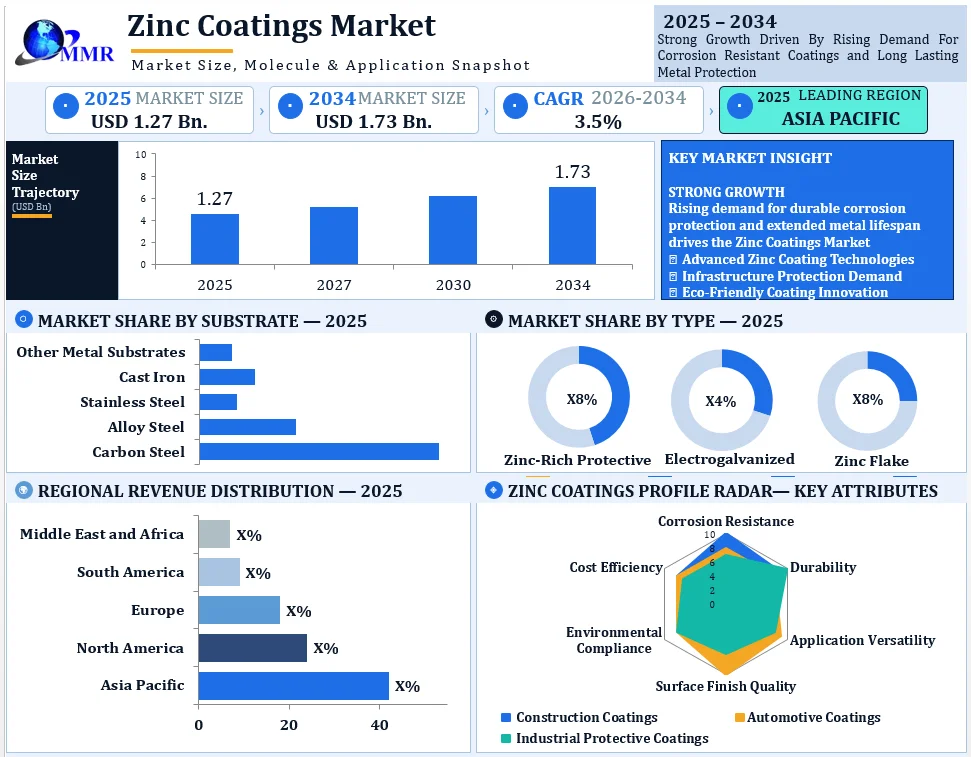
The Global Zinc Coatings Market size was valued at USD 1.27 Billion in 2025 and the total revenue is expected to grow at a CAGR of 3.5% from 2026 to 2034, reaching USD 1.73 Billion by 2034.
Global Zinc Coatings Market Overview:
Zinc coatings are protective surface treatments applied to steel, iron, and other suitable metals to prevent corrosion, rust formation, and premature material deterioration. The zinc coatings market includes hot-dip galvanizing, electrogalvanizing, zinc-rich paints, zinc thermal spraying, and other zinc-based corrosion protection technologies. These coatings improve metal durability, extend product service life, reduce maintenance requirements, and support the use of corrosion-resistant materials across industrial and commercial applications.
The zinc coatings market is expanding as construction, automotive manufacturing, infrastructure development, renewable energy installations, and industrial equipment production increase demand for long-lasting metal protection. Leading manufacturers such as Zinc Nacional and The Sherwin-Williams Company participate in zinc-based materials and protective coating solutions, while established galvanizing suppliers serve construction and manufacturing industries. Asia Pacific remains an important growth region, driven by industrialization, infrastructure investment, steel production, and manufacturing activity. Government infrastructure programs and corrosion-control standards further encourage the adoption of galvanized steel, zinc-coated metal sheets, structural components, and protective industrial coatings. Buyers include steel producers, construction companies, automotive manufacturers, infrastructure developers, energy companies, and industrial equipment manufacturers seeking reliable corrosion protection.
The MMR zinc coatings market research provides an assessment of market trends, growth drivers, restraints, opportunities, regional demand, competitive positioning, and market segmentation by coating type, application, and end-use industry. Growth opportunities include advanced corrosion-resistant coatings, infrastructure modernization, renewable energy installations, automotive lightweighting, and longer-lasting industrial materials. The research helps businesses evaluate customer demand, emerging technologies, competitive strategies, and investment opportunities across the zinc coatings industry.
Global Zinc Coatings Market Growth and Share Analysis
To know about the Research Methodology :- Request Free Sample Report
Global Zinc Coatings Market Key Highlights
| Key Highlight | Insight |
|---|---|
| Steady Market Growth | The zinc coatings market is valued at USD 1.27 billion in 2025 and is projected to reach USD 1.73 billion by 2034, growing at a CAGR of 3.5%. Demand is supported by the need for durable corrosion protection across industrial and commercial applications. |
| Asia Pacific Leads Regional Demand |
Asia Pacific holds the leading regional position, supported by steel production, infrastructure investment, automotive manufacturing, and industrial development in China, India, Japan, and South Korea. |
| Inorganic Zinc Coatings Support Corrosion Protection |
Inorganic zinc coatings are an important product category because they provide galvanic protection, mechanical durability, and resistance to demanding industrial environments, particularly for steel structures and infrastructure. |
| Infrastructure and Industrial Applications Drive Demand |
Building and construction, oil and gas, power generation, machinery, and automotive manufacturing create demand for zinc-coated steel and protective coating systems. Renewable energy installations and infrastructure maintenance offer additional growth opportunities. |
| Technology and Product Innovation Shape Competition |
Companies such as PPG Industries, AkzoNobel, Jotun, Hempel, and NOF Metal Coatings compete through zinc-rich primers, zinc-flake technologies, improved corrosion resistance, environmentally responsible formulations, and more efficient coating processes. |
Global Zinc Coatings Market Dynamics:
Zinc Coatings Market Driver
Rising demand for corrosion-resistant steel and long-lasting metal protection is a major driver of the zinc coatings market, as construction, automotive manufacturing, energy infrastructure, and industrial production require materials that withstand moisture, chemicals, and harsh environmental conditions. Zinc-coated steel is widely used in roofing sheets, structural frameworks, bridges, pipelines, vehicle body panels, and electrical equipment because zinc provides both barrier protection and sacrificial corrosion resistance. The World Steel Association identifies construction and infrastructure as major steel-consuming sectors, reinforcing the importance of effective corrosion protection throughout the steel value chain. Increasing investment in transportation networks, commercial buildings, industrial facilities, and renewable energy installations is encouraging manufacturers to adopt hot-dip galvanizing, electrogalvanizing, and zinc-rich protective coatings. Longer component service life, reduced maintenance frequency, and lower replacement requirements continue to strengthen demand for zinc coatings across infrastructure and manufacturing applications.
Zinc Coatings Market Restraint
Fluctuating zinc prices, high energy consumption, and the initial cost of coating processes can restrict the adoption of zinc coatings, particularly among small manufacturers and price-sensitive industrial buyers. Zinc is traded internationally, making raw material costs sensitive to mining output, smelting capacity, energy prices, transportation expenses, and supply chain disruptions. Hot-dip galvanizing also requires controlled heating, molten zinc handling, surface preparation, and specialized processing equipment, increasing operational expenditure for coating suppliers. Environmental compliance requirements involving industrial emissions, wastewater treatment, and chemical handling can create additional investment obligations for manufacturers. Although zinc-coated steel can reduce long-term corrosion-related expenses, some buyers may initially prefer lower-cost alternatives when purchasing decisions prioritize immediate expenditure over lifecycle performance. These cost pressures can influence coating selection, production margins, and zinc coatings market growth across construction, automotive, and industrial applications.
Zinc Coatings Market Opportunities
Growing investment in renewable energy, infrastructure modernization, and advanced corrosion protection creates attractive opportunities for zinc coatings manufacturers. Solar mounting structures, wind energy installations, transmission towers, highway barriers, and industrial facilities require durable metal components capable of operating under demanding environmental conditions. According to the International Energy Agency, global renewable electricity capacity additions reached 700 gigawatts in 2024, highlighting the substantial infrastructure requirements associated with the energy transition. This development creates potential demand for galvanized steel structures and specialized zinc-based protective systems. Additional opportunities include high-performance zinc-aluminium coatings, zinc-flake coatings for automotive fasteners, automated galvanizing processes, and coating technologies designed to improve durability while reducing material waste. Manufacturers that develop efficient coating systems, improve zinc utilization, and offer application-specific corrosion protection can strengthen their position in construction, automotive manufacturing, electrical infrastructure, and renewable energy markets.
Zinc Coatings Market Challenges
Maintaining consistent coating quality, meeting environmental requirements, and delivering reliable corrosion protection across different operating conditions remain important challenges for the zinc coatings market. Coating performance depends on factors such as zinc layer thickness, surface preparation, application uniformity, humidity, salt exposure, and the chemical characteristics of the surrounding environment. For example, steel structures exposed to coastal conditions may require more carefully selected coating specifications than components installed in relatively dry indoor environments. Manufacturers must also address competition from alternative corrosion protection technologies, including organic protective paints, aluminium-based coatings, stainless steel, and advanced surface treatments. Increasing expectations for lower environmental impact are encouraging suppliers to improve process efficiency, manage industrial waste, and evaluate the use of lower-impact coating formulations. Balancing coating durability, production costs, environmental compliance, and customer-specific performance requirements is therefore essential for maintaining competitiveness in the zinc coatings industry.
Global Zinc Coatings Market Key Trends
| Zinc Coatings Market Trend | Description |
|---|---|
| Rising Demand for Advanced Hot-Dip Galvanizing |
Hot-dip galvanizing remains an important trend in the zinc coatings market as infrastructure developers and steel manufacturers seek durable corrosion protection for bridges, transmission towers, roofing sheets, and industrial structures. Improved zinc utilization and better process control are helping galvanizing facilities deliver consistent coating quality and longer-lasting steel products. |
| Shift Toward Environmentally Friendly Zinc Coatings |
Coating manufacturers are developing water-based, low-volatile-organic-compound, and chromium-free zinc coating formulations to meet environmental requirements while maintaining corrosion resistance. These technologies are gaining attention from industrial customers seeking more sustainable protective coatings and compliance with applicable chemical regulations. |
| Growing Adoption of Zinc-Flake Coating Technology |
Zinc-flake coatings are gaining traction in automotive fasteners, springs, chassis components, and industrial machinery because they provide corrosion protection through thin, engineered coating layers. Their ability to support controlled friction and reduce the risk of hydrogen embrittlement associated with conventional electroplating makes them valuable for selected high-strength metal components. |
| Increasing Use of Zinc-Aluminium Alloy Coatings |
Zinc-aluminium alloy coatings are attracting interest from construction, automotive, and industrial manufacturers seeking improved corrosion resistance and surface durability. Their use in specialized coated steel products allows suppliers to address demanding exposure conditions and meet application-specific performance requirements. |
| Automation in Zinc Coating and Galvanizing Processes |
Galvanizing plants and zinc plating facilities are adopting automated material handling, process monitoring, and coating inspection to improve production consistency. Digital monitoring of bath conditions, coating thickness, and process parameters can help manufacturers identify defects earlier, reduce rework, and improve quality control in high-volume production. |
| Greater Focus on Zinc Recovery and Resource Efficiency |
Zinc coating producers are placing greater emphasis on recovering reusable zinc, recycling process by-products, reducing chemical waste, and reusing water in galvanizing operations. Industrial practices such as zinc recovery from surface residues and acid regeneration can improve material efficiency while helping coating manufacturers manage operating costs and environmental obligations. |
Global Zinc Coatings Market Segment Analysis:
By Type, the zinc coatings market is segmented into inorganic and organic. The inorganic zinc coatings segment is led the global market and registers a significant share of around xx% in 2025. Inorganic zinc coatings type segment offers galvanic protection to the steel surfaces and consists of metallic zinc dust mixed with the binder. The inorganic coatings have zinc silicate binder, which uses organic resins including butyl, epoxy, or urethane. The inorganic zinc coatings show favorable mechanical properties and impact resistance. These factors boost the segment demand in the market.
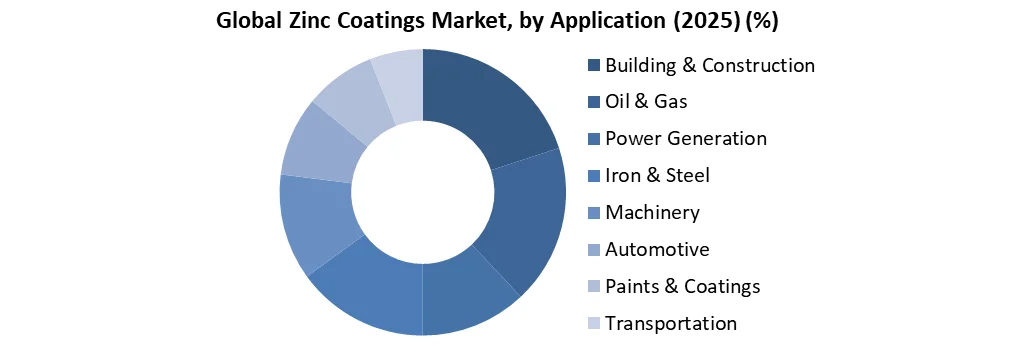
By Application, the market is segmented into paints & coatings, automotive, oil & gas, building & construction, power generation, machinery, iron & steel, and transportation. The paints & coatings applications segment is expected to witness significant growth during the forecast period. The segment growth is attributed to rising interest for various types of surfaces, like industrial coating, marine coatings, automotive coating, coil coatings, floor coatings, and can coatings propel the market in the paints & coatings segment.
Global Zinc Coatings Market Regional Insights:
Asia Pacific is the leading region in zinc coatings market, supported by extensive steel production, infrastructure development, automotive manufacturing, and industrial construction across China, India, Japan, and South Korea. Demand for galvanized steel, corrosion-resistant metal sheets, protective coatings, and zinc-coated structural components is reinforced by transportation projects, renewable energy installations, and manufacturing investments. The region also benefits from established steel processing facilities and a broad supplier network serving construction, machinery, power generation, and industrial equipment manufacturers.
North America maintains significant demand for zinc coatings through infrastructure maintenance, automotive production, oil and gas operations, and industrial equipment manufacturing. The United States, Canada, and Mexico require corrosion-resistant coatings for pipelines, transportation infrastructure, metal structures, and machinery exposed to demanding operating conditions. Increasing attention to asset durability, preventive maintenance, and long-term infrastructure performance supports the use of hot-dip galvanizing, zinc-rich paints, and specialized protective coating systems.
Europe represents an established zinc coatings market, supported by automotive manufacturing, engineering, construction, transportation infrastructure, and industrial machinery production. Germany, France, Italy, and the United Kingdom contribute to demand for galvanized steel and advanced zinc-based corrosion protection. The region's emphasis on product quality, environmental compliance, material efficiency, and durable infrastructure encourages manufacturers to improve coating performance and develop more environmentally responsible zinc coating technologies.
South America presents opportunities for zinc coatings through mining, energy infrastructure, construction, agricultural equipment, and industrial manufacturing. Brazil is an important demand centre, while Argentina and other regional markets require protective coatings for steel structures, pipelines, machinery, and transportation equipment. Investment in industrial facilities and infrastructure maintenance supports the use of zinc-coated metal products, although economic uncertainty, raw material price fluctuations, and project financing conditions can influence purchasing decisions.
The Middle East and Africa region is supported by demand from oil and gas facilities, power generation projects, industrial construction, mining, and transportation infrastructure. Countries such as Saudi Arabia, the United Arab Emirates, and South Africa require corrosion protection for steel structures exposed to heat, humidity, saline conditions, and demanding industrial environments. Zinc-rich coatings, galvanized steel, and specialized protective systems offer opportunities for suppliers serving energy facilities, ports, industrial plants, and infrastructure development projects.
Global Zinc Coatings Market Competitive Landscape
The zinc coatings market is characterized by competition among established protective coating manufacturers, zinc-based material suppliers, and specialized corrosion protection companies serving construction, automotive, oil and gas, power generation, machinery, and transportation industries. Key players include PPG Industries, The Sherwin-Williams Company, AkzoNobel, Jotun, Hempel, Kansai Paint, Nippon Paint Holdings, Axalta Coating Systems, Sika, and RPM International. These companies compete through zinc-rich primers, inorganic zinc coatings, zinc-based protective paints, product innovation, corrosion resistance, coating durability, technical support, and distribution capabilities. Market competitiveness increasingly depends on developing environmentally responsible coating formulations, improving application efficiency, meeting industry-specific performance requirements, and supplying reliable corrosion protection for infrastructure, industrial equipment, steel structures, and automotive components.
| Region | Country | Company | Market relevance and competitive positioning |
|---|---|---|---|
| Asia Pacific | Japan | Nippon Paint Holdings | Supplies protective coating solutions for industrial and manufacturing applications, with established regional distribution and technical capabilities. |
| Asia Pacific | Japan | Kansai Paint |
Serves automotive, industrial, and protective coatings applications, supporting demand for corrosion-resistant metal surfaces. |
| North America | United States | PPG Industries | Offers zinc-rich primers and protective coating systems for steel structures, industrial facilities, and infrastructure maintenance. |
| North America | United States |
The Sherwin-Williams Company |
Competes in industrial corrosion protection through zinc-rich primers and protective coatings for demanding operating environments. |
| Europe | Netherlands | AkzoNobel | Provides zinc-rich protective coating systems for marine, offshore, infrastructure, and industrial steel applications. |
| Europe | Norway | Jotun | Offers protective coating technologies for marine assets, offshore facilities, bridges, and industrial structures exposed to corrosion. |
| Europe | Denmark | Hempel | Focuses on protective coatings for marine, energy, and industrial assets requiring long-term corrosion resistance. |
| Europe | Switzerland | Sika | Supplies protective coating solutions for construction and infrastructure, including zinc-based systems for steel corrosion protection. |
Global Zinc Coatings Market Recent Development
| Month in 2026 | Company | Recent development |
|---|---|---|
| February 2026 | PPG Industries | PPG introduced STEELGUARD 652 for interior structural steel, adding a fire protection solution relevant to steel protection requirements. |
| March 2026 | PPG Industries |
PPG launched AQUACRON waterborne shop primers for structural steel, focusing on faster curing, lower volatile organic compound emissions, and efficient surface preparation. |
| April 2026 | NOF Metal Coatings | NOF Metal Coatings presented EXOMET 100 and GEOMET LT zinc flake technologies, emphasizing lower curing temperatures, reduced environmental impact, and corrosion resistance. |
| June 2026 | ArcelorMittal Nippon Steel India |
ArcelorMittal Nippon Steel India launched Zagnelis Protect, a zinc aluminium magnesium coated steel product designed for automotive applications and improved corrosion resistance. |
| October 2026 | NOF Metal Coatings | NOF Metal Coatings showcased zinc flake corrosion protection solutions, including EXOMET 100 and ZINCROKOTE M, for demanding metal components and fastener applications at an industry event in Poland. |
| October 2026 | PPG Industries |
PPG announced industrial finishing innovations for FABTECH 2026, including shop primers for structural steel and powder coatings designed to improve corrosion protection and production efficiency. |
Global Zinc Coatings Market Scope: Inquire before buying
| Zinc Coatings Market | |||
|---|---|---|---|
| Report Coverage | Details | ||
| Base Year: | 2025 | Forecast Period: | 2026-2034 |
| Historical Data: | 2020 to 2025 | Market Size in 2025: | 1.27 USD Billion |
| Forecast Period 2026-2034 CAGR: | 3.5% | Market Size in 2034: | 1.73 USD Billion |
| Segments Covered: | by Type | Inorganic Organic |
|
| by Substrate | Carbon Steel Alloy Steel Stainless Steel Cast Iron Other Metal Substrates |
||
| by Coating Type | Electrogalvanized Zinc-Rick Protective Zinc Flake |
||
| by Application | Paints & Coatings Automotive Oil & Gas Building & Construction Power Generation Machinery Iron & Steel Transportation |
||
Global Zinc Coatings Market, by Region
North America (United States, Canada and Mexico)
Europe (UK, France, Germany, Italy, Spain, Sweden, Austria and Rest of Europe)
Asia Pacific (China, South Korea, Japan, India, Australia, Indonesia, Malaysia, Vietnam, Taiwan, Bangladesh, Pakistan and Rest of APAC)
Middle East and Africa (South Africa, GCC, Egypt, Nigeria and Rest of ME&A)
South America (Brazil, Argentina Rest of South America)
Global Zinc Coatings Market, Key Players are:
1. Jotun Group
2. Akzo Nobel N.V.
3. PPG Industries, Inc.
4. The Sherwin-Williams Company
5. Hempel A/S
6. Axalta Coating Systems
7. Tnemec Company, Inc.
8. Sika AG
9. Kansai Paint Co., Ltd.
10. Nippon Paint Holdings Co., Ltd.
11. Carboline Company
12. RPM International Inc.
13. BASF SE
14. ZRC Worldwide
15. NOF Metal Coatings Group
16. Anochrome Group
17. Sumter Coatings, Inc.
18. Rust Bullet, LLC
19. Dulux Protective Coatings
20. NEI Corporation
21. Aalberts Surface Technologies
22. Atotech
23. MacDermid Enthone Industrial Solutions
24. Pioneer Metal Finishing
25. AUM Dacro Coatings
26. Marshal Laboratories
27. Corundum Coating and Innovation
28. ZINGA
29. Dörken Coatings
30. Geomet
31. Metal Coatings International
32. Element
33. Troy Chemical Industries
34. NANPAO Resins Chemical Group
35. Miba Coating Group
36. Erie Powder Coatings, Inc.
37. HMG Paints
38. Asian Paints Limited
39. Berger Paints India Limited
40. Zigma Paints
41. Advance Paints Pvt. Ltd.
42. Tuff Coat Polymers Pvt. Ltd.
43. Sichuan Jinhui Paint Co., Ltd.
44. Tongxiang Hengli Chemical Co., Ltd.
45. Jiangsu Lanling Chemical Group
46. Chongqing Sanxia Paints Co., Ltd.
47. Wuhan Shuanghu Paint Co., Ltd.
48. Shanghai Kailin Paint Co., Ltd.
49. Zhejiang Tiannv Group Paint Co., Ltd.
50. Shandong Qilu Paint Co., Ltd.
Frequently Asked Questions:
1. Which region has the largest share in Global Zinc Coatings Market?
Ans: Asia Pacific region held the highest share in 2025.
2. What is the growth rate of Global Zinc Coatings Market?
Ans: The Global Zinc Coatings Market is growing at a CAGR of 3.5% during forecasting period 2026-2034.
3. What is scope of the Global Zinc Coatings Market report?
Ans: Global Zinc Coatings Market report helps with the PESTEL, PORTER, COVID-19 Impact analysis, Recommendations for Investors & Leaders, and market estimation of the forecast period.
4. Who are the key players in Global Zinc Coatings Market?
Ans: The important key players in the Global Zinc Coatings Market are – The Jotun Group, Akzo Nobel N.V., Sumter Coatings, Inc., Rust Bullet Australia, Altex Coatings Ltd, Polyset Company, Anochrome Group, Specialized Coating Systems (Pty) Ltd., Dulux, Pinturas Villada, NEI Corporation, Tnemec, Brite Products, Promain Paints, East Coast Protective Coating, Sumter Coatings, Strands Industrial Coatings, and Others
5. What is the study period of this Market?
Ans: The Global Zinc Coatings Market is studied from 2020 to 2034.