Industrial Machinery Market by Type, by Operation, by Application, by End-Use Industry, by Distribution Channel and Regional Insights 2034

6.4%
CAGR (2026-2034)
748.98 USD Bn.
Forecast Market Size
325
Report Pages
123
Market Tables

Overview

The Global Industrial Machinery Market was valued at USD 748.98 Billion in 2025 and is projected to reach USD 1309.01 Billion by 2034, growing at a CAGR of 6.4% during the forecast period 2026–2034.

Parameter Value
Market Size (2025) USD 748.98 Billion
Market Size (2034) USD 1309.01 Billion
CAGR 6.4%
Historical Period 2020 to 2025
Forecast Period 2026 to 2034

Industrial Machinery Market Overview

The Industrial Machinery Market is highly involved with different kinds of machines and equipment used in manufacturing, construction, mining, agricultural, energy, and industrial sectors. The market involves machine tools, industrial robots, compressors, pumps, material handling equipment, and production machinery. Industrial machinery is critical to support the growth of production, reduce manual labor, ensure quality, and cut costs. The machinery is used in different industries to manufacture goods, process raw materials, operate heavy industry equipment, and streamline operations. Investment in the production facilities, industrial equipment, and factory infrastructure spurs the market growth. Additionally, there is an increase in demand for new and upgraded equipment in different industrial applications.

Industrial Machinery Market is witnessing considerable growth due to increased adoption of automation, artificial intelligence, robotics, smart sensors, and energy-efficient machinery. Modern machinery and equipment are designed to incorporate digital technologies to monitor and manage production processes efficiently and minimize breakdowns in production facilities. Key industries in the market include automotive manufacturing, construction, metal processing, food and beverage, chemicals, and electronics. Increased investment in smart technology and factory automation in the automotive manufacturing industry supports the growth of the market. However, the high initial cost of equipment, operational costs, and shortage of skilled workers are some key challenges facing the industry. The market has a significant gap for affordable and easy-to-use industrial equipment. Asia Pacific is the biggest region for industrial machinery, with a dynamic scene. Industrial production, construction, and infrastructure development are thriving in China, India, Japan, South Korea, and other countries, creating great demand for production and mining machinery.

The industrial machinery market is competitive as key manufacturers and suppliers continue to invest heavily in research and development activities to develop advanced products. Some of the key players in the industrial machinery market include Siemens, Caterpillar, Komatsu, Mitsubishi Heavy Industries, ABB, and Bosch Rexroth, among others. Notably, Siemens specializes in industrial automation and digitalization and serves diverse industries such as automotive, energy, and electronics. Meanwhile, Caterpillar offers various products and services in the machinery and equipment industry, including compressors, construction, and mining equipment. On the other hand, ABB focuses on robotics and provides automation products for industrial production and manufacturing, which enhances their performance.

These key players use various factors to compete in the market, such as product performance, technological capabilities, reliability, and after-sales service. Maximize Market Research offers market size, growth, and opportunity analysis, including market share and forecast, by type, application, industry, and region, as well as competitive intelligence and market dynamics. Our research covers the overall landscape, growth drivers, and challenges in the industrial machinery market, including emerging trends and innovations. We also discuss smart production and energy-efficient machinery and how they affect the market demand. Lastly, we highlight recent developments, investments, and customer demands in the industrial machinery market.

Global Industrial Machinery Market Growth and Share Analysis
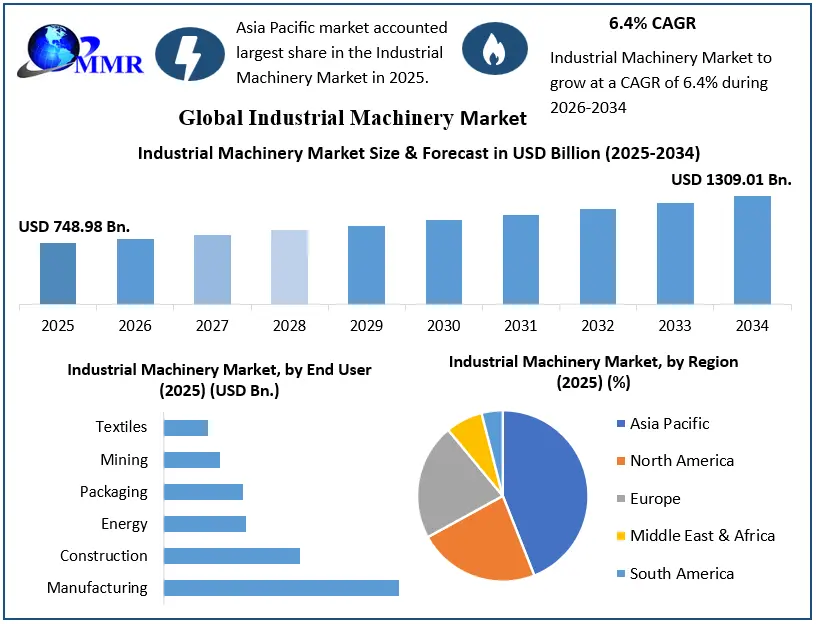
Industrial Machinery Market Growth

To know about the Research Methodology :- Request Free Sample Report

Industrial Machinery Market Dynamics

Expansion of Manufacturing Industries and Rising Industrial Production Requirements

Industrial production expansion, growing manufacturing facility networks, and increasing demand for quality end products fuel the Industrial Machinery Market demand. The automotive, electronics, food, chemical, and metal manufacturing industries require advanced machinery to increase production volumes and adapt to customer demands. Rising investments in factory construction and industrial facilities spurt the need for machine tools, compressors, pumps, robotic arms, and material handling equipment. For instance, industrial air compressors with motor power ranging from 15 kW to 75 kW enable compressed air production for pneumatic tools, automated production lines, and manufacturing equipment in small-scale facilities. Similarly, CNC machining centers with spindle speed ranges of 6,000 to 15,000 RPM facilitate various operations based on the machined material, machine type, and other variables. Growing industrial spend on production equipment stimulates the market growth and motivates manufacturers to scale production for Industrial Machinery.

Costly Equipment and Maintenance Spend Restrict Market Growth

Industrial equipment and machinery procurement, installation, and maintenance costs impede market growth and hinder the expansion of small and medium-scale manufacturers. Automated production lines, CNC machines, and industrial robots involve substantial capital investment, additional training, and operational expenditures. For instance, a small-scale manufacturing company must spend several tens of thousands of USD to acquire a CNC machine. In contrast, industrial manufacturing facilities must invest in large-scale automated machinery based on the production volume, required equipment types, and other factors. Meanwhile, maintenance and repair services, regular machine lubrication, tool replacement, and similar expenditures contribute to operational spend. Such expenditures limit the capacity of small and medium-sized manufacturers to afford modern machines, slowing the market growth and limiting the customer base for manufacturers.

Growing Automation Demand Creates Vendors’ Prospects

Industrial automation solutions, robotics, and energy-efficient production equipment advancements present opportunities for manufacturers and technology suppliers. Organizations invest in automated production lines, material handling equipment, and flexible machinery solutions to meet rising consumer demand and enhance production efficiency. Collaborative robots with a payload capacity of 5 to 30 kg handle various tasks in manufacturing and logistics, including sorting, assembly, and machine tending, depending on the application and scope. The growing need for energy-efficient machinery, electrical drives, and control equipment motivates manufacturers to adopt advanced solutions. The rising demand in the target regions and countries for automation, material handling equipment, and new production line solutions creates new business opportunities. For example, the Asia Pacific region has ample growth potential, as emerging countries such as China, India, Japan, and others invest heavily in industrial manufacturing. According to the market analysis, there is a significant demand for automation solutions, computer-controlled machines, and auxiliary equipment. A wide range of machinery options, competitive pricing, and tailored solutions for small and medium-scale manufacturers will generate substantial revenues and promote market growth.

Workforce Shortage and Changing Technologies Threaten Manufacturers

The global shortage of skilled machinists, maintenance engineers, and automation specialists impedes the Industrial Machinery Market growth and motivates manufacturers to seek new customer segments. Automated production lines and robotic cells in manufacturing facilities require qualified personnel to operate, manage, and maintain complex equipment. Additionally, companies must invest in additional machinery, robotics, and automated solutions to address a shortage of skilled workers and reduce overall production costs. For instance, manufacturing facilities must provide proper safety measures, machine location, and related equipment when integrating a 6-axis robot into the production process. Meanwhile, supply chain disruptions and equipment breakdowns threaten to disrupt manufacturing processes and incur additional costs. The inability to acquire specific industrial equipment, automation components, and materials threatens the production flow and increases maintenance and repair expenditures. Lastly, the complexity of industrial communication technologies and control systems prompts system integration issues between machinery from different manufacturers. It limits the span of automation solutions in manufacturing, as full production process automation remains a challenge. Lastly, market participants can offer extended training programs, equipment repair, and support services to promote steady sales growth and expand their customer base by supplying various machinery types.

Global Industrial Machinery Market Trend

Market Factors Traditional Market Future Market
Machinery Technology Uses traditional machines. Adopts smart and AI-powered machines.
Production Process Depends on manual work. Uses automated production systems.
Industrial Robots Focuses on large factories. Expands into more industries.
Maintenance Relies on regular repairs. Uses predictive maintenance.
Machine Monitoring Depends on manual checks. Uses real-time monitoring.
Energy Consumption Uses more energy. Focuses on energy savings.
Product Quality Relies on manual inspection. Uses AI-based quality checks.
Market Opportunities Focuses on machinery sales. Expands into robotics and automation.

Global Industrial Machinery Market Segment Analysis

Based on Type: The market is segmented into Material Handling Equipment, Machine Tools, Packaging Machinery, Industrial Robotics, Construction Machinery and Textile Machinery. The Material Handling Equipment segment held the largest Industrial Machinery Market share of around 26% in 2025. This is because the Material handling equipment streamlines supply chain processes that enhances warehouse efficiency and reduces manual labor. With the growth of e-commerce and modern logistics, these machine. The Machine Tools segment was the second largest segment in 2025. This is because the machine tools are the backbone of manufacturing, which enables the production of intricate parts with high precision. The evolution of CNC technology has revolutionized machining processes that allows for increased efficiency and accuracy.
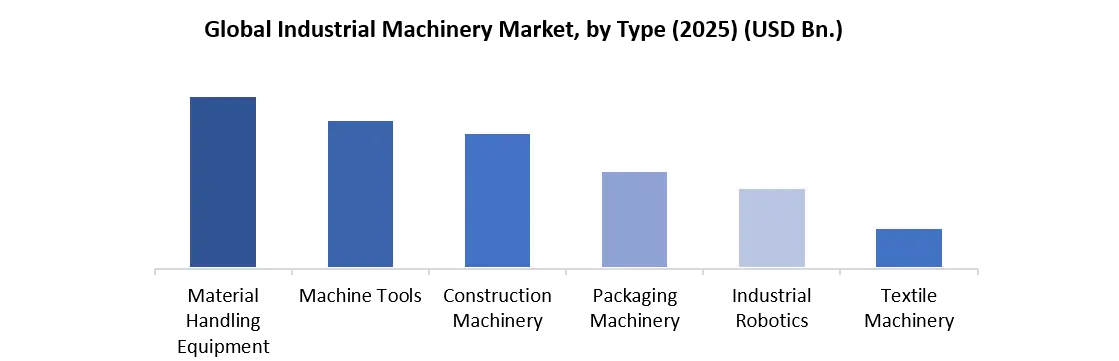
Industrial Machinery Market, by Type
Based on Application: The market is segmented into Cutting and Welding Machines, Assembly and Handling Systems, Testing and Measurement Equipment and Machining Centers. The Cutting and Welding Machines segment held largest Industrial Machinery Market share of around 32% in 2025. This segment is driven by the increasing demand for precision cutting and welding in industries such as aerospace, automotive, and shipbuilding. The Assembly and Handling Systems segment held the second largest market share in 2025 due to the increasing demand for automation and efficiency in manufacturing and logistics operations.
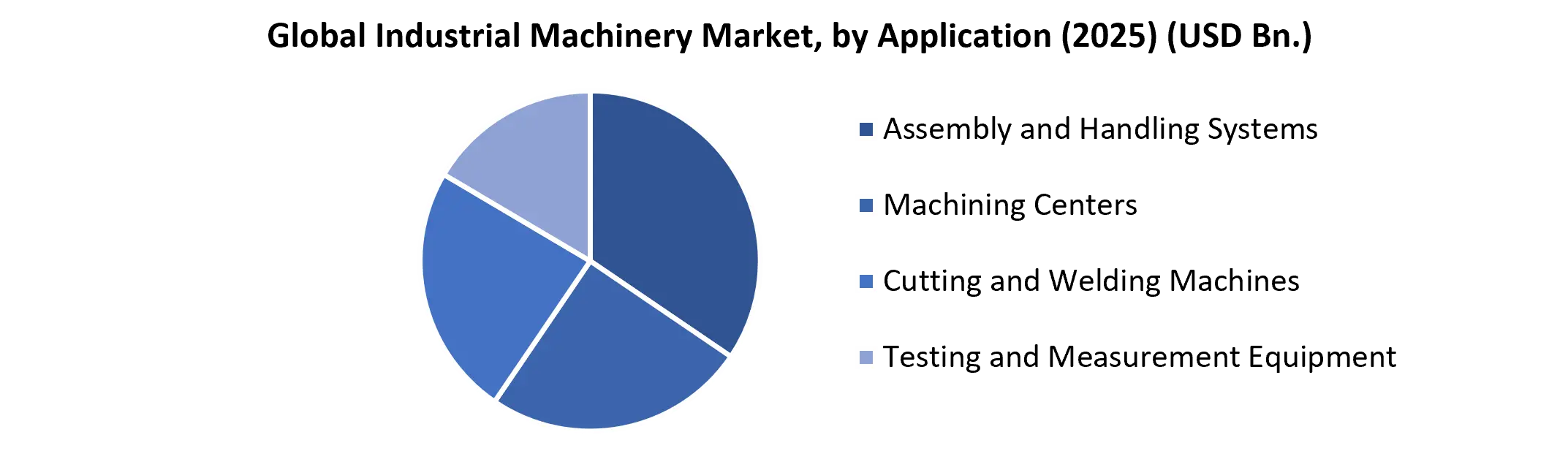
Industrial Machinery Market, by Application

Industrial Machinery Market Regional Insights

Asia Pacific has the leading position in the Industrial Machinery Market due to the significant manufacturing activity, industrial growth, and infrastructure development in China, India, Japan, and South Korea, which are the primary markets. The demand for automation, robotics, and advanced equipment is rising, which increases the size of the market and promotes its growth. Smart factory investments drive the market’s expansion and present numerous opportunities and potential.

North America is a developing market for industrial machinery, mainly due to the advanced manufacturing, industrial automation, and factory equipment modernization in the United States and Canada. The demand for smart machinery and artificial intelligence equipment and cost reduction in smart factories are the main factors that contribute to the market growth, increased production, and promotion of opportunities and potential.

Europe has a strong presence in the market due to the significant industrial machinery development, advanced engineering, and industrial technology in countries such as Germany, France, Italy, and the United Kingdom. The demand for smart manufacturing, industrial robots, and energy-efficient machinery and equipment supports the market size, potential, and growth. Additionally, the increasing investments in green manufacturing and smart production promote the market’s potential.

Middle East & Africa have a progressive market for industrial machinery due to diversification, increased investment in manufacturing, and infrastructure development in countries such as Saudi Arabia, UAE, and South Africa. The demand for construction equipment, processing machinery, and smart automation solutions supports the market growth and size. However, decreased technical expertise and significant costs of equipment limit market potential and opportunities on the other side, as the growing need for factory equipment and new construction projects increases.

South America has a developing market for industrial machinery, primarily due to the demand in mining, agriculture, food processing, and manufacturing in countries such as Brazil, Argentina, and Chile. The growing need for new equipment, factory automation, and smart manufacturing solutions impact the market size, opportunities, and potential positively. Nevertheless, limited possibilities for financing and high costs of equipment affect the market potential and growth negatively, while the increased need for new machinery, maintenance, and upgrades impact it positively.

Global Industrial Machinery Market Recent Developments

Published Date Recent Development
September-2026 Siemens has announced the launch of its program named Meet at the Machine in cooperation with TRAK Machine Tools. The program connects machine builders, software, and automation technology to enhance CNC production, reduce the time for preparation, and improve manufacturing.
September-2026 Komatsu has introduced a new generation of excavators – PC75-10M0. This is a 7-ton class hydraulic excavator made in India for the Southeast Asian market. The product is described as an innovative business booster for Komatsu’s business in South-East Asia.
September-2026 Caterpillar’s newest addition to its dozer family, the Cat D11 XE Electric Drive dozer, is focused on increased productivity and a lower cost per unit of production. In addition, Caterpillar has announced the launch of the electric drive dozer and said that it fits perfectly into the concept of electric drive machines that the company is promoting.
August-2026 DMG MORI’s new 5-axis horizontal machining center INH Series of 5-axis horizontal machining centers has been enhanced by the new INH 63 FD model, which can be used for milling and turning. Moreover, the manufacturer has added two more variants of Siemens control systems for these machines. Thus, DMG MORI offers a solution for aerospace and automotive industries.
April-2026 ABB Robotics’ new PoWa family of collaborative robots has been presented. Robots with a load force between 7 and 30 kg and a speed of up to 5:8 m/s will help small and large companies implement robotic automation in their manufacturing processes; they are suitable for various applications in the industry, from the assembly of components to the processing of packages.

Industrial Machinery Market Competitive Landscape

The Industrial Machinery Market demands a competitive environment, as prominent players focus on product development, automation, and business expansion to gain larger market shares. Industry participants compete on the basis of machinery efficiency, product quality, pricing, energy consumption, and after-sales services. Key manufacturers in the industrial machinery market include Siemens, Caterpillar, Komatsu, Mitsubishi Heavy Industries, ABB, Bosch Rexroth, Hitachi Construction Machinery, and DMG MORI, which emphasize on developing advanced machines and automating production processes. For instance, Siemens offers electronics and solutions for industrial automation, while Caterpillar and Komatsu manufacture construction and industrial equipment. In addition, ABB produces robots and solutions for industrial automation, and DMG MORI makes CNC machines for manufacturing. Moreover, industrial machinery market growth is supported by an increase in manufacturing activities and the adoption of smart manufacturing techniques around the world. Prominent manufacturers offer energy-efficient machines and artificial intelligence-enabled machines and systems to meet demand for factory automation.

Thus, market growth is achieved through extensive R&D activities in manufacturing companies and consistent infrastructure development. Nevertheless, the industrial machinery industry involves a shortage of affordable machinery and automation equipment, as well as increased maintenance costs, which hinders market growth. Apart from that, the Asia Pacific region is highly competitive and presents numerous opportunities for market players. In addition, the market in North America and Europe will grow due to the rising modernization of factories and infrastructure. The industrial machinery market will continue to grow at a rapid rate due to technological advancements, as well as various developments and upgrades around the world. In addition, manufacturers develop and launch new products to increase their market share and strengthen their position in the global industrial machinery market.

Industrial Machinery Market Scope: Inquiry Before Buying

Industrial Machinery Market
Report Coverage Details
Base Year: 2025 Forecast Period: 2026-2034
Historical Data: 2020 to 2025 Market Size in 2025: USD 748.98 Bn.
Forecast Period 2026 to 2034 CAGR: 6.4% Market Size in 2034: USD 1309.01 Bn.
Segments Covered: by Type Material Handling Equipment
Machine Tools
Packaging Machinery
Industrial Robotics
Construction Machinery
Textile Machinery
by Operation Autonomous
Semi- Autonomous
Manual
by Application Cutting and Welding Machines
Assembly and Handling Systems
Testing and Measurement Equipment
Machining Centers
by End-Use Industry Energy
Construction
Packaging
Textiles
Manufacturing
Mining
by Distribution Channel Offline
Online

Industrial Machinery Market, by Region

North America (United States, Canada and Mexico)
Europe (UK, France, Germany, Italy, Spain, Sweden, Austria and Rest of Europe)
Asia Pacific (China, South Korea, Japan, India, Australia, Indonesia, Malaysia, Vietnam, Taiwan, Bangladesh, Pakistan and Rest of APAC)
Middle East and Africa (South Africa, GCC, Egypt, Nigeria and Rest of ME&A)
South America (Brazil, Argentina Rest of South America

Industrial Machinery Key Players

1. Caterpillar Inc.
2. Komatsu Ltd.
3. Deere & Company
4. Siemens AG
5. Mitsubishi Heavy Industries Ltd.
6. ABB Ltd.
7. Hitachi Construction Machinery Co., Ltd.
8. Liebherr Group
9. XCMG Group
10. SANY Heavy Industry Co., Ltd.
11. Zoomlion Heavy Industry Science & Technology Co., Ltd.
12. Volvo Construction Equipment
13. CNH Industrial N.V.
14. Kubota Corporation
15. J.C. Bamford Excavators Ltd. (JCB)
16. Sandvik AB
17. Epiroc AB
18. Terex Corporation
19. Atlas Copco AB
20. Ingersoll Rand Inc.
21. FANUC Corporation
22. Yaskawa Electric Corporation
23. Kawasaki Heavy Industries Ltd.
24. DMG MORI Co., Ltd.
25. TRUMPF SE + Co. KG
26. AMADA Co., Ltd.
27. Okuma Corporation
28. Makino Milling Machine Co., Ltd.
29. Haas Automation Inc.
30. JTEKT Corporation
31. DN Solutions
32. Hurco Companies Inc.
33. Tsugami Corporation
34. Citizen Machinery Co., Ltd.
35. GEA Group AG
36. Alfa Laval AB
37. Krones AG
38. KUKA AG
39. Festo SE & Co. KG
40. Dürr AG
41. Parker-Hannifin Corporation
42. Emerson Electric Co.
43. Dover Corporation
44. Illinois Tool Works Inc.
45. Lincoln Electric Holdings Inc.
46. AGCO Corporation
47. Yanmar Holdings Co., Ltd.
48. Wacker Neuson SE
49. Metso Corporation
50. Astec Industries Inc.

Frequently Asked Questions

1] What is the expected CAGR of the Global Industrial Machinery Market during the forecast period?
Ans. During the forecast period, the Global Industrial Machinery Market is expected to grow at a CAGR of 6.4%

2] What was the Global Industrial Machinery Market size in 2025?
Ans: The Global Industrial Machinery Market size was USD 748.98 Billion in 2025.

3] What is the expected Industrial Machinery Market size by 2034?
Ans. USD 1309.01 Billion is the expected Industrial Machinery Market size by 2034.

4] What are the Industrial Machinery Market segments?
Ans. The market is divided by Type, Operation, Application, End-User and Distribution Channel.

5] Which region’s Industrial Machinery Market share is expected to grow at a high rate during the forecast period?
Ans. Asia-Pacific region is expected grow at a rapid growth rate over the forecast period.

Table of Contents

1. Industrial Machinery Market Introduction 1.1. Study Assumption and Market Definition 1.2. Scope of the Study 1.3. Executive Summary 2. Global Industrial Machinery Market: Competitive Landscape 2.1. MMR Competition Matrix 2.2. Competitive Landscape 2.3. Key Players Benchmarking 2.3.1. Company Name 2.3.2. Business Segment 2.3.3. End-user Segment 2.3.4. Revenue (2025) 2.3.5. Company Locations 2.4. Leading Industrial Machinery Market Companies, by market capitalization 2.5. Market Structure 2.5.1. Market Leaders 2.5.2. Market Followers 2.5.3. Emerging Players 2.6. Mergers and Acquisitions Details 3. Industrial Machinery Market: Dynamics 3.1. Industrial Machinery Market Trends by Region 3.1.1. North America Industrial Machinery Market Trends 3.1.2. Europe Industrial Machinery Market Trends 3.1.3. Asia Pacific Industrial Machinery Market Trends 3.1.4. Middle East and Africa Industrial Machinery Market Trends 3.1.5. South America Industrial Machinery Market Trends 3.2. Industrial Machinery Market Dynamics by Region 3.2.1. North America 3.2.1.1. North America Industrial Machinery Market Drivers 3.2.1.2. North America Industrial Machinery Market Restraints 3.2.1.3. North America Industrial Machinery Market Opportunities 3.2.1.4. North America Industrial Machinery Market Challenges 3.2.2. Europe 3.2.2.1. Europe Industrial Machinery Market Drivers 3.2.2.2. Europe Industrial Machinery Market Restraints 3.2.2.3. Europe Industrial Machinery Market Opportunities 3.2.2.4. Europe Industrial Machinery Market Challenges 3.2.3. Asia Pacific 3.2.3.1. Asia Pacific Industrial Machinery Market Drivers 3.2.3.2. Asia Pacific Industrial Machinery Market Restraints 3.2.3.3. Asia Pacific Industrial Machinery Market Opportunities 3.2.3.4. Asia Pacific Industrial Machinery Market Challenges 3.2.4. Middle East and Africa 3.2.4.1. Middle East and Africa Industrial Machinery Market Drivers 3.2.4.2. Middle East and Africa Industrial Machinery Market Restraints 3.2.4.3. Middle East and Africa Industrial Machinery Market Opportunities 3.2.4.4. Middle East and Africa Industrial Machinery Market Challenges 3.2.5. South America 3.2.5.1. South America Industrial Machinery Market Drivers 3.2.5.2. South America Industrial Machinery Market Restraints 3.2.5.3. South America Industrial Machinery Market Opportunities 3.2.5.4. South America Industrial Machinery Market Challenges 3.3. PORTER's Five Forces Analysis 3.4. PESTLE Analysis 3.5. Technology Roadmap 3.6. Regulatory Landscape by Region 3.6.1. North America 3.6.2. Europe 3.6.3. Asia Pacific 3.6.4. Middle East and Africa 3.6.5. South America 3.7. Key Opinion Leader Analysis For Industrial Machinery Industry 3.8. Analysis of Government Schemes and Initiatives For Industrial Machinery Industry 3.9. Industrial Machinery Market Trade Analysis 3.10. The Global Pandemic Impact on Industrial Machinery Market 4. Industrial Machinery Market: Global Market Size and Forecast by Segmentation (in USD Billion) 2025-2034 4.1. Industrial Machinery Market Size and Forecast, by Type (2025-2034) 4.1.1. Material Handling Equipment 4.1.2. Machine Tools 4.1.3. Packaging Machinery 4.1.4. Industrial Robotics 4.1.5. Construction Machinery 4.1.6. Textile Machinery 4.2. Industrial Machinery Market Size and Forecast, by Operation (2025-2034) 4.2.1. Autonomous 4.2.2. Semi- Autonomous 4.2.3. Manual 4.3. Industrial Machinery Market Size and Forecast, by Application (2025-2034) 4.3.1. Cutting and Welding Machines 4.3.2. Assembly and Handling Systems 4.3.3. Testing and Measurement Equipment 4.3.4. Machining Centers 4.4. Industrial Machinery Market Size and Forecast, by End-Use Industry (2025-2034) 4.4.1. Energy 4.4.2. Construction 4.4.3. Packaging 4.4.4. Textiles 4.4.5. Manufacturing 4.4.6. Mining 4.5. Industrial Machinery Market Size and Forecast, by Distribution Channel (2025-2034) 4.5.1. Offline 4.5.2. Online 4.6. Industrial Machinery Market Size and Forecast, by Region (2025-2034) 4.6.1. North America 4.6.2. Europe 4.6.3. Asia Pacific 4.6.4. Middle East and Africa 4.6.5. South America 5. North America Industrial Machinery Market Size and Forecast by Segmentation (in USD Billion) 2025-2034 5.1. North America Industrial Machinery Market Size and Forecast, by Type (2025-2034) 5.1.1. Material Handling Equipment 5.1.2. Machine Tools 5.1.3. Packaging Machinery 5.1.4. Industrial Robotics 5.1.5. Construction Machinery 5.1.6. Textile Machinery 5.2. North America Industrial Machinery Market Size and Forecast, by Operation (2025-2034) 5.2.1. Autonomous 5.2.2. Semi- Autonomous 5.2.3. Manual 5.3. North America Industrial Machinery Market Size and Forecast, by Application (2025-2034) 5.3.1. Cutting and Welding Machines 5.3.2. Assembly and Handling Systems 5.3.3. Testing and Measurement Equipment 5.3.4. Machining Centers 5.4. North America Industrial Machinery Market Size and Forecast, by End-Use Industry (2025-2034) 5.4.1. Energy 5.4.2. Construction 5.4.3. Packaging 5.4.4. Textiles 5.4.5. Manufacturing 5.4.6. Mining 5.5. North America Industrial Machinery Market Size and Forecast, by Distribution Channel (2025-2034) 5.5.1. Offline 5.5.2. Online 5.6. North America Industrial Machinery Market Size and Forecast, by Country (2025-2034) 5.6.1. United States 5.6.1.1. United States Industrial Machinery Market Size and Forecast, by Type (2025-2034) 5.6.1.1.1. Material Handling Equipment 5.6.1.1.2. Machine Tools 5.6.1.1.3. Packaging Machinery 5.6.1.1.4. Industrial Robotics 5.6.1.1.5. Construction Machinery 5.6.1.1.6. Textile Machinery 5.6.1.2. United States Industrial Machinery Market Size and Forecast, by Operation (2025-2034) 5.6.1.2.1. Autonomous 5.6.1.2.2. Semi- Autonomous 5.6.1.2.3. Manual 5.6.1.3. United States Industrial Machinery Market Size and Forecast, by Application (2025-2034) 5.6.1.3.1. Cutting and Welding Machines 5.6.1.3.2. Assembly and Handling Systems 5.6.1.3.3. Testing and Measurement Equipment 5.6.1.3.4. Machining Centers 5.6.1.4. United States Industrial Machinery Market Size and Forecast, by End-Use Industry (2025-2034) 5.6.1.4.1. Energy 5.6.1.4.2. Construction 5.6.1.4.3. Packaging 5.6.1.4.4. Textiles 5.6.1.4.5. Manufacturing 5.6.1.4.6. Mining 5.6.1.5. United States Industrial Machinery Market Size and Forecast, by Distribution Channel (2025-2034) 5.6.1.5.1. Offline 5.6.1.5.2. Online 5.6.2. Canada 5.6.2.1. Canada Industrial Machinery Market Size and Forecast, by Type (2025-2034) 5.6.2.1.1. Material Handling Equipment 5.6.2.1.2. Machine Tools 5.6.2.1.3. Packaging Machinery 5.6.2.1.4. Industrial Robotics 5.6.2.1.5. Construction Machinery 5.6.2.1.6. Textile Machinery 5.6.2.2. Canada Industrial Machinery Market Size and Forecast, by Operation (2025-2034) 5.6.2.2.1. Autonomous 5.6.2.2.2. Semi- Autonomous 5.6.2.2.3. Manual 5.6.2.3. Canada Industrial Machinery Market Size and Forecast, by Application (2025-2034) 5.6.2.3.1. Cutting and Welding Machines 5.6.2.3.2. Assembly and Handling Systems 5.6.2.3.3. Testing and Measurement Equipment 5.6.2.3.4. Machining Centers 5.6.2.4. Canada Industrial Machinery Market Size and Forecast, by End-Use Industry (2025-2034) 5.6.2.4.1. Energy 5.6.2.4.2. Construction 5.6.2.4.3. Packaging 5.6.2.4.4. Textiles 5.6.2.4.5. Manufacturing 5.6.2.4.6. Mining 5.6.2.5. Canada Industrial Machinery Market Size and Forecast, by Distribution Channel (2025-2034) 5.6.2.5.1. Offline 5.6.2.5.2. Online 5.6.3. Mexico 5.6.3.1. Mexico Industrial Machinery Market Size and Forecast, by Type (2025-2034) 5.6.3.1.1. Material Handling Equipment 5.6.3.1.2. Machine Tools 5.6.3.1.3. Packaging Machinery 5.6.3.1.4. Industrial Robotics 5.6.3.1.5. Construction Machinery 5.6.3.1.6. Textile Machinery 5.6.3.2. Mexico Industrial Machinery Market Size and Forecast, by Operation (2025-2034) 5.6.3.2.1. Autonomous 5.6.3.2.2. Semi- Autonomous 5.6.3.2.3. Manual 5.6.3.3. Mexico Industrial Machinery Market Size and Forecast, by Application (2025-2034) 5.6.3.3.1. Cutting and Welding Machines 5.6.3.3.2. Assembly and Handling Systems 5.6.3.3.3. Testing and Measurement Equipment 5.6.3.3.4. Machining Centers 5.6.3.4. Mexico Industrial Machinery Market Size and Forecast, by End-Use Industry (2025-2034) 5.6.3.4.1. Energy 5.6.3.4.2. Construction 5.6.3.4.3. Packaging 5.6.3.4.4. Textiles 5.6.3.4.5. Manufacturing 5.6.3.4.6. Mining 5.6.3.5. Mexico Industrial Machinery Market Size and Forecast, by Distribution Channel (2025-2034) 5.6.3.5.1. Offline 5.6.3.5.2. Online 6. Europe Industrial Machinery Market Size and Forecast by Segmentation (in USD Billion) 2025-2034 6.1. Europe Industrial Machinery Market Size and Forecast, by Type (2025-2034) 6.2. Europe Industrial Machinery Market Size and Forecast, by Operation (2025-2034) 6.3. Europe Industrial Machinery Market Size and Forecast, by Application (2025-2034) 6.4. Europe Industrial Machinery Market Size and Forecast, by End-Use Industry (2025-2034) 6.5. Europe Industrial Machinery Market Size and Forecast, by Distribution Channel (2025-2034) 6.6. Europe Industrial Machinery Market Size and Forecast, by Country (2025-2034) 6.6.1. United Kingdom 6.6.1.1. United Kingdom Industrial Machinery Market Size and Forecast, by Type (2025-2034) 6.6.1.2. United Kingdom Industrial Machinery Market Size and Forecast, by Operation (2025-2034) 6.6.1.3. United Kingdom Industrial Machinery Market Size and Forecast, by Application (2025-2034) 6.6.1.4. United Kingdom Industrial Machinery Market Size and Forecast, by End-Use Industry (2025-2034) 6.6.1.5. United Kingdom Industrial Machinery Market Size and Forecast, by Distribution Channel (2025-2034) 6.6.2. France 6.6.2.1. France Industrial Machinery Market Size and Forecast, by Type (2025-2034) 6.6.2.2. France Industrial Machinery Market Size and Forecast, by Operation (2025-2034) 6.6.2.3. France Industrial Machinery Market Size and Forecast, by Application (2025-2034) 6.6.2.4. France Industrial Machinery Market Size and Forecast, by End-Use Industry (2025-2034) 6.6.2.5. France Industrial Machinery Market Size and Forecast, by Distribution Channel (2025-2034) 6.6.3. Germany 6.6.3.1. Germany Industrial Machinery Market Size and Forecast, by Type (2025-2034) 6.6.3.2. Germany Industrial Machinery Market Size and Forecast, by Operation (2025-2034) 6.6.3.3. Germany Industrial Machinery Market Size and Forecast, by Application (2025-2034) 6.6.3.4. Germany Industrial Machinery Market Size and Forecast, by End-Use Industry (2025-2034) 6.6.3.5. Germany Industrial Machinery Market Size and Forecast, by Distribution Channel (2025-2034) 6.6.4. Italy 6.6.4.1. Italy Industrial Machinery Market Size and Forecast, by Type (2025-2034) 6.6.4.2. Italy Industrial Machinery Market Size and Forecast, by Operation (2025-2034) 6.6.4.3. Italy Industrial Machinery Market Size and Forecast, by Application (2025-2034) 6.6.4.4. Italy Industrial Machinery Market Size and Forecast, by End-Use Industry (2025-2034) 6.6.4.5. Italy Industrial Machinery Market Size and Forecast, by Distribution Channel (2025-2034) 6.6.5. Spain 6.6.5.1. Spain Industrial Machinery Market Size and Forecast, by Type (2025-2034) 6.6.5.2. Spain Industrial Machinery Market Size and Forecast, by Operation (2025-2034) 6.6.5.3. Spain Industrial Machinery Market Size and Forecast, by Application (2025-2034) 6.6.5.4. Spain Industrial Machinery Market Size and Forecast, by End-Use Industry (2025-2034) 6.6.5.5. Spain Industrial Machinery Market Size and Forecast, by Distribution Channel (2025-2034) 6.6.6. Sweden 6.6.6.1. Sweden Industrial Machinery Market Size and Forecast, by Type (2025-2034) 6.6.6.2. Sweden Industrial Machinery Market Size and Forecast, by Operation (2025-2034) 6.6.6.3. Sweden Industrial Machinery Market Size and Forecast, by Application (2025-2034) 6.6.6.4. Sweden Industrial Machinery Market Size and Forecast, by End-Use Industry (2025-2034) 6.6.6.5. Sweden Industrial Machinery Market Size and Forecast, by Distribution Channel (2025-2034) 6.6.7. Austria 6.6.7.1. Austria Industrial Machinery Market Size and Forecast, by Type (2025-2034) 6.6.7.2. Austria Industrial Machinery Market Size and Forecast, by Operation (2025-2034) 6.6.7.3. Austria Industrial Machinery Market Size and Forecast, by Application (2025-2034) 6.6.7.4. Austria Industrial Machinery Market Size and Forecast, by End-Use Industry (2025-2034) 6.6.7.5. Austria Industrial Machinery Market Size and Forecast, by Distribution Channel (2025-2034) 6.6.8. Rest of Europe 6.6.8.1. Rest of Europe Industrial Machinery Market Size and Forecast, by Type (2025-2034) 6.6.8.2. Rest of Europe Industrial Machinery Market Size and Forecast, by Operation (2025-2034) 6.6.8.3. Rest of Europe Industrial Machinery Market Size and Forecast, by Application (2025-2034) 6.6.8.4. Rest of Europe Industrial Machinery Market Size and Forecast, by End-Use Industry (2025-2034) 6.6.8.5. Rest of Europe Industrial Machinery Market Size and Forecast, by Distribution Channel (2025-2034) 7. Asia Pacific Industrial Machinery Market Size and Forecast by Segmentation (in USD Billion) 2025-2034 7.1. Asia Pacific Industrial Machinery Market Size and Forecast, by Type (2025-2034) 7.2. Asia Pacific Industrial Machinery Market Size and Forecast, by Operation (2025-2034) 7.3. Asia Pacific Industrial Machinery Market Size and Forecast, by Application (2025-2034) 7.4. Asia Pacific Industrial Machinery Market Size and Forecast, by End-Use Industry (2025-2034) 7.5. Asia Pacific Industrial Machinery Market Size and Forecast, by Distribution Channel (2025-2034) 7.6. Asia Pacific Industrial Machinery Market Size and Forecast, by Country (2025-2034) 7.6.1. China 7.6.1.1. China Industrial Machinery Market Size and Forecast, by Type (2025-2034) 7.6.1.2. China Industrial Machinery Market Size and Forecast, by Operation (2025-2034) 7.6.1.3. China Industrial Machinery Market Size and Forecast, by Application (2025-2034) 7.6.1.4. China Industrial Machinery Market Size and Forecast, by End-Use Industry (2025-2034) 7.6.1.5. China Industrial Machinery Market Size and Forecast, by Distribution Channel (2025-2034) 7.6.2. S Korea 7.6.2.1. S Korea Industrial Machinery Market Size and Forecast, by Type (2025-2034) 7.6.2.2. S Korea Industrial Machinery Market Size and Forecast, by Operation (2025-2034) 7.6.2.3. S Korea Industrial Machinery Market Size and Forecast, by Application (2025-2034) 7.6.2.4. S Korea Industrial Machinery Market Size and Forecast, by End-Use Industry (2025-2034) 7.6.2.5. S Korea Industrial Machinery Market Size and Forecast, by Distribution Channel (2025-2034) 7.6.3. Japan 7.6.3.1. Japan Industrial Machinery Market Size and Forecast, by Type (2025-2034) 7.6.3.2. Japan Industrial Machinery Market Size and Forecast, by Operation (2025-2034) 7.6.3.3. Japan Industrial Machinery Market Size and Forecast, by Application (2025-2034) 7.6.3.4. Japan Industrial Machinery Market Size and Forecast, by End-Use Industry (2025-2034) 7.6.3.5. Japan Industrial Machinery Market Size and Forecast, by Distribution Channel (2025-2034) 7.6.4. India 7.6.4.1. India Industrial Machinery Market Size and Forecast, by Type (2025-2034) 7.6.4.2. India Industrial Machinery Market Size and Forecast, by Operation (2025-2034) 7.6.4.3. India Industrial Machinery Market Size and Forecast, by Application (2025-2034) 7.6.4.4. India Industrial Machinery Market Size and Forecast, by End-Use Industry (2025-2034) 7.6.4.5. India Industrial Machinery Market Size and Forecast, by Distribution Channel (2025-2034) 7.6.5. Australia 7.6.5.1. Australia Industrial Machinery Market Size and Forecast, by Type (2025-2034) 7.6.5.2. Australia Industrial Machinery Market Size and Forecast, by Operation (2025-2034) 7.6.5.3. Australia Industrial Machinery Market Size and Forecast, by Application (2025-2034) 7.6.5.4. Australia Industrial Machinery Market Size and Forecast, by End-Use Industry (2025-2034) 7.6.5.5. Australia Industrial Machinery Market Size and Forecast, by Distribution Channel (2025-2034) 7.6.6. Indonesia 7.6.6.1. Indonesia Industrial Machinery Market Size and Forecast, by Type (2025-2034) 7.6.6.2. Indonesia Industrial Machinery Market Size and Forecast, by Operation (2025-2034) 7.6.6.3. Indonesia Industrial Machinery Market Size and Forecast, by Application (2025-2034) 7.6.6.4. Indonesia Industrial Machinery Market Size and Forecast, by End-Use Industry (2025-2034) 7.6.6.5. Indonesia Industrial Machinery Market Size and Forecast, by Distribution Channel (2025-2034) 7.6.7. Malaysia 7.6.7.1. Malaysia Industrial Machinery Market Size and Forecast, by Type (2025-2034) 7.6.7.2. Malaysia Industrial Machinery Market Size and Forecast, by Operation (2025-2034) 7.6.7.3. Malaysia Industrial Machinery Market Size and Forecast, by Application (2025-2034) 7.6.7.4. Malaysia Industrial Machinery Market Size and Forecast, by End-Use Industry (2025-2034) 7.6.7.5. Malaysia Industrial Machinery Market Size and Forecast, by Distribution Channel (2025-2034) 7.6.8. Vietnam 7.6.8.1. Vietnam Industrial Machinery Market Size and Forecast, by Type (2025-2034) 7.6.8.2. Vietnam Industrial Machinery Market Size and Forecast, by Operation (2025-2034) 7.6.8.3. Vietnam Industrial Machinery Market Size and Forecast, by Application (2025-2034) 7.6.8.4. Vietnam Industrial Machinery Market Size and Forecast, by End-Use Industry (2025-2034) 7.6.8.5. Vietnam Industrial Machinery Market Size and Forecast, by Distribution Channel (2025-2034) 7.6.9. Taiwan 7.6.9.1. Taiwan Industrial Machinery Market Size and Forecast, by Type (2025-2034) 7.6.9.2. Taiwan Industrial Machinery Market Size and Forecast, by Operation (2025-2034) 7.6.9.3. Taiwan Industrial Machinery Market Size and Forecast, by Application (2025-2034) 7.6.9.4. Taiwan Industrial Machinery Market Size and Forecast, by End-Use Industry (2025-2034) 7.6.9.5. Taiwan Industrial Machinery Market Size and Forecast, by Distribution Channel (2025-2034) 7.6.10. Rest of Asia Pacific 7.6.10.1. Rest of Asia Pacific Industrial Machinery Market Size and Forecast, by Type (2025-2034) 7.6.10.2. Rest of Asia Pacific Industrial Machinery Market Size and Forecast, by Operation (2025-2034) 7.6.10.3. Rest of Asia Pacific Industrial Machinery Market Size and Forecast, by Application (2025-2034) 7.6.10.4. Rest of Asia Pacific Industrial Machinery Market Size and Forecast, by End-Use Industry (2025-2034) 7.6.10.5. Rest of Asia Pacific Industrial Machinery Market Size and Forecast, by Distribution Channel (2025-2034) 8. Middle East and Africa Industrial Machinery Market Size and Forecast by Segmentation (in USD Billion) 2025-2034 8.1. Middle East and Africa Industrial Machinery Market Size and Forecast, by Type (2025-2034) 8.2. Middle East and Africa Industrial Machinery Market Size and Forecast, by Operation (2025-2034) 8.3. Middle East and Africa Industrial Machinery Market Size and Forecast, by Application (2025-2034) 8.4. Middle East and Africa Industrial Machinery Market Size and Forecast, by End-Use Industry (2025-2034) 8.5. Middle East and Africa Industrial Machinery Market Size and Forecast, by Distribution Channel (2025-2034) 8.6. Middle East and Africa Industrial Machinery Market Size and Forecast, by Country (2025-2034) 8.6.1. South Africa 8.6.1.1. South Africa Industrial Machinery Market Size and Forecast, by Type (2025-2034) 8.6.1.2. South Africa Industrial Machinery Market Size and Forecast, by Operation (2025-2034) 8.6.1.3. South Africa Industrial Machinery Market Size and Forecast, by Application (2025-2034) 8.6.1.4. South Africa Industrial Machinery Market Size and Forecast, by End-Use Industry (2025-2034) 8.6.1.5. South Africa Industrial Machinery Market Size and Forecast, by Distribution Channel (2025-2034) 8.6.2. GCC 8.6.2.1. GCC Industrial Machinery Market Size and Forecast, by Type (2025-2034) 8.6.2.2. GCC Industrial Machinery Market Size and Forecast, by Operation (2025-2034) 8.6.2.3. GCC Industrial Machinery Market Size and Forecast, by Application (2025-2034) 8.6.2.4. GCC Industrial Machinery Market Size and Forecast, by End-Use Industry (2025-2034) 8.6.2.5. GCC Industrial Machinery Market Size and Forecast, by Distribution Channel (2025-2034) 8.6.3. Nigeria 8.6.3.1. Nigeria Industrial Machinery Market Size and Forecast, by Type (2025-2034) 8.6.3.2. Nigeria Industrial Machinery Market Size and Forecast, by Operation (2025-2034) 8.6.3.3. Nigeria Industrial Machinery Market Size and Forecast, by Application (2025-2034) 8.6.3.4. Nigeria Industrial Machinery Market Size and Forecast, by End-Use Industry (2025-2034) 8.6.3.5. Nigeria Industrial Machinery Market Size and Forecast, by Distribution Channel (2025-2034) 8.6.4. Rest of ME&A 8.6.4.1. Rest of ME&A Industrial Machinery Market Size and Forecast, by Type (2025-2034) 8.6.4.2. Rest of ME&A Industrial Machinery Market Size and Forecast, by Operation (2025-2034) 8.6.4.3. Rest of ME&A Industrial Machinery Market Size and Forecast, by Application (2025-2034) 8.6.4.4. Rest of ME&A Industrial Machinery Market Size and Forecast, by End-Use Industry (2025-2034) 8.6.4.5. Rest of ME&A Industrial Machinery Market Size and Forecast, by Distribution Channel (2025-2034) 9. South America Industrial Machinery Market Size and Forecast by Segmentation (in USD Billion) 2025-2034 9.1. South America Industrial Machinery Market Size and Forecast, by Type (2025-2034) 9.2. South America Industrial Machinery Market Size and Forecast, by Operation (2025-2034) 9.3. South America Industrial Machinery Market Size and Forecast, by Application (2025-2034) 9.4. South America Industrial Machinery Market Size and Forecast, by End-Use Industry (2025-2034) 9.5. South America Industrial Machinery Market Size and Forecast, by Distribution Channel (2025-2034) 9.6. South America Industrial Machinery Market Size and Forecast, by Country (2025-2034) 9.6.1. Brazil 9.6.1.1. Brazil Industrial Machinery Market Size and Forecast, by Type (2025-2034) 9.6.1.2. Brazil Industrial Machinery Market Size and Forecast, by Operation (2025-2034) 9.6.1.3. Brazil Industrial Machinery Market Size and Forecast, by Application (2025-2034) 9.6.1.4. Brazil Industrial Machinery Market Size and Forecast, by End-Use Industry (2025-2034) 9.6.1.5. Brazil Industrial Machinery Market Size and Forecast, by Distribution Channel (2025-2034) 9.6.2. Argentina 9.6.2.1. Argentina Industrial Machinery Market Size and Forecast, by Type (2025-2034) 9.6.2.2. Argentina Industrial Machinery Market Size and Forecast, by Operation (2025-2034) 9.6.2.3. Argentina Industrial Machinery Market Size and Forecast, by Application (2025-2034) 9.6.2.4. Argentina Industrial Machinery Market Size and Forecast, by End-Use Industry (2025-2034) 9.6.2.5. Argentina Industrial Machinery Market Size and Forecast, by Distribution Channel (2025-2034) 9.6.3. Rest Of South America 9.6.3.1. Rest Of South America Industrial Machinery Market Size and Forecast, by Type (2025-2034) 9.6.3.2. Rest Of South America Industrial Machinery Market Size and Forecast, by Operation (2025-2034) 9.6.3.3. Rest Of South America Industrial Machinery Market Size and Forecast, by Application (2025-2034) 9.6.3.4. Rest Of South America Industrial Machinery Market Size and Forecast, by End-Use Industry (2025-2034) 9.6.3.5. Rest Of South America Industrial Machinery Market Size and Forecast, by Distribution Channel (2025-2034) 10. Company Profile: Key Players 10.1. Caterpillar Inc. 10.1.1. Company Overview 10.1.2. Business Portfolio 10.1.3. Financial Overview 10.1.4. SWOT Analysis 10.1.5. Strategic Analysis 10.1.6. Scale of Operation (small, medium, and large) 10.1.7. Details on Partnership 10.1.8. Regulatory Accreditations and Certifications Received by Them 10.1.9. Awards Received by the Firm 10.1.10. Recent Developments 10.2. Komatsu Ltd. 10.3. Deere & Company 10.4. Siemens AG 10.5. Mitsubishi Heavy Industries Ltd. 10.6. ABB Ltd. 10.7. Hitachi Construction Machinery Co., Ltd. 10.8. Liebherr Group 10.9. XCMG Group 10.10. SANY Heavy Industry Co., Ltd. 10.11. Zoomlion Heavy Industry Science & Technology Co., Ltd. 10.12. Volvo Construction Equipment 10.13. CNH Industrial N.V. 10.14. Kubota Corporation 10.15. J.C. Bamford Excavators Ltd. (JCB) 10.16. Sandvik AB 10.17. Epiroc AB 10.18. Terex Corporation 10.19. Atlas Copco AB 10.20. Ingersoll Rand Inc. 10.21. FANUC Corporation 10.22. Yaskawa Electric Corporation 10.23. Kawasaki Heavy Industries Ltd. 10.24. DMG MORI Co., Ltd. 10.25. TRUMPF SE + Co. KG 10.26. AMADA Co., Ltd. 10.27. Okuma Corporation 10.28. Makino Milling Machine Co., Ltd. 10.29. Haas Automation Inc. 10.30. JTEKT Corporation 10.31. DN Solutions 10.32. Hurco Companies Inc. 10.33. Tsugami Corporation 10.34. Citizen Machinery Co., Ltd. 10.35. GEA Group AG 10.36. Alfa Laval AB 10.37. Krones AG 10.38. KUKA AG 10.39. Festo SE & Co. KG 10.40. Dürr AG 11. Key Findings 12. Industry Recommendations 13. Industrial Machinery Market: Research Methodology 14. Terms and Glossary

Custom Market Research Services

We Will Customise The Research For You, In Case The Report Listed Above Does Not Meet With Your Requirements