
Polycarbonate Panels Market – Global Market Size, Strategic Growth Drivers, Risk Assessment Framework, Regulatory Landscape Review, Competitive Intensity Mapping & Long-Term Industry Outlook to 2030
Overview
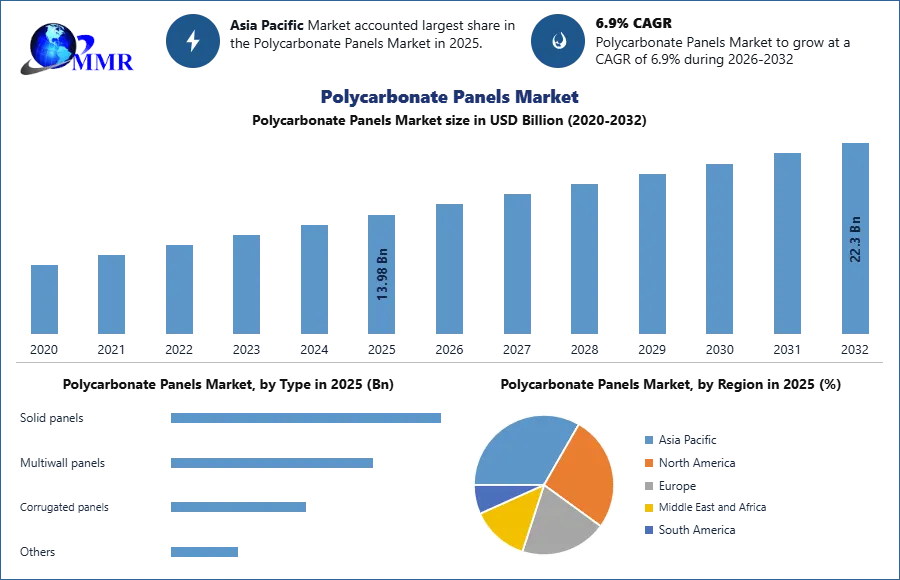
The Polycarbonate Panels Market was valued at USD 13.98 Billion in 2025 and is estimated to grow at a CAGR of 6.9% over the forecast period, reaching USD 22.3Billion by 2032.
Polycarbonate Panels Market Overview
The Polycarbonate Panels Market refers to the global industry producing and utilizing panels made from polycarbonate, a durable and lightweight plastic polymer. These panels are widely used in construction, automotive, electrical, and agriculture sectors due to their high impact resistance, UV protection, excellent insulation properties, and optical clarity. Polycarbonate panels are favored in industries requiring a balance of performance and safety, such as building and construction, automotive manufacturing, and greenhouse development.
Key growth factors include the increasing demand for energy-efficient and sustainable construction materials. Polycarbonate panels, due to their superior thermal insulation properties, help reduce energy consumption in buildings. Technological developments in polycarbonate materials have further enhanced their performance, particularly in terms of UV stability and mechanical strength, enabling broader application in harsh environments.
The demand outlook for the Polycarbonate Panels Market is highly positive, driven by the rapid growth in construction, particularly in emerging markets, the adoption of green building technologies, and the expansion of greenhouse agriculture. Additionally, with the rise in electric vehicles (EVs) and sustainable transport options, the automotive sector has been integrating polycarbonate panels into vehicle production for lightweight structures and energy efficiency.
Polycarbonate Panels Market Dynamics
Technological Advancements
Advancements in the production of polycarbonate panels have significantly enhanced their properties, making them more durable, energy-efficient, and suitable for a broader range of applications. New manufacturing techniques, such as multi-wall extrusion processes, have improved insulation properties, making polycarbonate panels a preferred choice in construction for their energy efficiency. Innovations such as UV-stable coatings and anti-scratch technologies have expanded the applicability of polycarbonate panels in outdoor environments, including roofing systems, skylights, and facades. Additionally, advancements in 3D printing technology and customized polycarbonate solutions have enabled the creation of more flexible, customized panels for specific structural needs, including in the automotive and agriculture sectors.
Industry Demand
The increasing demand for lightweight, durable, and energy-efficient materials in the building and construction sectors has significantly fueled the polycarbonate panels market. Polycarbonate panels are integral in meeting growing consumer preferences for green buildings and sustainable construction practices. In agriculture, the demand for greenhouses has led to the adoption of polycarbonate panels due to their superior light transmission, insulation properties, and impact resistance, which help optimize crop yields. The automotive sector is also contributing to market growth by using polycarbonate panels to reduce vehicle weight and improve fuel efficiency, particularly in electric vehicles (EVs).
Regulatory Support
Global regulatory frameworks, particularly in Europe and North America, are increasingly pushing for sustainable construction practices and energy-efficient buildings. Building codes and standards that require the use of energy-efficient materials have promoted the widespread adoption of polycarbonate panels in the construction sector. Furthermore, the rise in environmental consciousness has led to stronger policies encouraging the use of recyclable and sustainable materials, which boosts the demand for polycarbonate panels as a preferred eco-friendly building material. The push for energy-efficient building materials, coupled with green certifications, has played a significant role in driving market growth.
Polycarbonate Panels Market Restraints
High Costs
One of the primary constraints on the growth of the Polycarbonate Panels Market is the relatively high cost compared to traditional building materials such as glass and acrylic. While polycarbonate panels offer superior benefits in terms of durability and insulation, their higher upfront cost can deter adoption, especially in price-sensitive markets. The cost of manufacturing, including the need for specialized processing techniques and materials like UV inhibitors, adds to the overall expense. This price factor may limit the market’s expansion in regions where cost-efficiency is prioritized over performance features.
Regulatory Challenges
Although global regulations are pushing for sustainable construction practices, they also introduce challenges in the form of complex compliance requirements. Manufacturers must continuously update their products to meet the latest building codes, environmental regulations, and safety standards. In addition, the polycarbonate panels market faces local regulatory challenges, especially in countries with stringent guidelines regarding the environmental impact and disposal of materials. These regulations often impose additional costs and delays in product development, which can hinder the growth of the market, particularly in emerging economies with evolving regulatory frameworks.
Supply Chain Disruptions
The global supply chain disruptions, particularly due to the COVID-19 pandemic, have affected the availability of raw materials for polycarbonate production. Polycarbonate resin, which is primarily derived from petrochemical products, has faced price volatility and supply constraints, leading to delays in production and increased costs. Additionally, supply chain bottlenecks have affected the delivery schedules of polycarbonate panels, which has been particularly challenging in industries such as construction, automotive, and agriculture, where project timelines are critical. These disruptions are expected to continue to affect the market in the short term.
Polycarbonate Panels Market Opportunities
Emerging Markets
The increasing demand for polycarbonate panels in emerging markets presents significant growth opportunities. Rapid urbanization and industrialization, particularly in Asia-Pacific and Latin America, are driving the need for energy-efficient and cost-effective construction materials. The expansion of the greenhouse industry in countries with expanding agricultural sectors, such as India, China, and Brazil, presents additional opportunities for polycarbonate panels. As these regions grow and modernize, the demand for polycarbonate panels in construction and agriculture is expected to rise, creating a substantial market for high-performance panels.
Innovation
Continuous innovation in polycarbonate panel technology will further propel the market forward. Developments in multi-wall polycarbonate panels that offer superior thermal insulation, along with twin-wall, triple-wall, and honeycomb structures, will increase the material's use in more specialized applications. Advances in solar energy integration, where polycarbonate panels can be incorporated into solar-powered building materials, offer substantial growth potential. Furthermore, ongoing research into lightweight polycarbonate materials with improved aesthetic appeal, such as frosted and tinted panels, will drive demand in both residential and commercial construction projects.
New Applications
The Polycarbonate Panels Market is also set to benefit from new applications in industries such as transportation and automotive. The increasing demand for lightweight materials in vehicles is expected to promote the adoption of polycarbonate panels for windows, roofs, and glazing in electric vehicles (EVs) and solar-powered vehicles. Additionally, the use of polycarbonate panels in smart cities for building facades, rooftops, and public infrastructure will open new revenue streams. The **growing adoption of polycarbonate panels in airport terminals, sports arenas, and shopping malls due to their durability and energy-saving properties presents further growth opportunities.
Polycarbonate Panels Market Segmentation
Polycarbonate Panels Market Segmentation, by Type
In 2025, the Solid Panels segment was the largest in the Polycarbonate Panels Market, driven by their superior structural properties and impact resistance. Solid polycarbonate panels offer excellent strength-to-weight ratio, which makes them ideal for applications requiring high durability and clarity, such as in roofing systems, skylights, facades, and automotive glazing. These panels also provide outstanding thermal insulation and UV protection, making them highly attractive for use in environments exposed to intense sunlight or extreme weather conditions.
Solid polycarbonate panels are widely used in commercial construction projects where aesthetic clarity and energy efficiency are key priorities. Their ability to diffuse natural light while blocking UV rays has made them a preferred choice for green buildings and energy-efficient homes. Solid panels also have a broad range of applications in sports facilities, transportation hubs, and industrial roofing. The high demand for sustainable construction materials and eco-friendly solutions further boosted the popularity of solid polycarbonate panels in 2025, making them the dominant segment.
These panels have established their place due to their ability to balance performance with aesthetic appeal, contributing to their widespread adoption across different industries, including agriculture, where they are used in greenhouses for optimal light transmission. As a result, the Solid Panels segment accounted for the largest market share in 2025.
Polycarbonate Panels Market Segmentation, by Application
The Building & Construction segment dominated in 2025, driven by the increasing demand for energy-efficient materials in green buildings and sustainable urbanization projects. As urbanization continues to rise globally, particularly in Asia-Pacific, Latin America, and Africa, polycarbonate panels are increasingly sought after for roofing systems, skylights, facades, and wall cladding. These panels are highly valued for their ability to enhance thermal insulation while maintaining light transmission, which helps to reduce energy consumption in buildings.
The adoption of polycarbonate panels in commercial and residential construction is expected to grow due to their eco-friendly properties, such as UV protection, lightweight nature, and high impact resistance, all of which meet the growing demand for sustainable building materials. Polycarbonate panels also provide superior sound insulation, making them an attractive solution for applications in offices, public spaces, and transportation terminals. With increased environmental concerns and stricter building codes in regions such as Europe, North America, and Asia, the Building & Construction segment saw robust growth and continued to dominate the market in 2025.
In particular, the rise of green architecture and smart city initiatives in countries like China and India has further fueled the demand for polycarbonate panels, which offer a cost-effective and sustainable option for energy-efficient building designs. The market growth for polycarbonate panels is also supported by the growing focus on green roofs, skylights, and solar power integration, where polycarbonate panels are increasingly being used as part of the sustainable building materials suite.
Polycarbonate Panels Market Regional Analysis
In 2025, Asia Pacific was the leading region in the Polycarbonate Panels Market, capturing the highest market share. This dominance was driven by rapid industrialization, urbanization, and the ongoing construction boom in countries such as China, India, Japan, and several Southeast Asian nations. Asia Pacific is a hub for both manufacturing and consumption of polycarbonate panels, with significant demand coming from building and construction, automotive, and agriculture sectors.
The rapid growth of smart cities, green buildings, and infrastructure development in China and India is a key factor contributing to the regional dominance of polycarbonate panels. Governments in these regions have introduced sustainability mandates, such as eco-friendly building certifications, green building incentives, and energy-efficient construction codes, which have accelerated the adoption of polycarbonate panels. Additionally, cost-effectiveness and the lightweight nature of polycarbonate panels make them a preferred choice in Asia, where construction activities are booming, especially in high-rise buildings, shopping malls, and commercial complexes.
Furthermore, the agriculture sector in China, India, and Japan has seen growing adoption of polycarbonate panels for greenhouse construction, as these panels provide optimal light diffusion and better temperature control compared to traditional glass. The lightweight, durable, and cost-efficient nature of polycarbonate panels has allowed them to penetrate the agricultural market significantly, particularly in areas with harsh climates where greenhouse infrastructure is essential for year-round crop production.
North America and Europe follow closely as key regions due to the demand for energy-efficient building materials, sustainable construction practices, and green roofs. However, Asia Pacific remains the dominant region, with the largest share of market growth coming from emerging economies such as China and India. These regions continue to benefit from substantial infrastructure development, investments in smart cities, and government policies aimed at promoting sustainable urbanization.
Polycarbonate Panels Market Scope
| Polycarbonate Panels Market | |||
|---|---|---|---|
| Report Coverage | Details | ||
| Base Year: | 2025 | Forecast Period: | 2026-2032 |
| Historical Data: | 2020 to 2025 | Market Size in 2025: | USD 13.98 Billion |
| Forecast Period 2026-2032 CAGR: | 6.9% | Market Size in 2032: | USD 22.3 Billion |
| Segments Covered: | by Type | Solid panels Multiwall panels Corrugated panels Others |
|
| by Application | Building & construction Electrical & electronics Automotive Others |
||
Recent Developments
January 2025: Palram Industries launched a new range of UV-resistant polycarbonate panels for use in agriculture and construction projects.
February 2025: Lexan, part of SABIC, expanded its polycarbonate panel production capacity in Southeast Asia to meet increasing demand.
March 2025: 3A Composites announced the introduction of multi-wall polycarbonate panels with enhanced thermal insulation for use in automotive applications.
Polycarbonate Panels Market, by Region
North America (United States, Canada and Mexico)
Europe (UK, France, Germany, Italy, Spain, Sweden, Austria and Rest of Europe)
Asia Pacific (China, South Korea, Japan, India, Australia, Indonesia, Malaysia, Vietnam, Taiwan, Bangladesh, Pakistan and Rest of APAC)
Middle East and Africa (South Africa, GCC, Egypt, Nigeria and Rest of ME&A)
South America (Brazil, Argentina Rest of South America)
Key Players/Competitors Profiles Covered in the Polycarbonate Panels Market Report in Strategic Perspective
- Lexan (SABIC)
- Plazit-Polygal Group
- Parker Hannifin
- Palram Industries Ltd.
- Arla Plast
- BASF SE
- Bayer MaterialScience
- Kraton Polymers
- Pexco LLC
- Jiangsu GuoYao Plastics
- Arla Plast AB
- KraussMaffei
- Huntsman International LLC
- GE Plastics
- Saint-Gobain
- SABIC Innovative Plastics
- Mitsubishi Chemical Corporation
- Tianjin Zhongtai Group
- 3A Composites
- Yunnan Tin Company Limited
- U.S. Polycarbonate
- DOW Chemical Company
- Kraton Polymers
- Evonik Industries AG
- Formosa Plastics Corporation