
Global White Hydrogen Market By Source, By Extraction Technology, By End Use, by region and Forecast 2034
Overview
The Global White Hydrogen Market was valued at USD 4.85 Billion in 2025 and is projected to reach USD 12.01 Billion by 2034, growing at a CAGR of 10.60% during 2026-2034.
Global White Hydrogen Market Overview
The Global White Hydrogen Market covers the exploration, drilling, extraction, purification and supply of naturally occurring hydrogen found in the Earth’s crust. White hydrogen is also known as natural, geologic, gold or native hydrogen. Unlike green hydrogen, which is made by electrolysis, or grey and blue hydrogen, which are made from natural gas, white hydrogen is generated underground through serpentinization of ultramafic rocks, radiolysis, volcanic and magmatic activity, hydrothermal systems and degassing. It is reached through wells drilled into subsurface accumulations and is used in oil and gas refining, ammonia, methanol and chemicals production, steel, mobility, power generation and energy storage.
The Global White Hydrogen Market was valued at USD 4.85 Billion in 2025 and is projected to reach USD 12.01 Billion by 2034, growing at a CAGR of 10.60% during 2026-2034. In volume terms, the market is estimated at XX Kilotons in 2025 and is expected to reach XX Kilotons by 2034. Growth is supported by net-zero commitments, the cost advantage of extracted hydrogen over manufactured hydrogen, energy security priorities, and rising venture and corporate investment in exploration. Advances in geochemical detection, seismic imaging and reservoir modeling, together with new licensing rules for subsurface hydrogen, are widening the number of prospective basins.
The value chain starts with geochemical surveys, seismic imaging and reservoir modeling, followed by licensing, drilling, well completion and flow testing. Separation and purification units then remove associated gases such as nitrogen, methane and helium before the hydrogen is compressed and delivered by pipeline, tube trailer or on-site use. Reservoir productivity, hydrogen concentration, well depth and distance to demand centers determine project economics. Reserve validation, storage and transport infrastructure, and evolving subsurface regulation remain the main considerations for market participants.
The Maximize Market Research (MMR) report provides a comprehensive assessment of the Global White Hydrogen Market, covering market size, historical performance, growth forecasts, source types, extraction technologies, end uses and regional opportunities from 2020 to 2034. It also examines industry developments, exploration investments, production economics, government policies and the competitive landscape. With detailed profiles of 18 key industry participants, SWOT analysis, PESTLE analysis and Porter’s Five Forces analysis, the report helps clients understand market dynamics, evaluate competitors, identify emerging opportunities and make informed business, investment and market-entry decisions.
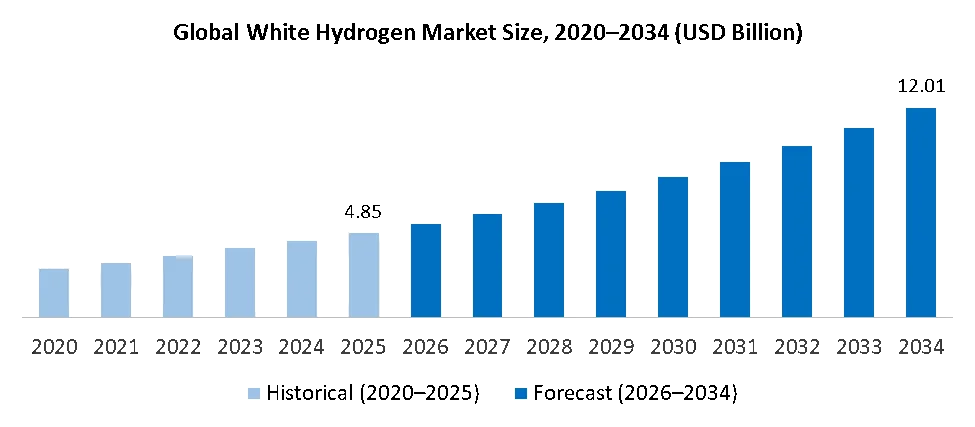
The Global White Hydrogen Market grew from USD 2.79 Billion in 2020 to USD 4.85 Billion in 2025 as the first appraisal wells and exploration funding reached the market. The market is projected to reach USD 12.01 Billion by 2034, a CAGR of 10.60% during 2026-2034. Revenue added each year increases through the forecast period as projects move from pilot wells to multi-well field development.
|
Parameter |
Value |
|
Market Size (2025) |
USD 4.85 Billion |
|
Market Size (2034) |
USD 12.01 Billion |
|
CAGR (2026-2034) |
10.60% |
|
Historical Period |
2020 to 2025 |
|
Forecast Period |
2026 to 2034 |
Global White Hydrogen Market Key Highlights
• Market Growth: The Global White Hydrogen Market was valued at USD 4.85 Billion in 2025 and is projected to reach USD 12.01 Billion by 2034, growing at a CAGR of 10.60% during 2026-2034.
• Cost Advantage: Extracted hydrogen avoids electrolyzer and reforming capital expenditure and reuses oilfield drilling skills, which supports a competitive cost outlook against green, blue and grey hydrogen.
• Decarbonization Demand: Net-zero commitments, carbon pricing and ESG targets are pushing refiners, ammonia producers and steelmakers toward low-carbon supply. The IEA reports that low-emissions hydrogen was less than 1% of global production in 2024.
• Exploration Momentum: Licensing and drilling activity in 2026 spans the United States, Australia, the Philippines, the United Arab Emirates and Oman, with new corporate investors entering the sector.
• Leading Source: Serpentinization of olivine and pyroxene ultramafic rocks holds the largest source share at 41% in 2025.
• Leading Extraction Technology: Direct extraction from underground reservoirs and natural gas fields holds the largest technology share at 36% in 2025.
• Leading End Use: Oil and gas refining and upgrading holds the largest end-use share at 31% in 2025.
• Regional Outlook: North America holds the largest regional share at 36% in 2025, and Asia Pacific is expected to be the fastest-growing region during 2026-2034.
• Competitive Landscape: Koloma, Natural Hydrogen Energy, Hydroma, Gold Hydrogen, HyTerra, H2Au, Helios Aragón, La Française de l’Énergie, 45-8 Energy and Repsol are among the leading participants.
The snapshot summarizes the Global White Hydrogen Market at a glance. North America leads the regional ranking with a 36% share in 2025, and serpentinization, direct extraction and oil and gas refining are the leading source, technology and end-use segments. The market is projected to rise from USD 4.85 Billion in 2025 to USD 12.01 Billion in 2034, a CAGR of 10.60% during 2026-2034.

To know about the Research Methodology :- Request Free Sample Report
Global White Hydrogen Market Dynamics:
Net-Zero Commitments and Low-Carbon Hydrogen Demand to Drive Global White Hydrogen Market Growth
Governments and corporates are tightening emission targets, and refining, ammonia, methanol and steel producers are looking for lower-carbon hydrogen. According to the IEA, hydrogen production in 2024 consumed 290 billion cubic meters of natural gas and 90 million tonnes of coal equivalent, while low-emissions hydrogen accounted for less than 1% of global production. That gap leaves a large base of grey hydrogen that buyers are expected to replace over time. White hydrogen is extracted rather than manufactured, so it avoids the reforming emissions of grey and blue hydrogen and the electricity demand of electrolysis.
Carbon pricing, emission rules and corporate ESG targets support the case for verified low-carbon supply. The carbon intensity of a project still depends on well design, the treatment of associated gases and the energy used for separation and compression, so developers that publish transparent measurement data are better placed to sign offtake agreements.
Cost Advantage over Green, Blue and Grey Hydrogen to Create Opportunities in the Global White Hydrogen Market
White hydrogen does not need electrolyzers, large volumes of renewable power or natural gas reforming units. Capital spending is concentrated in exploration, drilling, well completion and gas processing, where rigs, crews and subsurface skills from the oil and gas industry can be reused. At the Ramsay Project in South Australia, Gold Hydrogen has reported testing that indicates production potential of more than 100 kg of hydrogen per day per well.
Levelized cost will depend on well productivity, reservoir pressure, purity, depth and distance to the end user. Pilot projects have produced limited cost data so far, and repeat flow results from appraisal wells are expected to improve cost visibility and make project financing easier. Against electrolytic hydrogen, price competitiveness through 2034 will also depend on electrolyzer costs, power prices and policy support.
Energy Security and Resource Self-Sufficiency to Support Global White Hydrogen Market Expansion
Import-dependent countries are assessing domestic hydrogen as a way to diversify supply beyond electrolysis and natural gas reforming. National hydrogen strategies increasingly recognize geologic hydrogen, and governments are funding geological surveys and dedicated licensing frameworks. In the Philippines, Koloma holds three natural hydrogen service contracts, and the third gives exclusive exploration rights over more than 4,100 square kilometers across Central Luzon and western Zambales. The Bourakébougou field in Mali has supplied hydrogen-based electricity to a local village since 2012.
Natural hydrogen has also drawn interest for grid support and long-duration storage when paired with renewable power. Resource ownership, mineral rights and permitting rules differ by jurisdiction and will set the pace at which these energy security benefits are realized.
Rising Exploration Investment, Licensing and Pilot Drilling to Support Global White Hydrogen Market Growth
Venture capital, corporate investors and public research programs are funding subsurface hydrogen exploration. Fortescue holds a 39.8% stake in HyTerra, and JERA, Japan’s largest power generator, invested in Koloma through JERA Ventures in October 2026. Licensed acreage has expanded across North America, Australia, Europe, the Middle East, Africa and Southeast Asia.
Pilot drilling and appraisal wells are testing commercial viability, and technical partnerships between explorers, service providers and research institutions are standardizing resource assessment methods. HyTerra and Prometheus Hydrogen are targeting a full supply chain demonstration in the United States by December 2026, covering extraction, purification and delivery to a paying customer.
Geological Uncertainty, Regulation and Infrastructure Readiness to Influence Global White Hydrogen Market Commercialization
White hydrogen is at an early stage of commercialization. Market data presented in early 2026 shows only one site, the Bourakébougou field in Mali, producing natural hydrogen at meaningful scale, so replenishment rates, reserve size and long-term well flow remain unproven in most regions. Results can also fall short: in November 2026 HyTerra withdrew from one of its early US projects after flow rates proved sub-commercial.
Regulation is still evolving. Natural hydrogen may fall under mining, petroleum or dedicated hydrogen laws depending on the jurisdiction, and Idaho and Iowa have moved to regulate it alongside hydrocarbons. Storage, purification and transport infrastructure near prospective fields remains limited, and the small molecular size of hydrogen calls for careful well design, materials selection and leak monitoring.
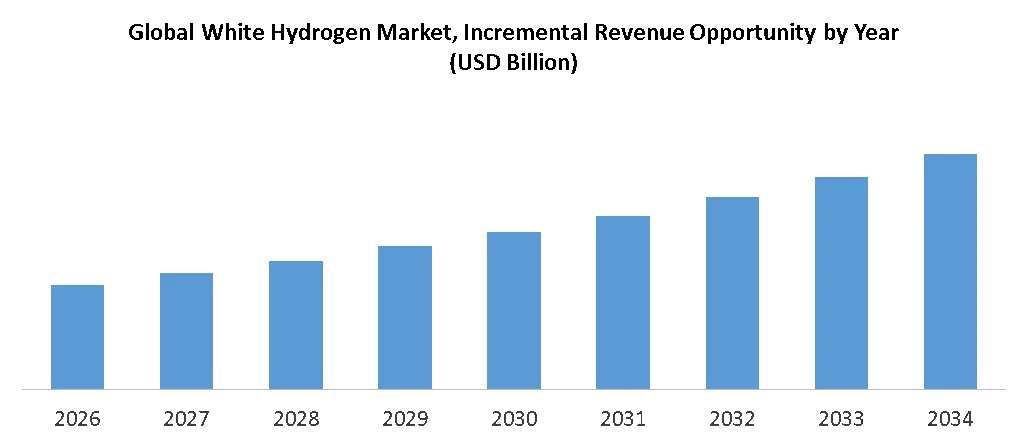
Incremental revenue in the Global White Hydrogen Market rises from USD 0.51 Billion in 2026 to USD 1.15 Billion in 2034. Over 2026-2034 the market adds USD 7.16 Billion, taking it from USD 4.85 Billion to USD 12.01 Billion. Each forecast year adds more revenue than the year before, as pilot wells convert into multi-well fields and offtake agreements reach commercial volumes.
Global White Hydrogen Market, Hydrogen Pathway Comparison
White hydrogen differs from green, blue and grey hydrogen in how it is produced, what energy it needs and how mature the supply route is. The comparison below summarizes these differences and shows where white hydrogen fits against established pathways.
|
Hydrogen |
Production |
Primary Input |
Carbon Profile |
Commercial |
|
White (Natural) |
Extracted from subsurface accumulations through wells |
Geologic hydrogen; energy for drilling and separation |
Low, depending on well design and gas handling |
Pilot and appraisal stage |
|
Green |
Water electrolysis |
Renewable electricity |
Low |
Commercial, scaling up |
|
Blue |
Natural gas reforming with carbon capture |
Natural gas |
Reduced, depending on capture rate |
Early commercial |
|
Grey |
Steam methane reforming or coal gasification |
Natural gas or coal |
High |
Mature, dominant supply route |
MMR Analyst Insight: Commercialization Stage-Gates for the Global White Hydrogen Market
MMR views commercialization as a sequence of three gates. The first is resource confirmation, which needs repeatable flow rates from appraisal wells. The second is supply chain validation, which covers purification, storage and delivery to a paying customer. The third is project financing, which depends on multi-well data and signed offtake agreements. Companies that clear all three gates are expected to capture the largest share of revenue growth through 2034, and the report tracks each profiled company against these gates.
Global White Hydrogen Market Segment Analysis
The Global White Hydrogen Market is segmented by source, extraction technology, end use and region. Each segment reflects different geological origins, recovery methods, demand patterns and commercialization readiness.
Global White Hydrogen Market, By Source
Based on source, the market is segmented into serpentinization of olivine and pyroxene ultramafic rocks, volcanic activity and magma crystallization, hydrothermal vents, degassing of primordial hydrogen, and other sources including biogenic and radiolysis-derived hydrogen.
Serpentinization of ultramafic rocks is the leading source with a 41% share in 2025. Exploration programs concentrate on iron-rich ultramafic formations where water-rock reactions generate hydrogen, and their link to identifiable geological settings supports targeted licensing and pilot drilling. The other sources are supported by geological research and subsea studies and add to the long-term resource base.
Global White Hydrogen Market, By Extraction Technology
Based on extraction technology, the market is segmented into direct extraction from underground reservoirs and natural gas fields, geological capture and separation, microbial hydrogen production and stimulated hydrogen generation.
Direct extraction is the leading technology with a 36% share in 2025, as it relies on drilling, well completion and gas handling practices that are already established in the oil and gas industry. Geological capture and separation systems remove nitrogen, methane, helium and other gases to deliver the required purity. Stimulated hydrogen generation, where water is injected into iron-rich rocks, is expected to gain share as pilot projects progress, while microbial pathways remain at an earlier stage.
Global White Hydrogen Market, By End Use
Based on end use, the market is segmented into oil and gas refining and upgrading, industrial feedstock, mobility, power generation and energy storage, and other applications including steel, aviation and residential heating.
Oil and gas refining and upgrading is the leading end use with a 31% share in 2025, as refiners look to replace carbon-intensive grey hydrogen with low-carbon supply. Industrial feedstock demand from ammonia, methanol and chemicals producers is supported by decarbonization targets, while mobility and power generation are expected to expand as supply and refueling infrastructure develop.
Global White Hydrogen Market Regional Insights:
The Global White Hydrogen Market is segmented into North America, Europe, Asia Pacific, Middle East & Africa and South America. North America holds the largest regional share at 36% in 2025, driven by exploration in the United States, venture-backed developers such as Koloma and Natural Hydrogen Energy, projects in Nebraska and Kansas, public research funding and an established oil and gas services base. Europe is shaped by decarbonization goals and cross-border collaboration, with France and Spain advancing exploration through La Française de l’Énergie, 45-8 Energy, Mantle8, Helios Aragón and Repsol.
Asia Pacific is expected to be the fastest-growing region during 2026-2034, supported by exploration in Australia, including Gold Hydrogen’s Ramsay Project on the Yorke Peninsula, by the Philippines’ dedicated natural hydrogen contracts, and by hydrogen demand in China, India, Japan and South Korea. South America is advancing feasibility studies in Brazil and Argentina. The Middle East & Africa region spans Saudi Arabia, the UAE, Oman, South Africa and Mali, where the Bourakébougou field operated by Hydroma supplies hydrogen-based electricity to a village.
Global White Hydrogen Market Competitive Landscape
The Global White Hydrogen Market is at an emerging stage of commercialisation, characterised by the presence of specialised natural hydrogen exploration companies, independent developers, oil and gas operators, technology providers and strategic investors. Koloma Inc., Natural Hydrogen Energy LLC, Hydroma Inc., Gold Hydrogen Limited, HyTerra Limited, H2Au Pty Limited, Helios Aragón Exploration, 45-8 Energy Group, Mantle8 SAS, La Française de l’Énergie, Repsol S.A. and Buru Energy Limited are among the key companies shaping the competitive landscape. North America holds a strong competitive position, supported by venture capital investments, exploration licensing and drilling activities in the United States. Meanwhile, European companies are strengthening their presence through geological surveys and subsurface exploration, while Australia is emerging as an important exploration hub through projects led by Gold Hydrogen, Buru Energy and HyTerra. Competition primarily depends on exploration acreage, geological expertise, resource discovery capabilities, extraction technologies and access to investment capital.
Mergers and acquisitions, strategic investments, joint ventures and exploration partnerships are becoming important strategies for strengthening competitive positioning in the Global White Hydrogen Market. Recent developments include Fortescue Limited's 39.8% stake in HyTerra, supporting its participation in natural hydrogen exploration, and JERA Ventures' investment in Koloma in October 2026 to strengthen its understanding of geological hydrogen exploration and development. Additionally, HyTerra signed an exclusive collaboration agreement with ARA Natural Resources LLC in March 2026 to evaluate geological hydrogen opportunities in Oman, while Koloma secured its third natural hydrogen service contract in the Philippines in July 2026. Companies are also investing in advanced seismic imaging, geochemical surveys, artificial intelligence-based geological modelling, drilling technologies and hydrogen purification systems. As the market progresses towards commercialisation, strategic acquisitions, technology collaborations, exploration licensing and long-term industrial offtake agreements are expected to play an important role in expanding project portfolios and establishing competitive advantages through 2034.
Global White Hydrogen Market Recent Developments:
|
Date |
Development |
|
February 13, |
Iowa moved to regulate natural hydrogen as Koloma drilled |
|
March 27, |
HyTerra signed an MoU with ARA Natural Resources LLC for |
|
July 23, 2026 |
Koloma secured its third natural hydrogen service |
|
July 25, 2026 |
Gold Hydrogen began flow testing at its Ramsay 1 well on |
|
October 15, |
JERA invested in Koloma through its corporate venture |
|
October 16, |
Gold Hydrogen completed flow testing of the Parara |
|
November 4, |
Mantle8 launched fieldwork for a natural hydrogen |
|
November 10, |
HyTerra withdrew from one of its early US projects |
Global White Hydrogen Market – Industry Analysis
The report presents a comprehensive analysis of the Global White Hydrogen Market, covering stakeholders across natural hydrogen exploration, extraction, technology and service provision, and end-use industries. It evaluates the historical and current market scenario, industry developments, market size, production volume and the growth outlook through 2034.
The report assesses growth drivers, restraints, opportunities and challenges, and examines macroeconomic conditions, oil and gas price movements, capital availability for exploration, production economics against green, blue and grey hydrogen, licensing and acreage trends, and infrastructure readiness for storage, purification and transport.
It also reviews the competitive positioning of leading exploration and extraction companies, start-ups, oil and gas majors and technology providers. Company analysis covers funding and financial position, acreage and project pipeline, drilling and testing milestones, strategic partnerships and recent developments.
PORTER’s Five Forces, PESTLE and SWOT analyses are used to assess the competitive environment and the influence of macroeconomic, regulatory, technological and environmental factors. Regional assessments and country-level forecasts identify emerging opportunities and investment hotspots for investors, developers, refiners, utilities and policy makers.
Global White Hydrogen Market Scope: Inquire before buying
|
Global White Hydrogen Market |
|||
|
Report Coverage |
Details |
||
|
Base Year: |
2025 |
Forecast Period: |
2026-2034 |
|
Historical Data: |
2020 to 2025 |
Market Size in 2025: |
USD 4.85 Billion |
|
Forecast Period 2026 to 2034 CAGR: |
10.60% |
Market Size in 2034: |
USD 12.01 Billion |
|
Segments |
By Source |
Serpentinization of Olivine and Pyroxene Volcanic Activity and Magma Crystallization Hydrothermal Vents Degassing of Primordial Hydrogen Other Sources (Biogenic and Radiolysis-Derived) |
|
|
By Extraction Technology |
Direct Extraction from Underground Reservoirs and Geological Capture and Separation Microbial Hydrogen Production Stimulated Hydrogen Generation |
||
|
By End Use |
Oil and Gas Refining and Upgrading Industrial Feedstock (Ammonia, Methanol and Mobility Power Generation and Energy Storage Other Applications (Steel, Aviation and |
||
Global White Hydrogen Market by Region
North America (United States, Canada and Mexico)
Europe (UK, France, Germany, Italy, Spain, Sweden, Austria and Rest of Europe)
Asia Pacific (China, South Korea, Japan, India, Australia, Indonesia, Malaysia, Vietnam, Taiwan, Bangladesh, Pakistan and Rest of APAC)
Middle East and Africa (South Africa, GCC, Egypt, Nigeria and Rest of ME&A)
South America (Brazil, Argentina, Rest of South America)
Global White Hydrogen Market Key Players:
A. North America – 12 Companies
1. Koloma Inc.
2. Natural Hydrogen Energy LLC
3. Eden GeoPower Inc.
4. Vema Hydrogen
5. GeoRedox Corp.
6. PureWave Hydrogen
7. Longhorn Exploration
8. MAX Power Mining Corp.
9. Quebec Innovative Materials Corp. (QIMC)
10. Primary Hydrogen Corp.
11. Desert Mountain Energy Corp.
12. Hethos Operating
B. Europe – 12 Companies
13. La Française de l'Énergie (FDE)
14. 45-8 Energy SAS
15. Storengy
16. Mantle8
17. Helios Aragón Exploration
18. Snowfox Discovery
19. Terrensis
20. TBH2 Aquitaine
21. 80 Mile Plc
22. Sudmine
23. Repsol S.A.
24. Getech Group plc
C. Asia Pacific – 17 Companies
25. Gold Hydrogen Limited
26. HyTerra Limited
27. H2Au Pty Limited
28. Buru Energy Limited
29. Santos Limited
30. H2EX Limited
31. Top End Energy Limited
32. Mosman Oil and Gas Limited
33. Greenvale Energy Limited
34. Fortescue Limited
35. Central Petroleum Limited
36. Whitebark Energy Limited
37. Osaka Gas Co., Ltd.
38. Mitsubishi Heavy Industries, Ltd.
39. ENEOS Holdings, Inc.
40. Toyota Motor Corporation
41. Mitsubishi Gas Chemical Company, Inc.
D. Middle East and Africa – 3 Companies
42. Hydroma Inc.
43. Rhino Resources
44. Desert Energy
E. South America – 7 Companies
45. Petróleo Brasileiro S.A. (Petrobras)
46. Ecopetrol S.A.
47. ANCAP
48. Pristine Energy
49. Quantum Hydrogen
50. TerraVent
51. Proton
F. Specialist Technology Providers and Emerging Players – 5 Companies
52. Cemvita
53. Fleet Space Technologies
54. Xcalibur Smart Mapping
55. Voyager H2
56. Cryptid Clean Energy
Others
Global White Hydrogen Market – Frequently Asked Questions:
1. Which region has the largest share in Global White Hydrogen Market?
Ans: North America region held the highest share in 2025.
2. What is the growth rate of Global White Hydrogen Market?
Ans: The Global White Hydrogen Market is growing at a CAGR of 10.60% during forecasting period 2026-2034.
3. What is scope of the Global White Hydrogen Market report?
Ans: Global White Hydrogen Market report helps with the PESTEL, PORTER and SWOT analysis, Recommendations for Investors & Leaders, and market estimation of the forecast period.
4. Who are the key players in Global White Hydrogen Market?
Ans: The important key players in the Global White Hydrogen Market are – Koloma Inc., Natural Hydrogen Energy LLC, Hydroma Inc., Gold Hydrogen Limited, HyTerra Ltd., H2Au Pty Ltd., Helios Aragón Exploration, S.L., 45-8 Energy Group SAS, Mantle8 SAS, Vema Hydrogen, La Française de l’Énergie S.A., Repsol S.A., Buru Energy, H2EX, Getech, PureWave Hydrogen, Charbone Hydrogen, QNB Metals / RéSolve Energy.
5. What is the study period of this Market?
Ans: The Global White Hydrogen Market is studied from 2020 to 2034.
6. What is white hydrogen?
Ans: White hydrogen, also called natural, geologic or native hydrogen, is molecular hydrogen that occurs naturally in the Earth’s crust and is produced by processes such as serpentinization, radiolysis and volcanic activity. It is accessed by drilling wells rather than manufactured.