
Lithium-Ion Battery Recycling Market by Source, by Industry, by Chemistry, by Technology
Overview
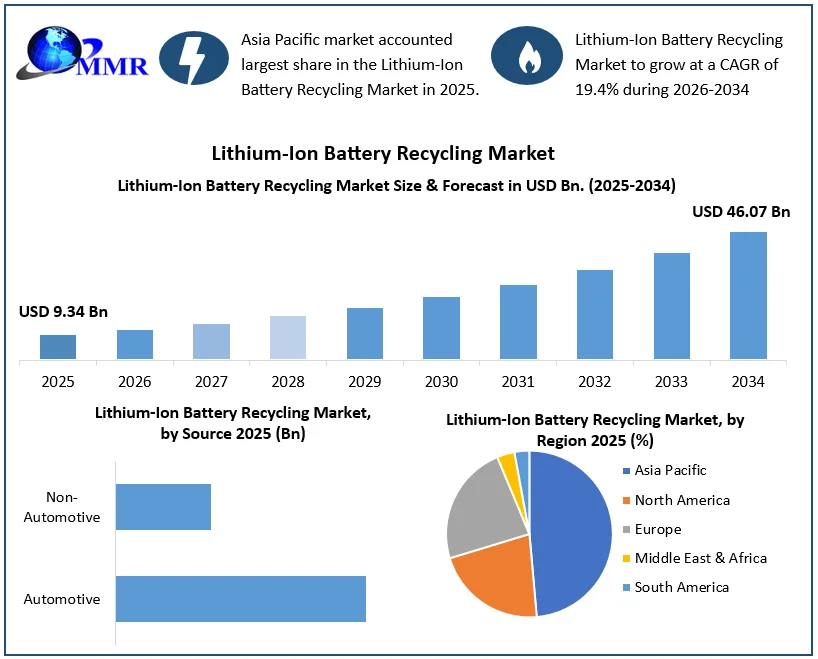
The Global Lithium-Ion Battery Recycling Market was valued at USD 9.34 Billion in 2025 and is projected to reach USD 46.07 Billion by 2034, growing at a CAGR of 19.4% during the forecast period 2026–2034.
Global Lithium-Ion Battery Recycling Market Overview
The Lithium-Ion Battery Recycling Market refers to the industry that collecting, processing, and reprocessing of spent lithium-ion batteries. This process usually begins with the collection and discharge of these batteries. Battery recycling facilities then dismantle and crush the batteries before extracting valuable metals like lithium, cobalt, nickel, copper, manganese, and aluminum. The process ends with the generation of cathode powders or precursor products with potential application in new battery cells.
Lithium-ion battery recycling is driven by the growing demand for these batteries and the high cost and low availability of some of their materials. Recycling helps reduce the reliance on primary materials and promotes the proper disposal of spent batteries. Some of the materials used in battery recycling are considered critical, and hence their supply must be sustained for the long term. Recycling facilities present an efficient solution to the problem of large-scale Li-ion battery waste management.
The growing need to promote a circular economy in battery production by recovering, reusing, and recycling valuable resources has led to an increase in the number of companies engaged in battery recycling activities. This includes electric vehicle producers, battery manufacturers, and recyclers. The Asia Pacific region is one of the largest consumers of lithium-ion batteries. It is the manufacturing hub for numerous battery producers and electric car companies. The European Union and North America are also notable base markets for the battery recycling industry. The market generates significant revenues from these two regions as firms continue to invest in enhancing their capabilities. Apart from the main players in the battery recycling industry, there are several prominent companies with significant influence in the market, including Umicore, Glencore, Redwood Materials, GEM Co., Ltd., Contemporary Amperex Technology Co., Ltd. (CATL), Cirba Solutions, Fortum Battery Recycling, SungEel HiTech, Ascend Elements, and Attero Recycling.
Lithium-Ion Battery Recycling Market Size, Growth and Share Analysis
To Know About The Research Methodology :- Request Free Sample Report
Global Lithium-Ion Battery Recycling Market, Dynamics
Rising Electric Vehicle Sales and Demand for Recovered Battery Materials Drive Market Growth
The Global Lithium-Ion Battery Recycling Market is primarily driven by the rising demand for electric vehicles, energy storage systems, electronics, and other battery-powered products. As these battery systems enter their end-of-life cycle, there emerges a critical need to develop safe and efficient methods to collect, process, and recover valuable materials like lithium, cobalt, nickel, copper, and manganese. Recycling operations can help reduce reliance on virgin materials and create a stable supply chain for battery manufacturers. Increasing production volumes of traction and industrial batteries create a rise in recycling expenditures for collection, processing, and recovery facilities, as well as research and development activities for more sustainable battery chemistries. Market potential and competition prospects allow for a significant rise in the industry size and market share of major battery recycling participants during the forecast period. Demand for localized battery material supply and efficient waste management solutions is likely to support market growth over the next decade.
High Recycling Cost and Complex Battery Collection Limit Market Expansion
The key factor which might restrict the growth of the Global Lithium-Ion Battery Recycling Market is the high cost of collection, transportation, sorting, and processing operations. Lithium-ion batteries vary significantly in size, design, and chemistry, presenting complex recycling needs and increasing overall expenditures. Proper transportation and storage of these batteries are challenging, as they involve the risk of fire and other safety hazards if mishandled. In some regions, the lack of established recycling infrastructure creates a substantial supply-demand gap, thus, limiting the potential market growth. Moreover, the low value of recyclable materials in some battery chemistries might discourage recycling facility owners and operators from pursuing this type of waste management. These financial limitations might hinder the rate of market share gains in the lithium-ion battery recycling industry, especially among small-scale participants, and impact the market forecast in the next ten years.
Growing Recycling Capacity and Circular Battery Supply Chains Create Strong Market Opportunities
Among the emerging opportunities for the Global Lithium-Ion Battery Recycling Market growth, the first one is presented by the transition toward more sustainable battery supply chains enabled by material recovery and recycling. Recycling facility owners and operators can contribute to the creation of closed-loop systems by recovering critical battery materials and transforming them into new battery products. This approach helps to reduce the environmental impact of battery production while supporting the stable supply of raw materials and components for manufacturers. Another opportunity is the growing supply-demand gap for lithium-ion battery recycling services in regions with a fast electric vehicle adoption rate, which creates a considerable market potential for collection, recycling, and material recovery infrastructures. The rising investments in direct recycling, hydro-metallurgical processes, and automated battery recycling facilities and systems are also expected to create a significant market opportunity during the forecast period. Finally, the expanding scope of collaboration between recycling market players and battery and electric vehicle manufacturers can generate competitive advantages and increase the market share of industry leaders while supporting the market’s overall growth. During the next ten years, the key market opportunity will be presented by the scale and efficiency of a company’s operations and its ability to establish strategic partnerships and alliances.
Battery Chemistry Changes and Difficult Collection Networks Create Operational Challenges
The primary threats to the lithium-ion battery recycling industry are the complexity of battery material recycling, higher collection costs, safety risks, and the need to maintain high profit margins from operations. As lithium-ion battery manufacturers and producers introduce new battery technologies and materials, global recyclers face the need to adapt their operations for the changes in chemistry and design which happen at a rapid pace. At the same time, the collection of spent lithium-ion batteries is capital-intensive and can be highly variable due to the long lifespan of these energy storage systems. Companies entering the Global Lithium-Ion Battery Recycling Market might face significant expenditures and delays before creating stable supplies of recyclable materials. Moreover, fluctuations in material prices, variations in recycling regulations between countries, and the complexity of international logistics might impact the sustainable operations of such facilities, limiting their capacity and overall contribution to the Global Lithium-Ion Battery Recycling Market growth.
Global Lithium-Ion Battery Recycling Market Segment Analysis
Lithium-Ion Battery Recycling Market, by Technology
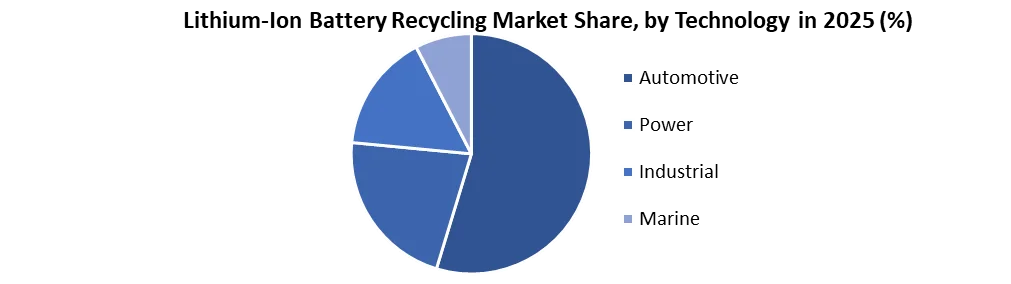
The Global Lithium-Ion Battery Recycling Market is segmented into Power, Marine, Automotive, and Industrial. Automotive segment is very significant as the rising adoption of electric vehicles will lead to a huge number of spent batteries that need to be recycled. The power segment is also a major contributor as lithium-ion batteries are extensively used in power storage, utility, and backup applications. In the marine segment, lithium-ion batteries are increasingly being used in electric boats, yachts, and hybrid ships and, as a result, a new need for recycling has emerged. The industrial segment covers batteries used in electric industrial equipment, forklifts, and telecommunication devices. With the demand for lithium-ion batteries expected to rise massively in the near future, recycling companies are focusing on reusing the valuable materials like lithium, nickel, cobalt, copper, and manganese that are recovered from spent batteries.
Lithium-Ion Battery Recycling Market, by Industry
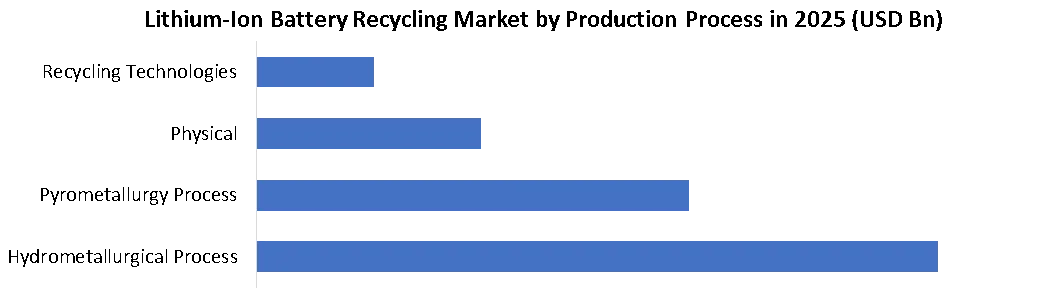
The Global Lithium-Ion Battery Recycling Market is segmented into Hydrometallurgical Process, Pyrometallurgy Process, Physical, and Recycling Technologies. Hydrometallurgical process is used to recover valuable metals such as nickel, lithium, manganese, and cobalt from spent batteries through the dissolution of metals with specific chemicals in a solution. This is done through high-rate recycling and low energy consumption. Pyrometallurgy process is another technique used to extract metals from spent batteries but through the application of high temperatures. It is ideal for processing complex battery waste but has high energy consumption. The physical and mechanical process involves shearing or shredding of batteries and separation of plastics, metals, and other materials. This is typically applied in recycling facilities to separate battery materials. As the global demand for battery materials grows, companies are investing in recycling technologies to improve the recovery of lithium, nickel, cobalt, manganese, and copper in much better and efficient ways while reducing the cost of recycling. Battery pack recycling technologies are also enabling the provision of new and recycled battery materials while reducing the overall carbon footprint of lithium-ion batteries, thus, aiding compliance.
Global Lithium-Ion Battery Recycling Market Regional Insights
The Global Lithium-Ion Battery Recycling Market is witnessing an upsurge across North America, Europe, Asia-Pacific, Middle East & Africa, and South America as companies across the world are investing in this segment. Asia-Pacific is a key region for the growth of the Global Lithium-Ion Battery Recycling Market due to the high amount of battery production in countries like China, Japan, South Korea, and India. Middle East & Africa and South America are emerging markets for lithium-ion battery recycling as the demand for EVs, energy storage, and electronics is on a rise; however, they contribute minimally to the Global Lithium-Ion Battery Recycling Market in comparison to other regions. The demand for battery recycling is rapidly growing in these two regions as a result of rising investment in electric vehicles, battery production facilities, and government policies promoting a circular economy. On the other hand, Europe is anticipated to witness significant growth as a result of substantial battery production, collection, and recycling in countries like Germany, France, and the United Kingdom. North America is also a key region for the Global Lithium-Ion Battery Recycling Market as companies are investing in electric vehicles, as well as the battery material supply chain, to meet sustainability goals.
Lithium-Ion Battery Recycling Industry Ecosystem
Lithium-ion Battery Recycling Market Recent Industry Developments
| Date | Company | Development | Impact |
| 09 April 2026 | Ascend Elements Inc. | The company filed for Chapter 11 bankruptcy protection due to liquidity issues and the cancellation of federal grants. | The filing aims to restructure $103.5 million in long-term debt while maintaining operations at its Kentucky and Georgia facilities. |
| 10 March 2026 | Contemporary Amperex Technology Co. Limited (CATL) | CATL reported recovering and processing 210,000 tonnes of used batteries in its 2025 annual report. | The process regenerated 24,000 tonnes of lithium salts, significantly reducing the company's reliance on newly mined raw materials. |
| 29 January 2026 | Redwood Materials Inc. | The company commenced critical materials recovery operations at its new campus in South Carolina. | This expansion strengthens the domestic supply chain for battery-grade lithium, nickel, and cobalt in North America. |
| 20 February 2026 | Umicore SA | Umicore announced that its Battery Recycling Solutions unit substantially decreased negative earnings through technology optimization. | The move aligns with their CORE strategy to restore value and improve margins within the battery materials segment for 2026. |
Lithium-Ion Battery Recycling Market Scope: Inquiry Before Buying
| Lithium-Ion Battery Recycling Market | |||
|---|---|---|---|
| Report Coverage | Details | ||
| Base Year: | 2025 | Forecast Period: | 2026-2034 |
| Historical Data: | 2020 to 2025 | Market Size in 2025: | 9.34 USD Bn |
| Forecast Period 2026-2034 CAGR: | 19.4% | Market Size in 2032: | 46.07 USD Bn |
| Segments Covered: | by Source | Automotive Non-Automotive |
|
| by Industry | Hydrometallurgical Process Pyrometallurgy Process Physical/Mechanical Process Recycling Technologies Other |
||
| by Chemistry | Lithium-manganese Oxide Spinal Lithium-titanate Oxide Lithium-nickel Cobalt Aluminum Oxide Lithium-nickel Manganese Cobalt Lithium-iron Phosphate Lithium-cobalt Oxide |
||
| by Technology | Power Marine Automotive Industrial Others |
||
Lithium-Ion Battery Recycling Market, by Region
North America (United States, Canada and Mexico)
Europe (UK, France, Germany, Italy, Spain, Sweden, Austria and Rest of Europe)
Asia Pacific (China, South Korea, Japan, India, Australia, Indonesia, Malaysia, Vietnam, Taiwan, Bangladesh, Pakistan and Rest of APAC)
Middle East and Africa (South Africa, GCC, Egypt, Nigeria and Rest of ME&A)
South America (Brazil, Argentina Rest of South America)
Lithium-Ion Battery Recycling Market Key Players
1. Umicore
2. Glencore
3. Contemporary Amperex Technology Co., Ltd. (CATL)
4. Brunp Recycling
5. GEM Co., Ltd.
6. Redwood Materials
7. Ecobat
8. Cirba Solutions
9. Fortum Battery Recycling
10. Stena Recycling
11. American Battery Technology Company
12. RecycLiCo Battery Materials
13. Duesenfeld GmbH
14. ACCUREC Recycling GmbH
15. Aqua Metals
16. Neometals Ltd.
17. Primobius
18. SungEel HiTech
19. SK tes
20. Ganfeng Lithium Group
21. Eramet
22. Green Li-ion
23. Veolia
24. Ascend Elements
25. Ace Green Recycling
26. Attero Recycling
27. Hydrovolt
28. Shenzhen Highpower Technology Co., Ltd.
29. Retriev Technologies
30. Raw Materials Company
31. Recupyl
32. BatX Energies
33. Lohum Cleantech
34. Metastable Materials
35. Li-Circle
36. Livium
37. Envirostream Australia
38. Cylib
39. Tozero
40. TES-AMM
Frequently Asked Questions:
1. What is the current size of the Global Lithium-Ion Battery Recycling Market
The Global Lithium-Ion Battery Recycling Market was valued at USD 9.34 Billion in 2025 and is projected to reach USD 46.07 Billion by 2034, growing at a CAGR of 19.4% during the forecast period 2026–2034.
2. What are the key factors driving the Global Lithium-Ion Battery Recycling Market
The growth in the battery recycling market size is primarily driven by the rise of electric vehicle sales, growing supply of electric vehicle batteries, rising demand for recycling of lithium, cobalt, and nickel from spent batteries, and the need to reduce reliance on newly mined materials.
3. Which application segment holds the largest share of the Global Lithium-Ion Battery Recycling Market
The Automotive segment is the largest in the battery recycling market, as it hosts a significant proportion of electric vehicle batteries that require recycling.
4. Which region dominates the Global Lithium-Ion Battery Recycling Market
Asia Pacific is the biggest region in the battery recycling market due to its significant share in the manufacturing of batteries, along with the notable production of electric vehicles in countries such as China, Japan, South Korea, and India.
5. Who are the major players operating in the Global Lithium-Ion Battery Recycling Market
The key players in the battery recycling market are Umicore, Glencore, CATL, Brunp Recycling, GEM Co., Ltd, Redwood Materials, Cirba Solutions, Fortum Battery Recycling, SungEel HiTech, and Attero Recycling.