
Pressure Relief Devices Market by Type, End-User Industry and Region – Global Market Size Estimation, Industry-Wide Analysis, Competitive Landscape Assessment & Long-Term Forecast to 2034
Overview
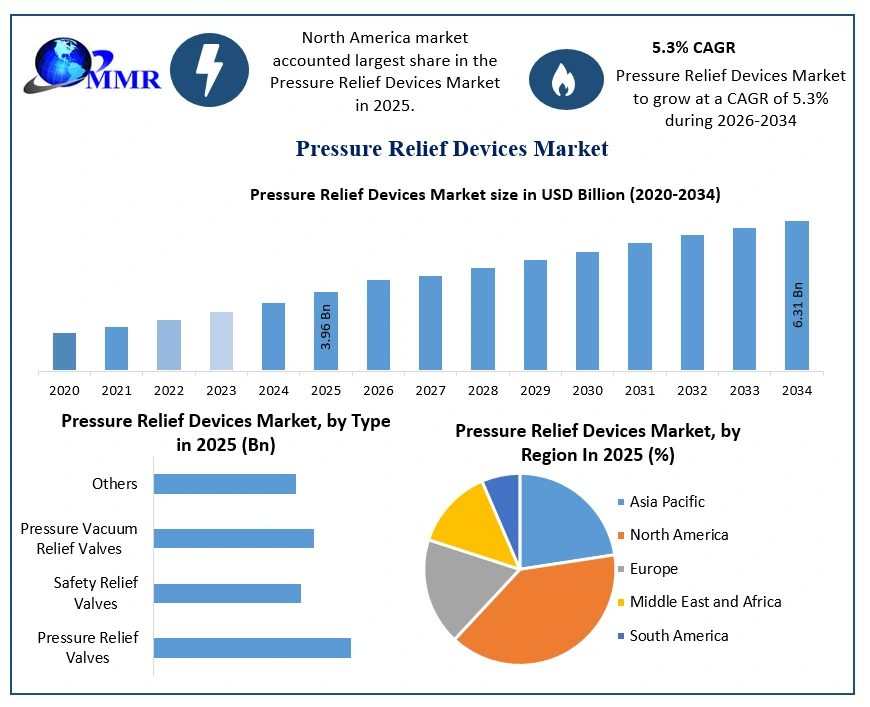
Pressure Relief Devices Market was valued at USD 3.96 Bn. in 2025 and is expected to reach USD 6.31Bn by 2034, at a CAGR of 5.3% during the forecast period.
Global Pressure Relief Devices Market Overview
Pressure relief devices are mechanisms or systems designed to prevent excessive pressure buildup within a vessel or system. These devices are crucial for ensuring the safety and integrity of various industrial processes, equipment, and storage containers that handle fluids or gases under pressure. The primary function of pressure relief devices is to release excess pressure before it reaches levels that potentially cause catastrophic failure or damage to the equipment. They are commonly used in industries such as oil and gas, chemical processing, pharmaceuticals, and manufacturing.
Stringent regulations and standards imposed by regulatory bodies and governments worldwide have compelled industries to invest in pressure relief devices to ensure workplace safety and environmental protection. Compliance with standards such as ASME Boiler and Pressure Vessel Code, API standards, and regional safety regulations drives demand for these devices. The pressure relief devices market is highly competitive, with numerous Pressure Relief Devices manufacturers competing based on product quality, performance, and reliability. Market players are actively engaged in strategic initiatives such as mergers, acquisitions, and partnerships to increase their product portfolios and market presence.
Pressure Relief Devices Market Growth Share Analysis
To know about the Research Methodology:-Request Free Sample Report
Pressure Relief Devices Market Dynamics
Industrialization and Infrastructure Development to boost the Pressure Relief Devices Market growth
The ongoing industrialization and infrastructure development in emerging economies, coupled with the growth of existing industries in developed regions, contribute to the growing demand for pressure relief devices. Industries such as oil and gas, chemical processing, pharmaceuticals, food and beverage, and manufacturing require pressure relief devices to ensure the safe operation of equipment and processes handling pressurized substances, which is expected to boost the Pressure Relief Devices Market growth.
Increasing emphasis on risk management and workplace safety drives the adoption of pressure relief devices across industries. Pressure-related accidents, such as explosions or equipment failures due to overpressure, have severe consequences, including injuries, fatalities, environmental damage, and financial losses. Therefore, companies prioritize the installation of reliable pressure relief systems to mitigate risks and ensure the safety of personnel, equipment, and the surrounding environment.
Ongoing technological advancements in pressure relief device design, materials, and manufacturing processes contribute to market growth. Innovations such as smart pressure relief devices with remote monitoring capabilities, predictive maintenance features, and enhanced performance characteristics are gaining traction in the market. These advancements improve the efficiency, reliability, and functionality of pressure relief devices, driving their adoption across various industries. The pressure relief devices market is highly competitive, with numerous manufacturers competing based on product quality, performance, and reliability.
Pressure Relief Devices Market players continuously invest in research and development to innovate and differentiate their products, offering solutions tailored to specific industry requirements and applications. Product innovations such as advanced materials, modular designs, and integrated technologies drive market growth and expand the range of available pressure relief solutions.
Operational Challenges and cost constraints to limit Pressure Relief Devices Market growth
Improper sizing, installation, or maintenance of pressure relief devices lead to operational challenges, including system inefficiencies, false alarms, or inadequate protection. Industries must ensure proper training for personnel responsible for operating and maintaining pressure relief systems to avoid performance issues or safety hazards. Integrating pressure relief devices into existing infrastructure or retrofitting older equipment pose logistical and compatibility challenges. The initial investment and ongoing maintenance costs associated with pressure relief devices is significant for industries, especially for small and medium-sized enterprises (SMEs) with limited budgets, which significantly limits the Pressure Relief Devices Market growth. High costs deter some companies from investing in advanced or redundant pressure relief systems, particularly in industries with thin profit margins or during economic downturns.
Inadequate calibration, aging components, or incorrect application of pressure relief devices result in false alarms or insufficient pressure protection. False alarms disrupt operations and lead to unnecessary downtime, while inadequate protection compromise safety and increase the risk of accidents or regulatory non-compliance. Industries must regularly assess and test pressure relief systems to verify their performance and reliability under varying operating conditions. The demand for pressure relief devices is closely tied to the performance and growth of end-user industries such as oil and gas, chemical processing, and manufacturing. Economic downturns, geopolitical uncertainties, or shifts in Pressure Relief Devices market demand for end products affect investment decisions and capital expenditures in these sectors, potentially impacting the demand for pressure relief devices.
Pressure Relief Devices Market Segment Analysis
Based on Type, the market is segmented into Pressure Relief Valves, Safety Relief Valves, Pressure Vacuum Relief Valves, and Others. Pressure Relief Valves segment dominated the market in 2025 and is expected to hold the largest Pressure Relief Devices Market share over the forecast period. Pressure Relief Valves are essential safety devices used across a wide range of industries to protect equipment, processes, and personnel from the potentially catastrophic consequences of overpressure events. The Pressure Relief Valves segment is influenced by Pressure Relief Devices market trends such as technological advancements, including the development of smart valves with remote monitoring capabilities and predictive maintenance features. The Pressure Relief Devices industry players focus on product innovation, material advancements, and customization to meet evolving industry needs and enhance the performance, reliability, and efficiency of pressure relief valve solutions.
Based on End-User Industry, the market is segmented into Energy & Utilities, Chemicals & Petrochemicals, Healthcare & Pharmaceuticals, Food & Beverage, Manufacturing & Automotive, and Others. Chemicals & Petrochemicals segment dominated the market in 2025 and is expected to hold the largest Pressure Relief Devices Market share over the forecast period. The Chemicals & Petrochemicals segment is a significant due to the complex and potentially hazardous nature of processes involved in chemical manufacturing, refining, and petrochemical production.
The Chemicals & Petrochemicals industry encompasses a wide range of activities involved in the production, processing, and distribution of chemicals, including basic chemicals, specialty chemicals, and petrochemicals derived from petroleum or natural gas feedstocks. These industries produce a diverse array of products used in various sectors, including plastics, pharmaceuticals, fertilizers, detergents, and paints.
The Pressure Relief Devices play a critical role in ensuring the safety and integrity of chemical and petrochemical processes by protecting equipment such as reactors, distillation columns, heat exchangers, storage tanks, and pipelines from overpressure conditions. Pressure Relief Valves, Rupture Disks (Bursting Discs), and Safety Relief Valves are commonly used in these applications to relieve excess pressure and prevent catastrophic failures or accidents.
Pressure Relief Devices Market Regional Insights
Booming Energy Sector to boost North America Pressure Relief Devices Market growth
North America dominated the market in 2025 and is expected to hold the largest Pressure Relief Devices Market share over the forecast period. North America, particularly the United States and Canada, has a robust energy sector, including oil and gas exploration, production, refining, and distribution. The growth of shale gas production, offshore drilling activities, and pipeline infrastructure development in regions such as the Permian Basin, Bakken Formation, and Alberta's oil sands drives the demand for pressure relief devices to ensure safe handling of pressurized fluids and gases in upstream, midstream, and downstream operations.
The chemical industry in North America is witnessing steady growth due to factors such as increasing demand for specialty chemicals, agrochemicals, and petrochemicals. Investments in new chemical plants, developments of existing facilities, and technological advancements drive the demand for pressure relief devices to safeguard against overpressure incidents in chemical processing units, reactors, storage tanks, and transportation vessels.
The healthcare sector in North America is characterized by advanced medical facilities, research institutions, and pharmaceutical manufacturing capabilities. Pressure relief devices are essential for maintaining sterile environments, controlling pressure differentials in cleanrooms, laboratories, and pharmaceutical production facilities, and ensuring the safety of medical gas delivery systems in hospitals and healthcare facilities, which significantly boosts the North America Pressure Relief Devices Market growth. North American industries are increasingly adopting automation, digitalization, and Industry 4.0 technologies to improve productivity, efficiency, and safety. Smart pressure relief devices equipped with sensors, actuators, and connectivity features enable real-time monitoring, data analytics, and predictive maintenance, enhancing operational visibility, process control, and risk management capabilities in industrial facilities.
Pressure Relief Devices Market Recent Development
| Date | Company | Development | Impact |
|---|---|---|---|
| 26 March 2025 | RF Health (Recovery Force Health) | RF Health acquired the HeelP.O.D. pressure offloading device portfolio from NelDerm to expand its specialized pressure injury prevention solutions. | The acquisition strengthens RF Health's product offering in targeted heel pressure injury relieving devices across acute care settings. |
| 15 April 2025 | Rotarex | Rotarex launched its next-generation Ring Valve for industrial gas cylinders, featuring an integrated burst disk pressure relief device and dual-stage residual pressure safety mechanisms operating up to 315 bar. | The innovation enhances operational safety against sudden pressure surges while extending gas cylinder service lifecycles to 15 years. |
| 09 June 2025 | Stryker | Stryker officially launched the APAISER X1 advanced ICU air mattress tailored for critical care patient management. | The system integrates 3-in-1 TrueCare alternating pressure technology and low-air loss systems to mitigate pressure injuries and streamline intensive care nursing workflows. |
| 20 June 2025 | NthJEN | NthJEN commercially launched a dynamic smart bed system equipped with over 1,000 embedded pressure sensors for automated patient monitoring. | This technological milestone advances high-tech support surfaces by enabling continuous real-time pressure mapping to prevent hospital-acquired bedsores. |
| 15 January 2026 | U.S. House of Representatives | Bipartisan lawmakers introduced the Under Pressure Act of 2026 to mandate Federal Railroad Administration evaluations of tank car pressure relief devices during thermal derailment incidents. | The regulatory movement accelerates technical standards and safety compliance requirements for high-pressure safety valves used in hazardous material transport. |
Global Pressure Relief Devices Market Scope: Inquire before buying
| Global Pressure Relief Devices Market | |||
|---|---|---|---|
| Report Coverage | Details | ||
| Base Year: | 2025 | Forecast Period: | 2026-2034 |
| Historical Data: | 2020 to 2025 | Market Size in 2025: | US $ 3.96 Bn. |
| Forecast Period 2026 to 2034 CAGR: | 5.3% | Market Size in 2034: | US $ 6.31 Bn. |
| Segments Covered: | By Type | Pressure Relief Valves Safety Relief Valves Pressure Vacuum Relief Valves Others |
|
| By End-User Industry | Energy & Utilities Chemicals & Petrochemicals Healthcare & Pharmaceuticals Food & Beverage Manufacturing & Automotive Others |
||
Pressure Relief Devices Market, by Region
North America (United States, Canada and Mexico)
Europe (UK, France, Germany, Italy, Spain, Sweden, Austria and Rest of Europe)
Asia Pacific (China, South Korea, Japan, India, Australia, Indonesia, Malaysia, Vietnam, Taiwan, Bangladesh, Pakistan and Rest of APAC)
South America (Brazil, Argentina Rest of South America)
Middle East & Africa (South Africa, GCC, Egypt, Nigeria and Rest of ME&A)
Leading Pressure Relief Devices manufacturers include:
North America:
1. Emerson Electric Co. (United States)
2. Curtiss-Wright Corporation (United States)
3.Flow Safe Inc. (United States)
4. Velan Inc. (Canada)
5. Pentair plc (United States)
6. BI-TORQ Valve Automation (United States)
7. Anderson Greenwood (United States)
Europe:
1. LESER GmbH & Co. KG (Germany)
2. IMI Critical Engineering (United Kingdom)
3. Elfab Ltd. (United Kingdom)
4. Tyco International Ltd. (Switzerland)
5. Weir Group plc (United Kingdom)
6. CROSBY GmbH (Germany)
7. Doedijns Group International (Netherlands)
Asia Pacific:
1. CSE Global Limited (Singapore)
2. Goetze India Ltd. (India)
3. ZOOK Enterprises, LLC (India)
4. Kunkle Valve India Pvt. Ltd. (India)
5. Yoshitake Inc. (Japan)
Latin America:
1. REMBE GmbH Safety + Control (Brazil)
Middle East & Africa:
1. KSB Pumps Arabia Ltd. (Saudi Arabia)
Frequently asked questions:
1. What are pressure relief devices, and why are they important?
Ans: Pressure relief devices are mechanisms or systems designed to prevent excessive pressure buildup within a vessel or system. They are crucial for ensuring the safety and integrity of various industrial processes, equipment, and storage containers handling fluids or gases under pressure.
2. What industries use pressure relief devices, and why?
Ans: Industries such as oil and gas, chemical processing, pharmaceuticals, and manufacturing primarily use pressure relief devices. These industries handle processes involving pressurized substances, where the risk of overpressure incidents leading to explosions, equipment failures, or environmental damage is significant.
3. How do stringent regulations drive the demand for pressure relief devices?
Ans: Stringent regulations and standards imposed by regulatory bodies and governments worldwide compel industries to invest in pressure relief devices to ensure workplace safety and environmental protection. Compliance with standards such as ASME Boiler and Pressure Vessel Code, API standards, and regional safety regulations drives the demand for these devices, as industries strive to meet safety requirements and avoid penalties or legal liabilities.
4. What factors contribute to the competitiveness of the pressure relief devices market?
Ans: The pressure relief devices market is highly competitive, with numerous manufacturers competing based on product quality, performance, and reliability. Market players invest in research and development to innovate and differentiate their products, offering solutions tailored to specific industry requirements and applications.
5. How does industrialization and infrastructure development impact the demand for pressure relief devices?
Ans: The ongoing industrialization and infrastructure development in emerging economies, along with the expansion of existing industries in developed regions, contribute to the growing demand for pressure relief devices.