Polysulfone Market by Type, by Application, by Form, by End User, by Processing Method

6.81%
CAGR (2026-2034)
2.84 USD Bn.
Forecast Market Size
322
Report Pages
154
Market Tables

Overview

Polysulfone Market was valued USD 2.84 Bn in 2025 and is expected to reach 5.14 Bn by 2034, at a CAGR of 6.81% during a forecast period.

Global Polysulfone Market Overview:

Polysulfone (PSU) is a high-performance engineering thermoplastic valued for its heat resistance, chemical resistance, strength, durability, transparency, and dimensional stability. It can withstand repeated sterilization and demanding operating conditions, making it useful in medical devices, water filtration membranes, electrical and electronics, automotive, aerospace, food processing, and industrial equipment. Related materials such as polyethersulfone (PESU) and polyphenylsulfone (PPSU) are also used for specialized high-performance applications.

The global polysulfone market is growing as industries look for lightweight and durable materials that can perform under high temperatures and harsh conditions. Asia Pacific is an important market because of its expanding healthcare, electronics, water treatment, and manufacturing sectors, while North America and Europe have strong demand from medical, aerospace, filtration, and industrial applications. Companies such as Solvay are also developing more sustainable sulfone polymer solutions, supporting new opportunities in high-performance and environmentally focused applications.

The MMR Polysulfone Market Report provides a detailed analysis of market trends, growth drivers, restraints, opportunities, product types, applications, end-use industries, regional demand, competitive landscape, key players, and forecasts. Growth opportunities are emerging in medical-grade polysulfone, water and wastewater filtration, membrane technology, electronics, aerospace, automotive components, and sustainable engineering plastics. The report helps manufacturers, investors, and suppliers understand changing demand and identify potential areas for business expansion.

Polysulfone Market Growth and Share Analysis
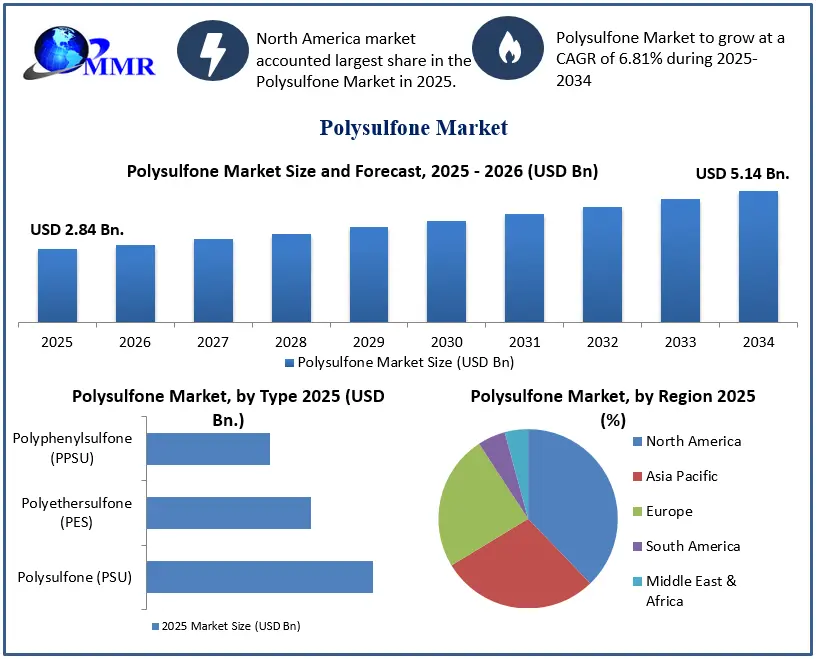
Polysulfone Market Growth

To know about the Research Methodology :- Request Free Sample Report

Global Polysulfone Market Dynamics:

Global Polysulfone Market Drivers

Rising Demand for High-Performance Engineering Thermoplastics:

The global polysulfone market is driven by increasing demand for high-performance engineering thermoplastics that can maintain mechanical strength, dimensional stability, and chemical resistance under demanding operating conditions. Polysulfone (PSU), polyethersulfone (PES), and polyphenylsulfone (PPSU) are increasingly used in applications where conventional plastics may not provide sufficient thermal or chemical performance. Their ability to withstand elevated temperatures and repeated exposure to aggressive chemicals supports their adoption in medical equipment, laboratory components, pharmaceutical processing systems, and industrial equipment.

Growing Application of Polysulfone Membranes in Water Treatment:

Expansion of water purification and wastewater treatment infrastructure is creating sustained demand for polysulfone-based membrane materials. PSU and PES are widely used as membrane-forming polymers because they combine mechanical durability with chemical resistance and suitable membrane-forming characteristics. Increasing requirements for reliable filtration in municipal, industrial, and process-water applications are therefore supporting the consumption of polysulfone materials.

Global Polysulfone Market Restraints

High Material and Processing Costs:

The relatively high cost of polysulfone resins compared with conventional engineering plastics can limit their adoption in applications where material cost is a major purchasing consideration. Manufacturing also requires controlled processing conditions to achieve consistent dimensional accuracy and mechanical performance. These factors can increase the overall production cost and make polysulfone less competitive in applications where lower-cost materials provide adequate performance.

Complexity of Membrane Manufacturing:

Polysulfone membrane production can involve multiple processing stages, solvent systems, controlled phase-inversion conditions, and specialized equipment. Maintaining consistent pore structure, membrane thickness, permeability, and mechanical strength can increase manufacturing complexity. For smaller manufacturers or cost-sensitive applications, these requirements can create barriers to wider adoption.

Global Polysulfone Market Opportunities

Growth of Advanced Filtration Technologies:

The increasing need for efficient water purification, industrial wastewater treatment, pharmaceutical filtration, and high-purity process water is creating opportunities for advanced polysulfone membrane technologies. Manufacturers can focus on developing membranes with improved permeability, selectivity, fouling resistance, and chemical durability. Improvements in membrane performance can help reduce energy consumption and replacement frequency while supporting the expansion of polysulfone-based filtration systems.

Development of Sustainable Polysulfone Solutions:

Sustainability is creating opportunities for manufacturers to improve the environmental profile of polysulfone products. Research into membrane recovery, material reuse, recycling-compatible designs, and lower-impact manufacturing processes can help address concerns associated with end-of-life waste. Developing more efficient production and recovery methods could also increase the long-term value of PSU and PES materials in filtration and engineering applications.

Global Polysulfone Market Challenges

Balancing Multiple Performance Requirements:

A key technical challenge is achieving the required combination of permeability, selectivity, mechanical strength, chemical resistance, thermal stability, and fouling resistance, particularly in membrane applications. Improving one property can sometimes affect another, making formulation and membrane design more technically demanding. Manufacturers therefore need to optimize material composition and processing conditions for specific end-use requirements.

End-of-Life Management and Recycling:

The durability and chemical stability that make polysulfone attractive in demanding applications can also complicate end-of-life management. Used filtration membranes may contain multiple polymer layers, support structures, coatings, or accumulated contaminants, making material separation and recycling more difficult. Developing practical recovery and recycling systems while maintaining the quality of recovered polymers remains an important challenge for the industry.

Global Polysulfone Market Trends:

Key Trends Description
Growing Adoption of Advanced Filtration Membranes Increasing demand for efficient water purification, wastewater treatment, and industrial filtration is supporting the use of polysulfone and polyethersulfone membranes. Manufacturers are focusing on improving membrane permeability, selectivity, fouling resistance, and operating life.
Rising Demand for Medical-Grade Polysulfone Materials PSU and PPSU are gaining attention in medical devices, sterilizable components, laboratory equipment, and pharmaceutical processing because of their thermal stability, durability, and resistance to repeated cleaning and sterilization cycles.
Development of High-Performance PES Membranes Polyethersulfone is increasingly being developed for applications requiring controlled pore structures and consistent filtration performance. Advances in membrane formulation and processing are helping manufacturers target higher flux, improved selectivity, and better resistance to fouling.
Shift Toward Longer-Life Engineering Components End users are increasingly selecting polysulfone materials for components exposed to heat, chemicals, repeated sterilization, or demanding operating conditions. The focus is shifting from initial material cost toward service life, reliability, and reduced component replacement.
Expansion of High-Purity Processing Applications Growth in pharmaceutical, biotechnology, laboratory, and specialty chemical processing is creating demand for high-performance polymer components that can maintain dimensional stability and chemical resistance under controlled processing conditions.
Increasing Interest in Polysulfone Recycling Greater attention to sustainability is encouraging research into recovering PSU and PES from used membranes and engineering components. Recycling-compatible designs, polymer recovery, and improved waste-management processes are becoming areas of development within the polysulfone industry.

Global Polysulfone Market Segment Analysis:

Global Polysulfone Market Segment Analysis, By Type

The Polysulfone Market by Type includes Polysulfone (PSU), Polyethersulfone (PES), and Polyphenylsulfone (PPSU), each serving different performance requirements. PSU is used in medical, industrial, and filtration components requiring thermal and chemical stability. PES has strong application in membrane filtration, particularly water treatment and dialysis, due to its membrane-forming properties. PPSU is preferred for applications requiring high impact strength and repeated sterilization, particularly in medical equipment. Demand across these grades is closely linked to application-specific requirements for durability, temperature resistance, and chemical stability.

Global Polysulfone Market Segment Analysis, By Application

The Polysulfone Market by Application covers membranes, automotive components, electrical and electronics components, medical devices, aerospace components, consumer goods, and industrial equipment. Membranes, particularly for water treatment and dialysis, represent a major application because PSU and PES provide suitable mechanical and chemical properties for filtration systems. Medical devices use polysulfone materials for components exposed to sterilization and repeated cleaning. Automotive, aerospace, and electrical applications use these polymers where dimensional stability and thermal performance are required. Industrial equipment and consumer goods account for additional demand across specialized components and durable products.

Global Polysulfone Market Segment Analysis, By Form

The Polysulfone Market by Form is segmented into granules, powder, sheets, films, and rods & tubes according to processing and end-use requirements. Granules are widely used as feedstock for injection molding and other thermoplastic processes, while powder is used in specialized manufacturing and formulation applications. Sheets and films serve filtration, electrical, fabrication, and protective applications requiring controlled thickness. Rods and tubes are used as semi-finished materials for machining industrial and engineering components. Form selection depends mainly on component geometry, processing method, dimensional requirements, and the intended application.
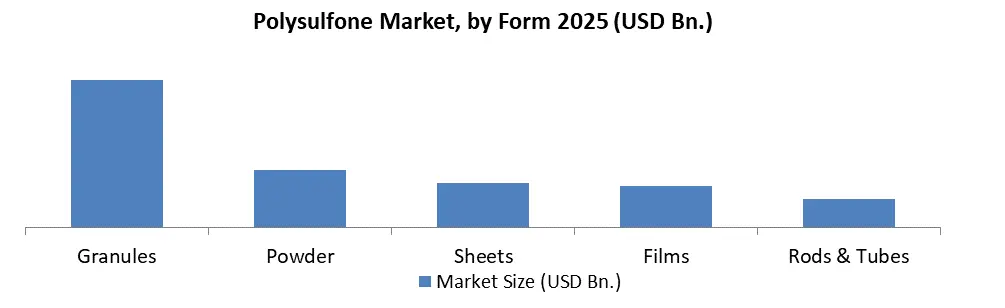
Polysulfone Market by form

Global Polysulfone Market Segment Analysis, By End User

The Polysulfone Market by End User comprises healthcare, automotive, aerospace, electrical & electronics, water & wastewater treatment, industrial manufacturing, and food & beverage industries. Healthcare represents an important end-use sector because PSU and PPSU can withstand demanding sterilization and cleaning conditions. Water & wastewater treatment generates demand for PSU and PES membrane materials used in filtration systems. Automotive, aerospace, and electrical & electronics applications require polysulfone for selected components where heat resistance and dimensional stability are important. Industrial manufacturing and food & beverage applications use polysulfone in processing, filtration, and equipment components requiring durable polymer performance.

Global Polysulfone Market Segment Analysis, By Processing Method:

The Polysulfone Market by Processing Method includes injection molding, extrusion, blow molding, compression molding, and thermoforming. Injection molding is used for precise and complex components in medical, electrical, and industrial applications. Extrusion is important for producing continuous forms such as films, sheets, rods, and tubes with consistent dimensions. Blow molding and compression molding serve more specialized component designs where controlled forming is required. Thermoforming is mainly associated with shaping polysulfone sheets into application-specific geometries. Processing method selection depends on material grade, product design, production requirements, and the dimensional characteristics of the finished component.

Global Polysulfone Market Regional Analysis:

North America is the leading global Polysulfone Market, supported by strong healthcare, pharmaceutical, water treatment, aerospace, and advanced manufacturing industries. The United States accounts for a major share of regional demand, particularly for medical devices, filtration membranes, laboratory equipment, and specialty engineering components. Established polymer processing capabilities and high demand for sterilizable, chemically resistant materials support the use of PSU, PES, and PPSU across specialized applications.

Asia Pacific represents a major regional market for polysulfone, supported by its large manufacturing base, growing healthcare infrastructure, electronics production, automotive manufacturing, and water-treatment requirements. China, Japan, South Korea, and India are important markets for engineering plastics and membrane technologies. Increasing industrialization and local production capabilities continue to support demand for polysulfone materials.

Europe maintains strong demand for polysulfone across healthcare, pharmaceutical manufacturing, automotive, water treatment, and industrial applications. Germany, France, Italy, and the United Kingdom are important markets for high-performance thermoplastics. Medical-grade PSU and PPSU are used in applications requiring repeated sterilization, dimensional stability, and chemical resistance. Environmental requirements also support the adoption of advanced filtration technologies.

South America has a developing Polysulfone Market, with demand linked to water treatment, healthcare, food processing, and industrial manufacturing. Brazil is an important market due to its industrial base and healthcare infrastructure. PSU and PES membranes are used in selected filtration and water-purification applications, while pharmaceutical and medical applications provide additional demand.

Middle East & Africa represents an emerging market for polysulfone, supported mainly by desalination, water treatment, healthcare, and industrial projects. Water scarcity across several Middle Eastern countries is increasing the need for advanced membrane technologies. Healthcare development and industrial investments are also supporting the use of medical-grade and high-performance polysulfone materials.

Global Polysulfone Market Competitive Landscape

The Polysulfone Market competitive landscape consists of established specialty polymer manufacturers and companies supplying PSU, PES, PPSU, and related high-performance materials for filtration, healthcare, electronics, automotive, and industrial applications. Key participants compete through material performance, product consistency, application-specific grades, processing technologies, and technical support rather than through volume alone. Companies are also focusing on developing specialized materials for medical devices, membrane filtration, and high-temperature engineering applications. Product development is increasingly centered on improved chemical resistance, sterilization performance, dimensional stability, and membrane efficiency. The competitive environment is also influenced by manufacturing capacity, regional supply networks, and the ability to meet application-specific quality and regulatory requirements.

Global Polysulfone Market Recent Development:

Month / 2026 Company Recent Development
January 2026 Syensqo Syensqo introduced Eviva PSU machinable stock shapes through its collaboration with Genesis Medical Plastics. The range includes PSU rods and custom plates that can be machined into medical components, helping manufacturers move from material selection and prototyping to component development more efficiently.
February 2026 Moyuum Moyuum introduced baby bottles made with Durade PPSU ECHO, a certified circular PPSU material supplied by Syensqo. The launch represents a practical application of circular-content PPSU in reusable consumer products, particularly where durability and repeated cleaning are important.
March 2026 BASF BASF added six Ultrason P PPSU grades for food-contact applications affected by changing European bisphenol requirements. The grades are intended to give manufacturers an alternative material option for products previously made with PESU, PSU, or PEI without requiring major changes to established injection-molding processes.
April 2026 CPC Biotech / Dover CPC Biotech introduced the AseptiQuik G PPSU HT Series for biopharmaceutical processing. The PPSU connectors are designed for applications involving higher temperatures and chemical exposure and can be sterilized using gamma irradiation or autoclave processes.
May 2026 Pentair X-Flow Pentair X-Flow announced a move toward PES-based tubular membranes as an alternative to its existing PVDF membrane solutions. The development focuses on providing PFAS-free filtration options while maintaining dimensions compatible with existing tubular membrane installations.
June 2026 Evonik Evonik opened an anion-exchange membrane application technology center in Shanghai to support membrane testing and development under practical operating conditions. The facility is intended to work with customers and accelerate the development of membrane solutions for hydrogen production and water electrolysis.

Polysulfone Market Scope: Inquire before buying

Polysulfone Market
Report Coverage Details
Base Year: 2025 Forecast Period: 2026-2034
Historical Data: 2020 to 2025 Market Size in 2025: 2.84 USD Billion
Forecast Period 2026-2034 CAGR: 6.81% Market Size in 2034: 5.14 USD Billion
Segments Covered: by Type Polysulfone (PSU)
Polyethersulfone (PES)
Polyphenylsulfone (PPSU)
by Application Membranes (Water Treatment, Dialysis)
Automotive Components
Electrical & Electronics Components
Medical Devices
Aerospace Components
Consumer Goods
Industrial Equipment
By Form Granules
Powder
Sheets
Films
Rods & Tubes
by End User Healthcare
Automotive
Aerospace
Electrical & Electronics
Water & Wastewater Treatment
Industrial Manufacturing
Food & Beverage
By Processing Method Injection Molding
Extrusion
Blow Molding
Compression Molding
Thermoforming

Polysulfone Market, by Region

• North America (United States, Canada and Mexico)
• Europe (UK, France, Germany, Italy, Spain, Sweden, Austria and Rest of Europe)
• Asia Pacific (China, South Korea, Japan, India, Australia, Indonesia, Malaysia, Vietnam, Taiwan, Bangladesh, Pakistan and Rest of APAC)
• Middle East and Africa (South Africa, GCC, Egypt, Nigeria and Rest of ME&A)
• South America (Brazil, Argentina Rest of South America)

Global Polysulfone Market Key Players

1. Syensqo SA
2. BASF SE
3. Sumitomo Chemical Co., Ltd.
4. SABIC
5. Mitsubishi Chemical Group Corporation
6. Ensinger GmbH
7. Toray Industries, Inc.
8. Arkema S.A.
9. Evonik Industries AG
10. Celanese Corporation
11. Victrex plc
12. Kingfa Science & Technology Co., Ltd.
13. Guangdong Youju Advanced New Materials Co., Ltd.
14. Shenzhen Wote Advanced Materials Co., Ltd.
15. Shandong Haoran Special Plastic Co., Ltd.
16. Changchun Jida Special Engineering Plastic Research Co., Ltd.
17. Fuhai (Dongying) Advanced Materials Technology Co., Ltd.
18. Shanxi Huda Special Plastics New Material Technology Co., Ltd.
19. Xiamen Keyuan Plastic Co., Ltd.
20. Zhejiang NHU Co., Ltd.
21. Wanhua Chemical Group Co., Ltd.
22. Jiangmen Youju New Materials Co., Ltd.
23. Sino Polymer Co., Ltd.
24. Yanjian Technology Co., Ltd.
25. Anhui Monapoli Technology Co., Ltd.
26. DIC Corporation
27. Daicel Corporation
28. Kuraray Co., Ltd.
29. Mitsui Chemicals, Inc.
30. Avient Corporation
31. RTP Company
32. Mitsubishi Chemical Advanced Materials
33. Westlake Plastics Company
34. Polymer Industries
35. Centroplast Engineering Plastics GmbH
36. GEHR GmbH
37. LATI Industria Termoplastici S.p.A.
38. Lehmann&Voss&Co.
39. Foster Corporation
40. Americhem Engineered Compounds
41. Ovation Polymers Inc.
42. Emco Industrial Plastics LLC
43. Trident Plastics Inc.
44. Performance Plastics Ltd.
45. Polyplastics Co., Ltd.
46. Dongyue Group
47. China Lumena New Materials Corp.
48. 3M Company
49. Daikin Industries, Ltd.
50. DSM Engineering Materials

Frequently Asked Questions:

1. What is polysulfone used for?
Polysulfone is used in membranes, medical devices, automotive parts, electronics, and industrial components.

2. What are the main types of polysulfone?
The main types are PSU, PES, and PPSU.

3. Which application dominates the market?
Membrane filtration is a major application of polysulfone.

4. Which region leads the polysulfone market?
North America is a major regional market for polysulfone.

5. What drives the polysulfone market?
Demand for heat-resistant, chemical-resistant, and durable engineering plastics drives market growth.

Table of Contents

1. Polysulfone Market Introduction 1.1. Study Assumption and Market Definition 1.2. Scope of the Study 1.3. Executive Summary 2. Global Polysulfone Market: Competitive Landscape 2.1. MMR Competition Matrix 2.2. Competitive Landscape 2.3. Key Players Benchmarking 2.3.1. Company Name 2.3.2. Business Segment 2.3.3. End-user Segment 2.3.4. Revenue (2025) 2.3.5. Company Locations 2.4. Leading Polysulfone Market Companies, by market capitalization 2.5. Market Structure 2.5.1. Market Leaders 2.5.2. Market Followers 2.5.3. Emerging Players 2.6. Mergers and Acquisitions Details 3. Polysulfone Market: Dynamics 3.1. Polysulfone Market Trends by Region 3.1.1. North America Polysulfone Market Trends 3.1.2. Europe Polysulfone Market Trends 3.1.3. Asia Pacific Polysulfone Market Trends 3.1.4. Middle East and Africa Polysulfone Market Trends 3.1.5. South America Polysulfone Market Trends 3.2. Polysulfone Market Dynamics by Region 3.2.1. North America 3.2.1.1. North America Polysulfone Market Drivers 3.2.1.2. North America Polysulfone Market Restraints 3.2.1.3. North America Polysulfone Market Opportunities 3.2.1.4. North America Polysulfone Market Challenges 3.2.2. Europe 3.2.2.1. Europe Polysulfone Market Drivers 3.2.2.2. Europe Polysulfone Market Restraints 3.2.2.3. Europe Polysulfone Market Opportunities 3.2.2.4. Europe Polysulfone Market Challenges 3.2.3. Asia Pacific 3.2.3.1. Asia Pacific Polysulfone Market Drivers 3.2.3.2. Asia Pacific Polysulfone Market Restraints 3.2.3.3. Asia Pacific Polysulfone Market Opportunities 3.2.3.4. Asia Pacific Polysulfone Market Challenges 3.2.4. Middle East and Africa 3.2.4.1. Middle East and Africa Polysulfone Market Drivers 3.2.4.2. Middle East and Africa Polysulfone Market Restraints 3.2.4.3. Middle East and Africa Polysulfone Market Opportunities 3.2.4.4. Middle East and Africa Polysulfone Market Challenges 3.2.5. South America 3.2.5.1. South America Polysulfone Market Drivers 3.2.5.2. South America Polysulfone Market Restraints 3.2.5.3. South America Polysulfone Market Opportunities 3.2.5.4. South America Polysulfone Market Challenges 3.3. PORTER's Five Forces Analysis 3.4. PESTLE Analysis 3.5. Technology Roadmap 3.6. Regulatory Landscape by Region 3.6.1. North America 3.6.2. Europe 3.6.3. Asia Pacific 3.6.4. Middle East and Africa 3.6.5. South America 3.7. Key Opinion Leader Analysis For Polysulfone Industry 3.8. Analysis of Government Schemes and Initiatives For Polysulfone Industry 3.9. Polysulfone Market Trade Analysis 3.10. The Global Pandemic Impact on Polysulfone Market 4. Polysulfone Market: Global Market Size and Forecast by Segmentation (in USD Billion) 2025-2034 4.1. Polysulfone Market Size and Forecast, by Type (2025-2034) 4.1.1. Polysulfone (PSU) 4.1.2. Polyethersulfone (PES) 4.1.3. Polyphenylsulfone (PPSU) 4.2. Polysulfone Market Size and Forecast, by Application (2025-2034) 4.2.1. Membranes (Water Treatment, Dialysis) 4.2.2. Automotive Components 4.2.3. Electrical & Electronics Components 4.2.4. Medical Devices 4.2.5. Aerospace Components 4.2.6. Consumer Goods 4.2.7. Industrial Equipment 4.3. Polysulfone Market Size and Forecast, by Form (2025-2034) 4.3.1. Granules 4.3.2. Powder 4.3.3. Sheets 4.3.4. Films 4.3.5. Rods & Tubes 4.4. Polysulfone Market Size and Forecast, by End-User (2025-2034) 4.4.1. Healthcare 4.4.2. Automotive 4.4.3. Aerospace 4.4.4. Electrical & Electronics 4.4.5. Water & Wastewater Treatment 4.4.6. Industrial Manufacturing 4.4.7. Food & Beverage 4.5. Polysulfone Market Size and Forecast, by Processing Method (2025-2034) 4.5.1. Injection Molding 4.5.2. Extrusion 4.5.3. Blow Molding 4.5.4. Compression Molding 4.5.5. Thermoforming 4.6. Polysulfone Market Size and Forecast, by Region (2025-2034) 4.6.1. North America 4.6.2. Europe 4.6.3. Asia Pacific 4.6.4. Middle East and Africa 4.6.5. South America 5. North America Polysulfone Market Size and Forecast by Segmentation (in USD Billion) 2025-2034 5.1. North America Polysulfone Market Size and Forecast, by Type (2025-2034) 5.1.1. Polysulfone (PSU) 5.1.2. Polyethersulfone (PES) 5.1.3. Polyphenylsulfone (PPSU) 5.2. North America Polysulfone Market Size and Forecast, by Application (2025-2034) 5.2.1. Membranes (Water Treatment, Dialysis) 5.2.2. Automotive Components 5.2.3. Electrical & Electronics Components 5.2.4. Medical Devices 5.2.5. Aerospace Components 5.2.6. Consumer Goods 5.2.7. Industrial Equipment 5.3. North America Polysulfone Market Size and Forecast, by Form (2025-2034) 5.3.1. Granules 5.3.2. Powder 5.3.3. Sheets 5.3.4. Films 5.3.5. Rods & Tubes 5.4. North America Polysulfone Market Size and Forecast, by End-User (2025-2034) 5.4.1. Healthcare 5.4.2. Automotive 5.4.3. Aerospace 5.4.4. Electrical & Electronics 5.4.5. Water & Wastewater Treatment 5.4.6. Industrial Manufacturing 5.4.7. Food & Beverage 5.5. North America Polysulfone Market Size and Forecast, by Processing Method (2025-2034) 5.5.1. Injection Molding 5.5.2. Extrusion 5.5.3. Blow Molding 5.5.4. Compression Molding 5.5.5. Thermoforming 5.6. North America Polysulfone Market Size and Forecast, by Country (2025-2034) 5.6.1. United States 5.6.1.1. United States Polysulfone Market Size and Forecast, by Type (2025-2034) 5.6.1.1.1. Polysulfone (PSU) 5.6.1.1.2. Polyethersulfone (PES) 5.6.1.1.3. Polyphenylsulfone (PPSU) 5.6.1.2. United States Polysulfone Market Size and Forecast, by Application (2025-2034) 5.6.1.2.1. Membranes (Water Treatment, Dialysis) 5.6.1.2.2. Automotive Components 5.6.1.2.3. Electrical & Electronics Components 5.6.1.2.4. Medical Devices 5.6.1.2.5. Aerospace Components 5.6.1.2.6. Consumer Goods 5.6.1.2.7. Industrial Equipment 5.6.1.3. United States Polysulfone Market Size and Forecast, by Form (2025-2034) 5.6.1.3.1. Granules 5.6.1.3.2. Powder 5.6.1.3.3. Sheets 5.6.1.3.4. Films 5.6.1.3.5. Rods & Tubes 5.6.1.4. United States Polysulfone Market Size and Forecast, by End-User (2025-2034) 5.6.1.4.1. Healthcare 5.6.1.4.2. Automotive 5.6.1.4.3. Aerospace 5.6.1.4.4. Electrical & Electronics 5.6.1.4.5. Water & Wastewater Treatment 5.6.1.4.6. Industrial Manufacturing 5.6.1.4.7. Food & Beverage 5.6.1.5. United States Polysulfone Market Size and Forecast, by Processing Method (2025-2034) 5.6.1.5.1. Injection Molding 5.6.1.5.2. Extrusion 5.6.1.5.3. Blow Molding 5.6.1.5.4. Compression Molding 5.6.1.5.5. Thermoforming 5.6.2. Canada 5.6.2.1. Canada Polysulfone Market Size and Forecast, by Type (2025-2034) 5.6.2.1.1. Polysulfone (PSU) 5.6.2.1.2. Polyethersulfone (PES) 5.6.2.1.3. Polyphenylsulfone (PPSU) 5.6.2.2. Canada Polysulfone Market Size and Forecast, by Application (2025-2034) 5.6.2.2.1. Membranes (Water Treatment, Dialysis) 5.6.2.2.2. Automotive Components 5.6.2.2.3. Electrical & Electronics Components 5.6.2.2.4. Medical Devices 5.6.2.2.5. Aerospace Components 5.6.2.2.6. Consumer Goods 5.6.2.2.7. Industrial Equipment 5.6.2.3. Canada Polysulfone Market Size and Forecast, by Form (2025-2034) 5.6.2.3.1. Granules 5.6.2.3.2. Powder 5.6.2.3.3. Sheets 5.6.2.3.4. Films 5.6.2.3.5. Rods & Tubes 5.6.2.4. Canada Polysulfone Market Size and Forecast, by End-User (2025-2034) 5.6.2.4.1. Healthcare 5.6.2.4.2. Automotive 5.6.2.4.3. Aerospace 5.6.2.4.4. Electrical & Electronics 5.6.2.4.5. Water & Wastewater Treatment 5.6.2.4.6. Industrial Manufacturing 5.6.2.4.7. Food & Beverage 5.6.2.5. Canada Polysulfone Market Size and Forecast, by Processing Method (2025-2034) 5.6.2.5.1. Injection Molding 5.6.2.5.2. Extrusion 5.6.2.5.3. Blow Molding 5.6.2.5.4. Compression Molding 5.6.2.5.5. Thermoforming 5.6.3. Mexico 5.6.3.1. Mexico Polysulfone Market Size and Forecast, by Type (2025-2034) 5.6.3.1.1. Polysulfone (PSU) 5.6.3.1.2. Polyethersulfone (PES) 5.6.3.1.3. Polyphenylsulfone (PPSU) 5.6.3.2. Mexico Polysulfone Market Size and Forecast, by Application (2025-2034) 5.6.3.2.1. Membranes (Water Treatment, Dialysis) 5.6.3.2.2. Automotive Components 5.6.3.2.3. Electrical & Electronics Components 5.6.3.2.4. Medical Devices 5.6.3.2.5. Aerospace Components 5.6.3.2.6. Consumer Goods 5.6.3.2.7. Industrial Equipment 5.6.3.3. Mexico Polysulfone Market Size and Forecast, by Form (2025-2034) 5.6.3.3.1. Granules 5.6.3.3.2. Powder 5.6.3.3.3. Sheets 5.6.3.3.4. Films 5.6.3.3.5. Rods & Tubes 5.6.3.4. Mexico Polysulfone Market Size and Forecast, by End-User (2025-2034) 5.6.3.4.1. Healthcare 5.6.3.4.2. Automotive 5.6.3.4.3. Aerospace 5.6.3.4.4. Electrical & Electronics 5.6.3.4.5. Water & Wastewater Treatment 5.6.3.4.6. Industrial Manufacturing 5.6.3.4.7. Food & Beverage 5.6.3.5. Mexico Polysulfone Market Size and Forecast, by Processing Method (2025-2034) 5.6.3.5.1. Injection Molding 5.6.3.5.2. Extrusion 5.6.3.5.3. Blow Molding 5.6.3.5.4. Compression Molding 5.6.3.5.5. Thermoforming 6. Europe Polysulfone Market Size and Forecast by Segmentation (in USD Billion) 2025-2034 6.1. Europe Polysulfone Market Size and Forecast, by Type (2025-2034) 6.2. Europe Polysulfone Market Size and Forecast, by Application (2025-2034) 6.3. Europe Polysulfone Market Size and Forecast, by Form (2025-2034) 6.4. Europe Polysulfone Market Size and Forecast, by End-User (2025-2034) 6.5. Europe Polysulfone Market Size and Forecast, by Processing Method (2025-2034) 6.6. Europe Polysulfone Market Size and Forecast, by Country (2025-2034) 6.6.1. United Kingdom 6.6.1.1. United Kingdom Polysulfone Market Size and Forecast, by Type (2025-2034) 6.6.1.2. United Kingdom Polysulfone Market Size and Forecast, by Application (2025-2034) 6.6.1.3. United Kingdom Polysulfone Market Size and Forecast, by Form (2025-2034) 6.6.1.4. United Kingdom Polysulfone Market Size and Forecast, by End-User (2025-2034) 6.6.1.5. United Kingdom Polysulfone Market Size and Forecast, by Processing Method (2025-2034) 6.6.2. France 6.6.2.1. France Polysulfone Market Size and Forecast, by Type (2025-2034) 6.6.2.2. France Polysulfone Market Size and Forecast, by Application (2025-2034) 6.6.2.3. France Polysulfone Market Size and Forecast, by Form (2025-2034) 6.6.2.4. France Polysulfone Market Size and Forecast, by End-User (2025-2034) 6.6.2.5. France Polysulfone Market Size and Forecast, by Processing Method (2025-2034) 6.6.3. Germany 6.6.3.1. Germany Polysulfone Market Size and Forecast, by Type (2025-2034) 6.6.3.2. Germany Polysulfone Market Size and Forecast, by Application (2025-2034) 6.6.3.3. Germany Polysulfone Market Size and Forecast, by Form (2025-2034) 6.6.3.4. Germany Polysulfone Market Size and Forecast, by End-User (2025-2034) 6.6.3.5. Germany Polysulfone Market Size and Forecast, by Processing Method (2025-2034) 6.6.4. Italy 6.6.4.1. Italy Polysulfone Market Size and Forecast, by Type (2025-2034) 6.6.4.2. Italy Polysulfone Market Size and Forecast, by Application (2025-2034) 6.6.4.3. Italy Polysulfone Market Size and Forecast, by Form (2025-2034) 6.6.4.4. Italy Polysulfone Market Size and Forecast, by End-User (2025-2034) 6.6.4.5. Italy Polysulfone Market Size and Forecast, by Processing Method (2025-2034) 6.6.5. Spain 6.6.5.1. Spain Polysulfone Market Size and Forecast, by Type (2025-2034) 6.6.5.2. Spain Polysulfone Market Size and Forecast, by Application (2025-2034) 6.6.5.3. Spain Polysulfone Market Size and Forecast, by Form (2025-2034) 6.6.5.4. Spain Polysulfone Market Size and Forecast, by End-User (2025-2034) 6.6.5.5. Spain Polysulfone Market Size and Forecast, by Processing Method (2025-2034) 6.6.6. Sweden 6.6.6.1. Sweden Polysulfone Market Size and Forecast, by Type (2025-2034) 6.6.6.2. Sweden Polysulfone Market Size and Forecast, by Application (2025-2034) 6.6.6.3. Sweden Polysulfone Market Size and Forecast, by Form (2025-2034) 6.6.6.4. Sweden Polysulfone Market Size and Forecast, by End-User (2025-2034) 6.6.6.5. Sweden Polysulfone Market Size and Forecast, by Processing Method (2025-2034) 6.6.7. Austria 6.6.7.1. Austria Polysulfone Market Size and Forecast, by Type (2025-2034) 6.6.7.2. Austria Polysulfone Market Size and Forecast, by Application (2025-2034) 6.6.7.3. Austria Polysulfone Market Size and Forecast, by Form (2025-2034) 6.6.7.4. Austria Polysulfone Market Size and Forecast, by End-User (2025-2034) 6.6.7.5. Austria Polysulfone Market Size and Forecast, by Processing Method (2025-2034) 6.6.8. Rest of Europe 6.6.8.1. Rest of Europe Polysulfone Market Size and Forecast, by Type (2025-2034) 6.6.8.2. Rest of Europe Polysulfone Market Size and Forecast, by Application (2025-2034) 6.6.8.3. Rest of Europe Polysulfone Market Size and Forecast, by Form (2025-2034) 6.6.8.4. Rest of Europe Polysulfone Market Size and Forecast, by End-User (2025-2034) 6.6.8.5. Rest of Europe Polysulfone Market Size and Forecast, by Processing Method (2025-2034) 7. Asia Pacific Polysulfone Market Size and Forecast by Segmentation (in USD Billion) 2025-2034 7.1. Asia Pacific Polysulfone Market Size and Forecast, by Type (2025-2034) 7.2. Asia Pacific Polysulfone Market Size and Forecast, by Application (2025-2034) 7.3. Asia Pacific Polysulfone Market Size and Forecast, by Form (2025-2034) 7.4. Asia Pacific Polysulfone Market Size and Forecast, by End-User (2025-2034) 7.5. Asia Pacific Polysulfone Market Size and Forecast, by Processing Method (2025-2034) 7.6. Asia Pacific Polysulfone Market Size and Forecast, by Country (2025-2034) 7.6.1. China 7.6.1.1. China Polysulfone Market Size and Forecast, by Type (2025-2034) 7.6.1.2. China Polysulfone Market Size and Forecast, by Application (2025-2034) 7.6.1.3. China Polysulfone Market Size and Forecast, by Form (2025-2034) 7.6.1.4. China Polysulfone Market Size and Forecast, by End-User (2025-2034) 7.6.1.5. China Polysulfone Market Size and Forecast, by Processing Method (2025-2034) 7.6.2. S Korea 7.6.2.1. S Korea Polysulfone Market Size and Forecast, by Type (2025-2034) 7.6.2.2. S Korea Polysulfone Market Size and Forecast, by Application (2025-2034) 7.6.2.3. S Korea Polysulfone Market Size and Forecast, by Form (2025-2034) 7.6.2.4. S Korea Polysulfone Market Size and Forecast, by End-User (2025-2034) 7.6.2.5. S Korea Polysulfone Market Size and Forecast, by Processing Method (2025-2034) 7.6.3. Japan 7.6.3.1. Japan Polysulfone Market Size and Forecast, by Type (2025-2034) 7.6.3.2. Japan Polysulfone Market Size and Forecast, by Application (2025-2034) 7.6.3.3. Japan Polysulfone Market Size and Forecast, by Form (2025-2034) 7.6.3.4. Japan Polysulfone Market Size and Forecast, by End-User (2025-2034) 7.6.3.5. Japan Polysulfone Market Size and Forecast, by Processing Method (2025-2034) 7.6.4. India 7.6.4.1. India Polysulfone Market Size and Forecast, by Type (2025-2034) 7.6.4.2. India Polysulfone Market Size and Forecast, by Application (2025-2034) 7.6.4.3. India Polysulfone Market Size and Forecast, by Form (2025-2034) 7.6.4.4. India Polysulfone Market Size and Forecast, by End-User (2025-2034) 7.6.4.5. India Polysulfone Market Size and Forecast, by Processing Method (2025-2034) 7.6.5. Australia 7.6.5.1. Australia Polysulfone Market Size and Forecast, by Type (2025-2034) 7.6.5.2. Australia Polysulfone Market Size and Forecast, by Application (2025-2034) 7.6.5.3. Australia Polysulfone Market Size and Forecast, by Form (2025-2034) 7.6.5.4. Australia Polysulfone Market Size and Forecast, by End-User (2025-2034) 7.6.5.5. Australia Polysulfone Market Size and Forecast, by Processing Method (2025-2034) 7.6.6. Indonesia 7.6.6.1. Indonesia Polysulfone Market Size and Forecast, by Type (2025-2034) 7.6.6.2. Indonesia Polysulfone Market Size and Forecast, by Application (2025-2034) 7.6.6.3. Indonesia Polysulfone Market Size and Forecast, by Form (2025-2034) 7.6.6.4. Indonesia Polysulfone Market Size and Forecast, by End-User (2025-2034) 7.6.6.5. Indonesia Polysulfone Market Size and Forecast, by Processing Method (2025-2034) 7.6.7. Malaysia 7.6.7.1. Malaysia Polysulfone Market Size and Forecast, by Type (2025-2034) 7.6.7.2. Malaysia Polysulfone Market Size and Forecast, by Application (2025-2034) 7.6.7.3. Malaysia Polysulfone Market Size and Forecast, by Form (2025-2034) 7.6.7.4. Malaysia Polysulfone Market Size and Forecast, by End-User (2025-2034) 7.6.7.5. Malaysia Polysulfone Market Size and Forecast, by Processing Method (2025-2034) 7.6.8. Vietnam 7.6.8.1. Vietnam Polysulfone Market Size and Forecast, by Type (2025-2034) 7.6.8.2. Vietnam Polysulfone Market Size and Forecast, by Application (2025-2034) 7.6.8.3. Vietnam Polysulfone Market Size and Forecast, by Form (2025-2034) 7.6.8.4. Vietnam Polysulfone Market Size and Forecast, by End-User (2025-2034) 7.6.8.5. Vietnam Polysulfone Market Size and Forecast, by Processing Method (2025-2034) 7.6.9. Taiwan 7.6.9.1. Taiwan Polysulfone Market Size and Forecast, by Type (2025-2034) 7.6.9.2. Taiwan Polysulfone Market Size and Forecast, by Application (2025-2034) 7.6.9.3. Taiwan Polysulfone Market Size and Forecast, by Form (2025-2034) 7.6.9.4. Taiwan Polysulfone Market Size and Forecast, by End-User (2025-2034) 7.6.9.5. Taiwan Polysulfone Market Size and Forecast, by Processing Method (2025-2034) 7.6.10. Rest of Asia Pacific 7.6.10.1. Rest of Asia Pacific Polysulfone Market Size and Forecast, by Type (2025-2034) 7.6.10.2. Rest of Asia Pacific Polysulfone Market Size and Forecast, by Application (2025-2034) 7.6.10.3. Rest of Asia Pacific Polysulfone Market Size and Forecast, by Form (2025-2034) 7.6.10.4. Rest of Asia Pacific Polysulfone Market Size and Forecast, by End-User (2025-2034) 7.6.10.5. Rest of Asia Pacific Polysulfone Market Size and Forecast, by Processing Method (2025-2034) 8. Middle East and Africa Polysulfone Market Size and Forecast by Segmentation (in USD Billion) 2025-2034 8.1. Middle East and Africa Polysulfone Market Size and Forecast, by Type (2025-2034) 8.2. Middle East and Africa Polysulfone Market Size and Forecast, by Application (2025-2034) 8.3. Middle East and Africa Polysulfone Market Size and Forecast, by Form (2025-2034) 8.4. Middle East and Africa Polysulfone Market Size and Forecast, by End-User (2025-2034) 8.5. Middle East and Africa Polysulfone Market Size and Forecast, by Processing Method (2025-2034) 8.6. Middle East and Africa Polysulfone Market Size and Forecast, by Country (2025-2034) 8.6.1. South Africa 8.6.1.1. South Africa Polysulfone Market Size and Forecast, by Type (2025-2034) 8.6.1.2. South Africa Polysulfone Market Size and Forecast, by Application (2025-2034) 8.6.1.3. South Africa Polysulfone Market Size and Forecast, by Form (2025-2034) 8.6.1.4. South Africa Polysulfone Market Size and Forecast, by End-User (2025-2034) 8.6.1.5. South Africa Polysulfone Market Size and Forecast, by Processing Method (2025-2034) 8.6.2. GCC 8.6.2.1. GCC Polysulfone Market Size and Forecast, by Type (2025-2034) 8.6.2.2. GCC Polysulfone Market Size and Forecast, by Application (2025-2034) 8.6.2.3. GCC Polysulfone Market Size and Forecast, by Form (2025-2034) 8.6.2.4. GCC Polysulfone Market Size and Forecast, by End-User (2025-2034) 8.6.2.5. GCC Polysulfone Market Size and Forecast, by Processing Method (2025-2034) 8.6.3. Nigeria 8.6.3.1. Nigeria Polysulfone Market Size and Forecast, by Type (2025-2034) 8.6.3.2. Nigeria Polysulfone Market Size and Forecast, by Application (2025-2034) 8.6.3.3. Nigeria Polysulfone Market Size and Forecast, by Form (2025-2034) 8.6.3.4. Nigeria Polysulfone Market Size and Forecast, by End-User (2025-2034) 8.6.3.5. Nigeria Polysulfone Market Size and Forecast, by Processing Method (2025-2034) 8.6.4. Rest of ME&A 8.6.4.1. Rest of ME&A Polysulfone Market Size and Forecast, by Type (2025-2034) 8.6.4.2. Rest of ME&A Polysulfone Market Size and Forecast, by Application (2025-2034) 8.6.4.3. Rest of ME&A Polysulfone Market Size and Forecast, by Form (2025-2034) 8.6.4.4. Rest of ME&A Polysulfone Market Size and Forecast, by End-User (2025-2034) 8.6.4.5. Rest of ME&A Polysulfone Market Size and Forecast, by Processing Method (2025-2034) 9. South America Polysulfone Market Size and Forecast by Segmentation (in USD Billion) 2025-2034 9.1. South America Polysulfone Market Size and Forecast, by Type (2025-2034) 9.2. South America Polysulfone Market Size and Forecast, by Application (2025-2034) 9.3. South America Polysulfone Market Size and Forecast, by Form (2025-2034) 9.4. South America Polysulfone Market Size and Forecast, by End-User (2025-2034) 9.5. South America Polysulfone Market Size and Forecast, by Processing Method (2025-2034) 9.6. South America Polysulfone Market Size and Forecast, by Country (2025-2034) 9.6.1. Brazil 9.6.1.1. Brazil Polysulfone Market Size and Forecast, by Type (2025-2034) 9.6.1.2. Brazil Polysulfone Market Size and Forecast, by Application (2025-2034) 9.6.1.3. Brazil Polysulfone Market Size and Forecast, by Form (2025-2034) 9.6.1.4. Brazil Polysulfone Market Size and Forecast, by End-User (2025-2034) 9.6.1.5. Brazil Polysulfone Market Size and Forecast, by Processing Method (2025-2034) 9.6.2. Argentina 9.6.2.1. Argentina Polysulfone Market Size and Forecast, by Type (2025-2034) 9.6.2.2. Argentina Polysulfone Market Size and Forecast, by Application (2025-2034) 9.6.2.3. Argentina Polysulfone Market Size and Forecast, by Form (2025-2034) 9.6.2.4. Argentina Polysulfone Market Size and Forecast, by End-User (2025-2034) 9.6.2.5. Argentina Polysulfone Market Size and Forecast, by Processing Method (2025-2034) 9.6.3. Rest Of South America 9.6.3.1. Rest Of South America Polysulfone Market Size and Forecast, by Type (2025-2034) 9.6.3.2. Rest Of South America Polysulfone Market Size and Forecast, by Application (2025-2034) 9.6.3.3. Rest Of South America Polysulfone Market Size and Forecast, by Form (2025-2034) 9.6.3.4. Rest Of South America Polysulfone Market Size and Forecast, by End-User (2025-2034) 9.6.3.5. Rest Of South America Polysulfone Market Size and Forecast, by Processing Method (2025-2034) 10. Company Profile: Key Players 10.1. Syensqo SA 10.1.1. Company Overview 10.1.2. Business Portfolio 10.1.3. Financial Overview 10.1.4. SWOT Analysis 10.1.5. Strategic Analysis 10.1.6. Scale of Operation (small, medium, and large) 10.1.7. Details on Partnership 10.1.8. Regulatory Accreditations and Certifications Received by Them 10.1.9. Awards Received by the Firm 10.1.10. Recent Developments 10.2. BASF SE 10.3. Sumitomo Chemical Co., Ltd. 10.4. SABIC 10.5. Mitsubishi Chemical Group Corporation 10.6. Ensinger GmbH 10.7. Toray Industries, Inc. 10.8. Arkema S.A. 10.9. Evonik Industries AG 10.10. Celanese Corporation 10.11. Victrex plc 10.12. Kingfa Science & Technology Co., Ltd. 10.13. Guangdong Youju Advanced New Materials Co., Ltd. 10.14. Shenzhen Wote Advanced Materials Co., Ltd. 10.15. Shandong Haoran Special Plastic Co., Ltd. 10.16. Changchun Jida Special Engineering Plastic Research Co., Ltd. 10.17. Fuhai (Dongying) Advanced Materials Technology Co., Ltd. 10.18. Shanxi Huda Special Plastics New Material Technology Co., Ltd. 10.19. Xiamen Keyuan Plastic Co., Ltd. 10.20. Zhejiang NHU Co., Ltd. 10.21. Wanhua Chemical Group Co., Ltd. 10.22. Jiangmen Youju New Materials Co., Ltd. 10.23. Sino Polymer Co., Ltd. 10.24. Yanjian Technology Co., Ltd. 10.25. Anhui Monapoli Technology Co., Ltd. 10.26. DIC Corporation 10.27. Daicel Corporation 10.28. Kuraray Co., Ltd. 10.29. Mitsui Chemicals, Inc. 10.30. Avient Corporation 10.31. RTP Company 10.32. Mitsubishi Chemical Advanced Materials 10.33. Westlake Plastics Company 10.34. Polymer Industries 10.35. Centroplast Engineering Plastics GmbH 10.36. GEHR GmbH 10.37. LATI Industria Termoplastici S.p.A. 10.38. Lehmann&Voss&Co. 10.39. Foster Corporation 10.40. Americhem Engineered Compounds 11. Key Findings 12. Industry Recommendations 13. Polysulfone Market: Research Methodology 14. Terms and Glossary

Custom Market Research Services

We Will Customise The Research For You, In Case The Report Listed Above Does Not Meet With Your Requirements