
Nucleic Acid Labeling Market Size by Product, Labeling Type, Method, Application, End users, Region – Segment-Level Market Assessment, Growth Opportunity Analysis, Competitive Mapping & Forecast to 2034
Overview
Nucleic Acid Labeling Market size was valued at USD 2.59 Bn in 2025 and the total revenue is expected to grow at 8.7% through 2026 to 2034, reaching nearly USD 5.48 Bn.
The global Nucleic Acid Labeling market report is a comprehensive analysis of the industry, market, and key players. The report has covered the market by demand and supply-side by segments. The global Nucleic Acid Labeling report also provides trends by market segments, technology, and investment with a competitive landscape.
Nucleic Acid Labeling Market Growth and Share Analysis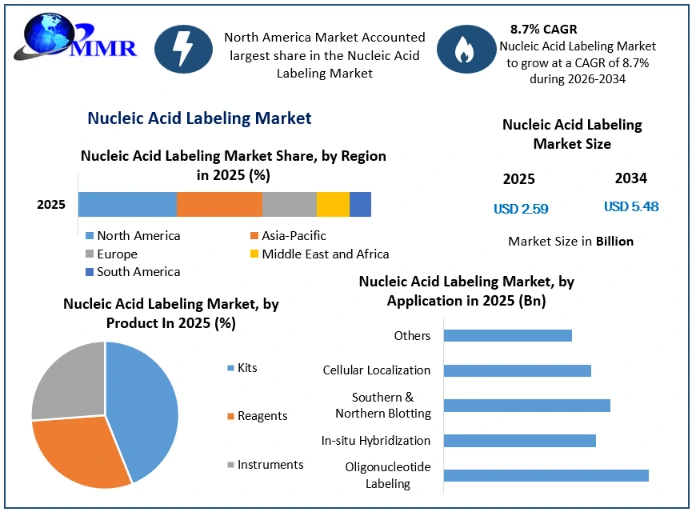
To know about the Research Methodology :- Request Free Sample Report
Nucleic Acid Labeling Market Overview:
Nucleic acids are complex compounds that are used to transmit genetic material, which is used to control all cellular functions. Deoxyribonucleic acid (DNA) and ribonucleic acid (RNA) are two of the most common forms of these molecules (RNA). To make the recognition and purification processes easier, these nucleic acids are usually labeled with tags. The use of radioactive phosphates, fluorescent labels, and biotin modifications are some of the most widely used nucleic acid labeling strategies. Chemical and enzymatic approaches are commonly used in biotechnology and life sciences with a broad range of applications.
From 2026 to 2034, the penetration of nucleic acid labels is expected to increase across DNA microarrays, bolstering demand development. The nucleic acid labeling industry's revenue-generating capability is strengthened by the launch of innovative nucleic acid identification product offerings, as well as the growing pool of commercial manufacturers.
By maintaining short response times, nucleic acid-based diagnostics play a critical role in pregnancy studies, disease risk control, cancer, and infectious disease research. Furthermore, given the increasing prevalence of genetic diseases, healthcare professionals are eager to engage in the advancement of nucleic acid analytics devices.
Nucleic Acid Labeling Market Dynamics:
Drivers:
The growing use of nucleic acid-based diagnostics for cancer risk management, diabetes diagnostics, and prenatal testing in the healthcare field is driving the industry. The rising incidences of genetic diseases around the world have fueled the demand for nucleic acid analytics in the field.
Along with this, there has been a growing trend for customized medications, which provide patients with treatments that are tailored to their specific needs. This has provided several prospects for genomic medicine and innovations, resulting in a promising future for the nucleic acid labeling industry, facilitated by the growing emphasis on patient-centered approaches.
The industry is also fueled by rapid advances in nanotechnology, which have resulted in continuous improvements in nucleic acid identification at the point of treatment (POC). Increased research and development (R&D) activities in the field of genomic research and disease detection, as well as growing healthcare spending around the world, are some of the other factors driving the market growth.
Restraints:
However, the market's development is hampered by a lack of qualified experts and an expensive method.
Nucleic Acid Labeling Market Segment Analysis:
Based on Product, the reagents division had the highest share of 42.77 percent, in 2025. This can be due to its high costs and widespread use of chemical and enzymatic labeling protocols. The superiority of reagents can be due to their frequent use in labeling protocols, as well as ongoing research and development in this field to improve the performance of these protocols. Although chemical methods are useful for large-scale nucleic acid labeling, enzymatic methods have proved to be a more cost-effective option for small-scale probe generation; both methods use both traditional and novel enzymes.
Based on Labeling Type, the radioactive labels segment accounted for the highest market share of 65.97 percent, in 2025. Radiolabeled nucleotides are the most common option for detecting nucleic acid sequences in a variety of applications. For analytical purposes, these labeled nucleic acid sequences are mainly integrated into RNA and DNA using enzyme-based approaches. Apart from the methods mentioned above, there are several other ways to insert the labeled nucleic acid sequences, including in vitro transcription using T7 or T3 RNA polymerase, SP6, and nick translation using DNAse 1 and DNA Polymerase 1.
Non-radioactive nucleotide labels are becoming much more common due to their sensitivity, stability, relative speed, and versatility. Moreover, neon stickers are among the most commonly used stickers. These tags are synthesized and then incorporated into oligonucleotides, which are useful in a variety of therapeutic applications.
Based on Method, the enzyme-based process segment, which includes PCR, 5' end labeling, 3' end labeling, and other enzyme-based methods, accounted for the highest share of 57.10 percent of total sales, in 2025. The enzyme-based method's superiority over the chemical-based method can be due to its widespread use and choice for producing small-scale probes. Enzymatic approaches are also a cost-effective option.
Enzymatic and chemical approaches for producing labeled nucleic acid, including radioactive phosphates, fluorophores, enzymes, and digoxygenin/biotin-modified nucleotides, are now widely available. As a result, companies in the nucleic acid marking market are eager to diversify their portfolios to keep up with the escalating business competition.
Based on Application, the in-situ hybridization dominated the market with sales over 30%, in 2025. With the increased usage of ISH techniques in the detection of genetic conditions such as Cri-du-chat syndrome, 22q13 deletion syndrome, Angelman syndrome, chronic myelogenous leukemia, Velocardiofacial syndrome, Prader-Willi syndrome, Down syndrome, and acute lymphoblastic leukemia, ucleic acid marking is expected to gain popularity in ISH applications.
For in-vitro polymerase chain reaction tests, nucleic acids labeled with nucleotide triphosphates (NTPs) or deoxynucleotide triphosphates (dNTPs) are favored (PCR). Furthermore, the creation of probes with end labels has become extremely popular in protein interaction experiments, especially gel-shift assays.
Based on End User, the diagnostics division had the highest market share of 39.79 percent, and this is projected to continue during the forecast period. From 2026 to 2034, the research segment is projected to rise at the fastest pace. This is due to the expansion of nucleic acid labels' implementations to include both purification and visualization, making it easier to diagnose chromosomal aberrations and complex sequences appropriate for in-situ hybridization.
Furthermore, radioisotope marking of nucleic acids has gained interest in cancer screening investigations and clinical trials, as well as a replication of bacteriophage-related research.
Nucleic Acid Labeling Market Regional Insights:
North America dominated the market in 2025, with a 39.47 percent share, and is projected to continue to do so during the predicted period. The presence of existing healthcare infrastructure, favorable reimbursement scenarios, and high accessibility of innovative diagnostic technologies due to the strong presence of key market players in this area are all key factors leading to regional market development.
During the forecast era, the Asia Pacific market is projected to rise at the fastest pace. The rise of local players and the increasing penetration of key players in the Asia Pacific region are credited with this development. Emerging firms are capitalizing on the opportunities in developed countries by offering a diverse range of marking solutions.
The objective of the report is to present a comprehensive analysis of the global Nucleic Acid Labeling market to the stakeholders in the industry. The past and current status of the industry with the forecasted market size and trends are presented in the report with the analysis of complicated data in simple language. The report covers all the aspects of the industry with a dedicated study of key players that include market leaders, followers, and new entrants.
PORTER, SVOR, PESTEL analysis with the potential impact of micro-economic factors of the market have been presented in the report. External as well as internal factors that are supposed to affect the business positively or negatively have been analyzed, which will give a clear futuristic view of the industry to the decision-makers.
The report also helps in understanding the global Nucleic Acid Labeling market dynamics, structure by analyzing the market segments and project the global Nucleic Acid Labeling market size. Clear representation of competitive analysis of key players by product, price, financial position, product portfolio, growth strategies, and regional presence in the global Nucleic Acid Labeling market make the report investor’s guide.
Nucleic Acid Labeling Market Recent Industry Development
| Date | Company | Development | Impact |
|---|---|---|---|
| 15 January 2025 | Thermo Fisher Scientific Inc. | Thermo Fisher launched its next-generation High-Efficiency Enzymatic Labeling Kit designed for advanced fluorescent tag incorporation in single-cell RNA sequencing. | The system improves fluorescent tagging accuracy by 35%, significantly expanding scalable genomics research capabilities across academic and clinical diagnostic sectors. |
| 18 March 2025 | Merck KGaA | Merck KGaA entered into a strategic collaboration with Illumina to co-develop non-radioactive biotinylated and digoxigenin nucleic acid probes for targeted oncology panels. | This partnership enhances diagnostic specificity for rare cancer biomarker discovery while streamlining downstream assay workflows. |
| 10 June 2025 | Agilent Technologies, Inc. | Agilent introduced a chemiluminescent oligonucleotide labeling suite tailored for high-throughput automated hybridization assays. | The platform reduces total reagent processing time by 25%, accelerating therapeutic target validation in biopharmaceutical discovery labs. |
| 22 September 2025 | Promega Corporation | Promega expanded its manufacturing facility in Wisconsin to scale production of custom fluorophore-conjugated dNTPs for molecular diagnostics. | The $50 million expansion boosts commercial supply chain resilience for PCR and FISH reagent developers globally. |
| 12 February 2026 | PerkinElmer Health Sciences | PerkinElmer unveiled an ultra-sensitive radioactive assay alternative kit featuring dual-mode radioactive and dye-based nucleotide labeling chemistry. | The product addresses strict laboratory safety mandates while maintaining attomole-level detection sensitivity in viral pathogen research. |
Nucleic Acid Labeling Market Scope: Inquire before buying
| Lead Acid Battery Market | |||
|---|---|---|---|
| Report Coverage | Details | ||
| Base Year: | 2025 | Forecast Period: | 2026-2034 |
| Historical Data: | 2020 to 2025 | Market Size in 2025: | USD 2.59 Bn. |
| Forecast Period 2026 to 2034 CAGR: | 8.7% | Market Size in 2034: | USD 5.48 Bn. |
| Segments Covered: | by Product | Kits Reagents Instruments |
|
| by Labeling Type | Radioisotope/Radioactive Labels Non-radioactive Labels |
||
| by Method | Enzyme-based PCR 5’ end labeling 3’ end labeling Others Chemical-Based Conjugation Photoreaction |
||
| by Application | Oligonucleotide Labeling In-situ Hybridization Southern & Northern Blotting Cellular Localization Others |
||
| by End users | Diagnostics Research Therapeutics |
||
Nucleic Acid Labeling Market by Region
North America (United States, Canada and Mexico)
Europe (UK, France, Germany, Italy, Spain, Sweden, Austria and Rest of Europe)
Asia Pacific (China, South Korea, Japan, India, Australia, Indonesia, Malaysia, Vietnam, Taiwan, Bangladesh, Pakistan and Rest of APAC)
Middle East and Africa (South Africa, GCC, Egypt, Nigeria and Rest of ME&A)
South America (Brazil, Argentina Rest of South America)
Nucleic Acid Labeling Market Key Players:
1. PerkinElmer, Inc.
2. F. Hoffmann La-Roche AG
3. General Electric Healthcare Life Science
4. Thermo Fisher Scientific, Inc.
5. Promega Corporation
6. New England Corporation
7. Enzo Biochem, Inc.
8. Vector Laboratories, Inc.
9. Merck KGaA
10. Agilent Technologies
Other Key Players
Frequently Asked Questions:
1. Which region has the largest share in Global Nucleic Acid Labeling Market?
Ans: North America region held the highest share in 2025.
2. What is the growth rate of Global Nucleic Acid Labeling Market?
Ans: The Global Nucleic Acid Labeling Market is growing at a CAGR of 8.7% during forecasting period 2026-2034.
3. What is scope of the Global Nucleic Acid Labeling market report?
Ans: Global Nucleic Acid Labeling Market report helps with the PESTEL, PORTER, COVID-19 Impact analysis, Recommendations for Investors & Leaders, and market estimation of the forecast period.
4. Who are the key players in Global Nucleic Acid Labeling market?
Ans: The important key players in the Global Nucleic Acid Labeling Market are – PerkinElmer, Inc., F. Hoffmann La-Roche AG, General Electric Healthcare Life Science, Thermo Fisher Scientific, Inc., Promega Corporation, New England Corporation, Enzo Biochem, Inc.,
5. What is the study period of this market?
Ans: The Global Nucleic Acid Labeling Market is studied from 2025 to 2034.