
Custom Antibody Market Size by Service, Type, Source, Research Area, End-User, Region – Segment-Level Market Assessment, Growth Opportunity Analysis, Competitive Mapping & Forecast to 2034
Overview
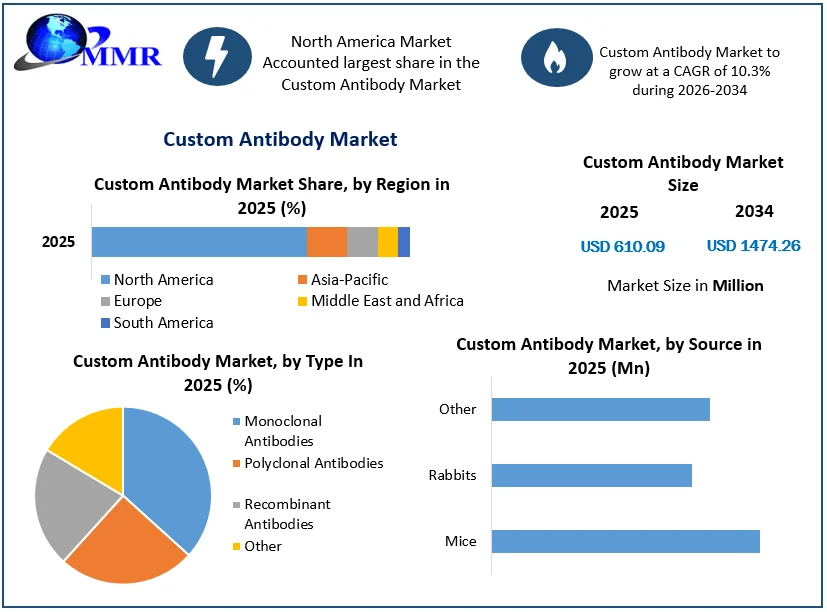
Custom Antibody Market was valued at US$ 610.09 Mn. in 2025. The Global Custom Antibody Market size is estimated to grow at a CAGR of 10.3 % over the forecast period.
Custom Antibody Market Overview:
The report explores the Custom Antibody market's segments (Service, Type, Source, Research Area, and Region). Data has been provided by market participants, and regions (North America, Asia Pacific, Europe, Middle East & Africa, and South America). This market report provides a thorough analysis of the rapid advances that are currently taking place across all industry sectors. Facts and figures, illustrations, and presentations are used to provide key data analysis for the historical period from 2020 to 2025. The report investigates the Custom Antibody market's drivers, limitations, prospects, and barriers. This MMR report includes investor recommendations based on a thorough examination of the Custom Antibody market's contemporary competitive scenario.
Custom Antibody Market Size, Growth and Share Analysis
To know about the Research Methodology:-Request Free Sample Report
Custom Antibody Market Dynamics:
The R&D sector has traditionally been capital-intensive due to long development periods and approval cycles. R&D investments account for a significant share of global expenditures. Governments recognize R&D as a crucial investment for a nation's progress, international competitiveness, and public benefit. This has led to a steady increase in R&D expenditures and funding over the years. According to the R&D Magazine, USD 2.7 trillion will be invested in R&D industries, government labs, and academic research centers across more than 116 countries in 2021. The sudden outbreak of COVID-19 sparked a drastic change in R&D spending across the globe. The R&D expenditures of various countries declined significantly in 2020, whereas China saw a historic investment of 12.0% of its annual growth.
The top 10 countries' R&D expenditures in 2020 totaled 79.4%, and this figure is expected to remain the same in 2021. Currently, the increasing demand for efficient therapeutic drugs with fewer side effects has led to an increased focus on the R&D of biopharmaceuticals. Approximately 80% of the total R&D expenditures in the life sciences industry are devoted to pharmaceutical research and development. Large pharmaceutical companies, such as F. Hoffmann-La Roche Ltd. (Switzerland), Merck KGaA (Germany), and Pfizer (US). Investing nearly USD 50 billion in R&D annually, the biopharmaceutical sector accounts for a significant portion of the sector's R&D spending. Similarly, the availability of funds from organizations for various genomic projects is boosting research in this field. An increase in research activity and the availability of funding are expected to drive the overall purchase and consumption of antibodies. This will boost the growth of the custom antibody market.
In the healthcare industry, personalized medicine has become a core area of research and has entered mainstream clinical practice, changing the way many diseases are diagnosed, classified, and treated. These advancements are especially evident in the field of oncology. The Personalized Medicine Coalition report states that the number of personalized medicine drugs, treatments, and diagnostics has increased and this trend is expected to continue. Further, biopharmaceutical companies have nearly doubled their R&D investments in personalized medicine over the last five years; this is further expected to increase by 35% during the next seven years.
Over the last few years, protein therapeutics, such as hormones, vaccines, monoclonal antibodies, blood factors, and therapeutic enzymes, have become more popular. In addition, newly engineered protein therapeutics, such as bispecific mAbs and mAbs conjugated with small-molecule drugs, are in development. Protein therapeutics are recognized for their potential use in treating various types of diseases. Their demand has increased in recent years due to the increasing prevalence of chronic diseases. The growing demand for protein therapeutics and personalized medicine, coupled with the development of newly engineered proteins, is expected to open up growth opportunities for research markets in terms of the uptake of highly specific custom-made antibodies.
Over the past decade, the life science industry has witnessed an increase in reproducibility problems for various published papers, which has multiplied tenfold. One of the major reasons for this reproducibility crisis is the use of poorly validated antibodies, which cause lot-to-lot variability and non-specific target binding. A growing number of proteins are being detected with protein scaffolds, RNA or DNA aptamers, and protein scaffolds engineered against specific targets and functions, which are consistent batch-to-batch and can be produced at a fraction of the cost of antibodies.
In addition, both affinity reagents are produced entirely in vitro and are not affected by the limitations of antibody production by animal immune systems. Their smaller size allows for better penetration of tissue, allowing access to epitopes within tissue sections for proteins for which antibodies cannot be generated. This also reduces false-negative immunohistochemistry results. These advantages, as well as the fact that they can be used in a wider range of conditions, including intracellular environments that degrade antibody structures, enable applications such as super-resolution microscopy and intracellular live-cell imaging to study the molecular dynamics of diverse cellular processes. Thus, these alternatives to antibodies can be used to resolve the ongoing reproducibility crisis.
Despite their benefits for research, these molecules are not suitable for therapeutic use because of their low molecular weight. The industry has employed various strategies to overcome this, such as adding an antibody domain or an albumin-binding domain to the scaffold or increasing the molecular weight of the protein scaffold. The fusion of an antibody domain with a protein scaffold can also improve therapeutic benefits by engaging the immune system. Therefore, the increase and improvement of antibody alternatives may hinder the growth of the overall antibodies market during the forecast period.
Custom Antibody Market Trends:
The custom antibody market, products, and services have been driven by the demand for high-performance antibody solutions to address various applications. Novel biomarkers are a key trend that is enhancing the product development arena and will continue to do so. As a result of some salient features they display that other types of custom antibodies do not, recombinant antibodies have gained in popularity. This type of custom antibody is gaining popularity in the pharmaceutical sector, driving massive revenues to boost the custom antibody market. These recombinant antibodies are free from batch-to-batch variability. The trend of animal-free production has also gained some traction in recent years.
Custom Antibody Market Segment Analysis:
Based on Services, the Custom Antibody Market is segmented into Antibody Development, Antibody Production & Purification, and Antibody Fragmentation & Labeling. The Antibody Development segment has the highest market share in 2025. Researchers are increasingly focusing on high-quality custom antibodies to achieve reproductively, which can be hindered when using commercial antibodies.
Based on Type, the Custom Antibody Market is segmented into Monoclonal Antibodies, Polyclonal Antibodies, Recombinant Antibodies, and Others. The Monoclonal Antibodies segment has the highest market share in 2025. This is because monoclonal antibodies give high specificity and selectivity compared to other antibodies and are thus the ideal choice in all types of research studies. Monoclonal antibodies are generally used in gold standard techniques such as ELISA, western blotting, flow cytometry, and other similarity-based assays or isolation techniques. For ELISA, a monoclonal antibody helps identify a particular antigen of interest. Monoclonal antibodies can also help distinguish specific cells in flow cytometry. Monoclonal antibodies are also helpful in protein purification. The monoclonal antibody can be used to combine a protein which can then be isolated from its solution.
Based on Source, the Custom Antibody Market is segmented into Mice, Rabbits, and Others. The Rabbits segment has the highest market share in 2025. The Mice segment has the highest market share in 2025. Mice are the most favored hosts for research-use antibody manufacture. Compare to other experimental animals, mice recommend advantages of lesser feeding costs and easiness of maintenance & handling due to their tiny size.
Based on Research Area: the Custom Antibody Market is segmented into Oncology, Infectious Disease, Neurobiology, Stem Cells, Immunology, Sports & energy drinks, Cardiovascular Disease, and others.
The Oncology segment has the highest market share in 2025. Oncology is the top therapy area for innovation - in terms of the level of clinical trial activity, several companies investing in therapeutics, clinical development, novel active substance being launched, and the level of expenses on these drugs. Cancer is one of the primary causes of death, which has led to an enhancement in cancer research and the percentage of therapeutic mAbs in research and clinical trials. This factor is responsible for the large share of the oncology segment.
Custom Antibody Market Regional Insights:
North America has the highest market share in 2025. Growing research activity and funding, quality concerns over catalog antibodies, an expanding antibody therapeutics pipeline, and industry-academia collaborations are some of the factors contributing to the market's growth in the North American region.
The Asia Pacific has witnessed the fastest-growing market during the forecast period. The Asia Pacific market for custom antibodies is dominated by Japan. This is attributed to the presence of key market players and their involvement in product development. Also, there is a high demand for research, growing support from governments, continuously changing disease profiles, and increasing funding activities that are all contributing to the growth of biotechnology.
The objective of the report is to present a comprehensive analysis of the global Custom Antibody Market to the stakeholders of the industry. The past and current status of the industry with the forecasted market size and trends are presented in the report with the analysis of complicated data in simple language. The report covers all the aspects of the industry with a dedicated study of key players that include market leaders, followers, and new entrants.
PORTER, PESTEL analysis with the potential impact of micro-economic factors of the market have been presented in the report. External as well as internal factors that are supposed to affect the business positively or negatively have been analyzed, which will give a clear futuristic view of the industry to the decision-makers.
The reports also help in understanding the Custom Antibody Market dynamic, and structure by analyzing the market segments and projecting the Custom Antibody Market size. Clear representation of competitive analysis of key players by Design, price, financial position, Service portfolio, growth strategies, and regional presence in the Custom Antibody Market make the report investor’s guide.
Custom Antibody Market Recent Development
| Date | Company | Development | Impact |
|---|---|---|---|
| 13 January 2025 | AbbVie Inc. | AbbVie partnered with Simcere Zaiming in an option-to-license deal worth up to $1.055 billion to co-develop SIM0500, a novel humanized trispecific antibody candidate targeting GPRC5D, BCMA, and CD3 for multiple myeloma. | The collaboration strengthens novel multispecific antibody engineering capabilities and expands clinical pipelines for complex target biologics. |
| 03 February 2025 | BioNTech SE | BioNTech completed its $800 million acquisition of Biotheus to acquire full global rights to investigational bispecific antibodies and Biotheus' in-house antibody generation platform. | The transaction significantly expands BioNTech's internal custom antibody discovery capacity and biologics manufacturing infrastructure for oncology therapeutics. |
| 11 February 2025 | Alloy Therapeutics Inc. | Alloy Therapeutics announced a multi-year strategic collaboration with Pfizer Inc. to co-develop a new custom antibody discovery platform designed to target challenging disease antigens. | The partnership enhances high-throughput antibody generation for complex targets by integrating proprietary transgenic mouse models with industrial R&D resources. |
| 17 April 2025 | BigHat Biosciences | BigHat Biosciences entered into a strategic collaboration with Eli Lilly and Company to advance AI-driven custom antibody discovery and optimization using its proprietary Milliner platform. | Integrating machine learning with wet-lab automation accelerates the development of high-affinity therapeutic antibodies with enhanced biophysical properties. |
| 12 May 2025 | AbTherx, Inc. | AbTherx signed a multi-program antibody discovery partnership with Spice Biotechnologies to generate custom immuno-oncology antibodies utilizing its Atlas Full Human Diversity Mouse technology. | The initiative expands custom discovery services for humanized and bispecific antibodies while streamlining lead optimization for targeted cancer therapies. |
| 22 October 2025 | ProImmune Ltd | ProImmune opened its new 18,000 sq ft global headquarters in Oxford to scale up immunology services and expand its Ankyron target binding platform as an alternative to custom antibodies. | The facility expansion boosts operational capacity and high-throughput reagent production to meet growing global demand for precision antibody research reagents. |
Custom Antibody Industry Ecosystem:

Custom Antibody Market Scope: Inquire before buying
| Custom Antibody Market | |||
|---|---|---|---|
| Report Coverage | Details | ||
| Base Year: | 2025 | Forecast Period: | 2026-2034 |
| Historical Data: | 2020 to 2025 | Market Size in 2025: | US$ 610.09 Mn. |
| Forecast Period 2026 to 2034 CAGR: | 10.3% | Market Size in 2034: | US$ 1474.26 Mn. |
| Segments Covered: | by Service | Antibody Development Antibody Production & Purification Antibody Fragmentation & Labeling |
|
| by Type | Monoclonal Antibodies Polyclonal Antibodies Recombinant Antibodies Other |
||
| by Source | Mice Rabbits Other |
||
| by Research Area | Oncology Infectious Disease Neurobiology Stem Cells Immunology Cardiovascular Disease Others |
||
| by End-User | Pharmaceutical & Biotechnology Companies Academic & Research Institutes Contract Research Organization |
||
Custom Antibody Market, by Region:
North America (United States, Canada and Mexico)
Europe (UK, France, Germany, Italy, Spain, Sweden, Austria and Rest of Europe)
Asia Pacific (China, South Korea, Japan, India, Australia, Indonesia, Malaysia, Vietnam, Taiwan, Bangladesh, Pakistan and Rest of APAC)
Middle East and Africa (South Africa, GCC, Egypt, Nigeria and Rest of ME&A)
South America (Brazil, Argentina Rest of South America)
Custom Antibody Market, Key Players:
The Global Custom Antibody refers to the industry that involves manufacturing customized antibodies produced in laboratories to target specific objectives selected by researchers. This market includes different categories of antibodies such as monoclonal, polyclonal, and recombinant antibodies.
| Company Name | Headquarters | Core Competencies |
| Thermo Fisher Scientific Inc. | Waltham, Massachusetts, USA | Custom antibody production, immunoassays, life science tools |
| GenScript Biotech Corporation | Nanjing, China | Custom antibody services, recombinant antibodies, CRO services |
| Danaher Corporation | Washington, D.C., USA | Custom antibodies, life science tools, diagnostics (includes Abcam) |
| Rockland Immunochemicals, Inc. | Pottstown, Pennsylvania, USA | Custom antibodies, antibody conjugation, assay development |
| Creative Biolabs | Shirley, New York, USA | Custom monoclonal and polyclonal antibody development |
| RayBiotech, Inc. | Peachtree Corners, Georgia, USA | Custom antibody production, protein arrays, immunoassays |
| Labcorp Drug Development | Burlington, North Carolina, USA | Custom antibody discovery, preclinical CRO services |
| Bio-Rad Laboratories, Inc. | Hercules, California, USA | Antibodies, immunoassays, life science research products |
| Merck KGaA | Darmstadt, Germany | Custom antibodies, life science reagents, bioprocessing |
| Cell Signaling Technology, Inc. | Danvers, Massachusetts, USA | Research antibodies, antibody validation, signaling pathway products |
| Agilent Technologies, Inc. | Santa Clara, California, USA | Companion diagnostics, antibodies, pathology solutions |
| Revvity, Inc. | Waltham, Massachusetts, USA | Antibodies, immunoassays, biomarker and life science solutions |
| ProMab Biotechnologies, Inc. | Richmond, California, USA | Custom monoclonal antibodies, recombinant proteins |
| Innovagen AB | Lund, Sweden | Custom antibody production, peptide synthesis |
| ProteoGenix SAS | Schiltigheim, France | Recombinant antibodies, antibody engineering, custom expression |
| Abnova Corporation | Taipei, Taiwan | Monoclonal antibodies, recombinant proteins, antibody development |
| Sino Biological Inc. | Beijing, China | Recombinant antibodies, antigens, CRO services |
| Bio-Techne Corporation | Minneapolis, Minnesota, USA | Antibodies, proteins, cell biology reagents |
| Absolute Antibody Ltd. | Oxford, England, United Kingdom | Recombinant antibody engineering, sequencing, custom antibody production |
| Leinco Technologies Inc. | Fenton, Missouri, USA | Custom monoclonal antibodies, immunoassay reagents |
Frequently Asked Questions:
1. What is the study period of the market?
Ans. The Global Custom Antibody Market is studied from 2020-2034.
2. What is the growth rate of Custom Antibody Market?
Ans. The Global Custom Antibody Market is growing at a CAGR of 10.3% over next 6 years.
3. Which region has largest share in The Global Custom Antibody Market?
Ans. North America holds the largest share.
4. What is the Global Custom Antibody Market segment based on Research Area?
Ans. Based on Research Area, The Global Custom Antibody Market is divided into Oncology, Infectious Disease, Neurobiology, Stem Cells, Immunology, and others.
5. Who are the key players in the Global Custom Antibody Market?
Ans. The key players in the Global Custom Antibody Market are, Thermo Fisher Scientific Inc., Genscript Biotech Corporation, Abcam plc, Rockland Immunochemicals Inc., Creative Biolabs Inc., RayBiotech Inc., Covance Inc, Bio-Rad Laboratories, Inc., Merck Group, Cell Signaling Technology, Inc., Agilent Technologies, Inc., BioLegend, Inc., ProMab Biotechnologies, Innovagen AB, ProteoGenix, Abnova Corporation, Precision Antibody, and Sino Biological.