
MOOC Market - Industry Structure Evaluation, Demand Drivers Analysis, Regional Growth Analysis and Identification, Competitive Positioning Review & Global Market Size Forecast to 2032
Overview
MOOC Market size was valued at USD 39.78 Bn. in 2025 and the total revenue is expected to grow at 39.20% through 2026 to 2032, reaching nearly USD 402.85Bn.
MOOC Market Overview:
A massive open online course (MOOC) is a type of online course that provides interested applicants with open access and direct participation via the internet. MOOCs provide users with course resources such as lectures, study materials, videos, and problem sets that would normally be found in a traditional educational context. MOOCs also include interactive user forums, which are extremely valuable for students, classroom teachers, and instructors in developing a community.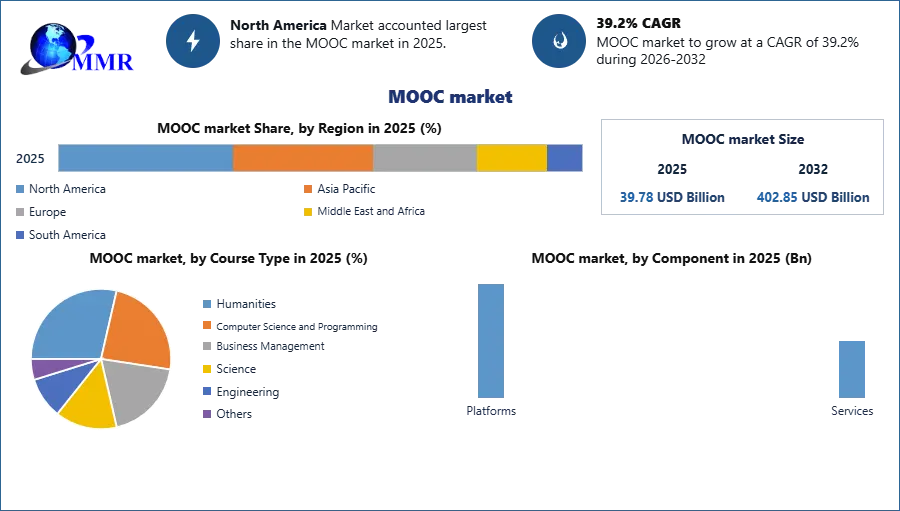 To know about the Research Methodology:- Request Free Sample Report
MOOC Market Dynamics:
The desire for open education that is both readily accessible for employees and students grows as technology advances and smart phones become more widely used. This factor is expected to propel the worldwide MOOC market further in the coming years. With the availability of free educational resources and tools in the virtual world, these courses promise learners a plethora of cheaper and more accessible educational alternatives.
According to a new Class Central analysis, Class Central is a company that tunes large-scale open online courses. One-third of all learners who have subscribed for a MOOC did so last year. As the biggest MOOC provider, Coursera has nearly quadrupled its number of innovative registered users, going from 8 million in 2022 to 31 million in 2022, a 387 percent increase. Coursera is a platform with 76 million users.
The most popular MOOC network, edX, has more than tripled its user base from 5 million in 2022 to 10 million by 2022. With 5 million new unique visitors in 2022, Evolutionary Teaching, based in the United Kingdom, is on track to virtually match Coursera's growth rate, up from 1.3 million in 2022, a 384 percent gain. The maximum number of subscribers is projected to be in the neighborhood of 15 million.
By the U.S. News World Survey statistics, around 22 of the top 25 colleges in the United States currently deliver free online courses. Despite India is lagging behind in the MOOC trend, reputable Indian schools have stepped further with specialization programs. IIT Bombay has teamed up with the Massachusetts Institute of Technology (MIT) and Harvard University to offer free MOOCs on its platforms to all potential applicants.
However, the lack of mentorship and personal oversight for students taking massive open online courses (MOOCs) on online platforms is anticipated to be a key barrier to the worldwide MOOC market's growth in the coming years.
Developments in digital technology are driving growth:
Over the last decade, digital improvements in online courses have significantly enhanced the growth of the MOOC business. Less expensive, available in a variety of languages, demo classes available, individualised attention for each student, open to anyone, and other benefits are fueling the demand for MOOCs around the world.
The transition to digital learning has aided in the personalization of education. Students can now determine their own learning rate and route thanks to technological improvements. Furthermore, it has enabled tutors to tailor learning sequences to each student's needs, allowing them to be more productive. Connected learning is one of the most important advantages of digitization.
The introduction of products like Zoom and Microsoft Teams has aided classmates in connecting with one another and their trainers or tutors in finding immediate answers to their questions.
COVID-19 propelled the growth of Global MOOC Market:
In the year 2022, one-third of all MOOC participants will have enrolled. Many people were drawn to online schooling as a result of the pandemic. MOOC providers, in particular, have reaped significant benefits from their free online courses from prominent universities, which have attracted a large number of students.
This is particularly apparent in Class Central. This year, 40% of people who had previously used Class Central for the first time did so again. Except for China, the MOOC effort has topped 180 million students in its tenth year. According to providers, roughly 2800 courses, 19 online programmes, and 360 microcredentials will be available in 2022.
The Science of Well-Being at Yale University was the most popular course during the epidemic, with over 2.5 million students enrolled by 2022. According to Shah, COVID-19 was directly tied to a fifth of the top 100 courses introduced in 2022.
MOOC Market Segment Analysis:
The global MOOC Market is segmented by Component, Course and User Type.
Based on the Component, the global MOOC market is sub-segmented into Platforms and Service. The Platforms segment held the largest market share of xx% in 2022. The Platforms segment is further sub-segmented into XMOOC and CMOOC. The XMOOC configuration is used on huge MOOC platforms and is focused on a minimal, adaptive support template, with a particular topic professional recording subject matter and scheduling evaluations, such as multiple-choice quizzes, programming assignments, or peer-review exercises, for the student group to capture the topic and learn the subject in detail while adjusting to the platform template at the point of registration the platform.
The XMOOC technique allows the platform to run the same classes on a rotating recruitment premise across the year, with the best performers from the previous group being asked to serve as community teaching assistants for the next group, providing forum prudence, technical services, and existing educational guidelines.
Based on the User Type, the global MOOC market is sub-segmented into Undergraduate, Postgraduate, High School, and Corporate. Corporate led the MOOC market with a market share of xx% in 2025. Students gain knowledge, values, opinions, habits, and skills through education and training, which they can then apply in numerous businesses. Education and training courses assist teachers, instructors, lecturers, and trainers in improving their teaching or training skills in an era of continual improvements where professional upfront needs adaptation to contemporary technologies. These MOOC courses also prepare university and college faculty and teaching personnel to understand the current pedagogical strategies demanded by students.
MOOC Market Regional Insights:
North America dominates the Global MOOC market during the forecast period 2026-2032. North America held the largest market share of xx% in 2025 and it is expected to grow at the highest CAGR of 35% in the global MOOC market during the forecast period. Because of the existing infrastructure that allows the MOOC market's adoption Universities in the United States are also giving students the option of enrolling in a standard on-campus course or signing up for a parallel version of classes that may be attended online. Several colleges in the United States also allow MOOCs to count toward the completion of a final decree, which is expected to be a lucrative business potential over the forecasted time period.
While Asia Pacific is the 2nd largest region which is expected to grow at a higher CAGR of xx% in the global MOOC market during the forecast period. China is utilizing digital learning technologies to improve education equity, quality, and productivity due to its massive working and studying population. As per the Chinese Ministry of National Education, China has 11 MOOC platforms that have been used by over 460 state universities and have given over 3,200 online classes to over 55 million learners. In particular, the global MOOC website has added approximately 200 Chinese online classes.
The objective of the report is to present a comprehensive analysis of the global MOOC Market to the stakeholders in the industry. The past and current status of the industry with the forecasted market size and trends are presented in the report with the analysis of complicated data in simple language. The report covers all the aspects of the industry with a dedicated study of key players that include market leaders, followers, and new entrants.
PORTER, PESTEL analysis with the potential impact of micro-economic factors of the market has been presented in the report. External as well as internal factors that are supposed to affect the business positively or negatively have been analyzed, which will give a clear futuristic view of the industry to the decision-makers.
The reports also helps in understanding the global MOOC Market dynamic, structure by analyzing the market segments and project the global MOOC Market size. Clear representation of competitive analysis of key players by product, price, financial position, product portfolio, growth strategies, and regional presence in the global MOOC Market make the report investor’s guide.
Recent Industry Developments
| Exact Date | Company | Development | Impact |
|---|---|---|---|
| 12 June 2025 | Global MOOC Platforms | Industry analysts confirmed the market is on track to double in value from $1.6 billion to $3.5 billion by 2032 due to surging demand for skill-driven learning. | This rapid expansion forces traditional providers to accelerate digital transformation to remain competitive with agile MOOC startups. |
| 26 June 2025 | SNS Insider | Released comprehensive data showing the xMOOC segment maintains market dominance while cMOOCs are witnessing the fastest growth in decentralized learning. | The shift toward cMOOCs signals a market pivot toward peer-based and community-focused educational models over traditional lecture-based formats. |
| 18 March 2026 | SNS Insider | Published data highlighting North America's 37% revenue share dominance driven by early adoption and major platform presence. | Strategic focus is expected to shift toward Asia-Pacific as the fastest-growing regional market through 2032. |
MOOC Market Scope: Inquire before buying
| MOOC market | |||
|---|---|---|---|
| Report Coverage | Details | ||
| Base Year: | 2025 | Forecast Period: | 2026-2032 |
| Historical Data: | 2020 to 2025 | Market Size in 2025: | 39.78 USD Billion |
| Forecast Period 2026-2032 CAGR: | 39.2% | Market Size in 2032: | 402.85 USD Billion |
| Segments Covered: | by Component | Platforms Services |
|
| by Course Type | Humanities Computer Science and Programming Business Management Science Engineering Others |
||
| by User Type | High School Undergraduate Postgraduate Corporate |
||
| by MOOC Type | xMOOC cMOOC |
||
MOOC Market, by Region
North America (United States, Canada, and Mexico)
Europe (UK, France, Germany, Italy, Spain, Sweden, Austria, and the Rest of Europe)
Asia Pacific (China, South Korea, Japan, India, Australia, Indonesia, Malaysia, Vietnam, Taiwan, Bangladesh, Pakistan, and the Rest of APAC)
Middle East and Africa (South Africa, GCC, Egypt, Nigeria, and the Rest of ME&A)
South America (Brazil, Argentina Rest of South America)
Key Players / Competitors Profiles Covered in Brief in Global MOOC Market Report in Strategic Perspective:
- 2U Inc.
- Academic Partnerships
- Apple Inc.
- Cengage Learning
- Course360
- Codecademy
- Coursera Inc.
- Degreed
- Education Portal
- edX
- Elsevier
- Embanet-Compass, LLC
- FutureLearn, Ltd.
- Instructure Inc.
- Khan Academy
- Lynda.com, Inc.
- Piazza Technologies, Inc.
- ProctorU Inc.
- SMARTHINKING, Inc.
- StraighterLine
- The Saylor Foundation
- Udacity, Inc.
- Udemy.com
- LinkedIn Learning
- Pluralsight LLC