
Marine Big Data Market System Market Size by Type, Deployment Model, Application, End-User and Region - Segment-Level Market Assessment, Growth Opportunity Analysis, Competitive Mapping & Forecast to 2032
Overview
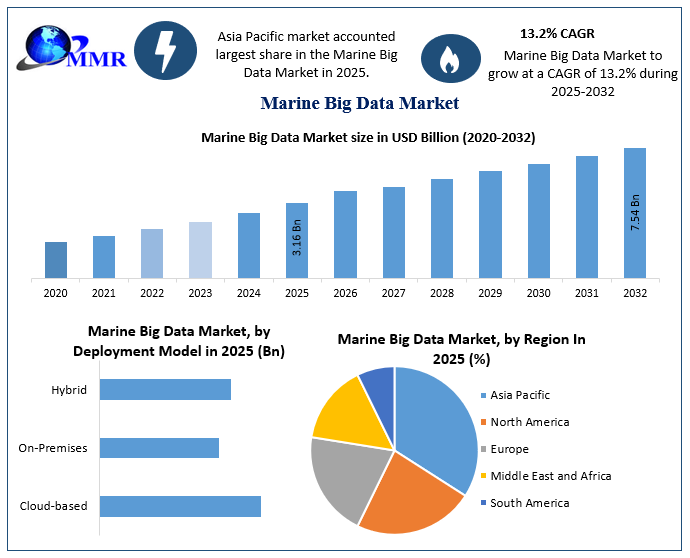
The Marine Big Data Market size was valued at USD 3.16 Billion in 2025 and the total Marine Big Data revenue is expected to grow at a CAGR of 13.2% from 2026 to 2032, reaching nearly USD 7.54 Billion by 2032.
Marine Big Data Market Overview:
The term "marine big data" refers to the vast and expanding body of information gathered from or about the ocean, coastal regions, and Great Lakes. Big data from the marine environment is crucial because it can improve our knowledge of and management of the oceans. Big data from the marine environment can be utilized to manage fisheries, forecast weather patterns, and monitor marine ecosystems.
 To know about the Research Methodology :- Request Free Sample Report
The amount of data produced and gathered by various gadgets have been multiplying globally in recent years at an astronomical rate. Countries all across the world have started monitoring initiatives including Argo, NEPTUNE, GOOS, and a number of marine observation satellites. Given the variety of observing methods and marine observation systems.
The MMR research methodology started with gathering information on the key vendors' revenue through secondary and primary research in order to estimate and forecast the market for Marine Big Data. The study of various industry-affecting factors, such as government policy, the market environment, the competitive landscape, historical data, current market trends, technological development, upcoming technologies, and the rapid progress in related industries, as well as market risks, opportunities, barriers, and challenges, was a part of the research process.
To divide the market into segments, by Component (Software (Data Analytics, Data Collection, Data Discovery, and Visualization, Data Management) Services (Consulting, System Integration, Operation, and Maintenance)), by Data Source (Environmental, Oceanographic, Geological Data, Economic, Others) vendors' offerings are taken into account. These segments were then confirmed through primary research by conducting in-depth interviews with important figures, including chief executive officers (CEOs), vice presidents (VPs), directors, and executives.
Marine Big Data Market Dynamics:
The MMR report contains a detailed study of factors that will drive and restrain the growth of the Marine Big Data market. The emergence of a vast generation of information has given rise to the revolutionary idea of "big data," which has taken over every industry due to its capacity for problem-solving and forecasting virtually precisely. 90% of global trade is handled by marine transportation, which generates a ton of data. Over the past few years, big data has helped the transportation and maritime industries in growing more rapidly. The effective use of big data has increased the operational effectiveness of ships and other boats. In addition, big data is utilized to manage ship sensors, find lost containers and ships, and develop trustworthy methods of delivering goods and commodities.
The exponential growth of big data in the maritime industry, the rising demand for the digitalization of marine transportation, the rise in trade and transportation via ships and vessels, and the rising demand for more effective operational processes in the shipping industry will all be major market drivers during the forecast period. The development of globalized trade is another driver that will propel the marine big data market, along with increased government and organization investments in the maritime sector.
Oil & gas held the greatest market share in 2023 as a result of the intense pricing competition in the industry. The market can be divided into environmental, oceanographic, geological, economic, and other categories depending on the type of data used. Among the data sources, the logistics, shipping, and economic sectors are anticipated to produce enormous amounts of data for the maritime sector.
However, the complexity of finding new breakthroughs, rising R&D expenses, and a lack of technical understanding will hinder market expansion. Given the enormous demand for commodities, a fundamental constraint is the lack of supply. Exploring the tremendous biodiversity of the oceans is challenging, which is another barrier to expansion.
Even though the COVID-19 pandemic impacts businesses and sectors, demand in the global maritime big data market is expected to reach new heights in the next years. There is minimal debate over the applicability of data-based research in high-end sectors including manufacturing, defense, and marine. For regional and international investors and stakeholders, the marine industry has turned out to be a veritable gold mine of opportunity. This is due to the marine industry's growing concerns over exploration and activities on the seabed.
Industries and sectors experienced substantial operational delays as a result of the coronavirus pandemic. However, despite severe lockdowns, marine operations proceeded in various places of the world. For the vendors competing in the global marine big data market, this is also a robust dynamic of growth and advancement. Additionally, by using marine big data for research and analysis, maritime enterprises were able to benefit from the advantages of the digital revolution during the pandemic situation.
Marine Big Data Market Segment Analysis
Based on Type, the market is segmented into Environmental Data, Operational Data, Vessel Performance Data, and Geographical Data. The Vessel Performance Data segment dominated the market in 2025 and is expected to hold the largest market share during the forecast period. This dominance is primarily driven by the rising need for fuel efficiency, real-time monitoring, predictive maintenance, and cost optimization in the shipping industry. Vessel performance data provides critical insights into engine health, fuel consumption, route optimization, and emission control, enabling shipping companies to comply with stringent environmental regulations such as IMO 2020. The growing adoption of digital twin technology, IoT-enabled sensors, and AI-based analytics further accelerates the demand for vessel performance data. As global trade and maritime transport continue to expand, shipping operators increasingly rely on performance-driven data to improve operational efficiency and reduce carbon footprint, making this segment the most preferred in the marine big data market.
Based on Application, the market is segmented into Fleet Management, Navigation Optimization, Predictive Maintenance, Regulatory Compliance, and Environmental Monitoring. The Fleet Management segment dominated the market in 2025 and is expected to hold the largest market share during the forecast period. This dominance is attributed to the rising need for efficient ship operations, fuel cost reduction, safety enhancement, and improved cargo handling in global maritime trade. Fleet management applications leverage big data analytics to optimize vessel scheduling, monitor real-time performance, track routes, and enhance crew management. The growing adoption of IoT, AI, and advanced analytics platforms by shipping companies enables better decision-making and operational visibility across large fleets. Furthermore, increasing global seaborne trade, coupled with stringent efficiency and emission standards, has accelerated the adoption of big data solutions in fleet management, making it the most critical application in the marine big data market.
Marine Big Data Market Regional Insights:
In 2021, APAC led the Marine Big Data market and contributed more than 35% of all revenues:
The marine big data market will be driven by quickly rising maritime export and import activity, increased technological advancements in the maritime sector, and significant expenditures made in the area by shipping companies.
China had seen the greatest gain in the value of owning ships in 2021 among the top ten nations. Due to its extensive fleet of container ships and the recent upsurge in global trade, the nation now holds the top rank in terms of fleet value. Japan continues to rank second on this ranking. The continual development of new technologies by various maritime analytics industry players is anticipated to create new growth chances for the APAC marine analytics market.
North America to Retain Lead through 2029
The market in the North American region is expanding primarily as a result of increased maritime trade and transportation, rising marine data collection from numerous sources, and rising need for logistics solutions for marine-based imports and exports.
Competitive Landscape:
Key players in the marine big data market have adopted various strategies to expand their global presence and increase their market shares. Partnerships, agreements, mergers and acquisitions, and new product developments are some of the major strategies adopted by the market players, to achieve growth in the marine big data market:
1. RightShip declared in November 2021 that it is concentrating on growing its footprint in uncharted territories, notably in the Asia Pacific. Japan is a pioneer in maritime decarburization. Building carbon-neutral vessels demand significant innovation and a dedication to decarbonizing its supply chain operations by 2030.
2. To provide consumers with improved marine due diligence services, RightShip teamed with Maritech Holdings Limited in September 2021. By allowing clients of Sea/trade to access RightShip's Safety Score, GHG Rating, and results of RightShip Dry Bulk Inspections without leaving the Sea/trade platform, digital agility is increased.
Key Factors:
1. The Latest Trend in The Maritime Big Data Market Is the Investment in Research and Development Since It’s an Emerging Application of Analytics.
2. Demand For Data-Driven Insights to Improve Marine Operations Is Rising.
3. The Expansion of Sensors and Linked Devices Across the Maritime Ecosystem
4. Big Data Analytics and Artificial Intelligence (AI) Are Becoming More And More Popular for Use in Nautical Applications
5. The Development of Blockchain Technology for Efficient, Transparent, And Secure Data Sharing
6. Creation Of Autonomous Vessels Requiring Highly Complex Big Data Analytics to Control Vessel Performance
The objective of the report is to present a comprehensive analysis of the Marine Big Data Market to the stakeholders in the industry. The past and current status of the industry with the forecasted market size and trends are presented in the report with the analysis of complicated data in simple language. The report covers all the aspects of the industry with a dedicated study of key players that include market leaders, followers, and new entrants.
The report also helps in understanding the Market dynamics, and structure by analyzing the market segments and projecting the Marine Big Data Market size. Clear representation of competitive analysis of key players by product, price, financial position, product portfolio, growth strategies, and regional presence in the Marine Big Data Market make the report investor’s guide.
Marine Big Data Market Scope: Inquire before buying
| Global Marine Big Data Market | |||
|---|---|---|---|
| Report Coverage | Details | ||
| Base Year: | 2025 | Forecast Period: | 2026-2032 |
| Historical Data: | 2020 to 2025 | Market Size in 2025: | USD 3.16 Bn. |
| Forecast Period 2026 to 2032 CAGR: | 13.2% | Market Size in 2032: | USD 7.54 Bn. |
| Segments Covered: | by Type | Environmental Data Operational Data Vessel Performance Data Geographical Data |
|
| by Deployment Model | Cloud-based On-Premises Hybrid |
||
| by Application | Fleet Management Navigation Optimization Predictive Maintenance Regulatory Compliance Environmental Monitoring |
||
| by End-User | Commercial Shipping Fishing Industry Naval Forces Research Institutions |
||
Marine Big Data Market, by Region
North America (United States, Canada and Mexico)
Europe (UK, France, Germany, Italy, Spain, Sweden, Austria and Rest of Europe)
Asia Pacific (China, South Korea, Japan, India, Australia, Indonesia, Malaysia, Vietnam, Taiwan, Bangladesh, Pakistan and Rest of APAC)
Middle East and Africa (South Africa, GCC, Egypt, Nigeria and Rest of ME&A)
South America (Brazil, Argentina Rest of South America)
Marine Big Data Market, Key Players
1. Teradata
2. Splunk, Inc.
3. AIMS-Sinay
4. Oceanwise
5. Intertrust Technologies Corporation
6. MarineFIND
7. BigOceanData
8. Avenca Limited
9. BMT Group Ltd.
10.Datameer Inc.
11.Databricks Inc.
12.Nautical Control Solutions, LP
13.Ocean Networks Canada
14.Smart Ocean and Open Ocean
15.IBM
16.A.P. Moller-Maersk
17.Microsoft Corporation
18.Hitachi Vantara Corporation
19.SAP
20.TIBCO Software
Frequently Asked Questions:
1] What segments are covered in the Marine Big Data Market report?
Ans. The segments covered in the Marine Big Data Market report are based on Component, Data Source.
2] Which region is expected to hold the highest share in the Marine Big Data Market?
Ans. APAC region is expected to hold the highest share in the Marine Big Data Market.
3] What is the market size of the Marine Big Data Market by 2032?
Ans. The market size of the Marine Big Data Market by 2032 is USD 7.54 Bn.
4] What is the forecast period for the Marine Big Data Market?
Ans. The forecast period for the Marine Big Data Market is 2026-2032.
5] What was the market size of the Marine Big Data Market in 2025?
Ans. The market size of the Marine Big Data Market in 2025 was USD 3.16 Bn.