Global Food Ultrasound Market Size by Product, Frequency Range, and Function – Segment-Level Market Assessment, Growth Opportunity Analysis, Competitive Landscape & Forecast to 2034

8%
CAGR (2026-2034)
165 USD Mn.
Forecast Market Size
310
Report Pages
137
Market Tables

Overview

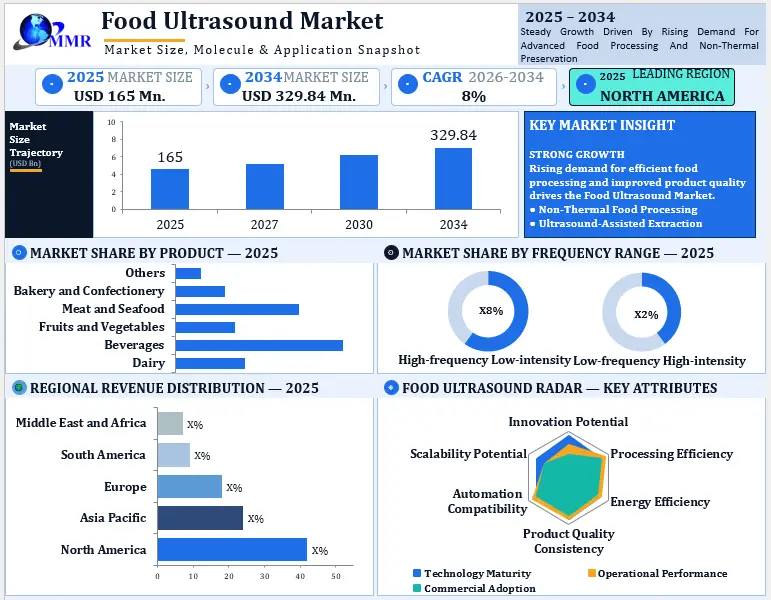
Global Food Ultrasound Market size was valued at USD 165 Mn. in 2025 and the total revenue is expected to grow at 8% through 2026 to 2034, reaching USD 329.84 Mn. by 2034.

Global Food Ultrasound Market Overview

The Food Ultrasound Market refers to the use of high-frequency sound waves in food processing to improve product quality, enhance extraction, support emulsification, assist in food preservation, and optimize processing efficiency. Food ultrasound technology enables non-thermal and energy-efficient food processing by improving mass transfer, texture modification, microbial control, and ingredient extraction while helping retain desirable sensory and nutritional properties. Its applications span dairy products, beverages, meat and seafood, fruits and vegetables, bakery products, and functional food ingredients, making food ultrasound an emerging solution for food manufacturers seeking advanced processing technologies, improved food safety, and sustainable production methods.

The Food Ultrasound Market is growing as food manufacturers increasingly adopt advanced food processing equipment, non-thermal food preservation, ultrasonic homogenization, and ultrasound-assisted extraction to improve processing performance and product consistency. Growing demand for clean-label foods, minimally processed products, resource-efficient manufacturing, and improved shelf-life management is encouraging investment in industrial ultrasound systems. Companies such as Hielscher Ultrasonics are contributing to technology development through ultrasonic processing equipment for food and beverage applications, while research initiatives from organizations such as the United States Department of Agriculture highlight the importance of food safety, processing innovation, and quality preservation. Food and beverage manufacturers, ingredient producers, dairy processors, meat processors, and food research laboratories represent important buyers, with opportunities emerging across Asia Pacific, North America, and Europe as manufacturers explore scalable ultrasound solutions for extraction, emulsification, crystallization, and food preservation.

The MMR Food Ultrasound Market Report provides an in-depth assessment of market trends, growth drivers, restraints, emerging technologies, competitive positioning, regional demand, and application-based opportunities. The research examines how ultrasonic food processing, non-thermal preservation, sustainable food manufacturing, and advanced extraction technologies are creating opportunities for equipment manufacturers and food producers. It also evaluates investment potential, product innovation, and competitive strategies to help clients identify high-growth applications, understand changing customer requirements, and make informed business decisions in the evolving food ultrasound industry.

Global Food Ultrasound Market Growth Outlook
Food Ultrasound Market Growth

To know about the Research Methodology :- Request Free Sample Report

Ultrasound is a type of sound wave. Its frequency is higher than the upper limit of human hearing and is used in different fields. As we all know, food ultrasound has a significant impact on the speed of various processes in the food industry. It's used in a variety of food-processing applications, including crystallisation, freezing, bleaching, degassing, extraction, drying, and filtration. Food ultrasound is a useful tool for processing, preservation and extraction in the field of food processing.

Global Food Ultrasound Market Key Highlights

Key Market Highlight Insights Business Opportunity
Food Ultrasound Market Growth Outlook The Food Ultrasound Market is valued at USD 165 million in 2025 and is projected to reach USD 329.84 million by 2034, registering a compound annual growth rate of 8% during 2026–2034. Ultrasonic equipment manufacturers can target food processors seeking advanced processing technologies, improved production efficiency, and high-quality food preservation solutions.
North America Leads Market Demand North America holds the leading regional position, supported by its established food processing industry, demand for packaged food and beverages, and interest in advanced manufacturing technologies. Equipment suppliers can strengthen regional sales through partnerships with food manufacturers, beverage processors, and industrial food production facilities.
Meat and Seafood Processing Creates Product-Level Opportunities Meat and seafood processing represents a key application area for food ultrasound because ultrasonic treatment can support marination, mass transfer, processing efficiency, and selected preservation applications. Technology providers can develop application-specific ultrasonic systems for meat processing, seafood treatment, texture management, and production optimization.
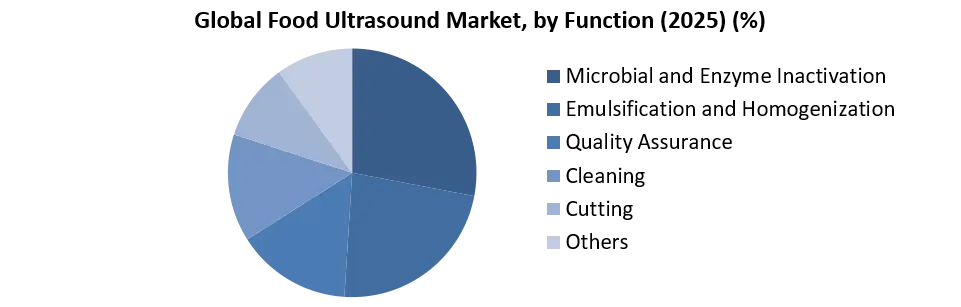
Microbial and Enzyme Inactivation Supports Functional Demand Microbial and enzyme inactivation is identified as a leading functional application in the report, reflecting interest in food quality preservation and processing technologies that can complement conventional treatment methods. Companies can invest in validated ultrasonic processing solutions that address microbial control, enzyme activity, and food quality while meeting applicable safety requirements.
Ultrasound-Assisted Extraction and Emulsification Offer Innovation Potential Ultrasound-assisted extraction, emulsification, homogenization, and food waste valorization offer opportunities to improve ingredient recovery, mixture consistency, and resource utilization across food manufacturing. Businesses can explore natural ingredient extraction, plant-based formulations, functional food ingredients, and scalable ultrasonic processing equipment to differentiate their product portfolios.

Global Food Ultrasound Market Dynamics

Rising Demand for Non-Thermal Food Processing and Improved Food Quality Drive the Food Ultrasound Market

The Food Ultrasound Market is gaining momentum as food manufacturers seek advanced processing technologies that improve product quality, reduce processing time, and support efficient food preservation. Ultrasound-assisted processing uses high-frequency sound waves, commonly operating between 20 kilohertz and 100 kilohertz in industrial applications, to support emulsification, extraction, homogenization, and mass transfer. These capabilities help dairy producers improve emulsion stability, beverage manufacturers enhance ingredient dispersion, and fruit processing companies improve juice extraction efficiency. Growing demand for clean-label ingredients, minimally processed foods, and resource-efficient production is encouraging food processors to evaluate ultrasonic food processing equipment as an alternative or complement to conventional techniques. Increasing attention to food safety, product consistency, and manufacturing efficiency is further supporting the adoption of food ultrasound technology across the food and beverage industry.

High Equipment Investment and Limited Industrial Standardization Restraint Food Ultrasound Market Adoption

The Food Ultrasound Market faces adoption barriers associated with equipment investment, process validation, maintenance requirements, and the challenges of transferring laboratory results to commercial food production. Industrial ultrasonic processing systems require suitable transducers, generators, reactors, and process controls, while specialized installations may require integration with existing production lines. Performance can vary according to food composition, viscosity, temperature, treatment intensity, and processing duration, making product-specific testing essential before commercial deployment. Food manufacturers must also verify microbial reduction, sensory quality, nutritional retention, and compliance with applicable food safety requirements rather than assuming ultrasound alone guarantees food safety. Smaller processors may be reluctant to invest in new equipment without a clear return on investment, particularly when conventional pasteurization, mechanical mixing, or extraction methods already meet their production requirements.

Ultrasound-Assisted Extraction and Sustainable Food Manufacturing Create New Growth Opportunities

The Food Ultrasound Market presents opportunities through ultrasound-assisted extraction, plant-based ingredient development, food waste valorization, and the production of natural flavors, colors, and functional ingredients. Acoustic cavitation can improve solvent penetration and mass transfer, helping processors recover valuable compounds from fruits, vegetables, herbs, seeds, and other food materials. For example, manufacturers can investigate ultrasound-assisted recovery of polyphenols, pigments, and antioxidants from processing by-products that would otherwise have limited commercial value. Processing trials evaluating treatment durations of 5–30 minutes can help identify suitable operating conditions for particular ingredients, although actual performance depends on the material and equipment configuration. Demand for plant-based foods, clean-label formulations, and circular food production creates opportunities for ultrasonic equipment suppliers to collaborate with ingredient manufacturers, beverage producers, and food research laboratories to develop scalable, resource-efficient processing solutions.

Maintaining Consistent Processing Performance and Food Safety Compliance Challenges the Food Ultrasound Market

The Food Ultrasound Market must address technical challenges involving uniform energy distribution, treatment scalability, microbial inactivation, and consistent product quality across industrial processing volumes. Ultrasonic performance depends on frequency, acoustic intensity, equipment geometry, food composition, and treatment temperature, which can produce different results between laboratory experiments and full-scale manufacturing systems. Process developers must establish validated operating conditions for each food category and demonstrate that the technology achieves the required food safety outcomes without adversely affecting texture, flavor, color, or nutritional properties. Manufacturers also need to assess energy consumption, equipment durability, cleaning requirements, and integration with continuous production lines. Collaboration among food processors, equipment suppliers, and research institutions is important for developing repeatable processing protocols, meeting regulatory requirements, and demonstrating that ultrasound technology delivers measurable commercial benefits alongside established food processing methods.

Global Food Ultrasound Market Key Trends

Market Trend Description
Adoption of Non-Thermal Food Processing Technology Food manufacturers are evaluating ultrasonic processing to improve food quality while reducing reliance on intensive heat treatment in suitable applications. This trend is gaining attention among beverage, dairy, and fruit processing companies seeking better texture, ingredient stability, and product consistency.
Growth in Ultrasound-Assisted Ingredient Extraction Food ingredient producers are using ultrasound-assisted extraction to recover valuable compounds such as natural pigments, polyphenols, flavors, and antioxidants from plant materials. The technology offers opportunities to improve extraction efficiency and develop higher-value ingredients for functional foods and clean-label formulations.
Integration of Ultrasonic Emulsification in Food Manufacturing Manufacturers are exploring ultrasonic emulsification to produce more uniform mixtures of oil, water, and other ingredients. This approach is relevant to sauces, dressings, beverages, dairy formulations, and plant-based products where emulsion stability and consistent texture influence product quality.
Increasing Focus on Food Waste Valorization Food processors are investigating ultrasound technology to recover useful ingredients from fruit peels, vegetable residues, seeds, and other food processing by-products. This trend aligns with circular food manufacturing strategies that aim to reduce material waste and generate additional value from existing production resources.
Development of Scalable Industrial Ultrasonic Processing Systems Equipment suppliers are focusing on ultrasonic reactors, improved transducers, automated process controls, and continuous processing configurations. These developments aim to make food ultrasound equipment more suitable for commercial production while improving treatment consistency, process monitoring, and integration with existing manufacturing lines.
Greater Emphasis on Process Validation and Product-Specific Applications Food manufacturers are placing greater importance on validating ultrasonic treatment conditions for individual food products. Research and industrial trials increasingly assess treatment intensity, frequency, processing time, temperature, microbial control, and sensory quality to determine where ultrasound can deliver reliable results alongside established food safety practices.

Global Food Ultrasound Market Segment Analysis:

On the basis of product, the global food ultrasound market is sub-segmented into dairy, beverages, fruits and vegetables, meat and seafood, backer, and confectionery. Meat & seafood is the dominant segment and it held xx% of the share in 2025. It has large demand because these products are most vulnerable to microbial contamination and it gives proteins and bone strength. Ultrasonic technologies help with the pickling process and reduce the time it takes to treat these products. The increased demand for process efficiency through decreased processing times and energy-saving technology is driving the market for ultrasonic food processing.

The dairy product is a second dominant segment with CAGR of 9.4% during forecast period 2026-2034. Growing demand for dairy products in countries like the United States, China, and India is moving the dairy industry forward. Food ultrasound demand is growing at a quick rate of roughly 5.2% in the United States, and it is expected to continue to grow during the forecast period.

On the basis of the frequency range, the global food ultrasound market is sub-segmented into High-frequency low-intensity, Low-frequency high-intensity. The high-frequency low-intensity segment is dominant and it held xx% of the share in 2025. The frequency range used to perform a food ultrasound is determined by the sample's sensitivity as well as the ultrasound's purpose. Both high and low ultrasound frequencies can be used to conduct most of the common purposes of an ultrasound. Cleaning, microbiological inactivation, and cutting can all be done with high or low ultrasound frequencies, depending on the sensitivity of the product being processed and the function that needs to be performed.

On the basis of function type, the global food ultrasound market is sub-segmented into quality assurance, microbial enzyme inactivation, cutting, emulsification & homogenization, cleaning, others. The Microbial enzyme inactivation segment dominated the function type in the food ultrasound market and it held xx% of the share in 2022, owing to it required shorter heating time, Heat distribution inside food is more uniform, resulting in lower nutrition losses and more energy efficiency. Ultrasound technologies are increasingly being adopted in place of traditional ways because they do not degrade the quality of the food. Food products are exposed to high-frequency radiation during this process, which causes microbe cells to disintegrate. Due to increased health concerns and the frequency of viral infections in major nations throughout the world, it is expected that Microbial enzyme inactivation expected to continue to dominance the function sector during the forecast period 2026-2034.
Food Ultrasound Market by Function

Global Food Ultrasound Market Regional Insights:

The North America market accounts for the major market share in terms of revenue and is expected to rapid growth during the forecast period. North America held xx% share of global market and demand of this region is increasing due to increased consumer consumption of packaged foods and beverages and the existence of a mature food processing industry are factors driving the market growth in this region. Canada is the second-largest food ultrasound market in the region, with total ultrasound food exports exceeding 12 million. Canada's urbanization rate is very high. It is expected that higher per capita disposable income will also promote the country's market growth.

The Asia-Pacific market is expected to have the fastest growth in terms of revenue in the global market because of the increasing adoption of new technologies and growing consumer demand for processed foods in the region. In addition, it is expected that there will be more and more processed food manufacturing industries in emerging economies such as China and India, which will promote the growth of target markets in the Asia-Pacific region.

The objective of the report is to present a comprehensive analysis of the global Food Ultrasound market to the stakeholders in the industry. The past and current status of the industry with the forecasted market size and trends are presented in the report with the analysis of complicated data in simple language. The report covers all the aspects of the industry with a dedicated study of key players that include market leaders, followers, and new entrants.

PORTER, PESTEL analysis with the potential impact of micro-economic factors of the market have been presented in the report. External as well as internal factors that are supposed to affect the business positively or negatively have been analysed, which will give a clear futuristic view of the industry to the decision-makers.

The report also helps in understanding the global Food Ultrasound market dynamics, structure by analyzing the market segments and projects the global Food Ultrasound market size. Clear representation of competitive analysis of key players by product, price, financial position, product portfolio, growth strategies, and regional presence in the global Food Ultrasound market make the report investor’s guide.

Global Food Ultrasound Market Competitive Landscape

The Food Ultrasound Market is characterized by competition among ultrasonic equipment manufacturers and food processing technology providers, with companies differentiating themselves through ultrasonic cutting systems, high-power ultrasound equipment, emulsification and homogenization solutions, and ultrasound-assisted food preservation technologies. Key players such as Hielscher Ultrasonics GmbH, Emerson Electric Co. through its Branson Ultrasonics brand, Sonics & Materials, Inc., Dukane Corporation, Weber Ultrasonics AG, Telsonic AG, Bühler AG, and Industrial Sonomechanics, LLC compete through equipment performance, process reliability, application-specific engineering, and customization for food and beverage manufacturers.

As demand for advanced food processing equipment, non-thermal food preservation, ultrasonic food extraction, and precision food cutting increases, market participants are focusing on scalable processing systems, improved energy efficiency, automation, and integration with existing production lines. Manufacturers that demonstrate consistent processing results, reliable technical support, and cost-effective industrial ultrasound solutions are well positioned to attract food processors seeking better product quality, manufacturing efficiency, and sustainable food production.

Region Country Key Company Market Relevance and Competitive Positioning
North America United States Emerson Electric Co. (Branson Ultrasonics) Industrial ultrasonic technology provider with expertise in ultrasonic systems and process control, relevant to food processing and manufacturing applications.
North America United States Sonics & Materials, Inc. Supplies ultrasonic liquid processing equipment relevant to food ingredient extraction, dispersion, emulsification, and homogenization research.
Europe Germany Hielscher Ultrasonics GmbH Specialist in high-power ultrasonic processors used for liquid processing, extraction, mixing, and food and beverage research applications.
Europe Switzerland Bühler Group Food processing engineering company with capabilities in industrial production systems and opportunities to integrate advanced processing technologies into food manufacturing.
Europe Germany RINCO ULTRASONICS AG Provides ultrasonic technology for industrial applications, including specialized joining and cutting systems relevant to selected food production and packaging operations.
Asia Pacific China CHEERSONIC Ultrasonic Equipment Co., Ltd. Offers ultrasonic equipment for industrial processing applications, including ultrasonic cutting and processing systems relevant to food manufacturers.
Asia Pacific India Newtech Intelligent Automation Limited Represents an automation-focused supplier to consider when assessing regional opportunities for ultrasonic processing integration and industrial equipment adoption.
Asia Pacific Australia Cavitus Pty Ltd Associated with ultrasonic technology for food and beverage processing, including applications involving liquid treatment and process efficiency.

Global Food Ultrasound Market Scope:Inquire before buying

Global Food Ultrasound Market
Report Coverage Details
Base Year: 2025 Forecast Period: 2026-2034
Historical Data: 2020 to 2025 Market Size in 2025: USD 165 Mn.
Forecast Period 2026 to 2034 CAGR: 8% Market Size in 2034: USD 329.84 Mn.
Segments Covered: by Product Dairy
Beverages
Fruits and Vegetables
Meat and Seafood
Backer and Confectionery
by Frequency Range High-frequency low-intensity
Low-frequency high-intensity
by Function Quality assurance
Microbial enzyme inactivation
Cutting
Emulsification & homogenization
Cleaning
Others

Global Food Ultrasound Market, by Region

North America (United States, Canada and Mexico)
Europe (UK, France, Germany, Italy, Spain, Sweden, Austria, Turkey, Russia and Rest of Europe)
Asia Pacific (China, India, Japan, South Korea, Australia, ASEAN and Rest of APAC)
Middle East and Africa (South Africa, GCC, Egypt, Nigeria and Rest of ME&A)
South America (Brazil, Argentina, Columbia and Rest of South America)

Global Food Ultrasound Market, Key Players are

1. Hielscher Ultrasonics GmbH
2. Sonics and Materials Inc.
3. Dukane Corporation
4. Weber Ultrasonics AG
5. TELSONIC AG
6. Emerson Electric Co.
7. Bühler Group
8. CHEERSONIC Ultrasonic Equipment Co., Ltd.
9. RINCO ULTRASONICS AG
10. Industrial Sonomechanics, LLC
11. Marchant Schmidt, Inc.
12. Elliptical Design Ltd.
13. SinapTec
14. Sonic Italia Srl
15. Cavitus Pty Ltd
16. Ultrasonic Power Corporation
17. UCM Ultrasonics
18. SONIMAT
19. XIAOWEI Ultrasonic Equipment Supplier
20. Hyusonic
21. SODEVA TDS
22. MS Ultrasonic Technology Group
23. Herrmann Ultrasonics GmbH & Co. KG
24. SONOTRONIC Nagel GmbH
25. Newtech Intelligent Automation Limited
26. FoodTools, Inc.
27. Bakon Food Equipment
28. JBT Marel Corporation
29. Heat and Control, Inc.
30. Syntegon Technology GmbH
31. SAIREM SAS
32. Qsonica LLC
33. Ralsonics Research Private Limited
34. EveryWave
35. Innovative Ultrasonics Pty Ltd
36. Ultrawave Ltd.
37. Seattle Ultrasonics
38. Robert Bosch GmbH
39. Hitachi, Ltd.
40. Koninklijke Philips N.V.

Global Food Ultrasound Market - Frequently Asked Questions:

1. Which region has the largest share in Global Food Ultrasound Market?
Ans: North America region holds the highest share in 2025.

2. What is the growth rate of Global Food Ultrasound Market?
Ans: The Global Food Ultrasound Market is growing at a CAGR of 8% during forecasting period 2026-2034.

3. What segments are covered in Global Food Ultrasound market?
Ans: Global Food Ultrasound market is segmented into product, frequency range, function and Region.

4. Who are the key players in Global Food Ultrasound market?
Ans: The important key players in the Global Food Ultrasound market are - Hitachi Corporation, Bosch, Buhler, Siemens Healthcare, Analogic Corporation, FUJIFILM Holdings Corporation, Koninklijke Philips N.V, Esaote S.p.A, Mindray Medical International Ltd., Robert Bosch GmbH, Emerson Electric Co., Buehler’s Fresh Foods, Dukane, Hielscher Ultrasonics GmbH, Newtech, Denny’s Franchisee Association, and Rinco Ultrasonics.

5. What is the study period of this market?
Ans: The Global Food Ultrasound market is studied from 2020 to 2034.

Table of Contents

1. Food Ultrasound Market Introduction 1.1. Study Assumption and Market Definition 1.2. Scope of the Study 1.3. Executive Summary 2. Global Food Ultrasound Market: Competitive Landscape 2.1. MMR Competition Matrix 2.2. Competitive Landscape 2.3. Key Players Benchmarking 2.3.1. Company Name 2.3.2. Business Segment 2.3.3. End-user Segment 2.3.4. Revenue (2025) 2.3.5. Company Locations 2.4. Leading Food Ultrasound Market Companies, by market capitalization 2.5. Market Structure 2.5.1. Market Leaders 2.5.2. Market Followers 2.5.3. Emerging Players 2.6. Mergers and Acquisitions Details 3. Food Ultrasound Market: Dynamics 3.1. Food Ultrasound Market Trends by Region 3.1.1. North America Food Ultrasound Market Trends 3.1.2. Europe Food Ultrasound Market Trends 3.1.3. Asia Pacific Food Ultrasound Market Trends 3.1.4. Middle East and Africa Food Ultrasound Market Trends 3.1.5. South America Food Ultrasound Market Trends 3.2. Food Ultrasound Market Dynamics by Region 3.2.1. North America 3.2.1.1. North America Food Ultrasound Market Drivers 3.2.1.2. North America Food Ultrasound Market Restraints 3.2.1.3. North America Food Ultrasound Market Opportunities 3.2.1.4. North America Food Ultrasound Market Challenges 3.2.2. Europe 3.2.2.1. Europe Food Ultrasound Market Drivers 3.2.2.2. Europe Food Ultrasound Market Restraints 3.2.2.3. Europe Food Ultrasound Market Opportunities 3.2.2.4. Europe Food Ultrasound Market Challenges 3.2.3. Asia Pacific 3.2.3.1. Asia Pacific Food Ultrasound Market Drivers 3.2.3.2. Asia Pacific Food Ultrasound Market Restraints 3.2.3.3. Asia Pacific Food Ultrasound Market Opportunities 3.2.3.4. Asia Pacific Food Ultrasound Market Challenges 3.2.4. Middle East and Africa 3.2.4.1. Middle East and Africa Food Ultrasound Market Drivers 3.2.4.2. Middle East and Africa Food Ultrasound Market Restraints 3.2.4.3. Middle East and Africa Food Ultrasound Market Opportunities 3.2.4.4. Middle East and Africa Food Ultrasound Market Challenges 3.2.5. South America 3.2.5.1. South America Food Ultrasound Market Drivers 3.2.5.2. South America Food Ultrasound Market Restraints 3.2.5.3. South America Food Ultrasound Market Opportunities 3.2.5.4. South America Food Ultrasound Market Challenges 3.3. PORTER's Five Forces Analysis 3.4. PESTLE Analysis 3.5. Technology Roadmap 3.6. Regulatory Landscape by Region 3.6.1. North America 3.6.2. Europe 3.6.3. Asia Pacific 3.6.4. Middle East and Africa 3.6.5. South America 3.7. Key Opinion Leader Analysis in the Food Ultrasound Market 3.8. Analysis of Government Schemes and Initiatives For Global Industry 3.9. Food Ultrasound Market Trade Analysis 3.10. The Global Pandemic Impact on Food Ultrasound Market 4. Food Ultrasound Market: Global Market Size and Forecast by Segmentation (in USD Million) 2025-2034 4.1. Food Ultrasound Market Size and Forecast, by Product (2025-2034) 4.1.1. Dairy 4.1.2. Beverages 4.1.3. Fruits and Vegetables 4.1.4. Meat and Seafood 4.1.5. Backer and Confectionery 4.2. Food Ultrasound Market Size and Forecast, by Frequency Range (2025-2034) 4.2.1. High-frequency low-intensity 4.2.2. Low-frequency high-intensity 4.3. Food Ultrasound Market Size and Forecast, by Function (2025-2034) 4.3.1. Quality assurance 4.3.2. Microbial enzyme inactivation 4.3.3. Cutting 4.3.4. Emulsification & homogenization 4.3.5. Cleaning 4.3.6. Others 4.4. Food Ultrasound Market Size and Forecast, by Region (2025-2034) 4.4.1. North America 4.4.2. Europe 4.4.3. Asia Pacific 4.4.4. Middle East and Africa 4.4.5. South America 5. North America Food Ultrasound Market Size and Forecast by Segmentation (in USD Million) 2025-2034 5.1. North America Food Ultrasound Market Size and Forecast, by Product (2025-2034) 5.1.1. Dairy 5.1.2. Beverages 5.1.3. Fruits and Vegetables 5.1.4. Meat and Seafood 5.1.5. Backer and Confectionery 5.2. North America Food Ultrasound Market Size and Forecast, by Frequency Range (2025-2034) 5.2.1. High-frequency low-intensity 5.2.2. Low-frequency high-intensity 5.3. North America Food Ultrasound Market Size and Forecast, by Function (2025-2034) 5.3.1. Quality assurance 5.3.2. Microbial enzyme inactivation 5.3.3. Cutting 5.3.4. Emulsification & homogenization 5.3.5. Cleaning 5.3.6. Others 5.4. North America Food Ultrasound Market Size and Forecast, by Country (2025-2034) 5.4.1. United States 5.4.1.1. United States Food Ultrasound Market Size and Forecast, by Product (2025-2034) 5.4.1.1.1. Dairy 5.4.1.1.2. Beverages 5.4.1.1.3. Fruits and Vegetables 5.4.1.1.4. Meat and Seafood 5.4.1.1.5. Backer and Confectionery 5.4.1.2. United States Food Ultrasound Market Size and Forecast, by Frequency Range (2025-2034) 5.4.1.2.1. High-frequency low-intensity 5.4.1.2.2. Low-frequency high-intensity 5.4.1.3. United States Food Ultrasound Market Size and Forecast, by Function (2025-2034) 5.4.1.3.1. Quality assurance 5.4.1.3.2. Microbial enzyme inactivation 5.4.1.3.3. Cutting 5.4.1.3.4. Emulsification & homogenization 5.4.1.3.5. Cleaning 5.4.1.3.6. Others 5.4.2. Canada 5.4.2.1. Canada Food Ultrasound Market Size and Forecast, by Product (2025-2034) 5.4.2.1.1. Dairy 5.4.2.1.2. Beverages 5.4.2.1.3. Fruits and Vegetables 5.4.2.1.4. Meat and Seafood 5.4.2.1.5. Backer and Confectionery 5.4.2.2. Canada Food Ultrasound Market Size and Forecast, by Frequency Range (2025-2034) 5.4.2.2.1. High-frequency low-intensity 5.4.2.2.2. Low-frequency high-intensity 5.4.2.3. Canada Food Ultrasound Market Size and Forecast, by Function (2025-2034) 5.4.2.3.1. Quality assurance 5.4.2.3.2. Microbial enzyme inactivation 5.4.2.3.3. Cutting 5.4.2.3.4. Emulsification & homogenization 5.4.2.3.5. Cleaning 5.4.2.3.6. Others 5.4.3. Mexico 5.4.3.1. Mexico Food Ultrasound Market Size and Forecast, by Product (2025-2034) 5.4.3.1.1. Dairy 5.4.3.1.2. Beverages 5.4.3.1.3. Fruits and Vegetables 5.4.3.1.4. Meat and Seafood 5.4.3.1.5. Backer and Confectionery 5.4.3.2. Mexico Food Ultrasound Market Size and Forecast, by Frequency Range (2025-2034) 5.4.3.2.1. High-frequency low-intensity 5.4.3.2.2. Low-frequency high-intensity 5.4.3.3. Mexico Food Ultrasound Market Size and Forecast, by Function (2025-2034) 5.4.3.3.1. Quality assurance 5.4.3.3.2. Microbial enzyme inactivation 5.4.3.3.3. Cutting 5.4.3.3.4. Emulsification & homogenization 5.4.3.3.5. Cleaning 5.4.3.3.6. Others 6. Europe Food Ultrasound Market Size and Forecast by Segmentation (in USD Million) 2025-2034 6.1. Europe Food Ultrasound Market Size and Forecast, by Product (2025-2034) 6.1.1. Dairy 6.1.2. Beverages 6.1.3. Fruits and Vegetables 6.1.4. Meat and Seafood 6.1.5. Backer and Confectionery 6.2. Europe Food Ultrasound Market Size and Forecast, by Frequency Range (2025-2034) 6.2.1. High-frequency low-intensity 6.2.2. Low-frequency high-intensity 6.3. Europe Food Ultrasound Market Size and Forecast, by Function (2025-2034) 6.3.1. Quality assurance 6.3.2. Microbial enzyme inactivation 6.3.3. Cutting 6.3.4. Emulsification & homogenization 6.3.5. Cleaning 6.3.6. Others 6.4. Europe Food Ultrasound Market Size and Forecast, by Country (2025-2034) 6.4.1. United Kingdom 6.4.1.1. United Kingdom Food Ultrasound Market Size and Forecast, by Product (2025-2034) 6.4.1.1.1. Dairy 6.4.1.1.2. Beverages 6.4.1.1.3. Fruits and Vegetables 6.4.1.1.4. Meat and Seafood 6.4.1.1.5. Backer and Confectionery 6.4.1.2. United Kingdom Food Ultrasound Market Size and Forecast, by Frequency Range (2025-2034) 6.4.1.2.1. High-frequency low-intensity 6.4.1.2.2. Low-frequency high-intensity 6.4.1.3. United Kingdom Food Ultrasound Market Size and Forecast, by Function (2025-2034) 6.4.1.3.1. Quality assurance 6.4.1.3.2. Microbial enzyme inactivation 6.4.1.3.3. Cutting 6.4.1.3.4. Emulsification & homogenization 6.4.1.3.5. Cleaning 6.4.1.3.6. Others 6.4.2. France 6.4.2.1. France Food Ultrasound Market Size and Forecast, by Product (2025-2034) 6.4.2.1.1. Dairy 6.4.2.1.2. Beverages 6.4.2.1.3. Fruits and Vegetables 6.4.2.1.4. Meat and Seafood 6.4.2.1.5. Backer and Confectionery 6.4.2.2. France Food Ultrasound Market Size and Forecast, by Frequency Range (2025-2034) 6.4.2.2.1. High-frequency low-intensity 6.4.2.2.2. Low-frequency high-intensity 6.4.2.3. France Food Ultrasound Market Size and Forecast, by Function (2025-2034) 6.4.2.3.1. Quality assurance 6.4.2.3.2. Microbial enzyme inactivation 6.4.2.3.3. Cutting 6.4.2.3.4. Emulsification & homogenization 6.4.2.3.5. Cleaning 6.4.2.3.6. Others 6.4.3. Germany 6.4.3.1. Germany Food Ultrasound Market Size and Forecast, by Product (2025-2034) 6.4.3.1.1. Dairy 6.4.3.1.2. Beverages 6.4.3.1.3. Fruits and Vegetables 6.4.3.1.4. Meat and Seafood 6.4.3.1.5. Backer and Confectionery 6.4.3.2. Germany Food Ultrasound Market Size and Forecast, by Frequency Range (2025-2034) 6.4.3.2.1. High-frequency low-intensity 6.4.3.2.2. Low-frequency high-intensity 6.4.3.3. Germany Food Ultrasound Market Size and Forecast, by Function (2025-2034) 6.4.3.3.1. Quality assurance 6.4.3.3.2. Microbial enzyme inactivation 6.4.3.3.3. Cutting 6.4.3.3.4. Emulsification & homogenization 6.4.3.3.5. Cleaning 6.4.3.3.6. Others 6.4.4. Italy 6.4.4.1. Italy Food Ultrasound Market Size and Forecast, by Product (2025-2034) 6.4.4.1.1. Dairy 6.4.4.1.2. Beverages 6.4.4.1.3. Fruits and Vegetables 6.4.4.1.4. Meat and Seafood 6.4.4.1.5. Backer and Confectionery 6.4.4.2. Italy Food Ultrasound Market Size and Forecast, by Frequency Range (2025-2034) 6.4.4.2.1. High-frequency low-intensity 6.4.4.2.2. Low-frequency high-intensity 6.4.4.3. Italy Food Ultrasound Market Size and Forecast, by Function (2025-2034) 6.4.4.3.1. Quality assurance 6.4.4.3.2. Microbial enzyme inactivation 6.4.4.3.3. Cutting 6.4.4.3.4. Emulsification & homogenization 6.4.4.3.5. Cleaning 6.4.4.3.6. Others 6.4.5. Spain 6.4.5.1. Spain Food Ultrasound Market Size and Forecast, by Product (2025-2034) 6.4.5.1.1. Dairy 6.4.5.1.2. Beverages 6.4.5.1.3. Fruits and Vegetables 6.4.5.1.4. Meat and Seafood 6.4.5.1.5. Backer and Confectionery 6.4.5.2. Spain Food Ultrasound Market Size and Forecast, by Frequency Range (2025-2034) 6.4.5.2.1. High-frequency low-intensity 6.4.5.2.2. Low-frequency high-intensity 6.4.5.3. Spain Food Ultrasound Market Size and Forecast, by Function (2025-2034) 6.4.5.3.1. Quality assurance 6.4.5.3.2. Microbial enzyme inactivation 6.4.5.3.3. Cutting 6.4.5.3.4. Emulsification & homogenization 6.4.5.3.5. Cleaning 6.4.5.3.6. Others 6.4.6. Sweden 6.4.6.1. Sweden Food Ultrasound Market Size and Forecast, by Product (2025-2034) 6.4.6.1.1. Dairy 6.4.6.1.2. Beverages 6.4.6.1.3. Fruits and Vegetables 6.4.6.1.4. Meat and Seafood 6.4.6.1.5. Backer and Confectionery 6.4.6.2. Sweden Food Ultrasound Market Size and Forecast, by Frequency Range (2025-2034) 6.4.6.2.1. High-frequency low-intensity 6.4.6.2.2. Low-frequency high-intensity 6.4.6.3. Sweden Food Ultrasound Market Size and Forecast, by Function (2025-2034) 6.4.6.3.1. Quality assurance 6.4.6.3.2. Microbial enzyme inactivation 6.4.6.3.3. Cutting 6.4.6.3.4. Emulsification & homogenization 6.4.6.3.5. Cleaning 6.4.6.3.6. Others 6.4.7. Austria 6.4.7.1. Austria Food Ultrasound Market Size and Forecast, by Product (2025-2034) 6.4.7.1.1. Dairy 6.4.7.1.2. Beverages 6.4.7.1.3. Fruits and Vegetables 6.4.7.1.4. Meat and Seafood 6.4.7.1.5. Backer and Confectionery 6.4.7.2. Austria Food Ultrasound Market Size and Forecast, by Frequency Range (2025-2034) 6.4.7.2.1. High-frequency low-intensity 6.4.7.2.2. Low-frequency high-intensity 6.4.7.3. Austria Food Ultrasound Market Size and Forecast, by Function (2025-2034) 6.4.7.3.1. Quality assurance 6.4.7.3.2. Microbial enzyme inactivation 6.4.7.3.3. Cutting 6.4.7.3.4. Emulsification & homogenization 6.4.7.3.5. Cleaning 6.4.7.3.6. Others 6.4.8. Rest of Europe 6.4.8.1. Rest of Europe Food Ultrasound Market Size and Forecast, by Product (2025-2034) 6.4.8.1.1. Dairy 6.4.8.1.2. Beverages 6.4.8.1.3. Fruits and Vegetables 6.4.8.1.4. Meat and Seafood 6.4.8.1.5. Backer and Confectionery 6.4.8.2. Rest of Europe Food Ultrasound Market Size and Forecast, by Frequency Range (2025-2034) 6.4.8.2.1. High-frequency low-intensity 6.4.8.2.2. Low-frequency high-intensity 6.4.8.3. Rest of Europe Food Ultrasound Market Size and Forecast, by Function (2025-2034) 6.4.8.3.1. Quality assurance 6.4.8.3.2. Microbial enzyme inactivation 6.4.8.3.3. Cutting 6.4.8.3.4. Emulsification & homogenization 6.4.8.3.5. Cleaning 6.4.8.3.6. Others 7. Asia Pacific Food Ultrasound Market Size and Forecast by Segmentation (in USD Million) 2025-2034 7.1. Asia Pacific Food Ultrasound Market Size and Forecast, by Product (2025-2034) 7.1.1. Dairy 7.1.2. Beverages 7.1.3. Fruits and Vegetables 7.1.4. Meat and Seafood 7.1.5. Backer and Confectionery 7.2. Asia Pacific Food Ultrasound Market Size and Forecast, by Frequency Range (2025-2034) 7.2.1. High-frequency low-intensity 7.2.2. Low-frequency high-intensity 7.3. Asia Pacific Food Ultrasound Market Size and Forecast, by Function (2025-2034) 7.3.1. Quality assurance 7.3.2. Microbial enzyme inactivation 7.3.3. Cutting 7.3.4. Emulsification & homogenization 7.3.5. Cleaning 7.3.6. Others 7.4. Asia Pacific Food Ultrasound Market Size and Forecast, by Country (2025-2034) 7.4.1. China 7.4.1.1. China Food Ultrasound Market Size and Forecast, by Product (2025-2034) 7.4.1.1.1. Dairy 7.4.1.1.2. Beverages 7.4.1.1.3. Fruits and Vegetables 7.4.1.1.4. Meat and Seafood 7.4.1.1.5. Backer and Confectionery 7.4.1.2. China Food Ultrasound Market Size and Forecast, by Frequency Range (2025-2034) 7.4.1.2.1. High-frequency low-intensity 7.4.1.2.2. Low-frequency high-intensity 7.4.1.3. China Food Ultrasound Market Size and Forecast, by Function (2025-2034) 7.4.1.3.1. Quality assurance 7.4.1.3.2. Microbial enzyme inactivation 7.4.1.3.3. Cutting 7.4.1.3.4. Emulsification & homogenization 7.4.1.3.5. Cleaning 7.4.1.3.6. Others 7.4.2. S Korea 7.4.2.1. S Korea Food Ultrasound Market Size and Forecast, by Product (2025-2034) 7.4.2.1.1. Dairy 7.4.2.1.2. Beverages 7.4.2.1.3. Fruits and Vegetables 7.4.2.1.4. Meat and Seafood 7.4.2.1.5. Backer and Confectionery 7.4.2.2. S Korea Food Ultrasound Market Size and Forecast, by Frequency Range (2025-2034) 7.4.2.2.1. High-frequency low-intensity 7.4.2.2.2. Low-frequency high-intensity 7.4.2.3. S Korea Food Ultrasound Market Size and Forecast, by Function (2025-2034) 7.4.2.3.1. Quality assurance 7.4.2.3.2. Microbial enzyme inactivation 7.4.2.3.3. Cutting 7.4.2.3.4. Emulsification & homogenization 7.4.2.3.5. Cleaning 7.4.2.3.6. Others 7.4.3. Japan 7.4.3.1. Japan Food Ultrasound Market Size and Forecast, by Product (2025-2034) 7.4.3.1.1. Dairy 7.4.3.1.2. Beverages 7.4.3.1.3. Fruits and Vegetables 7.4.3.1.4. Meat and Seafood 7.4.3.1.5. Backer and Confectionery 7.4.3.2. Japan Food Ultrasound Market Size and Forecast, by Frequency Range (2025-2034) 7.4.3.2.1. High-frequency low-intensity 7.4.3.2.2. Low-frequency high-intensity 7.4.3.3. Japan Food Ultrasound Market Size and Forecast, by Function (2025-2034) 7.4.3.3.1. Quality assurance 7.4.3.3.2. Microbial enzyme inactivation 7.4.3.3.3. Cutting 7.4.3.3.4. Emulsification & homogenization 7.4.3.3.5. Cleaning 7.4.3.3.6. Others 7.4.4. India 7.4.4.1. India Food Ultrasound Market Size and Forecast, by Product (2025-2034) 7.4.4.1.1. Dairy 7.4.4.1.2. Beverages 7.4.4.1.3. Fruits and Vegetables 7.4.4.1.4. Meat and Seafood 7.4.4.1.5. Backer and Confectionery 7.4.4.2. India Food Ultrasound Market Size and Forecast, by Frequency Range (2025-2034) 7.4.4.2.1. High-frequency low-intensity 7.4.4.2.2. Low-frequency high-intensity 7.4.4.3. India Food Ultrasound Market Size and Forecast, by Function (2025-2034) 7.4.4.3.1. Quality assurance 7.4.4.3.2. Microbial enzyme inactivation 7.4.4.3.3. Cutting 7.4.4.3.4. Emulsification & homogenization 7.4.4.3.5. Cleaning 7.4.4.3.6. Others 7.4.5. Australia 7.4.5.1. Australia Food Ultrasound Market Size and Forecast, by Product (2025-2034) 7.4.5.1.1. Dairy 7.4.5.1.2. Beverages 7.4.5.1.3. Fruits and Vegetables 7.4.5.1.4. Meat and Seafood 7.4.5.1.5. Backer and Confectionery 7.4.5.2. Australia Food Ultrasound Market Size and Forecast, by Frequency Range (2025-2034) 7.4.5.2.1. High-frequency low-intensity 7.4.5.2.2. Low-frequency high-intensity 7.4.5.3. Australia Food Ultrasound Market Size and Forecast, by Function (2025-2034) 7.4.5.3.1. Quality assurance 7.4.5.3.2. Microbial enzyme inactivation 7.4.5.3.3. Cutting 7.4.5.3.4. Emulsification & homogenization 7.4.5.3.5. Cleaning 7.4.5.3.6. Others 7.4.6. Indonesia 7.4.6.1. Indonesia Food Ultrasound Market Size and Forecast, by Product (2025-2034) 7.4.6.1.1. Dairy 7.4.6.1.2. Beverages 7.4.6.1.3. Fruits and Vegetables 7.4.6.1.4. Meat and Seafood 7.4.6.1.5. Backer and Confectionery 7.4.6.2. Indonesia Food Ultrasound Market Size and Forecast, by Frequency Range (2025-2034) 7.4.6.2.1. High-frequency low-intensity 7.4.6.2.2. Low-frequency high-intensity 7.4.6.3. Indonesia Food Ultrasound Market Size and Forecast, by Function (2025-2034) 7.4.6.3.1. Quality assurance 7.4.6.3.2. Microbial enzyme inactivation 7.4.6.3.3. Cutting 7.4.6.3.4. Emulsification & homogenization 7.4.6.3.5. Cleaning 7.4.6.3.6. Others 7.4.7. Malaysia 7.4.7.1. Malaysia Food Ultrasound Market Size and Forecast, by Product (2025-2034) 7.4.7.1.1. Dairy 7.4.7.1.2. Beverages 7.4.7.1.3. Fruits and Vegetables 7.4.7.1.4. Meat and Seafood 7.4.7.1.5. Backer and Confectionery 7.4.7.2. Malaysia Food Ultrasound Market Size and Forecast, by Frequency Range (2025-2034) 7.4.7.2.1. High-frequency low-intensity 7.4.7.2.2. Low-frequency high-intensity 7.4.7.3. Malaysia Food Ultrasound Market Size and Forecast, by Function (2025-2034) 7.4.7.3.1. Quality assurance 7.4.7.3.2. Microbial enzyme inactivation 7.4.7.3.3. Cutting 7.4.7.3.4. Emulsification & homogenization 7.4.7.3.5. Cleaning 7.4.7.3.6. Others 7.4.8. Vietnam 7.4.8.1. Vietnam Food Ultrasound Market Size and Forecast, by Product (2025-2034) 7.4.8.1.1. Dairy 7.4.8.1.2. Beverages 7.4.8.1.3. Fruits and Vegetables 7.4.8.1.4. Meat and Seafood 7.4.8.1.5. Backer and Confectionery 7.4.8.2. Vietnam Food Ultrasound Market Size and Forecast, by Frequency Range (2025-2034) 7.4.8.2.1. High-frequency low-intensity 7.4.8.2.2. Low-frequency high-intensity 7.4.8.3. Vietnam Food Ultrasound Market Size and Forecast, by Function (2025-2034) 7.4.8.3.1. Quality assurance 7.4.8.3.2. Microbial enzyme inactivation 7.4.8.3.3. Cutting 7.4.8.3.4. Emulsification & homogenization 7.4.8.3.5. Cleaning 7.4.8.3.6. Others 7.4.9. Taiwan 7.4.9.1. Taiwan Food Ultrasound Market Size and Forecast, by Product (2025-2034) 7.4.9.1.1. Dairy 7.4.9.1.2. Beverages 7.4.9.1.3. Fruits and Vegetables 7.4.9.1.4. Meat and Seafood 7.4.9.1.5. Backer and Confectionery 7.4.9.2. Taiwan Food Ultrasound Market Size and Forecast, by Frequency Range (2025-2034) 7.4.9.2.1. High-frequency low-intensity 7.4.9.2.2. Low-frequency high-intensity 7.4.9.3. Taiwan Food Ultrasound Market Size and Forecast, by Function (2025-2034) 7.4.9.3.1. Quality assurance 7.4.9.3.2. Microbial enzyme inactivation 7.4.9.3.3. Cutting 7.4.9.3.4. Emulsification & homogenization 7.4.9.3.5. Cleaning 7.4.9.3.6. Others 7.4.10. Rest of Asia Pacific 7.4.10.1. Rest of Asia Pacific Food Ultrasound Market Size and Forecast, by Product (2025-2034) 7.4.10.1.1. Dairy 7.4.10.1.2. Beverages 7.4.10.1.3. Fruits and Vegetables 7.4.10.1.4. Meat and Seafood 7.4.10.1.5. Backer and Confectionery 7.4.10.2. Rest of Asia Pacific Food Ultrasound Market Size and Forecast, by Frequency Range (2025-2034) 7.4.10.2.1. High-frequency low-intensity 7.4.10.2.2. Low-frequency high-intensity 7.4.10.3. Rest of Asia Pacific Food Ultrasound Market Size and Forecast, by Function (2025-2034) 7.4.10.3.1. Quality assurance 7.4.10.3.2. Microbial enzyme inactivation 7.4.10.3.3. Cutting 7.4.10.3.4. Emulsification & homogenization 7.4.10.3.5. Cleaning 7.4.10.3.6. Others 8. Middle East and Africa Food Ultrasound Market Size and Forecast by Segmentation (in USD Million) 2025-2034 8.1. Middle East and Africa Food Ultrasound Market Size and Forecast, by Product (2025-2034) 8.1.1. Dairy 8.1.2. Beverages 8.1.3. Fruits and Vegetables 8.1.4. Meat and Seafood 8.1.5. Backer and Confectionery 8.2. Middle East and Africa Food Ultrasound Market Size and Forecast, by Frequency Range (2025-2034) 8.2.1. High-frequency low-intensity 8.2.2. Low-frequency high-intensity 8.3. Middle East and Africa Food Ultrasound Market Size and Forecast, by Function (2025-2034) 8.3.1. Quality assurance 8.3.2. Microbial enzyme inactivation 8.3.3. Cutting 8.3.4. Emulsification & homogenization 8.3.5. Cleaning 8.3.6. Others 8.4. Middle East and Africa Food Ultrasound Market Size and Forecast, by Country (2025-2034) 8.4.1. South Africa 8.4.1.1. South Africa Food Ultrasound Market Size and Forecast, by Product (2025-2034) 8.4.1.1.1. Dairy 8.4.1.1.2. Beverages 8.4.1.1.3. Fruits and Vegetables 8.4.1.1.4. Meat and Seafood 8.4.1.1.5. Backer and Confectionery 8.4.1.2. South Africa Food Ultrasound Market Size and Forecast, by Frequency Range (2025-2034) 8.4.1.2.1. High-frequency low-intensity 8.4.1.2.2. Low-frequency high-intensity 8.4.1.3. South Africa Food Ultrasound Market Size and Forecast, by Function (2025-2034) 8.4.1.3.1. Quality assurance 8.4.1.3.2. Microbial enzyme inactivation 8.4.1.3.3. Cutting 8.4.1.3.4. Emulsification & homogenization 8.4.1.3.5. Cleaning 8.4.1.3.6. Others 8.4.2. GCC 8.4.2.1. GCC Food Ultrasound Market Size and Forecast, by Product (2025-2034) 8.4.2.1.1. Dairy 8.4.2.1.2. Beverages 8.4.2.1.3. Fruits and Vegetables 8.4.2.1.4. Meat and Seafood 8.4.2.1.5. Backer and Confectionery 8.4.2.2. GCC Food Ultrasound Market Size and Forecast, by Frequency Range (2025-2034) 8.4.2.2.1. High-frequency low-intensity 8.4.2.2.2. Low-frequency high-intensity 8.4.2.3. GCC Food Ultrasound Market Size and Forecast, by Function (2025-2034) 8.4.2.3.1. Quality assurance 8.4.2.3.2. Microbial enzyme inactivation 8.4.2.3.3. Cutting 8.4.2.3.4. Emulsification & homogenization 8.4.2.3.5. Cleaning 8.4.2.3.6. Others 8.4.3. Nigeria 8.4.3.1. Nigeria Food Ultrasound Market Size and Forecast, by Product (2025-2034) 8.4.3.1.1. Dairy 8.4.3.1.2. Beverages 8.4.3.1.3. Fruits and Vegetables 8.4.3.1.4. Meat and Seafood 8.4.3.1.5. Backer and Confectionery 8.4.3.2. Nigeria Food Ultrasound Market Size and Forecast, by Frequency Range (2025-2034) 8.4.3.2.1. High-frequency low-intensity 8.4.3.2.2. Low-frequency high-intensity 8.4.3.3. Nigeria Food Ultrasound Market Size and Forecast, by Function (2025-2034) 8.4.3.3.1. Quality assurance 8.4.3.3.2. Microbial enzyme inactivation 8.4.3.3.3. Cutting 8.4.3.3.4. Emulsification & homogenization 8.4.3.3.5. Cleaning 8.4.3.3.6. Others 8.4.4. Rest of ME&A 8.4.4.1. Rest of ME&A Food Ultrasound Market Size and Forecast, by Product (2025-2034) 8.4.4.1.1. Dairy 8.4.4.1.2. Beverages 8.4.4.1.3. Fruits and Vegetables 8.4.4.1.4. Meat and Seafood 8.4.4.1.5. Backer and Confectionery 8.4.4.2. Rest of ME&A Food Ultrasound Market Size and Forecast, by Frequency Range (2025-2034) 8.4.4.2.1. High-frequency low-intensity 8.4.4.2.2. Low-frequency high-intensity 8.4.4.3. Rest of ME&A Food Ultrasound Market Size and Forecast, by Function (2025-2034) 8.4.4.3.1. Quality assurance 8.4.4.3.2. Microbial enzyme inactivation 8.4.4.3.3. Cutting 8.4.4.3.4. Emulsification & homogenization 8.4.4.3.5. Cleaning 8.4.4.3.6. Others 9. South America Food Ultrasound Market Size and Forecast by Segmentation (in USD Million) 2025-2034 9.1. South America Food Ultrasound Market Size and Forecast, by Product (2025-2034) 9.1.1. Dairy 9.1.2. Beverages 9.1.3. Fruits and Vegetables 9.1.4. Meat and Seafood 9.1.5. Backer and Confectionery 9.2. South America Food Ultrasound Market Size and Forecast, by Frequency Range (2025-2034) 9.2.1. High-frequency low-intensity 9.2.2. Low-frequency high-intensity 9.3. South America Food Ultrasound Market Size and Forecast, by Function (2025-2034) 9.3.1. Quality assurance 9.3.2. Microbial enzyme inactivation 9.3.3. Cutting 9.3.4. Emulsification & homogenization 9.3.5. Cleaning 9.3.6. Others 9.4. South America Food Ultrasound Market Size and Forecast, by Country (2025-2034) 9.4.1. Brazil 9.4.1.1. Brazil Food Ultrasound Market Size and Forecast, by Product (2025-2034) 9.4.1.1.1. Dairy 9.4.1.1.2. Beverages 9.4.1.1.3. Fruits and Vegetables 9.4.1.1.4. Meat and Seafood 9.4.1.1.5. Backer and Confectionery 9.4.1.2. Brazil Food Ultrasound Market Size and Forecast, by Frequency Range (2025-2034) 9.4.1.2.1. High-frequency low-intensity 9.4.1.2.2. Low-frequency high-intensity 9.4.1.3. Brazil Food Ultrasound Market Size and Forecast, by Function (2025-2034) 9.4.1.3.1. Quality assurance 9.4.1.3.2. Microbial enzyme inactivation 9.4.1.3.3. Cutting 9.4.1.3.4. Emulsification & homogenization 9.4.1.3.5. Cleaning 9.4.1.3.6. Others 9.4.2. Argentina 9.4.2.1. Argentina Food Ultrasound Market Size and Forecast, by Product (2025-2034) 9.4.2.1.1. Dairy 9.4.2.1.2. Beverages 9.4.2.1.3. Fruits and Vegetables 9.4.2.1.4. Meat and Seafood 9.4.2.1.5. Backer and Confectionery 9.4.2.2. Argentina Food Ultrasound Market Size and Forecast, by Frequency Range (2025-2034) 9.4.2.2.1. High-frequency low-intensity 9.4.2.2.2. Low-frequency high-intensity 9.4.2.3. Argentina Food Ultrasound Market Size and Forecast, by Function (2025-2034) 9.4.2.3.1. Quality assurance 9.4.2.3.2. Microbial enzyme inactivation 9.4.2.3.3. Cutting 9.4.2.3.4. Emulsification & homogenization 9.4.2.3.5. Cleaning 9.4.2.3.6. Others 9.4.3. Rest Of South America 9.4.3.1. Rest Of South America Food Ultrasound Market Size and Forecast, by Product (2025-2034) 9.4.3.1.1. Dairy 9.4.3.1.2. Beverages 9.4.3.1.3. Fruits and Vegetables 9.4.3.1.4. Meat and Seafood 9.4.3.1.5. Backer and Confectionery 9.4.3.2. Rest Of South America Food Ultrasound Market Size and Forecast, by Frequency Range (2025-2034) 9.4.3.2.1. High-frequency low-intensity 9.4.3.2.2. Low-frequency high-intensity 9.4.3.3. Rest Of South America Food Ultrasound Market Size and Forecast, by Function (2025-2034) 9.4.3.3.1. Quality assurance 9.4.3.3.2. Microbial enzyme inactivation 9.4.3.3.3. Cutting 9.4.3.3.4. Emulsification & homogenization 9.4.3.3.5. Cleaning 9.4.3.3.6. Others 10. Company Profile: Key Players 10.1. Hielscher Ultrasonics GmbH 10.1.1. Company Overview 10.1.2. Business Portfolio 10.1.3. Financial Overview 10.1.4. SWOT Analysis 10.1.5. Strategic Analysis 10.1.6. Scale of Operation (small, medium, and large) 10.1.7. Details on Partnership 10.1.8. Regulatory Accreditations and Certifications Received by Them 10.1.9. Awards Received by the Firm 10.1.10. Recent Developments 10.2. Sonics and Materials Inc. 10.3. Dukane Corporation 10.4. Weber Ultrasonics AG 10.5. TELSONIC AG 10.6. Emerson Electric Co. 10.7. Bühler Group 10.8. CHEERSONIC Ultrasonic Equipment Co., Ltd. 10.9. RINCO ULTRASONICS AG 10.10. Industrial Sonomechanics, LLC 10.11. Marchant Schmidt, Inc. 10.12. Elliptical Design Ltd. 10.13. SinapTec 10.14. Sonic Italia Srl 10.15. Cavitus Pty Ltd 10.16. Ultrasonic Power Corporation 10.17. UCM Ultrasonics 10.18. SONIMAT 10.19. XIAOWEI Ultrasonic Equipment Supplier 10.20. Hyusonic 10.21. SODEVA TDS 10.22. MS Ultrasonic Technology Group 10.23. Herrmann Ultrasonics GmbH & Co. KG 10.24. SONOTRONIC Nagel GmbH 10.25. Newtech Intelligent Automation Limited 10.26. FoodTools, Inc. 10.27. Bakon Food Equipment 10.28. JBT Marel Corporation 10.29. Heat and Control, Inc. 10.30. Syntegon Technology GmbH 10.31. SAIREM SAS 10.32. Qsonica LLC 10.33. Ralsonics Research Private Limited 10.34. EveryWave 10.35. Innovative Ultrasonics Pty Ltd 10.36. Ultrawave Ltd. 10.37. Seattle Ultrasonics 10.38. Robert Bosch GmbH 10.39. Hitachi, Ltd. 10.40. Koninklijke Philips N.V. 11. Key Findings 12. Industry Recommendations 13. Food Ultrasound Market: Research Methodology 14. Terms and Glossary

Custom Market Research Services

We Will Customise The Research For You, In Case The Report Listed Above Does Not Meet With Your Requirements