
Eye Tracking System Market – Industry Structure Evaluation, Demand Drivers Analysis, Regional Growth Analysis and Identification, Competitive Positioning Review & Global Market Size Forecast to 2034
Overview
The global Eye Tracking System Market size was valued at 2.04 billion in 2025, and the total Eye Tracking System Market revenue is expected to grow by 27.53% from 2026 to 2034, reaching nearly USD 18.20 billion.
Eye Tracking System Market Overview
Eye tracking technology is the combination of advanced hardware and software systems for automating the measurement and analysis of eye movement, gaze, and pupil response. This includes infrared sensors, high-speed cameras, machine vision algorithms, and data analytics software. The eye tracking systems market has been growing rapidly because of increased demand in healthcare for diagnostics (e.g., neurology, psychology), the rise of consumer behaviour research, and the growth in technology for assistive technologies. The burgeoning interest from the automotive sector for driver monitoring systems (DMS), and the gaming and VR industries for immersive experiences, is further fuelling the market. While most market innovation is grouped into three segments of interest, more accurate sampling rates quantifying eye movements, ease of use, and reduced size of hardware, and additional software capabilities with real-time analyses.
Eye Tracking System Market Size,Share and Growth Analysis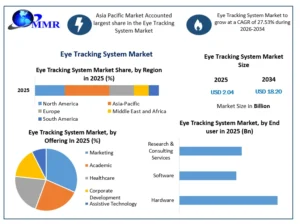
To know about the Research Methodology:-Request Free Sample Report
Innovation aims to limit non-intrusiveness, decrease the amount of time for recognition, increase predictive analysis capability, and make the application more accessible to diverse devices and platforms. In this regard, a few programs (e.g., desktop-based eye trackers intended for research, basic gaze interaction programs) have matured to the point that they will be characterized as commonplace was used for academic and commercial research. The past decade included several advancing improvements in AI and machine learning (ML); user intent and cognitive states prediction and recognition processing improvements; the prevalence of wearables and embedded eye trackers (e.g., AR/VR headsets); and most importantly improvements to standardised cloud data processing and analysis of the ubiquity of features made possible by accessing and analysing large datasets and gaze data. Some of the more advanced concepts (e.g. emotion identification using pupillometry; links with biometric sensors; and privacy safe in-vehicle monitoring are other sources of acceleration of sophistication and diversification in eye tracking technology.
North America, as the largest segment of the market, benefit from leading technology companies, elevated R&D spending, and early adoption across many sectors, including healthcare, aerospace, and gaming. The Asia Pacific segment builds off of ongoing growth in automotive facilities, and other technology developments, particularly performances in China, Japan and South Korea. As well, both consumer electronics trends and government encouragements related to assistive technology and smart transportation will multiply effects in these markets. Asia Pacific also demonstrates the potential for growth because of increases in tech literacy and heightened digitalization. Market entities include traditional technology companies, for example Tobii AB, SR Research Ltd., and EyeTracking Inc, and other technology organizations that specialize in the area, for instance Seeing Machines and Pupil Labs, and compete along a number of characteristics including: technology accuracy, integration and ease of use, and specificity in design by area of expertise (i.e. automotive safety, academic research, or clinical diagnostics).
Eye Tracking System Market Dynamics
Utilization of eye tracking system in healthcare to drive the Eye Tracking System Market Growth
Eye tracking systems are another category of valuable tools that are utilized in the health sector and will have substantial influence on patient care as well as assistive technologies. Thanks to eye tracking, these individuals utilize different devices operated by gaze-based interfaces to communicate and engage with their environment. Eye tracking systems read eye movements, and through translation of these towards commands, people with limitations on mobility can regain an extent of freedom. The eye tracking system industry includes the uptake of eye tracking systems in assistive technologies (e.g., controlling wheelchairs). Gaze-controlled wheelchairs enable motor-disabled individuals to navigate by using sensors which detecting gaze, and move in the preferred direction. Eye movements can be tracked to steer the wheelchair, and commands for acceleration and braking can also be performed. Such technology not only enhances mobility but also helps to install a level of independence in users, perhaps even those who needed to have physical support just to move. Further, eye tracking technologies have also been wholly transformative in terms of people who suffer from conditions like ALS (Amyotrophic Lateral Sclerosis) or locked-in syndrome when it comes to using devices for communication. These devices allow individuals to select letters, words, or phrases on the computer screen using only their eyes to transform their intention into text or speech. This is of great importance to people who might have been able to develop speech loss or paralysis of other body parts, meaning that Eye Tracking System Market is driving this growth.
In addition to assistive mobility and communication, the application of eye tracking differs throughout several domains in the field of health care, especially for diagnostics and research. Scientists and health care practitioners have been using eye tracking technology to gain insight into the study of visual attention and gaze behavior patterns in different clinical conditions. For example, in neurology, eye tracking is used to develop an understanding of and diagnose movement disorders such as Parkinson's disease, as well as attention-deficit/hyperactivity disorder (ADHD). In this way, the technology provides objective measures of visual attention outcomes and potential questions derived from cognitive processes behind designing more valid diagnostic tools. Thus, the inclusion of eye tracking into such health care spaces could help fuel growth of both the eye tracking system and market.
Growing technological advancements to drive the Eye Tracking Market Growth
The rapid evolution of technology is a key factor in the rising demand for the eye tracking systems market. Eye tracking systems have made substantial developments since the past – not only are they notably more accurate and quicker, but also generally less expensive. Several eye tracking technologies which used to be cumbersome, were not only expensive but also required difficult calibration methods. The introduction of high-resolution cameras, which often use infrared/near-infrared light, has improved eye tracking accuracy substantially. These cameras can capture micro saccades and fixations with more accuracy than any other eye movement detection devices. In addition, the use of infrared calibrated light sources has also improved eye-tracker system-based tracking performance. Upon using infrared light, tracking properties improved under available light making many eye tracker systems reliable and useful across environments.
Non-Intrusive Eye Tracking to Boost Eye Tracking Market Growth
Another notable trend in the Eye Tracking System Market is the introduction of remote systems. These systems allow for non-intrusive eye movement tracking from a distance, thus negating the need for technology headsets. Remote eye tracking has the potential to broaden the applications of eye tracking technology to a variety of real-world contexts, ranging from retail applications and automotive design, providing a more natural and less constrained user experience; all of those aforementioned features greatly contribute to the growth of the Eye Tracking System Market. The innovation of compactness and improvements in power performance have led to eye tracking solutions that are portable and can be included in other devices with ease. The development of eye tracking features in consumer devices such as laptops and smartphones has made this technology even more ubiquitous.
Global Eye Tracking System Market Segment Analysis
Based on the type of eye tracking system, the remote eye tracking system segment accounted for the largest Eye Tracking System Market share in 2025 and is projected to retain this lead throughout the projection period. Remote eye tracking systems allow for monitoring users which is a non-intrusive method, letting users facilitate movement without needing contact with the tracking device. Remote eye tracking systems can be adopted for a multitude of uses, from market research & advertising to healthcare and the automotive industry, giving the technology broad applicability for both workplace and public settings. Remote eye tracking also caters to a shifting demand for lesser obtrusive and more user-friendly and accessible technological solutions. The technology allows for eye movements to be captured with distance, even with sophisticated camera and infrared technologies. This further promotes usability and application for real-world use cases. As companies focusing on non-intrusive and adaptable eye tracking systems to track eye movements become increasingly common, it is forecasted that remote eye tracking systems will continue to be at the forefront for the duration of the projection period.

Based on the end user, the healthcare category held the highest revenue share in the Eye Tracking System Market in 2025, and is expected to continue to hold the highest revenue share over the forecast period. This is due to the importance of eye tracking in advanced medical research, patient care, and assistive technologies, and in different types of neurological conditions. Eye tracking systems provide accurate and non-invasive capability to assist with early detection and monitoring, and are useful for cognitive processes, eye studies of visual perception, and improving methods of rehabilitation. While monitoring patient outcomes, the healthcare industry is focusing on working on technologies that improve patient outcomes, adoption of these types of eye tracking systems will grow, illustrating the healthcare category's dominance in the Eye Tracking System Market throughout the forecast period.
Eye Tracking System Market Recent Development
| Date | Company | Development | Impact |
| 06 January 2025 | Smart Eye | Smart Eye showcased its next-generation Human Insight AI portfolio at CES 2025, featuring the award-winning Sheila AI Co-Driver and new 3D Depth Sensing for in-cabin safety. | The lineup enhances in-cabin safety and driver monitoring compliance for global OEMs aligning with Euro NCAP and U.S. FMVSS safety standards. |
| 17 January 2025 | Play For Dream Technology / Tobii | Play For Dream Technology announced a strategic partnership with Tobii at CES 2025 to integrate Tobii's XR5 eye tracking technology into its spatial computing MR headset. | This integration establishes new benchmarks for spatial computing and foveated rendering across enterprise, healthcare, and industrial simulation applications. |
| 26 May 2025 | Prophesee / Tobii | Prophesee partnered with Tobii to co-develop an ultra-fast, event-based eye tracking solution designed specifically for compact AR/VR smart eyewear. | Combining event-based vision with attention computing significantly reduces power consumption and latency for battery-constrained wearable devices. |
| 03 June 2025 | Tobii / Dynavox Group | Tobii extended its long-term supply contract with Dynavox Group for five years, secured by a SEK 100 million volume deal for specialized eye-tracking hardware components. | The deal cements Tobii's position as a primary OEM supplier while accelerating adoption of eye-gaze assistive communication technology. |
| 13 November 2025 | Seeing Machines | Seeing Machines launched its "attention sharing" distraction detection feature within the Guardian Generation 3 driver monitoring system for commercial fleets. | By tracking brief cumulative off-road glances in real time, the technology improves fleet safety interventions and reduces collision risks. |
| 10 December 2025 | HarmonEyes | HarmonEyes acquired iFocus Health to integrate objective eye-movement tracking tools into its AI-driven cognitive assessment platform. | The acquisition expands camera-based eye tracking into clinical healthcare and ADHD treatment monitoring at commercial scale. |
Eye Tracking System Market Regional Insights
In 2025, North America held the largest market share and is anticipated to retain the largest Eye Tracking System Market share through the forecast period. This can be attributed to several factors, which include, a solid technological ecosystem, high level of market players in the region, and high rates of adoption of new technologies like eye tracking systems. North America has a markedly strong research and development ecosystem and is known for innovation in eye tracking applications in particular across sectors like healthcare, gaming, and market research. Furthermore, the North America Eye Tracking System Market is undoubtedly supported by a mature consumer electronics industry, resulting in widespread adoption of eye tracking features in devices and applications. Along the same lines, the advanced North American healthcare sector also plays a role, with eye tracking systems being used for diagnostics and as assistive technologies.
The Eye Tracking System Market in Asia-Pacific is projected to record the highest CAGR throughout the forecast period due to factors such as rapid technological advancements and rising investments in R&D activities, especially in countries like China, India, Japan, and South Korea. This keeps driving new innovation and new designs of eye tracking technology. Also, the growing awareness as well as acceptance of eye tracking systems in several applications, including gaming, healthcare, and human-computer interaction, boosts the growth of the Eye Tracking System Market in Asia-Pacific. And there is also a growing market of consumer electronics in countries such as India and China with a growing tech-savvy population, this is increasing the demand for eye tracking features in smartphones, tablets, and other personal devices. Moreover, the healthcare sector in the region is also adopting eye tracking for diagnostics and rehabilitation, all of the mentioned above drives the growth for the Eye Tracking System Market.
Eye Tracking System Market Competitive Landscape:
In the global eye tracking market, the competitive climate is uniquely shaped by the competitive rivalry of two Swedish technology companies, Tobii AB and Smart Eye AB. They are both publicly traded companies making advancements in eye tracking technology, but they take very different strategic paths and market advantages.
Tobii AB has positioned itself as a diversified market leader, targeting a wide range of segments across academia (plot of land), assistive technologies for disabilities, and consumer devices like gaming and computing, with developments of a broader and centered umbrella horizontally for high-end research hardware and original equipment manufacturers for ease and integration. Tobii has a major comfort level with having extensive intellectual property and brand awareness across industries.
In contrast to Tobii, Smart Eye AB is pursuing a vertical strategy in becoming the dominant player in the automotive space with their primary business of providing AI-powered Driver Monitoring Systems (DMS) to large automotive manufacturers. In contrast to Tobii (and possibly other competitors), Smart Eye is singularly focused on one high-volume industry, which has by virtue, has provided them with deep mission-critical knowledge vis-a-vis automotive safety and human-machine interaction. Their growth is now closely tied to the automotive industry's move to adopt safety regulations.
Their competition is uniquely technical leadership. Both companies heavily invest in AI and computer vision technologies, but their motivations differ; Tobii is seeking to innovate for use cases across applications (creative), where Smart Eye invests solely in R&D to achieve ultra-reliability for automotive-grade solutions. In terms of market presence, Tobii appears to have a larger and more diverse global customer base, while Smart Eye has more intimate, deeper relationships in the automotive supply chain. Currently, their strategic paths are more parallel than directly in competition with each other, but going forward, I suspect the competitive overlap will likely increase as Tobii enters deeper automotive spaces past platform and Smart Eye begins to explore other applications beyond automotive.
Eye Tracking System Market Key Developments:
• 2025-06-Tobii-Sweden
Tobii launched Tobii Nexus, a software-only eye tracking platform that operates via standard webcams without additional hardware. It supports diverse users across education, digital collaboration, VR experiences, and behavioural health, offering inclusive, low-computation eye tracking accessible on common devices.
• 2025-06-Tobii-Sweden
Tobii introduced the next-generation IS5 platform featuring a custom EyeSensor with reduced illumination needs, a modular design 60% smaller than its predecessor, up to 75% improved power efficiency for mobile use, and enhanced eye-tracking algorithms for more responsive performance.
Eye Tracking System Market Key Trends:
• Advancement in Software-Only Eye Tracking: Companies like Tobii are innovating with software-only platforms (e.g., Tobii Nexus) that enable eye tracking through standard webcams without extra hardware, expanding accessibility and reducing costs.
• Improved Device Efficiency and User Experience: New hardware platforms, such as Tobii’s IS5 and Gazepoint’s GP3, focus on enhanced power efficiency, compact designs, and addressing user concerns (e.g., device warmth), highlighting the emphasis on better performance and comfort in eye tracking technology.
Scope of the Global Eye Tracking System Market: Inquire before buying
| Global Eye Tracking System Market | |||
|---|---|---|---|
| Report Coverage | Details | ||
| Base Year: | 2025 | Forecast Period: | 2026-2034 |
| Historical Data: | 2020 to 2025 | Market Size in 2025: | USD 2.04 Bn. |
| Forecast Period 2026 to 2034 CAGR: | 27.53% | Market Size in 2034: | USD 18.20 Bn. |
| Segments Covered: | by Type | Remote Eye Trackers Head-Mounted Eye Trackers Electrooculography (EOG) Eye Trackers |
|
| by Offering | Hardware Software Research & Consulting Services |
||
| by Location | Remote Mobile |
||
| by End-User | Marketing Academic Healthcare Corporate Development Assistive Technology |
||
Eye Tracking System Market, by Region
North America (United States, Canada and Mexico)
Europe (UK, France, Germany, Italy, Spain, Sweden, Austria and Rest of Europe)
Asia Pacific (China, South Korea, Japan, India, Australia, Indonesia, Malaysia, Vietnam, Taiwan, Bangladesh, Pakistan and Rest of APAC)
Middle East and Africa (South Africa, GCC, Egypt, Nigeria and Rest of ME&A)
South America (Brazil, Argentina Rest of South America)
Eye Tracking System Market, Key Players
North America
1. SR Research Ltd. (Canada)
2. iMotions A/S (Denmark, major US operations)
3. Gazepoint Research Inc. (Canada)
4. EyeTracking Inc. (USA)
5. LC Technologies, Inc. (USA)
6. Positive Science LLC (USA)
7. Applied Science Laboratories (ASL) (USA)
8. Pupil Labs GmbH (Germany)
9. Lattice Semiconductor (Canada)
10. Eyetech Digital Systems (USA)
Europe
1. Tobii AB (Sweden)
2. Smart Eye AB (Sweden)
3. Ergoneers GmbH (Germany)
4. Noldus Information Technology (Netherlands)
5. Eye Square (Germany)
6. Metavision (France) (Meta's VR division, R&D in eye tracking)
7. PlaySys (Spain)
8. ISCAN, Inc. (USA)
Asia-Pacific
1. Seeing Machines Ltd. (Australia)
2. Tencent (China) (R&D for gaming/AI)
3. Huawei Technologies Co., Ltd. (China)
4. Samsung Electronics (South Korea)
Frequently Asked Questions
1. Which region has the largest share in the Global Eye Tracking System Market?
Ans: The Asia Pacific region held the highest share in the Global Eye Tracking System Market in 2025.
2. What is the growth rate of the Global Eye Tracking System Market?
Ans: The Global Eye Tracking System Market is growing at a CAGR of 29.79% during the forecasting period 2026-2034.
3. What is the scope of the Global Eye Tracking System Market report?
Ans: The Global Eye Tracking System Market report helps with the PESTEL, PORTER, Recommendations for Investors & Leaders, and market estimation of the forecast period.
4. Who are the key players in the Global Eye Tracking System Market?
Ans: iMotions A/S (Denmark, major US operations), Eyegaze Inc. (United States), SR Research (Canada), EyeTech Digital Systems, Inc. (United States), LC Technologies, Inc. (United States), Gazepoint Research Inc. (Canada) are key players in market.
5. What is the study period of this Eye Tracking System Market?
Ans: The Global Eye Tracking System Market is studied from 2026 to 2034.