
eClinical Solutions Market Size by Product, Mode of Delivery, Clinical Trial, End-User, Region, Industry-Wide Analysis, Competitive Landscape Assessment & Long-Term Forecast to 2034
Overview
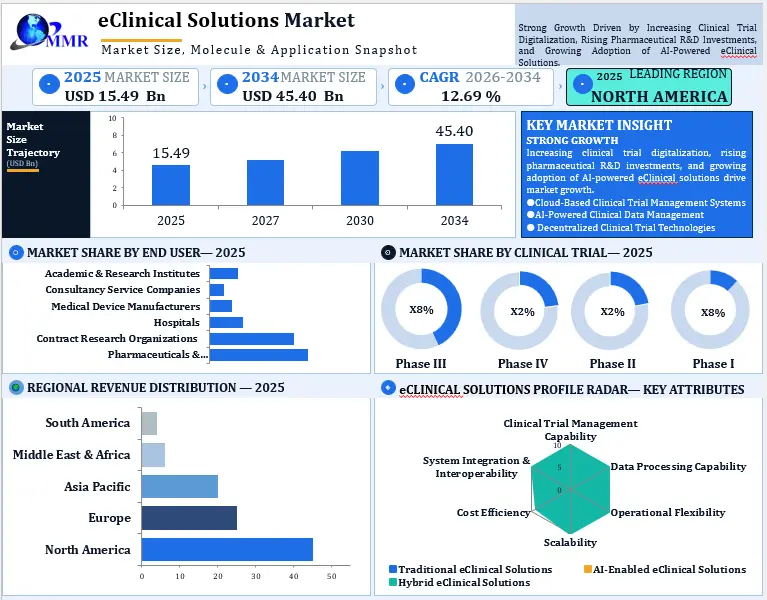
The eClinical Solutions Market was valued at USD 15.49 Bn in 2025, and the total revenue of the eClinical Solutions Market is expected to grow at a CAGR of 12.69% from 2026 to 2034, reaching USD 45.40 Bn by 2034.
eClinical Solutions Market Overview
The eClinical Solutions Market refers to the global industry comprising software platforms, digital tools, and related services used to plan, conduct, manage, monitor, and analyze clinical trials. These solutions include Electronic Data Capture (EDC), Clinical Trial Management Systems (CTMS), Clinical Data Management Systems (CDMS), Electronic Clinical Outcome Assessment (eCOA), Electronic Trial Master File (eTMF), Randomization and Trial Supply Management (RTSM), electronic consent, clinical data integration, and clinical analytics. These technologies enable pharmaceutical companies, biotechnology firms, CROs, hospitals, and research institutions to streamline clinical research workflows, enhance data integrity, reduce manual errors, and support compliance with clinical research regulations.
eClinical solutions are software and services designed to streamline clinical trials, including electronic data capture (EDC), clinical trial management systems (CTMS) and ePRO tools.
The eClinical solutions market growing due to the rising volume of clinical trials and stringent regulatory requirements, which necessitated efficient data management and compliance. Demand surged as pharmaceutical firms and CROs adopted digital solutions, while supply expanded with advancements in AI, cloud computing and decentralised trial models.
North America dominated, holding 45% revenue share in 2025, by robust R&D investments and high chronic disease prevalence. Also, Europe followed with strong regulatory frameworks and CRO partnerships. Key players like Oracle, Medidata and Veeva Systems led through technological innovation and strategic acquisitions. The market was further shaped by pharmaceutical companies as primary end-users, by data security concerns and high implementation costs posed challenges. Regulatory shifts, including FDA and EMA digital trial guidelines, also influenced adoption trends.
Global eClinical Solutions Market Highlights:
1.Strong Market Growth: Rising pharmaceutical R&D investment and clinical trial digitalization accelerate global eClinical Solutions Market growth.
2. AI-Powered Clinical Trials: Artificial intelligence, machine learning, and clinical data analytics improve trial efficiency and data accuracy.
3. Cloud-Based Solutions Dominate: Cloud-based EDC, CTMS, and clinical data management software enhance scalability, interoperability, and real-time collaboration.
4. North America Leads the Market: Advanced clinical research infrastructure, major CROs, and strong pharmaceutical investment support regional market leadership.
5. Decentralized Clinical Trials Create Opportunities: Growing adoption of eCOA, eConsent, remote patient monitoring, and real-world evidence solutions drives innovation in digital clinical research.
eclinical Solutions Market Growth and Share Analysis
To know about the Research Methodology :- Request Free Sample Report
eClinical Solutions Market Dynamics
Global eClinical Solutions Market Driver:
Increasing Clinical Trials and Digital Transformation in Clinical Research: The eClinical Solutions Market experiences strong growth as pharmaceutical companies, biotechnology firms, and Contract Research Organizations (CROs) increasingly adopt digital clinical trial management systems to improve research efficiency, data accuracy, and regulatory compliance. The growing volume of clinical trials, rising demand for precision medicine, and expansion of decentralized clinical trials increase the need for Electronic Data Capture (EDC), Clinical Trial Management Systems (CTMS), Electronic Trial Master Files (eTMF), and clinical data management solutions. Regulatory requirements for data integrity, audit trails, electronic records, and patient safety further encourage the adoption of eClinical software. Artificial intelligence (AI), machine learning, cloud computing, and real-time clinical data analytics strengthen clinical trial automation, streamline study monitoring, and accelerate drug development. The increasing outsourcing of clinical research to CROs also drives demand for integrated eClinical platforms that support collaboration among sponsors, investigators, research sites, and clinical data teams.
Global eClinical Solutions Market Restraint:
High Implementation Costs and Complex System Integration: High implementation costs remain a major restraint in the eClinical Solutions Market, particularly for small and medium-sized pharmaceutical companies, emerging biotechnology firms, and smaller CROs. The deployment of clinical trial management software, electronic data capture systems, cloud infrastructure, cybersecurity tools, and regulatory-compliant data platforms requires substantial investment in licensing, customization, employee training, and ongoing maintenance. Integration of eClinical software with legacy clinical databases, electronic health records (EHRs), laboratory information management systems (LIMS), and other clinical research platforms can increase implementation time and operational complexity. Limited technical expertise, inconsistent digital infrastructure, and resistance to transitioning from paper-based clinical trial processes also slow adoption in developing markets. These factors can delay implementation and restrict access to advanced clinical data management solutions, despite their long-term efficiency benefits.
Global eClinical Solutions Market Opportunity:
AI-Powered Clinical Data Management and Decentralized Clinical Trials: The eClinical Solutions Market offers significant growth opportunities through artificial intelligence in clinical trials, cloud-based clinical research platforms, decentralized clinical trials (DCTs), and real-world evidence (RWE) analytics. AI-powered clinical data review, automated data reconciliation, predictive analytics, and risk-based quality management help pharmaceutical companies identify discrepancies, improve data quality, and optimize clinical trial operations. Growing demand for electronic patient-reported outcomes (ePRO), electronic clinical outcome assessments (eCOA), electronic informed consent (eConsent), and remote patient monitoring creates opportunities for vendors to develop integrated, patient-centric clinical trial solutions. Emerging markets also present expansion opportunities as healthcare digitization, clinical research outsourcing, and pharmaceutical research investments increase. In October 2025, the U.S. Food and Drug Administration (FDA) published a guidance snapshot for decentralized clinical trials, reinforcing regulatory attention to remote trial activities and participant accessibility. This supports opportunities for eClinical technology providers offering compliant digital trial management and remote data collection capabilities.
Global eClinical Solutions Market Challenge:
Data Security, Patient Privacy, and Regulatory Compliance: Data security and patient privacy remain critical challenges for the global eClinical Solutions Market because clinical trial platforms process sensitive patient health information, electronic medical records, genomic data, and confidential pharmaceutical research data. Cybersecurity threats, unauthorized access, data breaches, and inadequate access controls increase the need for secure cloud infrastructure, encryption, identity management, and continuous monitoring. Compliance with regulations and standards such as FDA 21 CFR Part 11, Good Clinical Practice (GCP), HIPAA, GDPR, and applicable regional data protection laws adds complexity to global clinical trial operations. Multinational clinical trials require consistent data governance across jurisdictions with different privacy and electronic-record requirements. Furthermore, AI-generated insights require appropriate validation, explainability, and human oversight to maintain data integrity and regulatory confidence. In September 2024, the FDA issued final guidance on conducting clinical trials with decentralized elements, addressing oversight, participant safety, and trial-data integrity. These requirements reinforce the importance of reliable, secure, and compliant eClinical software.
Global eClinical Solutions Market Trend:
AI Integration, Cloud-Based Platforms, and Clinical Trial Automation: The eClinical Solutions Market is moving toward AI-enabled clinical data management, unified clinical data platforms, cloud-based CTMS, automated clinical data review, and connected clinical trial ecosystems. Pharmaceutical companies and CROs increasingly prioritize interoperable solutions that integrate electronic data capture, clinical trial management, electronic trial master files, safety databases, and clinical analytics within a unified environment. Risk-based quality management (RBQM), real-time data monitoring, predictive analytics, and automated data validation help improve clinical trial visibility and operational efficiency. Decentralized and hybrid clinical trials also increase the use of wearable devices, telehealth, remote patient monitoring, eConsent, and eCOA technologies.
A notable industry development occurred in December 2025, when eClinical Solutions announced AI agents for its elluminate Clinical Data Cloud, covering data mapping, data review, risk-based quality management, and study operations. The announcement highlights the shift toward governed AI and clinical data automation, while maintaining explainability and human supervision
eClinical Solutions Market Segment Analysis
Based on End-User, Pharmaceutical and biopharmaceutical companies segment dominated the eClinical Solutions Market in 2025,driving the demand for comprehensive eClinical solutions. The eClinical Solutions industry's influence on shaping eClinical trends is significant, with a focus on innovation and efficiency in trial management. CROs play a pivotal role in the eClinical Solutions Market, often forming strategic partnerships with solution providers to enhance their service offerings. The dynamics of the CRO segment influence eClinical solution features, emphasising collaboration and data sharing. Hospitals are increasingly adopting eClinical solutions, particularly for late-phase trials and real-world evidence generation.
As hospitals become more integral in clinical research, the eClinical Solutions Market has the opportunity to increase its reach and impact. Medical device manufacturers have unique requirements, leading to the development of specialised eClinical solutions catering to their specific needs. Ongoing innovation focuses on addressing the distinct challenges faced by medical device manufacturers in the clinical trial process. Consultancy service companies often play an advisory role in guiding organisations through the selection and implementation of eClinical solutions.
Based On Clinical Trial Phase is segmented into Phase I, Phase II, Phase III, and Phase IV, collectively accounting for 100% of the estimated market share in 2025. Phase III dominates with an estimated share of 43%, driven by the growing need for electronic data capture (EDC), clinical trial management systems (CTMS), clinical data management, patient safety monitoring, and regulatory-compliant data processing in large-scale, multicenter clinical trials. Phase II accounts for approximately 22%, supported by increasing demand for patient recruitment, randomization, dosage optimization, and clinical data analysis. Phase IV represents an estimated 23%, driven by post-marketing surveillance, pharmacovigilance, real-world evidence (RWE), and long-term safety monitoring, while Phase I holds approximately 12%, reflecting demand for early-stage safety assessments, dose evaluation, and pharmacokinetic data management.
eClinical Solutions Market Regional Insights
North America led the worldwide market and accounted for the biggest revenue share of 45% in 2025, owing to the rising incidence of cardiovascular and respiratory disorders, technical developments in ECMO technology, and increased use of ECMO systems. According to the Centers for Disease Control and Prevention (CDC), 659,000 individuals in the United States would die from heart disease, accounting for one out of every four fatalities. In addition, about 805,000 people in the United States experience heart attacks. The region's requirement for Extracorporeal Membrane Oxygenation (ECMO) is also growing owing to the increased adoption of new technological goods and changes in lifestyle choices that result in chronic diseases such as cardiac and respiratory ailments.
An increase in the number of improvements and sophisticated technology in these Extracorporeal Membrane Oxygenation (ECMO) devices, as well as an increase in public awareness of their many applications, has resulted in a significant quantity of output for hospitals. Additionally, in the United States, high blood pressure, obesity, type 2 diabetes, and poor eating habits have all increased the number of instances of cardiovascular disease. ECMO (extracorporeal membrane oxygenation) has the potential to reduce the number of in-hospital mortalities.
Europe represents a significant share of the global eClinical Solutions Market in 2025, supported by increasing clinical research activities, a strong pharmaceutical and biotechnology industry, and growing adoption of digital clinical trial management systems. Countries such as Germany, the United Kingdom, France, and Switzerland contribute to regional demand through pharmaceutical innovation, clinical research outsourcing, and investment in clinical data management technologies. The European Medicines Agency (EMA) and the EU Clinical Trials Regulation support standardized clinical trial processes, while the Clinical Trials Information System (CTIS) facilitates the submission and oversight of clinical trial applications across the European Union. Increasing adoption of Electronic Data Capture (EDC), Clinical Trial Management Systems (CTMS), electronic Trial Master Files (eTMF), and cloud-based clinical research platforms strengthens market development. However, GDPR compliance, data privacy requirements, and differences in national healthcare systems continue to influence implementation strategies.
Asia Pacific is emerging as a high-growth region in the eClinical Solutions Market, driven by increasing clinical trial activity, expanding pharmaceutical and biotechnology industries, large patient populations, and improving healthcare IT infrastructure. China, India, Japan, South Korea, and Australia contribute to regional demand through clinical research outsourcing, multinational clinical trials, and increasing adoption of electronic data capture (EDC), clinical trial management systems (CTMS), and cloud-based clinical data management platforms. Pharmaceutical companies and Contract Research Organizations (CROs) increasingly implement digital clinical trial solutions to improve patient recruitment, data accuracy, research productivity, and regulatory compliance.
South America is witnessing gradual growth in the eClinical Solutions Market as pharmaceutical companies, biotechnology firms, and CROs expand clinical research operations and adopt digital clinical trial technologies. Brazil and Argentina are important markets for clinical research, while Mexico is generally classified within Latin America rather than South America. Increasing demand for electronic data capture, clinical trial management software, remote patient monitoring, and clinical data analytics supports regional market development. Improvements in healthcare infrastructure, internet connectivity, regulatory processes, and collaboration with global pharmaceutical sponsors create opportunities for eClinical software providers. However, differences in regulatory requirements, limited digital resources at some research sites, implementation costs, and shortages of specialized IT expertise can restrict adoption. The expansion of cloud-based clinical research platforms and decentralized clinical trials offers further opportunities to improve research efficiency and support multinational clinical studies.
The Middle East & Africa eClinical Solutions Market is expanding as governments, healthcare providers, pharmaceutical companies, and research institutions invest in healthcare modernization and clinical research infrastructure. Saudi Arabia and the United Arab Emirates support regional growth through healthcare digitalization initiatives and investment in research capabilities, while South Africa remains an important clinical research destination due to its established trial-site network. Rising adoption of electronic data capture (EDC), clinical trial management systems (CTMS), electronic trial master files (eTMF), and cloud-based clinical data management solutions strengthens market demand. Increasing participation in multinational clinical trials and the growing focus on patient-centric research create opportunities for international eClinical technology providers. Nevertheless, limited digital infrastructure in some African markets, data privacy concerns, high implementation costs, and variations in regulatory frameworks continue to challenge adoption. Continued investment in clinical research capabilities and secure digital health infrastructure is expected to support long-term regional market growth.

eClinical Solutions Market Competitive Landscape
The eClinical solutions market is highly competitive, with key players such as Oracle Corporation, Medidata Solutions, Veeva Systems, ICON plc and Parexel International Corporation dominating the industry. Companies are led by their advanced technological innovations, strategic acquisitions and strong global presence.
Oracle Corporation focuses on an integrated cloud-based eClinical suite, leveraging AI and machine learning for real-time data analytics. Veeva Systems focuses on end-to-end clinical trial management, with a strong emphasis on regulatory compliance and Vault CDMS. ICON plc leads in data-driven clinical research, integrating AI for faster trial execution, while Parexel emphasises patient-centric trials with adaptive designs and real-world evidence (RWE) integration.
Medidata, a Dassault Systèmes company and a leading eClinical Solutions market share holder, has prolonged its partnership with Catalyst Clinical Research to support the global oncology brand, Catalyst Oncology. This partnership renewal includes the use of Medidata Rave EDC, Rave CTMS, and Rave eTMF, along with additional offerings like Medidata Grants Manager and Medidata AI Intelligent Trials. The collaboration enables Catalyst to run complex clinical trials efficiently, streamline workflows, automate document management, and enhance visibility into critical trial metrics. Catalyst, a prominent manufacturer in the eClinical Solutions market, has managed over 150 oncology studies and currently oversees more than 80 next-generation cancer clinical trials across Phases I-III.
| No. | Company | Headquarters / regional origin | Key eClinical solutions and specialization | Competitive position |
| 1 | Medidata Solutions | USA / North America | EDC, CTMS, eCOA, clinical data analytics | Global leader |
| 2 | Veeva Systems | USA / North America | Vault EDC, CTMS, eTMF, clinical operations | Global leader |
| 3 | Oracle Life Sciences | USA / North America | Clinical data management, CTMS, trial analytics | Global leader |
| 4 | IQVIA | USA / North America | Clinical technology, data analytics, clinical trial services | Global leader |
| 5 | ICON plc | Ireland / Europe | Clinical trial technology and CRO services | Global-scale competitor |
| 6 | Signant Health | USA / North America | eCOA, eConsent, decentralized trial technology | Major specialist |
| 7 | Clario | USA / North America | Clinical endpoint data, imaging, cardiac safety | Major specialist |
| 8 | Medable | USA / North America | Decentralized trials, eCOA, patient engagement | Major specialist |
eClinical Solutions Market Key Trends
| Trend | Description | Impact on Market |
| Decentralised Clinical Trials (DCTs) | Remote monitoring, telehealth, and digital patient engagement tools reduce site visits. | Increases trial efficiency, patient recruitment, and retention. |
| AI & Machine Learning Integration | AI-driven analytics for patient matching, risk prediction, and real-time data insights. | Speeds up trial timelines, reduces costs, and improves accuracy. |
| Cloud-Based eClinical Platforms | Shift from on-premise to SaaS solutions for scalability and remote access. | Enhances collaboration, data security, and regulatory compliance. |
Eclinical Solutions Industry Ecosystem:

eClinical Solutions Market Scope: Inquire before buying
| eClinical Solutions Market | |||
|---|---|---|---|
| Report Coverage | Details | ||
| Base Year: | 2025 | Forecast Period: | 2026-2034 |
| Historical Data: | 2020 to 2025 | Market Size in 2025: | 15.49 USD Billion |
| Forecast Period 2026-2034 CAGR: | 12.69% | Market Size in 2034: | 45.40 USD Billion |
| Segments Covered: | by Product | Electronic Data Capture (EDC) Clinical Data Management Systems (CDMS) Clinical Trial Management Systems (CTMS) Randomization and Trial Supply Management (RTSM) Electronic Patient Reported Outcomes (ePRO) Electronic Clinical Outcome Assessment (eCOA) Clinical Analytics Platforms Clinical Data Integration Platforms eConsent Safety Solutions (pharmacovigilance platforms) Regulatory Information Management (RIM) Risk-Based Monitoring (RBM) Electronic Trial Master File (eTMF) Wearable/Remote Monitoring Devices Integration Artificial Intelligence/Machine Learning in eClinical Others |
|
| by Mode of Delivery | Web-hosted (On-demand) Licensed Enterprise (On-premise) Cloud-based (SaaS) |
||
| by Clinical Trial | Phase I Phase II Phase III Phase IV |
||
| by Application | Data Collection Document Management & Storage Supply Management Data Analytics Clinical Trial Operations Regulatory Information Management Other Applications |
||
| by End-User | Pharmaceuticals & Biopharmaceutical Companies Contract Research Organizers Hospitals Medical Device Manufacturer Consultancy Service Companies Academic & Research Institutes |
||
eClinical Solutions Market, by Region
North America (United States, Canada, and Mexico)
Europe (UK, France, Germany, Italy, Spain, Sweden, Austria, and the Rest of Europe)
Asia Pacific (China, South Korea, Japan, India, Australia, ASEAN, Indonesia, Philippines, Malaysia, Vietnam, Thailand, ASEAN, Rest of Asia Pacific)
Middle East & Africa (South Africa, GCC, Nigeria, Rest of ME&A)
South America (Brazil, Argentina, Rest of South America)
eClinical Solutions Market, Key Players
1. Medidata Solutions
2. Oracle Corporation
3. Veeva Systems
4. Parexel International Corporation
5. PRA Health Sciences
6. Medrio, Inc.
7. eClinicalWorks
8. IBM Corporation
9. Bio-Optronics, Inc.
10. Datatrak International, Inc.
11. Bioclinica (Clario)
12. CRF Health (Signant Health)
13. IQVIA Inc.
14. Anju Software, Inc.
15. OpenClinica, LLC
16. MasterControl, Inc.
17. ClinCapture, Inc.
18. Medable, Inc.
19. Castor EDC
20. Saama Technologies, Inc.
21. OmniComm Systems, Inc.
22. Forte Research Systems, Inc.
23. TransPerfect Life Sciences
24. Perceptive (formerly Calyx)
25. Genedata
26. Clinipace
27. ERT Clinical (Clario)
28. Datamed
29. Tigermed
30. CMIC Holdings Co., Ltd.
31. ClinOne, Inc.
32. Viedoc Technologies
33. 4G Clinical
34. Suvoda LLC
35. Kayentis
36. Florence Healthcare
37. WCG Clinical
38. Curebase
39. Science 37
40. THREAD Research
41. ObvioHealth
42. Jeeva Clinical Trials
43. Climedo Health
44. Healthentia
45. CRScube
46. Novotech
47. George Clinical
48. Fortrea Holdings Inc.
49. Ergomed Group
50. MaxisIT
51. Anju Software
52. Fountayn
53. Clinion
54. EvidentIQ
55. Ennov
56. Mednet Solutions
57. YPrime, LLC
58. Merge Healthcare (IBM)
59. ArisGlobal
60. Calyx
Frequently Asked Questions:
1. What are eClinical Solutions, and how are they used in clinical trials?
Ans. eClinical solutions are digital platforms and software applications used to manage clinical trial planning, patient data collection, clinical data analysis, regulatory documentation, safety monitoring, and clinical research operations. Key technologies include Electronic Data Capture (EDC), Clinical Trial Management Systems (CTMS), Electronic Trial Master Files (eTMF), and Electronic Clinical Outcome Assessment (eCOA).
2. What are the major factors driving eClinical Solutions Market growth?
Ans. Key eClinical Solutions Market growth drivers include increasing clinical trial activity, rising pharmaceutical and biotechnology R&D expenditure, growing clinical research outsourcing, stricter regulatory compliance requirements, and increasing adoption of cloud-based clinical trial software and AI-enabled data management platforms.
3. Which product segment dominates the eClinical Solutions Market?
Ans. Clinical Trial Management Systems (CTMS) represent a leading product segment, supported by demand for clinical trial planning, site management, study monitoring, resource allocation, and regulatory-compliant clinical operations. Segment leadership varies across market research methodologies and product definitions.
4. Which delivery mode dominates the global eClinical Solutions Market?
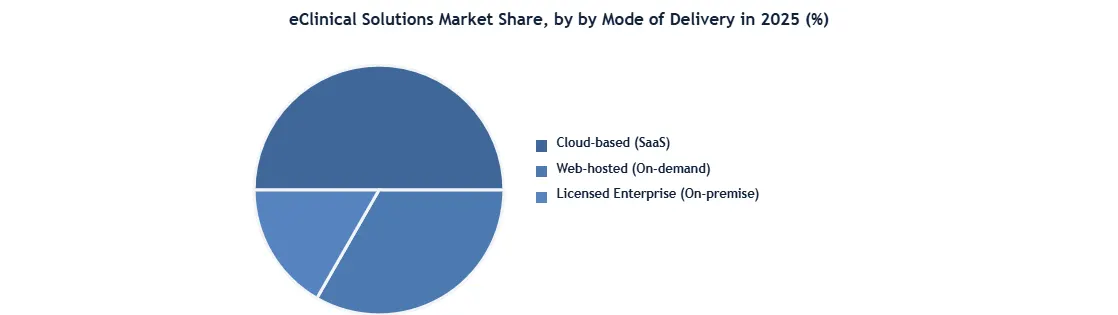
Ans. Cloud-based and web-based eClinical solutions dominate adoption because they offer scalable clinical data storage, remote accessibility, real-time collaboration, system integration, and lower upfront infrastructure requirements. Grand View Research reports that cloud and web-based solutions account for 91.3% of market revenue in 2025.
5. Which end-user segment dominates the eClinical Solutions Market?
Ans. Contract Research Organizations (CROs) represent a major end-user segment as pharmaceutical and biotechnology companies outsource clinical trial management, data management, monitoring, and research operations to specialized service providers. CRO adoption supports demand for integrated CTMS, EDC, eTMF, and clinical data analytics platforms.
6. Which region dominates the global eClinical Solutions Market?
Ans. North America dominates the global eClinical Solutions Market, supported by substantial pharmaceutical R&D expenditure, established clinical research infrastructure, strong CRO presence, advanced healthcare IT adoption, and regulatory emphasis on clinical data integrity.