
Drone Sensor Market 2025–2032: Sensor Fusion, Precision Sensing Systems, and AI Integration Accelerating Market Expansion
Overview
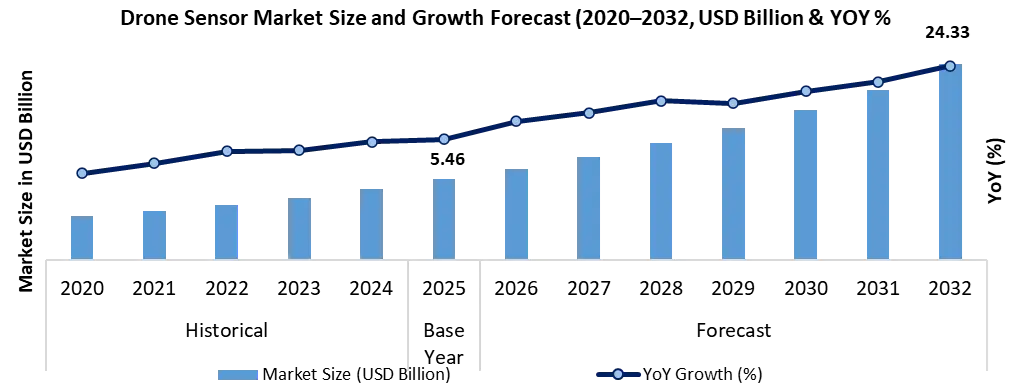
The Global Drone Sensor Market is experiencing robust expansion, driven by the accelerating adoption of advanced UAV sensor technologies, AI-enabled sensing systems, and real-time data intelligence platforms across multiple sectors. The market was valued at USD 5.46 billion in 2025 and is expected to reach USD 24.33 billion by 2032, registering a strong CAGR of 23.5%. This growth is primarily fueled by rising demand for high-precision navigation, autonomous drone operations, and multi-sensor data acquisition in applications such as precision agriculture, defense & surveillance, infrastructure monitoring, environmental sensing, and smart city development.
To know about the Research Methodology:-Request Free Sample Report
The Drone Sensor Market Size and Share are driven by increasing deployment of AI-enabled UAV sensors, multi-sensor fusion platforms, and real-time data intelligence systems across industrial and defense applications. The accelerated deployment of autonomous UAV systems, AI-powered anomaly detection, and digital twin integration is enhancing inspection accuracy, minimising operational risks, and optimising asset lifecycle management.
Drone Sensor Market Key Highlights:
| Market Parameter | Value / Insight | Trend |
| Global Drone Sensor Market Size (2025) | USD 5.46 Billion | ↑ Strong Growth |
| Projected Market Size (2032) | USD 24.33 Billion | ↑ Accelerating Expansion |
| Forecast CAGR (2025–2032) | 23.50% | ↑ High Growth Momentum |
| Regulatory Landscape | Expansion of standardized drone regulations & BVLOS approvals | ↑ Enabling Adoption |
| Dominant Sensor Type (2025) | Inertial Sensors | ↑ Market Leader |
| Leading Technology | AI-enabled sensors, sensor fusion & edge computing integration | ↑ Transformational Growth |
| Multi-Sensor Integration | LiDAR, thermal, multispectral, and GNSS are widely integrated | ↑ Rapid Adoption |
| Industry Adoption | High across defense, agriculture, infrastructure & energy sectors | ↑ Strong Demand |
| Supply Chain Trends | Localization of sensor manufacturing reduces costs | ↑ Efficiency Improvement |
| Market Competition | Entry of mid-size & niche sensor providers | ↑ Increasing Competition |
Key Market Drivers for the Drone Sensor Market
The Drone Sensor Market is driven by the growing need for high-accuracy data capture and intelligent sensing capabilities across industrial applications. Increasing deployment of drones in precision agriculture, infrastructure diagnostics, and environmental monitoring is fueling demand for advanced sensors. For example, farmers use multispectral sensors for crop stress analysis, while construction firms rely on LiDAR sensors for terrain mapping and volumetric analysis. Additionally, the shift toward autonomous UAV operations and sensor-driven analytics is strengthening the role of advanced sensing technologies in improving operational productivity and decision-making.
Restraints for the Drone Sensor Market
The Drone Sensor Market faces constraints due to high integration complexity and the cost of advanced sensor payloads, particularly for technologies such as LiDAR and hyperspectral imaging. Smaller enterprises often struggle with affordability and system compatibility. For instance, deploying high-end sensors for mining surveys or industrial inspections significantly increases overall project costs. Moreover, environmental limitations such as signal interference, low visibility, and sensor calibration challenges can affect performance, while the need for specialized technical expertise poses additional barriers to widespread adoption.
Opportunities for the Drone Sensor Market
Significant opportunities in the Drone Sensor Market are emerging from the rapid evolution of AI-enabled sensing technologies, advanced sensor miniaturisation (MEMS), and multi-sensor fusion systems. The increasing demand for high-resolution data acquisition and real-time analytics across sectors such as renewable energy, smart infrastructure, and environmental monitoring is creating strong growth potential.
The rise of edge computing sensors, next-generation GNSS technologies, and low-power high-performance sensors is enabling scalable deployment of drones in complex and data-intensive applications. AI-enabled sensing platforms and low-power MEMS-based architectures are expected to support double-digit adoption growth across precision agriculture, energy inspection, and smart infrastructure applications during the forecast period.
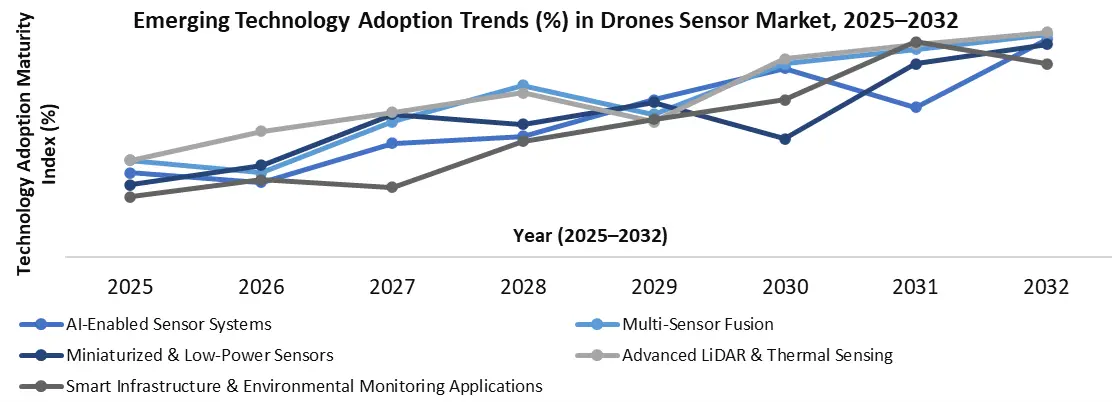
Emerging Trends Shaping the Drone Sensor Industry
AI-Enabled Sensor Systems
The integration of artificial intelligence into drone sensors is enhancing real-time data processing and decision-making. These systems can:
• Process sensor data at the edge (onboard processing)
• Enable real-time object detection and classification
• Improve accuracy through adaptive learning algorithms
Multi-Sensor Fusion Technology
The market is witnessing a shift toward integrated sensing platforms combining multiple sensor types. These systems enable:
• High-precision navigation using GNSS + IMU + vision sensors
• Improved reliability through data redundancy
• Enhanced performance in complex or GPS-denied environments
Miniaturization & Low-Power Sensor Development
Advancements in MEMS technology are driving the development of compact and energy-efficient sensors. This enables:
• Increased payload efficiency in drones
• An extended flight time through reduced power consumption
• Wider adoption in nano and micro-UAVs
Next-generation sensors are enabling high-precision data capture across industries. Key capabilities include:
• LiDAR for 3D mapping and terrain modelling
• Thermal sensors for heat detection and fault analysis
• Multispectral sensors for environmental and agricultural insights
Smart Infrastructure & Environmental Monitoring Applications
Drone sensors are playing a critical role in enabling intelligent monitoring solutions across sectors. Applications include:
• Smart city planning and traffic monitoring
• Environmental and pollution analysis
• Disaster management and risk assessment
Autonomous Sensing & AI-Driven Decision-Making
A key trend in the Drone Sensor Market is the adoption of semi-autonomous and fully autonomous sensor operations. Advanced drones are now equipped with AI-enabled sensors, obstacle detection modules, and predictive analytics algorithms, reducing dependency on manual monitoring.
This capability allows drones to continuously collect high-precision sensor data such as thermal anomalies, structural defects, or environmental changes rather than relying on periodic inspections. By detecting micro-level faults or deviations early, sensor-equipped drones enhance asset reliability, reduce downtime, and optimize maintenance cycles.
AI-assisted sensor analytics further enable real-time classification, anomaly detection, and predictive insights, transforming raw sensor outputs into actionable intelligence for industries such as energy, infrastructure, mining, and agriculture. This shift is driving a move from reactive interventions to proactive, data-driven decision-making.
Sensor Data Integration & Enterprise Systems
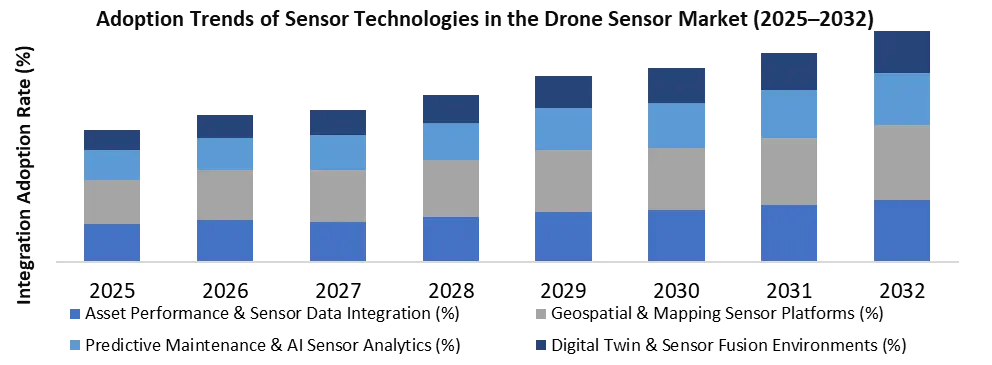
The value of drone sensors is increasingly realized through integration with enterprise digital ecosystems. Sensor data is being fed directly into business-critical systems, enabling actionable insights and operational efficiency.
Key integrations include:
• Asset performance management systems – leveraging sensor readings for predictive maintenance
• Geospatial intelligence platforms – combining LiDAR, multispectral, and GNSS data for precise mapping
• Digital twin environments – creating real-time digital replicas of physical assets
Cloud-based platforms and API-driven sensor architectures are enabling real-time sharing of sensor data across departments, fostering cross-functional collaboration, and supporting scalable deployment of intelligent sensor networks.
Shift Toward High-Precision & Multi-Sensor Integration Systems
The Drone Sensor Market is witnessing a significant transition from standalone sensing components to high-precision, multi-sensor integration platforms. Modern UAVs increasingly incorporate inertial sensors, image sensors, LiDAR, thermal sensors, multispectral sensors, and gas detection sensors to enable advanced capabilities such as real-time analytics, high-resolution mapping, and autonomous navigation. This multi-sensor fusion approach enhances data accuracy, reliability, and operational efficiency across applications, including precision agriculture, infrastructure monitoring, defense surveillance, and industrial inspection. Furthermore, integration with AI-powered analytics, 3D modeling, and digital twin technologies is enabling predictive insights, real-time decision-making, and next-generation UAV intelligence, driving strong drone sensor market growth.
Operational Efficiency & Workforce Transformation
The adoption of advanced drone sensor technologies is transforming operational efficiency and workforce dynamics across industries. Compared to traditional systems, sensor-enabled UAVs offer real-time data acquisition, reduced operational downtime, enhanced safety, and cost-efficient monitoring solutions. This shift is accelerating the transition from manual, labor-intensive processes to automated, data-driven workflows powered by AI and sensor analytics. As a result, organizations are increasingly reallocating resources toward data analysis, mission planning, and strategic decision-making. Additionally, the rising demand for skilled drone operators, sensor engineers, and AI/data specialists is fostering a new ecosystem within the UAV sensor industry, supporting long-term market expansion and digital transformation.
Drone Sensor Market Segment Analysis
In the Global drone sensor market, inertial sensors dominate with the largest share (30–35%), driven by their critical role in UAV flight stabilization, navigation, and control across commercial and defense drones. Image sensors follow with a significant share (~20–25%), supported by increasing demand for aerial imaging, surveillance, and drone inspection applications across industries such as agriculture, infrastructure, and media. LiDAR sensors are witnessing rapid growth due to their high-precision 3D mapping and terrain modeling capabilities, making them essential for surveying and autonomous navigation. GNSS/position sensors enable accurate positioning and navigation, particularly with advancements such as RTK and PPP. Meanwhile, radar sensors are gaining importance in defense and advanced UAV applications for reliable, all-weather detection and long-range sensing. Overall, advancements in sensor fusion, AI integration, and miniaturization are driving innovation in the drone sensor market.
Defense & Security remains the leading end-use industry in 2025, supported by rising demand for surveillance-grade imaging, inertial navigation, and radar-based sensing systems, while Agriculture & Forestry is emerging as a high-growth segment due to multispectral and thermal sensor adoption.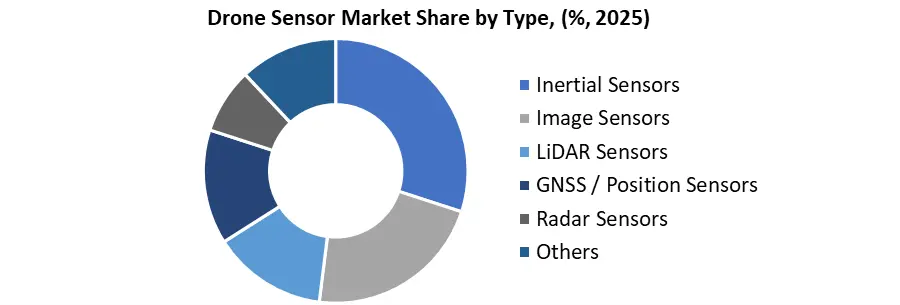
Drone Sensor Market Regional Insights
North America leads the Drone Sensor Market with ~35–40% share, driven by strong adoption of AI-enabled UAV sensors and autonomous drone systems. The United States contributes ~75–80% of regional revenue, supported by defense spending and demand for precision agriculture, while Canada holds ~20–25%. Advanced use of LiDAR, thermal, and GNSS sensors drives market growth.
Europe accounts for a significant share of the Drone Sensor Market, supported by strict regulatory frameworks and sustainability initiatives. Germany, the United Kingdom, and France lead regional demand. Growth is driven by applications in environmental monitoring, infrastructure inspection, and renewable energy, boosting the adoption of multispectral, LiDAR, and gas sensors.
Asia-Pacific is the fastest-growing region in the Drone Sensor Market, with China leading, followed by India, Japan, and South Korea. Growth is driven by smart cities, precision agriculture, and surveillance applications, increasing demand for AI-powered, LiDAR, and imaging sensors.
South America represents an emerging market for drone sensors, led by Brazil and Argentina, where adoption is increasing across agriculture, mining, and infrastructure inspection. Demand is supported by growing use of imaging, thermal, and GNSS sensors for cost-efficient aerial monitoring
Drone Sensor Market Competitive Landscape
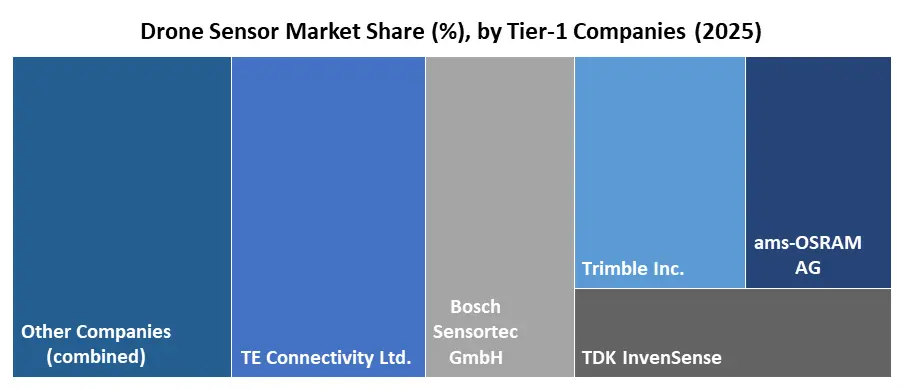
The Global Drone Sensor Market competitive landscape is highly dynamic, with companies focusing on sensor miniaturization, AI-enabled analytics, multi-sensor fusion, and real-time data processing capabilities. The market is driven by increasing demand for autonomous flight, precision navigation, and advanced imaging technologies across commercial and defense technologies.
Leading players include:
- TE Connectivity Ltd. – Leader in industrial-grade pressure, environmental, and connectivity sensors for UAV platforms
- Bosch Sensortec GmbH – Specialist in MEMS-based inertial sensors (IMUs) for drone stabilization and navigation
- Sony Semiconductor Solutions Corporation – Leader in high-resolution CMOS image sensors for aerial imaging and surveillance
- Trimble Inc. – Provider of advanced GNSS, positioning, and LiDAR solutions for mapping and surveying drones
- Teledyne Technologies Incorporated – Specialist in EO/IR and thermal imaging sensors for defense and industrial drone technologies
- TDK InvenSense – Key player in gyroscopes and motion sensors for flight control and obstacle detection
- ams-OSRAM AG – Provider of optical, infrared, and multispectral sensors for imaging and environmental monitoring
- Ouster, Inc. – Leader in digital LiDAR sensors for 3D mapping and autonomous navigation.
Recent Key Development:
| Date | Company | Development | Impact |
| Jun-25 | Ouster, Inc. | Received U.S. DoD approval for OS1 digital LiDAR under the Blue UAS framework | Strengthens position in defense drone programs and increases adoption of LiDAR sensors |
| Feb-25 | Ondas Holdings | Partnered with Volatus Aerospace to deploy LiDAR-equipped drones | Expands commercial drone sensor Technologies in surveillance and border security |
| Jul-24 | Inertial Labs | Collaborated with ideaForge for LiDAR-integrated UAV mapping solutions | Enhances high-precision mapping capabilities and boosts demand for integrated sensors |
| May-25 | Sony Semiconductor Solutions Corporation | Partnered with Swift Navigation for centimeter-level positioning solutions | Improves drone navigation accuracy and supports autonomous flight adoption |
| Mar-25 | TE Connectivity Ltd. | Expanded rugged sensor portfolio for UAV Technologies | Strengthens industrial and defense drone sensor reliability |
| Apr-25 | Teledyne Technologies Incorporated | Advanced thermal imaging sensors for UAV surveillance | Boosts adoption in security, defense, and inspection technologies |
| Jan-25 | Trimble Inc. | Enhanced GNSS and LiDAR integration for drone mapping | Improves geospatial data accuracy and strengthens surveying technologies |
Drone Sensor Market Scope: Inquire before buying
| Drone Sensor Market | |||
|---|---|---|---|
| Report Coverage | Details | ||
| Base Year: | 2025 | Forecast Period: | 2026-2032 |
| Historical Data: | 2020 to 2025 | Market Size in 2025: | USD 5.46 Bn. |
| Forecast Period 2026 to 2032 CAGR: | 23.5% | Market Size in 2032: | USD 24.33 Bn. |
| Segments Covered: | by Type | Inertial Sensors Image Sensors LiDAR Sensors Radar Sensors GNSS / Position Sensors Others |
|
| by Platform Type | Fixed-Wing Rotary-Wing (Multi-rotor) VTOL Hybrid Nano / Micro Drones Others |
||
| by Technology | MEMS Sensors AI-enabled Sensors Fiber Optic Sensors Edge Computing Sensors Others |
||
| by End-Use Industry | Defense & Security Agriculture & Forestry Energy & Utilities Construction & Mining Logistics & Warehousing Others (Consumer, media, telecom) |
||
North America (United States, Canada, and Mexico)
Europe (UK, France, Germany, Italy, Spain, Sweden, Austria, and the Rest of Europe)
Asia Pacific (China, South Korea, Japan, India, Australia, Indonesia, Malaysia, Vietnam, Taiwan, Bangladesh, Pakistan, and the Rest of APAC)
Middle East and Africa (South Africa, GCC, Egypt, Nigeria, and the Rest of ME&A)
South America (Brazil, Argentina, and, the rest of South America)
Key Players/Competitors Profiles Covered in the Drone Sensor Market Report in Strategic Perspective
Core Drone Sensor Market Leaders
1. Bosch Sensortec
2. Sony Semiconductor Solutions Corporation
3. TE Connectivity
4. InvenSense
5. Ouster
6. Trimble Inc.
7. Teledyne Technologies
8. Sparton Corporation
9. KVH Industries
10. Garmin Ltd.
11. u-blox AG
12. ams-OSRAM AG
13. OMNIVISION
14. LeddarTech
15. Infineon Technologies AG
16. Septentrio N.V.
MEMS / IMU / Motion Sensor Specialists
17. Analog Devices
18. STMicroelectronics
19. Murata Manufacturing
20. Honeywell Aerospace
21. Safran Electronics & Defense
22. Northrop Grumman
23. Thales Group
24. LORD MicroStrain
25. VectorNav Technologies
26. SBG Systems
27. Xsens
28. mCube
LiDAR Sensor & Mapping Companies
29. Velodyne LiDAR
30. RoboSense
31. SICK AG
32. RIEGL
33. Leica Geosystems
34. FARO Technologies
35. YellowScan
36. Phoenix LiDAR Systems
37. Cepton Technologies
38. Luminar Technologies
39. Innoviz Technologies
40. Ainstein
41. Benewake
Imaging / EO-IR Sensor Companies
42. Teledyne FLIR
43. Canon Inc.
44. Panasonic Corporation
45. Hikvision
46. Axis Communications
Specialized & Emerging Sensor Companies
47. Hottinger Brüel & Kjær
48. RTX Corporation
49. Drone Nerds
50. Sensirion
51. Sentera
52. SlantRange
53. Yost Labs
54. GreenValley International
55. GeoCue Group
56. Topodrone