
Telecommunication Market by Product, Service Type, Application, Transmission, and Region - Segment-Level Market Assessment, Growth Opportunity Analysis, Competitive Mapping & Forecast to 2034
Overview
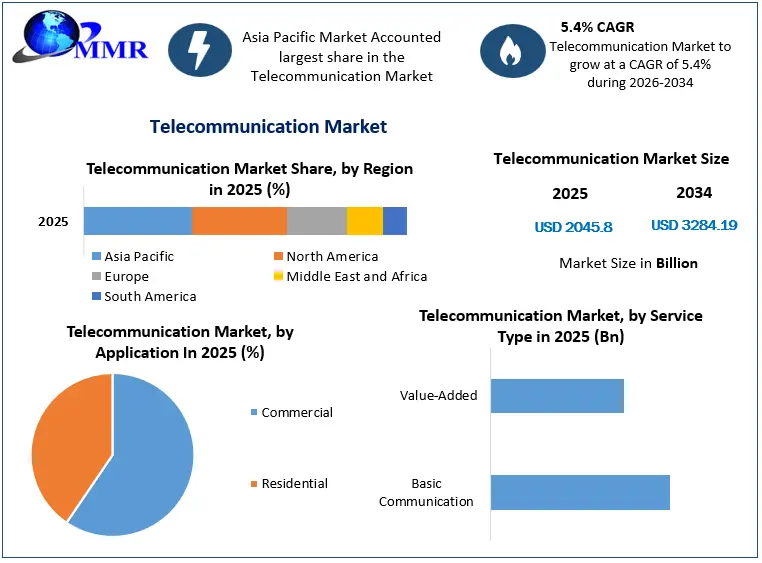
Global Telecommunication Market size was valued at USD 2045.8 Bn. in 2025 and the total revenue is expected to grow at a CAGR of 5.4% through 2026 to 2034, reaching nearly USD 3284.19 Bn.
Global Telecommunication Market Overview:
The Global telecommunications market was valued at USD 2045.8 Bn. in 2025, and it is expected to reach USD 3284.19 Bn. by 2034 with a CAGR of 5.4% during the forecast period. Telecommunication is the process of delivering data, voice, images, and other types of information via the electrical or light-emitting medium. Telecommunication is a broad term that encompasses a wide range of information-transmission technologies such as landlines, cell phones, VoIP networks, and broadcast networks. Telecommunications is the process of connecting and managing remote computer systems across a network.
This report analyzes the Telecommunication Market as the 2026 Middle East crisis triggers a strategic overhaul of global network resilience. With the Strait of Hormuz disruption driving crude oil, the industry is facing a dual challenge of surging infrastructure energy costs and heightened state-sponsored cyber threats. We explore the accelerated shift toward sovereign cloud architectures and agentic AI-driven network automation to bypass geopolitical vulnerabilities. By evaluating the pivot from basic connectivity to mission-critical 5G-Advanced and satellite-hybrid models, this study provides stakeholders with frameworks to maintain service continuity and digital sovereignty in an era of unprecedented maritime and digital instability.
Telecommunication Market Analysis from 2025 to 2034
To know about the Research Methodology :- Request Free Sample Report
Global Telecommunication Market Dynamics:
One of the key factors driving this market is rising investment in 5G infrastructure deployment due to a shift in customer preference toward next-generation technologies and Smartphone devices. Other potential drivers boosting the market growth include a rising number of mobile users, a growing need for high-speed data connectivity, and rising demand for value-added managed services.
The industry's product offering only speech and visual signals in the form of facsimile or telegraphs through wired infrastructure in the late nineteenth century to the current scenario of sharing audio, video, and text content across many wireless infrastructures. From the Global System for Mobile Communications (GSM) and Code Division Multiple Access (CDMA) to Third Generation (3G), Fourth Generation (4G), and now the commercialization of Fifth Generation (5G) networks, the market for telecom services has seen considerable advances in data speeds. The introduction of data connectivity has reduced the time it takes to send significant amounts of data from days to hours.
Customers choose Over-The-Top (OTT) channels in today's digital age for a multitude of reasons, the most significant of which is the quantity of viewing alternatives and cost given. Video, music, and other media content is delivered over the internet through OTT solution providers. They are usually not restricted by price agreements and have a limited number of viewing options. Netflix, Amazon Video, Roku, Hotstar, HBO, and others are examples of OTT applications.
OTT applications and content are becoming increasingly familiar to both consumers and marketers. Furthermore, Smartphone display and sound quality, open-source platforms, and super-fast Internet Protocol (IP) networks, among other innovative services, act as motivators to attract more consumers to OTT providers' 'freemium based business models, resulting in an ever-increasing adoption rate and boosting the market growth.
Global Telecommunication Market Segment Analysis:
Based on the Product, the market is segmented into Mobile Data, Mobile Voice, Fixed Data, Fixed Voice, and Others. The Mobile Data segment is expected to hold the largest market share by 2034. This can be related to the increased popularity of smartphones among consumers. Over the projected period, the rapidly growing demand for high-speed broadband services for business and household applications is expected to enhance the segment's growth. Furthermore, the data services industry is expected to rise due to a large demand for online 4K UHD films and online cloud gaming.
Based on the Transmission, the market is segmented into Wireline and Wireless. The wireless transmission segment is expected to grow rapidly during the forecast period 2026-2034. The adoption of cloud computing, artificial intelligence, and the Internet of Things is expected to have a significant impact on the global growth of wireless communication channels. Wireless Local Area Networks (WLANs) have been rapidly deployed in private residences, public spaces, airports, office buildings, cafeterias, and other venues throughout the years, enabling internet access via cellular devices. This type of wireless densification is thought to be advantageous in terms of simplifying work procedures and automating typical test actions.
Global Telecommunication Market Regional Insights:
The Asia Pacific dominates the Global telecommunications market during the forecast period 2026-2034. The Asia Pacific is expected to hold the largest market share by 2034. E-commerce and retailer buy-in platforms, Smartphone ubiquity, and investments in 5G networks are driving the regional market. China, Japan, and India have all contributed significantly to regional market growth. China and India were listed among the top internet users worldwide in 2020, according to statistics issued by the International Telecommunication Union (ITU), with over 854 million and 560 million users, respectively.
Additionally, increased government initiatives on digital integration through Information Communication Technologies (ICT) are expected to drive the APAC market forward. For example, the Indian government spent more than USD 600 million on the creation of 100 smart city initiatives, with IoT playing a key part in making such towns "smart." These are the major drivers that boost the growth of this region in the global market during the forecast period 2026-2034.
Recent Industry Developments
| Exact Date | Company | Development | Impact |
|---|---|---|---|
| 23 February 2026 | Vodafone, Orange, Telefónica, Deutsche Telekom, and TIM | The consortium launched the first pan-European federated Edge Continuum at MWC 2026, enabling seamless application deployment across a combined European footprint. | This initiative strengthens European digital sovereignty and provides enterprises with a unified entry point for low-latency cross-border services. |
| 11 February 2026 | T-Mobile US | The company reported adding 7.8 million postpaid customers in 2025, the highest annual gain in its history, and launched real-time translation for phone calls. | This record growth intensifies competitive pressure on AT&T and Verizon by demonstrating the success of T-Mobile’s aggressive 5G-led customer acquisition strategy. |
| 30 January 2026 | NTT DOCOMO | The operator entered a strategic partnership with Aduna to expand global network API access, facilitating developer interaction with carrier capabilities. | The move accelerates the monetization of 5G infrastructure by simplifying how third-party applications integrate with core telecom network functions. |
| 19 December 2025 | BSNL (with TCS and Tejas Networks) | The Department of Telecommunications confirmed the successful deployment of a fully indigenous 4G technology stack across India, covering 99.9% of districts. | This milestone establishes technological self-reliance for India and creates a scalable model for the future transition to homegrown 5G and 6G. |
| 06 October 2025 | NTT Group | The company announced the planned Q4 2026 commercialization of its photonics-electronics convergence device (PEC-2) in network switches to reduce power consumption by 50%. | This development directly addresses the energy efficiency crisis in data centers driven by the massive expansion of global AI processing. |
The objective of the report is to present a comprehensive analysis of the Global Telecommunication Market to the stakeholders in the industry. The past and current status of the industry with the forecasted market size and trends are presented in the report with the analysis of complicated data in simple language. The report covers all the aspects of the industry with a dedicated study of key players that include market leaders, followers, and new entrants.
PORTER, PESTEL analysis with the potential impact of micro-economic factors of the market have been presented in the report. External as well as internal factors that are supposed to affect the business positively or negatively have been analyzed, which will give a clear futuristic view of the industry to the decision-makers.
The reports also help in understanding the Global Telecommunication Market dynamic, structure by analyzing the market segments and project the Global Telecommunication Market size. Clear representation of competitive analysis of key players by product, price, financial position, product portfolio, growth strategies, and regional presence in the Global Telecommunication Market make the report investor’s guide.
Global Telecommunication Market Scope: Inquire before buying
| Telecommunication Market | |||
|---|---|---|---|
| Report Coverage | Details | ||
| Base Year: | 2025 | Forecast Period: | 2026-2034 |
| Historical Data: | 2020 to 2025 | Market Size in 2025: | 2045.8 USD Billion |
| Forecast Period 2026-2034 CAGR: | 5.4% | Market Size in 2034: | 3284.19 USD Billion |
| Segments Covered: | by Product | Telecommunication Hardware Mobile Devices PBX Equipment Networking Equipment Telecommunication Services Fixed Networking Services Mobile Voice Mobile Data Fixed Data Fixed Voice Mobile Networking Services |
|
| by Service Type | Basic Communication Value-Added |
||
| by Transmission | Wireline Wireless |
||
| by Application | Commercial Residential |
||
Global Telecommunication Market, by Region
North America (United States, Canada and Mexico)
Europe (UK, France, Germany, Italy, Spain, Sweden, Austria and Rest of Europe)
Asia Pacific (China, South Korea, Japan, India, Australia, Indonesia, Malaysia, Vietnam, Taiwan, Bangladesh, Pakistan and Rest of APAC)
Middle East and Africa (South Africa, GCC, Egypt, Nigeria and Rest of ME&A)
South America (Brazil, Argentina Rest of South America)
Key Players / Competitors Profiles Covered in Brief in Global Telecommunication Market Report in Strategic Perspective:
North America
1. AT&T Inc.
2. Verizon Communications Inc.
3. T-Mobile US, Inc.
4. Comcast Corporation
5. Charter Communications, Inc.
6. Rogers Communications Inc.
Europe
7. Deutsche Telekom AG
8. Vodafone Group Plc
9. Telefónica, S.A.
10. Orange S.A.
11. BT Group plc
12. Telenor ASA
13. Telecom Italia S.p.A. (TIM)
14. Swisscom AG
15. Arqiva Limited
16. Turkcell İletişim Hizmetleri A.Ş.
Asia Pacific
17. China Mobile Limited
18. China Telecom Corporation Limited
19. Nippon Telegraph and Telephone Corporation (NTT Group)
20. SoftBank Group Corp.
21. KDDI Corporation
22. KT Corporation
23. SK Telecom Co., Ltd.
24. Singapore Telecommunications Limited (Singtel)
25. Bharti Airtel Limited
26. Reliance Jio Infocomm Limited
27. Axiata Group Berhad
28. Telstra Group Limited
29. Globe Telecom, Inc.
Middle East & Africa
30. Emirates Telecommunications Group Company PJSC
South America
31. América Móvil, S.A.B. de C.V.
Others
Frequently Asked Questions
1. What is the projected Global Telecommunication Market Size and Forecast?
Ans. The market was valued at USD 2045.8 billion in 2025 and is projected to reach USD 3284.19 billion by 2034, maintaining a 5.4% CAGR.
2. Which region leads the Global Telecommunication Market Share Analysis?
Ans. Asia Pacific dominates due to massive smartphone penetration in China and India, coupled with government-led smart city initiatives and aggressive regional 5G network infrastructure investments.
3. What are the primary Global Telecommunication Market Trends 2026?
Ans. Growth is driven by high-speed 5G commercialization, cloud computing integration, and the rising popularity of OTT platforms like Netflix, which demand robust, high-bandwidth wireless connectivity.
4. How is the shift to 5G impacting Industry Growth Drivers?
Ans. 5G deployment catalyzes market expansion by enabling ultra-low latency, supporting IoT ecosystems, and meeting the surging consumer demand for high-speed mobile data and cloud gaming.
5. What role does AI play in the Global Telecommunication Market?
Ans. AI and photonics-electronics convergence are revolutionizing the sector by optimizing network energy efficiency, automating complex troubleshooting, and powering real-time translation services for global mobile users.
6. Which product segment dominates the Global Telecommunication Market?
Ans. The Mobile Data segment holds the largest share, fueled by ubiquitous smartphone usage and the increasing consumption of 4K UHD video content across wireless networks.
7. How are OTT services influencing the telecommunication revenue landscape?
Ans. OTT providers drive data demand through "freemium" models, forcing traditional telcos to evolve into value-added service providers to capture evolving digital media consumption revenue streams.