Dedicated Server Hosting Market - Industry Structure Evaluation, Demand Drivers Analysis, Regional Growth Analysis and Identification, Competitive Positioning / Landscape Review & Global Market Size Forecast to 2032

18.9%
CAGR (2025-2032)
23.96 USD Bn.
Market Size
304
Report Pages
120
Market Tables

Overview

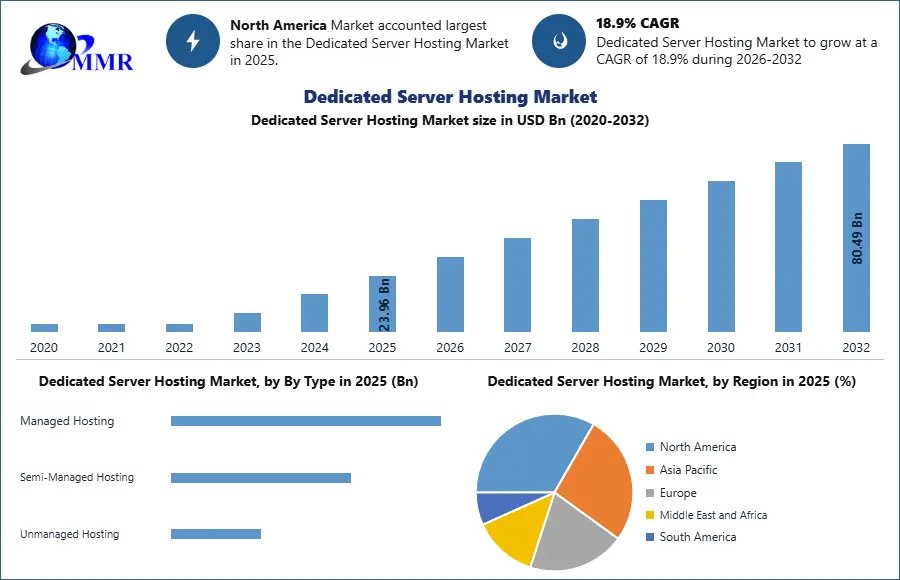
The Dedicated Server Hosting Market was valued at USD 23.96  Bn in 2025, and the total Global Dedicated Server Hosting Market revenue is expected to grow at a CAGR of 18.9% and reach nearly USD 80.49  Bn from 2025 to 2032.

Dedicated Server Hosting Market Overview:

Essentially, dedicated hosting means that a customer's website has access to a separate server. It has great flexibility and power but typically costs more. Along with cloud hosting, dedicated hosting is one of the most potent server types available. If a website is having trouble keeping up with an increase in traffic, dedicated server hosting may be necessary to resolve the problem. The demand for dedicated server hosting is forecast to increase with the growth of the IT and telecommunications sectors. A dedicated server is simply a server that only serves consumer websites. It can enhance site performance, speed up page load times, and help optimize security.Dedicated Server Hosting MarketTo know about the Research Methodology :- Request Free Sample Report
Dedicated Server Hosting Market Dynamics:

Market Drivers

Businesses are concerned about the security of their internet data. With dedicated server hosting, users can take security precautions like software tools and firewalls rather than relying on the hosting service provider to protect the website and apps. Virtualization technology is being more widely used as a result of rising demand from businesses for on-demand services, real-time user interaction, and efficient storage device utilization. The expense of dedicated server hosting is one of the main factors preventing the market from growing as much as shared hosting and virtual private servers. The sourcing market in India is still growing faster than the IT-BPM market.

The technical infrastructures needed to service foreign markets are much more complicated than what software companies have previously encountered. The performance of applications must be consistent across a wide range of PC configurations, thousands of different mobile device kinds, and a wide range of ISPs and mobile carrier networks. While offering more growth potential, this typically implies a distribution of redundant data centers, expensive and specialized scaling technologies, and cloud service integration.

Market Opportunity

Whenever it comes to distributing company online content to the target audience, hosting service providers are essential. Hosting servers make it possible to store website data and online content securely. In shared hosting, users share physical servers and resources like RAM, bandwidth, and storage. As it is shared among several users, the provided disc space and bandwidth are both constrained.

This means that if a user or website hosted by the same server is under attack due to a data breach, it could put other users at risk. On the other hand, dedicated server hosting dedicates the entire server to a single subscriber or one specific organization. The subscriber has complete access to and control over their server, security measures, operating system, hardware, and software while using dedicated server hosting. The subscriber can add their preferred scripts, programs, and applications as needed. Additionally, with shared hosting, the user must depend on the hosting service provider to maintain the protection of the websites and resources.

Market Trends

Application, firewall, and program installations for server security are the responsibility of the hosting company. In contrast, consumers take security precautions when running a dedicated server. Users can add more firewalls or security solutions to their systems to secure the servers and applications they host. Additionally, since a single user receives the entire bandwidth on dedicated servers, problems like traffic congestion or website failures are rare.

During the forecast period, factors such increasing virtualization and an increase in security breaches are expected to fuel the growth of the dedicated server hosting market. Enterprises all across the country are very concerned about online data security. Instead of depending on the hosting service provider, dedicated server hosting allows users to take the security steps such as software tools and firewalls required to safeguard the website and apps.

Virtualization technologies are becoming more widely used as a result of an increase in demand from companies for the provision of on-demand services, real-time user contact, and efficient storage device use. One of the main factors preventing the growth of the dedicated server hosting market is forecast to be the significantly higher costs of dedicated server hosting compared to shared hosting and virtual private servers.

Dedicated Server Hosting Market Segment Analysis:

In 2025, the Managed Hosting segment holds the highest demand in the Dedicated Server Hosting Market. Businesses increasingly prefer managed services as they reduce the need for in-house IT expertise while ensuring security, maintenance, and performance optimization. Semi-Managed Hosting is also witnessing steady adoption, particularly among organizations seeking partial control with limited technical support. Meanwhile, Unmanaged Hosting remains relevant among tech-savvy enterprises that require full control over server configurations, though its adoption is comparatively lower due to higher operational complexity.

Based on Deployment Type, Cloud-Based dedicated hosting emerges as the fastest-growing and most demanded segment in 2025. Organizations are rapidly shifting toward cloud-integrated dedicated servers due to their scalability, flexibility, and cost-efficiency. Hybrid Deployment is also gaining traction, enabling businesses to balance performance and control by combining on-premises and cloud environments. However, On-Premises deployment continues to be utilized in industries requiring strict data security and regulatory compliance, although its growth is relatively moderate compared to cloud-based solutions.

Based on Operating System, Linux-based servers account for the largest market share in 2025 due to their cost-effectiveness, flexibility, and strong support for open-source applications. Windows-based servers are widely adopted in enterprises requiring compatibility with Microsoft applications and enterprise software ecosystems. The Others segment, including customized and niche operating systems, holds a smaller share but serves specialized business requirements.

Dedicated Server Hosting Market
Report Coverage Details
Base Year: 2025 Forecast Period: 2026-2032
Historical Data: 2020 to 2025 Market Size in 2025: 23.96 USD Bn
Forecast Period 2026-2032 CAGR: 18.9% Market Size in 2032: 80.49 USD Bn
Segments Covered: By Type Managed Hosting
Semi-Managed Hosting
Unmanaged Hosting
By Deployment Type On-Premises
Cloud-Based
Hybrid
By Organization Size Small and Medium Enterprises (SMEs)
Large Enterprises
By Operating System Linux
Windows
Others
By Industry Vertical BFSI
IT & Telecom
E-commerce
Healthcare
Government
Gaming
Others

Regional Insights:

Based on Region, North America leads the Dedicated Server Hosting Market in 2025, supported by advanced IT infrastructure, high adoption of cloud technologies, and the presence of major hosting service providers. Asia Pacific is the fastest-growing region, driven by rapid digital transformation, expansion of e-commerce platforms, and increasing internet penetration. Europe shows steady growth with strong regulatory frameworks and enterprise adoption. Meanwhile, regions such as Middle East & Africa and South America exhibit moderate growth, supported by improving digital infrastructure and rising demand for secure hosting solutions.

The objective of the report is to present a comprehensive analysis of the global Dedicated Server Hosting Market to the stakeholders in the industry. The past and current status of the industry with the forecasted market size and trends are presented in the report with the analysis of complicated data in simple language. The report covers all the aspects of the industry with a dedicated study of key players that include market leaders, followers, and new entrants.

PORTER, PESTEL analysis with the potential impact of micro-economic factors of the market have been presented in the report. External as well as internal factors that are supposed to affect the business positively or negatively have been analyzed, which will give a clear futuristic view of the industry to the decision-makers.

The reports also help in understanding the Dedicated Server Hosting Market dynamic, structure by analyzing the market segments and projecting the Dedicated Server Hosting Market size. Clear representation of competitive analysis of key players by Vehicle type, price, financial position, product portfolio, growth strategies, and regional presence in the Dedicated Server Hosting Market make the report investor’s guide.

Dedicated Server Hosting Market Scope:Inquire before buying

Dedicated Server Hosting Market by Region

North America (United States, Canada and Mexico)
Europe (UK, France, Germany, Italy, Spain, Sweden, Austria and Rest of Europe)
Asia Pacific (China, South Korea, Japan, India, Australia, Indonesia, Malaysia, Vietnam, Taiwan, Bangladesh, Pakistan and Rest of APAC)
Middle East and Africa (South Africa, GCC, Egypt, Nigeria and Rest of ME&A)
South America (razil, Argentina Rest of South America)

Key Players

  1. Liquid Web
  2. Atlantic.Net
  3. HostGator
  4. IONOS
  5. Namecheap
  6. Hostwinds
  7. OVHcloud
  8. Hetzner
  9. Cantech
  10. HostingRaja
  11. MilesWeb
  12. Bluehost
  13. Serverwala
  14. Server Basket
  15. Go4hosting
  16. Everdata
  17. HOSTKEY
  18. Leaseweb
  19. Contabo
  20. DigitalOcean
  21. phoenixNAP
  22. Vyom Cloud

Table of Contents

1. Dedicated Server Hosting Market: Market Introduction 1.1. Executive Summary 1.2. Market Size (2025) & Forecast (2026-2032) 1.3. Market Size (USD Million) and Market Share (%) - By Segments, Regions and Country 2. Competitive Landscape 2.1. MMR Competition Matrix 2.2 Competitive Positioning Of Key Players 2.3. Key Players Benchmarking 2.3.1 Company Name 2.3.2 Headquarter 2.3.3 Service Portfolio 2.3.4 Technological Integration & Digitalization 2.3.5 Hosting Management Model 2.3.6 Network Quality & Reliability 2.3.7 Security & Compliance Readiness 2.3.8 Support Quality & Customer Experience 2.3.9 Sustainability & ESG Positioning 2.3.10 Total Cost of Ownership (TCO) 2.3.11 Pricing Competitiveness 2.3.12 Market Share (%) 2025 2.3.13 Revenue, 2025 2.3.14 R&D Investment 2.3.15 Global Reach 2.4. Market Structure 2.4.1 Market Leaders 2.4.2 Market Followers 2.4.3 Emerging Players 2.5. Mergers and Acquisitions Details 2.6. Market Share Analysis (2025) 2.6.1 Global market share by key providers 2.6.2 Regional market share segmentation 2.6.3 Historical market share trends (2020–2025) 2.6.4 Market concentration and competitive intensity 2.7. Strategic Initiatives & Expansion Plans 2.7.1 Recent mergers, acquisitions, and partnerships 2.7.2 Regional and global expansion strategies 2.7.3 Cloud and hybrid deployment adoption initiatives 2.7.4 Product innovation and R&D investment focus 2.8. Pricing Strategy Analysis 2.8.1 Average pricing by hosting type (Managed, Semi-Managed, Unmanaged) 2.8.2 Contract structures, SLAs, and renewal models 2.8.3 Regional price variations and competitive benchmarks 2.8.4 Price vs performance mapping of key providers 2.9. Technology Adoption & Innovation Ranking 2.9.1 AI/automation adoption in server provisioning and monitoring 2.9.2 High-performance GPU server adoption trends 2.9.3 Cloud integration & hybrid deployment adoption 2.9.4 Data center modernization (cooling, PUE, energy efficiency) 3. Dedicated Server Hosting Market Dynamics 3.1 Dedicated Server Hosting Market Trends 3.2. Dedicated Server Hosting Market Dynamics 3.2.1 Drivers 3.2.2 Restraints 3.2.3 Opportunities 3.2.4 Challenges 3.3. PORTER’s Five Forces Analysis 3.4. PESTLE Analysis 4. Deployment & Architecture Analysis 4.1 Adoption patterns of managed, semi-managed, and unmanaged hosting 4.2 On-premises, cloud-based, and hybrid deployment architectures 4.3 Bare metal and cloud-integrated dedicated server models 4.4 Architecture-level performance capability (latency, throughput, redundancy) 4.5 Infrastructure scalability, customization, and flexibility assessment 5. Pricing Architecture & Cost Economics (2025) 5.1 Dedicated server pricing models and contract structures 5.2 Regional pricing benchmarks and service-level cost variation 5.3 Total Cost of Ownership (TCO) comparison vs public cloud IaaS 5.4 Key cost drivers: hardware, bandwidth, licensing, and support 5.5 Price elasticity and affordability trends by organization size 6. Technology & Infrastructure Evolution 6.1 Server hardware evolution: CPUs, storage, memory, and networking 6.2 Adoption of GPU-enabled and high-performance server configurations 6.3 Automation, orchestration, and provisioning technology trends 6.4 Data center efficiency, cooling innovation, and power optimization 6.5 Impact of technology refresh cycles on hosting economics 7. Security, Compliance & Data Sovereignty Analysis 7.1 Security architecture advantages of physical server isolation 7.2 Technical compliance implementation across regulated industries 7.3 Data protection, residency enforcement, and access control mechanisms 7.4 Disaster recovery, backup, and business continuity frameworks 7.5 Operational risk mitigation and SLA enforcement mechanisms 8. End-User & Industry Vertical Demand Analysis 8.1 BFSI workloads and compliance-driven infrastructure demand 8.2 IT & telecom outsourcing, scalability, and latency requirements 8.3 E-commerce traffic volatility and peak-load management needs 8.4 Healthcare data protection and regulated hosting requirements 8.5 Gaming performance sensitivity and regional server demand 9. Buyer Behavior & Decision-Making Framework 9.1 Enterprise buyer personas and procurement workflows 9.2 Vendor evaluation criteria: cost, performance, security, and support 9.3 Migration triggers from cloud and on-prem environments 9.4 Managed vs unmanaged hosting adoption drivers 9.5 Contract duration, renewal patterns, and switching barriers 10. Service-Level & Performance Assurance Analysis 10.1 SLA structures, uptime guarantees, and penalty mechanisms 10.2 SLA-backed performance metrics and measurement frameworks 10.3 Incident response, MTTR, and escalation procedures 10.4 Support models, service tiers, and account management structures 10.5 Monitoring, reporting, and service transparency practices 11. Sustainability & ESG Impact 11.1 Data center energy consumption trends and PUE benchmarks 11.2 Renewable energy adoption and carbon reduction initiatives 11.3 Sustainable hosting offerings and green infrastructure strategies 11.4 ESG compliance expectations of enterprise buyers 11.5 Impact of sustainability practices on vendor selection and pricing 12. Cloud and Hybrid Hosting Competition 12.1 Comparison of dedicated server hosting vs. cloud hosting 12.2 Hybrid hosting: combining dedicated and cloud services 12.3 Benefits and limitations of cloud-hosted services 12.4 Cloud adoption trends and impact on dedicated hosting providers 12.5 Market trends: Is cloud replacing dedicated servers in some markets? 13. Dedicated Server Hosting Market: Global Dedicated Server Hosting Market Size and Forecast By Segmentation (By Value in USD Million) (2025-2032) 13.1. Global Dedicated Server Hosting Market Size and Forecast, By Type 13.1.1 Managed Hosting 13.1.2 Semi-Managed Hosting 13.1.3 Unmanaged Hosting 13.2. Global Dedicated Server Hosting Market Size and Forecast, By Deployment Type 13.2.1 On-Premises 13.2.2 Cloud-Based 13.2.3 Hybrid 13.3. Global Dedicated Server Hosting Market Size and Forecast, By 13.3.1 Organization Size 13.3.2 Small and Medium Enterprises (SMEs) 13.3.3 Large Enterprises 13.5. Global Dedicated Server Hosting Market Size and Forecast, By Industry Vertical 13.5.1 BFSI 13.5.2 IT & Telecom 13.5.3 E-commerce 13.5.4 Healthcare 13.5.5 Government 13.5.6 Gaming 13.5.7 Others 13.6. Global Dedicated Server Hosting Market Size and Forecast, By Region 13.6.1 North America 13.6.2 Europe 13.6.3 Asia Pacific 13.6.4 Middle East and Africa 13.6.5 South America 14. North America Dedicated Server Hosting Market Size and Forecast By Segmentation (By Value USD Million) (2025-2032) 14.1. North America Market Size and Forecast, By Type 14.2. North America Market Size and Forecast, By Deployment Type 14.3. North America Market Size and Forecast, By Operating System 14.4. North America Market Size and Forecast, By Organization Size 14.5. North America Market Size and Forecast, By Industry Vertical 14.6. North America Market Size and Forecast, By Country 14.6.1 United States 14.6.2 United States Market Size and Forecast, By Type 14.6.3 United States Market Size and Forecast, By Deployment Type 14.6.4 United States Market Size and Forecast, By Operating System 14.6.5 United States Market Size and Forecast, By Organization Size 14.6.6 United States Market Size and Forecast, By Industry Vertical 14.6.7 Canada 14.6.8 Mexico 15 Europe Dedicated Server Hosting Market Size and Forecast By Segmentation (By Value USD Million) (2025-2032) 15.1. Europe Market Size and Forecast, By Type 15.2. Europe Market Size and Forecast, By Deployment Type 15.3. Europe Market Size and Forecast, By Operating System 15.4. Europe Market Size and Forecast, By Organization Size 15.5. Europe Market Size and Forecast, By Industry Vertical 15.6. Europe Market Size and Forecast, By Country 15.6.1 United Kingdom 15.6.2 France 15.6.3 Germany 15.6.4 Italy 15.6.5 Spain 15.6.6 Sweden 15.6.7 Russia 15.6.8 Rest of Europe 16. Asia Pacific Dedicated Server Hosting Market Size and Forecast By Segmentation (By Value USD Million) (2025-2032) 16.1. Asia Pacific Market Size and Forecast, By Type 16.2. Asia Pacific Market Size and Forecast, By Deployment Type 16.3. Asia Pacific Market Size and Forecast, By Operating System 16.4. Asia Pacific Market Size and Forecast, By Organization Size 16.5. Asia Pacific Market Size and Forecast, By Industry Vertical 16.6. Asia Pacific Market Size and Forecast, By Country 16.6.1 China 16.6.2 S. Korea 16.6.3 India 16.6.4 Japan 16.6.5 Australia 16.6.6 Indonesia 16.6.7 Philippines 16.6.8 Malaysia 16.6.9 Singapore 16.6.10 Rest of Asia Pacific 17. Middle East and Africa Dedicated Server Hosting Market Size and Forecast By Segmentation (By Value USD Million ) (2025-2032) 17.1. Middle East and Africa Market Size and Forecast, By Type 17.2. Middle East and Africa Market Size and Forecast, By Deployment Type 17.3. Middle East and Africa Market Size and Forecast, By Operating System 17.4. Middle East and Africa Market Size and Forecast, By Organization Size 17.5. Middle east and Africa Market Size and Forecast, By Industry Vertical 17.6. Middle East and Africa Market Size and Forecast, By Country 17.6.1 South Africa 17.6.2 GCC 17.6.3 Nigeria 17.6.4 Egypt 17.6.5 Rest of ME&A 18. South America Dedicated Server Hosting Market Size and Forecast By Segmentation (By Value USD Million) (2025-2032) 18.1. South America Market Size and Forecast, By Type 18.2. South America Market Size and Forecast, By Deployment Type 18.3. South America Market Size and Forecast, By Operating System 18.4. South America Market Size and Forecast, By Organization Size 18.5. North America Market Size and Forecast, By Industry Vertical 18.6. South America Market Size and Forecast, By Country 18.6.1 Brazil 18.6.2 Argentina 18.6.3 Colombia 18.6.4 Chile 18.6.5 Rest Of South America 19. Company Profile: Key Players 19.01. Liquid Web 19.01.1 Overview 19.01.2 Business Portfolio 19.01.3 Financial Overview 19.01.4 SWOT Analysis 19.01.5 Strategic Analysis 19.02. Atlantic.Net 19.03. HostGator 19.04. IONOS 19.05. Namecheap 19.06. Hostwinds 19.07. OVHcloud 19.08. Hetzner 19.09. Cantech 19.10. HostingRaja 19.11. MilesWeb 19.12. Bluehost 19.13. Serverwala 19.14. Server Basket 19.15. Go4hosting 19.16. Everdata 19.17. HOSTKEY 19.18. Leaseweb 19.19. Contabo 19.20. DigitalOcean 19.21. phoenixNAP 19.22. Vyom Cloud 19.22.1 Others 20. Key Findings 21. Analyst Recommendations 22. Global Dedicated Server Hosting Market: Research Methodology

Custom Market Research Services

We Will Customise The Research For You, In Case The Report Listed Above Does Not Meet With Your Requirements