
Military Drone Technology Market Size – Industry Structure Evaluation, Demand Drivers Analysis, Regional Growth Analysis and Identification, Competitive Positioning Review & Global Market Size Forecast to 2032
Overview
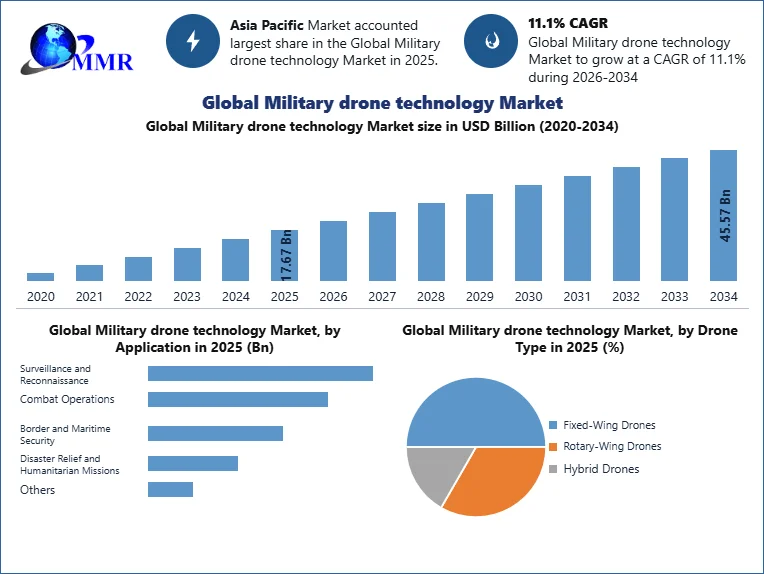
The Military Drone Technology Market size was valued at USD 17.67 Billion in 2025 and the total Military Drone Technology revenue is expected to grow at a CAGR of 11.1% from 2025 to 2034, reaching nearly USD 45.57 Billion by 2034.
Military drone technology Market Overview:
The military drone technology market refers to a global industry that revolves around the development and deployment of military purposes. Military drones are designed to operate semi-autonomously or autonomously with less intervention from humans. Drones are used to perform a wide range of tasks in various fields, including surveillance, reconnaissance, intelligence gathering, target acquisition, combat operations, and other support tasks. One of the significant recent developments in the military drone technology market is the use of AI-powered autonomous drones. These advanced drones are equipped with sophisticated algorithms that enable them to perform complex tasks with minimal human error as this technology needs less human intervention which provides accuracy and precision within the tasks.
To know about the Research Methodology :- Request Free Sample Report
Military drone technology Market Drivers:
Military drones equipped with advanced sensors, such as high-resolution EO/IR cameras and synthetic aperture radar (SAR), provide real-time situational awareness to the military base. This allows for better decision-making and strategic planning during operations. Drones can access hard-to-reach or hazardous areas, allowing armed forces to monitor enemy movements, identify potential threats, and gather critical intelligence without risking the lives of human personnel, boosting the Military Drone Technology market growth and hence reducing collateral damage, minimizing civilian casualties, and improves the overall effectiveness of military operations. The drone can be rapidly deployed, provides quick response to emerging threats, and ensures timely support with ground troops, this efficiency makes them an essential tool for counter-terrorism and counter-insurgency operations, and hence those efficiencies strive their requirement in the market within a forecast period.
Military drone technology Market Restraint
The use of military drones is subject to complex and evolving regulations, both domestically and internationally. Compliance with airspace regulations and adherence to rules of engagement will restrain the operational flexibility of military drone deployments. Concerns about potential misuse or violation of privacy may lead to increased public and governmental scrutiny, resulting in stricter regulations and limitations on drone usage expected to hamper industrial growth through the forecast period. Despite advancements, military drones still face challenges in flight endurance and range, which can limit their operational capabilities, especially for long-range missions and persistent surveillance. Adverse weather conditions, electronic interference, and cyber vulnerabilities are additional factors that will restrain drone performance and reliability in critical situations.
Military Drone Technology Market Challenges:
The production of commercial drones has raised concerns about their potential use by adversaries. And the development of the technology to counter, detect, track, and neutralize hostile drones is a critical challenge for military forces and is expected to be a challenging factor for the military drone market players within the forecast period.
Some adversaries may employ low-cost and low-tech methods, such as using small, agile drones to infiltrate secure areas or disrupt military operations, presenting unique challenges in front of drone defense security. Ensuring secure and reliable communication links between drones and ground control stations is essential to prevent potential cyber-attacks, unauthorized access, or data breaches. Securing data transmitted from drones, including real-time video feeds and sensitive mission data, is crucial to protect military intelligence, and maintaining a strategic advantage is the major challenge for the Military Drone Technology industry manufacturers as drone defense systems are getting advanced features.
Military drone technology Market opportunities:
The integration of artificial intelligence (AI) algorithms enables drones to operate autonomously, making real-time decisions based on sensor inputs and predefined mission objectives. This reduces the workload on human operators and enhances the efficiency and effectiveness of military drone operations. AI-driven image recognition and pattern analysis can improve target identification, reducing the risk of misidentifying civilian objects as potential threats. Continued advancements in sensor technology allow for the integration of multiple payloads on a single drone. For example, combining EO/IR sensors with communication relays or electronic warfare payloads expands the drone's versatility, enabling various mission profiles within a single deployment. Payload miniaturization and improved power efficiency are expected to offer opportunities to enhance the capabilities of the military drone and boost the military drone technology market growth.
Regional Insights:
North America
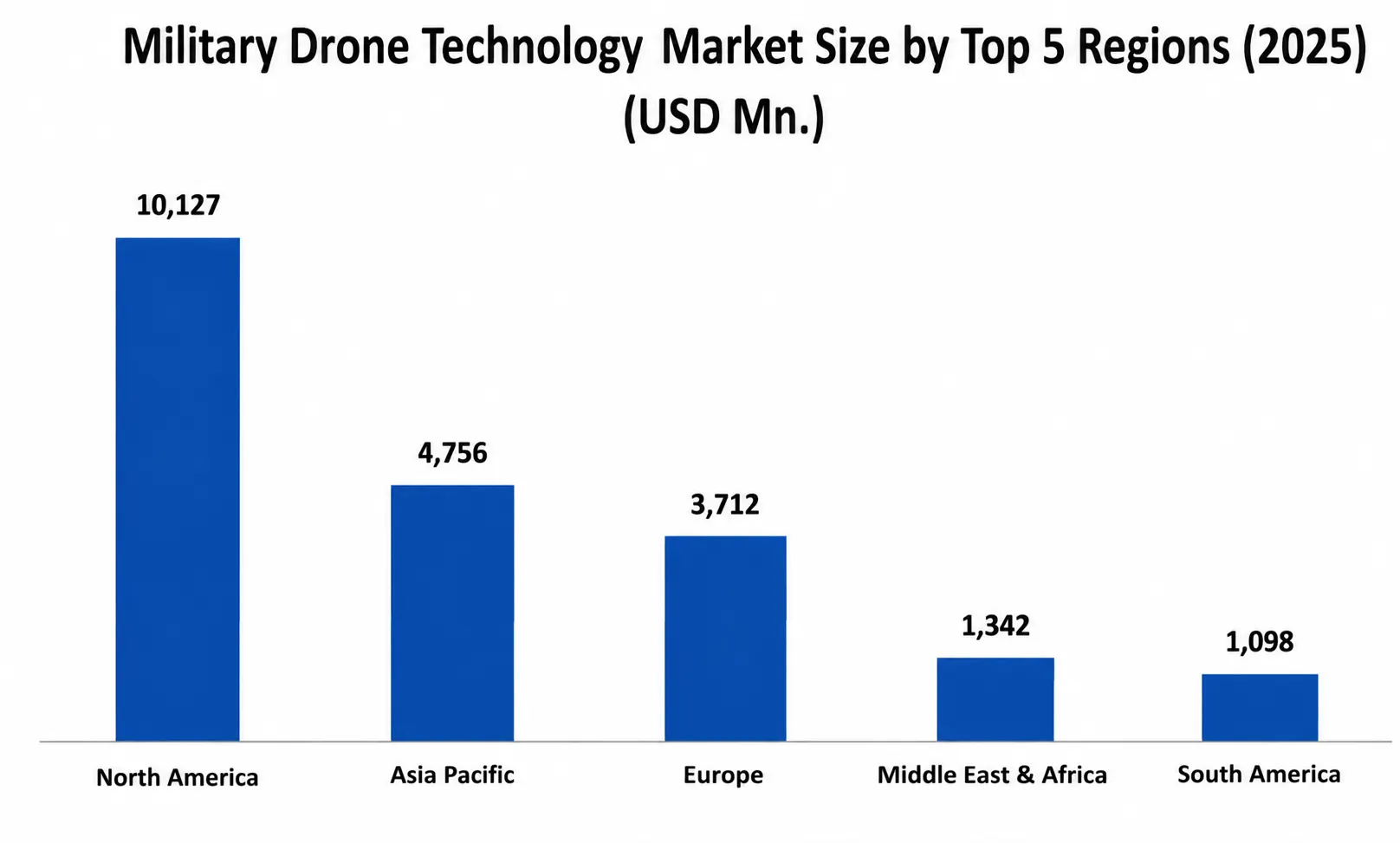
North America dominated the military drone technology market in 2025 and is expected to maintain its leadership throughout the forecast period. The United States continues to lead global military UAV development through substantial investments in autonomous systems, AI-enabled drones, and next-generation unmanned combat aerial vehicles (UCAVs). The U.S. Department of Defense's Replicator Initiative, launched to rapidly field thousands of low-cost autonomous systems, along with increased procurement under the FY2025 defense budget, has significantly accelerated drone deployment across all military branches. Leading defense contractors including General Atomics, Northrop Grumman, Boeing, AeroVironment, and Anduril Industries continue to introduce advanced ISR and combat drone technologies. Ongoing military modernization and rising investments in autonomous warfare are expected to sustain the region's market dominance.
Europe
Europe holds a significant share of the military drone technology market, driven by increasing defense spending and collaborative programs aimed at strengthening regional security. The European MALE RPAS (Eurodrone) programme, led by Airbus, Leonardo, and Dassault Aviation, continues to advance, while European nations have accelerated investments in loitering munitions, tactical UAVs, and counter-drone systems following heightened geopolitical tensions. Several NATO members have increased procurement of unmanned systems as part of their defense modernization strategies, supported by initiatives from the European Defence Fund (EDF) to enhance indigenous drone manufacturing and cross-border defense cooperation. These developments are expected to drive sustained market growth across the region.
Asia-Pacific
The Asia-Pacific region is expected to register the fastest CAGR during the forecast period, supported by rising defense budgets, regional security concerns, and rapid indigenous UAV development. China continues to expand production of advanced military drones through state-owned defense manufacturers such as AVIC and CASC, while India is accelerating self-reliance under the Aatmanirbhar Bharat initiative through organizations including DRDO, HAL, and private defense companies. In 2025, India approved large-scale procurement of indigenous surveillance and loitering drones while expanding drone manufacturing under the iDEX and emergency procurement programs. Meanwhile, countries including South Korea, Japan, and Australia are investing heavily in AI-enabled autonomous drones, swarm technologies, and next-generation unmanned combat systems, making Asia-Pacific the fastest-growing regional market for military drone technology.
Military Drone Technology Market Segment Analysis:
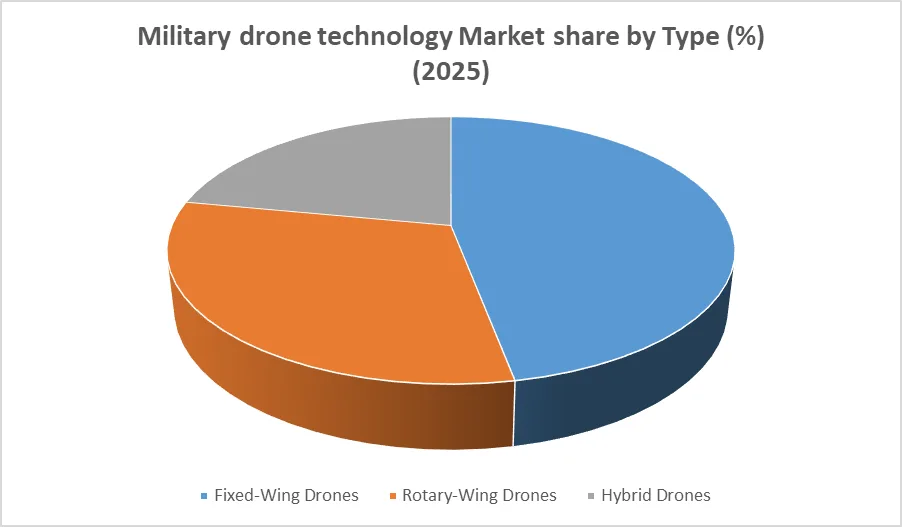
By Type: The military drone market is segmented into Fixed-Wing Drones, Rotary-Wing Drones, and Hybrid Drones. Fixed-wing drones held the largest market share in 2025 and are expected to maintain their dominance throughout the forecast period due to their superior endurance, longer operational range, higher payload capacity, and suitability for intelligence, surveillance, reconnaissance (ISR), border patrol, and long-range strike missions. However, hybrid drones are witnessing the fastest growth as armed forces increasingly adopt platforms that combine vertical take-off and landing (VTOL) capabilities with the endurance of fixed-wing aircraft, making them highly effective for multi-mission operations in contested environments. The rapid evolution of drone warfare has further accelerated demand for advanced UAV technologies; according to Ukrainian official data, Russia launched more than 54,500 Shahed-type UAVs during 2025, highlighting the unprecedented scale of drone operations in modern conflicts and driving increased investments in next-generation military drone platforms and counter-drone capabilities.
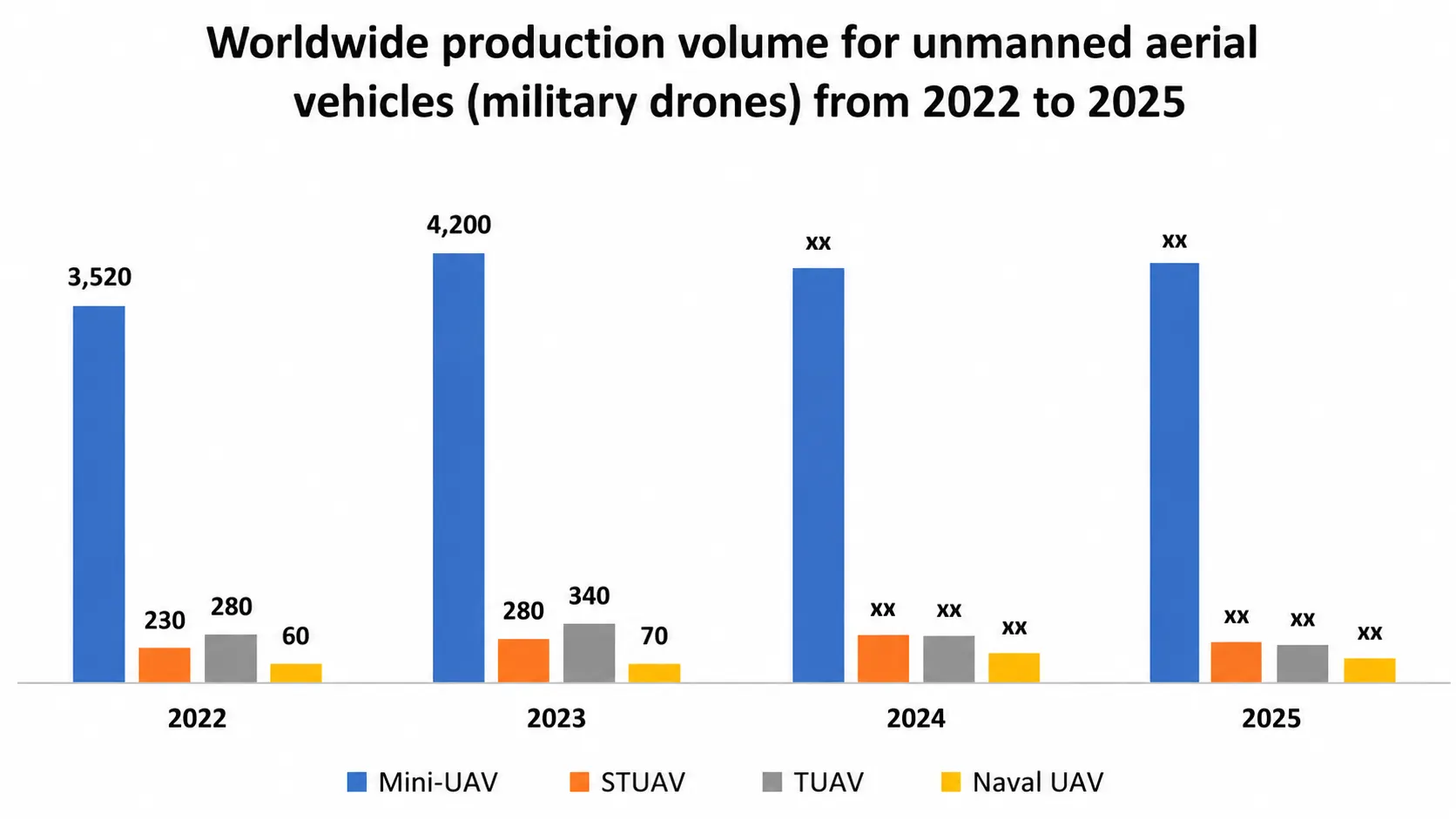
Strike drones are capable of carrying and deploying ammunition, including missiles and precision-guided bombs. These drones have been extensively used in counter-terrorism operations, reducing the risks associated with human-involved missions. Recently Ukrainian forces are using drones for traditional reconnaissance and direct artillery fire, they also have modified them to conduct direct attacks on Russian infantry.
Cargo drones are expected to boost the military drone technology market within the forecast period as these drones are focused on logistics and transportation tasks, carrying supplies and equipment to remote or hard-to-reach locations. They play a vital role in supporting troops in challenging terrains, disaster relief efforts, and resupply operations all of these applications of drone is expected to boost the market growth within the forecast period.
Competitive Landscape:
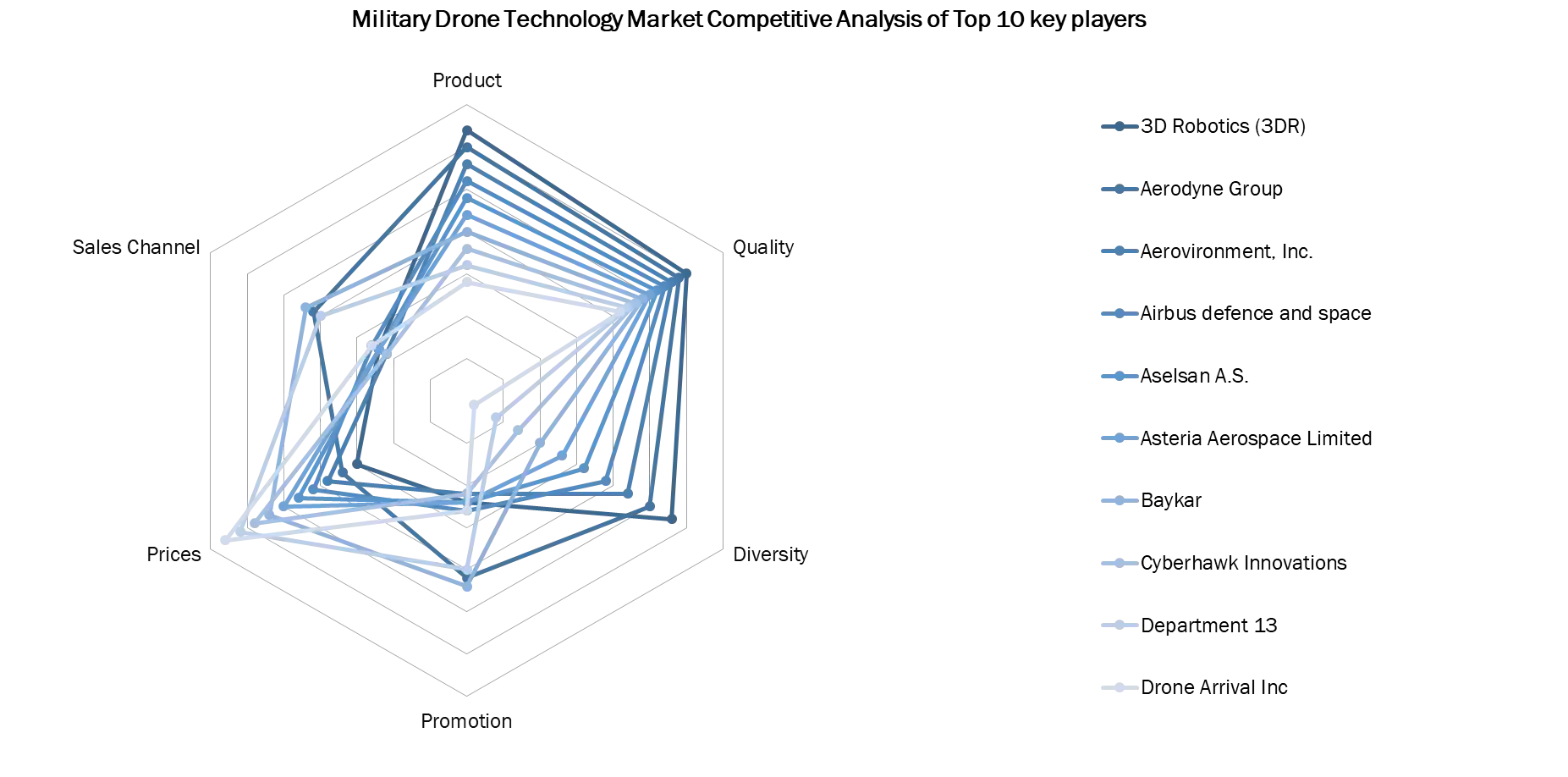
The Military Drone Technology Market is characterized by intense competition, advanced technology, and the capabilities of drones. The key factors driving the competition such as Technological Innovation, Cost-effectiveness, Contract Wins, and Regulatory Compliance. The key players in the market are investing in Research & Development activities for new technologies. The strategies adopted by the major player, such as expansion of product portfolio, mergers & acquisitions, geographical expansion, and collaborations, to enhance the Cloud Data Security market penetration.
General Atomics is the leading player in the military drone technology market, which has headquarters in the US. General Atomics is known for its UAVs such as Predator and Reaper those drones are sued to collect intelligence, surveillance, and also reconnaissance tasks. the General Atomics’ drones are also used for their high endurance, high-altitude flying capabilities, and Modular Payloads.
Israel Aerospace Industries is a major player in the military technology drone market, providing a wide range of UAV systems, including the Heron and the newer Heron TP. These drones are utilized for long-endurance missions, offering a variety of capabilities, including ISR, target acquisition, and strike missions. IAI's drones have gained international recognition for their combat-proven performance.
Recent Development
January 2025: A coalition-led drone procurement programme placed contracts worth £45 million to supply 30,000 drones for Ukraine. This development increased demand for low-cost tactical UAVs and strengthened Europe’s military drone supply chain.
June 2025: The UK announced a record £350 million investment to increase drone deliveries to Ukraine from 10,000 in 2024 to 100,000 in 2025. This accelerated mass production of battlefield drones and boosted demand for ISR, strike, and expendable UAV systems.
July 2025: Denmark procured four MQ-9B SkyGuardian remotely piloted aircraft along with ground control stations. This strengthened NATO’s long-endurance surveillance capability and supported growth in the medium-altitude military drone segment.
January 2026: Sweden announced more than SEK 4 billion for unmanned systems, including loitering munitions, reconnaissance drones, airborne electronic warfare drones, and unmanned marine vehicles. This increased European demand for multi-domain autonomous systems.
June 2026: Anduril received a production contract for the U.S. Air Force Collaborative Combat Aircraft programme to deliver initial FQ-44 semi-autonomous fighter aircraft. This pushed the market toward AI-enabled combat drones and loyal wingman platforms.
Military Drone Technology Market Scope: Inquire before buying
| Military Drone Technology Market | |||
|---|---|---|---|
| Report Coverage | Details | ||
| Base Year: | 2025 | Forecast Period: | 2026-2034 |
| Historical Data: | 2020 to 2025 | Market Size in 2025: | USD 17.67 Bn. |
| Forecast Period 2026 to 2034 CAGR: | 11.1% | Market Size in 2034: | USD 45.57 Bn. |
| Segments Covered: | by Drone Type | Fixed-Wing Drones Rotary-Wing Drones Hybrid Drones |
|
| by Technology | Remotely Operated Drones Semi-Autonomous Drones Autonomous Drones |
||
| by Range | Short-Range Drones Medium-Range Drones Long-Range Drones |
||
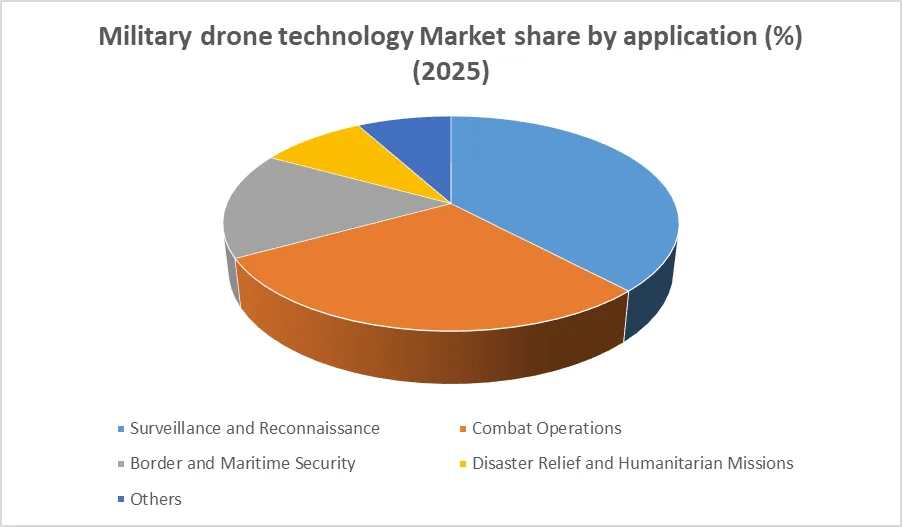
| by Application | Surveillance and Reconnaissance Combat Operations Border and Maritime Security Disaster Relief and Humanitarian Missions Others |
||
Military Drone Technology Market, by Region
North America (United States, Canada, and Mexico)
Europe (UK, France, Germany, Italy, Spain, Sweden, Austria, and the Rest of Europe)
Asia Pacific (China, South Korea, Japan, India, Australia, Indonesia, Malaysia, Vietnam, Taiwan, Bangladesh, Pakistan, and the Rest of APAC)
Middle East and Africa (South Africa, GCC, Egypt, Nigeria, and the Rest of ME&A)
South America (Brazil, Argentina Rest of South America)

Key Players
- 3D Robotics (3DR)
- Aerodyne Group
- Aerovironment, Inc.
- Airbus defence and space
- Aselsan A.S.
- Asteria Aerospace Limited
- Baykar
- Cyberhawk Innovations
- Department 13
- Drone Arrival Inc
- Drone Major Group
- Dronefly
- Elbit Systems Ltd
- Elsight
- General Atomics Aeronautical Systems Inc.
- Honeywell International Inc.
- Israel Aerospace Industries Ltd.
- Leonardo S.p.A.
- Lockheed Martin Corporation
- Maverick Drone Systems
- Meteksan Defence Industry Inc.
- Nidec Corporation
- Northrop Grumman Corporation
- Parrot Drone SAS
- Red Cat Holdings
- RXT Corporation
- SPH Engineering
- Sunnysky Motors
- Teledyne FLIR LLC
- Thales Group
- Others
Frequently Asked Questions:
1] What segments are covered in the Global Military Drone Technology Market report?
Ans. The segments covered in the Market report are based on Drone Type, Payload Capacity, Range and Endurance, Technology and Autonomy, Application, and Region.
2] Which region is expected to hold the highest share of the Global Military Drone Technology Market?
Ans. The North American region is expected to hold the highest share of the Military Drone Technology Market.
3] What is the market size of the Global Military Drone Technology Market by 2034?
Ans. The market size of the Military Drone Technology Market by 2034 is expected to reach USD 45.57 Bn.
4] What is the forecast period for the Global Military Drone Technology Market?
Ans. The forecast period for the Military Drone Technology Market is 2026-2034.
5] What was the Global Military Drone Technology Market Size in 2025?
Ans. The Military Drone Technology Market Size was at USD 17.67 Bn in 2025.