
Global Crude Steel Market By Production Process, By Offering, By Composition, By End-User Industry, by Region and Forecast 2034
Overview
The Global Crude Steel Market was valued at USD 1,020.40 Billion in 2025 and is projected to reach USD 1,427.40 Billion by 2034, growing at a CAGR of 3.80% during 2026-2034.
Global Crude Steel Market Overview
The Global Crude Steel Market covers steel in its first solid form: slabs, billets, blooms, ingots and other semi-finished shapes made through the basic oxygen furnace (BOF), electric arc furnace (EAF), induction furnace and other steelmaking routes. These products supply the rolling, forging and fabrication plants that serve building and construction, infrastructure, automotive, machinery, energy and consumer goods. Crude steel is made in two main ways. The BF-BOF route turns iron ore and coking coal into hot metal and refines it with oxygen, while the EAF route melts scrap, direct reduced iron (DRI) or hot briquetted iron (HBI) with electricity.
In volume terms, the World Steel Association (worldsteel) recorded global crude steel production of 1,849.4 Million Metric Tons in 2025, compared with 1,886.8 Million Metric Tons in 2024, and the report projects 2,023 Million Metric Tons by 2034. Growth is supported by infrastructure spending, urbanisation and manufacturing in India, Southeast Asia and the Middle East, and by new capacity that replaces ageing blast furnaces. Carbon rules such as the European Union Carbon Border Adjustment Mechanism (CBAM), which entered its definitive period on January 1, 2026, are also pushing producers toward scrap-based EAF, DRI-based and hydrogen-ready ironmaking.
The value chain starts with iron ore, coking coal and scrap supply, followed by ironmaking, steelmaking, secondary metallurgy and continuous casting into slabs, billets, blooms and ingots. Slabs go to hot-strip and plate mills, billets to bar and wire rod mills, and blooms and ingots to section, rail and forging operations. Raw material costs, energy prices, plant utilisation and trade measures determine producer margins, and overcapacity, carbon costs and import restrictions remain the main considerations for market participants.
The Maximize Market Research (MMR) report provides a comprehensive assessment of the Global Crude Steel Market, covering market size, historical performance, growth forecasts, production processes, offerings, compositions, end-user industries and regional opportunities from 2020 to 2034. It also examines production and capacity trends, raw material availability, production cost benchmarking, trade flows, government policies, decarbonisation pathways and the competitive landscape. With detailed profiles of 50+ key industry participants, SWOT analysis, PESTLE analysis and Porter's Five Forces analysis, the report helps clients understand market dynamics, evaluate competitors, identify emerging opportunities and make informed business, investment and market-entry decisions.
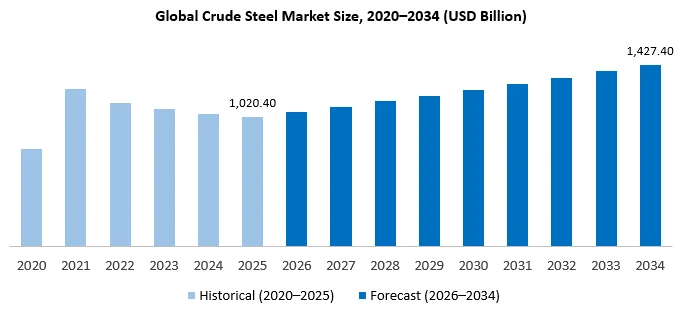
The Global Crude Steel Market was valued at USD 765.00 Billion in 2020, reached USD 1,235.00 Billion in 2021 and stood at USD 1,020.40 Billion in 2025, when global production eased. The market is projected to reach USD 1,427.40 Billion by 2034, a CAGR of 3.80% during 2026-2034. Revenue added each year rises through the forecast period as new capacity comes onstream and low-emission steel carries a higher value.
|
Parameter |
Value |
|
Market Size (2025) |
USD 1,020.40 Billion |
|
Market Size (2034) |
USD 1,427.40 Billion |
|
CAGR (2026-2034) |
3.80% |
|
Historical Period |
2020 to 2025 |
|
Forecast Period |
2026 to 2034 |
Global Crude Steel Market Key Highlights
• Market Growth: The Global Crude Steel Market was valued at USD 1,020.40 Billion in 2025 and is projected to reach USD 1,427.40 Billion by 2034, growing at a CAGR of 3.80% during 2026-2034.
• Demand Outlook: Worldsteel forecasts global steel demand of 1,722 Million Metric Tons in 2026 and 1,752 Million Metric Tons in 2027, with India at 172.4 and 186.2 Million Metric Tons in the same years.
• Policy Pressure: CBAM entered its definitive period on January 1, 2026, and the EU trade regime effective July 1, 2026 sets an 18.3 Million Metric Ton quota with a 50% out-of-quota duty.
• Capacity Additions: POSCO completed a 2.5 Million Metric Ton EAF on June 17, 2026, and JSW Steel and POSCO announced a 6 Million Metric Ton integrated plant in Odisha on April 20, 2026.
• Leading Production Process: Basic oxygen furnace holds the largest process share at 69% in 2025.
• Leading Offering: Slabs hold the largest offering share at 52% in 2025.
• Leading Composition: Non-alloy and carbon steel holds the largest composition share at 89% in 2025.
• Leading End-User Industry: Building and construction holds the largest end-user share at 34% in 2025.
• Regional Outlook: Asia Pacific holds the largest regional share at 72% in 2025, and India is expected to be the fastest-growing major producing economy during 2026-2034.
• Competitive Landscape: China Baowu, ArcelorMittal, Nippon Steel, POSCO, Ansteel, HBIS, Tata Steel, JSW Steel, Nucor and Hyundai Steel are among the leading participants.
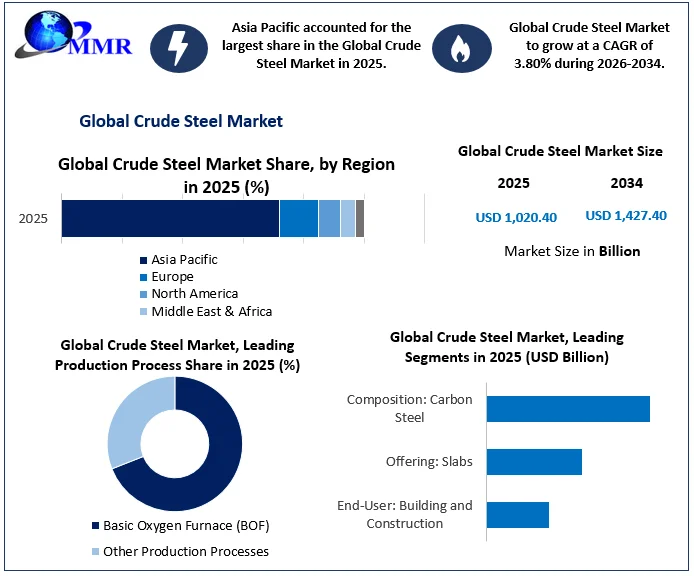
The snapshot summarizes the Global Crude Steel Market at a glance. Asia Pacific leads the regional ranking with a 72% share in 2025, and basic oxygen furnace, slabs, carbon steel and building and construction are the leading production process, offering, composition and end-user segments. The market is projected to rise from USD 1,020.40 Billion in 2025 to USD 1,427.40 Billion in 2034, a CAGR of 3.80% during 2026-2034.
To know about the Research Methodology :- Request Free Sample Report
Global Crude Steel Market Dynamics:
Infrastructure Investment, Urbanisation and Construction Demand to Drive Global Crude Steel Market Growth
Construction and infrastructure remain the largest source of steel demand, and public investment in housing, transport, energy and utilities keeps order books full for flat and long product mills. Worldsteel's October 2026 Short Range Outlook puts global steel demand at 1,722 Million Metric Tons in 2026 and 1,752 Million Metric Tons in 2027. Demand in India is forecast at 172.4 Million Metric Tons in 2026 and 186.2 Million Metric Tons in 2027, supported by infrastructure, real estate, machinery and automotive output.
Demand is also firm in developed markets. The United States is adding steel-intensive data centres and energy infrastructure, and Türkiye's demand is forecast at 40.4 Million Metric Tons in 2026. Producers with integrated plants, secure raw material access and proximity to these consumption centres are better placed to turn demand into volume.
Capacity Expansion in India, Southeast Asia and the Middle East to Create Opportunities in the Global Crude Steel Market
Output is rising where domestic demand is growing. India produced 164.9 Million Metric Tons in 2025, compared with 149.4 Million Metric Tons in 2024, while Viet Nam produced 24.7 Million Metric Tons and Saudi Arabia 10.8 Million Metric Tons, against 22.0 and 9.6 Million Metric Tons a year earlier. The Middle East as a region produced 56.9 Million Metric Tons.
New projects continue to be announced. On April 20, 2026, JSW Steel and POSCO agreed a 50:50 joint venture for a 6 Million Metric Ton greenfield integrated plant in Dhenkanal, Odisha. Such plants reduce import dependence and create demand for iron ore, coking coal, DRI and plant equipment, and Middle East producers with low-cost natural gas can supply DRI and low-carbon crude steel to export markets.
Advances in EAF, DRI-Based Steelmaking and Digitalisation to Support the Global Crude Steel Market Transition
Steelmakers are shifting capacity toward electric arc furnaces. POSCO completed a 2.5 Million Metric Ton EAF at its Gwangyang works on June 17, 2026, designed for fully electric and hybrid operation, and states that the route can reduce emissions by up to 75% compared with blast furnace production. In the United States, the Hyundai Steel and POSCO joint venture appointed Danieli on May 4, 2026 for a USD 5.8 Billion plant in Louisiana that includes a 2.5 Million Metric Ton DRI unit and is scheduled to start production in 2029.
Digital tools are spreading in parallel. AI-based process control, digital twins, machine-vision defect detection and predictive maintenance improve yield and energy efficiency, and connected plants raise the importance of cybersecurity and data governance.
Global Overcapacity, Trade Barriers and Input Cost Volatility to Restrain Global Crude Steel Market Growth
Production fell from 1,886.8 Million Metric Tons in 2024 to 1,849.4 Million Metric Tons in 2025, and weak demand in China is the main reason. China produced 960.8 Million Metric Tons in 2025, down from 1,005.1 Million Metric Tons, and worldsteel expects Chinese demand to contract further in 2026. Excess capacity keeps utilisation and prices under pressure, and output of 34.1 Million Metric Tons in Germany and 126.2 Million Metric Tons in the EU-27 shows the strain on mature producers.
Trade barriers are tightening in response. Regulation (EU) 2026/1384 applies from July 1, 2026 with an 18.3 Million Metric Ton tariff-rate quota and a 50% out-of-quota duty, up from 25% under the previous safeguard. Volatility in iron ore, coking coal, scrap, electricity and natural gas prices adds to the risk, because raw materials and energy form the largest part of production cost.
Carbon Regulation and CBAM to Influence Production Economics in the Global Crude Steel Market
Steel is one of the most carbon-intensive industries, and carbon pricing is raising the cost of high-emission routes. The EU CBAM entered its definitive period on January 1, 2026, so importers now bear a financial cost linked to the emissions embedded in imported steel. Producers are responding with decarbonisation roadmaps, new EAF and DRI capacity, higher scrap use and lower-carbon steel grades.
Several flagship hydrogen-based projects have been delayed by cost and financing, so near-term emission cuts are coming mainly from EAF and DRI investments. Producers with secure access to scrap, DRI-grade ore and low-cost power, and with verified emission data, hold a commercial advantage in regulated markets.
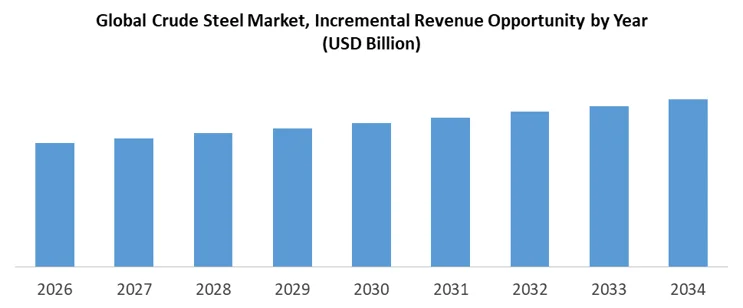
Incremental revenue in the Global Crude Steel Market rises from USD 38.80 Billion in 2026 to USD 52.30 Billion in 2034. Over 2026-2034 the market adds USD 407.00 Billion, taking it from USD 1,020.40 Billion to USD 1,427.40 Billion. Each forecast year adds more revenue than the year before, as new capacity, higher-value grades and carbon-linked pricing lift market value.
Global Crude Steel Market, Steelmaking Route Comparison
Crude steel routes differ in the raw materials they use, the energy they need and their carbon profile. The comparison below summarizes these differences and shows where each route fits in the market.
|
Steelmaking |
Production |
Primary Input |
Carbon Profile |
Typical Output |
|
Basic Oxygen |
Hot metal from a blast furnace refined with oxygen in a |
Iron ore, coking coal and some scrap |
High, unless paired with carbon capture |
Flat products, plate and high-grade automotive steel |
|
EAF – |
Ferrous scrap melted with electricity |
Ferrous scrap and electricity |
Lower, depending on the power mix |
Long products and a growing range of flat products |
|
EAF – |
DRI or HBI melted in an electric arc furnace |
DRI/HBI, natural gas or hydrogen, and electricity |
Lower, depending on reductant and power |
Premium flat products and low-emission grades |
|
Induction |
Scrap or sponge iron melted by induction heating |
Scrap and sponge iron |
Varies, with efficiency norms tightening |
Regional long products and castings |
MMR Analyst Insight: Decarbonisation Readiness Lens for the Global Crude Steel Market
MMR evaluates producers through a decarbonisation readiness lens built on three gates. The first is route mix, which compares BOF capacity with EAF and DRI capacity that is built or under construction. The second is feedstock security, which covers scrap, DRI-grade ore and low-cost power. The third is carbon border exposure, which measures how much output is sold into regulated markets such as the European Union. Producers that clear all three gates are expected to capture the largest share of value growth through 2034, and the report tracks each profiled company against these gates and quantifies the green steel premium in chapter A26.
Global Crude Steel Market Segment Analysis
The Global Crude Steel Market is segmented by production process, offering, composition, end-user industry and region. Each segment reflects different feedstock needs, capital intensity, product use and demand patterns.
Global Crude Steel Market, By Production Process
Based on production process, the market is segmented into basic oxygen furnace (BOF), electric arc furnace (EAF), induction furnace (IF) and other steelmaking processes. EAF is further divided into predominantly scrap-based, predominantly DRI/HBI-based and other or mixed-charge EAF.
Basic oxygen furnace is the leading process with a 69% share in 2025, supported by the scale of integrated steelmaking in China, India, Japan, South Korea and Europe and by the need for iron ore-based steel in high-quality flat products. EAF capacity is expanding on scrap availability and decarbonisation targets, while induction furnaces and other processes serve regional, lower-capital production, mainly in South Asia.
Global Crude Steel Market, By Offering
Based on offering, the market is segmented into slabs, billets, blooms, ingots and other first-solid steel forms.
Slabs are the leading offering with a 52% share in 2025 because they feed hot-rolled coil, cold-rolled sheet, plate and coated products used in automotive, appliances, pipes, shipbuilding and construction. Billets support bars and wire rod for building and infrastructure and are widely produced in EAF mini-mills, while blooms and ingots serve sections, rails, forgings and specialty grades.
Global Crude Steel Market, By Composition
Based on composition, the market is segmented into non-alloy or carbon steel (low-carbon, medium-carbon and high-carbon), stainless steel (austenitic, ferritic, martensitic, duplex and other stainless) and other alloy steel.
Non-alloy and carbon steel is the leading composition with an 89% share in 2025, led by low-carbon grades used in construction, pipes, sheet and general engineering. Stainless steel carries a higher value per metric ton and serves food processing, chemicals, energy and transport, with austenitic grades leading, while other alloy steel is gaining importance in automotive lightweighting, tooling and energy equipment.
Global Crude Steel Market, By End-User Industry
Based on end-user industry, the market is segmented into building and construction, infrastructure, automotive, machinery and industrial equipment, energy, consumer goods and appliances, and other end-use industries.
Building and construction is the leading end-user industry with a 34% share in 2025, driven by housing and commercial construction, while infrastructure demand comes from roads, railways, ports, bridges and utilities. Automotive, machinery and energy demand follows vehicle production, capital goods investment and power and pipeline projects, and shipbuilding, packaging and defence fall under other end-use industries.
Global Crude Steel Market Regional Insights:
The Global Crude Steel Market is segmented into Asia Pacific, Europe, North America, Middle East & Africa and South America, presented here in descending order of 2025 market share. Asia Pacific holds the largest regional share at 72% in 2025 and is the production centre of the industry. China is the largest producer, followed by India, Japan and South Korea, while Viet Nam, Taiwan and Indonesia are adding capacity. India is expected to be the fastest-growing major producing economy during 2026-2034, supported by infrastructure investment and integrated and EAF capacity additions such as the JSW Steel and POSCO project in Odisha.
Europe ranks second and is shaped by decarbonisation goals, CBAM and the new EU trade regime. Producers in Germany, Türkiye, Italy, France, Spain, Austria, Poland and the United Kingdom are moving toward EAF and DRI-based steelmaking, while import quotas and a 50% out-of-quota duty protect domestic mills.
North America ranks third and is led by the United States, where scrap-based EAF producers such as Nucor, Steel Dynamics and Commercial Metals Company benefit from tariff-supported domestic demand and data centre and energy infrastructure investment. Canada and Mexico add integrated and long-product capacity, and the Hyundai Steel and POSCO plant in Louisiana will add DRI-based capacity.
Middle East & Africa ranks fourth, with DRI-based and EAF capacity expanding in Saudi Arabia, the UAE, Egypt, Qatar, Oman and Türkiye on the back of low-cost natural gas and domestic construction demand. South Africa and Algeria add regional supply.
South America ranks fifth and is led by Brazil, with Argentina, Chile, Colombia and Peru supporting regional demand through construction and mining-related consumption. Producers such as Gerdau, CSN and Usiminas compete with imports from Asia.
Global Crude Steel Market Competitive Landscape
The Global Crude Steel Market is capital intensive and highly competitive, with integrated steelmakers, EAF mini-mill operators, and state-owned and private enterprises operating across regions. China Baowu Steel Group, ArcelorMittal, Nippon Steel Corporation, POSCO Holdings, Ansteel Group, HBIS Group, Jiangsu Shagang Group, Tata Steel Group, JSW Steel Limited, JFE Steel Corporation, Nucor Corporation, Hyundai Steel, Gerdau S.A., thyssenkrupp Steel and Cleveland-Cliffs Inc. are among the key companies shaping the competitive landscape. Asia Pacific hosts the largest producers, European players are shifting toward low-carbon routes, and North America's position is anchored by scrap-based EAF producers. Competition primarily depends on scale, raw material access, energy cost, product quality, carbon intensity and proximity to customers.
Joint ventures, capacity investments, technology partnerships and decarbonisation projects are becoming important strategies for strengthening competitive positioning in the Global Crude Steel Market. Recent developments include the JSW Steel and POSCO joint venture for a 6 Million Metric Ton integrated plant in Odisha on April 20, 2026, the Hyundai Steel and POSCO USD 5.8 Billion EAF plant in Louisiana with Danieli as technology partner on May 4, 2026, and POSCO's completion of a 2.5 Million Metric Ton EAF at Gwangyang on June 17, 2026. Companies are also investing in AI-based process control, digital twins, scrap preheating, DRI-ready furnaces and hydrogen-ready ironmaking. As carbon rules and trade measures tighten, access to low-emission feedstock, long-term offtake with automotive and construction customers and verified emission data are expected to define competitive advantage through 2034.
Global Crude Steel Market Recent Developments:
|
Date |
Development |
Impact |
|
January 1, |
The EU Carbon Border Adjustment Mechanism entered its |
Raises the landed cost of high-emission steel in the EU |
|
January 23, |
Worldsteel reported global crude steel production of |
Sets the 2025 volume base for the forecast and confirms |
|
April 20, |
JSW Steel and POSCO announced a 50:50 joint venture to |
Adds integrated capacity in the fastest-growing major |
|
May 4, 2026 |
The Hyundai Steel and POSCO joint venture appointed |
Adds DRI-fed EAF capacity for high-grade automotive steel |
|
June 17, 2026 |
POSCO completed a 2.5 Million Metric Ton electric arc |
Moves a major integrated producer toward scrap-based, |
|
July 1, 2026 |
Regulation (EU) 2026/1384 entered into force, replacing |
Restricts steel imports into the EU, supporting domestic |
|
October 12, |
Worldsteel's Short Range Outlook forecast global steel |
Signals a flat 2026 and a firmer 2027, shaping capacity |
Global Crude Steel Market – Industry Analysis
The report presents a comprehensive analysis of the Global Crude Steel Market, covering stakeholders across iron ore and coking coal supply, scrap and DRI supply, integrated steel plants, mini-mill operators, equipment and technology providers, and steel-consuming industries. It evaluates the historical and current market scenario, industry developments, market size, production volume and the growth outlook through 2034.
The report assesses growth drivers, restraints, opportunities and challenges, and examines the supply-demand balance, capacity utilisation, production cost benchmarking across BF-BOF and EAF routes, raw material availability, trade flows, tariffs and anti-dumping measures, carbon regulation and the plant project pipeline.
It also reviews the competitive positioning of leading steel producers, including integrated steelmakers, EAF producers and state-owned and private enterprises. Company analysis covers production, installed capacity, geographic presence, financial performance, capital expenditure, strategic alliances and decarbonisation initiatives.
PORTER's Five Forces, PESTLE and SWOT analyses are used to assess the competitive environment and the influence of macroeconomic, regulatory, technological and environmental factors. Regional assessments and country-level forecasts identify emerging opportunities and investment hotspots for steel producers, raw material suppliers, equipment makers, investors and policy makers.
Global Crude Steel Market Scope: Inquire before buying
|
Global Crude Steel Market |
|||
|
Report Coverage |
Details |
||
|
Base Year: |
2025 |
Forecast Period: |
2026-2034 |
|
Historical Data: |
2020 to 2025 |
Market Size in 2025: |
USD 1,020.40 Billion |
|
Forecast Period 2026 to 2034 CAGR: |
3.80% |
Market Size in 2034: |
USD 1,427.40 Billion |
|
Segments |
By Production Process |
Basic Oxygen Furnace (BOF) Electric Arc Furnace (EAF) Predominantly Scrap-Based EAF Predominantly DRI/HBI-Based EAF Other / Mixed-Charge EAF Induction Furnace (IF) Other Steelmaking Processes |
|
|
By Offering |
Slabs Billets Blooms Ingots Other First-Solid Steel Forms |
||
|
By Composition |
Non-Alloy / Carbon Steel Low-Carbon Steel Medium-Carbon Steel High-Carbon Steel Stainless Steel Austenitic Stainless Steel Ferritic Stainless Steel Martensitic Stainless Steel Other Stainless Steel Other Alloy Steel |
||
|
By End-User Industry |
Machinery and Industrial Equipment Consumer Goods and Appliances Other End-Use Industries |
||
Global Crude Steel Market , by Region
North America (United States, Canada and Mexico)
Europe (UK, France, Germany, Italy, Spain, Sweden, Austria and Rest of Europe)
Asia Pacific (China, South Korea, Japan, India, Australia, Indonesia, Malaysia, Vietnam, Taiwan, Bangladesh, Pakistan and Rest of APAC)
Middle East and Africa (South Africa, GCC, Egypt, Nigeria and Rest of ME&A)
South America (Brazil, Argentina, Rest of South America)
Global Crude Steel Market Key Players
A. North America – 8 Companies
1. Nucor Corporation (United States)
2. Cleveland-Cliffs Inc. (United States)
3. Steel Dynamics, Inc. (United States)
4. Commercial Metals Company (United States)
5. Deacero (Mexico)
6. Industrias CH / Simec (Mexico)
7. Algoma Steel Group (Canada)
8. Charter Steel (United States)
Others
B. Europe – 10 Companies
9. ArcelorMittal (Luxembourg)
10. NLMK Group (Russia)
11. Severstal (Russia)
12. thyssenkrupp Steel (Germany)
13. voestalpine AG (Austria)
14. SSAB AB (Sweden)
15. Salzgitter AG (Germany)
16. Riva Group (Italy)
17. CELSA Group (Spain)
18. Tata Steel Nederland (Netherlands)
Others
C. Asia Pacific – 18 Companies
19. China Baowu Steel Group (China)
20. Ansteel Group (China)
21. HBIS Group (China)
22. Jiangsu Shagang Group (China)
23. Jianlong Group (China)
24. Nippon Steel Corporation (Japan)
25. POSCO Holdings (South Korea)
26. Tata Steel Group (India)
27. JSW Steel Limited (India)
28. JFE Steel Corporation (Japan)
29. Shougang Group (China)
30. Delong Steel Group (China)
31. Hyundai Steel (South Korea)
32. Steel Authority of India Limited (India)
33. Jindal Steel Limited (India)
34. Hoa Phat Group (Vietnam)
35. China Steel Corporation (Taiwan)
36. Tsingshan Holding Group (China)
Others
D. Middle East and Africa (MEA) – 10 Companies
37. Tosyali Holding (Türkiye)
38. Mobarakeh Steel Company (Iran)
39. Saudi Iron and Steel Company (Saudi Arabia)
40. Emirates Steel Arkan (United Arab Emirates)
41. Ezz Steel (Egypt)
42. Qatar Steel (Qatar)
43. Egyptian Steel (Egypt)
44. ArcelorMittal South Africa (South Africa)
45. Scaw Metals Group (South Africa)
46. Algerian Qatari Steel (Algeria)
Others
E. South America – 6 Companies
47. Gerdau S.A. (Brazil)
48. Companhia Siderúrgica Nacional (Brazil)
49. Usinas Siderúrgicas de Minas Gerais (Brazil)
50. Ternium Argentina (Argentina)
51. Aceros Arequipa (Peru)
52. Aço Verde do Brasil (Brazil)
Others
Global Crude Steel Market – Frequently Asked Questions:
1. Which region has the largest share in Global Crude Steel Market?
Ans: Asia Pacific region held the highest share in 2025.
2. What is the growth rate of Global Crude Steel Market?
Ans: The Global Crude Steel Market is growing at a CAGR of 3.80% during forecasting period 2026-2034.
3. What is scope of the Global Crude Steel Market report?
Ans: Global Crude Steel Market report helps with the PESTEL, PORTER and SWOT analysis, Recommendations for Investors & Leaders, and market estimation of the forecast period.
4. Who are the key players in Global Crude Steel Market?
Ans: The important key players in the Global Crude Steel Market are – China Baowu Steel Group, ArcelorMittal, Nippon Steel Corporation, POSCO Holdings, Ansteel Group, HBIS Group, Jiangsu Shagang Group, Tata Steel Group, JSW Steel Limited, JFE Steel Corporation, Nucor Corporation, Hyundai Steel, Gerdau S.A., thyssenkrupp Steel, Cleveland-Cliffs Inc., Steel Dynamics, Inc., Salzgitter AG and SSAB AB.
5. What is the study period of this Market?
Ans: The Global Crude Steel Market is studied from 2020 to 2034.
6. What is crude steel?
Ans: Crude steel is steel in its first solid form after casting, such as slabs, billets, blooms and ingots. It is made in basic oxygen furnaces, electric arc furnaces and induction furnaces and is then rolled, forged or fabricated into finished steel products.