
Global Crude Oil and Petrochemical Tanker Market By Tanker Type, By Vessel Capacity, By Vessel Hull Configuration, By Fleet Age, By Trade Route, By Propulsion Type, By End User, by Region and Forecast 2034
Overview
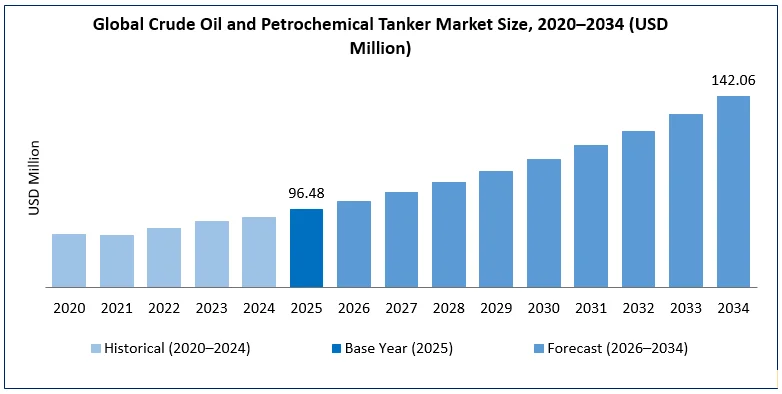
The Global Crude Oil and Petrochemical Tanker Market size was valued at USD 96.48 Billion in 2025 and the total market revenue is expected to grow at a CAGR of 4.37% from 2026 to 2034, reaching USD 142.06 Billion by 2034.
In terms of transportation volume, the market is estimated at XX Billion Metric Tons in 2025 and is projected to reach XX Billion Metric Tons by 2034.
Global Crude Oil and Petrochemical Tanker Market Overview
The Global Crude Oil and Petrochemical Tanker Market encompasses maritime transportation services used for the movement of crude oil, refined petroleum products, petrochemical feedstocks, and liquid chemical cargoes across domestic and international trade routes. Tanker vessels play a critical role in connecting oil-producing regions, petroleum refineries, petrochemical manufacturing facilities, storage terminals, and end-use markets. The market is influenced by global energy consumption, crude oil production, refinery utilization, international petroleum trade, petrochemical manufacturing activities, and the expansion of maritime transportation infrastructure.
Crude oil tankers are primarily used to transport unrefined petroleum from offshore production facilities, oil fields, and export terminals to refineries and storage facilities. Petroleum product tankers transport refined products such as gasoline, diesel, jet fuel, naphtha, and other petroleum derivatives, whereas chemical and petrochemical tankers are designed to carry specialized liquid cargoes, including ethylene, propylene, aromatics, and other chemical intermediates. Vessel capacity, deadweight tonnage (DWT), cargo segregation systems, hull configuration, and propulsion technology influence tanker selection and operational efficiency.
The adoption of advanced vessel technologies, digital fleet management systems, fuel-efficient propulsion systems, and automated cargo-handling solutions is increasingly transforming the global tanker shipping industry. Furthermore, changes in international trade routes, geopolitical developments, refinery capacity expansion, and increasing demand for petrochemical products are influencing tanker deployment and transportation requirements. The growing emphasis on maritime decarbonization, alternative marine fuels, and environmental compliance is also encouraging shipping companies to invest in fleet modernization and next-generation tanker vessels.
Global Crude Oil and Petrochemical Tanker Market Growth and Share Analysis
To know about the Research Methodology :- Request Free Sample Report
| Parameter | Value |
|---|---|
| Market Size (2025) | USD 96.48 Billion |
| Market Size (2034) | USD 142.06 Billion |
| CAGR | 4.37% |
| Historical Period | 2020 to 2025 |
| Forecast Period | 2026 to 2034 |
Crude Oil and Petrochemical Tanker Market Key Highlights
Global Crude Oil and Petrochemical Tanker Market Dynamics:
Increasing International Seaborne Crude Oil and Petroleum Trade to Drive Global Crude Oil and Petrochemical Tanker Market
The global oil and petroleum industry is witnessing continuous changes in production geography, refining capacity, energy consumption, and international trade patterns. Crude oil-producing countries rely heavily on maritime transportation to supply petroleum to major importing economies, while international refineries depend on tanker vessels for the procurement of crude oil and distribution of refined petroleum products. Increasing trade between the Middle East, North America, Europe, and Asia Pacific is creating transportation requirements for crude oil and petroleum product tanker operators.
The expansion of crude oil production in countries such as the United States, Brazil, Canada, and Guyana, along with established exports from Saudi Arabia, the UAE, Iraq, and other Middle Eastern countries, is influencing international tanker trade flows. Furthermore, changes in refinery utilization, strategic petroleum inventories, and regional energy demand are affecting cargo movements and vessel deployment. Longer transportation distances and changes in maritime trade routes are also influencing tanker utilization, freight rates, and overall transportation economics.
According to UN Trade and Development (UNCTAD), global maritime trade increased by 2.2% in 2024, while ton-miles increased by 5.9%, reflecting the impact of longer shipping routes and trade disruptions. Such developments demonstrate the importance of transportation distance and vessel availability in the global maritime shipping industry.
Increasing Petrochemical Production and International Chemical Trade to Create Market Opportunities
The growing demand for petrochemical products across packaging, automotive, construction, electronics, textiles, and industrial manufacturing is supporting international transportation of petrochemical feedstocks and liquid chemical products. Products such as ethylene, propylene, benzene, toluene, xylene, methanol, and other chemical intermediates require specialized transportation arrangements depending on their physical and chemical properties.
Chemical and petrochemical tanker vessels are equipped with specialized cargo tanks, coatings, heating systems, segregation arrangements, and cargo-handling equipment to transport different liquid products while maintaining cargo quality and preventing contamination. Increasing investments in petrochemical manufacturing facilities, particularly across China, India, the Middle East, and Southeast Asia, are creating opportunities for specialized tanker operators.
Furthermore, the expansion of international petrochemical trade and the development of integrated refinery-petrochemical complexes are increasing the importance of reliable maritime transportation networks. Shipping companies with specialized chemical tanker fleets and established relationships with petrochemical manufacturers are expected to benefit from evolving transportation requirements.
Technological Advancements in Tanker Vessel Design and Fleet Management
Technological advancements in vessel construction, propulsion systems, navigation equipment, cargo monitoring, and fleet management are improving the operational efficiency of tanker vessels. Modern tankers increasingly incorporate advanced navigation systems, automated cargo-handling equipment, real-time vessel tracking, and digital performance monitoring solutions to optimize voyage planning and reduce operational inefficiencies.
Furthermore, the integration of predictive maintenance technologies and digital fleet management platforms is helping shipping operators monitor vessel performance, identify equipment failures, and optimize maintenance schedules. Advanced hull designs, energy-efficient propulsion systems, and improved cargo tank configurations are also supporting higher operational reliability and fuel efficiency.
The development of LNG-powered and methanol-powered vessels is further influencing tanker fleet modernization strategies as shipping companies evaluate alternative fuels and technologies to reduce greenhouse gas emissions.
Increasing Investments in Tanker Fleet Expansion and Vessel Modernization
The global tanker shipping industry requires continuous investments in new vessel construction, fleet replacement, maintenance, and operational modernization. Increasing demand for petroleum transportation, changes in vessel availability, and the aging structure of certain tanker fleets are encouraging shipping companies to invest in newbuilding orders and fleet expansion.
Major tanker operators are increasingly focusing on acquiring modern vessels with improved fuel efficiency, higher cargo capacity, advanced navigation systems, and enhanced environmental performance. In addition, investments in specialized chemical tankers and product carriers are supporting the transportation requirements of petrochemical manufacturers and petroleum distributors.
The expansion of shipbuilding capabilities across South Korea, China, and Japan is also supporting the development of advanced tanker vessels. However, newbuilding costs, shipyard availability, delivery timelines, financing requirements, and regulatory compliance remain important considerations for tanker operators.
Stringent Maritime Environmental Regulations to Influence Tanker Fleet Operations
The global shipping industry is experiencing increasing regulatory pressure to reduce greenhouse gas emissions, improve fuel efficiency, and minimize marine pollution. International maritime regulations governing vessel emissions, ballast water management, oil pollution prevention, and operational safety are influencing tanker design, fleet management, and investment decisions.
The International Maritime Organization's (IMO) 2023 Greenhouse Gas Strategy establishes an ambition to achieve net-zero greenhouse gas emissions from international shipping by or around 2050. It also includes indicative checkpoints for reducing total annual GHG emissions and carbon intensity. These developments are encouraging tanker operators to evaluate alternative fuels, energy-efficient technologies, and vessel modernization strategies.
Furthermore, compliance with environmental standards and operational regulations is increasing the importance of double-hull construction, ballast water treatment systems, cargo monitoring technologies, and pollution prevention equipment. Shipping companies that invest in environmentally efficient vessels and compliant operational systems are better positioned to address evolving industry requirements.
Global Crude Oil and Petrochemical Tanker Market Segment Analysis
The Global Crude Oil and Petrochemical Tanker Market is segmented into tanker type, vessel capacity, vessel hull configuration, fleet age, trade route, propulsion type, and end user. Each segment represents different vessel specifications, cargo transportation requirements, operational characteristics, and commercial demand patterns.
By Tanker Type
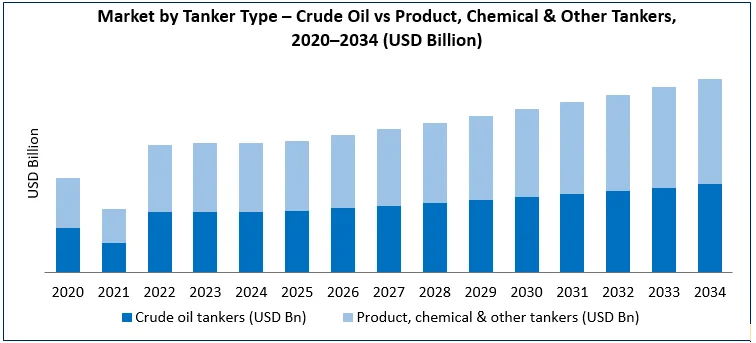
Based on tanker type, the global market is segmented into crude oil tankers, petroleum product tankers, chemical & petrochemical tankers, and others.
The crude oil tanker segment is expected to hold a significant share of the global market owing to the continuous requirement for transporting crude oil from major production regions to international refineries and storage terminals. Large-capacity vessels, including Very Large Crude Carriers (VLCCs), Ultra Large Crude Carriers (ULCCs), Suezmax, and Aframax tankers, are widely utilized for international crude oil transportation. Increasing seaborne crude oil trade, offshore production activities, and international energy supply requirements are supporting demand for crude oil tanker services.
The petroleum product tanker segment is witnessing increasing demand due to international transportation of refined petroleum products, including gasoline, diesel, jet fuel, naphtha, and other petroleum derivatives. These vessels support regional and international distribution networks connecting refineries, storage terminals, ports, and consumption markets.
The chemical & petrochemical tanker segment is gaining importance with increasing international trade of petrochemical feedstocks, industrial chemicals, and specialty liquid products. Specialized tank coatings, cargo segregation, heating arrangements, and cleaning systems are essential for maintaining cargo quality and preventing contamination during transportation.
By Vessel Capacity
Based on vessel capacity, the market is segmented into below 10,000 DWT, 10,000 to below 25,000 DWT, 25,000 to below 50,000 DWT, 50,000 to below 80,000 DWT, 80,000 to below 120,000 DWT, 120,000 to below 200,000 DWT, 200,000 to below 320,000 DWT, and 320,000 DWT and above.
The selection of tanker vessel capacity depends on cargo volume, transportation distance, port infrastructure, water depth, loading and unloading facilities, and operational requirements. Smaller-capacity tankers are primarily utilized for regional transportation, coastal distribution, and transportation to ports with infrastructure limitations. Medium-sized vessels support regional petroleum product and chemical transportation, while larger-capacity tankers are predominantly deployed for long-distance crude oil transportation and high-volume international trade.
Large-capacity crude oil carriers, including VLCCs and ULCCs, provide economies of scale for suitable long-haul routes by transporting substantial cargo volumes in a single voyage. However, their deployment depends on terminal compatibility, draft restrictions, maritime route accessibility, and cargo availability.
Global Crude Oil and Petrochemical Tanker Market Regional Insights:
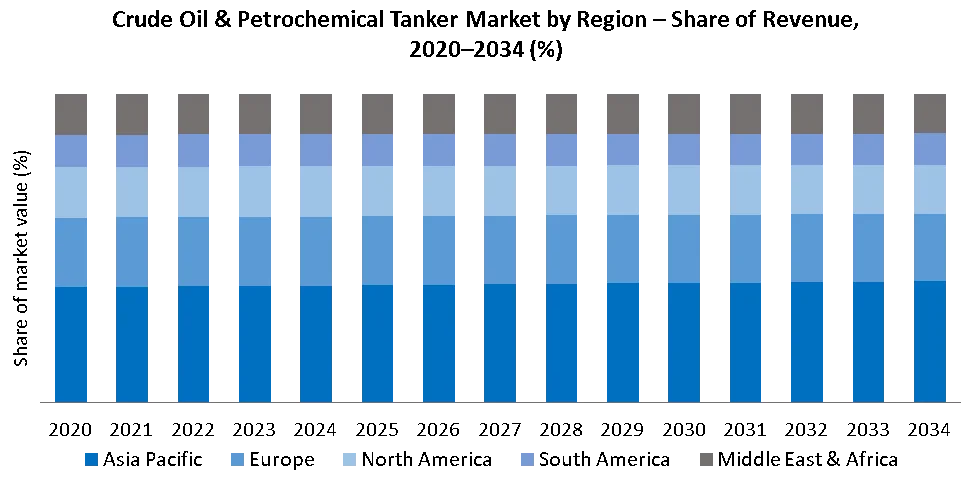
The Global Crude Oil and Petrochemical Tanker Market is segmented into North America, Europe, Asia Pacific, Middle East & Africa, and South America. Asia Pacific is expected to account for a significant market share of 38%, driven by strong petroleum consumption, refining activities, petrochemical manufacturing, and crude oil imports across China, India, Japan, and South Korea. Increasing trade between Middle Eastern exporters and Asian importing economies, alongside refinery expansion, port infrastructure development, and growing demand for petroleum products and petrochemical feedstocks, is supporting regional tanker transportation. North America represents an important market, supported by substantial hydrocarbon production, refinery infrastructure, and petroleum exports. The United States drives regional activity through its crude oil production and Gulf Coast export terminals, while Canada and Mexico contribute through oil production, refining, and petroleum distribution. Investments in export terminals, storage facilities, and maritime infrastructure are further supporting tanker operations.
Europe maintains established demand for petroleum product and chemical tanker transportation, supported by refining, petrochemical manufacturing, and international energy trade. Germany, the Netherlands, the United Kingdom, France, Italy, and Norway are important regional participants, while environmental regulations and decarbonization initiatives are encouraging fleet modernization and alternative propulsion technologies. The Middle East & Africa plays a strategic role in global crude oil transportation, with Saudi Arabia, the UAE, Iraq, Kuwait, Qatar, and Oman serving as major petroleum-producing and exporting countries. Key export terminals and routes, including the Strait of Hormuz, support international oil movements, while investments in refining, petrochemicals, and storage infrastructure create additional transportation requirements. African countries such as Nigeria, Egypt, and South Africa also contribute through petroleum production, refining, and distribution. South America is gaining importance through offshore oil production, particularly in Brazil, alongside petroleum exports and refining activities in Argentina and Colombia. Expanding export terminals, storage infrastructure, and international trade connections are creating further opportunities for crude oil and petroleum product tanker operators.
Global Crude Oil and Petrochemical Tanker Market – Industry Analysis
The objective of the report is to present a comprehensive analysis of the Global Crude Oil and Petrochemical Tanker Market, covering all major stakeholders across the maritime transportation and energy logistics industries. The study evaluates the historical and current market scenario, industry developments, market size, transportation volume, and future growth outlook through 2034.
The report provides an in-depth assessment of market dynamics, including major growth drivers, restraints, opportunities, and challenges influencing tanker transportation demand. It also examines crude oil production, petroleum refining, petrochemical manufacturing, international trade flows, tanker fleet composition, vessel capacity, freight rates, operating costs, and maritime infrastructure.
The study further evaluates the competitive positioning of leading tanker operators, shipowners, chartering companies, and specialized chemical shipping companies. Company-level analysis includes fleet size, vessel capacity, operational presence, financial performance, revenue growth, profitability, capital expenditure, strategic developments, and business expansion initiatives.
PORTER's Five Forces, PESTLE, and SWOT analyses are incorporated to evaluate the competitive environment and the influence of macroeconomic, regulatory, technological, geopolitical, and environmental factors on the industry. The report also provides regional market assessments and country-level forecasts to identify emerging opportunities and future investment hotspots.
The research helps investors, shipping companies, vessel operators, shipowners, charterers, petroleum producers, refinery operators, and petrochemical manufacturers understand the evolving tanker transportation landscape and make informed strategic business decisions.
Global Crude Oil and Petrochemical Tanker Market Scope: Inquire before buying
| Global Crude Oil and Petrochemical Tanker Market | |||
|---|---|---|---|
| Report Coverage | Details | ||
| Base Year: | 2025 | Forecast Period: | 2026-2034 |
| Historical Data: | 2020 to 2025 | Market Size in 2025: | USD 96.48 Billion |
| Forecast Period 2026 to 2034 CAGR: | 4.37% | Market Size in 2034: | USD 142.06 Billion |
| Segments Covered: |
By Tanker Type | Crude Oil Tankers Petroleum Product Tankers Chemical & Petrochemical Tankers Others |
|
| By Vessel Capacity | Below 10,000 DWT 10,000 to Below 25,000 DWT 25,000 to Below 50,000 DWT 50,000 to Below 80,000 DWT 80,000 to Below 120,000 DWT 120,000 to Below 200,000 DWT 200,000 to Below 320,000 DWT 320,000 DWT and Above |
||
| By Vessel Hull Configuration | Double-Hull Tankers Single-Hull Tankers Other Specialized Hull Configurations |
||
| By Fleet Age | Below 5 Years 5 to Below 10 Years 10 to Below 15 Years 15 to Below 20 Years 20 Years and Above |
||
| By Trade Route | Intra-Regional Transportation Inter-Regional Transportation |
||
| By Propulsion Type | Conventional Marine Fuel-Powered Tankers LNG-Powered Tankers Methanol-Powered Tankers Other Alternative-Fuel Tankers |
||
| By End User | Crude Oil Producers & Traders Petroleum Refining & Marketing Companies Petrochemical & Chemical Manufacturers Independent Commodity Trading Companies Other Cargo Owners & Charterers |
||
Crude Oil and Petrochemical Tanker Market, by Region
North America (United States, Canada and Mexico)
Europe (UK, France, Germany, Italy, Spain, Sweden, Austria and Rest of Europe)
Asia Pacific (China, South Korea, Japan, India, Australia, Indonesia, Malaysia, Vietnam, Taiwan, Bangladesh, Pakistan and Rest of APAC)
Middle East and Africa (South Africa, GCC, Egypt, Nigeria and Rest of ME&A)
South America (Brazil, Argentina, Rest of South America)
Crude Oil and Petrochemical Tanker Key Players:
Crude Oil and Petrochemical Tanker Market, Major Key Players
A. Asia Pacific – 19 Companies
1. COSCO Shipping Energy Transportation
2. China Merchants Energy Shipping
3. Sinochem Shipping
4. Nippon Yusen Kabushiki Kaisha (NYK Line)
5. Mitsui O.S.K. Lines (MOL)
6. MOL Chemical Tankers
7. Iino Kaiun Kaisha
8. ENEOS Ocean Corporation
9. SK Shipping
10. Pan Ocean
11. BW Group
12. Hafnia Limited
13. Eastern Pacific Shipping
14. Navig8 Group
15. MISC Berhad (AET)
16. Pertamina International Shipping
17. The Shipping Corporation of India
18. The Great Eastern Shipping Company
19. National Iranian Tanker Company (NITC)
B. Middle East – 5 Companies
20. Bahri (National Shipping Company of Saudi Arabia)
21. Vela International Marine
22. ADNOC Logistics & Services
23. Kuwait Oil Tanker Company
24. Iraqi Oil Tankers Company
C. International Tanker Operators and Shipping Companies – 27 Companies
25. Frontline
26. CMB.TECH (formerly Euronav)
27. DHT Holdings
28. Nordic American Tankers
29. Tsakos Energy Navigation
30. Dynacom Tankers Management
31. Minerva Marine
32. Maran Tankers Management
33. Okeanis Eco Tankers
34. Advantage Tankers
35. Pyxis Tankers
36. TORM
37. Maersk Tankers
38. Scorpio Tankers
39. Ardmore Shipping
40. Stena Bulk
41. Stolt-Nielsen (Stolt Tankers)
42. Odfjell
43. Team Tankers International
44. Ultratank
45. Christiania Shipping
46. HANSA Tankers
47. Ace Tankers
48. Utkilen
49. Seatrans Group
50. Sovcomflot
51. Tankers International (VLCC Pool)
D. North and South America – 6 Companies
52. International Seaways
53. Teekay Tankers
54. Teekay Corporation
55. Overseas Shipholding Group
56. Kirby Corporation
57. Transpetro (Petrobras)
E. Oil Majors and Traders with Their Own Shipping Operations – 6 Companies
58. Shell (Shell Shipping & Maritime)
59. BP Shipping
60. Chevron Shipping
61. TotalEnergies (Shipping)
62. Vitol
63. Trafigura
Others
Frequently Asked Questions:
1. What is the Global Crude Oil and Petrochemical Tanker Market size?
Ans: The Global Crude Oil and Petrochemical Tanker Market was valued at USD 96.48 Billion in 2025 and is projected to reach USD 142.06 Billion by 2034.
2. Which tanker types are covered in the market?
Ans: The market includes crude oil tankers, petroleum product tankers, chemical & petrochemical tankers, and others.
3. Which region is expected to dominate the Global Crude Oil and Petrochemical Tanker Market?
Ans: The Asia Pacific region is expected to dominate the global market in 2025.
4. Who are the major key players in the Global Crude Oil and Petrochemical Tanker Market?
Ans: Major companies include COSCO Shipping Energy Transportation, China Merchants Energy Shipping, NYK Line, Mitsui O.S.K. Lines, BW Group, Frontline, TORM, Scorpio Tankers, Stolt-Nielsen, Odfjell, International Seaways, Teekay Tankers, Shell Shipping & Maritime, BP Shipping, and others.
5. What is the forecast period for the Global Crude Oil and Petrochemical Tanker Market?
Ans: The report considers 2020–2025 as the historical period and 2026–2034 as the forecast period, with 2025 as the base year.