
Compact Camera Module Market Size by Component, Application, Region – Revenue Pool Analysis, Margin Structure Assessment, Capital Flow Trends, Competitive Benchmarking & Forecast to 2034
Overview
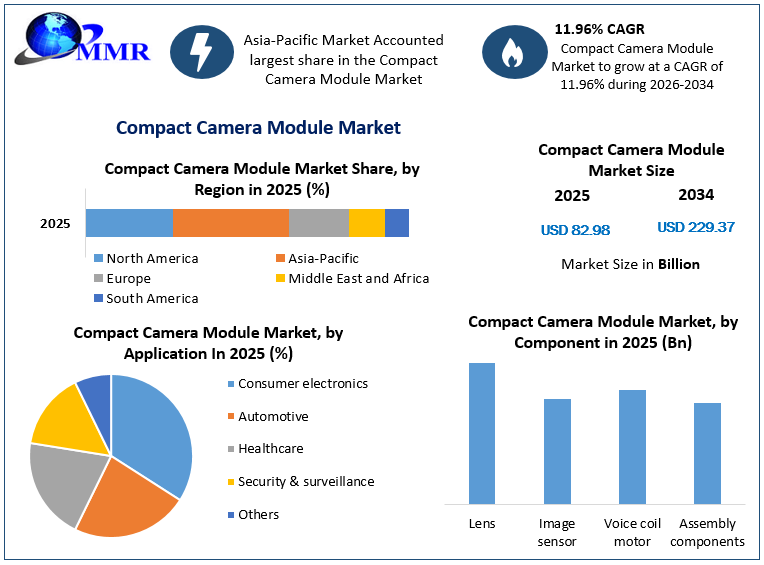
Compact Camera Module Market is expected to grow at a CAGR of 11.96% during the forecast period and it is expected to reach USD 229.37 Bn. by 2034.
The camera module contains of one solid tunable lens for optical power variation, two identical micro electromechanical systems (MEMS)-thermal actuators integrated with displacement amplifiers for lens driving, a complementary metal oxide semiconductor (CMOS) image sensor for recording, and necessary computer numerical control (CNC) fabricated components for supporting and housing.
Compact Camera Module Market Growth and Share Analysis
To know about the Research Methodology :- Request Free Sample Report
The Global Compact Camera Module Market is driven by the acceptance of high resolution cameras in mobiles and has been increased by the adoption of front-facing cameras, furthermore, increasing resolution in camera requirement for both rear and front-facing mobile cameras. The trend of application like Snap chat, Instagram and various application used for gaming has a great effect on the demand and performance of front-facing camera of mobiles, tabs and cost of camera devices.
This report provides complete analysis of its profit, loss, manufacturers, products, services, drivers and challenges. The Global Photomask Market report highlights the aspects that effect product development and market growth along with technological up gradations that improvement in the Photomask market.
Compact Camera Module Market Drivers and Restrains:
Rise in smartphone uses, increased consumers in electronics industry, and rise in need for slimmer, light weight and easy handling smartphones with advanced cameras drive are the growth components of compact camera module market. As billions of smartphones and tablets get sold across the global market, manufacturers of compact camera modules witness a rising demand during forecast period. A multi-physics Finite Element Methods (FEM) modelling is carried out to investigate the output displacement characteristic, the temperature distribution of the actuator, and hence to optimize its performance. Furthermore, as a major parameter, the temperature-versus-electric-resistance relation of the fixed silicon used in this work is characterized and then applied in the simulation modeling process of compact camera.
Compact Camera Modules with Auto-Focus Lens to Capture Maximum Sales
All hand-held camera contain electronics devices require specific compact camera modules to operate from front-end side or backside. On these specific phenomenon, manufacturers improve compact camera modules with auto-focus lens or fixed-focus lens. In 2025, it has been predictable that the sales of compact camera module with auto-focus lens accounted for an approximately two-third share of the global market value. The report projected up to 2034, compact camera modules developed with an auto-focus lens will outsell the modules with fixed-focus lens.
Increased Growth in Consumer Electronics Industry
The compact camera modules are working with functionalities like light sensing capabilities and down sampling features that enable the users to take pictures through electronic devices including laptops, smartphones, tablet PCs, and others. Therefore, the significant growth in demand for devices, such as cameras, tablets, and smartphones boosts the growth of the compact camera modules during forecast period.
Manufacturers in the Compact Camera Module are focusing on competitive pricing as the strategy to capture significant market share. Moreover, strategic mergers and acquisitions and technological innovations are also the key focus areas of the manufacturers.
Compact Camera Module Market Regional Insights:
Asia-Pacific dominated the global compact camera module market in 2025, because of the occurrence of a huge number of manufacturers. Supplementary, China generated a large percentage of regional profits. The present Compact Camera Module Market is dominated by Asian players, mainly Japanese and Korean firms. The other regions covered for the research study include North America, Europe, and LAMEA (Latin America, Middle East, and Africa). These report also analyzes applications such as automotive, security & surveillance, and others factors.
The objective of the report is to present comprehensive analysis of global Compact Camera Module market including all the stakeholders of the industry. The past and current status of the industry with forecasted market size and trends are presented in the report with the analysis of complicated data in simple language. The report covers the all the aspects of industry with dedicated study of key players that includes market leaders, followers and new entrants by region.
PORTER, SVOR, PESTEL analysis with the potential impact of micro-economic factors by region on the market have been presented in the report. External as well as internal factors that are supposed to affect the business positively or negatively have been analyzed, which will give clear futuristic view of the industry to the decision makers.
The report also helps in understanding global Compact Camera Module market dynamics, structure by analyzing the market segments, and project the global Compact Camera Module market size. Clear representation of competitive analysis of key players by Compact Camera Module Type, price, financial position, product portfolio, growth strategies, and regional presence in the global Compact Camera Module market make the report investor’s guide.
Compact Camera Module Market Recent Industry Developments
| Date | Company | Development | Impact |
|---|---|---|---|
| 02 July 2025 | Nippon Chemi-Con Corporation | Nippon Chemi-Con partnered with Microchip Technology and NetVision to release the industry's first ASA-ML automotive camera development ecosystem utilizing the CDTrans camera module. | The collaboration accelerates open-standard, high-speed camera connectivity and cybersecurity compliance for Japanese automotive OEMs in Software-Defined Vehicle architectures. |
| 31 December 2025 | LG Innotek | LG Innotek unveiled its invisible under-display automotive camera module (UDC) designed for driver monitoring systems ahead of CES 2026. | The innovation achieves 99% image fidelity via AI image restoration software while seamlessly integrating behind instrument panels to meet stringent EU safety mandates. |
| 13 April 2026 | Sunny Smartlead | Sunny Smartlead entered a strategic alliance with Microchip Technology to launch standardized ADAS camera modules integrated with ASA-ML serializers. | The partnership delivers interoperable, high-speed camera solutions that reduce system complexity and development costs for global automotive OEMs. |
| 30 April 2026 | Samsung Electro-Mechanics | Samsung Electro-Mechanics announced the active development of ultra-compact, high-resolution camera modules tailored for humanoid robots. | This initiative expands the company's optical module portfolio beyond smartphones and EVs into next-generation autonomous robotics applications. |
| 03 June 2026 | Cupola360 Inc. | Cupola360 introduced the Next-Gen Omni Speed Dome camera module solution featuring real-time 360-degree image stitching technology at COMPUTEX 2026. | The compact optical module eliminates mechanical rotation latency and blind spots, delivering multi-target tracking efficiency in remote server and industrial monitoring environments. |
| 08 June 2026 | Teledyne FLIR OEM | Teledyne FLIR OEM commercially launched the Boson SX8, the market's first NDAA-compliant 8 µm SXGA LWIR thermal camera module. | The module delivers unmatched thermal resolution and spatial precision in an ultra-compact form factor for defense, robotics, and commercial surveillance integrations. |
Compact Camera Module Market Scope: Inquire before Buying
| Compact Camera Module Market | |||
|---|---|---|---|
| Report Coverage | Details | ||
| Base Year: | 2025 | Forecast Period: | 2026-2034 |
| Historical Data: | 2020 to 2025 | Market Size in 2025: | USD 82.98 Bn. |
| Forecast Period 2026 to 2034 CAGR: | 11.96% | Market Size in 2034: | USD 229.37 Bn. |
| Segments Covered: | by Component | Lens Image sensor Voice coil motor Assembly components |
|
| by Application | Consumer electronics Automotive Healthcare Security & surveillance Others |
||
Compact Camera Module Market, by Region
North America (United States, Canada and Mexico)
Europe (UK, France, Germany, Italy, Spain, Sweden, Austria and Rest of Europe)
Asia Pacific (China, South Korea, Japan, India, Australia, Indonesia, Malaysia, Vietnam, Taiwan, Bangladesh, Pakistan and Rest of APAC)
Middle East and Africa (South Africa, GCC, Egypt, Nigeria and Rest of ME&A)
South America (Brazil, Argentina Rest of South America)
Compact Camera Module Market, Key Players are
1. Chicony electronics co ltds
2. Semco
3.LG Innotek
4. O-Film
5. Foxconn Sharp
6. Henkel
7. Sunny Optical
8. Nikon
9. Casio
10. Pentax
11. Polaroid
12. Menex
13. Liteon
14. Cowell
15. Q-tech
16. Samsang
17. Sony Coproration
18. Primax Electronics Ltd.
19. Sharp Electronics Corporation
20. Partron
21. MCNEX
Frequently Asked Questions:
1. Which region has the largest share in Global Compact Camera Module Market?
Ans: Asia-Pacific region holds the highest share in 2025.
2. What is the growth rate of Global Market?
Ans: The Global Market is growing at a CAGR of 11.96% during forecasting period 2026-2034.
3. What is scope of the Global market report?
Ans: Global Market report helps with the PESTEL, PORTER, COVID-19 Impact analysis, Recommendations for Investors & Leaders, and market estimation of the forecast period.
4. Who are the key players in Global market?
Ans: The important key players in the Global Market are -Chicony electronics co ltds, Semco, LG Innotek, O-Film, Foxconn Sharp, Henkel, Sunny Optical, Nikon, Casio, Pentax, Polaroid, Menex, Liteon, Cowell, Q-tech, Samsang, Sony Coproration, Primax Electronics Ltd., Sharp Electronics Corporation, Partron, and MCNEX.
5. What is the study period of this market?
Ans: The Global Market is studied from 2020 to 2034.