
Global Cranes Market Size by Crane Type, by Lifting Capacity, by Power Source, by Boom Type, by Operating Environment, by Ownership Model, by End Use Industry and Forecast 2034
Overview
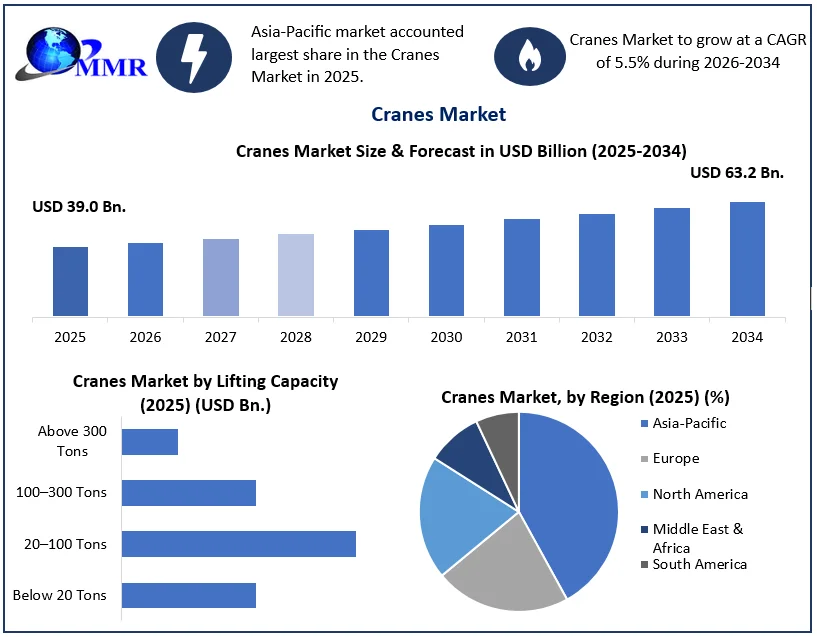
The global cranes market was valued at USD 39.0 billion in 2025 and is projected to reach USD 63.2 billion by 2034, expanding at a CAGR of 5.5% during 2026–2034.
Cranes Market Overview:
Cranes are heavy lifting and material-handling equipment used to lift, lower, move, and position heavy loads in construction, infrastructure, manufacturing, mining, energy, logistics, ports, and shipbuilding. Major products include tower cranes, mobile cranes, crawler cranes, overhead cranes, gantry cranes, jib cranes, rough-terrain cranes, and truck-mounted cranes. Increasing adoption of hydraulic systems, automation, IoT, telematics, GPS, remote monitoring, and operator-assistance technologies is improving lifting efficiency, safety, and precision.
The global cranes market was valued at USD 39.0 billion in 2025 and is projected to reach USD 63.2 billion by 2034, growing at a CAGR of 5.5% during 2026–2034. Growth is driven by urbanization, infrastructure development, construction projects, manufacturing expansion, mining, renewable energy, port modernization, and shipbuilding. Government infrastructure investment further supports demand; for example, the U.S. Census Bureau reported construction spending at an annualized USD 2.20 trillion in August 2026, indicating a substantial project base requiring lifting equipment. Asia-Pacific remains a leading region due to strong construction and industrial activity, with China and India representing important growth markets.
The MMR Global Cranes Market Report will provide detailed analysis of market size, CAGR, drivers, restraints, opportunities, trends, technological developments, and competitive landscape. The report will cover segmentation by product type, mobility, lifting capacity, operation, application, end-use industry, and region, including construction, manufacturing, mining, energy, oil and gas, marine, ports, and logistics. It will also assess electric and hybrid cranes, smart cranes, automation, IoT-enabled monitoring, predictive maintenance, fleet digitization, company developments, investments, product launches, and regional opportunities, helping clients identify high-growth markets and strategic expansion opportunities.
Cranes Market Size, Growth and Share Analysis
To know about the Research Methodology :- Request Free Sample Report
Cranes Market Dynamics:
Accelerating Infrastructure Development and Construction Activity Is Increasing Crane Demand
Rising investment in roads, bridges, airports, railways, metro systems, high-rise buildings, industrial facilities, ports, and renewable energy projects is creating sustained demand for cranes with higher lifting capacities and improved mobility. Large-scale infrastructure programs in emerging economies are encouraging contractors to deploy tower cranes, mobile cranes, crawler cranes, and rough-terrain cranes to improve project productivity. For example, construction activity in the U.S. reached an annualized USD 2.20 trillion in August 2026, reflecting the substantial project pipeline that supports demand for lifting and material-handling equipment.
High Capital, Maintenance, and Compliance Costs Are Limiting Crane Adoption
Cranes require significant expenditure for equipment acquisition, transportation, installation, maintenance, inspection, insurance, operator training, and regulatory compliance, particularly for high-capacity and specialized equipment. Fluctuations in the prices of steel, hydraulic components, electronic systems, and other raw materials can further increase manufacturing and procurement costs. These factors can discourage smaller contractors from purchasing new equipment and encourage greater use of crane rental, leasing, and equipment-sharing models, particularly for short-duration construction projects.
Automation, Electrification, and Connected Technologies Are Transforming Crane Operations
The increasing integration of IoT, telematics, artificial intelligence, remote operation, predictive maintenance, digital load monitoring, anti-collision systems, and fleet-management platforms is creating new opportunities for crane manufacturers and technology providers. Smart monitoring can help operators track equipment utilization, operating hours, load conditions, and maintenance requirements, improving productivity and reducing unexpected downtime. In addition, the growing adoption of electric and hybrid cranes provides opportunities to meet low-emission construction requirements and support the transition toward more sustainable lifting equipment.
Skilled Labor Shortages and Increasing Safety Requirements Are Complicating Crane Deployment
The cranes industry continues to face challenges associated with a shortage of qualified operators, technicians, maintenance personnel, and specialized installation teams. Crane operations require strict adherence to load limits, inspection procedures, site conditions, operator certification, and workplace safety standards, increasing the complexity of deployment. In addition, the growing use of automated and digitally connected systems requires operators and maintenance teams to develop new technical skills, while equipment downtime, difficult site conditions, and project delays can increase the overall operating cost of crane fleets.
Cranes Market Segment Analysis:
By Crane Type
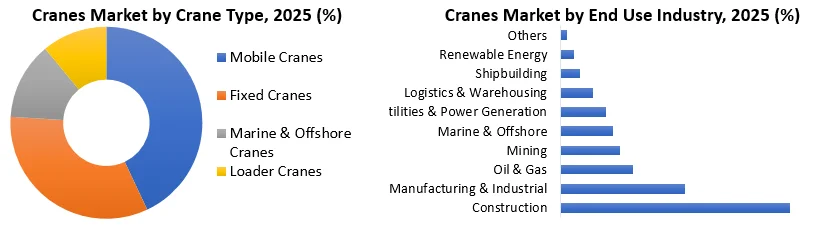
Mobile cranes account for a significant share of the global cranes market due to their mobility, flexible deployment, and suitability for construction, infrastructure, mining, utilities, and industrial projects. The segment includes truck-mounted, rough-terrain, all-terrain, crawler, and pick-and-carry cranes, which are selected based on lifting capacity and site conditions. Fixed cranes such as tower, overhead, gantry, and jib cranes are widely used for continuous lifting operations at construction sites, manufacturing facilities, warehouses, and industrial plants. Meanwhile, marine and offshore cranes, including knuckle boom, lattice boom, telescopic boom, and offshore pedestal cranes, are gaining importance in shipbuilding, ports, offshore oil and gas, and offshore wind projects where specialized lifting capabilities are required.
By End Use Industry
The construction industry represents a major demand center for cranes, driven by residential and commercial buildings, high-rise structures, roads, bridges, airports, railways, and metro projects requiring the movement of heavy materials and structural components. Manufacturing & industrial facilities use overhead, gantry, jib, and mobile cranes for machinery installation, assembly, maintenance, and material handling, while the oil & gas and mining industries require specialized high-capacity equipment for drilling sites, refineries, offshore platforms, equipment maintenance, and heavy machinery handling. Marine & offshore, utilities & power generation, logistics & warehousing, shipbuilding, and renewable energy projects, particularly wind farms, further contribute to crane demand through equipment installation, maintenance, cargo handling, and infrastructure development.
Cranes Market Regional Insights:
Asia-Pacific is the leading and fastest-growing regional market for cranes, driven by urbanization, infrastructure development, construction, manufacturing, industrialization, mining, ports, logistics, and renewable energy projects. China is a major market due to extensive construction, manufacturing, railway, highway, and port development, while India offers strong growth opportunities through road, railway, metro, industrial corridor, airport, and renewable energy investments. Japan, South Korea, Indonesia, Vietnam, Thailand, and Malaysia further support demand through shipbuilding, automotive manufacturing, industrial expansion, and logistics infrastructure.
North America is a technologically advanced cranes market, supported by infrastructure modernization, commercial construction, manufacturing, mining, oil and gas, logistics, data centers, ports, and renewable energy projects. The U.S. remains the leading country market, with increasing demand for mobile cranes, crawler cranes, all-terrain cranes, smart cranes, electric cranes, and telematics-enabled equipment. Canada offers opportunities in mining, energy, infrastructure, utilities, and large industrial projects.
Europe represents a mature market with strong demand for energy-efficient, automated, electric, hybrid, and digitally connected cranes. Germany, France, Italy, the U.K., Spain, and the Netherlands are important markets, supported by manufacturing, automotive, construction, ports, logistics, shipbuilding, and offshore wind projects. The region's focus on decarbonization, workplace safety, automation, and industrial modernization is creating opportunities for advanced crane technologies.
The Middle East & Africa market is gaining momentum from mega construction projects, oil and gas, tourism infrastructure, ports, airports, industrial zones, mining, and renewable energy development. Saudi Arabia and the UAE are major growth markets due to large-scale infrastructure and urban development projects, while South Africa, Egypt, and Nigeria offer opportunities through mining, transportation infrastructure, power generation, and port development.
South America offers emerging growth op
portunities through mining, construction, infrastructure modernization, oil and gas, ports, logistics, and renewable energy projects. Brazil represents the largest opportunity because of its construction, mining, industrial, port, and energy activities, while Chile and Peru have strong demand potential from mining projects. Increasing investment in transportation infrastructure, mining equipment, renewable power, and port modernization is expected to support crane adoption across the region.
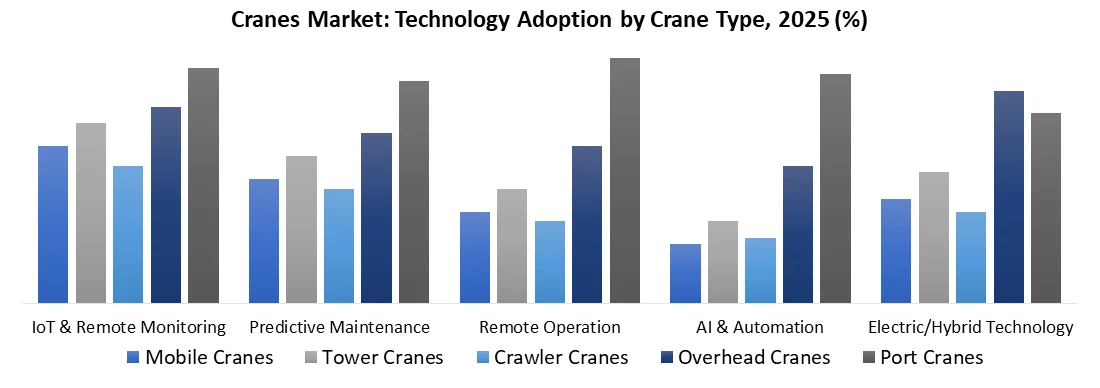
Technology Adoption by Crane Type, 2025
Technology adoption is transforming crane operations through IoT-based monitoring, predictive maintenance, remote operation, AI-driven automation, and electric or hybrid systems. Adoption levels vary by crane type, with port and overhead cranes generally showing higher integration of advanced technologies due to their suitability for automation and continuous operations. The following graph compares estimated technology adoption across major crane types in 2025.
Cranes Market Competitive Landscape
The global cranes market is highly competitive and fragmented, with manufacturers competing through product innovation, lifting capacity, equipment reliability, safety technologies, automation, electrification, digital monitoring, rental services, and global distribution networks. Leading companies are expanding their portfolios across mobile cranes, tower cranes, crawler cranes, overhead cranes, loader cranes, marine & offshore cranes, and specialized heavy-lifting equipment to address diverse construction, infrastructure, industrial, energy, mining, and logistics requirements.
The competitive environment is increasingly shaped by electric and hybrid cranes, IoT-enabled telematics, remote operation, predictive maintenance, automated lifting systems, advanced load monitoring, anti-collision technologies, and low-emission equipment. Strategic product launches, partnerships, acquisitions, manufacturing expansion, technology investments, and regional market expansion are also being used by manufacturers to increase market presence and address growing demand for smart, efficient, and sustainable lifting solutions.
Cranes Market Recent Industry Developments, 2026
| Date | Company | Recent Development |
| January 2026 | Konecranes | Konecranes received an order from an Indian container terminal for two Rail-Mounted Gantry (RMG) cranes, following an earlier order for 30 Rubber-Tired Gantry (RTG) cranes, supporting automated and efficient container-handling operations. |
| January 2026 | GRSE & K2 Cranes | Garden Reach Shipbuilders and Engineers (GRSE) signed an MoU with K2 Cranes & Components for the design, development, and indigenous manufacturing of marine, defence, and shipyard cranes, supporting India's Make in India and Atmanirbhar Bharat initiatives. |
| February 2026 | Palfinger & TVS Mobility | Palfinger expanded its India strategy through a partnership with TVS Mobility, focusing on local production, supply-chain development, dealerships, and aftermarket support for lifting equipment. |
| March 2026 | Liebherr | Liebherr expanded the commercialization of its Fibre tower crane technology, with nearly 400 Fibre cranes operating worldwide, while developing enhanced repair solutions and extending the technology's service life. |
| March 2026 | SANY | At CONEXPO-CON/AGG 2026, SANY America introduced the SCA3300A 330-ton crawler crane and SCA1100TB 110-ton telescopic crawler crane, strengthening its heavy-lifting portfolio in North America. |
| June 2026 | Hindustan Zinc | Hindustan Zinc deployed India's first 250-tonne electric crane at its Debari zinc smelter in Rajasthan. The crane can operate using both diesel and electric power, supporting industrial decarbonization. |
The objective of the report is to present a comprehensive analysis of the global Cranes Market to the stakeholders in the Equipment. The past and current status of the analysis of complicated data in simple language. The report covers all the aspects of the Equipment with a dedicated study of key players that include market leaders, followers, and new entrants.
PORTER, PESTEL analysis with the potential impact of micro-economic factors of the market has
Been presented in the report. External as well as internal factors that are supposed to affect the business positively or negatively have been analyzed, which will give a clear futuristic view of the Equipment to the decision-makers.
The report also helps in understanding the global Cranes Market dynamics, structure by analyzing the market segments and projects the global Cranes Market size. Clear representation of competitive analysis of key players by Power supply, price, and financial position, Power supply portfolio, growth strategies, and Regional presence in the global Cranes Market make the report investor’s guide.
Cranes Market Scope: Inquire before buying
| Cranes Market | |||
|---|---|---|---|
| Report Coverage | Details | ||
| Base Year: | 2025 | Forecast Period: | 2026-2034 |
| Historical Data: | 2020 to 2025 | Market Size in 2025: | 39 USD Billion |
| Forecast Period 2026-2034 CAGR: | 5.5% | Market Size in 2034: | 63.2 USD Billion |
| Segments Covered: | by Crane Type | Mobile Cranes Truck-Mounted Cranes Rough Terrain Cranes All-Terrain Cranes Crawler Cranes Pick-and-Carry Cranes Fixed Cranes Tower Cranes Overhead Cranes Gantry Cranes Jib Cranes Deck Cranes Marine & Offshore Cranes Knuckle Boom Cranes Lattice Boom Cranes Telescopic Boom Cranes Offshore Pedestal Cranes Loader Cranes |
|
| by Lifting Capacity | Below 20 Tons 20–100 Tons 100–300 Tons Above 300 Tons |
||
| by Power Source | Diesel Powered Cranes Electric Cranes Hybrid Cranes |
||
| by Boom Type | Lattice Boom Telescopic Boom Knuckle Boom Others |
||
| by Operating Environment | Onshore Offshore |
||
| by Ownership Model | Purchase Short Term Rental Long Term Rental/Lease |
||
| by End Use Industry | Construction Manufacturing & Industrial Oil & Gas Mining Marine & Offshore Utilities & Power Generation Logistics & Warehousing Shipbuilding Renewable Energy (Wind & Solar) Others |
||
Cranes Market, by Region
North America (United States, Canada and Mexico)
Europe (UK, France, Germany, Italy, Spain, Sweden, Austria and Rest of Europe)
Asia Pacific (China, South Korea, Japan, India, Australia, Indonesia, Malaysia, Vietnam, Taiwan, Bangladesh, Pakistan and Rest of APAC)
Middle East and Africa (South Africa, GCC, Egypt, Nigeria and Rest of ME&A)
South America (Brazil, Argentina Rest of South America)
Cranes Market Key Players are:
1. Konecranes PLC
2. Terex Corporation
3. Kato Works Co., Ltd.
4. IHI Construction Machinery Limited
5. Link-Belt Construction Equipment Co.
6. Liebherr Group
7. Tadano Ltd.
8. Altec Inc.
9. Cargotec Corporation
10. XCMG Group
11. Kobelco Cranes Co., Ltd.
12. Uesco Industries, Inc.
13. Whiting Corporation
14. Demag Cranes & Components GmbH
15. Gorbel Inc.
16. Street Crane Company Limited
17. North American Industries
18. The Manitowoc Company, Inc.
19. PALFINGER AG
20. Zoomlion Heavy Industry Science & Technology Co., Ltd.
21. SANY Group
22. Komatsu Ltd.
23. Caterpillar Inc.
24. Hitachi Construction Machinery Co., Ltd.
25. Action Construction Equipment Limited (ACE)
26. SENNEBOGEN Maschinenfabrik GmbH
27. Sumitomo Heavy Industries Construction Cranes Co., Ltd.
28. Favelle Favco Group
29. JASO Tower Cranes
30. WOLFFKRAN International AG
31. Yongmao Holdings Limited
32. Shandong Huaxia Group Co., Ltd.
33. Liugong Machinery Co., Ltd.
34. Manitex International, Inc.
35. Maeda Seisakusho Co., Ltd.
36. Spierings Mobile Cranes B.V.
37. Locatelli Crane S.r.l.
38. Ormig S.p.A.
39. Broderson Manufacturing Corp.
40. Sarens N.V.
41. Mammoet
42. Raimondi Cranes
43. Eng Cranes Srl
44. Pelloby Ltd.
45. GH Cranes & Components
46. ABUS Kransysteme GmbH
47. Columbus McKinnon Corporation
48. KITO Crosby
49. R&M Materials Handling, Inc.
50. Zhenhua Heavy Industries Co., Ltd. (ZPMC)
Frequently Asked Questions:
1) What was the Global Cranes Market size in 2025?
Ans: The Global Cranes Market size was USD 39.0 Billion in 2025.
2) What are the market segments of the Global Cranes Market?
Ans: The Global Cranes Market is segmented based on Crane Type, Lifting Capacity, Power Source, Boom Type, Operating Environment, Ownership Model, and End Use Industry.
3) What is the forecast period considered for the Global Cranes Market?
Ans: The forecast period for the Global Cranes Market is 2026 to 2034, with 2025 as the base year.
4) What is the market size of the Global Cranes Market in 2034?
Ans: The Global Cranes Market is estimated to reach USD 63.2 Billion by 2034.
5) What is the CAGR of the Global Cranes Market during the forecast period?
Ans: The Global Cranes Market is projected to grow at a CAGR of 5.5% during 2026–2034.
6) Which region dominated the Global Cranes Market in 2025?
Ans: Asia-Pacific dominated the Global Cranes Market in 2025, supported by rapid infrastructure development, construction activity, industrialization, manufacturing expansion, and port and logistics investments.