
Global Cobalt Market by Application, by Form, by Supply Source, by End User by Region and Forecast 2034
Overview
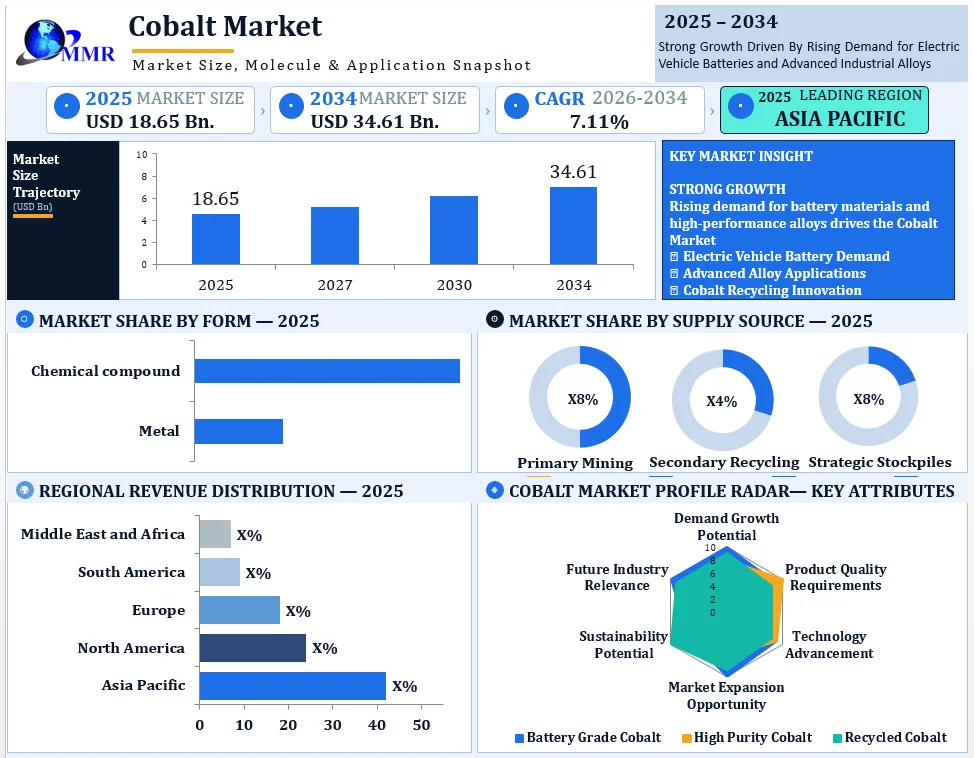
The Global Cobalt Market Size was valued at USD 18.65 Billion in 2025 and is estimated to grow at a CAGR of 7.11% over the forecast period, reaching USD 34.61 Billion by 2034.
Global Cobalt Market Overview:
Cobalt is a strategic transition metal valued for its strength, thermal stability, corrosion resistance, and role in advanced energy storage materials. The cobalt market encompasses cobalt metal, cobalt chemicals, cobalt compounds, and refined materials used in battery manufacturing, aerospace alloys, industrial tools, electronics, pigments, and chemical applications. Its importance stems from its contribution to lithium-ion battery performance, high-temperature engineering, and durable industrial components, making cobalt a critical raw material for modern manufacturing and clean energy technologies.
The cobalt market is growing as electric vehicle manufacturing, rechargeable battery production, renewable energy storage, aerospace engineering, and high-performance alloy applications increase demand for reliable cobalt supplies. Battery manufacturers, automotive companies, electronics producers, aerospace suppliers, and industrial manufacturers are key buyers, while material recyclers and refiners support supply chain resilience. Asia Pacific remains a significant region for cobalt refining, battery materials, and downstream manufacturing, while the Democratic Republic of the Congo plays a major role in mine supply. Industry data from the Cobalt Institute and critical mineral assessments by the International Energy Agency highlight the importance of battery demand, responsible sourcing, mineral processing capacity, and supply chain diversification. Changes in battery chemistry, cobalt recycling, ethical mining standards, and alternative materials are reshaping market competition and influencing long-term cobalt demand.
MMR's cobalt market research examines industry structure, market trends, demand drivers, restraints, emerging opportunities, regional growth patterns, and competitive positioning across the cobalt value chain. The analysis identifies opportunities in battery-grade cobalt chemicals, recycled cobalt materials, sustainable refining, advanced alloys, and diversified supply chains, helping manufacturers, investors, suppliers, and strategic decision-makers evaluate market potential and evolving customer requirements.
Global Cobalt Market Size, Growth and Share Analysis
To know about the Research Methodology :- Request Free Sample Report
Global Cobalt Market Key Highlights
| Key Highlight |
Insight |
|---|---|
| Market Growth Outlook |
The cobalt market is valued at USD 18.65 billion in 2025 and is projected to reach USD 34.61 billion by 2034, registering a CAGR of 7.11% during 2026–2034. |
| Leading Regional Market | Asia Pacific leads through its strong cobalt refining capacity, battery material production, electric vehicle manufacturing, and established electronics supply chains. |
| Dominant Application |
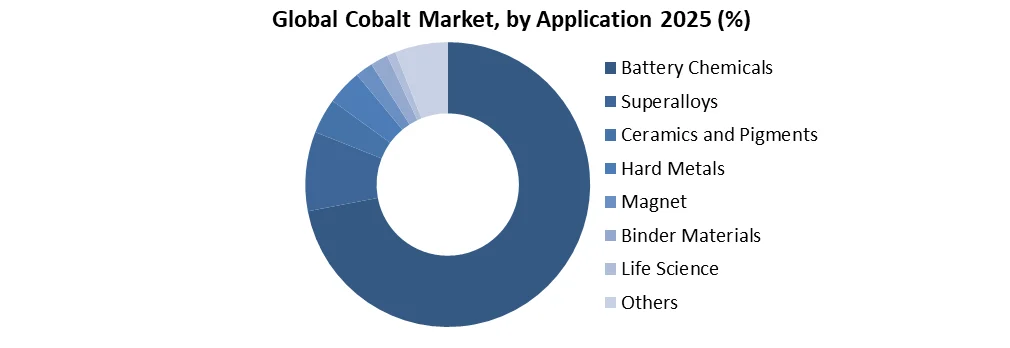
Battery chemicals represent a key application due to demand for cobalt-containing lithium-ion batteries, while superalloys support aerospace, defence, and high-temperature industrial applications. |
| Key Market Growth Drivers | Electric vehicle battery production, energy storage installations, advanced electronics, and aerospace materials support cobalt demand, while battery recycling creates additional supply opportunities. |
| Competitive Landscape and Supply Risks |
Glencore, CMOC Group, Zhejiang Huayou Cobalt, Umicore, and Jinchuan Group are important industry participants. Concentrated mining supply, export restrictions, cobalt price volatility, and cobalt-free battery alternatives influence competition and future market development. |
Global Cobalt Market Dynamics –
Rising Demand for Electric Vehicle Batteries and Energy Storage Systems Drive Cobalt Market Growth
The cobalt market is supported by rising demand for electric vehicle batteries, rechargeable consumer electronics, and stationary energy storage systems, where cobalt-containing battery chemistries help improve energy density, thermal stability, and battery performance. The increasing adoption of electric mobility and investments in battery manufacturing create opportunities for cobalt producers and refined material suppliers. According to the International Energy Agency, electric car sales exceeded 17 million units in 2024, representing more than 20% of new car sales worldwide, highlighting the growing importance of battery raw materials. Demand from aerospace superalloys, industrial machinery, and high-performance electronics also supports cobalt consumption, while battery recycling and advanced refining technologies strengthen long-term supply chain efficiency. Cobalt remains an important material for selected lithium-ion battery chemistries, particularly nickel-rich cathodes, supporting its role in electric vehicle battery manufacturing and energy storage applications.
Increasing Adoption of Cobalt-Free Battery Chemistries Limits Cobalt Market Demand
The cobalt market faces demand-side pressure from battery manufacturers adopting lithium iron phosphate batteries and other lower-cobalt technologies to reduce raw material costs and dependence on concentrated mineral supply chains. The International Energy Agency reports that lithium iron phosphate batteries accounted for two-thirds of electric car battery sales in emerging markets and developing economies in 2025, reflecting a significant shift in battery chemistry preferences. This trend creates challenges for cobalt suppliers serving electric vehicle manufacturers, particularly as battery producers prioritize affordability, material efficiency, and supply chain security. In addition, fluctuations in cobalt prices, high investment requirements for mining operations, and competition from alternative battery materials can affect procurement decisions and long-term purchasing contracts. These factors may limit cobalt consumption growth in selected battery applications, increasing the importance of diversifying demand across aerospace alloys, industrial catalysts, electronics, and other specialized applications.
Battery Recycling and Advanced Cobalt Recovery Technologies Create New Market Opportunities
The cobalt market presents significant opportunities through battery recycling, electronic waste recovery, and the development of efficient refining technologies that improve secondary cobalt supply. Manufacturers can capitalize on this opportunity by investing in hydrometallurgical recycling, battery collection networks, and cobalt recovery from end-of-life electric vehicle batteries and manufacturing scrap. Additional opportunities arise from demand for cobalt-based superalloys in aircraft engines, corrosion-resistant materials, industrial catalysts, and high-performance electronics. Developing regional refining facilities, traceable sourcing systems, and strategic partnerships with battery manufacturers can also help producers improve resource efficiency, strengthen supply chain resilience, and meet the growing preference for responsibly sourced critical minerals.
Concentrated Cobalt Mining Supply and Price Volatility Create Challenges for Cobalt Market Participants
The cobalt market faces structural challenges arising from concentrated mine production, geopolitical uncertainty, environmental compliance requirements, and unpredictable commodity prices. The Democratic Republic of the Congo accounted for almost two-thirds of cobalt supply, according to the International Energy Agency's 2026 battery analysis, making the market particularly sensitive to changes in mining policy, export restrictions, and logistical disruptions. Export controls and quota changes can rapidly affect the availability of cobalt intermediates and refined materials, creating procurement difficulties for battery manufacturers and industrial consumers. Mining companies must also address water management, energy consumption, worker safety, and responsible sourcing requirements while maintaining competitive production costs. At the same time, new mining projects face lengthy development timelines, capital-intensive infrastructure requirements, and uncertainty about future demand as battery technologies evolve. Strengthening supply diversification, improving mine-to-refinery traceability, and increasing recycling capacity remain essential strategies for reducing these risks and supporting a more resilient cobalt supply chain.
Global Cobalt Market Key Trends
| Cobalt Market Trends | Description |
|---|---|
| Rising Demand for Battery-Grade Cobalt | Battery-grade cobalt remains important for nickel-rich lithium-ion batteries used in electric vehicles and portable electronics. The Cobalt Institute reported that total cobalt demand reached 276,000 tonnes in 2025, increasing 13% from 2024, with battery applications remaining the main source of demand growth. |
| Growing Adoption of Cobalt-Free Battery Technologies |
Battery manufacturers are increasingly using lithium iron phosphate batteries for electric vehicles and stationary energy storage because these chemistries avoid cobalt and can reduce material costs. This shift is changing cobalt consumption patterns and encouraging suppliers to serve additional industrial applications. |
| Diversification of Cobalt Mining and Processing Supply |
Battery manufacturers and refiners are seeking alternatives to concentrated cobalt supply chains by sourcing material from Indonesia and other producing countries. Indonesia's share of mined cobalt production reached 14% in 2025, compared with 11% in 2024, according to the Cobalt Institute. |
| Increasing Focus on Battery Recycling and Cobalt Recovery |
Battery recycling companies are recovering cobalt from manufacturing scrap, used batteries, and black mass to supplement primary mineral supplies. Regulatory changes in China during 2026 are also reshaping recycled cobalt availability, pricing, and processing margins, making recycling efficiency a key competitive factor. |
| Greater Influence of Export Policies on Cobalt Prices |
Government export restrictions and quota systems are becoming major factors in cobalt procurement, trading, and inventory planning. In 2026, the International Energy Agency identified new supply risks associated with export quotas in the Democratic Republic of the Congo, contributing to greater uncertainty over future cobalt availability and prices. |
| Rising Strategic Demand for Cobalt-Based Superalloys |
Aerospace, defence, and other high-performance industrial applications continue to support demand for cobalt-based superalloys, which offer strength and heat resistance under demanding operating conditions. Growing attention to defence supply chains and advanced engineering materials is encouraging producers to serve customers beyond the electric vehicle battery sector. |
Global Cobalt Market Segment Analysis
Based on Application, Battery chemicals represent the leading and most influential application segment of the cobalt market, supported by demand for rechargeable batteries used in electric vehicles, consumer electronics, and energy storage systems. Cobalt-containing battery chemistries remain important where energy density, stability, and reliable performance are priorities, although the adoption of cobalt-free alternatives influences purchasing patterns. Superalloys are another important application, with demand from aerospace engines, defence equipment, and gas turbines supporting their use in high-temperature environments. Hard metals serve cutting tools, mining equipment, and wear-resistant industrial components, while ceramics and pigments use cobalt compounds to produce durable colours in glass, tiles, and specialty coatings. Magnet applications benefit from cobalt's magnetic properties, and binder materials support the manufacture of cemented carbides and diamond tools. Life science applications include selected medical and scientific uses, while other applications cover catalysts, surface treatments, and specialty industrial chemicals. Battery chemicals remain the leading application by demand, while superalloys are an important strategic market beyond batteries.
Based on Form, Chemical compounds are a key form for battery materials, particularly cobalt sulfate used in cathode precursor manufacturing, as well as cobalt oxides used in ceramics, pigments, and specialty applications. Cobalt metal remains important for aerospace superalloys, hard metals, and magnetic materials that require high strength, heat resistance, or specific magnetic properties. The leading segment depends on the market definition: some market analyses identify chemical compounds as the largest form by revenue, while others place metal first. For a report focused on these two categories, chemical compounds are strongly associated with battery supply chains, whereas metal continues to serve important high-performance industrial applications.
Global Cobalt Market Regional Analysis
Asia Pacific is the leading region in cobalt market, supported by its established battery manufacturing ecosystem, cobalt refining capacity, and demand from electric vehicles, consumer electronics, and energy storage systems. China plays a central role in cobalt chemical processing and battery material production, while South Korea and Japan contribute through advanced battery technologies, specialty alloys, and electronic component manufacturing. Indonesia also strengthens the regional supply chain through cobalt production associated with nickel processing. These combined capabilities support Asia Pacific's leadership in cobalt consumption, processing, and downstream manufacturing.
North America maintains a significant position in the cobalt market through demand for aerospace superalloys, electric vehicle batteries, industrial equipment, and advanced defence technologies. The United States supports demand through battery manufacturing investments and initiatives aimed at securing critical mineral supplies, while Canada contributes through mining, refining projects, and resource development. Battery recycling and domestic processing are gaining importance as manufacturers seek to reduce dependence on concentrated supply chains. The region's cobalt market is therefore shaped by supply security, high-performance industrial applications, and investment in alternative sourcing.
Europe remains an important cobalt market because of its automotive manufacturing base, battery production initiatives, aerospace industry, and emphasis on responsible mineral sourcing. Demand for cobalt-containing battery materials is supported by electric mobility and energy storage, while cobalt-based alloys serve aircraft engines and specialised industrial equipment. Manufacturers are also paying greater attention to battery recycling, material traceability, and environmental compliance. These priorities encourage investment in circular material recovery and more transparent cobalt procurement practices across the European supply chain.
South America participates in the cobalt market through mineral exploration, developing battery material supply chains, and opportunities to strengthen critical mineral processing. Countries with established mining industries can support regional industrial development through investment in mineral recovery, refining infrastructure, and specialised chemical production. Demand opportunities are linked to electric mobility, renewable energy storage, and industrial manufacturing, although cobalt production and processing remain less established than in leading Asian and African supply centres. Improvements in infrastructure, investment conditions, and technical capabilities can help the region strengthen its role in cobalt-related supply chains.
The Middle East and Africa region occupies an important position in the cobalt market through its contrasting roles in mineral supply and industrial demand. The Democratic Republic of the Congo is a major source of mined cobalt, making mining policies, export conditions, and responsible sourcing practices important influences on material availability. Other African countries have opportunities to increase mineral processing and capture more value from locally extracted resources. In the Middle East, industrial diversification, advanced manufacturing, and investment in energy technologies can support demand for cobalt-based materials. Reliable power infrastructure, processing capacity, and supply chain transparency remain important factors in developing the region's wider cobalt industry.
Global Cobalt Market Competitive Landscape
The competitive landscape of the cobalt market is shaped by established mining companies, refined cobalt producers, battery material manufacturers, and recycling specialists competing through reliable raw material supply, processing efficiency, product quality, and strategic partnerships. Major industry participants include Glencore, CMOC Group, Eurasian Resources Group, Zhejiang Huayou Cobalt, Umicore, Jinchuan Group, Sumitomo Metal Mining, Freeport-McMoRan, and Sherritt International. Competition increasingly focuses on securing cobalt mining assets, strengthening refining capacity, supplying battery-grade cobalt chemicals, and developing efficient recycling technologies. Companies with integrated mining and refining operations benefit from greater control over feedstock availability, while specialty material producers compete through technical expertise and tailored cobalt products for electric vehicle batteries, aerospace superalloys, hard metals, magnets, ceramics, and industrial catalysts. Supply diversification, responsible cobalt sourcing, long-term offtake agreements, and traceable mineral supply chains are also becoming important competitive priorities as manufacturers respond to export restrictions and commodity price volatility.
| Region | Country | Company | Market relevance and competitive advantage |
|---|---|---|---|
| Asia Pacific | China | CMOC Group | A major cobalt mining producer with significant operations in the Democratic Republic of the Congo. Its large-scale production and integrated mineral operations strengthen its position in cobalt supply. |
| Asia Pacific |
China | Zhejiang Huayou Cobalt |
Connects cobalt mining and processing with battery material manufacturing, supporting demand for battery-grade cobalt chemicals and electric vehicle supply chains. |
| Asia Pacific | China | Jinchuan Group | Participates in nonferrous metals production and cobalt processing, with relevance to refined cobalt products and industrial raw material supply. |
| North America |
Canada | Sherritt International |
Maintains expertise in nickel and cobalt production and refining. Its capabilities are relevant to diversified mineral supply and battery material production. |
| Europe | Switzerland | Glencore | A major cobalt producer with mining assets in the Democratic Republic of the Congo and other countries. Its mining and marketing network supports large-scale cobalt supply. |
| Europe | Belgium | Umicore | Focuses on advanced materials and battery recycling, positioning the company in cobalt recovery, circular material supply, and specialty battery materials. |
| South America | Brazil | Vale | Has nickel operations that also produce cobalt as a by-product. Its diversified mining portfolio offers an alternative source of cobalt-bearing materials for industrial and battery supply chains. |
| Middle East and Africa |
Democratic Republic of the Congo |
Gecamines | Plays a strategic role in the country's copper and cobalt mining sector. Its position in the mineral resource base makes it relevant to domestic resource development and partnerships aimed at retaining more value within the region. |
Global Cobalt Market Scope: Inquire before buying
| Cobalt Market | |||
|---|---|---|---|
| Report Coverage | Details | ||
| Base Year: | 2025 | Forecast Period: | 2026-2034 |
| Historical Data: | 2020 to 2025 | Market Size in 2025: | 18.65 USD Billion |
| Forecast Period 2026-2034 CAGR: | 7.11% | Market Size in 2034: | 34.61 USD Billion |
| Segments Covered: | by Application | Battery Chemicals Super alloys Ceramics and pigments Hard metals Magnet Binder Materials Life Science Others |
|
| by Form | Metal Chemical compound |
||
| by Supply Source | Primary Mining Secondary Recycling Strategic Stockpiles |
||
| by End User | Alloys Magnets Hard Materials Catalyst Inks and Dyes Batteries Others |
||
Global Cobalt Market, by Region
North America (United States, Canada and Mexico)
Europe (UK, France, Germany, Italy, Spain, Sweden, Austria and Rest of Europe)
Asia Pacific (China, South Korea, Japan, India, Australia, Indonesia, Malaysia, Vietnam, Taiwan, Bangladesh, Pakistan and Rest of APAC)
Middle East and Africa (South Africa, GCC, Egypt, Nigeria and Rest)
South America (Brazil, Argentina Rest of South America)
Global Cobalt Market, key player
1. Glencore plc
2. Umicore
3. Vale S.A.
4. Jinchuan Group International Resources Co. Ltd.
5. Zhejiang Huayou Cobalt Co., Ltd.
6. Freeport-McMoRan
7. Sherritt International Corporation
8. BHP Group
9. Eramet
10. Votorantim Metais
11. Sumitomo Corporation
12. CMOC Group Limited
13. Missouri Cobalt LLC
14. China Molybdenum Co., Ltd.
15. Norilsk Nickel
16. GEM Co., Ltd.
17. Yantai Cash Industrial Co., Ltd.
18. Horizonte Minerals
19. Jervois Global
20. Fleurette Properties Limited
21. Eurasian Resources Group
22. Gécamines SA
23. Sumitomo Metal Mining Co., Ltd.
24. Cobalt Blue Holdings Limited
25. First Quantum Minerals Ltd.
26. Wheaton Precious Metals Corp.
27. Rio Tinto
28. Nickel 28 Capital Corp.
29. Tsingshan Holding Group
30. Contemporary Amperex Technology Co. Limited
31. Electra Battery Materials Corporation
32. Lifezone Metals Limited
33. Fortune Minerals Limited
34. Canada Nickel Company Inc.
35. Talon Metals Corp.
36. FPX Nickel Corp.
37. Shandong Xinhai Technology Co., Ltd.
38. Zhejiang GEM High-Tech Co., Ltd.
39. Huayou New Energy Technology
40. Ningbo Ronbay New Energy Technology Co., Ltd.
41. Beijing Easpring Material Technology Co., Ltd.
42. Tianjin B&M Science and Technology Co., Ltd.
43. Guangdong Brunp Recycling Technology Co., Ltd.
44. BASF SE
45. Solvay SA
46. Nippon Chemical Industrial Co., Ltd.
47. Mitsui Mining & Smelting Co., Ltd.
48. Tradium GmbH
49. Palm Commodities International LLC
50. United States Strategic Metals LLC
Frequently Asked Questions:
1. Which region has the largest share in the Cobalt Market?
Ans: Asia Pacific held the leading position in the Cobalt Market in 2025, driven by cobalt refining and battery manufacturing.
2. What is the growth rate of the Cobalt Market?
Ans: The Cobalt Market is projected to grow at a CAGR of 7.11% during the forecast period from 2026 to 2034.
3. What is the scope of the Cobalt Market report?
Ans: The report covers market dynamics, segmentation by application and form, regional analysis, competitive landscape, PESTEL analysis, PORTER analysis, and growth opportunities.
4. Who are the key players in the Cobalt Market?
Ans: Major players include Glencore plc, Umicore, Zhejiang Huayou Cobalt, CMOC Group, Jinchuan Group, Vale S.A., Sherritt International, and Sumitomo Metal Mining.
5. What is the study period of the Cobalt Market?
Ans: The Cobalt Market is studied from 2020 to 2034.