Hybrid Composites Market – Global Market Size, Strategic Growth Drivers, Risk Assessment Framework, Regulatory Landscape Review, Competitive Intensity Mapping & Long-Term Industry Outlook to 2034

14.5%
CAGR (2026-2034)
1124.88 USD Mn.
Forecast Market Size
317
Report Pages
146
Market Tables

Overview

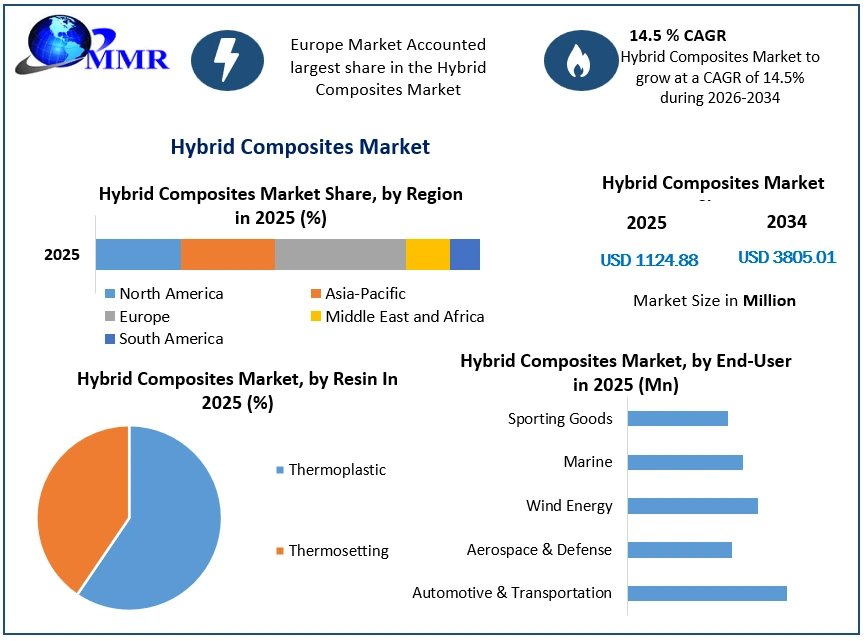
The Hybrid Composites Market size was valued at USD 1124.88 Million in 2025 and the total Hybrid Composites revenue is expected to grow at a CAGR of 14.5% from 2026 to 2034, reaching nearly USD 3805.01 Million.

Hybrid Composites Market Dynamics:

The objective of the report is to present a comprehensive assessment of the market and contains thoughtful insights, facts, historical data, industry-validated market data, and projections with a suitable set of assumptions and methodology. The report also helps in understanding hybrid composites market dynamics, structure by identifying and analyzing the market segments by Fiber Type, Resin, End-user, and Region and, project the global market size.

Further, the report also focuses on competitive analysis of key players by materials, price, financial position, materials portfolio, growth strategies, and regional presence. The report also provides PEST analysis, PORTER’s analysis, SWOT analysis to address the question of shareholders prioritizing the efforts and investment in the near future to the particular market segment.

Hybrid Composites Market Size, Share & Growth Analysis
Hybrid Composites Growth

To know about the Research Methodology:-Request Free Sample Report

Hybrid composites are formed using two or more reinforcement fibers to combine the properties of different fibers. These composites are used when longitudinal and lateral mechanical performances are required. The hybrid composites are formed by various configurations of fibers, which include fiber by fiber mixtures, skin-core-skin structures, layer-by-layer mixtures, tow-by-tow mixtures, internal ribs, and external ribs. The properties of a hybrid composite mainly depend upon the fiber content, length of individual fibers, orientation, the extent of an intermingling of fibers, fiber to matrix bonding, and arrangement of both the fibers.

The strength of the hybrid composite is also dependent on the failure strain of individual fibers. Maximum hybrid results are obtained when the fibers are highly strained compatible. Hybrid composites provide wider opportunities to control material stiffness, strength, and cost. The major restraint of hybrid composite has high recurring costs, has very expensive repairs and maintenance. Additionally, they are low-cost and lightweight. The increasing demand for lightweight aircraft and automobiles across the globe owing to stringent regulations for environment protection by the US Environmental Protection Agency and the European Chemicals Agency is one of the primary factors promoting the growth of the hybrid composites market.

Based on fiber type, Carbon/glass fiber hybrid composite parts are lighter and stronger than their metal counterparts, due to which, they are extensively used in many industries, including automotive & transportation, and wind energy. Carbon/glass hybrid fiber composites are used in high-end vehicles to reduce the overall cost. Users can get up to 90% of carbon’s benefits at a cost much lower than what they would have to incur in the case of using carbon fiber. Parts made out of these hybrid composites provide a high strength-to-weight ratio and are devoid of corrosion.

In terms of resins, Thermoset resins exhibit outstanding strength and crack resistance. These resins are suitable for use in automotive & transportation and marine Resins, which are some of the largest end-use industries requiring materials that possess high strength, lightweight, and flammability performance. Thermoset resin dominates the hybrid composites market owing to its wide-scale Resins in various end-use industries including automotive & transportation, aerospace & defense, wind energy, and marine.

In terms of end-user, the automotive & transportation segment accounts for the highest share in terms of revenue in the global market. The automotive & transportation industry uses hybrid composites to reduce weight and increase the fuel efficiency of vehicles. The use of hybrid composites in the automotive industry has enabled good performance and luxury at economical pricing. The better cost and performance properties offered by hybrid composites are expected to drive their demand in the automotive & transportation end-use industry.

Hybrid Composites Market Recent Development:

Date Company Development Impact
14 January 2025 SGL Carbon SGL Carbon launched a new series of carbon-glass hybrid fiber composites engineered specifically for next-generation electric vehicle battery enclosures. The innovation achieves a 15% weight reduction while significantly enhancing structural impact resistance and flame-retardant performance.
28 April 2025 Toray Industries Toray Industries partnered with a leading aerospace manufacturer to commercialize high-tensile hybrid thermoplastic composites for commercial aircraft interiors. This strategic collaboration accelerates fuel efficiency gains and reduces manufacturing cycle times by 25% across aerospace production lines.
11 September 2025 Gurit Holding AG Gurit Holding AG completed the expansion of its specialized manufacturing facility dedicated to high-performance wind turbine hybrid composite core materials. The expansion boosts production capacity by 30% to support the rapidly growing global demand for long-blade offshore wind energy installations.
03 November 2025 Hexcel Corporation Hexcel Corporation unveiled a bio-derived epoxy-carbon-flax hybrid composite material targeted at automotive and sporting goods applications. The bio-hybrid material substantially reduces the product's total carbon footprint by 40% while maintaining high mechanical stiffness and vibration damping.
10 February 2026 Teijin Limited Teijin Limited acquired a controlling stake in a European composite specialist to expand its global footprint in aramid-carbon hybrid laminate technologies. The acquisition strengthens Teijin's position in high-durability defense armor and heavy-duty transportation structural components.

Hybrid Composites Market Regional Analysis:

Europe is the major revenue-generating region in the hybrid composites market. Europe is home to some of the major automotive and aerospace & defense equipment manufacturers, which create demand for hybrid composites in the region. The infrastructure industry in Asia-Pacific has been growing at a healthy rate in recent times. Hence, the region is estimated to witness a tremendous growth rate over the assessment period in the Cement Board market.

Hybrid Composites Market Key Highlights:

• Global Hybrid Composites Market analysis and forecast, in terms of value.

• Comprehensive study and analysis of market drivers, restraints and opportunities influencing the growth of the Global Hybrid Composites Market

• Global Hybrid Composites Market segmentation on the basis of type, source, end-user, and region (country-wise) has been provided.

• Global Hybrid Composites Market strategic analysis with respect to individual growth trends, future prospects along with the contribution of various sub-market stakeholders have been considered under the scope of study.

• Global Market analysis and forecast for five major regions namely North America, Europe, Asia Pacific, the Middle East & Africa (MEA) and Latin America along with country-wise segmentation.

• Profiles of key industry players, their strategic perspective, market positioning and analysis of core competencies are further profiled.

• Competitive developments, investments, strategic expansion and competitive landscape of the key players operating in the Global Market are also profiled.

Hybrid Composites Market Scope: Inquire before buying

Global Hybrid Composites Market
Report Coverage Details
Base Year: 2025 Forecast Period: 2026-2034
Historical Data: 2020 to 2025 Market Size in 2025: USD 1124.88 Mn.
Forecast Period 2026 to 2034 CAGR: 14.5% Market Size in 2036: USD 3805.01 Mn.
Segments Covered: by Fiber Type Carbon/Glass
Carbon/Aramid
Hmpp (High-Modulus Polypropylene)
Uhmwpe (Ultra High Molecular Weight Polyethylene)
by Resin Thermoplastic
Thermosetting
by End-User Automotive & Transportation
Aerospace & Defense
Wind Energy
Marine
Sporting Goods
Others

Hybrid Composites Market, by Region:

North America (United States, Canada and Mexico)
Europe (UK, France, Germany, Italy, Spain, Sweden, Austria, Turkey, Russia and Rest of Europe)
Asia Pacific (China, India, Japan, South Korea, Australia, ASEAN and Rest of APAC)
Middle East and Africa (South Africa, GCC, Egypt, Nigeria and Rest of ME&A)
South America (Brazil, Argentina, Columbia and Rest of South America)

Hybrid Composites Market, Key Players are:

1 Royal DSM N.V.
2 SGL Group
3 Gurit
4 Hexcel Corporation
5 Teijin Limited
6 General Electric
7 Exel Composites
8 Innegra Technologies
9 Solvay
10 PlastiComp
11 The carbon Company
12 LLC
13 Quantum Composites
14 PolyOne Corporation
15 LANXESS

Frequently Asked Questions:

1. Which region has the largest share in Global Hybrid Composites Market?
Ans: Europe region held the highest share in 2025.

2. What is the growth rate of Global Hybrid Composites Market?
Ans: The Global Hybrid Composites Market is growing at a CAGR of 14.5% during forecasting period 2026-2034.

3. What is scope of the Global Hybrid Composites market report?
Ans: Global Hybrid Composites Market report helps with the PESTEL, PORTER, COVID-19 Impact analysis, Recommendations for Investors & Leaders, and market estimation of the forecast period.

4. Who are the key players in Global Hybrid Composites market?
Ans: The important key players in the Global Hybrid Composites Market are – Royal DSM N.V., SGL Group, Gurit, Hexcel Corporation, Teijin Limited, General Electric, Exel Composites, Innegra Technologies, Solvay, PlastiComp, The carbon Company, LLC, Quantum Composites, PolyOne Corporation, and LANXESS

5. What was the Hybrid Composites Market size in 2025?
Ans:
The Hybrid Composites Market size was USD 1124.88 Million in 2025.

Table of Contents

1. Hybrid Composites Market Introduction 1.1. Study Assumption and Market Definition 1.2. Scope of the Study 1.3. Executive Summary 2. Global Hybrid Composites Market: Competitive Landscape 2.1. MMR Competition Matrix 2.2. Competitive Landscape 2.3. Key Players Benchmarking 2.3.1. Company Name 2.3.2. Business Segment 2.3.3. End-user Segment 2.3.4. Revenue (2025) 2.3.5. Company Locations 2.4. Leading Hybrid Composites Market Companies, by market capitalization 2.5. Market Structure 2.5.1. Market Leaders 2.5.2. Market Followers 2.5.3. Emerging Players 2.6. Mergers and Acquisitions Details 3. Hybrid Composites Market: Dynamics 3.1. Hybrid Composites Market Trends by Region 3.1.1. North America Hybrid Composites Market Trends 3.1.2. Europe Hybrid Composites Market Trends 3.1.3. Asia Pacific Hybrid Composites Market Trends 3.1.4. Middle East and Africa Hybrid Composites Market Trends 3.1.5. South America Hybrid Composites Market Trends 3.2. Hybrid Composites Market Dynamics by Region 3.2.1. North America 3.2.1.1. North America Hybrid Composites Market Drivers 3.2.1.2. North America Hybrid Composites Market Restraints 3.2.1.3. North America Hybrid Composites Market Opportunities 3.2.1.4. North America Hybrid Composites Market Challenges 3.2.2. Europe 3.2.2.1. Europe Hybrid Composites Market Drivers 3.2.2.2. Europe Hybrid Composites Market Restraints 3.2.2.3. Europe Hybrid Composites Market Opportunities 3.2.2.4. Europe Hybrid Composites Market Challenges 3.2.3. Asia Pacific 3.2.3.1. Asia Pacific Hybrid Composites Market Drivers 3.2.3.2. Asia Pacific Hybrid Composites Market Restraints 3.2.3.3. Asia Pacific Hybrid Composites Market Opportunities 3.2.3.4. Asia Pacific Hybrid Composites Market Challenges 3.2.4. Middle East and Africa 3.2.4.1. Middle East and Africa Hybrid Composites Market Drivers 3.2.4.2. Middle East and Africa Hybrid Composites Market Restraints 3.2.4.3. Middle East and Africa Hybrid Composites Market Opportunities 3.2.4.4. Middle East and Africa Hybrid Composites Market Challenges 3.2.5. South America 3.2.5.1. South America Hybrid Composites Market Drivers 3.2.5.2. South America Hybrid Composites Market Restraints 3.2.5.3. South America Hybrid Composites Market Opportunities 3.2.5.4. South America Hybrid Composites Market Challenges 3.3. PORTER's Five Forces Analysis 3.4. PESTLE Analysis 3.5. Technology Roadmap 3.6. Regulatory Landscape by Region 3.6.1. North America 3.6.2. Europe 3.6.3. Asia Pacific 3.6.4. Middle East and Africa 3.6.5. South America 3.7. Key Opinion Leader Analysis For Hybrid Composites Industry 3.8. Analysis of Government Schemes and Initiatives For Hybrid Composites Industry 3.9. Hybrid Composites Market Trade Analysis 3.10. The Global Pandemic Impact on Hybrid Composites Market 4. Hybrid Composites Market: Global Market Size and Forecast by Segmentation (in USD Billion) 2025-2034 4.1. Hybrid Composites Market Size and Forecast, by Fiber Type (2025-2034) 4.1.1. Carbon/Glass 4.1.2. Carbon/Aramid 4.1.3. Hmpp (High-Modulus Polypropylene) 4.1.4. Uhmwpe (Ultra High Molecular Weight Polyethylene) 4.2. Hybrid Composites Market Size and Forecast, by Resin (2025-2034) 4.2.1. Thermoplastic 4.2.2. Thermosetting 4.3. Hybrid Composites Market Size and Forecast, by End-User (2025-2034) 4.3.1. Automotive & Transportation 4.3.2. Aerospace & Defense 4.3.3. Wind Energy 4.3.4. Marine 4.3.5. Sporting Goods 4.4. Hybrid Composites Market Size and Forecast, by Region (2025-2034) 4.4.1. North America 4.4.2. Europe 4.4.3. Asia Pacific 4.4.4. Middle East and Africa 4.4.5. South America 5. North America Hybrid Composites Market Size and Forecast by Segmentation (in USD Billion) 2025-2034 5.1. North America Hybrid Composites Market Size and Forecast, by Fiber Type (2025-2034) 5.1.1. Carbon/Glass 5.1.2. Carbon/Aramid 5.1.3. Hmpp (High-Modulus Polypropylene) 5.1.4. Uhmwpe (Ultra High Molecular Weight Polyethylene) 5.2. North America Hybrid Composites Market Size and Forecast, by Resin (2025-2034) 5.2.1. Thermoplastic 5.2.2. Thermosetting 5.3. North America Hybrid Composites Market Size and Forecast, by End-User (2025-2034) 5.3.1. Automotive & Transportation 5.3.2. Aerospace & Defense 5.3.3. Wind Energy 5.3.4. Marine 5.3.5. Sporting Goods 5.4. North America Hybrid Composites Market Size and Forecast, by Country (2025-2034) 5.4.1. United States 5.4.1.1. United States Hybrid Composites Market Size and Forecast, by Fiber Type (2025-2034) 5.4.1.1.1. Carbon/Glass 5.4.1.1.2. Carbon/Aramid 5.4.1.1.3. Hmpp (High-Modulus Polypropylene) 5.4.1.1.4. Uhmwpe (Ultra High Molecular Weight Polyethylene) 5.4.1.2. United States Hybrid Composites Market Size and Forecast, by Resin (2025-2034) 5.4.1.2.1. Thermoplastic 5.4.1.2.2. Thermosetting 5.4.1.3. United States Hybrid Composites Market Size and Forecast, by End-User (2025-2034) 5.4.1.3.1. Automotive & Transportation 5.4.1.3.2. Aerospace & Defense 5.4.1.3.3. Wind Energy 5.4.1.3.4. Marine 5.4.1.3.5. Sporting Goods 5.4.2. Canada 5.4.2.1. Canada Hybrid Composites Market Size and Forecast, by Fiber Type (2025-2034) 5.4.2.1.1. Carbon/Glass 5.4.2.1.2. Carbon/Aramid 5.4.2.1.3. Hmpp (High-Modulus Polypropylene) 5.4.2.1.4. Uhmwpe (Ultra High Molecular Weight Polyethylene) 5.4.2.2. Canada Hybrid Composites Market Size and Forecast, by Resin (2025-2034) 5.4.2.2.1. Thermoplastic 5.4.2.2.2. Thermosetting 5.4.2.3. Canada Hybrid Composites Market Size and Forecast, by End-User (2025-2034) 5.4.2.3.1. Automotive & Transportation 5.4.2.3.2. Aerospace & Defense 5.4.2.3.3. Wind Energy 5.4.2.3.4. Marine 5.4.2.3.5. Sporting Goods 5.4.3. Mexico 5.4.3.1. Mexico Hybrid Composites Market Size and Forecast, by Fiber Type (2025-2034) 5.4.3.1.1. Carbon/Glass 5.4.3.1.2. Carbon/Aramid 5.4.3.1.3. Hmpp (High-Modulus Polypropylene) 5.4.3.1.4. Uhmwpe (Ultra High Molecular Weight Polyethylene) 5.4.3.2. Mexico Hybrid Composites Market Size and Forecast, by Resin (2025-2034) 5.4.3.2.1. Thermoplastic 5.4.3.2.2. Thermosetting 5.4.3.3. Mexico Hybrid Composites Market Size and Forecast, by End-User (2025-2034) 5.4.3.3.1. Automotive & Transportation 5.4.3.3.2. Aerospace & Defense 5.4.3.3.3. Wind Energy 5.4.3.3.4. Marine 5.4.3.3.5. Sporting Goods 6. Europe Hybrid Composites Market Size and Forecast by Segmentation (in USD Billion) 2025-2034 6.1. Europe Hybrid Composites Market Size and Forecast, by Fiber Type (2025-2034) 6.2. Europe Hybrid Composites Market Size and Forecast, by Resin (2025-2034) 6.3. Europe Hybrid Composites Market Size and Forecast, by End-User (2025-2034) 6.4. Europe Hybrid Composites Market Size and Forecast, by Country (2025-2034) 6.4.1. United Kingdom 6.4.1.1. United Kingdom Hybrid Composites Market Size and Forecast, by Fiber Type (2025-2034) 6.4.1.2. United Kingdom Hybrid Composites Market Size and Forecast, by Resin (2025-2034) 6.4.1.3. United Kingdom Hybrid Composites Market Size and Forecast, by End-User (2025-2034) 6.4.2. France 6.4.2.1. France Hybrid Composites Market Size and Forecast, by Fiber Type (2025-2034) 6.4.2.2. France Hybrid Composites Market Size and Forecast, by Resin (2025-2034) 6.4.2.3. France Hybrid Composites Market Size and Forecast, by End-User (2025-2034) 6.4.3. Germany 6.4.3.1. Germany Hybrid Composites Market Size and Forecast, by Fiber Type (2025-2034) 6.4.3.2. Germany Hybrid Composites Market Size and Forecast, by Resin (2025-2034) 6.4.3.3. Germany Hybrid Composites Market Size and Forecast, by End-User (2025-2034) 6.4.4. Italy 6.4.4.1. Italy Hybrid Composites Market Size and Forecast, by Fiber Type (2025-2034) 6.4.4.2. Italy Hybrid Composites Market Size and Forecast, by Resin (2025-2034) 6.4.4.3. Italy Hybrid Composites Market Size and Forecast, by End-User (2025-2034) 6.4.5. Spain 6.4.5.1. Spain Hybrid Composites Market Size and Forecast, by Fiber Type (2025-2034) 6.4.5.2. Spain Hybrid Composites Market Size and Forecast, by Resin (2025-2034) 6.4.5.3. Spain Hybrid Composites Market Size and Forecast, by End-User (2025-2034) 6.4.6. Sweden 6.4.6.1. Sweden Hybrid Composites Market Size and Forecast, by Fiber Type (2025-2034) 6.4.6.2. Sweden Hybrid Composites Market Size and Forecast, by Resin (2025-2034) 6.4.6.3. Sweden Hybrid Composites Market Size and Forecast, by End-User (2025-2034) 6.4.7. Austria 6.4.7.1. Austria Hybrid Composites Market Size and Forecast, by Fiber Type (2025-2034) 6.4.7.2. Austria Hybrid Composites Market Size and Forecast, by Resin (2025-2034) 6.4.7.3. Austria Hybrid Composites Market Size and Forecast, by End-User (2025-2034) 6.4.8. Rest of Europe 6.4.8.1. Rest of Europe Hybrid Composites Market Size and Forecast, by Fiber Type (2025-2034) 6.4.8.2. Rest of Europe Hybrid Composites Market Size and Forecast, by Resin (2025-2034) 6.4.8.3. Rest of Europe Hybrid Composites Market Size and Forecast, by End-User (2025-2034) 7. Asia Pacific Hybrid Composites Market Size and Forecast by Segmentation (in USD Billion) 2025-2034 7.1. Asia Pacific Hybrid Composites Market Size and Forecast, by Fiber Type (2025-2034) 7.2. Asia Pacific Hybrid Composites Market Size and Forecast, by Resin (2025-2034) 7.3. Asia Pacific Hybrid Composites Market Size and Forecast, by End-User (2025-2034) 7.4. Asia Pacific Hybrid Composites Market Size and Forecast, by Country (2025-2034) 7.4.1. China 7.4.1.1. China Hybrid Composites Market Size and Forecast, by Fiber Type (2025-2034) 7.4.1.2. China Hybrid Composites Market Size and Forecast, by Resin (2025-2034) 7.4.1.3. China Hybrid Composites Market Size and Forecast, by End-User (2025-2034) 7.4.2. S Korea 7.4.2.1. S Korea Hybrid Composites Market Size and Forecast, by Fiber Type (2025-2034) 7.4.2.2. S Korea Hybrid Composites Market Size and Forecast, by Resin (2025-2034) 7.4.2.3. S Korea Hybrid Composites Market Size and Forecast, by End-User (2025-2034) 7.4.3. Japan 7.4.3.1. Japan Hybrid Composites Market Size and Forecast, by Fiber Type (2025-2034) 7.4.3.2. Japan Hybrid Composites Market Size and Forecast, by Resin (2025-2034) 7.4.3.3. Japan Hybrid Composites Market Size and Forecast, by End-User (2025-2034) 7.4.4. India 7.4.4.1. India Hybrid Composites Market Size and Forecast, by Fiber Type (2025-2034) 7.4.4.2. India Hybrid Composites Market Size and Forecast, by Resin (2025-2034) 7.4.4.3. India Hybrid Composites Market Size and Forecast, by End-User (2025-2034) 7.4.5. Australia 7.4.5.1. Australia Hybrid Composites Market Size and Forecast, by Fiber Type (2025-2034) 7.4.5.2. Australia Hybrid Composites Market Size and Forecast, by Resin (2025-2034) 7.4.5.3. Australia Hybrid Composites Market Size and Forecast, by End-User (2025-2034) 7.4.6. Indonesia 7.4.6.1. Indonesia Hybrid Composites Market Size and Forecast, by Fiber Type (2025-2034) 7.4.6.2. Indonesia Hybrid Composites Market Size and Forecast, by Resin (2025-2034) 7.4.6.3. Indonesia Hybrid Composites Market Size and Forecast, by End-User (2025-2034) 7.4.7. Malaysia 7.4.7.1. Malaysia Hybrid Composites Market Size and Forecast, by Fiber Type (2025-2034) 7.4.7.2. Malaysia Hybrid Composites Market Size and Forecast, by Resin (2025-2034) 7.4.7.3. Malaysia Hybrid Composites Market Size and Forecast, by End-User (2025-2034) 7.4.8. Vietnam 7.4.8.1. Vietnam Hybrid Composites Market Size and Forecast, by Fiber Type (2025-2034) 7.4.8.2. Vietnam Hybrid Composites Market Size and Forecast, by Resin (2025-2034) 7.4.8.3. Vietnam Hybrid Composites Market Size and Forecast, by End-User (2025-2034) 7.4.9. Taiwan 7.4.9.1. Taiwan Hybrid Composites Market Size and Forecast, by Fiber Type (2025-2034) 7.4.9.2. Taiwan Hybrid Composites Market Size and Forecast, by Resin (2025-2034) 7.4.9.3. Taiwan Hybrid Composites Market Size and Forecast, by End-User (2025-2034) 7.4.10. Rest of Asia Pacific 7.4.10.1. Rest of Asia Pacific Hybrid Composites Market Size and Forecast, by Fiber Type (2025-2034) 7.4.10.2. Rest of Asia Pacific Hybrid Composites Market Size and Forecast, by Resin (2025-2034) 7.4.10.3. Rest of Asia Pacific Hybrid Composites Market Size and Forecast, by End-User (2025-2034) 8. Middle East and Africa Hybrid Composites Market Size and Forecast by Segmentation (in USD Billion) 2025-2034 8.1. Middle East and Africa Hybrid Composites Market Size and Forecast, by Fiber Type (2025-2034) 8.2. Middle East and Africa Hybrid Composites Market Size and Forecast, by Resin (2025-2034) 8.3. Middle East and Africa Hybrid Composites Market Size and Forecast, by End-User (2025-2034) 8.4. Middle East and Africa Hybrid Composites Market Size and Forecast, by Country (2025-2034) 8.4.1. South Africa 8.4.1.1. South Africa Hybrid Composites Market Size and Forecast, by Fiber Type (2025-2034) 8.4.1.2. South Africa Hybrid Composites Market Size and Forecast, by Resin (2025-2034) 8.4.1.3. South Africa Hybrid Composites Market Size and Forecast, by End-User (2025-2034) 8.4.2. GCC 8.4.2.1. GCC Hybrid Composites Market Size and Forecast, by Fiber Type (2025-2034) 8.4.2.2. GCC Hybrid Composites Market Size and Forecast, by Resin (2025-2034) 8.4.2.3. GCC Hybrid Composites Market Size and Forecast, by End-User (2025-2034) 8.4.3. Nigeria 8.4.3.1. Nigeria Hybrid Composites Market Size and Forecast, by Fiber Type (2025-2034) 8.4.3.2. Nigeria Hybrid Composites Market Size and Forecast, by Resin (2025-2034) 8.4.3.3. Nigeria Hybrid Composites Market Size and Forecast, by End-User (2025-2034) 8.4.4. Rest of ME&A 8.4.4.1. Rest of ME&A Hybrid Composites Market Size and Forecast, by Fiber Type (2025-2034) 8.4.4.2. Rest of ME&A Hybrid Composites Market Size and Forecast, by Resin (2025-2034) 8.4.4.3. Rest of ME&A Hybrid Composites Market Size and Forecast, by End-User (2025-2034) 9. South America Hybrid Composites Market Size and Forecast by Segmentation (in USD Billion) 2025-2034 9.1. South America Hybrid Composites Market Size and Forecast, by Fiber Type (2025-2034) 9.2. South America Hybrid Composites Market Size and Forecast, by Resin (2025-2034) 9.3. South America Hybrid Composites Market Size and Forecast, by End-User (2025-2034) 9.4. South America Hybrid Composites Market Size and Forecast, by Country (2025-2034) 9.4.1. Brazil 9.4.1.1. Brazil Hybrid Composites Market Size and Forecast, by Fiber Type (2025-2034) 9.4.1.2. Brazil Hybrid Composites Market Size and Forecast, by Resin (2025-2034) 9.4.1.3. Brazil Hybrid Composites Market Size and Forecast, by End-User (2025-2034) 9.4.2. Argentina 9.4.2.1. Argentina Hybrid Composites Market Size and Forecast, by Fiber Type (2025-2034) 9.4.2.2. Argentina Hybrid Composites Market Size and Forecast, by Resin (2025-2034) 9.4.2.3. Argentina Hybrid Composites Market Size and Forecast, by End-User (2025-2034) 9.4.3. Rest Of South America 9.4.3.1. Rest Of South America Hybrid Composites Market Size and Forecast, by Fiber Type (2025-2034) 9.4.3.2. Rest Of South America Hybrid Composites Market Size and Forecast, by Resin (2025-2034) 9.4.3.3. Rest Of South America Hybrid Composites Market Size and Forecast, by End-User (2025-2034) 10. Company Profile: Key Players 10.1. Royal DSM N.V. 10.1.1. Company Overview 10.1.2. Business Portfolio 10.1.3. Financial Overview 10.1.4. SWOT Analysis 10.1.5. Strategic Analysis 10.1.6. Scale of Operation (small, medium, and large) 10.1.7. Details on Partnership 10.1.8. Regulatory Accreditations and Certifications Received by Them 10.1.9. Awards Received by the Firm 10.1.10. Recent Developments 10.2. SGL Group 10.3. Gurit 10.4. Hexcel Corporation 10.5. Teijin Limited 10.6. General Electric 10.7. Exel Composites 10.8. Innegra Technologies 10.9. Solvay 10.10. PlastiComp 10.11. The carbon Company 10.12. LLC 10.13. Quantum Composites 10.14. PolyOne Corporation 10.15. LANXESS 11. Key Findings 12. Industry Recommendations 13. Hybrid Composites Market: Research Methodology 14. Terms and Glossary

Custom Market Research Services

We Will Customise The Research For You, In Case The Report Listed Above Does Not Meet With Your Requirements