
Cloud Storage Market- Industry Structure Evaluation, Demand Drivers Analysis, Regional Growth Analysis and Identification, Competitive Positioning Review & Global Market Size Forecast to 2034
Overview
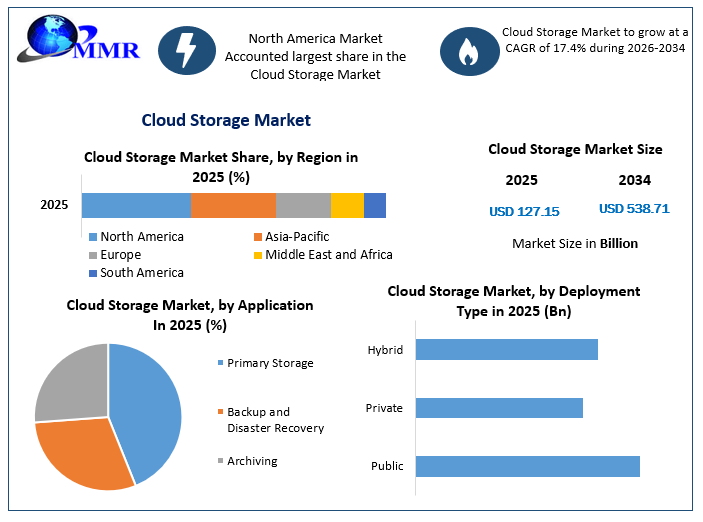
Cloud Storage Market was valued at US$ 127.15 Bn. in 2025 and the total Cloud Storage revenue is expected to grow at 17.4% from 2025 to 2034, reaching nearly US$ 538.71 Bn.
Cloud Storage Market Overview:
Cloud storage is a computer data storage strategy in which digital data is kept in logical pools that are referred to as "the cloud." Physical storage is often spread over numerous servers (possibly in various regions), and the physical environment is owned and maintained by a hosting provider. These cloud storage providers are in charge of maintaining the data available and accessible, as well as keeping the physical environment safe, protected, and operational. People and businesses purchase or lease storage capacity from providers to store user, organization, or application data.
Organizations of all sizes are attempting to reduce expenses while meeting rising expectations, which are being driven by tremendous data volume and ever-changing laws. Storage sector experts are turning to cloud computing and cloud storage solutions to overcome these difficulties. Cloud computing is a new business model that incorporates a range of technologies, such as server virtualization, that minimize the cost of accessing information technology (IT) resources. Cloud computing makes use of web-based techniques to deliver scalably, virtualized IT resources as a service across a network. The benefits of cloud storage and other cloud services include "pay as you go" (i.e., payment only for services consumed—no fixed costs), the illusion of endless capacity (elasticity), and ease of use/management.
Cloud Storage Market Report Scope:
The Cloud Storage market is segmented based on Component, Application, Deployment Type, Vertical, and Region. The growth of various segments helps report users in acquiring knowledge of the many growth factors expected to be prevalent throughout the market and develop different strategies to help identify core application areas and the gap in the target market. The report provides an in-depth analysis of the market and contains meaningful insights, facts, historical data, and statistically supported and industry-validated market statistics. It also includes estimates based on an appropriate set of assumptions and methodologies.
A bottom-up approach has been used to estimate the market size. Key Players in the Cloud Storage market are identified through secondary research and their market revenues are determined through primary and secondary research. Secondary research included a review of annual and financial reports of leading manufacturers, while primary research included interviews with important opinion leaders and industry experts such as skilled front-line personnel, entrepreneurs, and marketing professionals. Some of the leading key players in the global Cloud Storage market include AWS, Google, Microsoft, and IBM. They are continuously strategizing on mergers and acquisitions, strategic alliances, joint ventures, and partnerships for the growth of their market shares.
Cloud Storage Market Analysis from 2025 to 2034
 To know about the Research Methodology :- Request Free Sample Report
Cloud Storage Market Dynamics:
Increasing Requirement to Offer Remote Workers Constant Access to Data
The COVID-19 pandemic has increased the work-from-home culture. Companies must maintain business continuity, accommodate increased workloads, and foster improved cooperation. Data storage in the cloud allows businesses to make it easier for employees to collaborate and distribute files via cloud drives, while also ensuring employees have constant access to data resources and files. According to LogicMonitor's 2020 Cloud 2025 research, more than 85% of global IT decision-makers feel that the COVID-19 outbreak accelerated cloud migration for the vast majority of enterprises globally. According to a survey, the United States, Canada, and the United Kingdom are expected to be at the forefront of cloud migration. Several cloud storage firms rely on file hosting and sharing services offered by corporations such as Microsoft, Oracle, Google, pCloud, Dropbox, and Box. However, the market is dominated by a small number of competitors.
Issues with latency and network outages in public cloud settings:
Latency concerns arise when storing and receiving data to and from the public cloud. When data is stored in the public cloud, end-to-end network control is lost, which, when paired with excessive latency, can have a negative influence on the performance of applications. Similarly, network disruptions on the cloud storage provider's end can cause storage solutions to fail, resulting in work interruption and significant losses for enterprises. Similarly, AWS had a similar network outage from 2019 to June 2022, failing its EC2 DNS resolves in South Korea, EC2 and EBS service in the Tokyo area and other networking control plane congestions across the US.
Other variables that contribute to delay include insufficient internet bandwidth, remote data center locations, and heavy network traffic. Even while choosing a local data center for data storage and sufficient network bandwidth might minimize latency to some amount, the consequences cannot be ignored. Furthermore, some cloud storage companies have the option to construct a Wide Area Network (WAN) link to assist clients in eliminating latency difficulties. Customers may reduce the effect of latency issues on their work processes by using such technologies and preventative actions.
Concerns about data privacy and security a concern in growth of Cloud Storage Market:
Due to the rising number of cyber-attacks and security breaches, effective data privacy and security procedures are critical for any solution vendor in the cloud storage industry. DDoS and other assaults have a significant influence on the availability of cloud resources, thus most firms that utilize public cloud storage solutions are concerned about the privacy and security of their data. Companies may avoid data security breaches by discovering the general safeguards supplied by providers with a little R&D on the Service-Level Agreements (SLAs) of cloud storage vendors.
As a result, businesses can evaluate the security arrangements in cloud storage solutions in terms of maintaining compliance with important regulations such as International Organization for Standardization/International Electrotechnical Commission 9001 and adherence to industry regulations such as Health Insurance Portability and Accountability Act, System and Organization Control, and Payment Card Industry Data Security Standard. Furthermore, other regional regulations, such as the Protection and Electronic Documents Act, the General Data Protection Regulation, the European Union (EU)-US Privacy Data Shield, and the Australian Privacy Principles (APPs), may help to ensure that data security is not compromised.
Cloud Storage Market Segment Analysis:
By Deployment Type, the public segment in Cloud Storage Market is expected to grow at a CAGR of 7.3% during the forecast period. Some of the important drivers promoting revenue growth in this segment include cost-effectiveness, excellent dependability, no maintenance requirements, and infinite scalability. Third-party service companies manage public clouds for storage capacity licensing. Public cloud file services provide simple file data repositories for collaboration, sharing, and archiving. Furthermore, public cloud storage offers highly automated management with a diverse set of Application Programming Interfaces (APIs).
According to a study, public cloud services spending, which includes Software as a Service, Infrastructure as a Service, and Platform-as-a-Service reached nearly USD 470 billion in 2022. Oracle announced a reduced entry point for Oracle Cloud Infrastructure (OCI) Dedicated Region on June 27, 2022, as well as a preview of Compute Cloud Customer services. OCI Dedicated Region offers comprehensive public cloud services to client data centers with new and smaller footprints at a lower cost. The new services are anticipated to fulfill stringent latency, data sovereignty, and data residency standards.
By Vertical, the BFSI segment in Cloud Storage Market is expected to grow at a CAGR of 7.4% during the forecast period. The increased need for safe storage models, rapid digitization, and usage of channels such as e-wallet, net banking, and digital payments, among others, is a primary driver driving revenue growth in this segment. The growing need for financial institutions to make data-driven choices to maintain a competitive advantage necessitates the development of smarter business platforms that are more flexible, adaptable, and scalable. Major corporations establishing data centers in their communities are driving the use of different cloud storage solutions in the BFSI industry to improve customer service and reduce operational expenses for enhanced profitability.
As a result, cost-effectiveness and flexibility with greater security are major aspects driving the growth of the BFSI segment. Fiserv, Inc., a prominent global provider of payment and financial services solutions, purchased Finxact, Inc., a developer of the cloud-native banking system that is allowing digital transformation throughout the financial services sector, on February 2022. The acquisition is expected to advance Fiserv's digital banking strategy by expanding the company's leading account processing, payments, and digital solutions, allowing it to position itself as the partner of choice for people seeking scaling, acceleration, and advancement of digital banking experiences for delivery.
Cloud Storage Market Regional Insights:
In 2022, the North American cloud storage market had the highest revenue share of more than 40%. The presence of major cloud service providers, as well as the growing number of data centers, as well as the fast use of new technologies and smart home devices, are some of the important reasons driving revenue growth in the region. Also, the growing popularity of video streaming services and digital payments is generating consistent demand for cloud storage solutions. Increasing high-value financing in different R&D activities for cloud-based solutions, as well as improved IT infrastructure, are also contributing to market growth.
The industry partnerships in the region is one of the major factors driving the overall market growth. Opti9 Technologies LLC, a trusted North American managed cloud services provider for hybrid cloud, security, and application modernization, partnered with HostedBizz, one of Canada's leading laas platform providers, in May 2022. The merger is expected to enable the merging of Opti9 and HostedBizz capabilities for developing expertise in the Canadian cloud computing industry, as well as enhancing the partner ecosystem for widening the variety of offered services.
During the forecast period, the European market is expected to grow at a CAGR of 8.1%. Rising cloud computing use, as well as an increase in the number of government efforts in favor of cloud storage solutions, are the key reasons driving revenue in the region. According to a study, in 2022, over 70% of firms in the European Union used cloud computing services for file storage, and approximately 42% of enterprises used cloud computing across several organizations. Hive, a peer-to-peer cloud streaming solution that uses idle computer resources, was launched in June 2022 after successfully raising USD 7 million in startup funding. Global Ventures and OneRagtime, as well as prominent angel investors, spearheaded the funding. Hive allows users to donate computer resources to the network in return for network bandwidth and monetary reimbursement.
Over the forecast period, the Asia Pacific cloud storage market is expected to grow at a CAGR of 9.2%. Increasing government initiatives for digital transformation, as well as increasing use of hybrid cloud storage, which leads to lower Capital Expenditure and Operating Expense, are important drivers boosting the market growth. The global firms looking to expand their cloud network in Asia is a major driver of market growth e.g. Wasabi Technologies, a hot cloud storage firm established a new storage area in Singapore on June 2022, marking Wasabi's 13th storage region globally and fourth in APAC. The firm is expected to address the demand for high-performance, low-cost cloud storage while remaining connected to its client and partner network.
Cloud Storage Market Recent Development
| Date | Company | Development | Impact |
|---|---|---|---|
| 20 May 2025 | Bharti Airtel | Partnered with Google to roll out an integrated 100 GB Google One cloud storage subscription package to its postpaid and Wi-Fi customer base. | Alleviates mobile device storage constraints by providing millions of consumers with seamless, secure cloud backups for photos, videos, and files. |
| 18 June 2025 | Pure Storage | Introduced the Enterprise Data Cloud (EDC) framework powered by Pure Fusion autonomous orchestration to unify and pool distributed multi-cloud storage fleets. | Enables organizations to transition from manual infrastructure tuning to an automated storage-as-a-service model that minimizes human deployment errors. |
| 30 July 2025 | Hitachi Vantara | Launched its Virtual Storage Platform One (VSP One) Software-Defined Storage solution on the Google Cloud Marketplace. | Simplifies complex data mobility and lowers corporate hybrid cloud operational expenses by up to 40% through automated two-way asynchronous replication. |
| 18 November 2025 | Hitachi Vantara | Released its next-generation Virtual Storage Platform One (VSP One) Block High End, an all-flash NVMe block storage configuration tailored for heavy AI workloads. | Empowers large enterprises to consolidate massive data sets under a sustainable system meeting high U.S. government cybersecurity standards. |
| 12 March 2026 | IONOS | Formed a strategic partnership with Bocada to pair flexible cloud storage options with AI-powered, automated backup monitoring solutions. | Improves workflow visibility for managed service providers by matching S3-compatible object storage directly with real-time SLA compliance reporting. |
| 22 April 2026 | Commvault | Announced that its subsidiary Clumio is expanding its rapid data recovery and cloud-native cyber resilience capabilities directly to Google Cloud Storage. | Allows companies to secure large-scale datasets fueling AI analytics pipelines via isolated, immutable, and air-gapped data backups. |
Cloud Storage Market Scope: Inquire before buying
| Cloud Storage Market | |||
|---|---|---|---|
| Report Coverage | Details | ||
| Base Year: | 2025 | Forecast Period: | 2026-2034 |
| Historical Data: | 2020 to 2025 | Market Size in 2025: | US $ 127.15 Bn. |
| Forecast Period 2026 to 2034 CAGR: | 17.4% | Market Size in 2034: | US $ 538.71 Bn. |
| Segments Covered: | by Component | Solutions Services |
|
| by Application | Primary Storage Backup and Disaster Recovery Archiving |
||
| by Deployment Type | Public Private Hybrid |
||
| by Vertical | BFSI IT and ITeS Telecommunications Healthcare and Life Sciences Media and Entertainment Consumer Goods and Retail Manufacturing Government and Public Sector Energy and Utilities Others |
||
Cloud Storage Market, by Region
North America (United States, Canada and Mexico)
Europe (UK, France, Germany, Italy, Spain, Sweden, Austria, Turkey, Russia and Rest of Europe)
Asia Pacific (China, India, Japan, South Korea, Australia, ASEAN and Rest of APAC)
Middle East and Africa (South Africa, GCC, Egypt, Nigeria and Rest of ME&A)
South America (Brazil, Argentina, Columbia and Rest of South America)
Cloud Storage Market, Key Players are:
1. Amazon Web Services, Inc (US)
2. Google (US)
3. Microsoft (US)
4. IBM (US)
5. Wasabi (US)
6. Oracle (US)
7. Rackspace Technology (US)
8. Hewlett Packard Enterprise (US)
9. Dell Technologies (US)
10. Dropbox (US)
11. VMware (US)
12. NetApp (US)
13. Hitachi Vantara (US)
14. Scality (US)
15. Citrix (US)
16. DigitalOcean (US)
17. Zadara (US)
18. Cisco Systems, Inc. (US)
19. Data direct Networks (US)
20. MongoDB, Inc. (US)
21. Alibaba Cloud (China)
Frequently Asked Questions:
1. Which region is expected to dominate the Cloud Storage Market at the end of the forecast period?
Ans. North America is expected to dominate the Cloud Storage Market at the end of the forecast period.
2. Which American company established a cloud storage facility in Asia in 2025?
Ans. Wasabi Technologies, a hot cloud storage firm established a new storage area in Singapore on June 2025.
3. What is expected to drive the growth of the Cloud Storage market in the forecast period?
Ans. A growing requirement to offer remote workers constant access to data and files is expected to drive the growth of the Cloud Storage market in the forecast period.
4. What is the projected market size & growth rate of the Cloud Storage Market?
Ans. Cloud Storage Market was valued at US$ 127.15 Bn. in 2025 and the total Cloud Storage revenue is expected to grow at 17.4% from 2026 to 2034, reaching nearly US$ 538.71 Bn.
5. What segments are covered in the Cloud Storage Market report?
Ans. The segments covered are Component, Application, Deployment Type, Vertical, and Region