
Ayurvedic Market by Mode of sales(Retail Sale,Online Sale),Product( Personal Care Products, Hair Care & Fragrances, Skin Care, Oral Care, Make-Up, Healthcare Products, Ayurvedic Medicines, Ayurvedic Nutraceuticals, Dietary Supplements), Application(Cancer Treatments, Respiratory Disorders, Mental Health, Nervous System Disorders, Diabetes, Skin Diseases, Cardiovascular Diseases, Autoimmune Diseases, Other Applications) and Distribution Channel- Forecast to 2032
Overview
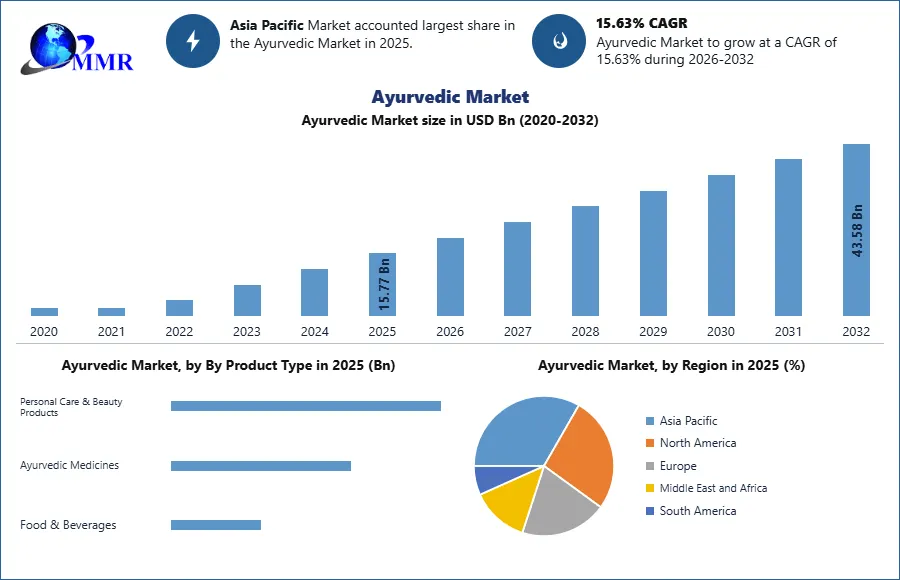
The Ayurvedic Market size was valued at USD 15.77 Billion in 2025 and the total Ayurvedic revenue is expected to grow at a CAGR of 15.63% from 2026 to 2032, reaching nearly USD 43.58 Billion by 2032.
Ayurvedic Market Overview:
People are becoming more aware of the adverse effects of allopathic treatments, so the Ayurvedic market is growing at a CAGR of 15.63% over the forecast period. A favorable impact aspect on market growth is also the ease of availability and increased awareness of the products' benefits. Expanding medical tourism is helping to boost the market's growth. The research on the global Ayurveda industry includes a comprehensive analysis of the market for the forecast period. The report includes several sections as well as an analysis of the market's major trends and factors.
To know about the Research Methodology :- Request Free Sample Report
Ayurvedic Market Dynamics:
Some of the factors driving market growth include rising demand for natural and organic products, higher consumer knowledge and desire for ayurvedic cosmetics, and increased medical tourism around the world. Organic skincare is gaining popularity, and the market is likely to expand even further. Anti-wrinkle and anti-aging creams are also expected to expand the market in order to reach a wider audience. Due to an increase in medical tourism, the global market is expected to grow.
Certain constraints and barriers have been encountered, which will limit market expansion. Lack of optimal treatments, a lack of a killer instinct in the ayurveda business, and severe regulations are all significant limitations to the worldwide Ayurvedic Market's overall growth. Nonetheless, technological advancements, practical breakthroughs in ayurveda treatment, and untapped potential in new countries all present good growth prospects.
Ayurvedic Market Segment Analysis:
In 2025, the Personal Care & Beauty Products segment holds a significant share in the Ayurvedic market, driven by rising consumer preference for chemical-free and herbal-based skincare and haircare solutions. Skincare products such as herbal creams, face washes, and serums witness strong demand due to increasing awareness of natural ingredients. Haircare products, including oils, shampoos, and conditioners, also maintain high adoption, particularly in emerging markets.
The Ayurvedic Medicines segment remains a core pillar of the market, with Classical Ayurvedic Formulations continuing to dominate due to their long-standing trust and effectiveness. However, Patented/Proprietary Medicines are gaining rapid traction as companies innovate with modern formulations and convenient packaging.
Additionally, Dietary Supplements, including Herbal Supplements and Nutraceuticals, are witnessing accelerated growth due to increasing focus on preventive healthcare and immunity boosting. The Food & Beverages segment, particularly Ayurvedic Teas & Juices and Functional Foods, is expanding steadily as consumers integrate Ayurveda into daily nutrition.
Based on form, Tablets & Capsules dominate the market in 2025 due to their ease of consumption, precise dosage, and growing acceptance among urban consumers. Powders & Churnas continue to hold a strong presence, especially among traditional users who prefer authentic Ayurvedic preparations.
Oils & Balms and Creams & Lotions witness robust demand in therapeutic and personal care applications, particularly for pain relief, skincare, and wellness treatments. Syrups & Tonics are widely used for respiratory and immunity-related conditions, especially among children and elderly populations.
Meanwhile, Teas & Beverages are emerging as one of the fastest-growing segments, driven by lifestyle changes and increasing demand for convenient herbal wellness products.
In 2025, Respiratory Disorders and Skin Diseases account for a substantial share of the Ayurvedic market due to the widespread use of herbal remedies for conditions such as cough, cold, asthma, acne, and eczema.
Nervous System Disorders are gaining traction as Ayurvedic solutions for stress, anxiety, and sleep disorders become more popular among urban populations. Cardiovascular Diseases and Autoimmune Diseases segments are also witnessing increasing adoption, supported by growing clinical validation and consumer trust in holistic treatments.
The Cancer Treatments segment, while relatively niche, is expanding steadily as Ayurveda is increasingly used as a complementary therapy alongside conventional treatments. The Others category, including digestive disorders and general wellness, continues to contribute significantly to overall demand.
Ayurvedic Market Regional Analysis:
Based on region, Asia Pacific leads the global Ayurvedic market in 2025, primarily driven by strong cultural roots, high consumer awareness, and government support for traditional medicine systems, particularly in India.
North America is witnessing significant growth due to increasing demand for natural and alternative healthcare products, along with rising awareness of Ayurveda among health-conscious consumers.
Europe shows steady expansion, supported by regulatory acceptance of herbal products and growing inclination toward organic and sustainable wellness solutions. Meanwhile, regions such as Middle East & Africa and South America are experiencing moderate growth, driven by increasing urbanization, rising disposable incomes, and expanding distribution networks.
The objective of the report is to present a comprehensive analysis of the Global Ayurvedic Market to the stakeholders in the industry. The past and current status of the industry with the forecasted market size and trends are presented in the report with the analysis of complicated data in simple language. The report covers all the aspects of the industry with a dedicated study of key players that include market leaders, followers, and new entrants.
PORTER, PESTEL analysis with the potential impact of micro-economic factors of the market have been presented in the report. External as well as internal factors that are supposed to affect the business positively or negatively have been analyzed, which will give a clear futuristic view of the industry to the decision-makers.
The report also helps in understanding the Global Ayurvedic Market dynamics, structure by analyzing the market segments and project the global market size. Clear representation of competitive analysis of key players by product, price, financial position, product portfolio, growth strategies, and regional presence in the global market make the report investor’s guide.
Ayurvedic Market Scope: Inquire before buying
| Ayurvedic Market | |||
|---|---|---|---|
| Report Coverage | Details | ||
| Base Year: | 2025 | Forecast Period: | 2026-2032 |
| Historical Data: | 2020 to 2025 | Market Size in 2025: | 15.77 USD Bn |
| Forecast Period 2026-2032 CAGR: | 15.63% | Market Size in 2032: | 43.58 USD Bn |
| Segments Covered: | By Product Type | Personal Care & Beauty Products Skincare Haircare Oral Care Ayurvedic Medicines Classical Ayurvedic Formulations Patented/Proprietary Medicines Dietary Supplements Herbal Supplements Nutraceuticals Food & Beverages Ayurvedic Teas & Juices Functional Foods |
|
| By Form | Tablets & Capsules Powders & Churnas Oils & Balms Creams & Lotions Syrups & Tonics Pastes Teas & Beverages |
||
| By Application | Cancer Treatments Respiratory Disorders Nervous System Disorders Skin Diseases Cardiovascular Diseases Autoimmune Diseases Others |
||
| By Distribution Channel | Offline Retail Ayurvedic Stores Pharmacies/Drugstores Supermarkets/Hypermarkets Health & Wellness Centers Online Retail E-commerce Platforms Brand-owned Websites |
||
Ayurvedic Market, by Region
North America (United States, Canada and Mexico)
Europe (UK, France, Germany, Italy, Spain, Sweden, Austria and Rest of Europe)
Asia Pacific (China, South Korea, Japan, India, Australia, Indonesia, Malaysia, Vietnam, Taiwan, Bangladesh, Pakistan and Rest of APAC)
Middle East and Africa (South Africa, GCC, Egypt, Nigeria and Rest of ME&A)
South America (Brazil, Argentina Rest of South America)
Ayurvedic Market Key Players:
1. Ayurvedic Medicines & Herbal Formulation Companies
These companies manufacture and market classical Ayurvedic medicines, proprietary herbal formulations, and wellness products.
North America
1. Maharishi Ayurveda Products International – United States
Europe
1. Maharishi Ayurveda Europe B.V. – Netherlands
2. Ayurveda Rasa GmbH – Germany
Asia Pacific
1. Dabur India Limited – India
2. Patanjali Ayurved Limited – India
3. Himalaya Wellness Company – India
4. Baidyanath Group – India
5. Zandu Realty Limited (Emami Group) – India
2. Ayurvedic Consumer Healthcare & Wellness Companies
These companies offer Ayurvedic products for immunity, digestive health, stress management, and preventive healthcare.
North America
1. Maharishi Ayurveda Products International – United States
Europe
1. A.Vogel AG – Switzerland
Asia Pacific
1. Dabur India Limited – India
2. Himalaya Wellness Company – India
3. Patanjali Ayurved Limited – India
4. Emami Limited – India
3. Ayurvedic Personal Care & Beauty Companies
These companies develop Ayurvedic-based skincare, haircare, oral care, and personal wellness products.
North America
1. Auromere Inc. – United States
Europe
1. Khadi Naturprodukte GmbH & Co. KG – Germany
Asia Pacific
1. Himalaya Wellness Company – India
2. Dabur India Limited – India
3. Patanjali Ayurved Limited – India
4. Emami Limited – India
4. Ayurvedic Ingredients & Herbal Extract Manufacturers
These companies produce herbal extracts, botanical ingredients, and raw materials used in Ayurvedic formulations.
North America
1. Sabinsa Corporation – United States
Europe
1. Martin Bauer Group – Germany
2. Indena S.p.A. – Italy
Asia Pacific
1. Sami-Sabinsa Group – India
2. Natural Remedies Pvt. Ltd. – India
3. Arjuna Natural Pvt. Ltd. – India
5. Integrated Ayurvedic Healthcare & Traditional Medicine Companies
These companies provide comprehensive Ayurvedic healthcare solutions, including medicines, wellness products, and healthcare services.
North America
1. Maharishi Ayurveda Products International – United States
Europe
1. Maharishi Ayurveda Europe B.V. – Netherlands
Asia Pacific
1. Dabur India Limited – India
2. Patanjali Ayurved Limited – India
3. Himalaya Wellness Company – India
4. Kerala Ayurveda Limited – India
5. Arya Vaidya Sala Kottakkal – India