
Medical Batteries Market Size by Product, End-Use, Region – Segment-Level Market Assessment, Growth Opportunity Analysis, Competitive Mapping & Forecast to 2032
Overview
Global Medical Batteries Market size was valued at USD 4.10 Bn. in 2024, and the total Medical Batteries Market revenue is expected to grow by 6.8% from 2025 to 2032, reaching nearly USD 6.94 Bn.
Medical Batteries Market Overview:
The Medical Batteries Market is the sector within the healthcare industry that supplies batteries to propel medical devices, from portable diagnostic devices to critical implantable devices.
Medical batteries, used in both implantable and non-implantable devices, are designed to provide safe, reliable, and durable energy that meets strict medical requirements. The report highlights the strong availability of these batteries in the market, supported by robust supply chains and established manufacturers equipped with advanced production technologies.
With rising global demand for portable and wearable medical devices, telemedicine solutions, and home healthcare equipment, the need for high-performance medical batteries is rapidly increasing.
North America leads the global Medical Batteries Market due to its well-established healthcare infrastructure, strong adoption of new medical technologies, and the presence of key manufacturers such as Panasonic, GE Healthcare, Saft Groupe, and Integer Holdings. Europe follows closely, driven by a growing elderly population and strict regulatory standards.
Additionally, the report notes that primary end-user segments, including hospitals, nursing homes, and clinics, contribute significantly to overall market revenues. These facilities require uninterrupted device performance to ensure continuity of care and improved patient outcomes.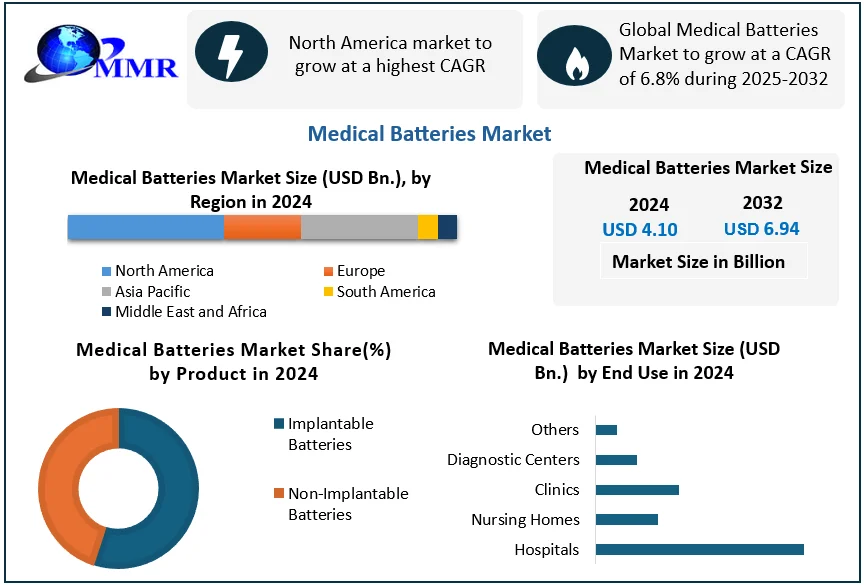 To know about the Research Methodology:- Request Free Sample Report
Medical Batteries Market Dynamics
Surge in Battery-Powered Portable and Implantable Devices to Drive Medical Batteries Market Growth
The Medical Batteries Market is expected to witness considerable growth by 2032 due to the rise in demand for batteries to power portable and implantable medical devices. As discussed by the MMR report, chronic diseases, such as cardiovascular disease and diabetes, are increasing, leading to the need for devices such as pacemakers, defibrillators, insulin pumps, and portable monitors.
In addition, there is plenty of innovation - for example, CONMED's Hall Li battery system and Ultra Life Corporation's LiFePO4 smart batteries provide good examples of breakthroughs in the face of ongoing surgical and monitoring technologies needing performance and long life.
Advanced and Smart Battery Products to create Medical Batteries Market Opportunity
New opportunities exist to create safer, smarter, more efficient battery products that are designed for advanced medical applications. The increase in minimally invasive procedures and home health care devices drives demand for small, safe batteries with longer life. With the increased use of battery-powered insulin pumps and continuous glucose monitoring systems, manufacturers can capitalize on the developments in smart battery systems that provide accurate fuel gauging for battery life, safety features (examples could include layering the battery's safety features), and applications for the development of next-generation medical applications. In short, smart batteries can be manufactured to strengthen companies' position in high-growth segments.
Technical and regulatory Hurdles prevented seamless adoption to create Medical Batteries Market Challenges
However, there are also significant barriers still to be addressed in the Medical Batteries Market in terms of performance and safety. With emerging technology, reliable power delivery is essential and one that isn't prone to failure, especially as patient safety is a concern. There are technical challenges in designing batteries with consistent output in high-drain devices and challenging operating conditions. Market players also have challenges relating to miniaturization, without sacrificing capacity in application areas where capacity is critical, especially for implantable devices such as pacemakers and neurostimulators. Furthermore, while achieving certified medical standards, there is also pressure on manufacturers and their price competitiveness.
Hazard Concerns and Failure Risk to Restrain Medical Batteries Market
The associated hazards of lithium-ion batteries remain a key constraint to market expansion by 2032. According to the MMR reports, Li-ion batteries are associated with overheating, overcharging, and combustion risks, which lead to failures of the mobile medical systems and cause hospital emergencies. With these hazards, some rechargeable batteries and associated chemistries have never been adopted. There is also a need for having sound safety testing standards for batteries, which requires additional cost and time to market for battery manufacturers, especially related to medical devices.
Rising Demand for Medical Supplies and PPE Amid COVID-19 to drive Medical Batteries Market growth
To care for the growing number of patients, the demand for medical supplies is increasing. Respiratory support equipment, such as atomizers, life-support machines, oxygen generators, and monitors, is among the most commonly used devices in primary clinical treatment.
Furthermore, the COVID-19 pandemic has led to a significant surge in demand for medical supplies, particularly personal protective equipment (PPE), including masks, gloves, and protective eyewear. With the continuous rise in global COVID-19 cases, the need for medical supplies remains high, both within the healthcare sector and among the general public for safety measures.
Manufacturers of these products have an opportunity to capitalize on this increased demand by ensuring an adequate and consistent supply of personal protective equipment, which also contributes to the growth of the medical batteries market, as these devices rely on reliable power sources.
Advancements in Medical Devices and Growing Disease Burden to create Medical Batteries Market Opportunity
The rise in the occurrence of cardiovascular & chronic diseases & further encourages the need for treatment, fuels the essential need for more technological progress in medical equipment for prevention, like innovators & defibrillators. Also, an increase in acceptance of the long-life batteries for monitoring patients like glucometers, hemodynamic, cardiac & temperature is pouring into the medical batteries market development. Numerous government rules to be tracked by sellers for the recycling of used batteries would limit the market development. A rise in the usage of rechargeable medical batteries associated with main batteries, owing to long life, is the factor prompting the development of medical batteries. Technical progressions in the medical devices are powering the development & the rise in medical device & healthcare services is also prompting the development. The battery reduction, battery leak & high internal resistance are the reasons limiting the growth.
Segment Analysis of the Medical Batteries Market
Based on Product, Implantable Batteries, holding an estimated 55% market share. This dominance is primarily due to the rising prevalence of chronic conditions such as cardiovascular diseases and diabetes, which require long-term implantable medical devices like pacemakers, neurostimulators, and cardiac defibrillators. These devices rely heavily on highly reliable, long-life batteries to ensure uninterrupted operation inside the patient’s body. Technological advancements, such as the development of smart implantable batteries with better energy density and safety features, further reinforce this segment’s leading position.
Based on End Use, Hospitals are the dominant end-use segment with an estimated 50% market share. This is because hospitals are the primary centers for surgical procedures, implantations, and critical care monitoring that utilize a wide range of battery-powered medical equipment. Hospitals also have the highest patient intake and conduct most complex treatments requiring implantable devices, thereby generating consistent and large-scale demand for both implantable and non-implantable medical batteries.
Medical Batteries Market Regional Analysis
The Medical Batteries Market identified key factors influencing regional segmentation in the report, including healthcare systems, regulatory environment, and pace of adoption of novel medical devices. The North American region has the largest share (approximately 40%) due to high healthcare expenditures, a well-developed hospital infrastructure, and a sizeable number of patients who require implanted devices, like pacemakers and neurostimulators. Within North America, the United States is the largest with sustained increases in investment in medical technology and a high rate of chronic disease: over 630,000 Americans die from heart disease each year, which has resulted in high demand for reliable implanted batteries.
The Asia-Pacific region, with a market share of around 30% is growing at the fastest rate with an increase in healthcare coverage, rising surgical procedures, and an increase in the incidence of chronic diseases in countries like China and India. Europe has a share of 25% due to supportive regulations, an ever-increasing aging population, and continuous innovation in battery technology for portable and home-care devices. The Rest of the World has a smaller market share; however, improvements in healthcare systems in Latin America and the Middle East will present potential opportunities for market players looking to expand their market share over the next few years.
Medical Batteries Market Competitive Landscape
The medical batteries market is highly competitive, with both global battery makers (like Panasonic, Duracell, Maxell, VARTA, and Ultralife) and medical device companies (such as Medtronic, GE Healthcare, Philips, and Siemens Healthineers) competing on innovation, safety, energy efficiency, and regulatory compliance. Major players are investing heavily in advanced battery technologies, including next-generation lithium-ion, solid-state, and nickel-based batteries for implantable and portable devices. They are also expanding facilities, mainly in North America and Asia-Pacific, and forming partnerships or making acquisitions, like Murata upgrading its European operations and EnerSys acquiring Bren-Tronics. The market remains fragmented, and strict regulations and fast-paced technology changes push companies to stand out through continuous product development and strategic collaborations.
Medical Batteries market: Recent key developments
March 2024, China, Tianjin University of Technology
Researchers at Tianjin University of Technology developed an innovative sodium oxygen battery for implantable medical devices like pacemakers and defibrillators, which uses body oxygen to generate electricity and features biocompatible electrodes, extending device lifespan and reducing the need for surgical replacement.
July 2024, Germany, Panasonic
In July 2024, Panasonic introduced a new lineup of high-capacity lithium-ion batteries specifically designed for medical implants to extend device performance and lifespan, responding to the growing demand for dependable medical power solutions.
2024 (unspecified month), Global, Ultralife Corporation
During 2024, Ultralife Corporation launched an advanced ultrathin lithium battery aimed at implantable devices such as pacemakers and hearing aids, offering a high energy-to-weight ratio and improved biocompatibility.
Medical Batteries Market Key Trends
1. Rising Adoption of Implantable Medical Devices Driving Advanced Battery Demand:
A significant trend shaping the medical batteries market is the rapid increase in the use of implantable devices such as pacemakers, defibrillators, neurostimulators, and insulin pumps. According to recent data, over 3 million people globally have pacemakers, and this number continues to grow by about 600,000 implants per year. This surge is directly boosting demand for compact, high-energy-density batteries with extended lifespan and biocompatibility. Companies like Ultralife and Panasonic are investing in ultrathin, long-life lithium batteries to meet this growing need for reliable power in life-critical devices.
2. Technological Innovations Focused on Smart and Safer Battery Solutions:
Another key trend is the push for smarter, safer battery technologies to address performance and safety concerns. Innovations include batteries with integrated smart fuel gauging, temperature monitoring, and overcharge protection. Ultralife Corporation’s new 492Wh LiFePO4 smart battery offers accurate state-of-charge indication and enhanced safety circuits, replacing traditional sealed lead-acid (SLA) batteries in mobile medical equipment.
Medical Batteries Market Scope: Inquire before buying
| Global Medical Batteries Market | |||
|---|---|---|---|
| Report Coverage | Details | ||
| Base Year: | 2024 | Forecast Period: | 2025-2032 |
| Historical Data: | 2019 to 2024 | Market Size in 2024: | USD 4.10 Bn |
| Forecast Period 2025 to 2032 CAGR: | 6.8% | Market Size in 2032: | USD 6.94 Bn |
| Segments Covered: | by Product | Implantable batteries Non-Implantable batteries |
|
| by End-Use | Hospitals Nursing homes Clinics Diagnostic centers Others |
||
Medical Batteries Market, by region
North America (United States, Canada and Mexico)
Europe (United Kingdom, France, Germany, Italy, Spain, Sweden, Russia, Rest of Europe)
Asia Pacific (China, Japan, South Korea, India, Australia, Malaysia, Thailand, Vietnam, Indonesia, Philippines, Rest of APAC)
Middle East and Africa (South Africa, GCC, Nigeria, Egypt, Turkey, Rest of MEA)
South America (Brazil, Argentina, Colombia, Chile, Peru, Rest of South America)
Medical Batteries Market, Key Players are:
North America
1. Panasonic — US headquarters in Newark, New Jersey (global HQ in Japan)
2. Integer Holdings — Plano, Texas, USA
3. Duracell — Bethel, Connecticut, USA
4. GE Healthcare — Chicago, Illinois, USA
5. EnerSys — Reading, Pennsylvania, USA
6. Saft — US operations based in Jacksonville, Florida (global HQ in France)
7. Eagle Picher — Joplin, Missouri, USA
Europe
8. Saft Groupe — Bordeaux, France
9. Panasonic — European headquarters in Bracknell, UK (global HQ in Japan)
10. Tadiran Batteries — Main R&D and manufacturing in Israel, with sales offices worldwide
11. Maxell — European branch in Hamburg, Germany (global HQ in Japan)
Asia-Pacific
12. Panasonic — Osaka, Japan
13. Murata Manufacturing — Nagaokakyo, Kyoto, Japan
14. Kayo Battery — Shenzhen, Guangdong, China
15. Shenzhen Battsys — Shenzhen, Guangdong, China
FAQ:
1) What was the Size of the Global Medical Batteries Market in 2024?
Ans: The Global Medical Batteries Market accounted for 4.10 USD in the year 2024.
2) Which end-use segment is dominating the Global Medical Batteries Market?
Ans: The Hospitals sector is the dominating end-use segment in the Medical Batteries Market.
3) What are the key players in the Global Medical Batteries Market?
Ans: Siemens, EaglePicher Technologies, GE, Electrochem Solutions, Maxim Integrated, Ultralife Corp, Panasonic, STMicroelectronics N.V, Texas Instruments, Quallion LLC, EnerSys, Vitec Group Plc, Liberting Technologies, Shenzhen Kayo Battery Co, Tadiran Batteries Ltd., Arotech Corporation, Saft Groupe S.A.
4) Which factor acts as the driving factor for the growth of the Global Medical Batteries Market?
Ans: The major factors for the growth of the Global Medical Batteries market include increasing demand for battery-powered portable and implantable devices.