Global Aquaculture Market - Industry Structure Evaluation, Demand Drivers Analysis, Regional Growth Analysis and Identification, Competitive Positioning / Landscape Review & Global Market Size Forecast to 2032

7.5%
CAGR (2026-2032)
53.81 USD Bn.
Forecast Market Size
317
Report Pages
164
Market Tables

Overview

Global Aquaculture Market size was valued at USD 53.81 Bn. in 2025, and the total global aquaculture Market revenue is expected to grow by 7.5% from 2026 to 2032, reaching nearly USD 89.28 Bn.

Global Aquaculture Market Overview:

Aquaculture is a major sector of the global food industry, dealing with the breeding, cultivation, and harvesting of fish, shellfish, and aquatic vegetation under controlled aquatic environments, such as ponds, rivers, oceans, and tanks. The aquaculture sector has evolved over the years from conventional pond systems to high-tech, technology-based recirculating Aquaculture systems (RAS), offshore cages, and biofloc systems, which provide higher production, a lower environmental footprint, and more accurate management of water quality and Fish health. The demand for Seafood, coupled with population increases, dwindling wild fish supplies, and demand for high-protein, healthy diets, is propelling global expansion of aquaculture.

CP Foods (Charoen Pokphand Foods) in Thailand has one of Asia's largest and most integrated shrimp aquaculture complexes with hatcheries, feed mills, farms,and processing facilities. It has invested in sustainable measures like biosecurity-controlled shrimp farming and zero-water exchange systems to minimize environmental footprints. Its adoption of digital surveillance, automatic feeders, and green feeds makes it a smart and sustainable aquaculture model in the Asia-Pacific region. Other top-producing nations, such as India, Vietnam, and China, producers are increasingly embracing sensor-based water quality monitoring, automated feeding systems, and genetic improvement initiatives. In developed aquaculture centers in Japan and Australia, moreover, attention is mounting on land-based RAS and traceability for high-value species like tuna and barramundi.

The report covered an in-depth analysis of top drivers for the Aquaculture market, including technological advances in breeding and disease management, increased government support for aquaculture facilities, and premium value-added seafood products. Major competitors in the worldwide aquaculture industry are Mowi ASA, Thai Union Group, Nippon Suisan Kaisha, Cermaq, Grieg Seafood, Tassal Group, and CP Foods, each investing in sustainability, digitization, and growth. The report also notes recent trends such as the explosion of land-based salmon farming, diversification into Latin and African markets, and crossover into pharmaceutical feedstock and nutraceuticals production.Aquaculture Market

To know about the Research Methodology :- Request Free Sample Report

Global Aquaculture Market Dynamics:

Technological Advancements to Drive the Aquaculture Market Growth

One of the most significant drivers of growth in the global aquaculture market is the rapid advancement of aquaculture technologies. Modern systems such as Recirculating Aquaculture Systems (RAS), biofloc technology, offshore cage farming, and automated monitoring systems have revolutionized how fish and other aquatic species are farmed. These technologies enable higher stocking densities, improved water quality management, efficient feed utilization, and better disease control, all while minimizing environmental impact.

For example, RAS allows for fish to be raised in controlled, land-based environments with minimal water exchange, making it suitable for urban or water-scarce regions. In addition, the integration of Artificial Intelligence (AI) and Internet of Things (IoT) devices helps farmers track temperature, oxygen levels, and pH in real-time, optimizing yields and reducing risks. These innovations are making aquaculture more sustainable, cost-effective, and scalable, positioning it as a critical solution for meeting the growing global demand for seafood.

Expansion in Sustainable and Premium Seafood to Create Aquaculture Market Opportunity

A key opportunity in the global aquaculture market lies in the growing consumer demand for sustainable, organic, and premium seafood products. As awareness increases regarding the environmental impact of traditional fishing and the health benefits of clean, traceable seafood, consumers, especially in developed markets, are willing to pay more for certified, responsibly farmed fish and shellfish. This has opened up lucrative avenues for aquaculture businesses that adopt eco-friendly practices and obtain certifications like Aquaculture Stewardship Council (ASC), GlobalG.A.P., and Best Aquaculture Practices (BAP).

Additionally, niche markets such as antibiotic-free, non-GMO, and omega-3 enriched fish are emerging rapidly. This shift in consumer preference not only helps producers command premium prices but also encourages sustainable innovation and investment in the aquaculture sector, particularly in high-end retail and export markets.

Environmental and Biosecurity to Create Aquaculture Market Challenge

One of the most pressing challenges in the global aquaculture market is managing the environmental impact and biosecurity risks associated with intensive fish farming. High-density aquaculture operations often lead to issues such as water pollution, excessive nutrient discharge, and habitat degradation, especially when farms are located in coastal or inland ecosystems.

Additionally, the risk of disease outbreaks and parasitic infestations—such as sea lice in salmon farms—can spread rapidly in crowded conditions, causing significant mortality rates and economic losses. The overuse of antibiotics and chemicals to control these problems raises concerns about antimicrobial resistance and long-term environmental sustainability.

Moreover, the lack of standardized biosecurity protocols across regions makes it difficult to control cross-border disease spread. These challenges require substantial investment in waste treatment systems, biosecure infrastructure, and robust regulatory frameworks, which can be particularly difficult for small- and medium-scale aquaculture operators to implement.

Global Aquaculture Market Segment Analysis

Based on Type, Fish farming is the largest and most significant segment within the global aquaculture market. It involves the cultivation of various species such as salmon, tilapia, catfish, and trout, which are primarily raised for food consumption. As the global demand for protein-rich foods continues to rise, fish farming has become a vital solution to meet this growing need. The segment’s prominence stems from the high nutritional value of fish, which are rich in essential nutrients like omega-3 fatty acids, making them a popular dietary choice worldwide.

Fish farming thrives in both freshwater and marine environments, offering flexibility for producers and ensuring a consistent supply of seafood. This segment benefits from advancements in aquaculture technology, improving sustainability and reducing reliance on wild fish stocks, which helps alleviate the pressures of overfishing. Additionally, fish farming’s scalability allows for efficient production to meet regional and global demands. With a market share of over 50%, fish farming plays a pivotal role in the aquaculture industry, driving economic growth in many coastal and rural areas. Its continued expansion is crucial for food security, employment generation, and maintaining ecological balance in marine ecosystems.

Global Aquaculture Market Regional Insights

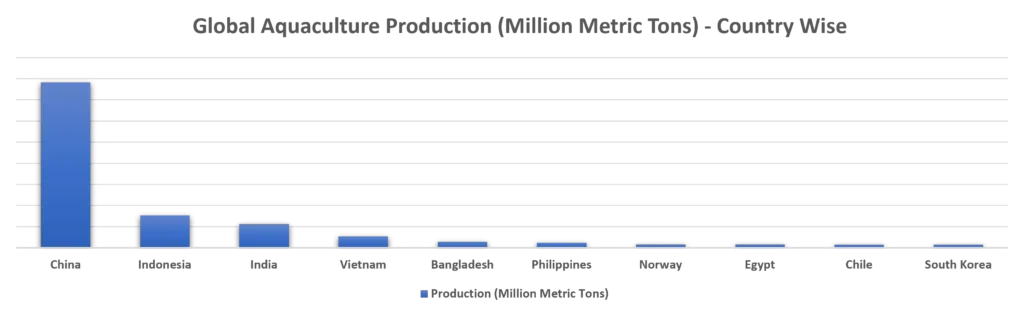
Asia Pacific dominated the global Aquaculture market in 2025. Asia Pacific held the largest market share, 41.34% in 2025. Due to an increase in demand for advanced and latest aquaculture products that help in producing more quality output with available land for aqua farming, and enhance the efficiency of aquaculture operations. China is the leading market in this region and is expected due to cheap labor, appropriate climatic conditions, and availability of natural resources in this region.

Moreover, factors such as technological innovations in this region and development in cultivation as per regional climatic conditions are expected to create lucrative opportunities for the market in this region. APAC is followed by North America and Europe. North America is expected to grow at a higher CAGR of xx% over the forecast period, owing to the strong support from both the U.S. and Canadian governments for its expansion. The species substantially contributing to the industry growth include salmonids and mollusks, especially hard clams, oysters, and mussels.

The objective of the report is to present a comprehensive analysis of the global Aquaculture Market to the stakeholders in the industry. The past and current status of the industry, with the forecasted market size and trends, are presented in the report, with the analysis of complicated data in simple language. The report covers all the aspects of the industry with a dedicated study of key players that include market leaders, followers, and new entrants.

PORTER, PESTEL analysis with the potential impact of micro-economic factors of the market has been presented in the report. External as well as internal factors that are supposed to affect the business positively or negatively have been analyzed, which will give a clear futuristic view of the industry to the decision-makers.

The reports also help in understanding the global Aquaculture Market dynamics and structure by analyzing the market segments and projecting the global Aquaculture Market size. Clear representation of competitive analysis of key players by product, price, financial position, product portfolio, growth strategies, and regional presence in the global Aquaculture Market makes the report an investor’s guide.

Global Aquaculture Market Competitive Landscape

There are many competitors in the Aquaculture market, comprising firms like Mowi ASA and China National Fisheries Corporation (CNFC) lead the competitive landscape by capitalizing on innovation, volume, and geographical presence to fortify their positions in the market. Mowi ASA, a Leading seafood company, made an estimated USD 5.6billion in revenue in 2024, mostly from high-volume production of farmed salmon. The company is strongly committed to integrated operations—covering breeding, feed, farming, and processing—and spends a considerable share of its budget on sustainable farming operations, automation, and genetics to improve fish health and quality.

China National Fisheries Corporation (China), supported by state-owned resources, is among the largest producers and exporters of fishery and seafood products in Asia. With considerable support from China's national policy framework that favors domestic aquaculture growth, CNFC has concentrated on large-scale coastal and inland aquaculture growth. Its Activities encompass a broad range of species, including carps, tilapia, and shrimp, making it a key player in fulfilling domestic demand and aiding export expansion.

Other significant players are Thai Union Group (Thailand), which operates vertically integrated shrimp and tuna businesses, and Cooke Aquaculture (Canada), which is spreading globally through acquisition and diversified aquaculture businesses. These players are focusing on investments in biosecurity, sustainable feed innovation, and traceability technologies to cope with increasing consumer and regulatory demands. Mowi and CNFC, among others, are doubling up on sustainability programs, automation, and health management systems to maintain market share, establish brand trust, and respond to environmental problems facing the changing aquaculture sector.

Global Aquaculture Market Recent Development

May 2025 , India , BioMar Group
The group announced a partnership with Iceland’s Fóðurblandan to produce aquafeed in Iceland, becoming the first global feed manufacturer to have production in the region, boosting the aquaculture feed supply chain for salmon farming in North Atlantic waters.

May 2025 , Norway/Global , ScaleAQ (Scale Aquaculture)
It acquired Norwegian start-up Probotic, gaining their autonomous net inspection and cleaning technology, advancing aquaculture farm maintenance automation

June 2025 , Global (United Nations Conference on Trade and Development (UNCTAD)
They released a report warning that recent U.S. tariffs on seafood imports will raise American aquaculture and wild-caught seafood prices due to limited domestic production capacity and lengthy production cycles.

Global Aquaculture Market Recent Trends

Category Key Trend Example Product Market Impact
Smart Farming Systems Adoption of IoT, AI, and automation in feeding and water quality monitoring Mowi SmartFarm 2.0 (Norway) Boosted efficiency and fish health; up to 20% feed savings and reduction in disease outbreaks.
Alternative Protein Feed Shift toward sustainable, non-fishmeal feed ingredients BioMar insect- and algae-based feed formulations Reduced environmental footprint and improved sustainability appeal in premium aquaculture segments
Land-Based RAS (Recirculating Aquaculture Systems) Growing use of RAS for inland, high-density fish farming Atlantic Sapphire Bluehouse (USA) Enabled year-round production, lowered transport costs, and increased traceability for consumers.

Global Aquaculture Market Scope: Inquire before buying

Aquaculture Market
Report Coverage Details
Base Year: 2025 Forecast Period: 2026-2032
Historical Data: 2020 to 2025 Market Size in 2025: 53.81 USD Billion
Forecast Period 2026-2032 CAGR: 7.5% Market Size in 2032: 89.28 USD Billion
Segments Covered: by Product Type Fish
Carps, Barbels, and Other Cyprinids
Catfishes
Tilapias and Other Cichlids
Salmons, Trouts, Smelts
Freshwater Fishes nei
Crustaceans
Marine Shrimps and Prawns
Mollusks
Oysters
Clams, Cockles, Arkshells
Aquatic plant
Brown Seaweeds
Red Seaweeds
Others
by Form Fresh and Chilled
Frozen
Prepared and Preserved
Others
by Water Environment Marine Water
Fresh Water
Brackish Water
by Culture System Pond Culture
Cage Culture (Net Pen, Floating)
Recirculating Aquaculture Systems (RAS)
Flow-through Systems
Rice Field
Integrated Multi-Trophic Aquaculture (IMTA)
Others
by Distribution channel Traditional Retail
Supermarkets and Hypermarkets
Specialized Retailers
Online Stores
Others
by End-User Retail Consumers
Food Processing Industry
HoReCa
Animal Feed Industry
Pharmaceutical & Nutraceutical Industries
Others

Aquaculture Market by Region

North America (United States, Canada and Mexico)
Europe (United Kingdom, France, Germany, Italy, Spain, Sweden, Russia, Rest of Europe)
Asia Pacific (China, Japan, South Korea, India, Australia, Malaysia, Thailand, Vietnam, Indonesia, Philippines, Rest of APAC)
Middle East and Africa (South Africa, GCC, Nigeria, Egypt, Turkey, Rest of MEA)
South America (Brazil, Argentina, Colombia, Chile, Peru, Rest of South America)

Aquaculture Market Key Players are:

1. Mondelez International, Inc.
2. Thai Union Group PCL.
3. Maruha Nichiro Corporation
0. Cooke Aquaculture
5. SalMar ASA
6. Cermaq Group AS
7. P/F Bakkafrost
8. Lerøy
9. Huon Aqua
10.Tassal Group Ltd
11.Grieg Seafood
12.Nireus
13.Charoen Pokphand Foods PCL.
14.AquaChile
15.Atlantic Sapphire
16.Mitsubishi Corporation
17.Pure Salmon AG
18.Andfjord Salmon
19.Yumbah
20.Blue Ridge Aquaculture Inc
21.AquaBounty Technologies, Inc
22.Stolt Sea Farm
23.Stehr Group

Frequently Asked Questions:

1. Which region has the largest share in the Global Aquaculture Market?
Ans: The Asia Pacific region held the highest share in 2025.

2. What is the growth rate of the Global Aquaculture Market?
Ans: The Global Aquaculture Market is growing at a CAGR of 7.5% during the forecasting period 2026-2032.

3. What is the scope of the Global Aquaculture market report?
Ans: The Global Aquaculture Market report helps with the PESTEL, Porter's, COVID-19 Impact analysis, Recommendations for Investors & Leaders, and market estimation of the forecast period.

4. Who are the key players in the Global Aquaculture market?
Ans: The important key players in the Global Aquaculture Market are – Pentair plc., AKVA Group, Xylem Inc., Aquaculture Equipment Ltd., Aquaculture System Technologies, LLC, Luxsol, Pioneer Group, CPI Equipment Inc., Asakua, FREA Aquaculture Solutions, Lifegard Aquatics, Tan International Ltd, Reef Industries, Inc., Aquafarm Equipment AS, Aquaculture of Texas, Inc., WH Group, JBS S.A., Smithfield Foods, Triumph Foods, Danish Crown, Tyson Foods Inc., Yurun Group, and Vion Food Group Ltd.

5. What is the study period of this market?
Ans: The Global Aquaculture Market is studied from 2025 to 2032.

Table of Contents

1. Aquaculture Market: Executive Summary 1.1. Executive Summary 1.2. Market Size (2025) & Forecast (2026-2032) 1.3. Market Size (Value in USD, Volume in Tons) and Market Share (%) – By Segments, Regions, and Country 2. Competitive Landscape 2.1. MMR Competition Matrix 2.2. Competitive Positioning Of Global Key Players 2.3. Key Players Benchmarking 2.3.1 Company Name 2.3.2 Headquarters 2.3.3 Product Portfolio 2.3.4 Production Capacity (Tons) 2.3.5 Technological Innovation 2.3.6 Pricing Strategy 2.3.7 Feed and Nutrition Strategy 2.3.8 R&D Investment 2.3.9 Sustainability Certifications 2.3.10 Environmental Footprint & Carbon Reduction 2.3.11 Brand Strength & Market Positioning 2.3.12 Revenue (2025) 2.3.13 Market Share (%) 2.3.14 Revenue Growth Rate (%) 2.3.15 Global Presence 2.4. Market Structure 2.4.1 Market Leaders 2.4.2 Market Followers 2.4.3 Emerging Players 2.5. Mergers and Acquisitions Details 3. Market Dynamics 3.1. Market Trends 3.2. Aquaculture Market Dynamics 3.2.1 Drivers 8.3. Trade balance and logistics interlinkages 8.4. Tariffs, trade barriers, and regulatory impacts 8.5. Emerging export opportunities in sustainable seafood 9. Investment, Policy, and Certification Landscape 9.1. Government incentives and public–private programs 9.2. FDI inflows and funding activity in aquaculture ventures 9.3. National and international certification schemes (ASC, BAP, MSC) 9.4. Policy harmonization and trade facilitation measures 9.5. Impact of regulations on competitiveness and sustainability 10. Feed and Nutrition Analysis 10.1. Feed composition and nutritional requirements 10.2. Sustainable protein ingredients (insect, algae, plant-based) 10.3. Cost structure and profitability analysis 10.4. FCR benchmarking and performance efficiency 10.5. Key feed producers and innovation trends 11. Consumer Insights and Demand Trends 11.1. Changing seafood consumption behavior 11.2. Demand for traceable and eco-certified products 11.3. Premiumization and convenience food trends 11.4. Health-driven preferences and protein diversification 12. Value-Added and Processed Aquaculture Products 12.1. Growth in frozen, ready-to-cook, and processed seafood 12.2. Innovations in packaging and preservation technologies 12.3. Export competitiveness of value-added seafood 12.4. Sustainability-driven product innovation 13. Future Disruptions and Innovation Outlook 13.1. AI, blockchain, and precision aquaculture evolution 13.2. Emergence of cell-based and hybrid seafood alternatives 13.3. Integration of renewable energy in aquaculture systems 13.4. Future digitalization and value chain transformation 14. Climate Change and Aquaculture Adaptation 14.1. Climate impact on marine and freshwater aquaculture 14.2. Salinity management and temperature-resilient species 14.3. R&D in climate-resilient aquaculture systems 14.4. Disaster risk and coastal farm protection strategies 14.5. Case studies: Climate-smart aquaculture projects 15. Feed Innovation and Nutritional Research 15.1. Trends in plant-based and alternative protein feeds 15.2. Impact of feed composition on growth and health 15.3. Innovations in probiotics and bioactive additives 15.4. Sustainable feed formulations and cost optimization 15.5. Future of algae-based and insect-derived feed ingredients 16. Production Analysis (2025) 16.1. Overview of global aquaculture production trends (2020–2025) 16.2. Total aquaculture output (volume & value) by region 16.3. Top producing countries and their market shares 16.4. Species-wise production distribution (fish, shrimp, mollusks, others) 16.5. Production systems and methods by country (intensive, semi-intensive, extensive) 16.6. Productivity per hectare and unit yield comparisons 17. Consumption Analysis 17.1. Global aquatic food consumption trends and patterns 17.2. Regional distribution of per capita aquaculture product consumption 17.3. Consumption by species type (finfish, crustaceans, mollusks, seaweed) 17.4. Price elasticity and consumer demand drivers 17.5. Dietary and health trends supporting seafood intake 17.6. Country-level per capita fish consumption (kg/person/year) 18. Aquaculture Market: Global Market Size and Forecast by Segmentation (by Value in USD Billion and Volume In Tons) (2025-2032) 18.1. Aquaculture Market Size and Forecast, By Product Type (2025-2032) 18.1.1 Fish 18.1.2 Carps, Barbels, and Other Cyprinids 18.1.3 Catfishes 18.1.4 Tilapias and Other Cichlids 18.1.5 Salmons, Trouts, Smelts 18.1.6 Freshwater Fishes nei 18.1.7 Crustaceans 18.1.8 Marine Shrimps and Prawns 18.1.9 Mollusks 18.1.10 Oysters 18.1.11 Clams, Cockles, Arkshells 18.1.12 Aquatic plant 18.1.13 Brown Seaweeds 18.1.14 Red Seaweeds 18.1.15 Others 18.2. Aquaculture Market Size and Forecast, By Form (2025-2032) 18.2.1 Fresh and Chilled 18.2.2 Frozen 18.2.3 Prepared and Preserved 18.2.4 Others 18.3. Aquaculture Market Size and Forecast, By Water Environment (2025-2032) 18.3.1 Marine Water 18.3.2 Fresh Water 18.3.3 Brackish Water 18.4. Aquaculture Market Size and Forecast, By Culture System (2025-2032) 18.4.1 Pond Culture 18.4.2 Cage Culture (Net Pen, Floating) 18.4.3 Recirculating Aquaculture Systems (RAS) 18.4.4 Flow-through Systems 18.4.5 Rice Field 18.4.6 Integrated Multi-Trophic Aquaculture (IMTA) 18.4.7 Others 18.5. Aquaculture Market Size and Forecast, By Distribution channel (2025-2032) 18.5.1 Traditional Retail 18.5.2 Supermarkets and Hypermarkets 18.5.3 Specialized Retailers 18.5.4 Online Stores 18.5.5 Others 18.6. Aquaculture Market Size and Forecast, By End-User (2025-2032) 18.6.1 Retail Consumers 18.6.2 Food Processing Industry 18.6.3 HoReCa 18.6.4 Animal Feed Industry 18.6.5 Pharmaceutical & Nutraceutical Industries 18.6.6 Others 18.7. Aquaculture Market Size and Forecast, by Region (2025-2032) 18.7.1 North America 18.7.2 United States 18.7.3 Canada 18.7.4 Mexico 18.7.5 Europe 18.7.6 United Kingdom 18.7.7 France 18.7.8 Germany 18.7.9 Italy 18.7.10 Spain 18.7.11 Sweden 18.7.12 Russia 18.7.13 Rest of Europe 18.7.14 Asia Pacific 18.7.15 China 18.7.16 South Korea 18.7.17 Japan 18.7.18 India 18.7.19 Australia 18.7.20 Indonesia Philippines 18.7.21 Malaysia 18.7.22 Vietnam 18.7.23 Thailand 18.7.24 Rest of Asia Pacific 18.7.25 Middle East and Africa 18.7.26 South Africa 18.7.27 GCC 18.7.28 Egypt 18.7.29 Nigeria 18.7.30 Rest of MEA 18.7.31 South America 18.7.32 Brazil 18.7.33 Argentina 18.7.34 Colombia 18.7.35 Chile 18.7.36 Rest of South America 19. Company Profile: Key Players 19.01. Mondelez International, Inc. 19.01.1 Company Overview 19.01.2 Business Portfolio 19.01.3 Financial Overview 19.01.4 SWOT Analysis 19.01.5 Strategic Analysis 19.01.6 Recent Developments 19.02. Thai Union Group PCL. 19.03. Maruha Nichiro Corporation 19.04. Cooke Aquaculture 19.05. SalMar ASA 19.06. Cermaq Group AS 19.07. P/F Bakkafrost 19.08. Lerøy 19.09. Huon Aqua 19.10. Tassal Group Ltd 19.11. Grieg Seafood 19.12. Nireus 19.13. Charoen Pokphand Foods PCL. 19.14. AquaChile 19.15. Atlantic Sapphire 19.16. Mitsubishi Corporation 19.17. Pure Salmon AG 19.18. Andfjord Salmon 19.19. Yumbah 19.20. Blue Ridge Aquaculture Inc 19.21. AquaBounty Technologies, Inc 19.22. Stolt Sea Farm 19.23. Stehr Group 19.23.1 Others 20. Key Findings 21. Future Outlook and Strategic Recommendations 21.1 Market growth projections through 2032 21.2 Investment hotspots and emerging regions 21.3 Technology adoption and sustainability roadmap 21.4 Strategic recommendations for stakeholders 22. Research Methodology 22.1 Restraints 22.2 Opportunities 22.3 Challenges 3.3. PORTER’s Five Forces Analysis 3.4. PESTLE Analysis 4. Sustainability and Environmental Framework 4.1. Global sustainability standards and certifications 4.2. Waste management and water quality regulations 4.3. Traceability, labeling, and food safety compliance 4.4. Low-impact and eco-efficient aquaculture practices 5. Pricing Analysis (2025) 5.1. Price trend analysis for aquaculture products (2020–2025) 5.2. Feed price volatility and impact on overall production economics 5.3. Export and import pricing patterns with cost competitiveness insights 5.4. Evaluation of major exporting and importing markets by product category 5.5. Profit margin benchmarking across value chain stages and key species 6. Technology and Innovation Landscape 6.1. Advancements in RAS, biofloc, and cage systems 6.2. Application of IoT, AI, and automation in aquaculture 6.3. Digital transformation, robotics, and data-driven monitoring 6.4. Sustainable feed development and genetic innovation 6.5. Emerging tools for disease prevention and productivity 7. Supply Chain Assessment 7.1. Input supply and feed sourcing ecosystem 7.2. Processing, cold chain, and logistics infrastructure 7.3. Value addition, packaging, and distribution dynamics 7.4. Profit margins and key players across the value chain 8. Import and Export Landscape (2025) 8.1. Overview of global aquaculture trade flows 8.2. Major exporting and importing countries

Custom Market Research Services

We Will Customise The Research For You, In Case The Report Listed Above Does Not Meet With Your Requirements