
Small Drones Market by Segment Analysis and Region – Segment-Level Market Assessment, Growth Opportunity Analysis, Competitive Mapping & Forecast to 2034
Overview
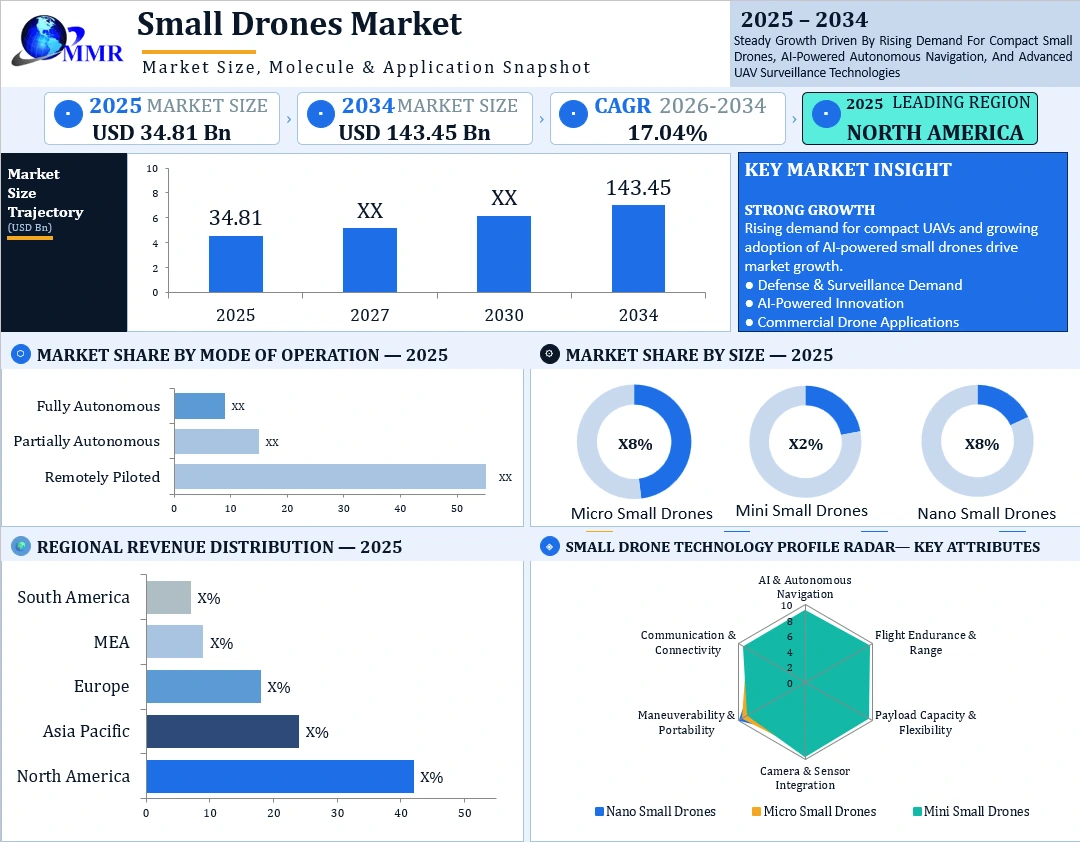
The Small Drones Market size was valued at USD 34.81 Billion in 2025 and the total Small Drones revenue is expected to grow at a CAGR of 17.04% from 2026 to 2034, reaching USD 143.45 Billion.
Small Drones Market Overview
The Global Small Drones Market comprises compact, lightweight unmanned aerial vehicles (UAVs) designed for commercial, military, industrial, agricultural, and recreational applications. Small drones generally include fixed-wing, rotary-wing, and hybrid UAV platforms, with many commercially operated models weighing less than 25 kg. These drones integrate advanced technologies such as artificial intelligence (AI), machine learning, GPS navigation, LiDAR sensors, thermal imaging cameras, high-resolution aerial imaging, autonomous flight control, and real-time data transmission systems. Their compact size, operational flexibility, lower deployment costs, and ability to access difficult environments make them suitable for aerial photography, precision agriculture, infrastructure inspection, land surveying, border surveillance, disaster management, and defense reconnaissance. The Federal Aviation Administration (FAA) classifies drones weighing less than 55 pounds (approximately 25 kg) within its small-drone registration framework, demonstrating the importance of lightweight UAV systems in modern aviation.
The Global Small Drones Market is expanding rapidly, driven by increasing adoption of autonomous drone technologies, rising military modernization expenditure, expanding commercial UAV applications, and growing demand for cost-effective aerial intelligence solutions. North America represents a major market for small drones, supported by defense investments, advanced UAV research, and increasing adoption in public safety, logistics, construction, and infrastructure monitoring. Asia Pacific is emerging as a significant growth region, supported by China's established drone manufacturing ecosystem, technological innovations, and increasing government initiatives promoting drone adoption. Leading manufacturers such as DJI, Skydio, Parrot, AeroVironment, Autel Robotics, and ideaForge are strengthening market competition through AI-enabled navigation, enhanced battery performance, obstacle avoidance systems, and advanced imaging capabilities.
According to the European Union Aviation Safety Agency (EASA), Europe had surpassed 2 million registered drone operators by 2025, reflecting expanding participation in the wider UAV ecosystem. Additionally, Spain's Aviation Safety Agency (AESA) reported 150,332 registered drone operators in 2025, representing 26% year-on-year growth, highlighting increasing commercial and recreational drone adoption. These figures represent overall drone operator activity rather than small-drone-specific market sales. Growing investment in beyond visual line of sight (BVLOS) operations, AI-powered autonomous drones, drone-as-a-service (DaaS), and advanced aerial surveillance is expected to create significant Small Drones Market growth opportunities through 2034.
The Maximize Market Research (MMR) Global Small Drones Market Report provides comprehensive insights into market size, growth trends, key drivers, restraints, opportunities, and forecasts through 2034. The report covers market segmentation by drone type, weight, propulsion, application, end user, and region, along with competitive landscape analysis, leading manufacturers, technological advancements, and recent developments. It also includes Porter’s Five Forces Analysis, PESTLE Analysis, market share assessment, and regional growth opportunities, helping investors, manufacturers, and industry stakeholders identify emerging trends, evaluate competition, and make strategic business decisions in the Global Small Drones Market.
Global Small Drones Market Size, share and Growth Analysis
To know about the Research Methodology :- Request Free Sample Report
Small Drones Market Dynamics
Small Drones Market Driver
The major driver for the Small Drones Market is the increasing adoption of compact unmanned aerial vehicles across defense, surveillance, agriculture, logistics, infrastructure inspection, and commercial photography applications. Governments and enterprises are increasingly utilizing small drones because of their low operational cost, portability, real-time monitoring capability, and ease of deployment. In defense and homeland security, small drones are extensively used for reconnaissance, border surveillance, and tactical intelligence operations. Commercial industries are also deploying drones for crop monitoring, aerial mapping, asset inspection, and delivery services. Technological advancements in AI-based navigation, lightweight materials, battery efficiency, and high-resolution imaging systems are further accelerating the global adoption of small drones.
Small Drones Market Trend
A major trend in the Small Drones Market is the integration of artificial intelligence, autonomous flight systems, and advanced imaging technologies into compact drone platforms. Manufacturers are increasingly developing AI-powered drones capable of autonomous navigation, obstacle avoidance, object tracking, and real-time analytics for commercial and defense applications. Another key trend is the rising deployment of swarm drone technologies for surveillance, disaster management, and military missions. Increasing use of cloud-connected drone management systems and 5G communication technologies is also improving drone efficiency and real-time data transmission. Furthermore, the growing popularity of electric vertical takeoff and landing (eVTOL) drones is expanding the use of small drones across urban mobility and logistics applications.
Small Drones Market Opportunity
The growing expansion of smart cities, precision agriculture, industrial automation, and drone delivery services presents significant opportunities for the Small Drones Market. Governments and enterprises are increasingly investing in drone technologies for traffic monitoring, infrastructure inspection, environmental surveillance, and emergency response operations. In agriculture, rising demand for precision farming solutions is accelerating deployment of drones for crop spraying, soil analysis, and field monitoring. Emerging economies are also supporting drone adoption through favorable regulations and digital transformation initiatives. Additionally, advancements in AI analytics, thermal imaging, and autonomous navigation systems are enabling new commercial applications in mining, oil & gas, construction, and logistics, creating long-term growth opportunities globally.
Small Drones Market Restraint
One of the major restraints in the Small Drones Market is the strict regulatory environment and operational limitations associated with drone deployment. Many countries impose restrictions related to airspace usage, flight altitude, payload capacity, and beyond-visual-line-of-sight (BVLOS) operations, limiting commercial scalability. Concerns regarding cybersecurity threats, unauthorized surveillance, and data privacy also create challenges for drone operators and government agencies. In addition, limited battery life, weather-related operational constraints, and risks of communication failure can reduce drone efficiency during long-duration missions. High maintenance costs, technical integration complexity, and lack of skilled drone operators may further restrict widespread adoption of small drones across certain industries and regions.
Small Drones Market Segment Analysis
By Size – Mini Small Drones Dominant Segment
The mini small drones segment dominates the market because of its balance between operational capability, payload capacity, flight endurance, and portability. Mini drones are widely utilized across defense, surveillance, industrial inspection, agriculture, and commercial photography applications due to their ability to carry advanced imaging systems, thermal sensors, and AI-enabled navigation technologies. Compared to nano and micro drones, mini drones offer longer flight duration, improved communication range, and greater operational flexibility, making them suitable for both commercial and military missions. Increasing demand for infrastructure inspection, mapping, aerial surveillance, and logistics operations is significantly driving segment growth. Furthermore, advancements in lightweight battery technologies, autonomous navigation systems, and cloud-based drone management platforms are improving mini drone efficiency and operational performance, strengthening their dominance within the global Small Drones Market.
By Type – Rotary Wing Dominant Segment
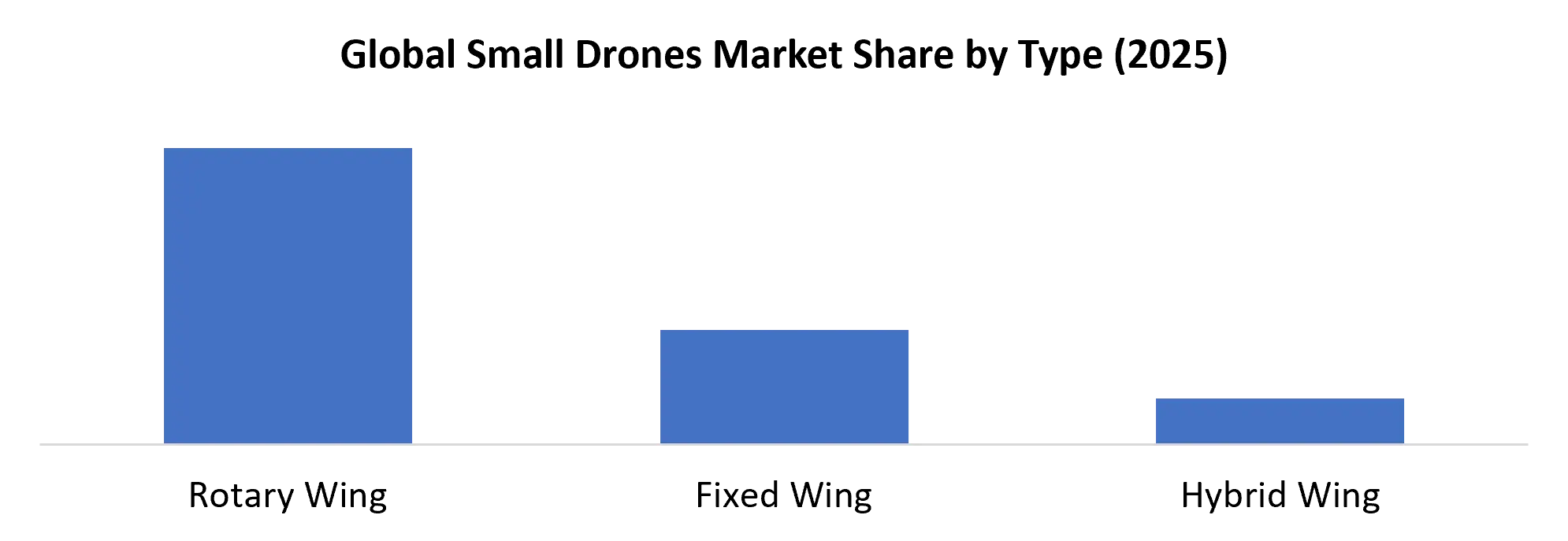
The rotary wing segment dominates the Small Drones Market due to its superior maneuverability, vertical takeoff and landing capability, and ability to hover in fixed positions for real-time monitoring and inspection tasks. Rotary wing drones are extensively used for aerial surveillance, industrial inspection, agriculture spraying, photography, emergency response, and military reconnaissance applications. Their operational flexibility in confined and urban environments makes them highly suitable for commercial and defense use. Increasing integration of AI-powered flight control systems, obstacle avoidance technologies, and high-resolution imaging sensors is significantly improving rotary wing drone performance. Additionally, rising demand for compact drones with precise navigation and stable flight capabilities across logistics, infrastructure inspection, and public safety sectors continues to strengthen the dominance of the rotary wing segment globally.
Small Drones Market Regional Analysis
North America Dominates the Global Small Drones Market
North America is expected to maintain a leading position in the Global Small Drones Market during 2026–2034, driven by rising defense investments, expanding commercial UAV applications, and advanced drone technologies. The United States leads regional demand, supported by small drone adoption in military surveillance, infrastructure inspection, agriculture, logistics, and public safety. According to the FAA's 2025 forecast, the U.S. commercial drone fleet was projected to exceed 1 million units in 2025, highlighting the expansion of unmanned aviation. Major companies such as Skydio, AeroVironment, and Teledyne FLIR support regional innovation.
Asia Pacific Small Drones Market Expected to Witness Rapid Growth
Asia Pacific is expected to experience significant growth through 2034, supported by expanding UAV manufacturing, precision agriculture, defense modernization, and commercial drone applications. China dominates regional drone manufacturing capabilities, supported by companies such as DJI, Autel Robotics, and XAG. India, Japan, South Korea, and Australia are emerging markets for autonomous small drones, aerial mapping, and industrial inspection. India's Ministry of Civil Aviation reported 10,208 registered type-certified commercial drones as of September 2024, highlighting the country's developing drone ecosystem.
Europe Small Drones Market Driven by Commercial UAV Adoption
Europe represents a significant market for small drones, supported by increasing adoption in agriculture, infrastructure monitoring, defense reconnaissance, and environmental surveillance. Germany, France, the UK, and Italy are important regional markets. According to the European Commission, the EU had surpassed 2 million registered drone operators by the end of 2024, reflecting expanding UAV adoption. Companies such as Parrot, Quantum Systems, and Delair strengthen regional technological development.
Middle East & Africa Small Drones Market Shows Steady Expansion
The Middle East & Africa Small Drones Market is expected to grow steadily, driven by defense modernization, smart city investments, oil and gas infrastructure inspection, and border surveillance. Saudi Arabia, the UAE, Israel, and South Africa represent important markets. Increasing demand for AI-powered surveillance drones, autonomous navigation, and industrial UAV solutions is expected to create growth opportunities through 2034.
South America Small Drones Market Supported by Precision Agriculture
South America is emerging as a promising market for small drones, supported by growing adoption in precision farming, mining inspection, environmental monitoring, and infrastructure development. Brazil leads regional opportunities, followed by Argentina, Chile, and Colombia. Increasing use of agricultural spraying drones, aerial mapping systems, and remote sensing technologies is expected to strengthen regional market expansion during 2026–2034.
Global Small Drones Market Recent Developments
| Month & Year | Company | Recent Developments | Market Impact |
| September 2026 | Skydio | Launched the F10 Lightrunner fixed-wing autonomous drone and MegaDock system at Ascend 2026. The aircraft is designed for speeds up to 100 mph and a 30-mile operational radius, supporting emergency response, surveillance, and infrastructure inspection. | Strengthens innovation in autonomous small UAVs, long-range aerial surveillance, and drone docking technologies. |
| August 2026 | Skydio | Announced that its current drone solutions had been added to the Blue UAS Cleared List, supporting adoption in U.S. government and defense applications. | Supports government procurement opportunities and demand for secure small drone systems. |
| August 2026 | ideaForge Technology | Reported progress in air-launched drone technologies and fuel-hybrid propulsion development for its ZOLT platform, alongside completion of a ₹500 crore qualified institutional placement. | Supports innovation in military UAV endurance, hybrid propulsion, and indigenous drone manufacturing. |
| July 2026 | DJI | Demonstrated its Matrice 4E drone for high-altitude mapping operations on Mount Everest, highlighting advanced aerial surveying and geospatial data collection capabilities. | Expands potential applications of compact enterprise drones in environmental monitoring and difficult terrain. |
| June–July 2026 | DJI Enterprise | Advanced its 2026 Onboard AI Challenge, promoting AI-based applications using the Matrice 4 Series and Manifold 3 onboard computing platform. | Encourages development of intelligent small drones, onboard AI processing, and autonomous aerial analytics. |
| April 2026 | Skydio | Raised USD 110 million in Series F financing, reaching a USD 4.4 billion valuation, to support manufacturing expansion and autonomous drone technologies for defense, public safety, and infrastructure applications. | Strengthens investment in AI-powered drones, U.S. manufacturing capabilities, and commercial UAV deployment. |
| April 2026 | Skydio | Introduced cloud software improvements supporting automatic drone deconfliction, enhanced remote flight operations, and improved fleet visibility for Dock-based operations. | Improves operational safety and scalability of autonomous multi-drone systems. |
Global Small Drones Market Competitive Landscape
The Global Small Drones Market is highly competitive, with established UAV manufacturers and emerging technology companies focusing on autonomous flight systems, artificial intelligence, advanced imaging technologies, and lightweight drone platforms. Major companies such as DJI, Skydio, AeroVironment, Parrot, Autel Robotics, Quantum Systems, ideaForge, and Teledyne FLIR are strengthening their market presence through product innovation, strategic partnerships, defense contracts, and expanding commercial applications. DJI maintains a strong position in commercial and enterprise drone technology, supported by its Matrice 4 Series, which incorporates AI-based object detection, thermal imaging, and precision mapping capabilities.
Increasing investments in AI-powered small drones, autonomous navigation, beyond visual line of sight (BVLOS) operations, and advanced surveillance systems are intensifying competition. In April 2026, Skydio announced USD 110 million in Series F funding, reaching a valuation of USD 4.4 billion, to support autonomous drone development and manufacturing expansion. The company also announced plans to invest USD 3.5 billion in U.S. drone manufacturing, research, and supply chains over five years.
Meanwhile, companies such as AeroVironment, Quantum Systems, and ideaForge are focusing on military reconnaissance, tactical UAVs, and secure drone technologies, supporting growing demand from defense and government agencies.
Asia Pacific remains an important small drone manufacturing hub, particularly China, while North America and Europe continue to strengthen domestic UAV production and defense-focused innovation. Manufacturers are increasingly competing on flight endurance, payload capacity, battery efficiency, sensor integration, cybersecurity, and cost-effective drone solutions. Strategic collaborations, R&D investments, localized manufacturing, and drone-as-a-service (DaaS) business models are expected to shape the competitive landscape of the Global Small Drones Market through 2034.
The scope of the Small Drones Market: Inquire before buying
| Small Drones Market | |||
|---|---|---|---|
| Report Coverage | Details | ||
| Base Year: | 2025 | Forecast Period: | 2026-2034 |
| Historical Data: | 2020 to 2025 | Market Size in 2025: | 34.81 USD Bn |
| Forecast Period 2026-2034 CAGR: | 17.04% | Market Size in 2034: | 143.45 USD Bn |
| Segments Covered: | by Size | Nano Small Drones Micro Small Drones Mini Small Drones |
|
| by Type | Rotary Wing Fixed Wing Others |
||
| by Propulsion System | Hybrid Cell Solar Cell Fuel Cell Lithium-Ion Hydroge |
||
| by Payload | Cameras Sensors Nbc Detection System Telemetry System Videoscreen Synthetic Aperture Radar (SAR) |
||
| by Maximum Take-off Weight | Less than 5 kg 5 - 25 kg 25 - 150 kg |
||
| by Mode of Operation | Remotely Piloted Partially Autonomous Fully Autonomous |
||
| by Application | Commercial Defense |
||
Small Drones Market, by Region
North America (United States, Canada and Mexico)
Europe (UK, France, Germany, Italy, Spain, Sweden, Austria and Rest of Europe)
Asia Pacific (China, South Korea, Japan, India, Australia, Indonesia, Malaysia, Vietnam, Taiwan, Bangladesh, Pakistan and Rest of APAC)
Middle East and Africa (South Africa, GCC, Egypt, Nigeria and Rest)
Small Drones Market Key Players
1. DJI (China)
2. AeroVironment, Inc. (United States)
3. Northrop Grumman Corporation (United States)
4. Lockheed Martin Corporation (United States)
5. Elbit Systems Ltd. (Israel)
6. Parrot Drones SAS (France)
7. Skydio, Inc. (United States)
8. Teledyne FLIR LLC (United States)
9. Boeing Insitu Inc. (United States)
10. Autel Robotics (China)
11. Yuneec International Co. Ltd. (China)
12. Draganfly Inc. (Canada)
13. Delair SAS (France)
14. Quantum Systems GmbH (Germany)
15. Anduril Industries (United States)
16. Shield AI (United States)
17. Israel Aerospace Industries (Israel)
18. BAE Systems plc (United Kingdom)
19. AeroVironment Puma (United States)
20. Textron Systems (United States)
21. General Atomics Aeronautical Systems (United States)
22. Rheinmetall AG (Germany)
23. Saab AB (Sweden)
24. Thales Group (France)
25. Leonardo S.p.A. (Italy)
26. Garuda Aerospace (India)
27. ideaForge Technology Ltd. (India)
28. AEVEX Aerospace (United States)
29. JOUAV Inc. (China)
30. Freefly Systems (United States)
Global Small Drones Market – Frequently Asked Questions (FAQs)
1. What are the key factors driving the growth of the Global Small Drones Market?
The market is driven by increasing defense investments, growing adoption of commercial UAVs, advancements in AI-powered autonomous drones, and rising demand for aerial surveillance, precision agriculture, and infrastructure inspection.
2. Which region dominates the Global Small Drones Market?
North America is expected to maintain a leading position in the Global Small Drones Market, supported by advanced UAV technologies, defense modernization, government investments, and expanding commercial drone applications.
3. Which type segment holds the largest share of the Global Small Drones Market?
The rotary wing segment is expected to hold the largest market share, driven by its vertical takeoff and landing capabilities, superior maneuverability, stable hovering, and widespread applications in commercial and defense operations.
4. Who are the key players operating in the Global Small Drones Market?
Major players include DJI, Skydio, AeroVironment, Parrot, Autel Robotics, Quantum Systems, ideaForge Technology, Teledyne FLIR, Yuneec International, and Delair.
5. What are the emerging trends and growth opportunities in the Global Small Drones Market through 2034?
Major trends include AI-powered autonomous navigation, BVLOS operations, drone swarm technology, hybrid propulsion systems, advanced thermal imaging, lightweight UAV designs, and increasing adoption of drone-as-a-service (DaaS) solutions.