Global Ethylene and Propylene Market by Product Type, Production Process, Derivative, Application , and Regional Analysis (2026–2034)

5.1%
CAGR (2026-2034)
326.2 USD Bn.
Forecast Market Size
307
Report Pages
143
Market Tables

Overview

Ethylene and Propylene Market Size to Reach USD 504.6 Billion by 2034 from USD 326.2 Billion in 2025, Growing at a CAGR of 5.1%, Driven by Rising Demand for Polyethylene, Polypropylene, Ethylene Oxide, Propylene Oxide, and Other Downstream Derivatives.

Global Ethylene and Propylene Market Overview

Ethylene and propylene are key building blocks of the petrochemical industry and are used to manufacture a wide range of everyday and industrial products. They are produced mainly through processes such as steam cracking, FCC, propane dehydrogenation (PDH), and olefin metathesis, and are further converted into derivatives such as polyethylene, polypropylene, ethylene oxide, ethylene dichloride, propylene oxide, acrylonitrile, and cumene.

Ethylene and propylene together represent the largest-volume organic chemicals produced globally and form the backbone of the modern petrochemical and plastics value chain. Demand for both olefins is closely linked to global consumption of polyethylene and polypropylene in flexible and rigid packaging, as well as to automotive, construction, textile, and consumer-durable end uses. Continued capacity additions across Asia Pacific and the Middle East, growing adoption of ethane- and propane-based feedstocks in North America, and expanding on-purpose propylene production through PDH units are shaping the structure of global supply, even as producers navigate feedstock cost volatility and periods of regional oversupply.

Ethylene and Propylene Market growth is supported by rising downstream demand for polyolefins in packaging and consumer applications, continued expansion of integrated petrochemical complexes across Asia Pacific and the Middle East, and increasing investment in ethane cracking and propane dehydrogenation capacity. The feedstock price volatility, cyclical overcapacity, and tightening environmental and plastics-related regulation are expected to influence regional supply-demand dynamics and margins through 2034.

Global Ethylene and Propylene Market Key Highlights

• Asia Pacific accounted for the largest regional share in 2025, more than 50% of the combined market, supported by large-scale steam cracker and PDH capacity in China, India, and Southeast Asia.
• Polyethylene and Polypropylene together represented the largest derivative applications in 2025, accounting for nearly 59% of combined market value.
• Steam cracking remained the dominant production route in 2025, while propane dehydrogenation (PDH) is expected to register the fastest process-level growth through 2034.

Ethylene and Propylene Market Growth and Share Analysis
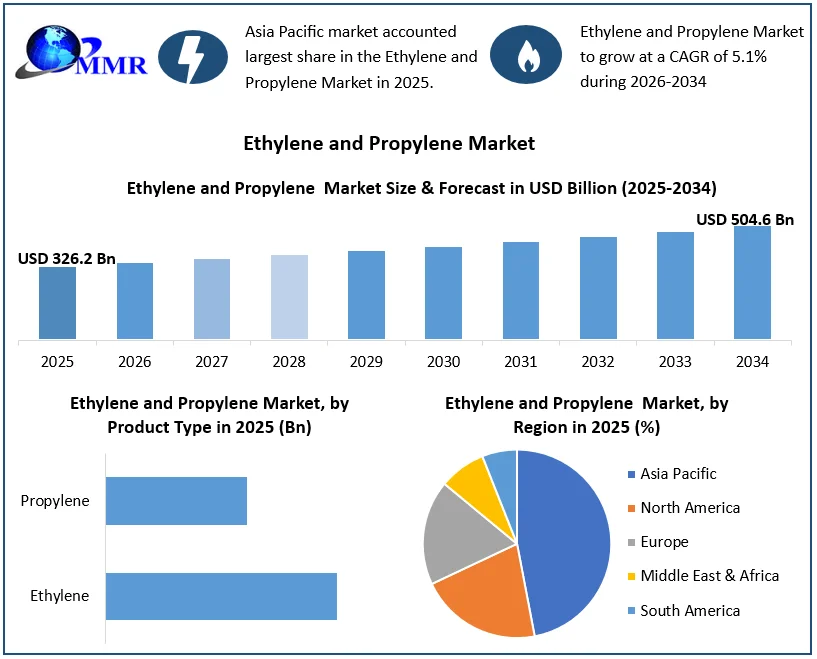
Ethylene and Propylene Market Growth AnalysisTo know about the Research Methodology :- Request Free Sample Report

Global Ethylene and Propylene Market Dynamics

Increasing Demand for Polyethylene and Polypropylene across Packaging, Automotive, and Consumer Applications to drive Ethylene and Propylene Market Growth

Increasing consumption of polyethylene and polypropylene in flexible and rigid packaging, films, automotive components, construction products, and consumer durables continues to be the primary driver of ethylene and propylene demand. Growth in e-commerce and food-delivery-driven packaging, expansion of light-weighting initiatives in the automotive sector, and rising per-capita plastics consumption in emerging economies are supporting steady off take of both olefins. Continued expansion of derivative-manufacturing capacity, particularly across Asia Pacific and the Middle East, is further reinforcing demand for ethylene and propylene feedstock.

Ethylene and Propylene Market Usage Rate of Plastic

Growing Opportunities in On-Purpose Propylene Production, Ethane Cracking, and Integrated Petrochemical Complexes

Increasing investment in propane dehydrogenation (PDH) units is creating opportunities for producers to secure on-purpose propylene supply independent of steam cracker co-production, particularly in regions with access to competitively priced propane and NGLs. Similarly, continued build-out of ethane-based cracking capacity in North America and the Middle East, supported by abundant shale gas and associated gas resources, is creating opportunities for cost-advantaged ethylene production. Integration of refining and petrochemical operations, along with growing interest in bio-based and chemically recycled olefins, is expected to create additional value-added opportunities for producers through 2034.

Feedstock Price Volatility and Capital-Intensive Capacity Additions to Restraint Market Stability

Ethylene and propylene production economics remain closely tied to the cost of naphtha, ethane, propane, and other NGL feedstocks, which are influenced by fluctuations in crude oil and natural gas prices. Steam crackers and PDH units require substantial capital investment and long construction lead times, which can limit the ability of producers to respond quickly to short-term shifts in demand. These factors, combined with periodic feedstock supply disruptions, can constrain margins and limit the pace of new capacity additions in certain regions.

Overcapacity, Regional Oversupply, and Margin Pressure Remain Key Industry Challenges

Large-scale capacity additions, particularly across China and other parts of Asia Pacific, have contributed to periods of regional oversupply and compressed cracker margins. Producers must balance capacity utilization, feedstock flexibility, and export competitiveness while managing rising compliance costs associated with emissions regulation and plastics-related environmental policy.

Ethylene and Propylene Market Trends: Feedstock Shift, On-Purpose Production, Integration, and Sustainability

Shift toward Ethane and NGL-Based Feedstocks in North America and the Middle East

Abundant availability of shale-gas-derived ethane in North America and associated gas in the Middle East continues to support a structural shift toward ethane-based ethylene production, offering cost advantages over naphtha-based crackers in Asia and Europe. This feedstock shift is influencing global trade flows and competitive positioning among regional producers.

Expansion of Propane Dehydrogenation (PDH) Capacity for On-Purpose Propylene

Growing demand for propylene from the polypropylene and propylene oxide value chains is encouraging producers, particularly in China and the United States, to invest in dedicated PDH units that are not dependent on steam cracker co-production, supporting more flexible and demand-aligned propylene supply.

Increasing Focus on Circular Economy, Chemical Recycling, and Bio-Based Olefins

Regulatory and brand-owner pressure to reduce virgin plastics use is encouraging select producers to invest in chemically recycled and bio-based ethylene and propylene pathways, although these remain a small share of overall supply as of 2025.

Large-Scale Integrated Petrochemical Complex Expansions across Asia Pacific and the Middle East

Continued investment in large, integrated refining-to-petrochemicals complexes across China, India, and the Middle East is expanding regional ethylene and propylene capacity, supporting self-sufficiency and export potential while reshaping global trade patterns.

Rising Demand for Specialty and High-Performance Polyolefin Grades

Growing requirements for specialty polyethylene and polypropylene grades in medical, high-barrier packaging, and engineered automotive applications are encouraging producers to focus on differentiated, higher-value derivative offerings rather than commodity-grade volumes alone.

Global Ethylene and Propylene Market – Segment Analysis

Based on Application, the market is segmented into Packaging, Automotive & Transportation, Building & Construction, Chemical & Petrochemical, Consumer Goods, Electrical & Electronics, Textiles & Fibers, Healthcare & Pharmaceuticals, Agriculture, and Others.

• Packaging held the largest share in 2025, driven by extensive use of polyethylene and polypropylene in films, containers, bottles, bags, and closures.

• Packaging accounted for 32% of global plastics use, making it the largest plastics-consuming application.

• Polypropylene accounted for 16%, while HDPE and LDPE/LLDPE together accounted for 24% of global plastics use, highlighting the importance of ethylene- and propylene-derived polymers.

• Automotive & Transportation and Building & Construction are major supporting industries due to increasing use of lightweight, durable polyolefin-based materials.

• Chemical & Petrochemical remains strategically important as ethylene and propylene are key feedstocks for numerous downstream derivatives.

Global Ethylene and Propylene Market Regional Analysis:

North America dominated ethylene and propylene Market in 2025, supported by strong petrochemical infrastructure and access to shale-based ethane and propane feedstocks. The U.S. Gulf Coast remains the key production hub, with extensive cracker, refinery, and derivative capacity. Ethylene demand is driven mainly by polyethylene and other derivatives, while propylene consumption is supported by polypropylene, propylene oxide, acrylonitrile, and related chemicals. Increasing PDH capacity is also strengthening regional propylene supply.

Europe maintains an established but comparatively higher-cost naphtha-based cracker base, with Germany, France, the United Kingdom, Italy, and other industrial economies contributing to regional demand for ethylene and propylene derivatives. Rising energy costs, stringent emissions regulation, and competition from cost-advantaged imports are encouraging European producers to focus on efficiency improvements, feedstock flexibility, and circular and bio-based olefin initiatives.

Global Ethylene and Propylene Market – Competitive Landscape

The global ethylene and propylene market is moderately consolidated, dominated by large, vertically integrated energy and chemical companies that compete on feedstock access, production scale, cost efficiency, derivative integration, and geographic reach. Key companies focus on expanding ethane- and propane-based cracking capacity, investing in on-purpose PDH units, strengthening derivative integration, and improving feedstock flexibility to manage margin volatility. Leading participants include LyondellBasell Industries N.V., ExxonMobil Corporation, Saudi Basic Industries Corporation (SABIC), Dow Inc., Shell plc, China Petroleum & Chemical Corporation (Sinopec), Reliance Industries Limited, INEOS Group Holdings S.A., TotalEnergies SE, Chevron Phillips Chemical Company LLC, BASF SE, Formosa Plastics Corporation, Braskem S.A., Mitsubishi Chemical Group Corporation, Borealis AG, Sumitomo Chemical Co., Ltd., NOVA Chemicals Corporation, Eastman Chemical Company, Huntsman Corporation, and National Petrochemical Company (NPC, Iran). As demand for on-purpose propylene, integrated derivatives, and lower-carbon production pathways develops, companies that can offer cost-advantaged feedstock access, reliable supply, and derivative-integration capabilities are expected to strengthen their market position through 2034.

Global Ethylene and Propylene Market Scope: Inquire before buying

Ethylene and Propylene Market
Report Coverage Details
Base Year: 2025 Forecast Period: 2026-2034
Historical Data: 2020 to 2025 Market Size in 2025: 326.2 USD Billion
Forecast Period 2026-2034 CAGR: 5.1% Market Size in 2034: 504.6 USD Billion
Segments Covered: by Product Type Ethylene
    Polyethylene
    Ethylene Oxide
    Ethylene Dichloride
    Ethylbenzene
    Vinyl Acetate
    Others
Propylene
    Polypropylene
    Propylene Oxide
    Acrylonitrile
    Cumene
    Acrylic Acid
    Others
by Production Process Steam Cracking
Fluid Catalytic Cracking (FCC)
Propane Dehydrogenation (PDH)
Olefin Metathesis
Other Processes
by Application Packaging
Automotive & Transportation
Building & Construction
Chemical & Petrochemical
Consumer Goods
Electrical & Electronics
Textiles & Fibers
Healthcare & Pharmaceuticals
Agriculture
Others

Global Ethylene and Propylene Market by Region:

North America (United States, Canada, and Mexico)
Europe (UK, France, Germany, Italy, Spain, Sweden, Austria, and the Rest of Europe)
Asia Pacific (China, South Korea, Japan, India, Australia, ASEAN, Indonesia, Philippines, Malaysia, Vietnam, Thailand, ASEAN, Rest of Asia Pacific)
Middle East & Africa (South Africa, GCC, Nigeria, Rest of ME&A)
South America (Brazil, Argentina, Rest of South America)

Global Ethylene and Propylene Key Players:

North America

1. ExxonMobil
2. Dow Inc.
3. Chevron Phillips Chemical
4. LyondellBasell Industries
5. Westlake Corporation
6. Nova Chemicals
7. Enterprise Products Partners
8. Occidental Petroleum
9. INEOS
10. Shell

Europe

11. BASF
12. TotalEnergies
13. Versalis
14. Borealis
15. Repsol
16. OMV
17. SABIC
18. INEOS Styrolution

Asia Pacific

19. Sinopec
20. PetroChina
21. Formosa Plastics Corporation
22. Reliance Industries
23. Indian Oil Corporation
24. GAIL
25. LG Chem
26. LOTTE Chemical
27. Mitsubishi Chemical Group
28. Mitsui Chemicals
29. Sumitomo Chemical
30. Maruzen Petrochemical
31. Asahi Kasei
32. Tosoh Corporation
33. SK Geo Centric
34. Hanwha Solutions
35. Hengli Petrochemical
36. Rongsheng Petrochemical
37. Wanhua Chemical
38. PTT Global Chemical
39. Petronas Chemicals Group
40. CPC Corporation, Taiwan
41. Siam Cement Public Company
42. GS Caltex

Middle East & Africa

43. Saudi Aramco
44. QatarEnergy
45. ADNOC
46. Borouge
47. OQ
48. Kuwait Petroleum Corporation
49. Equate Petrochemical Company
50. SABIC Agri-Nutrients
51. Sasol

South America

52. Braskem
53. YPF
54. Petrobras
55. Oxiteno

Global Ethylene and Propylene Market – Frequently Asked Questions

1. What is the expected size of the Global Ethylene and Propylene Market by 2034?
Ans: The market is projected to reach USD 504.6 Billion by 2034, up from USD 326.2 Billion in 2025, growing at a CAGR of around 5.1% during the forecast period.

2. What are the major applications of ethylene and propylene?
Ans: Major applications include polyethylene, polypropylene, ethylene oxide/ethylene glycol, ethylene dichloride, ethylbenzene, propylene oxide, acrylonitrile, cumene, and isopropanol, feeding into packaging, automotive, construction, textiles, and consumer goods.

3. Which segment was the largest share of the market in 2025?
Ans: Polyethylene and polypropylene together represent the largest derivative applications, together accounting for 59% of market value in 2025, supported by strong demand from packaging and consumer goods.

4. Which region is expected to lead the Global Ethylene and Propylene Market?
Ans: Asia Pacific is expected to remain the leading region, supported by large-scale integrated petrochemical complexes and expanding derivative manufacturing capacity in China, India, and Southeast Asia.

5. What is the difference between ethylene and propylene production routes?
Ans: Ethylene is produced predominantly through steam cracking of naphtha or ethane, while propylene is produced both as a steam-cracker co-product and increasingly through on-purpose routes such as propane dehydrogenation (PDH) and fluid catalytic cracking (FCC).

6. Which countries are the major markets for ethylene and propylene?
Ans: China, the United States, India, Saudi Arabia, South Korea, and Germany are among the important markets, supported by large integrated cracker and derivative manufacturing capacity.

Table of Contents

1. Ethylene and Propylene Market Introduction 1.1. Study Assumption and Market Definition 1.2. Scope of the Study 1.3. Executive Summary 2. Global Ethylene and Propylene Market: Competitive Landscape 2.1. MMR Competition Matrix 2.2. Key Players Benchmarking 2.2.1. Company Name 2.2.2. Headquarters 2.2.3. Product Portfolio 2.2.4. Production Capacity 2.2.5. Revenue Details in 2025 2.2.6. Market Share (%) 2.2.7. Operating Margin (%) 2.2.8. Production Cost Positioning 2.2.9. Technological Capabilities 2.2.10. Geographical Presence 2.3. Market Structure 2.3.1. Market Leaders 2.3.2. Market Followers 2.3.3. Emerging Players 2.4. Mergers, Acquisitions, Joint Ventures, and Strategic Partnerships 3. Ethylene and Propylene Market: Dynamics 3.1. Ethylene and Propylene Market Trends 3.2. Ethylene and Propylene Market Dynamics 3.2.1. Drivers 3.2.2. Restraints 3.2.3. Opportunities 3.2.4. Challenges 3.3. PORTER's Five Forces Analysis 3.4. PESTLE Analysis 3.5. Regulatory Landscape by Region 3.6. Key Opinion Leader Analysis for the Global Industry 3.7. Analysis of Government Policies, Schemes, and Initiatives Supporting Petrochemical and Olefin Production 4. Global Olefin Demand Trends, Petrochemical Industry Transformation, and Consumption Pattern Assessment 4.1. Comparative Assessment of Ethylene and Propylene Demand across Major Downstream Industries 4.2. Evolution of Global Petrochemical Consumption and Olefin Demand Patterns 4.3. Influence of Packaging, Construction, Automotive, Consumer Goods, and Industrial Manufacturing on Olefin Demand 4.4. Growing Demand for Polyethylene, Polypropylene, Ethylene Oxide, and Other Olefin Derivatives 4.5. Impact of Urbanization, Industrialization, Infrastructure Development, and Economic Growth on Ethylene and Propylene Consumption 4.6. Future Olefin Demand Trends Reshaping Global Petrochemical Production 5. Product Portfolio Performance, Derivative Benchmarking, and Application Assessment 5.1. Comparative Performance Assessment of Ethylene and Propylene 5.2. Ethylene Derivative Demand Analysis 5.2.1. Polyethylene 5.2.2. Ethylene Oxide 5.2.3. Ethylene Dichloride 5.2.4. Ethylene Glycol 5.2.5. Styrene 5.2.6. Other Derivatives 5.3. Propylene Derivative Demand Analysis 5.3.1. Polypropylene 5.3.2. Propylene Oxide 5.3.3. Acrylonitrile 5.3.4. Cumene 5.3.5. Acrylic Acid 5.3.6. Other Derivatives 5.4. Comparative Analysis of Commodity, Intermediate, and Specialty Olefin Products 5.5. Product Portfolio Diversification and Downstream Integration Strategies 5.6. Future Derivative Development and High-Growth Product Opportunities 6. Feedstock, Raw Material Availability, and Petrochemical Resource Assessment 6.1. Comparative Assessment of Naphtha, Ethane, Propane, LPG, and Other Feedstocks 6.2. Feedstock Performance Benchmarking Based on Cost, Availability, Yield, and Regional Accessibility 6.3. Assessment of Ethane-Based, Naphtha-Based, and Propane-Based Olefin Production 6.4. Feedstock Flexibility and Refinery-Petrochemical Integration 6.5. Feedstock Price Volatility and Supply Security Assessment 6.6. Future Feedstock Strategies Supporting Cost-Efficient and Sustainable Olefin Production 7. Ethylene and Propylene Production Technology, Process Innovation, and Efficiency Assessment 7.1. Ethylene and Propylene Production Process Overview 7.2. Steam Cracking Technology Assessment 7.3. Fluid Catalytic Cracking (FCC) Technology Assessment 7.4. Propane Dehydrogenation (PDH) Technology Assessment 7.5. Metathesis and Other Propylene Production Technologies 7.6. Future Production Technology Innovations Supporting Yield Improvement and Energy Efficiency 8. Global Ethylene and Propylene Manufacturing Landscape, Capacity, and Operational Excellence Assessment 8.1. Comparative Assessment of Global Olefin Manufacturing Hubs Based on Production Capacity and Cost 8.2. Integrated Refinery-Petrochemical Complexes and Standalone Olefin Plants 8.3. Production Capacity Utilization and Operational Efficiency Assessment 8.4. Plant Expansion, Debottlenecking, and New Capacity Development 8.5. Operational Excellence through Process Optimization, Maintenance, and Quality Management 8.6. Future Manufacturing Transformation through Automation, Digitalization, and Advanced Process Technologies 9. Feedstock Procurement, Petrochemical Supply Chain, and Raw Material Processing Analysis 9.1. End-to-End Feedstock Procurement Ecosystem 9.2. Comparative Assessment of Ethane, Naphtha, Propane, LPG, and Refinery Feedstocks 9.3. Feedstock Processing and Olefin Separation Operations 9.4. Supplier Network Evaluation and Procurement Cost Optimization 9.5. Feedstock Availability, Price Volatility, and Global Supply Risk Assessment 9.6. Future Feedstock Procurement Strategies Supporting Supply Security 10. Digital Transformation, Artificial Intelligence, Automation, and Smart Petrochemical Manufacturing Assessment 10.1. Digital Transformation across Olefin Production and Petrochemical Operations 10.2. AI Applications for Predictive Maintenance, Process Optimization, and Production Planning 10.3. Smart Manufacturing Technologies Including Industrial Automation, Sensors, and Process Control Systems 10.4. IoT-Based Plant Monitoring and Real-Time Production Visibility 10.5. Data Analytics, Digital Twins, and Advanced Process Control 10.6. Future Digital Transformation Roadmap for Ethylene and Propylene Production 11. Downstream Demand, End-Use Industries, and Consumption Pattern Assessment 11.1. Comprehensive Assessment of Ethylene and Propylene Consumption across Major End-Use Industries 11.2. Comparative Demand Analysis across Packaging, Construction, Automotive, Chemicals, and Consumer Goods 11.3. Polyethylene and Polypropylene Demand Assessment 11.4. Demand for Ethylene and Propylene Derivatives in Chemical Manufacturing 11.5. Industrial and Specialty Chemical Application Analysis 11.6. Future Downstream Demand Evolution Influencing Global Olefin Consumption 12. Pricing Strategy, Cost Structure, Profitability, and Margin Optimization Assessment 12.1. Comprehensive Breakdown of Ethylene and Propylene Production Cost Structure 12.2. Comparative Pricing Analysis of Ethylene and Propylene 12.3. Assessment of Feedstock, Energy, Utilities, Labor, Logistics, and Processing Costs 12.4. Regional Production Cost and Margin Benchmarking 12.5. Integrated Refinery-Petrochemical Cost Advantage Assessment 12.6. Future Pricing Outlook under Feedstock, Energy, and Supply-Demand Volatility 13. Global Petrochemical Trade, Distribution Network, and International Market Access Assessment 13.1. Evolution of Global Ethylene and Propylene Trade Networks 13.2. Comparative Assessment of Domestic Production, Imports, and Exports 13.3. Regional Distribution Networks and Storage Infrastructure 13.4. Pipeline, Maritime, and Other Transportation Infrastructure 13.5. International Trade Routes and Logistics Cost Optimization 13.6. Future Global Olefin Distribution and Trade Network Development 14. Sustainability, Decarbonization, Circular Economy, and Responsible Petrochemical Production Assessment 14.1. Assessment of Sustainable Ethylene and Propylene Production Pathways 14.2. Carbon Emission Reduction and Energy Efficiency Initiatives 14.3. Bio-Based, Recycled, and Alternative Feedstock Opportunities 14.4. Carbon Capture, Utilization, and Storage (CCUS) in Olefin Production 14.5. Circular Economy and Chemical Recycling Opportunities for Olefin Derivatives 14.6. Future Decarbonization Roadmap for the Ethylene and Propylene Industry 15. Regulatory Framework, Trade Policies, Product Standards, and Environmental Compliance Assessment 15.1. Comparative Assessment of Petrochemical and Olefin Regulations across Major Markets 15.2. Import-Export Policies, Tariff Structures, and International Trade Agreements 15.3. Product Quality, Purity, Storage, and Handling Standards 15.4. Environmental Regulations Covering Emissions, Energy Consumption, and Industrial Waste 15.5. Chemical Safety, Worker Safety, and Process Safety Regulations 15.6. Future Regulatory Developments Influencing the Global Olefin Industry 16. Supplier Ecosystem, Procurement Strategy, Vendor Benchmarking, and Strategic Sourcing Analysis 16.1. Global Supplier Landscape across Feedstock, Equipment, Catalysts, and Petrochemical Inputs 16.2. Vendor Selection Criteria Based on Cost, Quality, Capacity, Technology, and Reliability 16.3. Strategic Procurement Assessment across Olefin Production Operations 16.4. Long-Term Feedstock Supply Agreements and Strategic Partnerships 16.5. Supplier Risk Assessment Including Geopolitical and Supply Disruption Factors 16.6. Future Procurement Transformation through Digital Sourcing and Supply Chain Platforms 17. End-to-End Value Chain, Supply Chain Optimization, Storage, and Logistics Assessment 17.1. End-to-End Ethylene and Propylene Value Chain Assessment 17.2. Feedstock Procurement, Production, Separation, Storage, and Distribution Analysis 17.3. Pipeline, Terminal, Storage, and Transportation Infrastructure Assessment 17.4. Inventory Planning, Demand Forecasting, and Supply Chain Visibility 17.5. Digital Supply Chain Technologies for Petrochemical Operations 17.6. Future Supply Chain Resilience and Business Continuity Strategies 18. Global Manufacturing Competitiveness, Country Benchmarking, and Production Capacity Assessment 18.1. Comparative Assessment of Ethylene and Propylene Manufacturing Competitiveness across Major Countries 18.2. Feedstock Cost, Energy Cost, Production Capacity, and Infrastructure Benchmarking 18.3. Government Incentives Supporting Petrochemical and Olefin Capacity Investments 18.4. Comparative Analysis of Manufacturing Competitiveness across North America, Europe, Asia Pacific, and Middle East 18.5. Export Competitiveness and Regional Olefin Production Hub Assessment 19. Regional Demand Assessment, Consumption Patterns, and Market Opportunity Analysis 19.1. Comparative Regional Ethylene and Propylene Consumption across North America, Europe, Asia Pacific, Middle East & Africa, and South America 19.2. Regional Demand Analysis by Ethylene and Propylene Derivatives 19.3. Downstream Industry Growth and Regional Consumption Patterns 19.4. Market Penetration across Developed and Emerging Petrochemical Markets 19.5. High-Growth Countries and Untapped Olefin Market Opportunities 20. Competitive Benchmarking of Global Olefin Producers Based on Capacity, Technology, Integration, and Cost 20.1. Comparative Production Capacity Benchmarking 20.2. Feedstock Advantage and Cost Positioning 20.3. Technology and Production Process Benchmarking 20.4. Downstream Integration and Derivative Portfolio Assessment 20.5. Global Manufacturing Footprint and Distribution Network Comparison 20.6. Competitive Positioning Assessment across Key Geographic Markets 21. Competitive Landscape, Capacity Expansion, Strategic Partnerships, and Market Consolidation Analysis 21.1. Competitive Landscape Assessment Based on Production Capacity and Market Presence 21.2. Mergers, Acquisitions, Joint Ventures, and Strategic Partnership Analysis 21.3. Geographic Expansion and New Plant Development Strategies 21.4. Capacity Expansion, Debottlenecking, and Plant Modernization 21.5. Competitive Differentiation through Technology, Cost Efficiency, and Integration 21.6. Future Competitive Dynamics across the Global Ethylene and Propylene Industry 22. Investment Landscape, White Space Opportunities, and Emerging Business Potential Assessment 22.1. Investment Attractiveness across Ethylene, Propylene, and Major Derivative Markets 22.2. Identification of High-Growth Downstream Applications and White Space Opportunities 22.3. Strategic Investment Trends in Petrochemical and Olefin Capacity 22.4. Greenfield and Brownfield Capacity Investment Analysis 22.5. Investment Opportunities across Feedstock, Production, Infrastructure, and Derivatives 22.6. Future Business Expansion Opportunities across the Olefin Value Chain 23. Risk Assessment Covering Feedstock Volatility, Supply Disruptions, Environmental Risks, and Geopolitical Factors 23.1. Assessment of Feedstock Supply Risks and Procurement Challenges 23.2. Production Downtime, Plant Reliability, and Operational Risks 23.3. Supply Chain Disruption Risks Including Transportation and Infrastructure Constraints 23.4. Geopolitical, Trade Policy, Tariff, and Sanctions Risk Assessment 23.5. Environmental, Regulatory, and Carbon Compliance Risks 23.6. Business Risk Mitigation and Supply Resilience Strategies 24. Global Import–Export Trade Analysis, Cross-Border Supply Chain, and International Trade Flow Assessment 24.1. Global Ethylene and Propylene Trade Flow Assessment 24.2. Country-Wise Export Competitiveness and Trade Performance Benchmarking 24.3. Cross-Border Supply Chain Analysis Supporting Global Olefin Trade 24.4. Trade Agreements, Tariff Structures, and Customs Policy Assessment 24.5. Regional Import Dependency and Export Opportunity Analysis 25. Petrochemical Infrastructure, Storage Facilities, Terminal Development, and Distribution Network Assessment 25.1. Comparative Assessment of Olefin Storage and Distribution Infrastructure 25.2. Ethylene and Propylene Pipeline Network Analysis 25.3. Petrochemical Terminals, Storage Tanks, and Handling Infrastructure 25.4. Port Infrastructure and Maritime Transportation Assessment 25.5. Infrastructure Expansion Strategies across Developed and Emerging Markets 25.6. Future Infrastructure Requirements Supporting Global Olefin Trade 26. Polyethylene, Polypropylene, and Polymer Industry Demand Opportunity Assessment 26.1. Comparative Assessment of Polyethylene and Polypropylene Demand 26.2. Packaging Industry Demand for Polyethylene and Polypropylene 26.3. Automotive and Transportation Applications 26.4. Construction and Infrastructure Applications 26.5. Consumer Goods, Electrical & Electronics, and Industrial Applications 26.6. Future Polymer Demand Trends Driving Ethylene and Propylene Consumption 27. Ethylene and Propylene Derivatives, Specialty Chemicals, and Downstream Value-Added Products Assessment 27.1. Comparative Assessment of Major Ethylene Derivatives 27.2. Comparative Assessment of Major Propylene Derivatives 27.3. Demand for Ethylene Oxide, Ethylene Glycol, and Ethylene Dichloride 27.4. Demand for Polypropylene, Propylene Oxide, Acrylonitrile, Cumene, and Acrylic Acid 27.5. Specialty Chemical and Industrial Application Opportunities 27.6. Future High-Value Derivative Development Opportunities 28. Petrochemical Industry Integration, Refinery Strategy, Strategic Partnerships, and Downstream Expansion Analysis 28.1. Refinery-Petrochemical Integration Strategies 28.2. Upstream Feedstock-to-Olefin Integration Assessment 28.3. Olefin-to-Derivative Downstream Integration 28.4. Strategic Partnerships and Long-Term Supply Agreements 28.5. Vertical Integration and Portfolio Diversification Strategies 28.6. Future Integrated Petrochemical Complex Development 29. Innovation Roadmap Covering Advanced Olefin Production, Low-Carbon Technologies, and Process Optimization 29.1. Advanced Ethylene and Propylene Production Technologies 29.2. Energy-Efficient Steam Cracking and Process Optimization 29.3. Advanced Catalysts and Production Yield Improvement 29.4. Low-Carbon and Alternative Olefin Production Technologies 29.5. Carbon Capture, Electrification, and Renewable Energy Integration 29.6. Future Commercialization of Emerging Olefin Technologies 30. Circular Economy, Chemical Recycling, Bio-Based Feedstocks, and Sustainable Olefin Ecosystem Assessment 30.1. Circular Economy Assessment across the Olefin and Polymer Value Chain 30.2. Chemical Recycling and Pyrolysis-Based Feedstock Recovery 30.3. Mechanical and Advanced Recycling Impact on Virgin Olefin Demand 30.4. Bio-Based and Renewable Feedstock Opportunities 30.5. Waste-to-Olefin and Alternative Feedstock Technologies 30.6. Future Circular and Low-Carbon Olefin Production Opportunities 31. Global Ethylene and Propylene Market Size and Forecast by Segmentation (By Value in USD Million and Volume in Metric Tons) (2025–2034) 31.1. Ethylene and Propylene Market Size and Forecast, By Product (2025–2034) 31.1.1. Ethylene 31.1.2. Propylene 31.2. Ethylene and Propylene Market Size and Forecast, By Production Process (2025–2034) 31.2.1. Steam Cracking 31.2.2. Fluid Catalytic Cracking (FCC) 31.2.3. Propane Dehydrogenation (PDH) 31.2.4. Metathesis 31.2.5. Other Processes 31.3. Ethylene and Propylene Market Size and Forecast, By Application (2025–2034) 31.3.1. Packaging 31.3.2. Construction 31.3.3. Automotive & Transportation 31.3.4. Consumer Goods 31.3.5. Electrical & Electronics 31.3.6. Chemical & Petrochemical 31.3.7. Healthcare & Pharmaceuticals 31.3.8. Industrial Manufacturing 31.3.9. Others 31.4. Ethylene and Propylene Market Size and Forecast, By Region (2025–2034) 31.4.1. North America 31.4.1.1. United States 31.4.1.2. Canada 31.4.1.3. Mexico 31.4.2. Europe 31.4.2.1. Germany 31.4.2.2. France 31.4.2.3. United Kingdom 31.4.2.4. Italy 31.4.2.5. Netherlands 31.4.2.6. Belgium 31.4.2.7. Spain 31.4.2.8. Russia 31.4.2.9. Norway 31.4.2.10. Poland 31.4.2.11. Rest of Europe 31.4.3. Asia Pacific 31.4.3.1. China 31.4.3.2. India 31.4.3.3. Japan 31.4.3.4. South Korea 31.4.3.5. Taiwan 31.4.3.6. Singapore 31.4.3.7. Indonesia 31.4.3.8. Thailand 31.4.3.9. Malaysia 31.4.3.10. Vietnam 31.4.3.11. Australia 31.4.3.12. Rest of Asia Pacific 31.4.4. Middle East and Africa 31.4.4.1. Saudi Arabia 31.4.4.2. United Arab Emirates 31.4.4.3. Qatar 31.4.4.4. Kuwait 31.4.4.5. Iran 31.4.4.6. South Africa 31.4.4.7. Egypt 31.4.4.8. Nigeria 31.4.4.9. Rest of Middle East & Africa 31.4.5. South America 31.4.5.1. Brazil 31.4.5.2. Argentina 31.4.5.3. Chile 31.4.5.4. Colombia 31.4.5.5. Rest of South America 32. Company Profile: Key Players 32.1. SABIC 32.1.1. Company Overview 32.1.2. Business Portfolio 32.1.3. Financial Overview 32.1.4. SWOT Analysis 32.1.5. Strategic Analysis 32.1.6. Recent Developments 32.2. Saudi Aramco 32.3. LyondellBasell Industries N.V. 32.4. Exxon Mobil Corporation 32.5. Dow Inc. 32.6. Chevron Phillips Chemical Company LLC 32.7. INEOS Group Limited 32.8. Shell plc 32.9. BASF SE 32.10. TotalEnergies SE 32.11. Sinopec 32.12. China National Petroleum Corporation (CNPC) 32.13. Formosa Plastics Corporation 32.14. Reliance Industries Limited 32.15. LG Chem Ltd. 32.16. Mitsubishi Chemical Group Corporation 32.17. Sumitomo Chemical Co., Ltd. 32.18. LOTTE Chemical Corporation 32.19. Hanwha Solutions Corporation 32.20. SK Geo Centric Co., Ltd. 32.21. Borealis AG 32.22. Braskem S.A. 32.23. PTT Global Chemical Public Company Limited 32.24. Indian Oil Corporation Limited 32.25. GAIL (India) Limited 32.26. QatarEnergy 32.27. Kuwait Petroleum Corporation 32.28. Abu Dhabi National Oil Company (ADNOC) 32.29. Borouge Plc 32.30. Petronas Chemicals Group Berhad 32.31. Reliance Sibur Elastomers Private Limited 32.32. Westlake Corporation 32.33. Sasol Limited 32.34. Versalis S.p.A. 32.35. Maruzen Petrochemical Co., Ltd. 32.36. Asahi Kasei Corporation 32.37. Tosoh Corporation 32.38. Mitsui Chemicals, Inc. 32.39. CPC Corporation, Taiwan 32.40. PRefChem 32.41. PetroChina Company Limited 32.42. Hengli Petrochemical Co., Ltd. 32.43. Rongsheng Petrochemical Co., Ltd. 32.44. Wanhua Chemical Group Co., Ltd. 32.45. Braskem Idesa 32.46. Nova Chemicals Corporation 32.47. Sasol Chemicals 32.48. Equate Petrochemical Company 32.49. Borouge International 32.50. Orpic / OQ Others 33. Key Findings 34. Analyst Recommendations 35. Ethylene and Propylene Market: Research Methodology

Custom Market Research Services

We Will Customise The Research For You, In Case The Report Listed Above Does Not Meet With Your Requirements