
Global Drone Market— The Complete Strategic Intelligence Report for Defense, Enterprise and Investor Audiences
Overview
| 9.8% | $147.8 Bn | 320+ | 140 |
| CAGR (2025-2032) | FULL-STACK FCST. 2036 | REPORT PAGES | MARKET TABLES |
| "Competitor report tells you the drone market is worth USD 9.23 billion in 2025. This report tells you which six sub-segments have no dominant player yet, which contracts already prove the budget exists, and which capability gap BVLOS reform and defense-scale autonomy contracts are both racing to close. That is the difference between a market report and an intelligence report."
— Rucha Deshpande, MMR Research Head, Global Defense & Aerospace Intelligence Practice |
Global Drone Market: The Sky Just Became the Most Contested Real Estate in Global Industry.
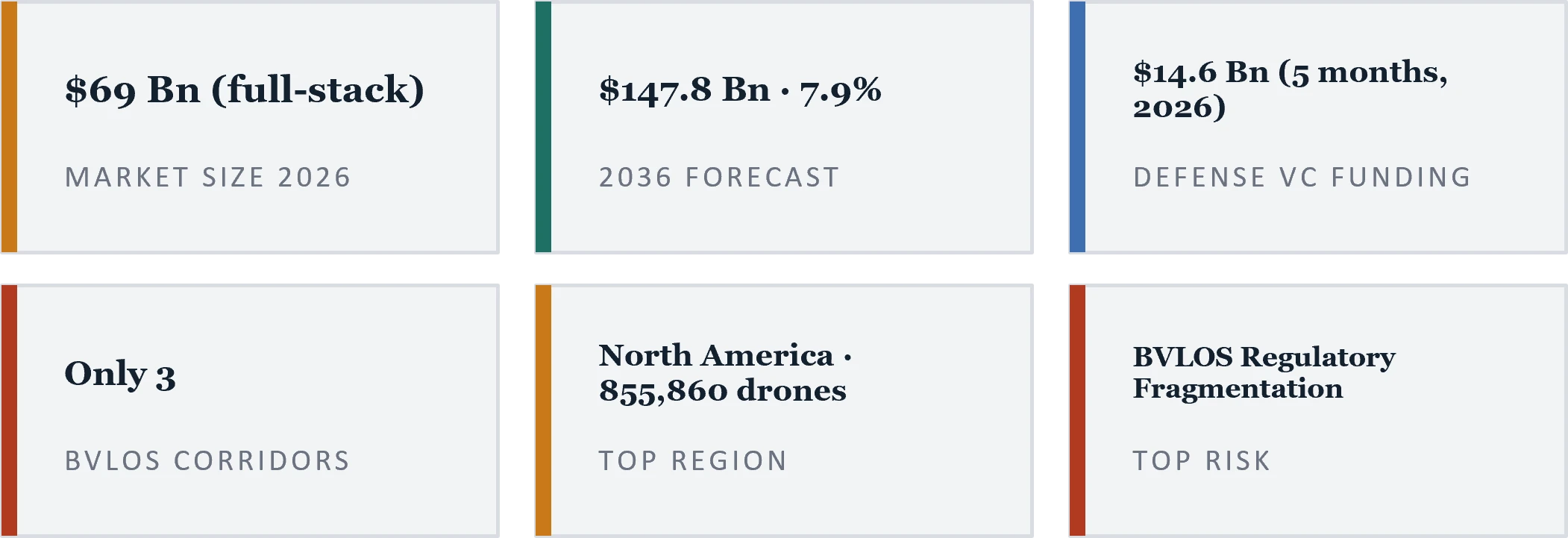
In December 2024, waves of unidentified drone sightings over New Jersey and near multiple U.S. military installations triggered a multi-week national security response, congressional briefings, and a public debate over airspace defense that no radar system built before 2020 was designed to answer. The incident itself resolved without a confirmed hostile act — but the reaction it provoked was the real signal: an entire government apparatus scrambled because it could not reliably detect, attribute, or neutralize small unmanned aircraft over its own soil. That gap is the entire logic of the Global Drone Market. In 2024 alone, drone attacks in active conflict zones jumped from 4,525 to 19,704 incidents — a 335 percent surge in a single year — and defense-tech startups pulled in USD 14.6 billion in venture funding in just the first five months of 2026, more than any full prior year on record.
On a core platform-transaction basis, the Global Drone Market is valued at USD 9.23 Billion in 2025, reaching USD 17.42 Billion by 2032 at a 9.8% CAGR. Widen the lens to the full consumer, commercial and defense stack, and independent industry estimates place the market at approximately USD 69 Billion in 2026, climbing to USD 147.8 Billion by 2036 at a 7.9% CAGR. Either way you cut it, this is not a hardware market growing steadily. It is a battle for airspace, autonomy, and algorithmic control being fought simultaneously across defense budgets, enterprise logistics, and consumer skies.
Consider the scale of what is converging: Anduril Industries, a company that did not exist a decade ago, generated approximately USD 2.1 billion in revenue in 2025 and is projected to reach USD 4.3 billion in 2026 — commanding a USD 61 billion valuation on the strength of autonomous ISR platforms alone. China now files roughly 1.8 million patent applications a year and holds 6 of the world's top 10 UAV patent positions. Commercial drone shipments are set to grow 2.3x between 2025 and 2036 — but sensor shipments inside those same drones will grow 4x, meaning the real growth story is not more drones, it is smarter drones. And BVLOS — Beyond Visual Line of Sight operation — remains so regulated that India, despite 795 registered drone startups, had approved only three commercial BVLOS corridors by early 2026. The companies that solve that regulatory bottleneck first do not just win market share. They unlock an entirely new addressable market that does not exist on paper yet.
[ GRAPH — EXECUTIVE DASHBOARD ] KPI dashboard tile set — market size, CAGR, defense funding, BVLOS corridor count, sensor-density trend, top risk — rendered as a single glance summary above the fold.
To know about the Research Methodology :- Request Free Sample Report
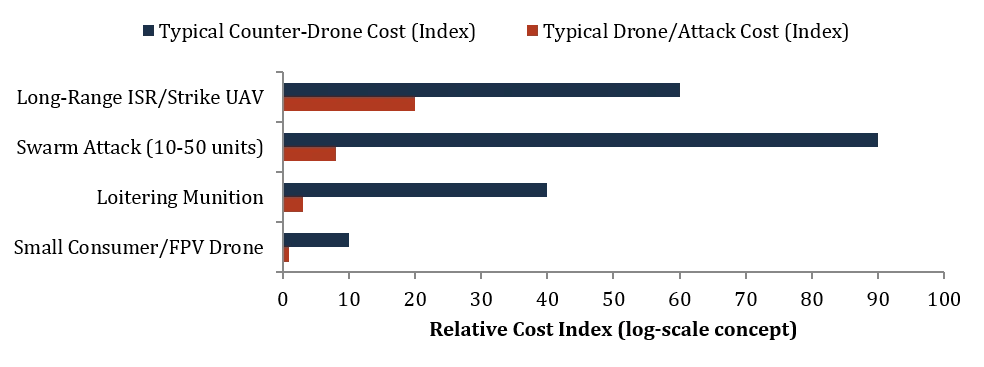
The USD 500 Drone vs. USD 50,000 Interceptor Problem
This is the industry's defining economic contradiction. A single commercial quadcopter used for reconnaissance or a low-cost loitering munition can cost a few hundred dollars to a few thousand dollars to build or acquire. The counter-drone systems built to detect and neutralize it — RF jammers, kinetic interceptors, directed-energy prototypes — routinely cost orders of magnitude more per engagement. Used unselectively, layered counter-drone defense becomes a war of attrition that favors the attacker on cost alone — and every counter-UAS budget in this report is, in some way, a response to that asymmetry.
| Threat Type | Typical Drone Cost | Typical Counter-Drone Cost | Cost Ratio | Industry Response |
| Small Consumer/FPV Drone | < USD X00 | USD X–XK (RF/kinetic) | ~X:20–X0 | Detection + RF mitigation |
| Loitering Munition | USD X–XK | USD X–XM (interceptor) | ~X:X0–X00 | AI-prioritized selective engagement |
| Swarm Attack (10-50 units) | < USD X0K total | USD X–XM (unselective) | ~X:20+ | Directed energy / HPM (cost-per-shot → electricity) |
| Long-Range ISR/Strike UAV | USD X0K–XM | USD X–XM (SAM-class) | ~X:2–X | Layered, multi-tier interception |
COST-ASYMMETRY CHART ] Horizontal log-scale bar chart comparing typical drone cost vs typical counter-drone cost by threat type, mirroring the attack-cost-vs-defense-cost visual used in adjacent defense-market reports.
Global Drone Market Snapshot
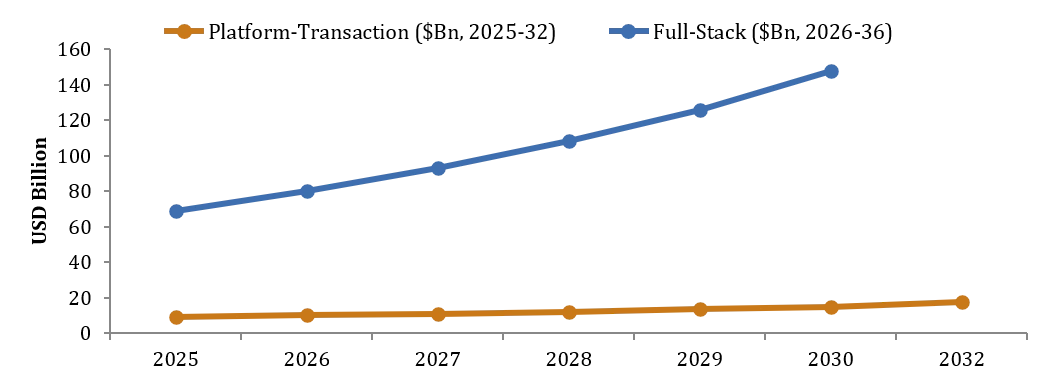
On a core platform-transaction basis, the Global Drone Market was valued at USD 9.23 Billion in 2025 and is projected to reach USD 17.42 Billion by 2032, growing at a CAGR of 9.8% during the forecast period. On a full-stack basis inclusive of consumer, commercial and defense platforms across the complete sensor and software payload, independent industry estimates size the market at approximately USD 69 Billion in 2026, reaching USD 147.8 Billion by 2036 at a 7.9% CAGR — with commercial drone unit shipments alone projected to exceed 9 million annually by 2036. The gap between these two figures is the exact size of the sensor, software and services layer now stacking on top of the airframe. Growth is driven by rising adoption of drone technology across construction, agriculture, defense, logistics, energy and utilities, mining, real estate, public safety, media and entertainment, and infrastructure inspection. Major markets — the United States, China, India, Japan, Germany, the United Kingdom, France, Canada, Australia and the UAE — are accelerating investment in commercial drones, military UAVs, autonomous aerial systems, and Drone-as-a-Service (DaaS) platforms.
MARKET SIZE FORECAST CHART ] Dual-scope line forecast — platform-transaction scope (USD 9.23 Bn → 17.42 Bn, 2025–2032) vs. full-stack scope (USD 69 Bn → 147.8 Bn, 2026–2036), shaded gap showing the sensor/software premium.
Executive Summary
Advancements in artificial intelligence, machine learning, computer vision, edge computing, 5G connectivity, IoT integration, GPS/GNSS navigation, LiDAR, thermal imaging and digital-twin technology are transforming drones into intelligent platforms for real-time monitoring, precision mapping, surveillance, asset inspection and last-mile delivery. Continuous innovation in BVLOS operations, autonomous flight, drone-swarm technology, battery efficiency and cloud-based analytics is expanding commercial applications while improving operational efficiency, safety and decision-making. North America leads global commercial drone adoption with 855,860 registered drones and a commercial fleet forecast to exceed 1.09 million registered aircraft. Europe has built the world's most harmonized drone regulatory framework, with over 2 million registered drone operators under EASA's unified rules. So what does this mean in practice? The industry is no longer gated by hardware capability — it is gated by airspace policy and sensor intelligence, and the companies that solve both first will capture the commercial upside first.
Drone Industry Pain Points
Five pain points define where this industry genuinely struggles today — the gaps every competitor report glosses over.
• BVLOS approval bottleneck: India has approved only three commercial BVLOS corridors despite 795 registered drone startups — regulatory approval, not technology, is the binding constraint on commercial scale.
• Sensor cost and integration complexity: industrial drones are moving toward 10-15 sensors per platform by 2036 (multi-camera vision, LiDAR, radar, ultrasonic, redundant IMUs), and integration cost is rising faster than airframe cost.
• Geopolitical component restrictions: the US FCC restricted additional foreign-made UAV equipment in December 2025 while China tightened its own flight regulations in May 2026 — supply chains are being forced to fragment along geopolitical lines.
• Airspace congestion and safety risk: the FAA receives more than 100 drone sightings near airports every month, and UTM (Unmanned Traffic Management) infrastructure remains immature relative to the volume of operations it must eventually support.
• Autonomy and AI talent scarcity: century-old aerospace manufacturing organizations are competing directly against pure AI companies for the same scarce autonomy-software engineering talent, often losing on compensation structure alone.MMR Drone Industry CEO Dashboard
A one-glance strategic summary for executives who need the answer before the analysis.
| Parameter | Insight |
| Largest Market | North America (855,860 registered drones) |
| Fastest Growing | Defense & Military UAV/ISR |
| Highest Margin | Autonomous Software & AI Platforms |
| Biggest Risk | BVLOS Regulatory Fragmentation |
| Best Investment | Counter-Drone (C-UAS) Systems |
| Future Winner | Fully Autonomous / Swarm-Enabled UAVs |
Drone Industry Value Migration Analysis
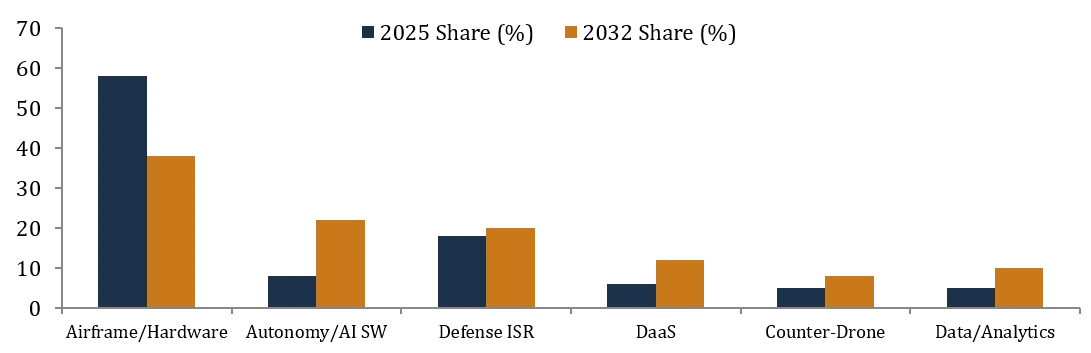
Market size tells you how big the industry is today. Value migration tells you where the industry's revenue pools are physically moving — from airframe hardware toward autonomy software, data services, and counter-drone security.
| Revenue Pool | 2025 Share (Est.) | 2032 Share (Est.) | Direction |
| Airframe & Hardware Manufacturing | 58% | 38% | Declining — commoditizing fastest in civilian rotary-wing |
| Autonomy & AI Software | 8% | 22% | Fastest Rising — the core Anduril/Shield AI/Skydio thesis |
| Defense ISR & Payload Systems | 18% | 20% | Stable / Protected — tied to defense budget cycles |
| Drone-as-a-Service (DaaS) | 6% | 12% | Rising — enterprise services replacing one-time hardware sale |
| Counter-Drone (C-UAS) Systems | 5% | 8% | Emerging — fastest-growing security sub-category |
| Data & Analytics Licensing | 5% | 10% | Small today; among the highest-margin pools by 2032 |
VALUE MIGRATION WATERFALL ] 2025→2032 waterfall showing hardware's share shrinking while autonomy software, DaaS, and counter-drone systems expand into the freed space.
The Margin Migration Map
Value in the Global Drone Market is not static — it migrates. The 2025–2032 window is the most consequential migration since commercial drones first scaled, as programs shift from buying airframes to buying autonomy ecosystems.
| FROM (2020–2023) | SHIFT | TO (2025–2032) | Margin Impact |
| Airframe unit count | → | Autonomy & sensor-fusion capability | 3-6% → 20-28% |
| Remote-piloted operation | → | Fully autonomous / swarm-coordinated missions | Labor cost → software margin |
| One-time hardware sale | → | Drone-as-a-Service recurring contracts | Capex → recurring margin |
| Single-sensor payloads | → | 10-15 sensor multi-modal platforms | Higher ASP, higher data-monetization ceiling |
| Manual airspace waivers | → | BVLOS-enabled automated corridors | Unlocks entirely new addressable revenue |
| "DJI does not compete with Anduril on flight range. Anduril competes on autonomy stack and defense-contract scale — and the U.S. Army just backed that thesis with a USD 20 billion, ten-year contract larger than most full-market forecasts for the entire counter-drone industry. The company that owns the sensor-fusion and autonomy layer captures disproportionate value going forward, regardless of which airframe ultimately flies."
— MMR Intelligence Analysis |
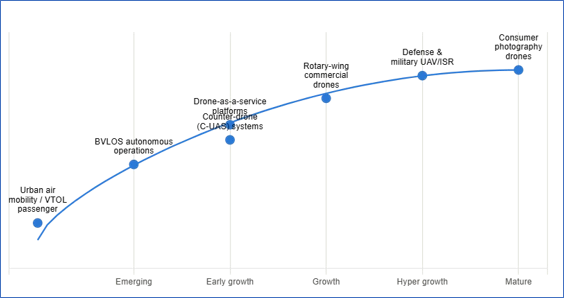
Drone Industry Maturity Curve
Not every segment inside this market sits at the same lifecycle stage — treating drones as one undifferentiated category obscures exactly where the strategic urgency and investable upside actually sit.
| Segment | Maturity Stage |
| Consumer Photography/Videography Drones | Mature |
| Rotary-Wing Commercial Drones | Growth |
| Defense & Military UAV/ISR | Hyper Growth |
| BVLOS-Enabled Autonomous Operations | Emerging |
| Drone-as-a-Service (DaaS) Platforms | Early Growth |
| Counter-Drone (C-UAS) Systems | Early Growth |
| Urban Air Mobility (UAM) / Hybrid VTOL Passenger Platforms | Nascent |
MATURITY CURVE CHART ] S-curve plotting all seven segments along a single lifecycle axis (Nascent → Emerging → Early Growth → Growth → Hyper Growth → Mature).
MMR Drone Future Readiness Index
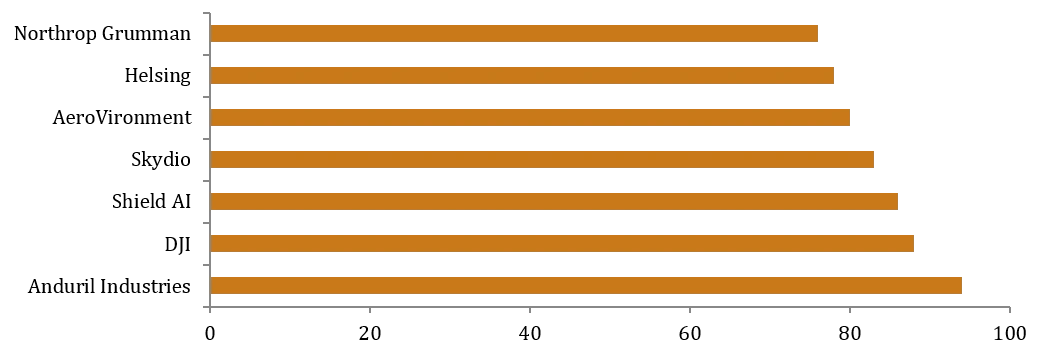
Companies scored across six forward-looking capability dimensions — autonomy software, AI/ML maturity, manufacturing scale, defense-program access, counter-drone capability, and capital access — rather than backward-looking revenue alone.
| Company | Future Readiness Score (/100) |
| Anduril Industries | 94 |
| DJI | 88 |
| Shield AI | 86 |
| Skydio | 83 |
| AeroVironment | 80 |
| Helsing | 78 |
| Northrop Grumman | 76 |
FUTURE READINESS INDEX BAR CHART ] Horizontal ranked bar chart of all scored companies, color-graded by score band (80+ green, 70-79 amber, <70 red).
Drone Industry Future Scenarios 2040
Four distinct structural end-states are plausible for how the global drone industry organizes itself by 2040, beyond simple unit-growth extrapolation.
| Scenario | Description |
| A — Autonomy-Dominated Industry | Fully autonomous, AI-piloted fleets become the commercial default; human remote piloting shrinks to a supervisory exception rather than the operating norm. |
| B — Defense-Dominated Industry | Escalating geopolitical conflict keeps military ISR and loitering-munition demand as the largest single profit pool, with commercial applications as a secondary market. |
| C — Airspace-as-Infrastructure Economy | BVLOS and UTM (Unmanned Traffic Management) mature into public infrastructure comparable to road networks, unlocking mass-scale delivery and inspection use cases. |
| D — Counter-Drone Security Economy | Proliferation of low-cost UAVs drives C-UAS detection and neutralization into a standalone security-market category as large as the drone market itself. |
Global Drone Market Dynamics
Driver: Rising Defense Spending & Military UAV/ISR Adoption
Rising military drone spending is accelerating global demand for advanced UAVs across defense, surveillance and intelligence missions. Defense-technology startups attracted a record USD 14.6 billion in venture capital funding during just the first five months of 2026, surpassing previous full-year funding records outright. Anduril Industries generated approximately USD 2.1 billion in revenue in 2025 and is projected to reach USD 4.3 billion in 2026, supported by ISR platforms and the U.S. Air Force's Collaborative Combat Aircraft (CCA) program — and has secured USD 11.3 billion in cumulative funding, making it the highest-funded company in the global drone industry. Drone attacks in active conflict zones increased from 4,525 incidents in 2023 to 19,704 incidents in 2024, reinforcing the strategic importance of cost-effective autonomous UAVs in modern warfare.
Restraint: Airspace Regulation Complexity & BVLOS Approval Barriers
BVLOS regulation barriers continue to delay large-scale commercialization of delivery, inspection, mapping and surveillance drone operations worldwide. India had approved only three commercial BVLOS corridors — Ladakh, Telangana and Andhra Pradesh — by early 2026, despite having approximately 795 registered drone startups. The European Union Aviation Safety Agency issued its first U-space Service Provider certificate only in May 2025, indicating that structured BVLOS airspace management is still developing across Europe. The FAA had issued 405,682 Remote Pilot Certificates by December 2024, yet most commercial BVLOS missions in the U.S. still require individual regulatory waivers. Regulatory fragmentation continues globally, with the U.S. FCC restricting additional foreign-made UAV equipment in December 2025 while China introduced stricter Beijing drone flight regulations effective May 2026.
Opportunity: Autonomous & BVLOS-Enabled Drone Operations
Expansion of BVLOS-enabled drone operations is creating new opportunities across logistics, infrastructure inspection, agriculture, mining, utilities and public safety. The global enterprise drone-services market is expected to generate an additional USD 29.44 billion in annual revenue by 2032 as BVLOS regulations continue to mature. India reduced GST on drones to 5% and allocated USD 230 million under the PLI Scheme (2025–2028) to strengthen domestic manufacturing and support future BVLOS deployment. Papa John's and Wing conducted a commercial drone-delivery pilot in North Carolina in May 2026, demonstrating real-world scalability of BVLOS-enabled logistics, while Skydio's USD 3.5 billion investment in U.S. manufacturing reflects strong confidence that autonomous-drone regulation will significantly expand defense and public-safety demand.
DRIVER-RESTRAINT-OPPORTUNITY IMPACT CHART ] Three-column comparative bar chart showing relative momentum of the top driver, restraint, and opportunity forces shaping the market through 2032.
DROCT Framework — Strategic Market Forces
| Dimension | Key Forces | Impact |
| Drivers | Defense spend surge; conflict-zone drone usage +335% YoY; record VC funding ($14.6Bn in 5 months); Anduril-scale defense contracts | Very High |
| Restraints | BVLOS approval bottlenecks; geopolitical component/export restrictions (US FCC, China); airspace safety/UTM immaturity | High |
| Opportunities | BVLOS-enabled enterprise services (+$29.44Bn by 2032); India PLI/GST incentives; sensor-driven ASP expansion | Very High |
| Challenges | Autonomy/AI talent scarcity; sensor integration cost rising faster than airframe cost; C-UAS proliferation risk | Medium-High |
| Trends | AI-native autonomy stacks; drone-in-a-box automation; swarm coordination; software-native entrants winning prime-scale contracts | Transformative |
The Geopolitical Trigger Map
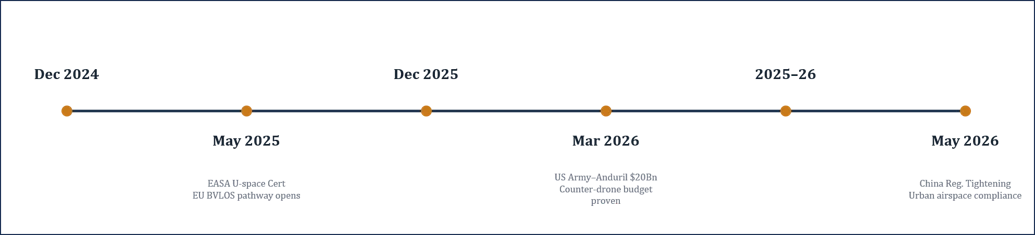
Six geopolitical events are simultaneously reshaping drone procurement and regulation across every region this report covers — each has already created a specific, identifiable commercial or defense opportunity.
| Trigger | Market Impact | Programme / Corridor Created | First-Mover Advantage |
| US Drone-Sighting Incidents (Dec 2024–ongoing) | National-security scramble exposed UTM/detection gap; accelerated C-UAS budget allocation | FAA Remote ID enforcement; homeland-security counter-drone pilots | Early detection-tech vendors (Dedrone, Fortem) gain federal credibility |
| US Army–Anduril Contract (Mar 2026) | USD 20Bn, 10-year deal proves counter-drone budget scale exists industry-wide | AI-enabled Lattice C-UAS suite deployment | Anduril locks multi-year defense-scale position ahead of competitors |
| India DGCA / PLI Reform (2025–2026) | GST cut to 5%; USD 230M PLI allocation catalyzes domestic manufacturing | 3 approved BVLOS corridors (Ladakh, Telangana, Andhra Pradesh) | ideaForge, Garuda Aerospace, ZenaTech-style DaaS consolidators gain first-mover domestic share |
| EASA U-space Certification (May 2025) | First Service Provider certificate signals structured EU BVLOS pathway opening | Harmonized C0-C6 + STS operational scenarios | EU-based DaaS and inspection platforms position ahead of national fragmentation |
| US FCC Foreign-UAV Restriction (Dec 2025) | Forces supply-chain fragmentation along geopolitical lines | Domestic manufacturing incentives (Skydio's $3.5Bn US investment) | US-based manufacturers capture displaced demand from restricted foreign OEMs |
| China Flight Regulation Tightening (May 2026) | Stricter urban airspace compliance reshapes domestic operator economics | Enhanced registration and geofencing infrastructure | Compliance-technology vendors gain a new mandatory-adoption customer base |
GEOPOLITICAL TRIGGER TIMELINE ] Horizontal timeline plotting all six triggers by date, connected to the specific programme or corridor each created.
Technology, Innovation & Future Drone Ecosystem
Countries leading the Global Innovation Index 2025 — Switzerland, Sweden, the United States, Republic of Korea, Singapore, the United Kingdom, Finland, the Netherlands, Denmark and China — are driving the global drone market through investment in AI, robotics, autonomous systems, 5G and advanced manufacturing. The global drone industry is witnessing rapid technology adoption driven by AI-powered drones, autonomous UAV navigation, BVLOS operations, swarm intelligence, hydrogen fuel-cell propulsion, and Drone-as-a-Service (DaaS).
INNOVATION SIGNAL COMPARISON CHART ] Grouped bar chart comparing China, US, Europe and India across patent filings, registered drones, and certified pilots.
Sensor Proliferation & Payload Intelligence
The real growth story inside this market is not unit count — it is sensor density. Commercial drone shipments are forecast to grow 2.3x between 2025 and 2036, but sensor shipments inside those same drones will grow 4x over the identical window, highlighting a structural shift toward higher-density, multi-sensor configurations. By 2036, many industrial drones are expected to integrate 10-15 sensors per platform — multi-camera vision systems, high-performance LiDAR and radar, ultrasonic modules, barometric altimeters, and redundant IMUs for high-reliability missions. This increase in sensing capability is what actually enables greater autonomy, improved safety, and more complex mission profiles across commercial sectors — not airframe improvements alone.
| Metric | 2025 | 2036 (Forecast) | Growth Multiple |
| Commercial Drone Unit Shipments | Baseline | 9 Million+ annually | 2.3x |
| Sensor Shipments (across fleet) | Baseline | — | 4x |
| Average Sensors per Industrial Platform | 3-5 | 10-15 | ~3x |
Regulatory Convergence — The Real Unlock for Commercial Scale
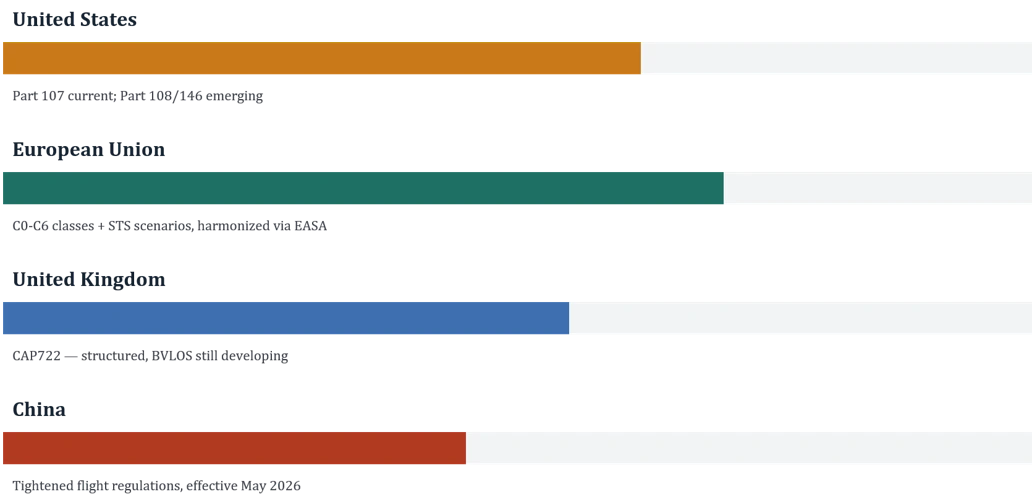
Global drone regulation is converging toward harmonized, risk-based frameworks — and this convergence, more than any single technology breakthrough, is what will determine which companies scale commercially first. The US has established Part 107 with emerging Part 108/146 rules; the EU has built C0-C6 aircraft classes alongside Specific Category (STS) operational scenarios; the UK operates under CAP722; and China has introduced its own tightening framework. Common regulatory themes across all four jurisdictions include altitude limitations around 120 meters, mandatory registration and pilot certification, stricter rules specifically for BVLOS and operations over people, and digital authorization systems to manage real-time airspace access.
| Jurisdiction | Framework | Status |
| United States | Part 107 (current); Part 108/146 (emerging) | BVLOS rules maturing; individual waivers still common |
| European Union | C0-C6 aircraft classes; Specific Category (STS) scenarios | Harmonized across 27 member states via EASA |
| United Kingdom | CAP722 | Structured but still developing BVLOS airspace management |
| China | Tightened flight regulations (effective May 2026) | Stricter compliance, especially in urban airspace |
REGULATORY MATURITY TIMELINE ] Horizontal timeline plotting each jurisdiction's regulatory maturity stage from Basic Registration through Full BVLOS Commercialization.
Commercial Application Deep-Dive
Agriculture — Digital Farming at Scale
Agriculture has rapidly entered the era of digital farming, particularly across China, the US, and Southeast Asia. By 2025, more than 30% of large farms worldwide are expected to use drones for spraying, seeding, and crop monitoring. While multirotor drones dominate today, fixed-wing and hybrid VTOL platforms are expanding their presence in large-area mapping and long-range autonomous missions.
Infrastructure Inspection — The Fastest-Growing Commercial Segment
Inspection and maintenance — spanning wind turbines, powerlines, pipelines, and industrial assets — is becoming the fastest-growing commercial drone segment. Equipped with LiDAR, thermal cameras, and AI defect recognition, drones are displacing costly and hazardous manual inspections. Operators are increasingly adopting automated inspection workflows, including drone-in-a-box systems and cloud-based analytics, with the segment forecast to account for over 25% of commercial drone revenue by 2030.
Delivery — Moving from Pilot to Regional Commercialization
Delivery drones are transitioning from experimental trials toward regional commercialization. Companies across the US, Europe, and China are expanding both last-mile and mid-range logistics routes, aided by technology improvements in automated loading, cold-chain transport, and U-space/UTM integration.
Public Safety & Defense — The Revenue Anchor
Public safety and security applications remain robust, with drones supporting surveillance, traffic monitoring, search and rescue, and emergency response. The defense sector continues to dominate overall market revenue, driven by rising demand for reconnaissance drones, tactical platforms, and loitering munitions.
Segmentation Intelligence
Rotary-wing drones dominated the global drone market in 2025 and are expected to sustain the highest CAGR through 2032, driven by VTOL capability, ease of deployment, hovering precision, and suitability for commercial, industrial, inspection, agriculture, public-safety and construction applications. Fixed-wing drones retain superior range and endurance for surveying, mapping, defense and infrastructure inspection, while hybrid VTOL drones are gaining adoption by combining vertical takeoff with long-distance flight efficiency.
The complete report decomposes value and volume across type (fixed-wing, rotary-wing, hybrid VTOL); component (hardware, software, services); payload capacity (under 2 kg, 2–25 kg, 25–150 kg, above 150 kg); range (VLOS, EVLOS, BVLOS); mode of operation (remotely piloted, semi-autonomous, fully autonomous); application (defense and military, agriculture, surveying and mapping, infrastructure inspection, logistics and delivery, construction and mining, energy and utilities, telecommunications, media and entertainment, public safety and emergency response, environmental monitoring, consumer photography and videography, and others); end user (military and defense, commercial enterprises, government and public agencies, consumer); and sales channel (direct OEM, distributors and dealers, online sales).
[SEGMENTATION SUNBURST ] Multi-ring sunburst — type as inner ring, application as middle ring, mode of operation as outer ring — sized by 2025 revenue share.
Regional Intelligence
North America dominated the global drone market in 2025, driven by the highest commercial drone adoption, a mature regulatory framework, strong private investment, and expanding drone-delivery networks — with 855,860 registered drones, 480,000+ certified drone pilots, 38.3 million annual drone flights, and USD 3.5 billion invested in drone manufacturing and commercial drone technology. Europe is the fastest-growing defense drone market, supported by USD 49 billion in drone-related commitments and approximately USD 458 billion in overall defense spending, driving demand for military UAVs, AI-powered drones and autonomous defense systems. China remains the global manufacturing leader, accounting for 80–90% of civilian drone production, approximately 70% of global drone patents, and 3.29 million registered drones. India has emerged as one of the fastest-growing drone-manufacturing hubs, backed by USD 117 million-plus under PLI 2.0, a proposed USD 1.17 billion Drone Shakti Scheme, 38,500+ registered drones, and 39,890 certified drone pilots.
| Region | Strategic Role | The One Insight |
| North America | Volume & Regulatory Anchor | 855,860 registered drones and a mature Part 107 framework mean the region sets the de facto commercial compliance bar every other market eventually copies. |
| Europe | Defense Growth Engine | USD 49 billion in drone-related commitments inside a USD 458 billion defense envelope turns 27 fragmented national procurement decisions into one EASA-harmonized buying bloc. |
| China | Manufacturing & Patent Leader | 80-90% of civilian drone production and ~70% of global patents mean any Western restriction on Chinese components is really a restriction on the industry's own supply chain. |
| India | Fastest Single-Country Ramp | USD 230M PLI plus a 5% GST cut converted policy intent into manufacturing capacity in under 24 months — the clearest emerging-market replication template in this report. |
| Middle East & Africa | First-Mover Counter-Drone Frontier | Counter-UAS demand is showing up in homeland-security budgets years before a full commercial-drone ecosystem exists — the inverse sequencing of every other region. |
Competitive War Room
The global drone industry is led by DJI (China), commanding the largest share of the global civilian drone market with a valuation exceeding USD 15 billion, while Anduril (U.S.) leads the defense-drone market with USD 11.3 billion in cumulative funding and a USD 61 billion valuation. Shield AI (USD 12.7 billion) and Skydio (USD 4.4 billion) are accelerating AI-powered drones and autonomous UAV innovation, while AeroVironment expanded through its USD 3.5 billion BlueHalo acquisition. In Europe, Germany's Helsing secured approximately USD 1.6 billion in funding and Quantum Systems raised USD 1.2 billion at an USD 8 billion valuation.
| Country | Commercial/Defense DaaS | Autonomy | Counter-Drone (C-UAS) | Manufacturing | Software/AI |
| United States | High | High | Medium | Medium | High |
| China | High | Medium | High | High | Medium |
| India | High | Low | Medium | Medium | Medium |
| Germany | Medium | High | Low | Medium | Medium |
| United Kingdom | Medium | Medium | High | Low | Medium |
| Israel | Medium | High | Medium | Medium | High |
COMPETITIVE LEADERSHIP RADAR ] Radar chart scoring the six countries above across the five capability axes shown in the table.

Industrial-Base & Contract Intelligence — Deals That Reshape the Market
| Deal / Contract | Date | Value | Strategic Signal |
| AeroVironment – ESAero acquisition | Mar 2026 | USD 200M | Strengthens autonomous-systems engineering and precision-defense drone capability |
| Ondas Holdings – Omnisys acquisition | May 2026 | ~USD 196.6M (all-stock) | Enhances AI-powered defense planning capability |
| Aureus Greenway – Powerus merger | Mar 2026 | USD 50M investment commitment | Stock-for-stock merger signals consolidation around autonomous power/energy for drones |
| Ondas Inc. – Rotron/SkyLance acquisition | May 2026 | Undisclosed | Expands autonomous UAV portfolio and international export reach |
| ZenaTech – L.D. King acquisition | Jun 2026 | 20th DaaS acquisition in 12 months | Confirms Drone-as-a-Service roll-up is now a repeatable, scalable playbook |
| US Army – Anduril (Lattice C-UAS) | Mar 2026 | USD 20Bn, 10-year | Software-native entrant holds a contract larger than most full-market drone forecasts |
| Skydio – US Manufacturing Investment | 2026 | USD 3.5Bn | Confirms confidence that domestic autonomy regulation will expand defense/public-safety demand |
MMR Capability-Economics Matrix
The Capability-Economics Matrix synthesizes five dimensions for each segment of the Global Drone Market: market size, growth trajectory, investment risk, entry difficulty, and the resulting capital-allocation verdict.
| Opportunity | Market Size | CAGR | Investment Risk | MMR Verdict |
| Autonomous Defense ISR Platforms | High | Very High | High | ENTER — capital-intensive, few qualified primes |
| Drone-as-a-Service (Enterprise) | High | Very High | Medium | ENTER NOW — proven repeatable roll-up model |
| Counter-Drone (C-UAS) Systems | Medium | High | Medium | ENTER NOW — Anduril-scale contracts prove budget exists |
| BVLOS Delivery & Logistics | High | High | High | ENTER — window closes as incumbents scale first |
| Agricultural & Precision-Mapping Drones | Medium | Medium-High | Low | WATCH — steady, no first-mover window |
| Hybrid VTOL / Urban Air Mobility | Medium | Very High | Very High | WATCH → ENTER — early stage, high upside |
| Drone Software & Fleet Analytics | Medium | Very High | Low | ENTER NOW — highest margin, least capital-intensive |
Drone Industry White Space Map
• BVLOS regulatory-technology platforms — compliance and airspace-integration software remains structurally under-built relative to regulatory complexity
• Rural and last-mile medical/agricultural delivery in emerging markets — high need, low current commercial penetration
• Counter-drone detection for critical infrastructure (airports, power plants, stadiums) — fragmented, low competitive density
• Drone-data monetization and analytics-as-a-service — smallest profit pool today, among the highest-margin by 2032
• Hydrogen and long-endurance propulsion for industrial-scale inspection — early-stage, structurally under-covered
• Swarm-coordination software for multi-drone commercial operations — nascent outside defense applications
Drone Investment Heat Map
| Segment | Growth | Profitability | Competition | Investment Score |
| Defense UAV / ISR | Very High | High | Medium | ★★★★★ |
| Autonomy Software & AI | Very High | Very High | Medium | ★★★★★ |
| Counter-Drone (C-UAS) | High | High | Low-Medium | ★★★★☆ |
| Drone-as-a-Service | High | Medium-High | Medium | ★★★★☆ |
| Consumer Drones | Low | Low-Medium | High | ★★☆☆☆ |
The Drone Conviction Scorecard
Every segment in this report receives a Conviction Score — synthesizing margin opportunity, first-mover window, competitive density, technology readiness, and regulatory trajectory — mapped to a specific closing window.
| Opportunity | Score /100 | Window | Verdict |
| Autonomy Software & AI Platforms | 92 | Closes ~2029 | ENTER NOW |
| Counter-UAS / Anti-Drone Systems | 90 | Closes ~2028 | ENTER NOW |
| Drone-as-a-Service (Enterprise) | 87 | Closes ~2029 | ENTER NOW |
| BVLOS Delivery & Logistics | 83 | Closes ~2030 | ENTER |
| Defense ISR / Autonomous Platforms | 81 | Closes ~2030 | ENTER — capital intensive |
| Hybrid VTOL / Urban Air Mobility | 72 | Closes ~2032 | WATCH → ENTER |
| Consumer Photography Drones | 41 | Saturated | AVOID — commoditized, margin-compressed |
Strategic Recommendations
From 2025–2027, prioritize securing BVLOS regulatory approval pathways, defense-program qualification, and autonomy-software talent — capability gaps here compound faster than they close. From 2028–2030, scale Drone-as-a-Service distribution across enterprise logistics, agriculture and infrastructure inspection, and integrate counter-drone detection as a standard offering alongside commercial fleet sales. From 2031–2032, pursue full autonomous-swarm platform maturity and data-monetization infrastructure, positioning drone fleets as continuously monetizable data-collection assets rather than one-time hardware sales.
Global Drone Market Scope: Inquire before buying
| Report Coverage | Details |
| Base Year | 2025 |
| Forecast Period | 2026 – 2032 |
| Historical Data | 2020 – 2025 |
| Market Size in 2025 | USD 9.23 Billion |
| Market Size in 2032 | USD 17.42 Billion |
| Forecast CAGR | 9.8% |
| Segments Covered — By Type | Fixed-Wing Drones | Rotary-Wing Drones | Hybrid VTOL Drones |
| Segments Covered — By Component | Hardware | Software | Services |
| Segments Covered — By Payload Capacity | Less than 2 kg | 2–25 kg | 25–150 kg | Above 150 kg |
| Segments Covered — By Range | VLOS | EVLOS | BVLOS |
| Segments Covered — By Mode of Operation | Remotely Piloted | Semi-Autonomous | Fully Autonomous |
| Segments Covered — By Application | Defense & Military | Agriculture | Surveying & Mapping | Infrastructure Inspection | Logistics & Delivery | Construction & Mining | Energy & Utilities | Telecommunications | Media & Entertainment | Public Safety & Emergency Response | Environmental Monitoring | Consumer Photography & Videography | Others |
| Segments Covered — By End User | Military & Defense | Commercial Enterprises | Government & Public Agencies | Consumer |
| Segments Covered — By Sales Channel | Direct Sales (OEM) | Distributors & Dealers | Online Sales |
Global Drone Market, By Region
North America (United States, Canada, Mexico)
Europe (United Kingdom, France, Germany, Italy, Spain, Sweden, Russia, Rest of Europe)
Asia-Pacific (China, South Korea, Japan, India, Australia, Indonesia, Malaysia, Philippines, Thailand, Vietnam, Rest of Asia-Pacific)
Middle East & Africa (South Africa, GCC, Nigeria, Rest of MEA)
South America (Brazil, Argentina, Colombia, Chile, Rest of South America)
Competitive Landscape: The Tiered Player Map
The Global Drone Market spans four distinct competitive tiers — from scale-first defense primes to software-native disruptors and regional emerging champions.
Tier 1 — Global Primes & Scale Defense Manufacturers
| Company | HQ | Core Strength | 2026 Strategic Bet |
| General Atomics Aeronautical | USA | MQ-1/MQ-9 Reaper-class long-endurance UAVs | Expanding allied export approvals amid rising ISR demand |
| Northrop Grumman | USA | Global Hawk, high-altitude ISR platforms | Anchoring next-gen autonomous ISR architecture |
| Lockheed Martin | USA | Stalker, tactical UAV systems | Integrating drone autonomy into broader missile-defense sensor fusion |
| Boeing (Insitu) | USA | ScanEagle, RQ-21 Blackjack | Scaling maritime and expeditionary ISR drone lines |
| DJI | China | Global civilian drone volume leader | Defending share as US/EU restrictions redirect demand to domestic OEMs |
Tier 2 — Specialist & Allied Champions
| Company | HQ | Core Strength | 2026 Strategic Bet |
| Airbus Defence and Space | Europe | Tactical & MALE UAV systems | Deepening European sovereign-drone co-production |
| Thales Group | France | ISR sensors, drone C2 systems | Integration with European Sky Shield-adjacent programs |
| BAE Systems | UK | Combat drone systems, autonomy R&D | Expanding transatlantic autonomy co-development |
| Israel Aerospace Industries (IAI) | Israel | Heron-class ISR, combat-proven platforms | Export growth on the back of live operational data |
| Elbit Systems / Rafael | Israel | Loitering munitions, precision strike drones | Scaling combat-validated systems into new export markets |
| Quantum Systems / Tekever | Germany/Portugal | Fixed-wing ISR, European battlefield drones | Capturing NATO re-armament-driven procurement |
Tier 3 — Software-Native & Autonomy Disruptors
| Company | HQ | Core Strength | 2026 Strategic Bet |
| Anduril Industries | USA | AI-enabled Lattice autonomy platform | USD 20Bn, 10-year U.S. Army contract — largest counter-drone deal on record |
| Shield AI | USA | Autonomous piloting AI (Hivemind) | Scaling autonomy-as-a-software licensing across allied militaries |
| Skydio | USA | Autonomous inspection & public-safety drones | USD 3.5Bn US manufacturing investment to onshore supply chain |
| Auterion | Switzerland/USA | Open-source drone autonomy OS | Positioning as the 'Android of defense drones' across NATO fleets |
| Helsing | Germany | AI battle-software for drone swarms | Converting European rearmament budgets into software-first contracts |
Tier 4 — Regional & Emerging-Market Champions
| Company | HQ | Core Strength | 2026 Strategic Bet |
| ideaForge Technology | India | Surveillance UAVs, DGCA-approved platforms | Riding India's PLI 2.0 and defense-indigenization push |
| Garuda Aerospace | India | Agricultural & DaaS drone fleets | Scaling rural precision-agriculture deployment nationally |
| Adani Defence / Zen Technologies | India | Loitering munitions, counter-drone systems | Capturing India's expanding indigenous defense procurement |
| EHang | China | Autonomous aerial vehicles (passenger-capable) | Pioneering urban air mobility certification pathways |
| ZenaTech | Canada/USA | DaaS roll-up consolidator | 20th acquisition in 12 months — fastest-scaling DaaS consolidation platform in the market |
Additional Companies Tracked in Full Report
General Atomics · Insitu (Boeing) · Kratos Defense · Draganfly · Freefly Systems · KDE Direct · Garmin · Zipline · Amazon Prime Air · Parrot · Wingtra · Flyability · Delair · Azur Drones · Deltaquad · Nordic Unmanned · Volocopter · Autel Robotics · XAG · JOUAV · Yuneec · PowerVision · Meituan UAS · Aeronautics Defense Systems · Percepto · UVision Air · Paras Defence/Aerospace · Hindustan Aeronautics (HAL) · IoTechWorld Avigation · Others.
Strategic Takeaway & The Central Thesis
• Volume is structurally guaranteed: drone demand does not collapse with budget cycles — it recalibrates around new threats and new commercial use cases.
• Margin migrates toward autonomy software: AI and sensor-fusion software now out-earns airframe hardware by roughly 3-5x on operating margin.
• The cost-asymmetry crisis is the industry's biggest unsolved problem: the company that solves cost-per-engagement, not flight range, wins the next decade of defense contracts.
• BVLOS reform is a price-discovery event for the entire commercial market: every corridor approved unlocks addressable revenue that does not exist on paper until regulation catches up.
• Asia-Pacific and India add the most absolute opportunity through 2032: India's PLI-driven manufacturing ramp is the clearest replication template for other emerging markets.
| "The Global Drone Market is no longer about who can build the fastest airframe. It is about who can detect, prioritize, and neutralize — or deploy — a drone before its cost asymmetry ever gets to play out. BVLOS reform, defense-scale autonomy contracts, and the rapid consolidation of Drone-as-a-Service platforms are not isolated headlines — they are the early architecture of that shift, and in committed dollars they are already worth more than much of the airframe-specific market they grew out of."
— THE CENTRAL THESIS |
Frequently Asked Questions
What is the projected market size & growth rate of the Global Drone Market?
Ans. The Global Drone Market was valued at USD 9.23 Billion in 2025 and is projected to reach USD 17.42 Billion by 2032, growing at a CAGR of 9.8% during the forecast period.
Which region dominates the global drone market?
Ans. North America dominates, with 855,860 registered drones, 480,000+ certified pilots, and 38.3 million annual drone flights, supported by a mature regulatory framework and strong private investment.
Which country leads global drone manufacturing?
Ans. China leads global drone manufacturing, accounting for 80–90% of civilian drone production and holding approximately 70% of global drone patents.
What is driving growth in the military drone market?
Ans. Rising defense spending, escalating conflict-zone drone usage (up from 4,525 to 19,704 incidents between 2023 and 2024), and record venture funding — USD 14.6 billion in the first five months of 2026 alone — are driving military UAV demand.
What is the biggest restraint on commercial drone adoption?
Ans. Airspace regulation complexity and BVLOS approval barriers — India, for example, had approved only three commercial BVLOS corridors by early 2026 despite 795 registered drone startups.
What is BVLOS and why does it matter?
Ans. BVLOS (Beyond Visual Line of Sight) refers to drone operations conducted outside the operator's direct line of sight. It is the single biggest regulatory unlock for large-scale delivery, inspection and surveillance drone use cases.
Which companies lead the Global Drone Market?
Ans. DJI leads the civilian drone market with a valuation exceeding USD 15 billion; Anduril leads the defense-drone market with a USD 61 billion valuation and USD 11.3 billion in cumulative funding.
What is Drone-as-a-Service (DaaS)?
Ans. A business model where enterprises pay for drone-enabled outcomes — inspection, mapping, delivery — as a recurring service rather than purchasing drone hardware outright.
What is counter-drone (C-UAS) technology?
Ans. Counter-Unmanned Aircraft Systems technology detects, tracks and neutralizes unauthorized or hostile drones, an increasingly important security category as drone proliferation accelerates.
How is AI transforming the drone industry?
Ans. AI enables autonomous navigation, object recognition, swarm coordination, and predictive analytics, converting drones from remotely piloted tools into self-directed data-collection and mission-execution platforms.
What is Remote ID?
Ans. A regulatory requirement, similar to a digital license plate, that broadcasts a drone's identification and location information during flight to support airspace safety and enforcement.
What is UTM (Unmanned Traffic Management)?
Ans. A digital air-traffic-management system designed specifically for coordinating drone operations at low altitude, distinct from traditional manned-aviation air traffic control.
What segments are covered in the Global Drone Market report?
Ans. Type, component, payload capacity, range, mode of operation, application, end user, sales channel, and region.
What is the biggest investment opportunity in the drone industry?
Ans. Autonomy software and AI platforms carry the highest projected margin and fastest revenue-pool growth, alongside counter-drone systems given low current competitive density.
What is the full-stack forecast for the Global Drone Market?
Ans. Independent industry estimates size the full consumer, commercial and defense drone stack at approximately USD 69 Billion in 2026, reaching USD 147.8 Billion by 2036 at a 7.9% CAGR, with commercial unit shipments exceeding 9 million annually by 2036.
Why are sensor shipments growing faster than drone shipments?
Ans. Commercial drone shipments are forecast to grow 2.3x between 2025 and 2036, while sensor shipments grow 4x over the same period, as industrial platforms move toward 10-15 sensors each for higher autonomy and mission reliability.
Lead Analyst Profile
Lead Analyst — Global Defense & Aerospace Intelligence Practice
This research is authored by Rucha Deshpande, MMR Lead Analyst, with deep expertise in autonomous-systems economics, drone and counter-UAS competitive dynamics, BVLOS regulatory architecture, defense-industrial procurement, and geopolitical risk modeling — advising defense ministries, Tier-1 OEM strategy teams, institutional and private-equity investors, and enterprise drone-services operators across North America, Europe, the Middle East, and Asia-Pacific. Core competencies: drone-market econometrics · capability-gap and conviction scoring · industrial-base & M&A intelligence · geopolitical trigger mapping · regional demand modeling.