
Global Commercial Drones Market by Product, by Application, by End-use, by Technology, by Region and Forecast 2034
Overview
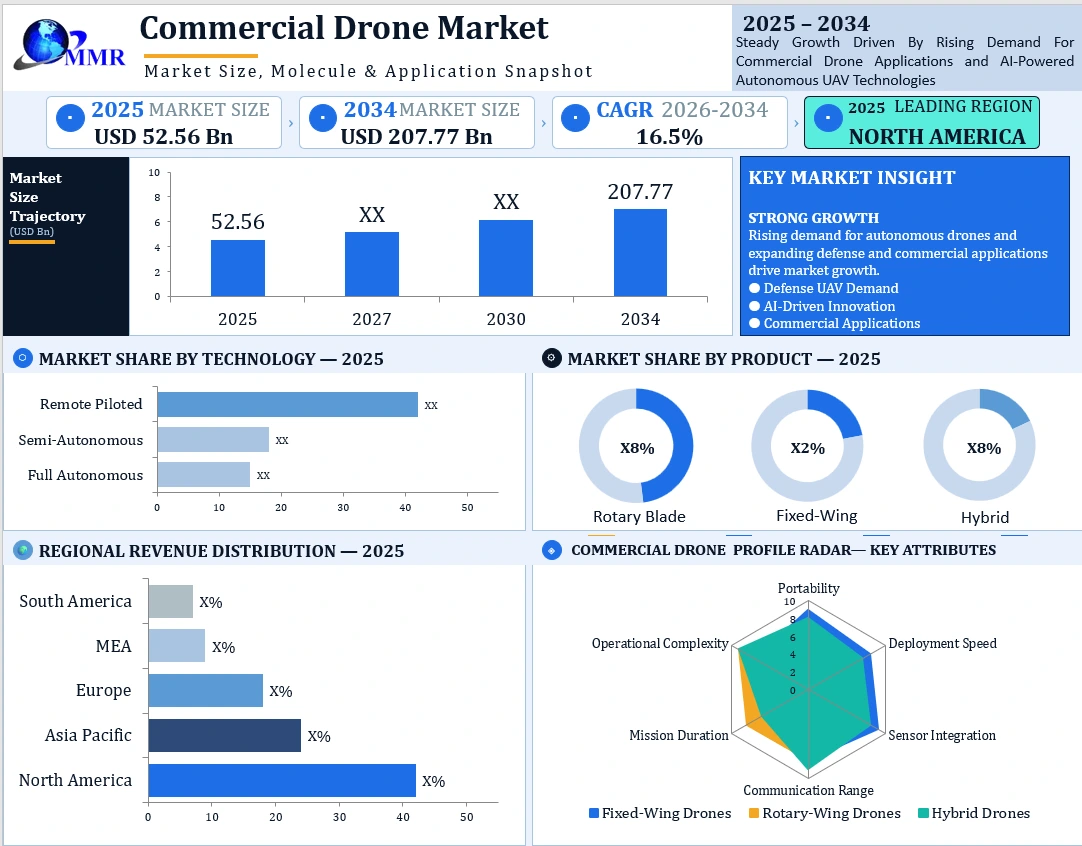
The Commercial Drones Market size was valued at USD 52.56 Billion in 2025 and the total Commercial Drones revenue is expected to grow at a CAGR of 16.5% from 2026 to 2034, reaching USD 207.77 Billion by 2034.
Commercial Drones Market Overview:
Commercial drones, also known as Unmanned Aerial Vehicles (UAVs), are autonomous or remotely operated flying systems integrated with advanced technologies such as GPS, sensors, Artificial Intelligence (AI), and Machine Learning (ML). These systems are widely deployed across industries including agriculture, media & entertainment, logistics, energy, and surveillance.
In 2025, over 65% of commercial drone deployments were concentrated in inspection, surveillance, and aerial imaging applications, while delivery and logistics applications are witnessing rapid adoption, driven by the expansion of e-commerce and last-mile delivery optimization.
Additionally, urban air mobility (UAM) initiatives are gaining traction, with more than 10 major cities globally (including Dubai, Los Angeles, and Singapore) actively testing drone-based passenger and cargo transport systems. Increasing smartphone penetration and advancements in connectivity technologies (5G-enabled drones) are further accelerating real-time data processing and operational efficiency. The market is also supported by rising investments in AI-powered drones, which enhance autonomous navigation, predictive analytics, and real-time decision-making, improving operational productivity by 20–30% in industrial applications.
Commercial Drones Market Size, Growth and Share Analysis
To know about the Research Methodology :- Request Free Sample Report
Commercial Drone Market Key Trends
| Trend | Description |
| AI-Powered Drone Inspection and Data Analysis | Commercial drone operators are increasingly using artificial intelligence to identify equipment defects, analyze aerial images, and prioritize maintenance work. This helps energy companies, construction firms, and infrastructure operators turn drone-captured data into practical decisions rather than relying entirely on manual image review. |
| Expansion of Beyond Visual Line of Sight Operations | Businesses are showing greater interest in drones that can operate beyond the pilot’s direct visual range. These operations can support longer pipeline inspections, agricultural surveys, infrastructure monitoring, and delivery routes, subject to applicable aviation approvals and safety requirements. |
| Adoption of Drone-in-a-Box Systems | Companies are deploying automated docking stations that allow drones to launch, land, recharge, and prepare for subsequent missions with limited on-site intervention. These systems are gaining attention for continuous industrial inspections, remote facility monitoring, and perimeter security. |
| Growth of Drone-as-a-Service Business Models | Organizations are increasingly able to access drone inspections, mapping, surveying, and aerial data collection through specialist service providers instead of purchasing and maintaining their own fleets. This approach can reduce upfront investment and provide access to trained operators, software, and specialized sensors. |
| Development of Advanced Mapping and Sensor Technologies | Demand is growing for commercial drones equipped with thermal cameras, LiDAR sensors, multispectral imaging, and high-precision positioning systems. These technologies support applications such as crop assessment, land surveying, construction progress tracking, and the detection of heat anomalies in industrial equipment. |
| Integration of Drones into Automated Delivery Networks | Retailers and logistics operators are moving beyond isolated delivery demonstrations toward broader drone delivery networks. These deployments depend on route planning, reliable fleet coordination, suitable landing locations, and regulatory permissions, with particular interest in time-sensitive and last-mile deliveries |
Innovative Strategies Shaping the Commercial Drone Market
Commercial drone companies are increasingly differentiating themselves through intelligent automation, industry-specific services, and integrated data platforms rather than relying solely on aircraft performance. The following innovative points highlight practical market strategies that manufacturers and service providers can use to strengthen their competitive position and reach new commercial customers.
| Innovative strategy | Market approach and competitive advantage |
| Artificial Intelligence Based Predictive Inspection | Commercial drone companies can integrate artificial intelligence with thermal imaging and visual analytics to identify equipment defects before they lead to costly failures. This strategy is particularly relevant to energy facilities, manufacturing plants, bridges, and other infrastructure assets where customers value reliable maintenance planning and reduced inspection downtime. |
| Drone in a Box Automation | Manufacturers can introduce automated docking stations that allow drones to launch, recharge, transfer collected data, and prepare for scheduled missions with limited manual involvement. Offering these systems through subscription contracts can help companies secure recurring revenue from industrial inspections, construction monitoring, and facility security. |
| Drone as a Service Subscription Models | Instead of relying exclusively on aircraft sales, providers can offer monthly or annual packages covering drone operations, trained pilots, maintenance, software access, and analytical reports. This approach makes commercial drone technology more accessible to small and medium-sized businesses while creating longer-term customer relationships. |
| Industry Specific Drone Solutions | Companies can develop tailored drone packages for agriculture, logistics, construction, and energy rather than selling the same equipment to every customer. For example, multispectral imaging can support crop health assessment, while high precision mapping can help construction firms monitor project progress and identify deviations from plans. |
| Autonomous Fleet Management Platforms | Integrating flight scheduling, battery monitoring, route planning, maintenance alerts, and data processing into a single platform can help commercial operators manage multiple drones more efficiently. Manufacturers that provide both hardware and fleet management software can differentiate their offerings through easier deployment and centralized operational control. |
| Advanced Delivery Network Integration | Drone manufacturers can partner with retailers, logistics companies, healthcare providers, and warehouse operators to develop delivery systems suited to specific routes and payload requirements. Integrating drones with existing order management and warehouse software can improve dispatch coordination and help businesses evaluate delivery costs, service reliability, and operational feasibility. |
Commercial Drones Market Dynamics:
Commercial Drone Market Drivers
Rising demand for commercial drone applications across agriculture, infrastructure inspection, logistics, and aerial surveying is supporting market growth as businesses seek faster data collection and lower operating costs. The United States Federal Aviation Administration reported that its commercial drone fleet was forecast to exceed one million aircraft by the end of 2025, reflecting growing business and institutional adoption. Beyond visual line of sight operations, automated flight planning, high-resolution imaging, and artificial intelligence based data analysis are strengthening the commercial value of drones across industrial applications.
Commercial Drone Market Restraints
Regulatory restrictions and airspace safety requirements remain significant restraints on the Commercial Drone Market, particularly for package delivery and long-distance operations. Operators may need specific approvals to fly beyond the pilot’s visual line of sight, while requirements for aircraft identification, pilot competency, operational risk assessment, and privacy protection can increase compliance costs. Differences in national aviation rules also make it difficult for drone manufacturers and service providers to deploy the same operating model across multiple markets, slowing adoption among businesses with limited budgets or regulatory expertise.
Commercial Drone Market Opportunities
Commercial drone manufacturers and service providers have opportunities to develop automated inspection systems, precision agriculture solutions, medical delivery services, and drone fleet management platforms. The Federal Aviation Administration’s BEYOND program recorded 70,563 flights during its first phase, including 48,383 beyond visual line of sight operations, demonstrating the practical testing of advanced drone applications. Further opportunities lie in automated docking stations, improved battery performance, secure communications, and integrated traffic management systems that can help businesses conduct repeatable drone operations with less manual intervention.
Commercial Drone Market Challenges
Maintaining safe and reliable commercial drone operations at scale remains a major challenge because aircraft must avoid other drones, helicopters, and conventional aircraft while operating in changing weather and communication conditions. A February 2026 report from the United States Government Accountability Office highlighted gaps in communication and collision avoidance planning for future drone operations. Manufacturers must therefore improve detect and avoid technologies, navigation reliability, cybersecurity, and interoperability with air traffic management systems while balancing payload weight, battery endurance, and operating costs. These technical and infrastructure requirements remain important considerations for commercial drone deployment across delivery, construction, energy, and public safety applications.
Commercial Drones Market Segment Analysis:
The Commercial Drones Market is segmented into Product, Application and End user.
Based on Product, market is sub-segmented into fixed wing, rotary wing and hybrid wing. In terms of volume, the rotary blade segment accounted for 80.0% of the market in 2025 and is likely to continue leading the market over the forecast period. Because of their capacity to maintain a visual on a single target for an extended period of time. Rotary blade drones are likely to become more popular for inspection purposes.
Drones are commonly thought to be a viable alternative for a variety of commercial uses, including filming and photography, surveillance, and monitoring. In terms of volume, the hybrid segment is expected to grow at the fastest rate, with a CAGR of over 64.0 % from 2026 to 2034. Hybrid drones are being used by technology companies like Facebook and Amazon to provide internet connectivity in rural places and for efficient parcel delivery, offering a combination of vertical takeoff capabilities and efficient forward flight.
Based on End use, market is sub-segmented into Agriculture, Delivery and logistics, Energy, Media and Entertainment, Real estate and Construction. In 2025, the media and entertainment segment held the highest market share of over 27.0 %, and this trend is likely to continue during the forecast period. Drones have a wide range of applications in media and entertainment. Filmmakers have begun to use professional drones to capture accurate frames in the most cost-effective method possible. The growing demand from clients and owners for aerial photography to advertise resorts, hotels, tourist attractions, public spaces, and amusement parks is expected to enhance the segment's growth.
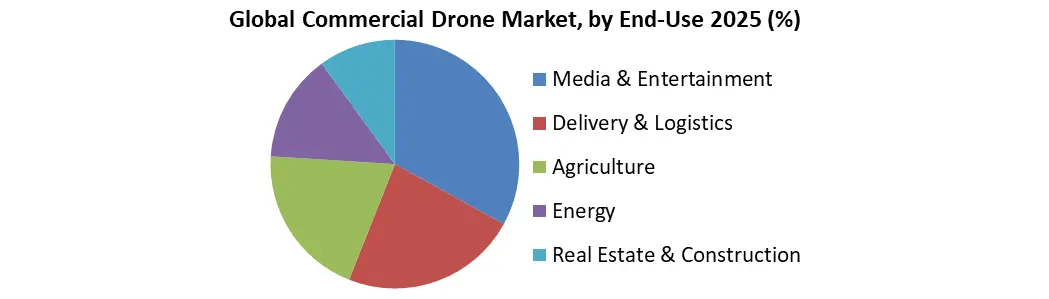 From 2026 to 2034, the delivery and logistics segment is expected to remain the second-largest segment. Because of the rise of the e-commerce business, drones are poised to alter the delivery and logistics industry globally. Drones are increasingly being used in e-commerce warehouses for product warehousing and delivery in response to the increased demand for quick delivery of items. Warehouses throughout the globe are spending a lot of money to improve their automation. UAVs are beneficial for jobs and operations that take a long time to complete. Barcode scanning is one of the most common uses of drones in warehouses.
Commercial Drone Market Regional Analysis –
North America held the largest market share in terms of volume in 2025, accounting for 37.0 %, and it is expected to grow significantly over the forecast period as a result of favorable government efforts, developments in drone technology, and rising demand from enterprises across a wide range of industries The Federal Aviation Administration (FAA) in the United States has issued new regulations to provide more coherent and consistent guidance for the legal and safe operation of unmanned aerial vehicles (UAVs) in commercial environments. These policies and regulations should lower entry barriers and drive product uptake in the region.
From 2026 to 2034, Asia Pacific is expected to remain the second-largest region. A favorable regulatory framework, particularly among developed countries, is expected to drive market growth. Several governments are continually working on new laws for drones used for commercial purposes. A slew of new start-up companies are experimenting with new Commercial Drones applications and aiming to improve drone safety.
The objective of the report is to present a comprehensive analysis of the global Commercial Drones Market to the stakeholders in the industry. The past and current status of the industry with the forecasted market size and trends are presented in the report with the analysis of complicated data in simple language. The report covers all the aspects of the industry with a dedicated study of key players that include market leaders, followers, and new entrants.
PORTER, PESTEL analysis with the potential impact of micro-economic factors of the market have been presented in the report. External as well as internal factors that are supposed to affect the business positively or negatively have been analyzed, which will give a clear futuristic view of the industry to the decision-makers.
The report also helps in understanding the global Commercial Drones Market dynamics, structure by analyzing the market segments and project the global Commercial Drones Market size. Clear representation of competitive analysis of key players by product, price, financial position, product portfolio, growth strategies, and regional presence in the global Commercial Drones Market make the report investor’s guide.
Commercial Drone Market Competitive Landscape
The Commercial Drone Market is highly competitive, with leading companies focusing on technological innovation, autonomous flight systems, artificial intelligence, advanced imaging, and industry-specific drone solutions to strengthen their market position. DJI maintains a strong presence through its broad commercial drone portfolio, while AeroVironment, Skydio, Parrot, Autel Robotics, and EHang compete through specialized unmanned aerial vehicles, intelligent navigation, and enterprise applications. Meanwhile, companies such as DroneDeploy, Pix4D, and FlytBase enhance the commercial drone ecosystem through aerial data analytics, mapping software, fleet management, and automation platforms. Drone service providers, including Terra Drone, Aerodyne Group, and Zeitview, are expanding the use of drone-based inspection, surveying, infrastructure monitoring, and industrial data collection. Competition is increasingly shaped by AI-powered drone technology, autonomous operations, flight safety, payload capacity, battery performance, and regulatory compliance. Strategic partnerships, product launches, software integration, and expansion into agriculture, delivery and logistics, energy, media and entertainment, and real estate and construction are important strategies adopted by market participants. As commercial drone adoption increases, companies that combine reliable hardware, intelligent software, and scalable service solutions are well positioned to strengthen their competitive advantage during the forecast period.
Recent Developments in the Commercial Drone Market in 2026
| Month | Company | Recent development |
| March 2026 | Skydio | Skydio announced an order exceeding 52 million United States dollars from the United States Army for more than 2500 X10D drones, supporting demand for autonomous aerial systems. |
| July 2026 | DoorDash | DoorDash received Federal Aviation Administration Part 135 certification and launched DoorDash Air, enabling the company to operate its own commercial drone delivery service. |
| July 2026 | Zipline | Zipline announced plans to launch services in Austin and Cleveland and reported substantial growth in businesses using its drone delivery platform. |
| August 2026 | Uber and Zipline | Uber and Zipline announced a strategic partnership to bring autonomous drone delivery to more United States customers through Uber Eats, alongside a strategic investment by Uber in Zipline. |
| September 2026 | Lowe's and Wing | Lowe’s and Wing partnered with DoorDash to introduce drone delivery of selected home improvement products, integrating drone operations with existing retail fulfilment services. |
| October 2026 | A2Z Drone Delivery, Grab and SKYY Network | A2Z Drone Delivery, Grab and SKYY Network companies launched a beyond visual line of sight food delivery pilot in Bali, Indonesia, using drone technology to connect restaurant orders with a designated delivery destination. |
Commercial Drones Market Scope: Inquire before buying
| Commercial Drones Market | |||
|---|---|---|---|
| Report Coverage | Details | ||
| Base Year: | 2025 | Forecast Period: | 2026-2034 |
| Historical Data: | 2020 to 2025 | Market Size in 2025: | 52.56 USD Billion |
| Forecast Period 2026-2034 CAGR: | 16.5% | Market Size in 2034: | 207.77 USD Billion |
| Segments Covered: | by Product | Fixed-wing Rotary Blade Hybrid |
|
| by Application | Filming & Photography Inspection & Maintenance Mapping & Surveying Precision Agriculture Surveillance & Monitoring Others |
||
| by End-use | Agriculture Delivery & Logistics Energy Media & Entertainment Real Estate & Construction |
||
| by Technology | Remotely Piloted Semi-Autonomous Fully Autonomous |
||
Commercial Drones Market, by Region
North America (United States, Canada and Mexico)
Europe (UK, France, Germany, Italy, Spain, Sweden, Austria and Rest of Europe)
Asia Pacific (China, South Korea, Japan, India, Australia, Indonesia, Malaysia, Vietnam, Taiwan, Bangladesh, Pakistan and Rest of APAC)
Middle East and Africa (South Africa, GCC, Egypt, Nigeria and Rest of ME&A)
South America (Brazil, Argentina Rest of South America)
Key Players are:
The market report lists the top global Commercial Drone companies. These key companies are engaged in the development of technologically advanced commercial drones and related software to enhance functionality, security, and connectivity for users. They also focus on expanding their market share through aggressive marketing, strategic partnerships, and targeted promotions to reach clients. These key companies also focus on operational efficiency to enhance productivity, reduce costs, and improve overall profitability.
Hardware Companies
- DJI – China
- Parrot Drones SAS – France
- Yuneec International – China
- AeroVironment Inc. – USA
- Skydio – USA
- EHANG Holdings – China
- Autel Robotics – China/USA
- Quantum Systems – Germany
- Wingtra AG – Switzerland
- Delair – France
- Teledyne FLIR – USA
- Freefly Systems – USA
Software & Analytics Companies
- DroneDeploy – USA
- Pix4D – Switzerland
- PrecisionHawk – USA
- Airware – USA
- Kespry – USA
- Skycatch – USA
- Measure (AgEagle) – USA
- Propeller Aero – Australia
- FlytBase – India
- Aloft (Kittyhawk) – USA
Service Providers (DaaS)
- Terra Drone Corporation – Japan
- Cyberhawk Innovations – UK
- Sky-Futures – UK
- Aerobo – USA
- Phoenix Drone Services – USA
- Deveron UAS – Canada
- DroneBase (Zeitview) – USA
- The Sky Guys – Canada
- Prioria Robotics – USA
- Unmanned Experts Inc. – USA
Frequently Asked Questions:
1) What was the market size of Global Market in 2025?
Ans - Global was worth USD 52.56 Bn. in 2025.
2) What is the market segment of the Commercial Drones Market?
Ans -The market segments are based on Product, Application and End use.
3) What is the forecast period considered for Commercial Drones Market?
Ans -The forecast period for Commercial Drones Market is 2026 to 2034.
4) What is the market size of Commercial Drones Market in 2034?
Ans –Commercial Drones Market is estimated as worth USD 207.77 Bn.
5) Which region is dominated in Commercial Drones Market?
Ans -In 2025, the North America region dominated the Commercial Drones Market.