Space Robotics Market Size – Industry Structure Evaluation, Demand Drivers Analysis, Regional Growth Analysis and Identification, Competitive Positioning Review & Global Market Size Forecast to 2032

8.6%
CAGR (2026-2032)
5 USD Bn.
Forecast Market Size
315
Report Pages
131
Market Tables

Overview

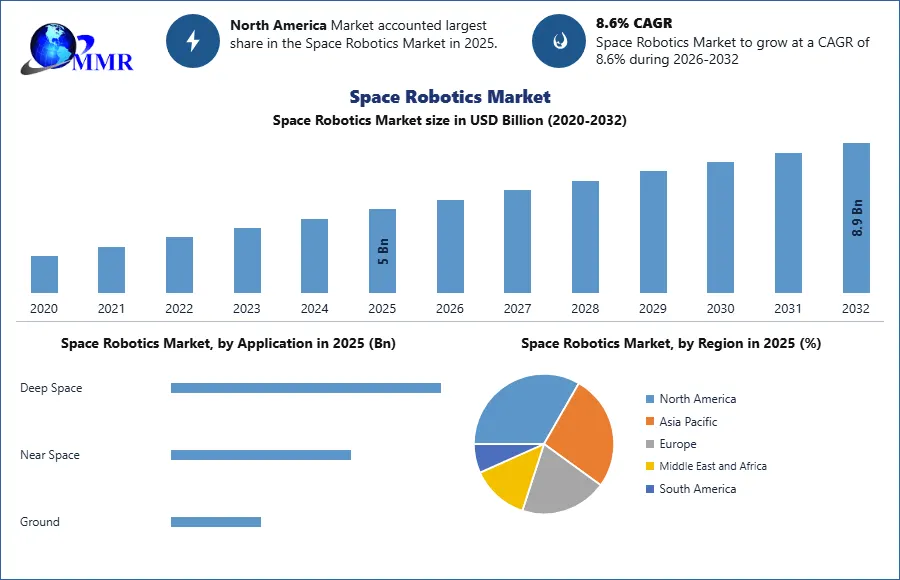
The Space Robotics Market size was valued at USD 5 Billion in 2025 and the total Space Robotics revenue is expected to grow at a CAGR of 8.6% from 2025 to 2032, reaching nearly USD 8.9 Billion.

Space Robotics Market Overview

The increasing investments in space exploration, satellite servicing, lunar missions, and autonomous space operations. Space robotics systems are widely used for satellite maintenance, planetary exploration, in-space manufacturing, cargo handling, and robotic arm operations on spacecraft and space stations. Government space agencies and private aerospace companies are increasingly deploying intelligent robotic systems to reduce mission risks, improve operational efficiency, and support long-duration space missions. Advancements in artificial intelligence, autonomous navigation, machine vision, and robotic mobility technologies are accelerating market expansion globally. North America dominates the market due to strong investments from NASA, SpaceX, and defense organizations. Continuous innovation in autonomous systems, in-space servicing, and robotic exploration technologies is expected to create substantial growth opportunities for the Space Robotics Market during the forecast period.
To know about the Research Methodology :- Request Free Sample Report

Space Robotics Market Dynamics

Trend: Increasing Development of Autonomous In-Space Servicing Robots

One of the major trends shaping the Space Robotics Market is the increasing development of autonomous robotic systems for in-space servicing, satellite maintenance, and orbital operations. Space agencies and private aerospace companies are investing heavily in robotic technologies capable of performing inspection, repair, refueling, assembly, and debris removal activities in orbit with minimal human intervention. The growing deployment of satellites and rising concerns regarding orbital congestion and space debris are accelerating demand for autonomous servicing robots. Companies are developing AI-enabled robotic arms, autonomous docking systems, and intelligent navigation technologies to support long-duration space missions and satellite life extension programs. Additionally, advancements in machine vision, edge AI, and autonomous control systems are improving robotic operational accuracy in harsh space environments. Robotic technologies are also being integrated into lunar exploration missions, space station maintenance, and in-space manufacturing operations. The increasing commercialization of space and expansion of low Earth orbit (LEO) infrastructure continue to strengthen demand for advanced space robotics solutions globally.

Investments in Space Exploration and Satellite Missions to Drive Space Robotics Market

The increasing investments in space exploration programs and satellite deployment activities are major drivers fueling the growth of the Space Robotics Market. Governments and private aerospace companies are rapidly expanding investments in lunar missions, Mars exploration, satellite servicing, and deep-space research programs. Space robotics systems play a critical role in performing hazardous and precision-based operations such as spacecraft maintenance, robotic exploration, cargo transportation, and autonomous mission support. The growing number of commercial satellites, communication satellites, and Earth observation missions is significantly increasing demand for robotic technologies capable of orbital inspection, assembly, and repair. Additionally, space agencies are adopting robotics to reduce astronaut risk exposure and improve mission efficiency in harsh extraterrestrial environments. Private companies are also investing in reusable launch systems, autonomous docking technologies, and robotic mobility platforms to support future commercial space operations. Continuous advancements in AI, autonomous systems, machine vision, and lightweight robotic components are further accelerating the adoption of space robotics technologies globally.

High Development Costs and Technical Complexity to Hamper Market Growth

High development costs and extreme technical complexity remain major restraints affecting the growth of the Space Robotics Market. Designing robotic systems capable of operating reliably in harsh space environments requires advanced engineering, radiation-resistant materials, autonomous control systems, and highly durable components, resulting in significant research and development expenditure. Space robotics projects also involve lengthy testing cycles, strict regulatory compliance, and complex mission integration requirements, increasing operational costs for aerospace companies and government agencies. Additionally, robotic systems operating in space must withstand extreme temperatures, microgravity conditions, radiation exposure, and communication delays, creating major technical challenges. Failures in robotic missions can result in substantial financial losses and mission disruptions. Smaller private companies often face funding limitations and technological barriers in developing advanced space robotics platforms. Furthermore, limited launch opportunities, cybersecurity concerns, and uncertainties related to long-duration autonomous operations continue to create operational risks.

Space Robotics Market Segment Analysis

By Solution , The Product segment dominates the Space Robotics Market due to increasing deployment of robotic arms, autonomous mobility systems, sensors, AI-enabled navigation technologies, and robotic subsystems across space missions and satellite operations. Space agencies and private aerospace companies are heavily investing in advanced robotic hardware and software solutions to support satellite servicing, planetary exploration, cargo handling, and orbital assembly activities. Robotic products are essential for autonomous operations in harsh space environments where precision, reliability, and remote functionality are critical. The growing number of lunar missions, Mars exploration projects, and commercial satellite launches is significantly increasing demand for intelligent robotic systems and autonomous space technologies. Additionally, advancements in machine vision, lightweight robotic materials, and autonomous control systems are improving operational efficiency and mission reliability.

By Application, The Space Exploration segment held the largest Space Robotics Market share due to increasing investments in lunar missions, Mars exploration programs, asteroid research, and deep-space scientific operations. Space robotics technologies are widely used for planetary surface mobility, robotic sampling, autonomous navigation, spacecraft maintenance, and extraterrestrial environmental analysis. Government space agencies and private aerospace companies increasingly rely on robotic systems to conduct high-risk operations in extreme space environments where human presence is limited or impossible. Robotic rovers, autonomous landers, and AI-enabled robotic arms are playing a critical role in supporting scientific experimentation and long-duration exploration missions. The growing commercialization of space and expansion of international space exploration initiatives are significantly driving demand for advanced robotic technologies.

Space Robotics Market Regional Insights:

North America dominated the Space Robotics Market in 2025 and is expected to continue its dominance over the forecast period. The strong government funding, advanced aerospace infrastructure, and the presence of leading space technology companies across the United States and Canada. NASA, SpaceX, Blue Origin, Northrop Grumman, and Lockheed Martin are heavily investing in autonomous robotic systems for satellite servicing, lunar exploration, deep-space missions, and space station operations. The region has witnessed significant advancements in robotic arms, autonomous docking systems, AI-powered space navigation, and orbital servicing technologies. Increasing defense-related space programs and rising deployment of commercial satellites are further accelerating market growth. North America also benefits from strong research and development capabilities, government-private partnerships, and rapid innovation in AI, robotics, and autonomous systems. NASA’s Artemis lunar exploration program and Mars mission initiatives are significantly increasing demand for intelligent robotic exploration technologies.

Recent Developments

March 2025: Northrop Grumman Corporation expanded its autonomous space robotics capabilities through advancements in satellite servicing, robotic mission operations, and lunar infrastructure technologies. The company strengthened development of intelligent robotic systems for NASA’s Artemis lunar exploration initiatives and autonomous spacecraft maintenance programs. Northrop Grumman also enhanced robotic docking, orbital maneuvering, and autonomous control technologies designed to support long-duration space missions and satellite life-extension operations. The development focused on improving mission reliability, reducing astronaut risk exposure, and enabling autonomous in-space operations.

February 2025: Maxar Technologies Inc. expanded its space robotics and autonomous satellite servicing capabilities through enhanced robotic arm systems and AI-driven space infrastructure technologies. The company focused on improving robotic mobility, autonomous inspection systems, and high-precision orbital servicing technologies for satellite maintenance and space exploration applications. Maxar also strengthened support for lunar surface missions and in-space assembly projects through advanced robotic navigation and autonomous operational systems.

Space Robotics Market Scope: Inquire before buying

Space Robotics Market
Report Coverage Details
Base Year: 2025 Forecast Period: 2026-2032
Historical Data: 2020 to 2025 Market Size in 2025: 5 USD Billion
Forecast Period 2026-2032 CAGR: 8.6% Market Size in 2032: 8.9 USD Billion
Segments Covered: by Solution Product
    Robotics and Subsystems
    Sensors and Autonomous Systems
    Software
    Others
Services
    On-orbit Assembly & Manufacturing
    Satellite Servicing
    De-orbiting Services
    Surface Mobility
    Launch Support
    Re-supply
by Application Deep Space
    Space Transportation
    Space Exploration
Near Space
    In-space 3D Printing
    Space Operations/Scientific Experimentation
    Space Transportation
    Space Exploration
    In-space Maintenance & Inspection
Ground
by Technology Type Government
    Space Agencies
    Departments of Defense
    Others
Commercial
    Satellite Operators/Owners
    Launch Service Providers
    Others

Space Robotics Market, by Region

North America (United States, Canada and Mexico)
Europe (UK, France, Germany, Italy, Spain, Sweden, Austria and Rest of Europe)
Asia Pacific (China, South Korea, Japan, India, Australia, Indonesia, Malaysia, Vietnam, Taiwan, and Rest of APAC)
Middle East and Africa (South Africa, GCC, Egypt, Nigeria and Rest of ME&A)
South America (Brazil, Argentina Rest of South America)

Key players/Competitors profiles covered in the Space Robotics Market report in strategic perspective

  1. Northrop Grumman Corporation (U.S.)
  2. Maxar Technologies Inc. (U.S.)
  3. Airbus SE (Netherlands)
  4. Honeybee Robotics (U.S.)
  5. Motiv Space Systems Inc. (U.S.)
  6. Astrobotic Technology, Inc. (U.S.)
  7. Altius Space Machines, Inc. (U.S.)
  8. Oceaneering International, Inc. (U.S.)
  9. Intuitive Machines, Inc. (U.S.)
  10. iRobot Corporation (U.S.)
  11. Space Applications Services NV/SA (Belgium)
  12. Effective Space Solutions Ltd. (Israel)
  13. Lunar Outpost, Inc. (U.S.)
  14. GITAI Inc. (Japan)
  15. ispace, Inc. (Japan)
  16. MDA Ltd. (Canada)
  17. Blue Origin LLC (U.S.)
  18. Lockheed Martin Corporation (U.S.)
  19. Boeing Company (U.S.)
  20. Sierra Space Corporation (U.S.)
  21. Thales Alenia Space (France)
  22. Redwire Corporation (U.S.)
  23. ClearSpace SA (Switzerland)
  24. ABB Ltd. (Switzerland)
  25. KUKA AG (Germany)
  26. Olis Robotics (U.S.)
  27. Collins Aerospace (U.S.)
  28. Axiom Space, Inc. (U.S.)
  29. Orbit Fab, Inc. (U.S.)
  30. Robotics Research LLC (U.S.)

Table of Contents

Global Space Robotics Market 1. Preface 1.1. Report Scope and Market Segmentation 1.2. Research Highlights 1.3. Research Objectives 2. Assumptions and Research Methodology 2.1. Report Assumptions 2.2. Abbreviations 2.3. Research Methodology 2.3.1. Secondary Research 2.3.1.1. Secondary data 2.3.1.2. Secondary Sources 2.3.2. Primary Research 2.3.2.1. Data from Primary Sources 2.3.2.2. Breakdown of Primary Sources 3. Executive Summary: Global Space Robotics Market Size, by Market Value (US$ Bn) 4. Market Overview 4.1. Introduction 4.2. Market Indicator 4.2.1. Drivers 4.2.2. Restraints 4.2.3. Opportunities 4.2.4. Challenges 4.3. Porter’s Analysis 4.4. Value Chain Analysis 4.5. Market Risk Analysis 4.6. SWOT Analysis 4.7. Industry Trends and Emerging Technologies 5. Supply Side and Demand Side Indicators 6. Global Space Robotics Market Analysis and Forecast 6.1. Space Robotics Market Size & Y-o-Y Growth Analysis 6.1.1. North America 6.1.2. Europe 6.1.3. Asia Pacific 6.1.4. Middle East & Africa 6.1.5. South America 7. Global Space Robotics Market Analysis and Forecast, By Solution 7.1. Introduction and Definition 7.2. Key Findings 7.3. Space Robotics Market Value Share Analysis, By Solution 7.4. Space Robotics Market Size (US$ Bn) Forecast, By Solution 7.5. Space Robotics Market Analysis, By Solution 7.6. Space Robotics Market Attractiveness Analysis, By Solution 8. Global Space Robotics Market Analysis and Forecast, By Application 8.1. Introduction and Definition 8.2. Key Findings 8.3. Space Robotics Market Value Share Analysis, By Application 8.4. Space Robotics Market Size (US$ Bn) Forecast, By Application 8.5. Space Robotics Market Analysis, By Application 8.6. Space Robotics Market Attractiveness Analysis, By Application 9. Global Space Robotics Market Analysis and Forecast, By End User 9.1. Introduction and Definition 9.2. Key Findings 9.3. Space Robotics Market Value Share Analysis, By End User 9.4. Space Robotics Market Size (US$ Bn) Forecast, By End User 9.5. Space Robotics Market Analysis, By End User 9.6. Space Robotics Market Attractiveness Analysis, By End User 10. Global Space Robotics Market Analysis, By Region 10.1. Space Robotics Market Value Share Analysis, By Region 10.2. Space Robotics Market Size (US$ Bn) Forecast, By Region 10.3. Space Robotics Market Attractiveness Analysis, By Region 11. North America Space Robotics Market Analysis 11.1. Key Findings 11.2. North America Space Robotics Market Overview 11.3. North America Space Robotics Market Value Share Analysis, By Solution 11.4. North America Space Robotics Market Forecast, By Solution 11.4.1. Product 11.4.1.1. Rovers 11.4.1.2. Landers 11.4.1.3. Probes 11.4.1.4. Arms 11.4.1.5. Manipulators 11.4.2. Services 11.4.2.1. On-orbit service 11.4.2.2. De-orbiting service 11.4.2.3. Surface mobility 11.4.2.4. Launch support 11.5. North America Space Robotics Market Value Share Analysis, By Application 11.6. North America Space Robotics Market Forecast, By Application 11.6.1. Deep Space 11.6.2. Near Space 11.6.3. Ground 11.7. North America Space Robotics Market Value Share Analysis, By End User 11.8. North America Space Robotics Market Forecast, By End User 11.8.1. Government 11.8.2. Commercial 11.9. North America Space Robotics Market Value Share Analysis, by Country 11.10. North America Space Robotics Market Forecast, by Country 11.10.1. U.S. 11.10.2. Canada 11.11. North America Space Robotics Market Analysis, by Country 11.12. U.S. Space Robotics Market Forecast, By Solution 11.12.1. Product 11.12.1.1. Rovers 11.12.1.2. Landers 11.12.1.3. Probes 11.12.1.4. Arms 11.12.1.5. Manipulators 11.12.2. Services 11.12.2.1. On-orbit service 11.12.2.2. De-orbiting service 11.12.2.3. Surface mobility 11.12.2.4. Launch support 11.13. U.S. Space Robotics Market Forecast, By Application 11.13.1. Deep Space 11.13.2. Near Space 11.13.3. Ground 11.14. U.S. Space Robotics Market Forecast, By End User 11.14.1. Government 11.14.2. Commercial 11.15. Canada Space Robotics Market Forecast, By Solution 11.15.1. Product 11.15.1.1. Rovers 11.15.1.2. Landers 11.15.1.3. Probes 11.15.1.4. Arms 11.15.1.5. Manipulators 11.15.2. Services 11.15.2.1. On-orbit service 11.15.2.2. De-orbiting service 11.15.2.3. Surface mobility 11.15.2.4. Launch support 11.16. Canada Space Robotics Market Forecast, By Application 11.16.1. Deep Space 11.16.2. Near Space 11.16.3. Ground 11.17. Canada Space Robotics Market Forecast, By End User 11.17.1. Government 11.17.2. Commercial 11.18. North America Space Robotics Market Attractiveness Analysis 11.18.1. By Solution 11.18.2. By Application 11.18.3. By End User 11.19. PEST Analysis 11.20. Key Trends 11.21. Key Developments 12. Europe Space Robotics Market Analysis 12.1. Key Findings 12.2. Europe Space Robotics Market Overview 12.3. Europe Space Robotics Market Value Share Analysis, By Solution 12.4. Europe Space Robotics Market Forecast, By Solution 12.4.1. Product 12.4.1.1. Rovers 12.4.1.2. Landers 12.4.1.3. Probes 12.4.1.4. Arms 12.4.1.5. Manipulators 12.4.2. Services 12.4.2.1. On-orbit service 12.4.2.2. De-orbiting service 12.4.2.3. Surface mobility 12.4.2.4. Launch support 12.5. Europe Space Robotics Market Value Share Analysis, By Application 12.6. Europe Space Robotics Market Forecast, By Application 12.6.1. Deep Space 12.6.2. Near Space 12.6.3. Ground 12.7. Europe Space Robotics Market Value Share Analysis, By End User 12.8. Europe Space Robotics Market Forecast, By End User 12.8.1. Government 12.8.2. Commercial 12.9. Europe Space Robotics Market Value Share Analysis, by Country 12.10. Europe Space Robotics Market Forecast, by Country 12.10.1. Germany 12.10.2. U.K. 12.10.3. France 12.10.4. Italy 12.10.5. Spain 12.10.6. Rest of Europe 12.11. Europe Space Robotics Market Analysis, by Country 12.12. Germany Space Robotics Market Forecast, By Solution 12.12.1. Product 12.12.1.1. Rovers 12.12.1.2. Landers 12.12.1.3. Probes 12.12.1.4. Arms 12.12.1.5. Manipulators 12.12.2. Services 12.12.2.1. On-orbit service 12.12.2.2. De-orbiting service 12.12.2.3. Surface mobility 12.12.2.4. Launch support 12.13. Germany Space Robotics Market Forecast, By Application 12.13.1. Deep Space 12.13.2. Near Space 12.13.3. Ground 12.14. Germany Space Robotics Market Forecast, By End User 12.14.1. Government 12.14.2. Commercial 12.15. U.K. Space Robotics Market Forecast, By Solution 12.15.1. Product 12.15.1.1. Rovers 12.15.1.2. Landers 12.15.1.3. Probes 12.15.1.4. Arms 12.15.1.5. Manipulators 12.15.2. Services 12.15.2.1. On-orbit service 12.15.2.2. De-orbiting service 12.15.2.3. Surface mobility 12.15.2.4. Launch support 12.16. U.K. Space Robotics Market Forecast, By Application 12.16.1. Deep Space 12.16.2. Near Space 12.16.3. Ground 12.17. U.K. Space Robotics Market Forecast, By End User 12.17.1. Government 12.17.2. Commercial 12.18. France Space Robotics Market Forecast, By Solution 12.18.1. Product 12.18.1.1. Rovers 12.18.1.2. Landers 12.18.1.3. Probes 12.18.1.4. Arms 12.18.1.5. Manipulators 12.18.2. Services 12.18.2.1. On-orbit service 12.18.2.2. De-orbiting service 12.18.2.3. Surface mobility 12.18.2.4. Launch support 12.19. France Space Robotics Market Forecast, By Application 12.19.1. Deep Space 12.19.2. Near Space 12.19.3. Ground 12.20. France Space Robotics Market Forecast, By End User 12.20.1. Government 12.20.2. Commercial 12.21. Italy Space Robotics Market Forecast, By Solution 12.21.1. Product 12.21.1.1. Rovers 12.21.1.2. Landers 12.21.1.3. Probes 12.21.1.4. Arms 12.21.1.5. Manipulators 12.21.2. Services 12.21.2.1. On-orbit service 12.21.2.2. De-orbiting service 12.21.2.3. Surface mobility 12.21.2.4. Launch support 12.22. Italy Space Robotics Market Forecast, By Application 12.22.1. Deep Space 12.22.2. Near Space 12.22.3. Ground 12.23. Italy Space Robotics Market Forecast, By End User 12.23.1. Government 12.23.2. Commercial 12.24. Spain Space Robotics Market Forecast, By Solution 12.24.1. Product 12.24.1.1. Rovers 12.24.1.2. Landers 12.24.1.3. Probes 12.24.1.4. Arms 12.24.1.5. Manipulators 12.24.2. Services 12.24.2.1. On-orbit service 12.24.2.2. De-orbiting service 12.24.2.3. Surface mobility 12.24.2.4. Launch support 12.25. Spain Space Robotics Market Forecast, By Application 12.25.1. Deep Space 12.25.2. Near Space 12.25.3. Ground 12.26. Spain Space Robotics Market Forecast, By End User 12.26.1. Government 12.26.2. Commercial 12.27. Rest of Europe Space Robotics Market Forecast, By Solution 12.27.1. Product 12.27.1.1. Rovers 12.27.1.2. Landers 12.27.1.3. Probes 12.27.1.4. Arms 12.27.1.5. Manipulators 12.27.2. Services 12.27.2.1. On-orbit service 12.27.2.2. De-orbiting service 12.27.2.3. Surface mobility 12.27.2.4. Launch support 12.28. Rest of Europe Space Robotics Market Forecast, By Application 12.28.1. Deep Space 12.28.2. Near Space 12.28.3. Ground 12.29. Rest Of Europe Space Robotics Market Forecast, By End User 12.29.1. Government 12.29.2. Commercial 12.30. Europe Space Robotics Market Attractiveness Analysis 12.30.1. By Solution 12.30.2. By Application 12.30.3. By End User 12.31. PEST Analysis 12.32. Key Trends 12.33. Key Developments 13. Asia Pacific Space Robotics Market Analysis 13.1. Key Findings 13.2. Asia Pacific Space Robotics Market Overview 13.3. Asia Pacific Space Robotics Market Value Share Analysis, By Solution 13.4. Asia Pacific Space Robotics Market Forecast, By Solution 13.4.1. Product 13.4.1.1. Rovers 13.4.1.2. Landers 13.4.1.3. Probes 13.4.1.4. Arms 13.4.1.5. Manipulators 13.4.2. Services 13.4.2.1. On-orbit service 13.4.2.2. De-orbiting service 13.4.2.3. Surface mobility 13.4.2.4. Launch support 13.5. Asia Pacific Space Robotics Market Value Share Analysis, By Application 13.6. Asia Pacific Space Robotics Market Forecast, By Application 13.6.1. Deep Space 13.6.2. Near Space 13.6.3. Ground 13.7. Asia Pacific Space Robotics Market Value Share Analysis, By End User 13.8. Asia Pacific Space Robotics Market Forecast, By End User 13.8.1. Government 13.8.2. Commercial 13.9. Asia Pacific Space Robotics Market Value Share Analysis, by Country 13.10. Asia Pacific Space Robotics Market Forecast, by Country 13.10.1. China 13.10.2. India 13.10.3. Japan 13.10.4. ASEAN 13.10.5. Rest of Asia Pacific 13.11. Asia Pacific Space Robotics Market Analysis, by Country 13.12. China Space Robotics Market Forecast, By Solution 13.12.1. Product 13.12.1.1. Rovers 13.12.1.2. Landers 13.12.1.3. Probes 13.12.1.4. Arms 13.12.1.5. Manipulators 13.12.2. Services 13.12.2.1. On-orbit service 13.12.2.2. De-orbiting service 13.12.2.3. Surface mobility 13.12.2.4. Launch support 13.13. China Space Robotics Market Forecast, By Application 13.13.1. Deep Space 13.13.2. Near Space 13.13.3. Ground 13.14. China Space Robotics Market Forecast, By End User 13.14.1. Government 13.14.2. Commercial 13.15. India Space Robotics Market Forecast, By Solution 13.15.1. Product 13.15.1.1. Rovers 13.15.1.2. Landers 13.15.1.3. Probes 13.15.1.4. Arms 13.15.1.5. Manipulators 13.15.2. Services 13.15.2.1. On-orbit service 13.15.2.2. De-orbiting service 13.15.2.3. Surface mobility 13.15.2.4. Launch support 13.16. India Space Robotics Market Forecast, By Application 13.16.1. Deep Space 13.16.2. Near Space 13.16.3. Ground 13.17. India Space Robotics Market Forecast, By End User 13.17.1. Government 13.17.2. Commercial 13.18. Japan Space Robotics Market Forecast, By Solution 13.18.1. Product 13.18.1.1. Rovers 13.18.1.2. Landers 13.18.1.3. Probes 13.18.1.4. Arms 13.18.1.5. Manipulators 13.18.2. Services 13.18.2.1. On-orbit service 13.18.2.2. De-orbiting service 13.18.2.3. Surface mobility 13.18.2.4. Launch support 13.19. Japan Space Robotics Market Forecast, By Application 13.19.1. Deep Space 13.19.2. Near Space 13.19.3. Ground 13.20. Japan Space Robotics Market Forecast, By End User 13.20.1. Government 13.20.2. Commercial 13.21. ASEAN Space Robotics Market Forecast, By Solution 13.21.1. Product 13.21.1.1. Rovers 13.21.1.2. Landers 13.21.1.3. Probes 13.21.1.4. Arms 13.21.1.5. Manipulators 13.21.2. Services 13.21.2.1. On-orbit service 13.21.2.2. De-orbiting service 13.21.2.3. Surface mobility 13.21.2.4. Launch support 13.22. ASEAN Space Robotics Market Forecast, By Application 13.22.1. Deep Space 13.22.2. Near Space 13.22.3. Ground 13.23. ASEAN Space Robotics Market Forecast, By End User 13.23.1. Government 13.23.2. Commercial 13.24. Rest of Asia Pacific Space Robotics Market Forecast, By Solution 13.24.1. Product 13.24.1.1. Rovers 13.24.1.2. Landers 13.24.1.3. Probes 13.24.1.4. Arms 13.24.1.5. Manipulators 13.24.2. Services 13.24.2.1. On-orbit service 13.24.2.2. De-orbiting service 13.24.2.3. Surface mobility 13.24.2.4. Launch support 13.25. Rest of Asia Pacific Space Robotics Market Forecast, By Application 13.25.1. Deep Space 13.25.2. Near Space 13.25.3. Ground 13.26. Rest of Asia Pacific Space Robotics Market Forecast, By End User 13.26.1. Government 13.26.2. Commercial 13.27. Asia Pacific Space Robotics Market Attractiveness Analysis 13.27.1. By Solution 13.27.2. By Application 13.27.3. By End User 13.28. PEST Analysis 13.29. Key Trends 13.30. Key Developments 14. Middle East & Africa Space Robotics Market Analysis 14.1. Key Findings 14.2. Middle East & Africa Space Robotics Market Overview 14.3. Middle East & Africa Space Robotics Market Value Share Analysis, By Solution 14.4. Middle East & Africa Space Robotics Market Forecast, By Solution 14.4.1. Product 14.4.1.1. Rovers 14.4.1.2. Landers 14.4.1.3. Probes 14.4.1.4. Arms 14.4.1.5. Manipulators 14.4.2. Services 14.4.2.1. On-orbit service 14.4.2.2. De-orbiting service 14.4.2.3. Surface mobility 14.4.2.4. Launch support 14.5. Middle East & Africa Space Robotics Market Value Share Analysis, By Application 14.6. Middle East & Africa Space Robotics Market Forecast, By Application 14.6.1. Deep Space 14.6.2. Near Space 14.6.3. Ground 14.7. Middle East & Africa Space Robotics Market Value Share Analysis, By End User 14.8. Middle East & Africa Space Robotics Market Forecast, By End User 14.8.1. Government 14.8.2. Commercial 14.9. Middle East & Africa Space Robotics Market Value Share Analysis, by Country 14.10. Middle East & Africa Space Robotics Market Forecast, by Country 14.10.1. GCC 14.10.2. South Africa 14.10.3. Rest of Middle East & Africa 14.11. Middle East & Africa Space Robotics Market Analysis, by Country 14.12. GCC Space Robotics Market Forecast, By Solution 14.12.1. Product 14.12.1.1. Rovers 14.12.1.2. Landers 14.12.1.3. Probes 14.12.1.4. Arms 14.12.1.5. Manipulators 14.12.2. Services 14.12.2.1. On-orbit service 14.12.2.2. De-orbiting service 14.12.2.3. Surface mobility 14.12.2.4. Launch support 14.13. GCC Space Robotics Market Forecast, By Application 14.13.1. Deep Space 14.13.2. Near Space 14.13.3. Ground 14.14. GCC Space Robotics Market Forecast, By End User 14.14.1. Government 14.14.2. Commercial 14.15. South Africa Space Robotics Market Forecast, By Solution 14.15.1. Product 14.15.1.1. Rovers 14.15.1.2. Landers 14.15.1.3. Probes 14.15.1.4. Arms 14.15.1.5. Manipulators 14.15.2. Services 14.15.2.1. On-orbit service 14.15.2.2. De-orbiting service 14.15.2.3. Surface mobility 14.15.2.4. Launch support 14.16. South Africa Space Robotics Market Forecast, By Application 14.16.1. Deep Space 14.16.2. Near Space 14.16.3. Ground 14.17. South Africa Space Robotics Market Forecast, By End User 14.17.1. Government 14.17.2. Commercial 14.18. Rest of Middle East & Africa Space Robotics Market Forecast, By Solution 14.18.1. Product 14.18.1.1. Rovers 14.18.1.2. Landers 14.18.1.3. Probes 14.18.1.4. Arms 14.18.1.5. Manipulators 14.18.2. Services 14.18.2.1. On-orbit service 14.18.2.2. De-orbiting service 14.18.2.3. Surface mobility 14.18.2.4. Launch support 14.19. Rest of Middle East & Africa Space Robotics Market Forecast, By Application 14.19.1. Deep Space 14.19.2. Near Space 14.19.3. Ground 14.20. & Africa Space Robotics Market Forecast, By End User 14.20.1. Government 14.20.2. Commercial 14.21. Middle East & Africa Space Robotics Market Attractiveness Analysis 14.21.1. By Solution 14.21.2. By Application 14.21.3. By End User 14.22. PEST Analysis 14.23. Key Trends 14.24. Key Developments 15. South America Space Robotics Market Analysis 15.1. Key Findings 15.2. South America Space Robotics Market Overview 15.3. South America Space Robotics Market Value Share Analysis, By Solution 15.4. South America Space Robotics Market Forecast, By Solution 15.4.1. Product 15.4.1.1. Rovers 15.4.1.2. Landers 15.4.1.3. Probes 15.4.1.4. Arms 15.4.1.5. Manipulators 15.4.2. Services 15.4.2.1. On-orbit service 15.4.2.2. De-orbiting service 15.4.2.3. Surface mobility 15.4.2.4. Launch support 15.5. South America Space Robotics Market Value Share Analysis, By Application 15.6. South America Space Robotics Market Forecast, By Application 15.6.1. Deep Space 15.6.2. Near Space 15.6.3. Ground 15.7. South America Space Robotics Market Value Share Analysis, By End User 15.8. South America Space Robotics Market Forecast, By End User 15.8.1. Government 15.8.2. Commercial 15.9. South America Space Robotics Market Value Share Analysis, by Country 15.10. South America Space Robotics Market Forecast, by Country 15.10.1. Brazil 15.10.2. Mexico 15.10.3. Rest of South America 15.11. South America Space Robotics Market Analysis, by Country 15.12. Brazil Space Robotics Market Forecast, By Solution 15.12.1. Product 15.12.1.1. Rovers 15.12.1.2. Landers 15.12.1.3. Probes 15.12.1.4. Arms 15.12.1.5. Manipulators 15.12.2. Services 15.12.2.1. On-orbit service 15.12.2.2. De-orbiting service 15.12.2.3. Surface mobility 15.12.2.4. Launch support 15.13. Brazil Space Robotics Market Forecast, By Application 15.13.1. Deep Space 15.13.2. Near Space 15.13.3. Ground 15.14. Brazil Space Robotics Market Forecast, By End User 15.14.1. Government 15.14.2. Commercial 15.15. Mexico Space Robotics Market Forecast, By Solution 15.15.1. Product 15.15.1.1. Rovers 15.15.1.2. Landers 15.15.1.3. Probes 15.15.1.4. Arms 15.15.1.5. Manipulators 15.15.2. Services 15.15.2.1. On-orbit service 15.15.2.2. De-orbiting service 15.15.2.3. Surface mobility 15.15.2.4. Launch support 15.16. Mexico Space Robotics Market Forecast, By Application 15.16.1. Deep Space 15.16.2. Near Space 15.16.3. Ground 15.17. Mexico Space Robotics Market Forecast, By End User 15.17.1. Government 15.17.2. Commercial 15.18. Rest of South America Space Robotics Market Forecast, By Solution 15.18.1. Product 15.18.1.1. Rovers 15.18.1.2. Landers 15.18.1.3. Probes 15.18.1.4. Arms 15.18.1.5. Manipulators 15.18.2. Services 15.18.2.1. On-orbit service 15.18.2.2. De-orbiting service 15.18.2.3. Surface mobility 15.18.2.4. Launch support 15.19. Rest of South America Space Robotics Market Forecast, By Application 15.19.1. Deep Space 15.19.2. Near Space 15.19.3. Ground 15.20. Rest of South America Space Robotics Market Forecast, By End User 15.20.1. Government 15.20.2. Commercial 15.21. South America Space Robotics Market Attractiveness Analysis 15.21.1. By Solution 15.21.2. By Application 15.21.3. By End User 15.22. PEST Analysis 15.23. Key Trends 15.24. Key Developments 16. Company Profiles 16.1. Market Share Analysis, by Company 16.2. Competition Matrix 16.2.1. Competitive Benchmarking of key players by price, presence, market share, Applications and R&D investment 16.2.2. New Product Launches and Product Enhancements 16.2.3. Market Consolidation 16.2.3.1. M&A By Regions, Investment and Applications 16.2.3.2. M&A Key Players, Forward Integration and Backward 16.2.3.3. Integration 16.3. Company Profiles: Key Players 16.3.1. Honeybee Robotics 16.3.1.1. Company Overview 16.3.1.2. Financial Overview 16.3.1.3. Product Portfolio 16.3.1.4. Business Strategy 16.3.1.5. Recent Developments 16.3.1.6. Development Footprint 16.3.2. Made In Space 16.3.3. Northrop Grumman 16.3.4. Effective Space Solutions Limited 16.3.5. Maxar Technologies 16.3.6. Motiv Space Systems 16.3.7. Astrobotic Technology 16.3.8. Altius Space Machine 16.3.9. Ispace 16.3.10. Metecs 16.3.11. Olis Robotics 16.3.12. BluHaptics, Inc. 16.3.13. Intuitive Machines, LLC 16.3.14. Oceaneering International, Inc. 16.3.15. ITT Corporation 16.3.16. Stinger Ghaffarian Technologies (SGT). 16.3.17. GITAI Inc. 17. Primary Key Insights

Custom Market Research Services

We Will Customise The Research For You, In Case The Report Listed Above Does Not Meet With Your Requirements