
Connected Tires Market by Offering, Component, Vehicle Type, Propulsion, Rim Size, Sales Channel and Region – Global Market Size Estimation, Industry-Wide Analysis, Competitive Landscape Assessment & Long-Term Forecast to 2032
Overview
The Connected Tires Market size was valued at USD 6.08 Million in 2024 and the total Connected Tires revenue is expected to grow at a CAGR of 58.5% from 2025 to 2032, reaching nearly USD 242.43 Million.
Connected Tires Market Overview
The connected tires market refers to the incorporation of advanced technologies and connectivity features into automotive tires. These smart tires utilize sensors, microchips, and wireless communication capabilities to gather and transmit real-time data on tire pressure, temperature, tread wear, and overall tire health.
The market is driven by the increasing adoption of connected and autonomous vehicles, growing awareness about tire safety and performance optimization, advancements in tire sensor technologies and wireless connectivity, and a focus on predictive maintenance and real-time monitoring in fleet management. The market is segmented based on vehicle type, connectivity technology, application, and end-user. North America currently holds the largest market share, but the Asia Pacific region is expected to witness significant growth. The market is highly competitive, with key players investing in R&D, collaborations, and partnerships. The future outlook of the connected tires market is promising, with advancements in technology, increasing demand for intelligent vehicles, and evolving regulations driving its growth.
Report includes market analysis, forecasts, industry segmentation and competitive analysis of top Connected Tires manufacturers. The Report also emphasises on sustainability, innovation and consumer preferences, offering global outlook with trends, drivers, challenges and opportunities. It will help industry stakeholders (manufacturers, distributors, retailers, investors) make informed decisions and capitalise on Connected Tires market opportunities.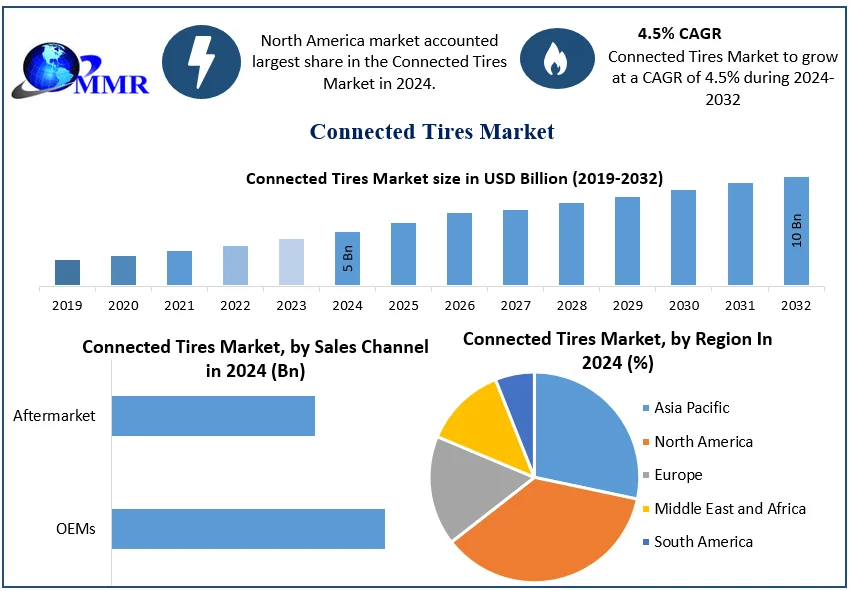 To know about the Research Methodology :- Request Free Sample Report
Connected Tires Market Dynamics
Market Drivers:
Increasing Adoption of Connected and Autonomous Vehicles: The rising demand for connected and autonomous vehicles is a significant driver for the connected tires market. As vehicles become more intelligent and reliant on data-driven systems, the need for real-time tire monitoring and optimization grows. For instance, Tesla's Autopilot system incorporates tire pressure monitoring and alerts to ensure optimal safety and performance.
Emphasis on Tire Safety and Performance Optimization: Tire safety and performance are critical factors for vehicle owners, fleet operators, and regulatory bodies. Connected tires enable real-time monitoring of parameters such as tire pressure, tread wear, and temperature. This helps prevent accidents caused by underinflated tires, optimizes fuel efficiency, and extends tire lifespan. As a result, there is increasing awareness and emphasis on tire safety and performance optimization, driving connected tires market growth.
Advancements in Tire Sensor Technologies and Wireless Connectivity: Technological advancements have led to the development of more sophisticated tire sensors and improved wireless connectivity options. For example, companies like Michelin have introduced advanced tire sensors that can monitor multiple tire parameters simultaneously. Additionally, the evolution of wireless communication technologies like 5G enables seamless data transmission between tires and connected devices.
Market Restraints:
High Implementation Costs: The integration of advanced technologies into tires comes with associated costs, including sensor installation, connectivity modules, and data analytics infrastructure. These costs can be a barrier, especially for budget-conscious consumers or fleet operators with large vehicle fleets. However, as technology matures and economies of scale are realized, the cost of connected tires is expected to decrease, alleviating this restraint over time. This is expected to majorly hamper the connected tires market growth in the future.
Lack of Industry Standards and Interoperability: The absence of standardized protocols and interoperability among different tire manufacturers and vehicle systems poses a challenge to the connected tires market. For seamless integration and data exchange, industry-wide standards need to be established. Initiatives such as the Global Platform for Sustainable Natural Rubber are working towards developing global standards for tire traceability and sustainability, promoting collaboration among stakeholders.
Market Opportunities:
Predictive Maintenance and Remote Diagnostics: Connected tires provide an opportunity for predictive maintenance and remote diagnostics, enabling proactive identification of tire issues and timely maintenance. This can result in cost savings, improved vehicle uptime, and enhanced operational efficiency for fleet operators. For example, Bridgestone's Tirematics solution offers real-time tire data, predictive maintenance insights, and remote diagnostics capabilities.
Fleet Management and Optimization: Connected tires offer extensive benefits for fleet management, such as remote monitoring of tire conditions, automated maintenance scheduling, and efficient tire replacements. This can help fleet operators reduce downtime, optimize tire performance, and enhance overall operational efficiency. Government initiatives promoting electric and connected fleets, such as the European Green Deal's focus on sustainable mobility, present opportunities for connected tire solutions. This is expected to drive the connected tires market growth in the future.
Market Challenges:
Data Security and Privacy Concerns: The connectivity of tires introduces potential cybersecurity risks, including unauthorized access to sensitive vehicle and tire data. Manufacturers and technology providers need to prioritize robust data security measures to ensure the privacy and integrity of the information transmitted between tires and connected systems. Recent data breaches in the automotive sector highlight the need for stringent cybersecurity practices.
Integration Complexity and Retrofitting Challenges: Retrofitting existing vehicles with connected tire technologies can be challenging, particularly for older vehicle models or those without built-in connectivity features. Integration complexities may arise due to differences in vehicle architectures, tire sizes, or compatibility issues. Manufacturers and service providers need to develop seamless integration solutions to address these challenges.
Connected Tires Market Segmentation:
Based on Sales Channel, The Connected Tires Market is segmented into original equipment manufacturers (OEMs) and the aftermarket. OEMs hold a significant market share as tire manufacturers establish direct partnerships with automobile manufacturers to supply tires for new vehicles. As automotive manufacturers strive to deliver vehicles with superior performance and safety, they rely on OEMs to provide high-quality tires that meet their specifications. On the other hand, the aftermarket segment is also experiencing substantial growth. This growth can be attributed to tire replacements and upgrades, as vehicle owners seek to enhance the performance or aesthetics of their vehicles.
The aftermarket segment presents opportunities for tire retailers and service providers to cater to the growing demand for tire replacements and customization. While both segments play crucial roles in the Connected Tires Market, the aftermarket segment is widely used and has the potential to further expand in the future. As the global vehicle parc continues to grow, the need for tire replacements and upgrades is expected to rise, driving the aftermarket segment's growth prospects.
Connected Tires Market Regional Analysis:
The connected tires market exhibits regional variations influenced by factors such as government initiatives, infrastructure development, technological advancements, and consumer preferences. Currently, North America is one of the key markets for connected tires due to several factors. The region's strong automotive industry, early adoption of connected and autonomous vehicles, and robust technological infrastructure contribute to its dominance. Moreover, government initiatives in North America, such as the United States Department of Transportation's Smart City Challenge and investments in smart infrastructure, support the growth of the connected tires market. Additionally, the presence of key market players and their focus on research and development activities further strengthens North America's market position.
Looking ahead, the Asia Pacific region is expected to lead the connected tires market in the near future. The region's increasing urbanization, expanding automotive sector, and rising disposable income contribute to market growth. Government initiatives promoting smart cities and intelligent transportation systems in countries like China and India are driving the demand for connected vehicles and, consequently, connected tires. For instance, the Chinese government's "Made in China 2025" initiative aims to enhance the country's manufacturing capabilities, including in the automotive sector, fostering the adoption of connected technologies. Additionally, the rapid development of infrastructure, including 5G networks, provides a conducive environment for the proliferation of connected tire solutions in the Asia Pacific region.
Connected Tires Market Scope: Inquire Before Buying
| Global Connected Tires Market | |||
|---|---|---|---|
| Report Coverage | Details | ||
| Base Year: | 2024 | Forecast Period: | 2025-2032 |
| Historical Data: | 2019 to 2024 | Market Size in 2024: | US $ 6.08 Mn. |
| Forecast Period 2025 to 2032 CAGR: | 58.5% | Market Size in 2032: | US $ 242.43 Mn. |
| Segments Covered: | by Offering | Hardware Software |
|
| by Component | TPMS Accelerometer sensors Strain gauge sensors RFID chips Other sensors |
||
| by Vehicle Type | Passenger Cars Commercial Vehicles |
||
| by Propulsion | Electric ICE |
||
| by Rim Size | 12-17 Inches 18-22 Inches More Than 22 Inches |
||
| by Sales Channel | OEMs Aftermarket |
||
Connected Tires Market, by Region
North America (United States, Canada and Mexico)
Europe (UK, France, Germany, Italy, Spain, Sweden, Austria, Turkey, Russia and Rest of Europe)
Asia Pacific (China, India, Japan, South Korea, Australia, ASEAN and Rest of APAC)
Middle East and Africa (South Africa, GCC, Egypt, Nigeria and Rest of ME&A)
South America (Brazil, Argentina, Columbia and Rest of South America)
Connected Tires Key Players are:
The following Connected Tires Companies are the key players in the market and are selected based on criteria for further evaluation. The strategies followed by the companies to sustain and grow in the market are discussed in detail in the report
1. Bridgestone Corporation
2. Michelin
3. Continental AG
4. Pirelli & C. S.p.A
5. Goodyear Tire and Rubber Company
6. Sumitomo Rubber Industries, Ltd.
7. Hankook Tire & Technology Co., Ltd.
8. Yokohama Rubber Co., Ltd.
9. Giti Tire Corporation
10. Kumho Tire Co., Inc.
11. Toyo Tire Corporation
12. Nokian Tyres plc
13. Cooper Tire & Rubber Company
14. Apollo Tyres Ltd.
15. MRF Limited
16. Nexen Tire Corporation
17. CEAT Limited
18. Maxxis International
19. Falken Tire Corporation
20. BKT (Balkrishna Industries Limited)
21. Triangle Group Co., Ltd.
22. GT Radial (Giti Tire Global Trading Pte. Ltd.)
23. Double Coin Holdings Ltd.
24. Linglong Tire Co., Ltd.
25. Alliance Tire Group (ATG)
FAQs
1. How big is the Connected Tires Market?
Ans: Connected Tires Market was valued at USD 6.08 million in 2024.
2. What is the growth rate of the Connected Tires Market?
Ans: The CAGR of the Connected Tires Market is 58.5%.
3. What are the segments of the Connected Tires Market?
Ans: There are primarily 5 segments – Sales channels, Rim size, Vehicle type, Propulsion type and Geography for the Connected Tires Market
4. Which region has the highest market share in the Connected Tires Market sector?
Ans: North America has the highest market share in the Connected Tires Market sector.
5. Is it profitable to invest in the Connected Tires Market?
Ans: There is a fair growth rate in this market and there are various factors to be analyzed like the driving forces and opportunities of the market which have been discussed extensively in Maximize’s full report. That would help in understanding the profitability of the market.