Vehicles for Disabled Market Size by Entry Configuration, Entry Mechanism, Driving Option, Vehicle Type, Region – Segment-Level Market Assessment, Growth Opportunity Analysis, Competitive Mapping & Forecast to 2034

11.8%
CAGR (2026-2034)
4.05 USD Bn.
Forecast Market Size
323
Report Pages
163
Market Tables

Overview

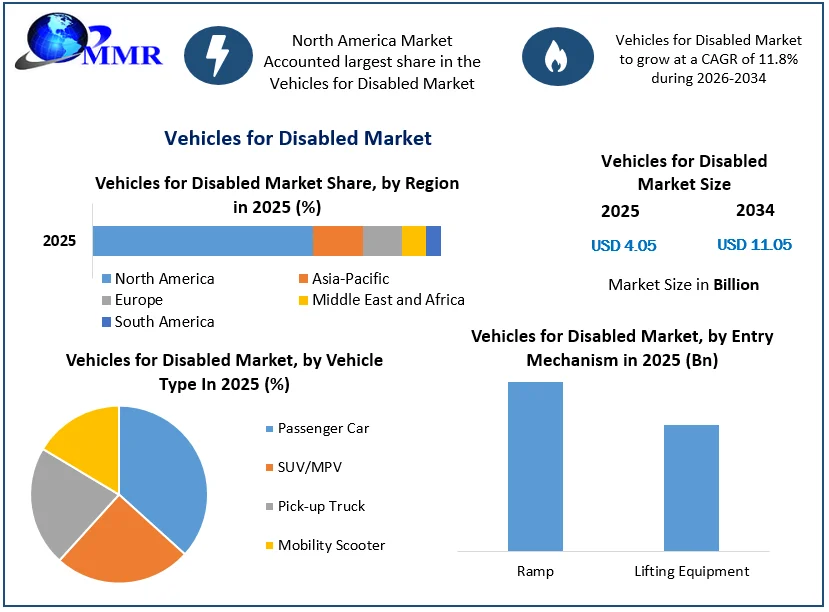
Global Vehicles for Disabled Market is anticipated to reach US$ 11.05 Bn. by 2034 from US$ 4.05 Bn. in 2025 at a CAGR of 11.8% during a forecast period.

Vehicles for Disabled Market Overview

Vehicles for the Disabled are essentially a vehicle equipped with a self-navigating wheelchair that is meant to carry a disabled person from one place to another. The Vehicles for the Disabled have a wider ramp and higher height than regular vehicles, making it easier for disabled people to enter and depart. Europe is the largest market for the vehicles for disabled, accounted for 58% of the market share in 2022. North America and the Asia Pacific held 25% and 17% of the market share respectively in 2025.

Vehicles for Disabled Market Size, Growth and Share Analysis
Vehicles for Disabled Market Size

To know about the Research Methodology :- Request Free Sample Report

In report, 2025 is considered a base year however 2025 numbers are on the real output of the companies in the market. Special attention is given to 2022 and the effect of lockdown on the demand and supply, and also the impact of lockdown for the next two years on the market. Some companies have done well in lockdown also and specific strategic analysis of those companies is done in the report.

Vehicles for Disabled Market Dynamics

Some of the primary reasons driving the worldwide growth of the vehicle for disabled market are the growing elderly population and the rising vehicle modernization. The growth of the automobile for disabled people has made driving a more independent, comfortable, and safe experience for disabled and elderly individuals. In addition, as the number of traffic accidents grows, so does the number of people who are disabled. These factors are likely to boost demand for disabled vehicles during the forecast period.

The world's population is aging, particularly in countries like United States, Europe, and Japan. The global elderly population is expected to increase from 760 million (11%) to 1 billion by 2029. As a result, the growing elderly population boosts the market's growth.

In addition, governments in developing countries focusing more on providing equality to disabled people via enhanced healthcare facilities, mobility services, and accessibility. Thus, rising awareness of Entry Configurations among the patient population is likely to fuel the growth of the market. The majority of disabled vehicles, on the other hand, have been seen in developed countries like United States, Europe, and Japan. Furthermore, disabled vehicles give a user-friendly choice for persons with disabilities. This is expected to grow demand for disabled vehicles during the forecast period.

Restraints: Disabled vehicles are quite expensive, which makes them difficult to implement in developing countries. This factor is expected to hamper the market's growth during the forecast period.

Vehicles for Disabled Market Segment Analysis

By Vehicle Type, the mobility scooter segment is expected to grow at CAGR of xx% during the forecast period. Mobility scooters are electric scooters that provide a low-cost means of traveling independently both indoors and outside. Mobility scooters are preferred by people with disabilities over electric wheelchairs because they are more efficient and require less physical effort. Many mobility scooter companies are investing in R&D to create a more creative product that is expected to appeal to disabled individuals. Various improvements have been made to make mobility scooters more efficient. Mobility scooters, for example, may travel at speeds of 4 to 8 miles per hour and have seats that can be adjusted to the user's height. Government efforts and programs, as well as an increase in the incidence of orthopedic illnesses and technical advancements, are expected to drive the segment for mobility scooters for the disabled.

This statistic represents the expected global retail sales of electric scooters from 2022 through 2022. Projected global retail sales of electric scooters are expected to reach approximately 50 million units by 2022.

The worldwide SUV/MPV segment is expected to grow at a 9.4 percent CAGR, with the United States, Canada, Japan, China, and Europe leading the way. These regional markets, which had a combined market value of US$ 385.2 million in 2022, are expected to grow at US$ 723.9 million by 2029. In these regional markets, China is expected to continue to be one of the fastest-growing regions. The Asia-Pacific market is expected to reach US$ 687.9 million by 2029, led by countries like India, and South Korea.

Vehicles for Disabled Market Regional Insights

The United States and Canada are expected to drive the demand for disabled vehicles in the North American region due to government policies and technology advancements. In the year 2022, the market for Vehicles for the Disabled in the United States was worth US$ 836.3 million. The demand for disabled vehicles in Europe is rising as people become more aware of mobility alternatives and as various orthopedic procedures become more common. Within Europe, Germany is expected to grow at a 7.9% CAGR during the forecast period.

The Asia Pacific market is expected to grow at the highest rate during the forecast period as government provides mobility and infrastructure solutions. Japan's rising senior population and government efforts are driving the growth of advanced technologies for cars built for disabled persons. Toyota is the market leader in Japan for developing self-driving vehicles for individuals with impairments. Japan and Canada are two additional significant geographic markets, with expected growth rates of 9.7% and 9.2%, respectively, from 2026 to 2034. China is expected to reach an expected market size of US$ 1 billion by 2029, representing a 10.5 percent CAGR from 2026 to 2034.

Leading market key players are working to demonstrate the opportunity to Vehicles for Disabled market.

Major players are involved in adopting maintainable strategies to gain competitive edges such as new product launches, product up-gradation, and M&A, collaborative agreements. For example, Toyota Motor Corporation introduced a new vehicle type called the APM (accessible people mover) in July 2021. According to Toyota officials, the new vehicle can transport approximately six people at a speed of 19 kilometers per hour. It can travel approximately 100 kilometers on a single charge of the lithium-ion battery. The trucks are equipped with stretchers for emergency situations and are also built to provide comfort. Additionally, Toyota has also bagged the contracts for these vehicles for 2022 Beijing Winter Olympics and 2029 Paris Olympics.

In February 2021, Vantage Mobility International (a US-based maker and distributor of wheelchair accessible cars) signed a deal to buy Revability. (Designer and manufacture of wheelchair accessible vehicles for commercial and personal use).

BraunAbility (a US-based producer of wheelchair accessible vans and wheelchair lifts) extended its product range in January 2021 to include the BraunAbility Turny Evo seat, a new mobility transportation option.

Nissan released the Versa Go for individuals with disabilities in Mexico in July 2021. The OEM manufacturer was the first in the region to provide a mobility alternative for individuals with disabilities with this product.

Vehicles for Disabled Market Recent Development

Date Company Development Impact
15 January 2025 BraunAbility BraunAbility introduced its next-generation wheelchair-accessible SUV conversion based on the latest electric vehicle platform. The launch expands sustainable mobility options for wheelchair users by integrating advanced low-floor ramp technologies into modern zero-emission platforms.
22 May 2025 Vantage Mobility International (VMI) VMI partnered with key regional transit operators to roll out commercial wheelchair-accessible minivans fitted with automated ramp entry systems. This collaboration enhances public paratransit availability while improving passenger boarding safety and operational efficiency.
10 September 2025 Toyota Motor Corporation Toyota commercialized its updated Welcab accessible vehicle series featuring motorized swivel seats and compact rear-entry power ramps. The innovation broadens personal transportation accessibility for elderly passengers and individuals with severe mobility impairments.
18 November 2025 Mobility Networks Mobility Networks completed a major facility expansion to scale the manufacturing of high-capacity hydraulic cassette lifts for accessible buses and vans. The expansion boosts overall production capacity by 35% to meet growing demand for commercial adaptive mobility solutions.
12 February 2026 Ford Mobility Ford Mobility launched a specialized adaptive driving hand-control suite designed specifically for full-size electric transit vehicles. This system empowers drivers with lower-body disabilities to operate fleet vehicles with enhanced ergonomics and precision control.

Vehicles for Disabled Market Scope: Inquire before buying

Vehicles for Disabled Market
Report Coverage Details
Base Year: 2025 Forecast Period: 2026-2034
Historical Data: 2020 to 2025 Market Size in 2025: US $ 4.05 Bn.
Forecast Period 2026 to 2034 CAGR: 11.8% Market Size in 2034: US $ 11.05 Bn.
Segments Covered: by Entry Configuration Side Entry
Rear Entry
by Entry Mechanism Ramp
Lifting Equipment
by Driving Option Driving on Swivel Seat
Driving through Wheelchair
Driving on Normal Seat
by Vehicle Type Passenger Car
SUV/MPV
Pick-up Truck
Mobility Scooter

Vehicles for Disabled Market, by Region

Asia Pacific (China, South Korea, Japan, India, Australia, Indonesia, Malaysia, Vietnam, Taiwan, Bangladesh, Pakistan and Rest of APAC)
Europe (UK, France, Germany, Italy, Spain, Sweden, Austria and Rest of Europe)
North America (United States, Canada and Mexico)
Middle East and Africa (South Africa, GCC, Egypt, Nigeria and Rest of ME&A)
South America (Brazil, Argentina Rest of South America)

Vehicles for Disabled Market: Key Players

The Vehicles for Disabled involves the trade of specialized, adapted automobiles, vans, and mobility devices. It includes wheelchair-accessible vehicles (WAVs), hand controls, and power lifts.

Company Name Headquarters Core Competencies
Toyota Motor Corporation Toyota City, Aichi, Japan Wheelchair-accessible vehicles, mobility solutions, and adaptive vehicle technologies
BraunAbility Winamac, Indiana, USA Wheelchair-accessible vans, vehicle conversions, and mobility lifts
Pride Mobility Products Corporation Duryea, Pennsylvania, USA Mobility scooters, power wheelchairs, and mobility transportation solutions
Sunrise Medical Malsch, Germany Manual and powered wheelchairs, seating systems, and mobility products
Invacare Corporation Elyria, Ohio, USA Wheelchairs, mobility scooters, and rehabilitation equipment
Kwang Yang Motor Co., Ltd. (KYMCO) Kaohsiung, Taiwan Mobility scooters and accessible transportation solutions
Vantage Mobility International Phoenix, Arizona, USA Wheelchair-accessible vehicle conversions and adaptive driving solutions
Amigo Mobility International, Inc. Bridgeport, Michigan, USA Mobility scooters and personal mobility vehicles
MobilityWorks Richfield, Ohio, USA Wheelchair-accessible vehicle sales, rentals, and conversions
Brotherwood Automobility Limited Dorset, England, United Kingdom Wheelchair-accessible vehicle conversions and adaptations
KIRCHHOFF Mobility GmbH & Co. KG Menden, Germany Vehicle adaptations, driving aids, and wheelchair-accessible solutions
TGA Mobility Sudbury, England, United Kingdom Mobility scooters and accessible mobility products
Rollx Vans Savage, Minnesota, USA Wheelchair-accessible vans and adaptive vehicle conversions
Freedom Motors USA Battle Creek, Michigan, USA Wheelchair-accessible vehicles and adaptive mobility conversions
Allied Mobility Glasgow, Scotland, United Kingdom Wheelchair-accessible vehicles (WAVs), vehicle conversions, and accessible transport solutions

Frequently Asked Questions

1. What is the projected market size & growth rate of Global Vehicles for Disabled Market?
Ans- Vehicles for Disabled Market was valued at USD 4.05 Billion in 2025 and is projected to reach USD 11.05 Billion by 2034, growing at a CAGR of 11.8 % during the forecast period.

2. What are the key driving factors for the growth of Global Vehicles for Disabled Market?
Ans- Some of the primary reasons driving the worldwide growth of the Vehicle for Disabled Market are the growing elderly population and the rising vehicle modernization.

3. Which Region accounted for the largest Global Vehicles for Disabled Market share?
Ans- North America is the largest market for the vehicles for disabled, accounted for 25% of the market share in 2025.

4. What makes Asia Pacific a Lucrative Market for Global Vehicles for Disabled Market?
Ans- The Asia Pacific market is expected to grow at the highest rate during the forecast period as government provides mobility and infrastructure solutions.

5. What are the top players operating in Global Vehicles for Disabled Market?
Ans- Toyota Motor Corporation, BraunAbility, Pride Mobility, Sunrise Medical Holdings, Invacare Corporation, KYMCO Global, Vantage Mobility International, Amigo Mobility International, Inc., and Mobilit Works.

Table of Contents

1. Vehicles for Disabled Market Introduction 1.1. Study Assumption and Market Definition 1.2. Scope of the Study 1.3. Executive Summary 2. Global Vehicles for Disabled Market: Competitive Landscape 2.1. MMR Competition Matrix 2.2. Competitive Landscape 2.3. Key Players Benchmarking 2.3.1. Company Name 2.3.2. Business Segment 2.3.3. End-user Segment 2.3.4. Revenue (2025) 2.3.5. Company Locations 2.4. Leading Vehicles for Disabled Market Companies, by market capitalization 2.5. Market Structure 2.5.1. Market Leaders 2.5.2. Market Followers 2.5.3. Emerging Players 2.6. Mergers and Acquisitions Details 3. Vehicles for Disabled Market: Dynamics 3.1. Vehicles for Disabled Market Trends by Region 3.1.1. North America Vehicles for Disabled Market Trends 3.1.2. Europe Vehicles for Disabled Market Trends 3.1.3. Asia Pacific Vehicles for Disabled Market Trends 3.1.4. Middle East and Africa Vehicles for Disabled Market Trends 3.1.5. South America Vehicles for Disabled Market Trends 3.2. Vehicles for Disabled Market Dynamics by Region 3.2.1. North America 3.2.1.1. North America Vehicles for Disabled Market Drivers 3.2.1.2. North America Vehicles for Disabled Market Restraints 3.2.1.3. North America Vehicles for Disabled Market Opportunities 3.2.1.4. North America Vehicles for Disabled Market Challenges 3.2.2. Europe 3.2.2.1. Europe Vehicles for Disabled Market Drivers 3.2.2.2. Europe Vehicles for Disabled Market Restraints 3.2.2.3. Europe Vehicles for Disabled Market Opportunities 3.2.2.4. Europe Vehicles for Disabled Market Challenges 3.2.3. Asia Pacific 3.2.3.1. Asia Pacific Vehicles for Disabled Market Drivers 3.2.3.2. Asia Pacific Vehicles for Disabled Market Restraints 3.2.3.3. Asia Pacific Vehicles for Disabled Market Opportunities 3.2.3.4. Asia Pacific Vehicles for Disabled Market Challenges 3.2.4. Middle East and Africa 3.2.4.1. Middle East and Africa Vehicles for Disabled Market Drivers 3.2.4.2. Middle East and Africa Vehicles for Disabled Market Restraints 3.2.4.3. Middle East and Africa Vehicles for Disabled Market Opportunities 3.2.4.4. Middle East and Africa Vehicles for Disabled Market Challenges 3.2.5. South America 3.2.5.1. South America Vehicles for Disabled Market Drivers 3.2.5.2. South America Vehicles for Disabled Market Restraints 3.2.5.3. South America Vehicles for Disabled Market Opportunities 3.2.5.4. South America Vehicles for Disabled Market Challenges 3.3. PORTER's Five Forces Analysis 3.4. PESTLE Analysis 3.5. Technology Roadmap 3.6. Regulatory Landscape by Region 3.6.1. North America 3.6.2. Europe 3.6.3. Asia Pacific 3.6.4. Middle East and Africa 3.6.5. South America 3.7. Key Opinion Leader Analysis For Vehicles for Disabled Industry 3.8. Analysis of Government Schemes and Initiatives For Vehicles for Disabled Industry 3.9. Vehicles for Disabled Market Trade Analysis 3.10. The Global Pandemic Impact on Vehicles for Disabled Market 4. Vehicles for Disabled Market: Global Market Size and Forecast by Segmentation (in USD Billion) 2025-2034 4.1. Vehicles for Disabled Market Size and Forecast, by Entry Configuration (2025-2034) 4.1.1. Side Entry 4.1.2. Rear Entry 4.2. Vehicles for Disabled Market Size and Forecast, by Entry Mechanism (2025-2034) 4.2.1. Ramp 4.2.2. Lifting Equipment 4.3. Vehicles for Disabled Market Size and Forecast, by Driving Option (2025-2034) 4.3.1. Driving on Swivel Seat 4.3.2. Driving through Wheelchair 4.3.3. Driving on Normal Seat 4.4. Vehicles for Disabled Market Size and Forecast, by Vehicle Type (2025-2034) 4.4.1. Passenger Car 4.4.2. SUV/MPV 4.4.3. Pick-up Truck 4.4.4. Mobility Scooter 4.5. Vehicles for Disabled Market Size and Forecast, by Region (2025-2034) 4.5.1. North America 4.5.2. Europe 4.5.3. Asia Pacific 4.5.4. Middle East and Africa 4.5.5. South America 5. North America Vehicles for Disabled Market Size and Forecast by Segmentation (in USD Billion) 2025-2034 5.1. North America Vehicles for Disabled Market Size and Forecast, by Entry Configuration (2025-2034) 5.1.1. Side Entry 5.1.2. Rear Entry 5.2. North America Vehicles for Disabled Market Size and Forecast, by Entry Mechanism (2025-2034) 5.2.1. Ramp 5.2.2. Lifting Equipment 5.3. North America Vehicles for Disabled Market Size and Forecast, by Driving Option (2025-2034) 5.3.1. Driving on Swivel Seat 5.3.2. Driving through Wheelchair 5.3.3. Driving on Normal Seat 5.4. North America Vehicles for Disabled Market Size and Forecast, by Vehicle Type (2025-2034) 5.4.1. Passenger Car 5.4.2. SUV/MPV 5.4.3. Pick-up Truck 5.4.4. Mobility Scooter 5.5. North America Vehicles for Disabled Market Size and Forecast, by Country (2025-2034) 5.5.1. United States 5.5.1.1. United States Vehicles for Disabled Market Size and Forecast, by Entry Configuration (2025-2034) 5.5.1.1.1. Side Entry 5.5.1.1.2. Rear Entry 5.5.1.2. United States Vehicles for Disabled Market Size and Forecast, by Entry Mechanism (2025-2034) 5.5.1.2.1. Ramp 5.5.1.2.2. Lifting Equipment 5.5.1.3. United States Vehicles for Disabled Market Size and Forecast, by Driving Option (2025-2034) 5.5.1.3.1. Driving on Swivel Seat 5.5.1.3.2. Driving through Wheelchair 5.5.1.3.3. Driving on Normal Seat 5.5.1.4. United States Vehicles for Disabled Market Size and Forecast, by Vehicle Type (2025-2034) 5.5.1.4.1. Passenger Car 5.5.1.4.2. SUV/MPV 5.5.1.4.3. Pick-up Truck 5.5.1.4.4. Mobility Scooter 5.5.2. Canada 5.5.2.1. Canada Vehicles for Disabled Market Size and Forecast, by Entry Configuration (2025-2034) 5.5.2.1.1. Side Entry 5.5.2.1.2. Rear Entry 5.5.2.2. Canada Vehicles for Disabled Market Size and Forecast, by Entry Mechanism (2025-2034) 5.5.2.2.1. Ramp 5.5.2.2.2. Lifting Equipment 5.5.2.3. Canada Vehicles for Disabled Market Size and Forecast, by Driving Option (2025-2034) 5.5.2.3.1. Driving on Swivel Seat 5.5.2.3.2. Driving through Wheelchair 5.5.2.3.3. Driving on Normal Seat 5.5.2.4. Canada Vehicles for Disabled Market Size and Forecast, by Vehicle Type (2025-2034) 5.5.2.4.1. Passenger Car 5.5.2.4.2. SUV/MPV 5.5.2.4.3. Pick-up Truck 5.5.2.4.4. Mobility Scooter 5.5.3. Mexico 5.5.3.1. Mexico Vehicles for Disabled Market Size and Forecast, by Entry Configuration (2025-2034) 5.5.3.1.1. Side Entry 5.5.3.1.2. Rear Entry 5.5.3.2. Mexico Vehicles for Disabled Market Size and Forecast, by Entry Mechanism (2025-2034) 5.5.3.2.1. Ramp 5.5.3.2.2. Lifting Equipment 5.5.3.3. Mexico Vehicles for Disabled Market Size and Forecast, by Driving Option (2025-2034) 5.5.3.3.1. Driving on Swivel Seat 5.5.3.3.2. Driving through Wheelchair 5.5.3.3.3. Driving on Normal Seat 5.5.3.4. Mexico Vehicles for Disabled Market Size and Forecast, by Vehicle Type (2025-2034) 5.5.3.4.1. Passenger Car 5.5.3.4.2. SUV/MPV 5.5.3.4.3. Pick-up Truck 5.5.3.4.4. Mobility Scooter 6. Europe Vehicles for Disabled Market Size and Forecast by Segmentation (in USD Billion) 2025-2034 6.1. Europe Vehicles for Disabled Market Size and Forecast, by Entry Configuration (2025-2034) 6.2. Europe Vehicles for Disabled Market Size and Forecast, by Entry Mechanism (2025-2034) 6.3. Europe Vehicles for Disabled Market Size and Forecast, by Driving Option (2025-2034) 6.4. Europe Vehicles for Disabled Market Size and Forecast, by Vehicle Type (2025-2034) 6.5. Europe Vehicles for Disabled Market Size and Forecast, by Country (2025-2034) 6.5.1. United Kingdom 6.5.1.1. United Kingdom Vehicles for Disabled Market Size and Forecast, by Entry Configuration (2025-2034) 6.5.1.2. United Kingdom Vehicles for Disabled Market Size and Forecast, by Entry Mechanism (2025-2034) 6.5.1.3. United Kingdom Vehicles for Disabled Market Size and Forecast, by Driving Option (2025-2034) 6.5.1.4. United Kingdom Vehicles for Disabled Market Size and Forecast, by Vehicle Type (2025-2034) 6.5.2. France 6.5.2.1. France Vehicles for Disabled Market Size and Forecast, by Entry Configuration (2025-2034) 6.5.2.2. France Vehicles for Disabled Market Size and Forecast, by Entry Mechanism (2025-2034) 6.5.2.3. France Vehicles for Disabled Market Size and Forecast, by Driving Option (2025-2034) 6.5.2.4. France Vehicles for Disabled Market Size and Forecast, by Vehicle Type (2025-2034) 6.5.3. Germany 6.5.3.1. Germany Vehicles for Disabled Market Size and Forecast, by Entry Configuration (2025-2034) 6.5.3.2. Germany Vehicles for Disabled Market Size and Forecast, by Entry Mechanism (2025-2034) 6.5.3.3. Germany Vehicles for Disabled Market Size and Forecast, by Driving Option (2025-2034) 6.5.3.4. Germany Vehicles for Disabled Market Size and Forecast, by Vehicle Type (2025-2034) 6.5.4. Italy 6.5.4.1. Italy Vehicles for Disabled Market Size and Forecast, by Entry Configuration (2025-2034) 6.5.4.2. Italy Vehicles for Disabled Market Size and Forecast, by Entry Mechanism (2025-2034) 6.5.4.3. Italy Vehicles for Disabled Market Size and Forecast, by Driving Option (2025-2034) 6.5.4.4. Italy Vehicles for Disabled Market Size and Forecast, by Vehicle Type (2025-2034) 6.5.5. Spain 6.5.5.1. Spain Vehicles for Disabled Market Size and Forecast, by Entry Configuration (2025-2034) 6.5.5.2. Spain Vehicles for Disabled Market Size and Forecast, by Entry Mechanism (2025-2034) 6.5.5.3. Spain Vehicles for Disabled Market Size and Forecast, by Driving Option (2025-2034) 6.5.5.4. Spain Vehicles for Disabled Market Size and Forecast, by Vehicle Type (2025-2034) 6.5.6. Sweden 6.5.6.1. Sweden Vehicles for Disabled Market Size and Forecast, by Entry Configuration (2025-2034) 6.5.6.2. Sweden Vehicles for Disabled Market Size and Forecast, by Entry Mechanism (2025-2034) 6.5.6.3. Sweden Vehicles for Disabled Market Size and Forecast, by Driving Option (2025-2034) 6.5.6.4. Sweden Vehicles for Disabled Market Size and Forecast, by Vehicle Type (2025-2034) 6.5.7. Austria 6.5.7.1. Austria Vehicles for Disabled Market Size and Forecast, by Entry Configuration (2025-2034) 6.5.7.2. Austria Vehicles for Disabled Market Size and Forecast, by Entry Mechanism (2025-2034) 6.5.7.3. Austria Vehicles for Disabled Market Size and Forecast, by Driving Option (2025-2034) 6.5.7.4. Austria Vehicles for Disabled Market Size and Forecast, by Vehicle Type (2025-2034) 6.5.8. Rest of Europe 6.5.8.1. Rest of Europe Vehicles for Disabled Market Size and Forecast, by Entry Configuration (2025-2034) 6.5.8.2. Rest of Europe Vehicles for Disabled Market Size and Forecast, by Entry Mechanism (2025-2034) 6.5.8.3. Rest of Europe Vehicles for Disabled Market Size and Forecast, by Driving Option (2025-2034) 6.5.8.4. Rest of Europe Vehicles for Disabled Market Size and Forecast, by Vehicle Type (2025-2034) 7. Asia Pacific Vehicles for Disabled Market Size and Forecast by Segmentation (in USD Billion) 2025-2034 7.1. Asia Pacific Vehicles for Disabled Market Size and Forecast, by Entry Configuration (2025-2034) 7.2. Asia Pacific Vehicles for Disabled Market Size and Forecast, by Entry Mechanism (2025-2034) 7.3. Asia Pacific Vehicles for Disabled Market Size and Forecast, by Driving Option (2025-2034) 7.4. Asia Pacific Vehicles for Disabled Market Size and Forecast, by Vehicle Type (2025-2034) 7.5. Asia Pacific Vehicles for Disabled Market Size and Forecast, by Country (2025-2034) 7.5.1. China 7.5.1.1. China Vehicles for Disabled Market Size and Forecast, by Entry Configuration (2025-2034) 7.5.1.2. China Vehicles for Disabled Market Size and Forecast, by Entry Mechanism (2025-2034) 7.5.1.3. China Vehicles for Disabled Market Size and Forecast, by Driving Option (2025-2034) 7.5.1.4. China Vehicles for Disabled Market Size and Forecast, by Vehicle Type (2025-2034) 7.5.2. S Korea 7.5.2.1. S Korea Vehicles for Disabled Market Size and Forecast, by Entry Configuration (2025-2034) 7.5.2.2. S Korea Vehicles for Disabled Market Size and Forecast, by Entry Mechanism (2025-2034) 7.5.2.3. S Korea Vehicles for Disabled Market Size and Forecast, by Driving Option (2025-2034) 7.5.2.4. S Korea Vehicles for Disabled Market Size and Forecast, by Vehicle Type (2025-2034) 7.5.3. Japan 7.5.3.1. Japan Vehicles for Disabled Market Size and Forecast, by Entry Configuration (2025-2034) 7.5.3.2. Japan Vehicles for Disabled Market Size and Forecast, by Entry Mechanism (2025-2034) 7.5.3.3. Japan Vehicles for Disabled Market Size and Forecast, by Driving Option (2025-2034) 7.5.3.4. Japan Vehicles for Disabled Market Size and Forecast, by Vehicle Type (2025-2034) 7.5.4. India 7.5.4.1. India Vehicles for Disabled Market Size and Forecast, by Entry Configuration (2025-2034) 7.5.4.2. India Vehicles for Disabled Market Size and Forecast, by Entry Mechanism (2025-2034) 7.5.4.3. India Vehicles for Disabled Market Size and Forecast, by Driving Option (2025-2034) 7.5.4.4. India Vehicles for Disabled Market Size and Forecast, by Vehicle Type (2025-2034) 7.5.5. Australia 7.5.5.1. Australia Vehicles for Disabled Market Size and Forecast, by Entry Configuration (2025-2034) 7.5.5.2. Australia Vehicles for Disabled Market Size and Forecast, by Entry Mechanism (2025-2034) 7.5.5.3. Australia Vehicles for Disabled Market Size and Forecast, by Driving Option (2025-2034) 7.5.5.4. Australia Vehicles for Disabled Market Size and Forecast, by Vehicle Type (2025-2034) 7.5.6. Indonesia 7.5.6.1. Indonesia Vehicles for Disabled Market Size and Forecast, by Entry Configuration (2025-2034) 7.5.6.2. Indonesia Vehicles for Disabled Market Size and Forecast, by Entry Mechanism (2025-2034) 7.5.6.3. Indonesia Vehicles for Disabled Market Size and Forecast, by Driving Option (2025-2034) 7.5.6.4. Indonesia Vehicles for Disabled Market Size and Forecast, by Vehicle Type (2025-2034) 7.5.7. Malaysia 7.5.7.1. Malaysia Vehicles for Disabled Market Size and Forecast, by Entry Configuration (2025-2034) 7.5.7.2. Malaysia Vehicles for Disabled Market Size and Forecast, by Entry Mechanism (2025-2034) 7.5.7.3. Malaysia Vehicles for Disabled Market Size and Forecast, by Driving Option (2025-2034) 7.5.7.4. Malaysia Vehicles for Disabled Market Size and Forecast, by Vehicle Type (2025-2034) 7.5.8. Vietnam 7.5.8.1. Vietnam Vehicles for Disabled Market Size and Forecast, by Entry Configuration (2025-2034) 7.5.8.2. Vietnam Vehicles for Disabled Market Size and Forecast, by Entry Mechanism (2025-2034) 7.5.8.3. Vietnam Vehicles for Disabled Market Size and Forecast, by Driving Option (2025-2034) 7.5.8.4. Vietnam Vehicles for Disabled Market Size and Forecast, by Vehicle Type (2025-2034) 7.5.9. Taiwan 7.5.9.1. Taiwan Vehicles for Disabled Market Size and Forecast, by Entry Configuration (2025-2034) 7.5.9.2. Taiwan Vehicles for Disabled Market Size and Forecast, by Entry Mechanism (2025-2034) 7.5.9.3. Taiwan Vehicles for Disabled Market Size and Forecast, by Driving Option (2025-2034) 7.5.9.4. Taiwan Vehicles for Disabled Market Size and Forecast, by Vehicle Type (2025-2034) 7.5.10. Rest of Asia Pacific 7.5.10.1. Rest of Asia Pacific Vehicles for Disabled Market Size and Forecast, by Entry Configuration (2025-2034) 7.5.10.2. Rest of Asia Pacific Vehicles for Disabled Market Size and Forecast, by Entry Mechanism (2025-2034) 7.5.10.3. Rest of Asia Pacific Vehicles for Disabled Market Size and Forecast, by Driving Option (2025-2034) 7.5.10.4. Rest of Asia Pacific Vehicles for Disabled Market Size and Forecast, by Vehicle Type (2025-2034) 8. Middle East and Africa Vehicles for Disabled Market Size and Forecast by Segmentation (in USD Billion) 2025-2034 8.1. Middle East and Africa Vehicles for Disabled Market Size and Forecast, by Entry Configuration (2025-2034) 8.2. Middle East and Africa Vehicles for Disabled Market Size and Forecast, by Entry Mechanism (2025-2034) 8.3. Middle East and Africa Vehicles for Disabled Market Size and Forecast, by Driving Option (2025-2034) 8.4. Middle East and Africa Vehicles for Disabled Market Size and Forecast, by Vehicle Type (2025-2034) 8.5. Middle East and Africa Vehicles for Disabled Market Size and Forecast, by Country (2025-2034) 8.5.1. South Africa 8.5.1.1. South Africa Vehicles for Disabled Market Size and Forecast, by Entry Configuration (2025-2034) 8.5.1.2. South Africa Vehicles for Disabled Market Size and Forecast, by Entry Mechanism (2025-2034) 8.5.1.3. South Africa Vehicles for Disabled Market Size and Forecast, by Driving Option (2025-2034) 8.5.1.4. South Africa Vehicles for Disabled Market Size and Forecast, by Vehicle Type (2025-2034) 8.5.2. GCC 8.5.2.1. GCC Vehicles for Disabled Market Size and Forecast, by Entry Configuration (2025-2034) 8.5.2.2. GCC Vehicles for Disabled Market Size and Forecast, by Entry Mechanism (2025-2034) 8.5.2.3. GCC Vehicles for Disabled Market Size and Forecast, by Driving Option (2025-2034) 8.5.2.4. GCC Vehicles for Disabled Market Size and Forecast, by Vehicle Type (2025-2034) 8.5.3. Nigeria 8.5.3.1. Nigeria Vehicles for Disabled Market Size and Forecast, by Entry Configuration (2025-2034) 8.5.3.2. Nigeria Vehicles for Disabled Market Size and Forecast, by Entry Mechanism (2025-2034) 8.5.3.3. Nigeria Vehicles for Disabled Market Size and Forecast, by Driving Option (2025-2034) 8.5.3.4. Nigeria Vehicles for Disabled Market Size and Forecast, by Vehicle Type (2025-2034) 8.5.4. Rest of ME&A 8.5.4.1. Rest of ME&A Vehicles for Disabled Market Size and Forecast, by Entry Configuration (2025-2034) 8.5.4.2. Rest of ME&A Vehicles for Disabled Market Size and Forecast, by Entry Mechanism (2025-2034) 8.5.4.3. Rest of ME&A Vehicles for Disabled Market Size and Forecast, by Driving Option (2025-2034) 8.5.4.4. Rest of ME&A Vehicles for Disabled Market Size and Forecast, by Vehicle Type (2025-2034) 9. South America Vehicles for Disabled Market Size and Forecast by Segmentation (in USD Billion) 2025-2034 9.1. South America Vehicles for Disabled Market Size and Forecast, by Entry Configuration (2025-2034) 9.2. South America Vehicles for Disabled Market Size and Forecast, by Entry Mechanism (2025-2034) 9.3. South America Vehicles for Disabled Market Size and Forecast, by Driving Option (2025-2034) 9.4. South America Vehicles for Disabled Market Size and Forecast, by Vehicle Type (2025-2034) 9.5. South America Vehicles for Disabled Market Size and Forecast, by Country (2025-2034) 9.5.1. Brazil 9.5.1.1. Brazil Vehicles for Disabled Market Size and Forecast, by Entry Configuration (2025-2034) 9.5.1.2. Brazil Vehicles for Disabled Market Size and Forecast, by Entry Mechanism (2025-2034) 9.5.1.3. Brazil Vehicles for Disabled Market Size and Forecast, by Driving Option (2025-2034) 9.5.1.4. Brazil Vehicles for Disabled Market Size and Forecast, by Vehicle Type (2025-2034) 9.5.2. Argentina 9.5.2.1. Argentina Vehicles for Disabled Market Size and Forecast, by Entry Configuration (2025-2034) 9.5.2.2. Argentina Vehicles for Disabled Market Size and Forecast, by Entry Mechanism (2025-2034) 9.5.2.3. Argentina Vehicles for Disabled Market Size and Forecast, by Driving Option (2025-2034) 9.5.2.4. Argentina Vehicles for Disabled Market Size and Forecast, by Vehicle Type (2025-2034) 9.5.3. Rest Of South America 9.5.3.1. Rest Of South America Vehicles for Disabled Market Size and Forecast, by Entry Configuration (2025-2034) 9.5.3.2. Rest Of South America Vehicles for Disabled Market Size and Forecast, by Entry Mechanism (2025-2034) 9.5.3.3. Rest Of South America Vehicles for Disabled Market Size and Forecast, by Driving Option (2025-2034) 9.5.3.4. Rest Of South America Vehicles for Disabled Market Size and Forecast, by Vehicle Type (2025-2034) 10. Company Profile: Key Players 10.1. Toyota Motor Corporation 10.1.1. Company Overview 10.1.2. Business Portfolio 10.1.3. Financial Overview 10.1.4. SWOT Analysis 10.1.5. Strategic Analysis 10.1.6. Scale of Operation (small, medium, and large) 10.1.7. Details on Partnership 10.1.8. Regulatory Accreditations and Certifications Received by Them 10.1.9. Awards Received by the Firm 10.1.10. Recent Developments 10.2. BraunAbility 10.3. Pride Mobility Products Corporation 10.4. Sunrise Medical 10.5. Invacare Corporation 10.6. Kwang Yang Motor Co. 10.7. Ltd. (KYMCO) 10.8. Vantage Mobility International 10.9. Amigo Mobility International 10.10. Inc. 10.11. MobilityWorks 10.12. Brotherwood Automobility Limited 10.13. KIRCHHOFF Mobility GmbH & Co. KG 10.14. TGA Mobility 10.15. Rollx Vans 10.16. Freedom Motors USA 10.17. Allied Mobility 11. Key Findings 12. Industry Recommendations 13. Vehicles for Disabled Market: Research Methodology 14. Terms and Glossary

Custom Market Research Services

We Will Customise The Research For You, In Case The Report Listed Above Does Not Meet With Your Requirements