
Calcium Propionate Market Size by Form, Application, Region – Segment-Level Market Assessment, Growth Opportunity Analysis, Competitive Mapping & Forecast to 2029
Overview
Calcium Propionate Market is anticipated to reach US$ 362.15 Mn. by 2029 from US$ 296.47 Mn. in 2022 at a CAGR of 2.9 % during a forecast period.
Propanoic acid's calcium salt is calcium propionate. Calcium propionate is used as a food preservative in a wide range of products, including processed meat, baked foods like bread, and dairy products like whey. In agriculture, calcium propionate is used as a nutritional supplement and is provided to cows to prevent milk fever. Propionates, unlike benzoates, prevent microbes from creating the energy they require. Propionates, unlike benzoates, have no acidic needs. 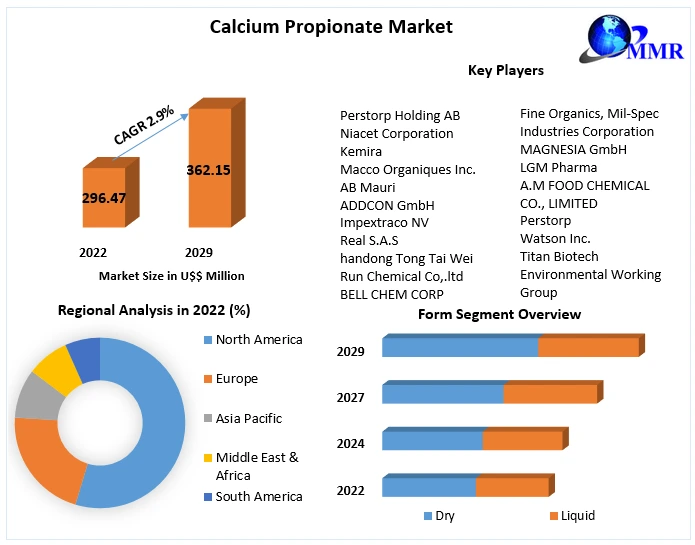 To know about the Research Methodology :- Request Free Sample Report
In report, 2022 is considered a base year however 2022’s numbers are on the real output of the companies in the market. Special attention is given to 2020 and the effect of lockdown on the demand and supply, and also the impact of lockdown for the next two years on the market. Some companies have done well in lockdown also and specific strategic analysis of those companies is done in the report.
Calcium Propionate Market Dynamics
The worldwide calcium propionate market is growing as a result of shifting consumer dietary choices. The growing public knowledge of health issues, combined with people's changing lifestyles, has raised the demand for calcium propionate. Calcium propionate is a preservative found in bread, baked goods, processed meat, and a variety of dairy products. It kills microorganisms such as viruses, bacteria, algae, and fungus by acting as an antimicrobial agent. As a result, its market demand is growing, causing the market to grow. Calcium propionate is provided to animals as a dietary supplement. The growing food preservation sector is driving up the global demand for calcium propionate. It is a very cost-effective product when compared to other replacements such as sulfites, sorbates, and others, so its market demand is growing.
Due to changing consumer habits and increased demand for fresh products, Middle Eastern and African countries are rapidly adopting calcium propionate. Due to growing knowledge of calcium propionate and the advantages it provides, Asia Pacific is expected to be the second-largest market for calcium propionate after North America in 2022. Due to its size and regulatory environment, it remains one of the most significant markets for calcium propionate makers.
The shift in the trend toward using natural goods, as well as the high pricing of propionic acid and its restricted availability, are hampering the market growth.
Calcium Propionate Market Segmentation Analysis
By Form, The dry segment accounted for a larger share of the global calcium propionate market in 2022. It is also expected to grow at a CAGR of xx% over the forecast period due to factors such as ease of mixing and higher dispersion across the food matrix. Calcium propionate is affected by storage circumstances such as low temperature and humidity. As a result, changing climatic conditions have an even bigger effect on market growth.
By Application, Calcium propionate is commonly used as a food preservative because it inhibits the growth and reproduction of bacteria, hence extending the shelf life of food. Bread, tortillas, pizza dough, pastries, breakfast cereals, pasta, noodles, dried and condensed milk, flavoured milk, dairy-based spreads, cheese, some processed meats, certain processed fruit and vegetable products, dairy, egg, and fat-based desserts, such as puddings, frosting, and confections, are just a few examples. Calcium propionate is also utilized as a preservative in sports drinks, diet meals, and beverages. In the next years, the burgeoning meat industry and increased awareness of safe meat storage due to the present spread of COVID-19 are anticipated to drive demand for preservation products such as calcium propionate. In 2022, the Asian area produced roughly 136.06 million metric tonnes of beef, according to the Food and Agriculture Organization. Furthermore, it is expected that global beef consumption would increase by 12% by 2029.
The demand for processed and ready-to-eat meals such as burgers, hot dogs, bread, pizzas, cakes, and other similar items is increasing as consumers become more time-pressed and embrace the convenience of freezers and microwave cooking. In the forecast period, such needs are likely to have a favourable influence on the use of preservatives like calcium propionate.
Because of the world's growing population, the global food and beverage business has seen tremendous growth in recent years. The food and beverage industry's growth is a primary driving force in the sector being investigated. The worldwide food and beverage business earned USD 155,488 million in sales in 2020, up from USD 100,297 million in 2017. The food processing business is being driven by rising consumer demand from Asian nations such as India, China, Indonesia, and Malaysia, as well as a growing global need for food safety.
This is expected to operate as a boosting factor for calcium propionate, which is expected to help to preserve and extend the shelf life of processed foods.
Calcium Propionate Market Regional Insight
The growing pharmaceutical industry in Asia-Pacific is rising demand for calcium propionate in the medical and pharmaceutical industries. Also, rising demand for animal feed from countries like China and India is driving market demand in Asia-Pacific. Global demand for animal-derived meals is rapidly growing. Commercial cattle agriculture and its accompanying food chains have met the growth in this demand. In the agricultural industry, China is a major market for items such as calcium propionate. China's agriculture business produces 18% of the world's cereal grains, 29% of its meat, and 50% of its vegetables. In all, the country produces nearly 20% of the world's food, making it the world's largest agricultural economy.
The pharmaceutical industry in Japan is the world’s third-biggest. International corporations seek possibilities to invest in and exploit the vast, well-funded healthcare system, while the domestic market anticipates more exports. The healthcare industry in the country is driven by an aging population and widespread access to healthcare, which is likely to fuel demand for calcium propionate throughout the forecast period. The Korean government announced bio-health to be a national ambition in May 2019, to capture 6% of the worldwide medical device and pharmaceutical industry. By 2030, the government hoped to raise medical device and pharmaceutical exports to $50 billion, making bio-health one of the country's five major export businesses. The calcium propionate market is expected to grow in the Asia-Pacific area as a result of all of these reasons.
Report Objectives:
Landscape analysis of the Calcium Propionate Market
competitive benchmarking
Past and current status of the industry with the forecasted market size and trends
Evaluation of potential key players that include market leaders, followers, and new entrants
Technology trends
Potential impact of micro-economic factors of the market
External and Internal factors affecting market have been analysed
The report also helps in understanding the Calcium Propionate Market dynamics, structure by analysing the market segments and project the Calcium Propionate Market size. Clear representation of competitive analysis of key players by product, price, financial position, product portfolio, growth strategies, and regional presence in the Calcium Propionate Market make the report investor’s guide.
Calcium Propionate Market Scope: Inquiry Before Buying
| Calcium Propionate Market | |||
|---|---|---|---|
| Report Coverage | Details | ||
| Base Year: | 2022 | Forecast Period: | 2023-2029 |
| Historical Data: | 2018 to 2022 | Market Size in 2022: | US $ 296.47 Mn. |
| Forecast Period 2023 to 2029 CAGR: | 2.9 % | Market Size in 2029: | US $ 362.15 Mn. |
| Segments Covered: | by Form | Dry Liquid |
|
| by Application | Food Bakery Products Dairy & Frozen Desserts Meat Fish & Seafood Products Feed |
||
Calcium Propionate Market by Region
North America (United States, Canada and Mexico)
Europe (UK, France, Germany, Italy, Spain, Sweden, Austria and Rest of Europe)
Asia Pacific (China, South Korea, Japan, India, Australia, Indonesia, Malaysia, Vietnam, Taiwan, Bangladesh, Pakistan and Rest of APAC)
Middle East and Africa (South Africa, GCC, Egypt, Nigeria and Rest of ME&A)
South America (Brazil, Argentina Rest of South America)
Calcium Propionate Market: Key Players
1. Perstorp Holding AB
2. Niacet Corporation
3. Kemira
4. Macco Organiques Inc.
5. AB Mauri
6. ADDCON GmbH
7. Impextraco NV
8. Real S.A.S
9. handong Tong Tai Wei Run Chemical Co,.ltd
10.BELL CHEM CORP
11.Fine Organics, Mil-Spec Industries Corporation
12.MAGNESIA GmbH
13.LGM Pharma
14.A.M FOOD CHEMICAL CO., LIMITED
15.Perstorp
16.Watson Inc.
17.Titan Biotech
18.Environmental Working Group
19.Saf Sulphur Company
Frequently Asked Questions
1. What is the projected market size & growth rate of Calcium Propionate Market?
Ans- Calcium Propionate Market was valued at USD 296.47 Million in 2022 and is projected to reach USD 362.15 Million by 2029, growing at a CAGR of 2.9 % during the forecast period.
2. What are the key driving factor for the growth of Calcium Propionate Market?
Ans- The growing public knowledge of health issues, combined with people's changing lifestyles, has raised the demand for calcium propionate.
3. Which Region accounted for the largest Calcium Propionate Market share?
Ans- The growing pharmaceutical industry in Asia-Pacific is rising demand for calcium propionate in the medical and pharmaceutical industries.
4. What makes Asia Pacific a Lucrative Market for Calcium Propionate Market?
Ans- rising demand for animal feed from countries like China and India is driving market demand in Asia-Pacific.
5. What are the top players operating in Calcium Propionate Market?
Ans- Perstorp Holding AB, Niacet Corporation, Kemira, Macco Organiques Inc., AB Mauri, ADDCON GmbH, Impextraco NV, and Real S.A.S.