
Succinic Acid Market Size by Region – Segment-Level Market Assessment, Growth Opportunity Analysis, Competitive Mapping & Forecast to 2032
Overview
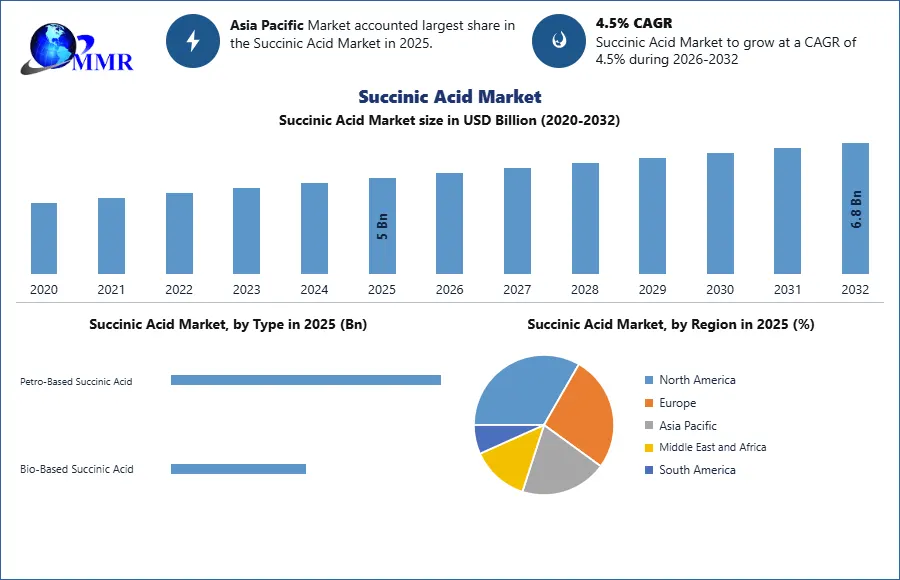
The Succinic Acid Market was valued at USD 202.55 Million in 2025 and is estimated to grow at a CAGR of around 7.3% over the forecast period, reaching USD 331.68 Million by 2032.
The Succinic Acid Market is experiencing significant growth, driven by increasing demand for sustainable and bio-based alternatives to petrochemical products. Succinic acid, derived from renewable sources like glucose, is widely used across industries such as chemicals, food and beverages, pharmaceuticals, and personal care. Technological advancements in fermentation processes and increasing regulatory support for environmentally friendly products are key growth factors. The market's expansion is also fueled by rising demand for biodegradable polymers, eco-friendly plasticizers, and natural food additives. The trend towards sustainable manufacturing and growing consumer preference for clean-label products further accelerates market growth.
 To know about the Research Methodology:-Request Free Sample Report
The objective of the report is to present a comprehensive assessment of the market and contains thoughtful insights, facts, historical data, industry-validated market data, and projections with a suitable set of assumptions and methodology. The report also helps in understanding market dynamics, structure by identifying and analyzing the market segments and project the global market size.
Succinic Acid Market Segmentation Analysis
Succinic Acid Market Segmentation, by Type
The Petro-Based Succinic Acid segment was the largest in the Succinic Acid Market in 2025. This segment dominated due to the cost-effectiveness and well-established production processes associated with petrochemical feedstocks. Petro-based succinic acid had a significant adoption rate among manufacturers, as it was primarily used in the production of industrial chemicals, including plasticizers, solvents, and resins. The dominance of petro-based succinic acid was also driven by its wide availability and established production infrastructure, which has been heavily utilized in various sectors, such as automotive, coatings, and agriculture.
Bio-Based Succinic Acid has been gaining significant traction, particularly due to increasing environmental concerns and demand for sustainable alternatives. The bio-based variant, derived from renewable feedstocks such as glucose, is supported by several government policies aimed at promoting sustainability. Bio-based succinic acid has applications in biodegradable polymers, food additives, and pharmaceutical products, which has fueled its growth. Despite the higher costs associated with bio-based production processes, the segment has benefited from technological advancements in fermentation technology that have improved its economic feasibility.
Succinic Acid Market Segmentation, by Grade
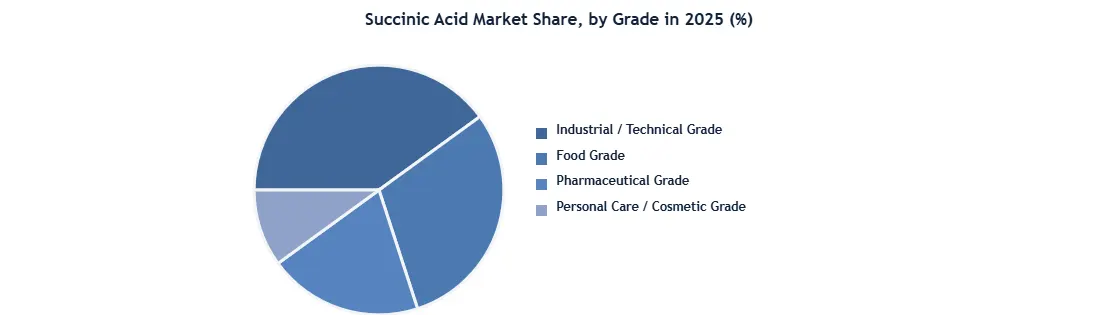
The Industrial/Technical Grade segment was the largest in the Succinic Acid Market in 2025. This grade accounted for the highest demand due to its critical applications in the production of plasticizers, resins, and adhesives, which are vital in the automotive, construction, and packaging industries. The segment's dominance can be attributed to its established use in industrial-scale production, where lower purity grades are sufficient for processing applications. This grade is utilized extensively in manufacturing durable goods, contributing significantly to the overall market demand.
The Food Grade segment followed closely, driven by the increasing adoption of succinic acid in the food and beverage industry, where it is used as an acidity regulator and flavor enhancer. Demand for food-grade succinic acid has been particularly strong in emerging markets as food manufacturers seek clean-label, natural ingredients to meet consumer demand for healthier products. The Pharmaceutical Grade segment, though smaller, has grown steadily due to its applications in the pharmaceutical and nutraceutical industries, particularly in drug formulation and as an excipient in controlled-release formulations.
Succinic Acid Market Segmentation, by Application
The Chemical Intermediates segment dominated the Succinic Acid Market in 2025. Succinic acid is widely used as a key chemical building block in the production of plasticizers, solvents, and polymers, which are integral to industries such as automotive, construction, and packaging. The high demand for succinic acid in these applications, due to its ability to modify the properties of polymers and enhance the functionality of plastics, has made this segment the largest contributor to market growth.
Food & Beverage Additives was another significant application segment in 2025, driven by the increasing demand for natural food preservatives and acidity regulators. As consumers have become more health-conscious, there has been a surge in the demand for cleaner ingredients, boosting the adoption of succinic acid in food production. Other notable segments, such as Pharmaceutical Applications and Personal Care & Cosmetics, also contributed to market growth as succinic acid found applications in drug formulations and cosmetic products, primarily as a stabilizer or exfoliant.
Succinic Acid Market Segmentation, by End-Use Industry
The Chemical Industry dominated the Succinic Acid Market in 2025, accounting for the largest share due to the widespread use of succinic acid as a precursor for various chemicals, including bioplastics, polyesters, and solvents. The growing demand for sustainable chemical products in industries such as automotive, construction, and packaging led to an increase in succinic acid consumption for producing eco-friendly plasticizers and resins. As sustainability became a core focus for manufacturers, the chemical industry continued to rely on succinic acid to meet environmental regulations and consumer demand for greener alternatives.
The Food & Beverage Industry was the second-largest consumer, with succinic acid being used as an acidity regulator and flavor enhancer in food processing. The shift towards healthier, clean-label products in the food and beverage sector contributed significantly to the growth of this segment. Other key sectors, such as the Pharmaceutical Industry and Personal Care & Cosmetics Industry, also experienced steady growth in the demand for succinic acid, driven by its role in drug formulations and cosmetic products.
Succinic Acid Market Regional Analysis
The North American region dominated the Succinic Acid Market in 2025. The region’s dominance can be attributed to a robust industrial base, government incentives promoting bio-based chemicals, and advanced technological infrastructure. The United States, in particular, led this dominance, supported by large chemical companies investing in bio-based succinic acid production. Government support for sustainable chemicals, such as the Renewable Fuel Standard (RFS) and policies encouraging green chemistry, drove the adoption of bio-based succinic acid.
The region’s dominance was also fueled by significant investments in research and development to improve the efficiency of bio-based succinic acid production processes. The presence of major manufacturers of succinic acid in North America further cemented its position as the leading region, with companies such as BioAmber (now a part of Mitsui & Co., Ltd.) and BASF playing a key role in the development and commercialization of bio-based succinic acid. The North American market benefited from high demand in the automotive, packaging, and chemical industries, where succinic acid is used to produce sustainable plasticizers and resins.
Succinic Acid Market Scope: Inquire before buying
| Succinic Acid Market | |||
|---|---|---|---|
| Report Coverage | Details | ||
| Base Year: | 2025 | Forecast Period: | 2026-2032 |
| Historical Data: | 2020 to 2025 | Market Size in 2025: | 202.55 USD Mn |
| Forecast Period 2026-2032 CAGR: | 4.5% | Market Size in 2032: | 331.68 USD Mn |
| Segments Covered: | by Type | Petro-Based Succinic Acid Bio-Based Succinic Acid |
|
| by Grade | Industrial / Technical Grade Food Grade Pharmaceutical Grade Personal Care / Cosmetic Grade |
||
| by Application | Chemical Intermediates Food & Beverage Additives Pharmaceutical Applications Personal Care & Cosmetics Coatings, Resins & Polymers Biodegradable Polymers (PBS) Others |
||
Succinic Acid Market, by Region:
Asia Pacific (China, South Korea, Japan, India, Australia, Indonesia, Malaysia, Vietnam, Taiwan, Bangladesh, Pakistan and Rest of APAC)
Europe (UK, France, Germany, Italy, Spain, Sweden, Austria and Rest of Europe)
North America (United States, Canada and Mexico)
Middle East and Africa (South Africa, GCC, Egypt, Nigeria and Rest of ME&A)
South America (Brazil, Argentina Rest of South America)
Key players/competitors profiles covered in the Succinic Acid Market report in strategic perspective:
- BASF SE
- DuPont
- Mitsubishi Chemical Corporation
- BioAmber Inc.
- DOW Chemical
- Myriant Corporation
- LH Chemical
- Reverdia
- Xinjiang Zhongtai Chemical Co., Ltd.
- Genomatica
- Kingdomway
- Succinity GmbH
- Davy Process Technology
- Evonik Industries AG
- Fermentation Biotech Co. Ltd.
- BASF-YPC Company Ltd.
- Emory University
- Mitsubishi Chemical Holdings
- Jungbunzlauer
- National Chemical Laboratories, Inc.
- Corbion
- Tate & Lyle
- Wuxi Haikai Biochemical Co., Ltd.
- Asahi Kasei Corporation
- Lonza Group
Recent Developments
January 2025: BioAmber Inc. launched a new bio-based succinic acid production facility in the United States to increase supply capacity and cater to the growing demand for sustainable chemicals in the automotive and packaging industries. The expansion is expected to enhance production efficiency, reduce carbon emissions, and meet the increasing demand for biodegradable polymers and bio-based plasticizers.
June 2025: Mitsubishi Chemical Corporation partnered with BASF SE to develop a new line of eco-friendly resins using bio-based succinic acid. The collaboration aimed to expand the use of bio-based chemicals in the automotive sector, offering an alternative to traditional petrochemical-based plasticizers and resins, contributing to sustainability goals in the automotive industry.
August 2025: Genomatica announced a strategic investment in new fermentation technology to improve the cost-effectiveness of bio-based succinic acid production. The company plans to use the technology to scale up production and cater to the increasing demand for bio-based materials in the packaging and agriculture industries, with a focus on improving the efficiency and scalability of the fermentation process.